
Showing 5 items matching "petrol fuelled irons"
-
 City of Moorabbin Historical Society (Operating the Box Cottage Museum)
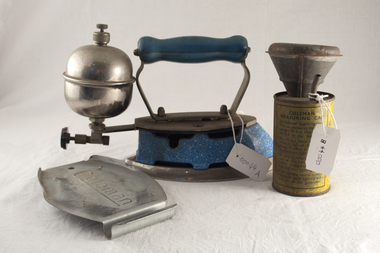
Domestic object - Kitchen equipment, spirit-fuelled sad iron, c1920
... ...petrol fuelled irons...irons. This spirit- fuelled flat iron was very popular in 1920s - 30s These sad irons remind us of the difficult circumstances experienced in their daily routines by the pioneers and early settlers of Moorabbin Shire The family of Miss M Curtis were early settlers in Moorabbin Shire sad iron kitchen equipment coleman william kansas oklahoma pioneers early settlers market gardeners sewing craftwork clothing moorabbin brighton bentleigh fireplaces stoves petrol fuelled irons spirit flat irons coleman lamp stove co. ltd. ...Sad-irons or "solid" irons were made by blacksmiths and used to smooth out material by pressing the hot iron over it. A piece of sheet -iron was placed over the kitchen fire and the irons placed on it could be heated whilst remaining clean of ash.. The women used 2 irons - one heating while the other was used. Thick cloth or gloves protected their hands from the hot irons. The handle was removed from the cool iron and re- attached to remove the hot iron from the fire. The cool iron was replaced on the fire or stove to heat again. These irons were cleaned with steel wool to prevent them marking the material. If the iron was too hot the material would scorch. Most homes set aside one day for ironing and some large households had an ironing room with a special stove designed to heat irons. However, most women had to work with a heavy, hot iron close to the fireplace even in summer. Late in the 19thC designers experimented with heat retaining fillings for these irons. William Coleman began selling Kerosene lanterns in 1900 in Kingfisher, Oklahoma, USA. He moved to Wichita, Kansas in 1902 and the company became world wide. The company also produced a range of cooking stoves and domestic irons. This spirit- fuelled flat iron was very popular in 1920s - 30s These sad irons remind us of the difficult circumstances experienced in their daily routines by the pioneers and early settlers of Moorabbin Shire The family of Miss M Curtis were early settlers in Moorabbin ShireA) spirit- fuelled, sad iron with chrome plated sole c1920, and metal trivet The iron is blue enamel with a white speckled body, with a hemispherical tank for the Coleman 'Lighting Petrol' that provided the heat for smoothing the material B) Coleman Fuel measuring can and funnellMetal Trivet/stand " COLEMAN" ; Petrol can " COLEMAN" / MEASURING CAN / for INSTANT LIGHTING IRON/ with printed instructionssad iron, kitchen equipment, coleman william, kansas, oklahoma, pioneers, early settlers, market gardeners, sewing, craftwork, clothing, moorabbin, brighton, bentleigh, fireplaces, stoves, petrol fuelled irons, spirit flat irons, coleman lamp stove co. ltd. -
 Stawell Historical Society Inc
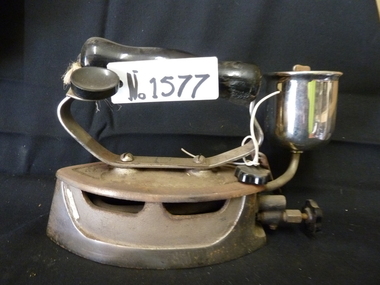
Memorabilia - Realia, Spirit operated Iron, 1826-1900
... Designed for use in rural areas without electricity, these petrol-fueled irons used Shellite, requiring no hand pumping to maintain pressure, and were often called spirit irons. ...Designed for use in rural areas without electricity, these petrol-fueled irons used Shellite, requiring no hand pumping to maintain pressure, and were often called spirit irons. ...A pumpless iron is a vintage, self-heating laundry iron primarily manufactured in Australia (notably by Handi Works in Brisbane) between the 1920s and 1950s. Designed for use in rural areas without electricity, these petrol-fueled irons used Shellite, requiring no hand pumping to maintain pressure, and were often called spirit irons. Pumpless IronPumpless iron Handi Works Pty Lidstawell -
 Bendigo Historical Society Inc.
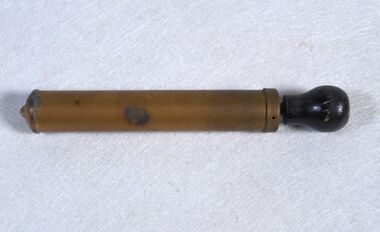
Functional object - Brass air Pump
... For pumping air into petrol irons, the maker is probably Coleman. Liquid fuel irons were a great advancement from Sad Irons in the late 1800's and were used before electricity was available...For pumping air into petrol irons, the maker is probably Coleman. Liquid fuel irons were a great advancement from Sad Irons in the late 1800's and were used before electricity was available Coleman Iron Brass Air Pump K15.3 Brass air pump with wooden handle. ...For pumping air into petrol irons, the maker is probably Coleman. Liquid fuel irons were a great advancement from Sad Irons in the late 1800's and were used before electricity was availableBrass air pump with wooden handle. A brass tube two centimetres diameter and 14 ccentimetres long with a half centimetre diameter. A 14 centimetre long metal rod with a two and a half centimetre diameter and a three and a half centimetre long wooden handle which slides in and out of the tube. Presumably there is a fitting inside the tube on the end of the rod to push air out of the hole on the other end of the tube.K15.3coleman iron, brass air pump -
 Clunes Museum
Domestic object - IRON - PETROL
... irons ALBERT LEA MINN. AMERICAN GAS MACHINE CO. NO. 4 PATENT NO. T043421 THIS IS A PETROL DRIVEN IRON. METAL WITH A WOODEN HANDLE AND A METAL CYLINDER FOR FUEL. ...THIS IS A PETROL DRIVEN IRON. METAL WITH A WOODEN HANDLE AND A METAL CYLINDER FOR FUEL. SCREW AT THE END OF THE IRON TO REGULATE THE FUEL. ALBERT LEA MINN. AMERICAN GAS MACHINE CO. NO. 4 PATENT NO. T043421local history, domestic item, iron, domestic items, irons -
Emerald Museum & Nobelius Heritage Park
Domestic object - Shellite iron
... Petrol irons were manufactured as early as 1900. The types of fuel used included petrol, alcohol, methylated spirits and kerosene....Petrol irons were manufactured as early as 1900. The types of fuel used included petrol, alcohol, methylated spirits and kerosene. ...Petrol irons were manufactured as early as 1900. The types of fuel used included petrol, alcohol, methylated spirits and kerosene.The petrol iron was regarded by many as a great improvement on the flat iron because a flat iron had to be heated (and be continually reheated) on top of a hot wood stove. Electricity did not become available in Emerald until 1934 - and then not to everybody - so that irons such as the flat iron or the petrol iron continued to be used for some time. Petrol irons were potentially dangerous - they were known to explode.Shellite' Iron - A metal iron enamelled in blue colour, with a silver metal fuel reservoir. Shellite was the fuel used to heat the iron. The handle is also blue and made of wood. Metal stand for the iron. Metal pourer for the fuel.emerald, victoria, australia, domestic life, irons (domestic), shellite
