
Showing 38 items matching "phillip island ship wrecks"
-
 Phillip Island and District Historical Society Inc.
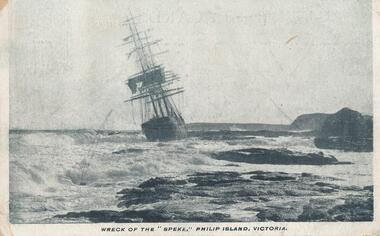
Photograph - Post Card, Early 1900's
... wreck of the speke...south coast phillip island...phillip island...ship...One of a collection of photographs purchased by the Society from Jack Day of Mornington. the speke wreck of the speke south coast phillip island phillip island ship wrecks phillip island jack day collection "Wrck of the "Speke", Philip Island, Victoria" Black & White postcard of the Speke wrecked off the South Coast of Phillip Island with the loss of one life. 22/2/1906. ...One of a collection of photographs purchased by the Society from Jack Day of Mornington.Black & White postcard of the Speke wrecked off the South Coast of Phillip Island with the loss of one life. 22/2/1906."Wrck of the "Speke", Philip Island, Victoria"the speke, wreck of the speke, south coast phillip island, phillip island, ship wrecks phillip island, jack day collection -
 Phillip Island and District Historical Society Inc.
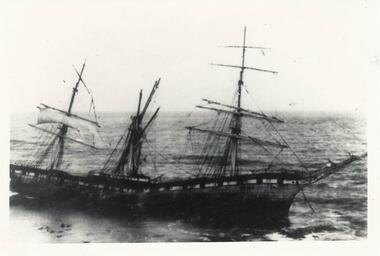
Photograph, The "Speke", 1906 (original photograph)
... wreck of the speke...phillip island ship wrecks...ships built in 1891. It was wrecked in 1906 near Kitty Miller Bay due to a navigational error. One man drowned but the rest of the crew reached safety. Remains of the hull are a tourist attraction now over 100 years later. the speke wreck of the speke phillip island ship wrecks anne grayden Black & White photograph of the wreck of the Speke. ...One of a collection of 6 photographs donated by Anne Grayden. The Speke was the third largest 3 masted ships built in 1891. It was wrecked in 1906 near Kitty Miller Bay due to a navigational error. One man drowned but the rest of the crew reached safety. Remains of the hull are a tourist attraction now over 100 years later.Black & White photograph of the wreck of the Speke. The shop is listing but still in one piece. It is in the water seemingly stuck on rocks.the speke, wreck of the speke, phillip island ship wrecks, anne grayden -
 Phillip Island and District Historical Society Inc.
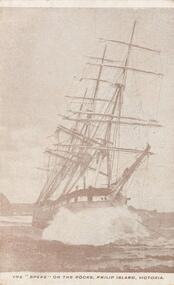
Photograph - Post Card, Early 1900's
... wreck of the speke...phillip island...ship...One of a collection of photographs purchased by the Society from Jack Day of Mornington. the speke wreck of the speke phillip island ship wrecks phillip island jack day collection "The "Speke" on the rocks, Phillip Island, Victoria." ...One of a collection of photographs purchased by the Society from Jack Day of Mornington.Sepia postcard of the "Speke" wrecked on rocks off south coast of Phillip Island on 22nd February 1906 with the lost of one life."The "Speke" on the rocks, Phillip Island, Victoria."the speke, wreck of the speke, phillip island, ship wrecks phillip island, jack day collection -
 Flagstaff Hill Maritime Museum and Village
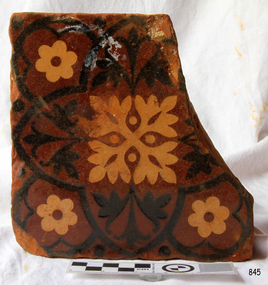
Ceramic - Tile, circa 1878
... wreck site and form part of the collection at Flagstaff Hill. The iron-hulled clipper ship from the Loch Line was heading for Port Phillip from London when it ran into the cliffs of Mutton Bird Island near Port Campbell and was wrecked on June 1st, 1878. ...wreck site and form part of the collection at Flagstaff Hill. The iron-hulled clipper ship from the Loch Line was heading for Port Phillip from London when it ran into the cliffs of Mutton Bird Island near Port Campbell and was wrecked on June 1st, 1878. ...This Minton floor tile is from the wreck of the LOCH ARD along with other examples of this manufacture recovered from the wreck site and form part of the collection at Flagstaff Hill. The iron-hulled clipper ship from the Loch Line was heading for Port Phillip from London when it ran into the cliffs of Mutton Bird Island near Port Campbell and was wrecked on June 1st, 1878. The LOCH ARD was laden with high-value cargo including luxury goods intended for display at the Melbourne International Exhibition in 1880. One notable survivor from the ship’s freight manifest was the well-packed Minton porcelain peacock, a two-metre-high ceramic masterpiece of vivid glazed colours. The almost total loss of life and property from the LOCH ARD registered as a shocking tragedy for the Colony of Victoria, at a time when social confidence and economic optimism were otherwise high. The wealth generated from Gold and Wool was increasingly being spent on grandiose private residences and imposing public buildings. The demand for quality furnishings and fittings was therefore strong. Among the products consigned to burgeoning colonial markets by the Milton Pottery at Stoke upon Trent, were their new range of colourfully patterned but very durable floor tiles – ideal for the high-traffic spaces in the large civic buildings then being constructed in Australia and America. These new floor tiles were “encaustic”, meaning that their designs and colours were encased “within” the depth of the tile. Rather than their decorative patterns being glazed onto the surface of the tile, their inlaid designs were created during the manufacturing process, as “coloured slips” (or liquid clay) were poured into a deep pre-moulded casting. When fired, the resulting tile was colour-fast and design-fast. A brief history of the Loch Ard (1873-1878): - The sailing ship Loch Ard was one of the famous Loch Line ships that sailed from England to Australia. Barclay, Curdle and Co. built the three-masted iron vessel in Glasgow in 1873. It had sailed three trips to Australia and one trip to Calcutta before its fateful voyage. Loch Ard left England on March 2, 1878, under the command of recently married, 29-year-old Captain Gibbs. It was bound for Melbourne with a crew of 37, plus 17 passengers. The general cargo reflected the affluence of Melbourne at the time. Onboard were straw hats, umbrellas, perfumes, clay pipes, pianos, clocks, confectionery, linen and candles, and a heavier load of railway irons, cement, lead and copper. Other cargo included items intended for display in the Melbourne International Exhibition of 1880. The Loch Ard had been sailing for three months and was close to its destination on June 1, 1878. Captain Gibbs had expected to see land at about 3 am but the Loch Ard ran into a fog that greatly reduced visibility and there was no sign of land or the Cape Otway lighthouse. The fog lifted at 4 am and the sheer cliffs of Victoria's west coast were much closer to them than Captain Gibbs expected. He tried to manage the vessel but failed and the ship struck a reef at the base of Mutton Bird Island, near Port Campbell. The top deck loosened from the hull, and the masts and rigging crashed down, knocking passengers and crew overboard. The lifeboat was launched by Tom Pearce but crashed into the side of Loch Ard and capsized. He clung onto its overturned hull and sheltered under it. He drifted out to sea and the tide brought him back to what is now called Loch Ard Gorge. He swam to shore and found a cave for shelter. A passenger, Eva Carmichael, had raced onto the deck to find out what was happening and was confronted by towering cliffs above the ship. She was soon swept off the ship by a huge wave. Eva saw Tom Pearce on a small rocky beach and yelled to attract his attention. He swam out and dragged her to the shelter of the cave. He revived her with a bottle of brandy from a case that had washed up on the beach. Tom scaled a cliff in search of help and followed some horse hoof prints. He came from two men from Glenample Station, three and a half miles away. He told the men of the tragedy and then returned to the gorge while the two men rode back to the station to get help. They reached Loch Ard Gorge and took the two shipwreck survivors to Glenample Station to recover. Eva stayed at the station for six weeks before returning to Ireland by steamship. In Melbourne, Tom Pearce received a hero's welcome and was presented with a medal and some money. Of the 54 crew members and passengers on board, only two survived: the apprentice, Tom Pearce and the young woman passenger, Eva Carmichael, who lost her family in the tragedy. One of the most unlikely pieces of cargo to have survived the shipwreck was a Minton porcelain peacock - one of only nine in the world. The peacock was destined for the Melbourne International Exhibition in 1880. It had been well packed, which gave it adequate protection during the violent storm. Today, the Minton peacock can be seen at the Flagstaff Hill Maritime Museum in Warrnambool. From Australia's most dramatic shipwreck, it has now become Australia's most valuable shipwreck artefact and is one of very few 'objects' on the Victorian State Heritage Register. The Minton floor tile is significant for its hard-wearing yet attractive design. The shipwreck of the LOCH ARD is of State significance. Victorian Heritage Register S417. Flagstaff Hill’s collection of artefacts from LOCH ARD is significant for being one of the largest collections of artefacts from this shipwreck in Victoria. It is significant for its association with the shipwreck, which is on the Victorian Heritage Register (VHR S417). The collection is significant because of the relationship between the objects, as together they have a high potential to interpret the story of the LOCH ARD. The LOCH ARD collection is archaeologically significant as the remains of a large international passenger and cargo ship. The LOCH ARD collection is historically significant for representing aspects of Victoria’s shipping history and its potential to interpret sub-theme 1.5 of Victoria’s Framework of Historical Themes (living with natural processes). The collection is also historically significant for its association with the LOCH ARD, which was one of the worst and best-known shipwrecks in Victoria’s history. A square Minton floor tile with a black and apricot pattern against a chocolate brown background. There is a large chip missing. This decorative floor tile was recovered from the shipwreck of the LOCH ARD. On the back, or base, of the tile is inscribed the number “46” and the letters “Minton & Co Patent Stoke upon Trent”.flagstaff hill, warrnambool, shipwrecked coast, flagstaff hill maritime museum, maritime museum, shipwreck coast, flagstaff hill maritime village, great ocean road, loch line, loch ard, captain gibbs, eva carmichael, tom pearce, glenample station, mutton bird island, loch ard gorge, encaustic tile, melbourne international exhibition, floor tile, minton floor tile -
 Flagstaff Hill Maritime Museum and Village
Ceramic - Tile, circa 1878
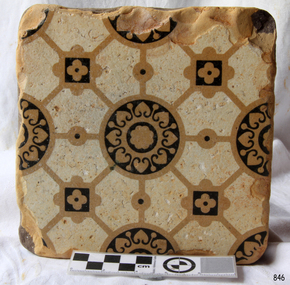
... wreck site and form part of the collection at Flagstaff Hill. The iron-hulled clipper ship from the Loch Line was heading for Port Phillip from London when it ran into the cliffs of Mutton Bird Island near Port Campbell and was wrecked on the early morning of June 1, 1878. ...wreck site and form part of the collection at Flagstaff Hill. The iron-hulled clipper ship from the Loch Line was heading for Port Phillip from London when it ran into the cliffs of Mutton Bird Island near Port Campbell and was wrecked on the early morning of June 1, 1878. ...This Minton floor tile is from the wreck of the LOCH ARD. Other examples of this manufacture have been recovered from the wreck site and form part of the collection at Flagstaff Hill. The iron-hulled clipper ship from the Loch Line was heading for Port Phillip from London when it ran into the cliffs of Mutton Bird Island near Port Campbell and was wrecked on the early morning of June 1, 1878. The LOCH ARD was laden with high-value cargo including luxury goods intended for display at the Melbourne International Exhibition in 1880. One notable survivor from the ship’s freight manifest was the well-packed Minton porcelain peacock, a two-metre-high ceramic masterpiece of vivid glazed colours. The almost total loss of life and property from the LOCH ARD registered as a shocking tragedy for the Colony of Victoria, at a time when social confidence and economic optimism were otherwise high. The wealth generated from gold and wool was increasingly being spent on magnificent private residences and imposing public buildings. The demand for quality furnishings and fittings was therefore strong. Among the products consigned to burgeoning colonial markets by the Milton Pottery at Stoke upon Trent were their new range of colourfully patterned but very durable floor tiles – ideal for the high-traffic spaces in the large civic buildings then being constructed in Australia and America. These new floor tiles were “encaustic”, meaning that their designs and colours were encased within the depth of the tile. Rather than their decorative patterns being glazed onto the surface of the tile, their inlaid designs were created during the manufacturing process, as “coloured slips” (or liquid clay) that were poured into a deep pre-moulded casting. When fired, the resulting tile was colour-fast and design-fast.The Minton encaustic floor tile is significant for its method of manufacture which makes it durable as well as decorative. The shipwreck of the LOCH ARD is of State significance. Victorian Heritage Register S417. Flagstaff Hill’s collection of artefacts from LOCH ARD is significant for being one of the largest collections of artefacts from this shipwreck in Victoria. It is significant for its association with the shipwreck, which is on the Victorian Heritage Register (VHR S417). The collection is significant because of the relationship between the objects, as together they have a high potential to interpret the story of the LOCH ARD. The LOCH ARD collection is archaeologically significant as the remains of a large international passenger and cargo ship. The LOCH ARD collection is historically significant for representing aspects of Victoria’s shipping history and its potential to interpret sub-theme 1.5 of Victoria’s Framework of Historical Themes (living with natural processes). The collection is also historically significant for its association with the LOCH ARD, which was one of the worst and best-known shipwrecks in Victoria’s history.A square Minton floor tile with a black and beige pattern against a white base. This encaustic floor tile was recovered from the shipwreck of the LOCH ARD. On the back, or base, of the tile is inscribed the number “46” and the letters “Minton & Co Patent Stoke upon Trent”.flagstaff hill, warrnambool, shipwrecked coast, flagstaff hill maritime museum, maritime museum, shipwreck coast, flagstaff hill maritime village, great ocean road, loch line, loch ard, mutton bird island, loch ard gorge, minton floor tile, encaustic tile, melbourne international exhibition, floor tile -
 Flagstaff Hill Maritime Museum and Village
Ceramic - Floor Tile, circa 1878
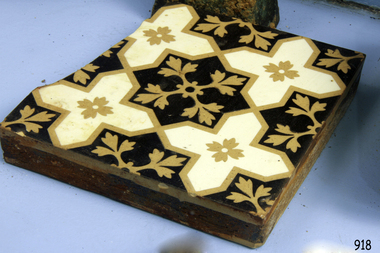
... wreck of the Loch Ard and is currently on display in the Great Circle Gallery at Flagstaff Hill. The iron hulled clipper ship from the Loch Line was heading for Port Phillip from London, when it ran into the cliffs of Mutton Bird Island near Port Campbell. ...wreck of the Loch Ard and is currently on display in the Great Circle Gallery at Flagstaff Hill. The iron hulled clipper ship from the Loch Line was heading for Port Phillip from London, when it ran into the cliffs of Mutton Bird Island near Port Campbell. ...This Minton floor tile is from the wreck of the Loch Ard and is currently on display in the Great Circle Gallery at Flagstaff Hill. The iron hulled clipper ship from the Loch Line was heading for Port Phillip from London, when it ran into the cliffs of Mutton Bird Island near Port Campbell. The Loch Ard was laden with a high value cargo including luxury goods intended for display at the Melbourne International Exhibition in 1880. One notable survivor from the ship’s freight manifest was the well packed Minton porcelain peacock, a two meter high ceramic masterpiece of vivid glazed colours. (This is also on display in the Great Circle Gallery). The almost total loss of life and property from the Loch Ard registered as a shocking tragedy for the Colony of Victoria, at a time when social confidence and economic optimism were otherwise high. Wealth generated from Gold and Wool was increasingly being spent on grandiose private residences and imposing public buildings. The demand for quality furnishings and fittings was therefore strong. Among the products consigned to burgeoning colonial markets by the Milton pottery at Stoke upon Trent, were their new range of colourfully patterned but very durable floor tiles ideal for the high-traffic spaces in the large civic buildings then being constructed in Australia and America. These new floor tiles were “encaustic”, meaning that their designs and colours were encased “within” the depth of the tile. Rather than their decorative patterns being glazed onto the surface of the tile, their inlaid designs were created during the manufacturing process, as “coloured slips” (or liquid clay) were poured into a deep pre-molded casting. When fired, the resulting tile was colours-fast and design-fast. The Minton floor tile is significant for its hard-wearing yet attractive design. The shipwreck of the Loch Ard is of significance for Victoria and is registered on the Victorian Heritage Register ( S 417). Flagstaff Hill has a varied collection of artefacts from Loch Ard and its collection is significant for being one of the largest accumulations of artefacts from this notable Victorian shipwreck of which the subject items are a small part. The collections of objects give us a snapshot of how we can interpret the story of this tragic event. The collection is also archaeologically significant as it represents aspects of Victoria's shipping history that allows us to interpret Victoria's social and historical themes of the time. Through is associated with the worst and best-known shipwreck in Victoria's history. A square Minton floor tile with a dark brown, beige and white pattern. The tile has a piece broken off along one side and some chipping along the edges. This ‘encaustic’ floor tile was recovered from the shipwreck of the LOCH ARD. Branded "... MINTON&CO Patent ..."flagstaff hill, warrnambool, flagstaff hill maritime museum, shipwreck coast, flagstaff hill maritime village, great ocean road, loch line, loch ard, captain gibbs, eva carmichael, tom pearce, glenample station, mutton bird island, minton floor tile, encaustic tile, melbourne international exhibition, floor tile -
 Flagstaff Hill Maritime Museum and Village
Functional object - Porthole Frame, Russell & Co, 1888
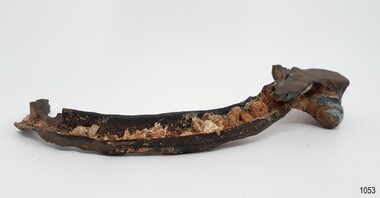
... ship was later found at the base of a cliff at the Bay of Islands near Warrnambool in November 1914; there were no survivors. The Antares is significant as it was a sail trader carrying international inbound cargo during the early part of the 20th century. It is part of the Great Ocean Road Historic Shipwreck Trail and as such is registered as a protected wreck in the Victorian Heritage Database VHS S34 . flagstaff hill warrnambool shipwrecked-coast flagstaff-hill flagstaff-hill-maritime-museum maritime-museum shipwreck-coast flagstaff-hill-maritime-village antares tall ship sailing ship peterborough phillip le couteur peter mathieson constable stainsbury sutlej antares rock. bay of islands porthole ship fitting 1914 shipwreck porthole frame None Porthole frame section, brass, large part corroded away. ...This portion of the porthole frame was part of the fittings of the Antares. The Italian barque “Antares” was an iron three-masted sailing ship built in 1888 by Russell & Co of Port Glasgow. The ship was originally named the “Sutlej” but was renamed the “Antares” in 1907 when sold to the Semider Bros of Genoa, Italy, where it was registered. The vessel left Marseilles on the 18th of December 1913 with its master Captain Gazedo destined for Mullaly & Byrne of Melbourne with a cargo of roofing tiles but failed to arrive. The wreckage was found near the Bay of Islands, twenty-two miles east of Warrnambool, after a body had washed ashore. Some of the timbers washed up were charred by fire, and a small boat's stern board with the name "Sutlej" led to the identification of the wreck as Antares, which had been reported missing. According to later reports, the Antares wrecking was overshadowed by war news at the time. A young local boy had remarked that the Germans had arrived off the coast as he had seen them firing off shells and rockets, but his story was passed off as a joke. These rockets were most likely the distress signals from the stricken ship. The Italian barque, clipper, Antares was sometime later reported as overdue. The wreck of the ship was later found at the base of a cliff at the Bay of Islands near Warrnambool in November 1914; there were no survivors.The Antares is significant as it was a sail trader carrying international inbound cargo during the early part of the 20th century. It is part of the Great Ocean Road Historic Shipwreck Trail and as such is registered as a protected wreck in the Victorian Heritage Database VHS S34 .Porthole frame section, brass, large part corroded away. Hing is still visible on the end. The underside is shaped to allow the fitting of the glass. Recovered from the wreck of the Antares. Noneflagstaff hill, warrnambool, shipwrecked-coast, flagstaff-hill, flagstaff-hill-maritime-museum, maritime-museum, shipwreck-coast, flagstaff-hill-maritime-village, antares, tall ship, sailing ship, peterborough, phillip le couteur, peter mathieson, constable stainsbury, sutlej, antares rock., bay of islands, porthole, ship fitting, 1914 shipwreck, porthole frame -
 Flagstaff Hill Maritime Museum and Village
Functional object - Pulley Sheave, Russell & Co, 1888
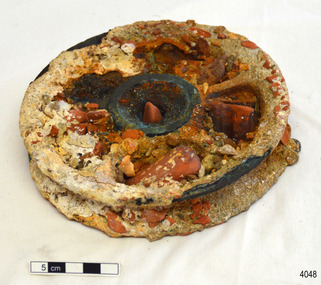
... ship was later found at the base of a cliff at the Bay of Islands near Warrnambool in November 1914, there were no survivors. The Antares is significant as it was a sail trader carrying an international inbound cargo during the early part of the 20th century. It is part of the Great Ocean Road Historic Shipwreck Trail and as such is registered as a protected wreck in the Victorian Heritage Database VHS S34. flagstaff hill warrnambool flagstaff-hill-maritime-museum shipwreck-coast flagstaff-hill-maritime-village pulley sheave antares tall ship peterborough 1914 shipwreck phillip le couteur peter mathieson constable stainsbury sutlej bay of islands pully sheave pulley Lifting Equipment None Pulley sheave; brass, with recesses full of concretion. ...This ship's pully sheave was part of the Antares rigging. A pulley sheave is a circle on a shaft that is manufactured to hold up movement and change of way of a cable or/and rope, or transfer of power between the shaft and cable or/and rope. A pulley is a unique mechanism that is used to leverage the lifting of heavy loads to required heights. The Italian barque Antares was an iron three-masted sailing clipper built in 1888 by Russell & Co of Port Glasgow originally named the “Sutlej” and renamed in 1907 the “Antares” when sold to the Semider Bros of Genoa Italy. The vessel left Marseilles on the 18th of December 1913 with its master captain Gazedo destined for Mullaly & Byrne of Melbourne with a cargo of roofing tiles but failed to arrive. The wreckage was found near the Bay of Islands twenty-two miles east of Warrnambool after a body had washed ashore. Some of the timbers washed up were charred by fire, and a small boat's stern board with the name "Sutlej" led to the identification of the wreck as Antares which had been reported missing. According to later reports, the Antares wrecking was overshadowed by war news at the time. A young local boy had remarked that the Germans had arrived off the coast as he had seen them firing off shells and rockets, but his story was passed off as a joke. These rockets were most likely the distress signals from the stricken ship. The Italian barque/clipper Antares was sometime later reported as overdue. The wreck of the ship was later found at the base of a cliff at the Bay of Islands near Warrnambool in November 1914, there were no survivors.The Antares is significant as it was a sail trader carrying an international inbound cargo during the early part of the 20th century. It is part of the Great Ocean Road Historic Shipwreck Trail and as such is registered as a protected wreck in the Victorian Heritage Database VHS S34.Pulley sheave; brass, with recesses full of concretion. The metal has some blue-green colouration due to exposure to sea water. Recovered from the wreak of the Antares. Noneflagstaff hill, warrnambool, flagstaff-hill-maritime-museum, shipwreck-coast, flagstaff-hill-maritime-village, pulley sheave, antares, tall ship, peterborough, 1914 shipwreck, phillip le couteur, peter mathieson, constable stainsbury, sutlej, bay of islands, pully sheave, pulley, lifting equipment -
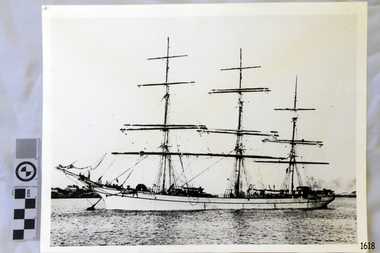 Flagstaff Hill Maritime Museum and Village
Photograph, 1907-1914
... ship ANTARES at full sail, taken between 1907, when she was named ANTARES, and 1914, when she was wrecked.. THE ANTARES In mid-November 1914, after the beginning of the First World War, a young local man went one evening to fish near the Bay of Islands, west of Peterborough. He later arrived home hurriedly and in an agitated state declaring: "The Germans are coming!" His family laughed and disbelieved him, as this young fellow was prone to telling fictional tales. About a month later, on December 13th 1914, local farmers Phillip...ship ANTARES at full sail, taken between 1907, when she was named ANTARES, and 1914, when she was wrecked.. THE ANTARES In mid-November 1914, after the beginning of the First World War, a young local man went one evening to fish near the Bay of Islands, west of Peterborough. He later arrived home hurriedly and in an agitated state declaring: "The Germans are coming!" His family laughed and disbelieved him, as this young fellow was prone to telling fictional tales. About a month later, on December 13th 1914, local farmers Phillip ...This photograph is of the sailing ship ANTARES at full sail, taken between 1907, when she was named ANTARES, and 1914, when she was wrecked.. THE ANTARES In mid-November 1914, after the beginning of the First World War, a young local man went one evening to fish near the Bay of Islands, west of Peterborough. He later arrived home hurriedly and in an agitated state declaring: "The Germans are coming!" His family laughed and disbelieved him, as this young fellow was prone to telling fictional tales. About a month later, on December 13th 1914, local farmers Phillip Le Couteur and Peter Mathieson were riding in the vicinity, checking on cattle. Phillip Le Couteur saw what he “thought was the hull of a ship below the cliffs.” He rode to Allansford and contacted police. The next day, two Constables and Phillip Le Couteur returned to the site, where they dug a trench near the top of the cliff and sank a log in it. To this they attached a rope, which they threw down the cliff face. Constable Stainsbury and Phillip Le Couteur then made the dangerous descent down the rope on the sheer cliff face. They found wreckage strewn around a small cove and a portion of a man's body under the cliffs. The hull of the ship could be seen about 300 metres out to sea. Some of the wreckage revealed the name Antares and the remains of the ship's dinghy bore the name Sutlej. During the next two weeks and with the help of the Warrnambool lifeboat and crew, two more bodies were found. Later investigations proved that the tragic wreck was indeed that of the Antares, reported overdue on the 207th day of her voyage from Marseilles, France, to Melbourne. She was a three masted, 1749 ton iron clipper, built in Glasgow in 1888 and originally named and launched as the Sutlej. Bought in 1907 by Semider Bros. from Genoa, Italy, she was refitted and renamed Antares. It was later realised that the local lad who a month earlier had declared he had seen German guns being fired, had probably seen distress flares fired from the deck of the Antares the night she was wrecked. She was last sailed under Captain Gazedo and wrecked at what is now known as Antares Rock, near the Bay of Islands. She had been carrying a large cargo of roofing tiles from France to Melbourne, consigned to Mullaly & Byrne. Many of them are now to be seen amongst the battered and scattered remains of the wreck. Some of the timbers were found to be blackened by fire. An Information Board has been erected on the cliff top near to the site of the Antares wreck, at the end of Radfords Rd, west of Peterborough. (Ref: Flagstaff Hill Maritime Village’s “Antares” fact sheet, Victorian Heritage Database, Information Board at Peterborough, Flagstaff Hill Significance Assessment 2010) The Antares was one of the last of the 'tall ships' to be lost along the south west coast of Victoria, and is the only wreck that took the lives of all people on board. She is listed on the Victorian Heritage Register VHS S34. The Antares is significant as a sail trader carrying an international inbound cargo. It is part of the Great Ocean Road Historic Shipwreck Trail. Photograph of the three masted fully rigged Antares at anchor. (ref: Ships A-B SH016.)flagstaff hill, warrnambool, shipwrecked-coast, flagstaff-hill, flagstaff-hill-maritime-museum, maritime-museum, shipwreck-coast, flagstaff-hill-maritime-village, antares, tall ship, peterborough, 1914 shipwreck, phillip le couteur, peter mathieson, constable stainsbury, sutlej, antares rock., bay of islands -
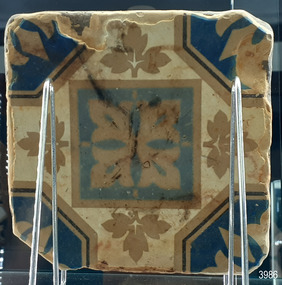 Flagstaff Hill Maritime Museum and Village
Ceramic - Floor Tile, circa 1878
... wreck of the Loch Ard. The iron-hulled clipper ship from the Loch Line was heading for Port Phillip from London, when it ran into the cliffs of Mutton Bird Island near Port Campbell. ...wreck of the Loch Ard. The iron-hulled clipper ship from the Loch Line was heading for Port Phillip from London, when it ran into the cliffs of Mutton Bird Island near Port Campbell. ...This Minton floor tile is from the wreck of the Loch Ard. The iron-hulled clipper ship from the Loch Line was heading for Port Phillip from London, when it ran into the cliffs of Mutton Bird Island near Port Campbell. The Loch Ard was laden with high-value cargo including luxury goods intended for display at the Melbourne International Exhibition in 1880. One notable survivor from the ship’s freight manifest was the well-packed Minton porcelain peacock, a two-meter high ceramic masterpiece of vivid glazed colours. (This is also on display in the Great Circle Gallery). The almost total loss of life and property from the Loch Ard registered as a shocking tragedy for the Colony of Victoria, at a time when social confidence and economic optimism were otherwise high. The wealth generated from Gold and Wool was increasingly being spent on grandiose private residences and imposing public buildings. The demand for quality furnishings and fittings was therefore strong. Among the products consigned to burgeoning colonial markets by the Milton Pottery at Stoke upon Trent, were their new range of colourfully patterned but very durable floor tiles ideal for the high-traffic spaces in the large civic buildings then being constructed in Australia and America. These floor tiles were “encaustic”, meaning that their designs and colours were encased “within” the depth of the tile. Rather than their decorative patterns being glazed onto the surface of the tile, their inlaid designs were created during the manufacturing process, as “coloured slips” (or liquid clay) were poured into a deep pre-moulded casting. When fired, the resulting tile was colour-fast and design-fast. The Minton floor tile is significant for its hard-wearing yet attractive design. The shipwreck of the Loch Ard is of significance for Victoria and is registered on the Victorian Heritage Register ( S 417). Flagstaff Hill has a varied collection of artefacts from Loch Ard and its collection is significant for being one of the largest accumulations of artefacts from this notable Victorian shipwreck of which the subject items are a small part. The collections of objects give us a snapshot of how we can interpret the story of this tragic event. The collection is also archaeologically significant as it represents aspects of Victoria's shipping history that allows us to interpret Victoria's social and historical themes of the time. Through is associated with the worst and best-known shipwreck in Victoria's history. A square Minton floor tile with a white background, and beige, dark blue, light blue and black geometric pattern as well as leaves in the design. The tile has corner broken off and some chipping along the edges. The reverse has five rows of five evenly spaced holes. The back of the tile has inscriptions. Made by Minton & Co. at Stoke upon Trent. This encaustic floor tile was recovered from the shipwreck of the LOCH ARD. Branded "... MINTON&CO / PATENT / STOKE UPON TRENT"flagstaff hill, warrnambool, flagstaff hill maritime museum, shipwreck coast, flagstaff hill maritime village, great ocean road, loch line, loch ard, captain gibbs, eva carmichael, tom pearce, glenample station, mutton bird island, minton floor tile, encaustic tile, melbourne international exhibition, floor tile, minton tile, minton & co., stoke upon trent -
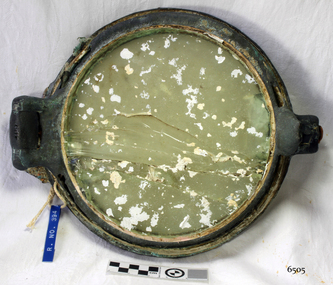 Flagstaff Hill Maritime Museum and Village
Functional object - Porthole, c 1888
... ships' to be lost along the south west coast of Victoria, and is the only wreck that took the lives of all people on board. She is listed on the Victorian Heritage Register VHS S34. The Antares is significant as a sail trader carrying an international inbound cargo. It is part of the Great Ocean Road Historic Shipwreck Trail. flagstaff hill warrnambool shipwrecked-coast flagstaff-hill flagstaff-hill-maritime-museum maritime-museum shipwreck-coast flagstaff-hill-maritime-village porthole antares. tall ship peterborough 1914 shipwreck phillip le couteur peter mathieson constable stainsbury sutlej antares rock. bay of islands ship's fitting Porthole with glass, brass, screw dog broken off, glass has cracks through it, some encrustation. ...This porthole was part of the ship's fittings when the Antares was constructed. THE ANTARES In mid-November 1914, after the beginning of the First World War, a young local man went one evening to fish near the Bay of Islands, west of Peterborough. He later arrived home hurriedly and in an agitated state declaring: "The Germans are coming!" His family laughed and disbelieved him, as this young fellow was prone to telling fictional tales. About a month later, on December 13th 1914, local farmers Phillip Le Couteur and Peter Mathieson were riding in the vicinity, checking on cattle. Phillip Le Couteur saw what he “thought was the hull of a ship below the cliffs.” He rode to Allansford and contacted police. The next day, two Constables and Phillip Le Couteur returned to the site, where they dug a trench near the top of the cliff and sank a log in it. To this they attached a rope, which they threw down the cliff face. Constable Stainsbury and Phillip Le Couteur then made the dangerous descent down the rope on the sheer cliff face. They found wreckage strewn around a small cove and a portion of a man's body under the cliffs. The hull of the ship could be seen about 300 metres out to sea. Some of the wreckage revealed the name Antares and the remains of the ship's dinghy bore the name Sutlej. During the next two weeks and with the help of the Warrnambool lifeboat and crew, two more bodies were found. Later investigations proved that the tragic wreck was indeed that of the Antares, reported overdue on the 207th day of her voyage from Marseilles, France, to Melbourne. She was a three masted, 1749 ton iron clipper, built in Glasgow in 1888 and originally named and launched as the Sutlej. Bought in 1907 by Semider Bros. from Genoa, Italy, she was refitted and renamed Antares. It was later realised that the local lad who a month earlier had declared he had seen German guns being fired, had probably seen distress flares fired from the deck of the Antares the night she was wrecked. She was last sailed under Captain Gazedo and wrecked at what is now known as Antares Rock, near the Bay of Islands. She had been carrying a large cargo of roofing tiles from France to Melbourne, consigned to Mullaly & Byrne. Many of them are now to be seen amongst the battered and scattered remains of the wreck. Some of the timbers were found to be blackened by fire. An Information Board has been erected on the cliff top near to the site of the Antares wreck, at the end of Radfords Rd, west of Peterborough. (Ref: Flagstaff Hill Maritime Village’s “Antares” fact sheet, Victorian Heritage Database, Information Board at Peterborough, Flagstaff Hill Significance Assessment 2010)The Antares was one of the last of the 'tall ships' to be lost along the south west coast of Victoria, and is the only wreck that took the lives of all people on board. She is listed on the Victorian Heritage Register VHS S34. The Antares is significant as a sail trader carrying an international inbound cargo. It is part of the Great Ocean Road Historic Shipwreck Trail. Porthole with glass, brass, screw dog broken off, glass has cracks through it, some encrustation. Artefact Reg No A/5, recovered from the wreck of the Antares.flagstaff hill, warrnambool, shipwrecked-coast, flagstaff-hill, flagstaff-hill-maritime-museum, maritime-museum, shipwreck-coast, flagstaff-hill-maritime-village, porthole, antares., tall ship, peterborough, 1914 shipwreck, phillip le couteur, peter mathieson, constable stainsbury, sutlej, antares rock., bay of islands, ship's fitting -
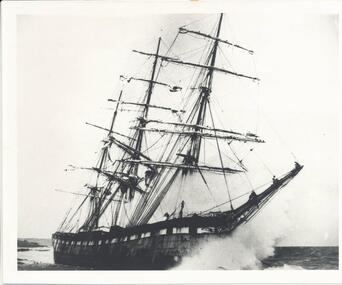 Phillip Island and District Historical Society Inc.
Photograph, The Speke, 22/02/1906
... Life boats were immediately lowered and the ship’s crew all made it to shore except Seaman Frank Henderson, who lost his life. wreck of the speke the speke jack loney Black & White photograph of The Speke running aground on the south coast of Phillip Island. ...The Speke was an all steel ship of 310 feet, beam of 35 feet and weight of 2,712 tons and triple masted. She was built in 1891 at Carnarvon in Wales for a cost of 22,000 pounds. The wreck of the Speke was purchased for a mere 12 pounds after it went aground in 1906. The Speke had come from Peru to Sydney. She was then on her way to load wheat in Geelong when she ran aground on the 22 February 1906. Captain Tiltson confused a bushfire, near Cowes, for navigation lights. The ship drifted close to shore in Kitty Miller Bay and was eventually holed at 3 pm on the rocks. Life boats were immediately lowered and the ship’s crew all made it to shore except Seaman Frank Henderson, who lost his life.Black & White photograph of The Speke running aground on the south coast of Phillip Island.wreck of the speke, the speke, jack loney -
 Phillip Island and District Historical Society Inc.
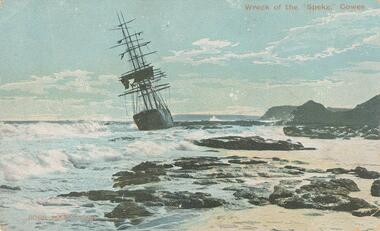
Photograph - Post Card, 1906
... The ship drifted broadside on to a reef to the east of Kitty Miller Bay on the 22nd February 1906 while on route from Peru via Sydney to Geelong in ballast to pick up wheat. wreck of the speke kitty miller bay phillip island robb bros cowes phillip island joan wilson Wreck of the Speke," Cowes. ...The "Speke" was a three masted steel ship built in Wales 1891 - the second largest at the time. The ship drifted broadside on to a reef to the east of Kitty Miller Bay on the 22nd February 1906 while on route from Peru via Sydney to Geelong in ballast to pick up wheat. Coloured postcard of the Wreck of the "Speke" near Kitty Miller Bay, Phillip Island.Wreck of the Speke," Cowes. Robb Bros. Cowes. On back: A letter from Miss Palmer's niece, Elsie with general family information. Sent on the 24/11/1907wreck of the speke, kitty miller bay phillip island, robb bros cowes phillip island, joan wilson -
 Phillip Island and District Historical Society Inc.
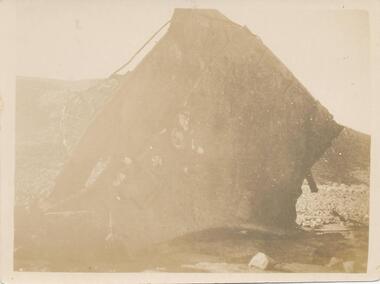
Photograph, 1910-1920 approx
... wreck of the sailing ship "speke"...wrecks...phillip island...One of a collection of 8 photographs donated by Bob Notley of San Remo wreck of the speke wreck of the sailing ship "speke" wrecks phillip island wrecks bob notley Black & White photograph of a part of the Wreck of "Speke" at Kitty Miller Bay Photograph Photograph ...One of a collection of 8 photographs donated by Bob Notley of San RemoBlack & White photograph of a part of the Wreck of "Speke" at Kitty Miller Baywreck of the speke, wreck of the sailing ship "speke", wrecks, phillip island wrecks, bob notley -
 Phillip Island and District Historical Society Inc.
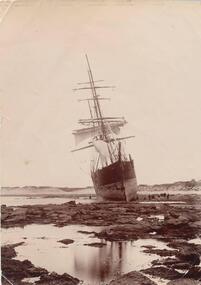
Photograph, Early 20th Century
... "artisan" sailing ship ship wrecks phillip island jessie smith collection stan mcfee On Back: "Artisan" Photograph of the "Artisan" Sailing Ship run aground and leaning. ...One of 23 photographs from the Jessie Smith Collection. Donated by Stan McFee.Photograph of the "Artisan" Sailing Ship run aground and leaning. A man's figure in the water to the left of the ship and figures of eight to ten people on rocks to the right of the ship.On Back: "Artisan""artisan" sailing ship, ship wrecks, phillip island, jessie smith collection, stan mcfee -
 Phillip Island and District Historical Society Inc.
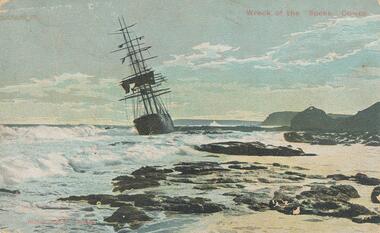
Photograph - Post Card, 1906
... wreck of the sailing ship "speke"...phillip island...One of a collection of photographs donated by Shirley Peterson. wreck of the sailing ship "speke" phillip island coastline phillip island shirley peterson "Wreck of the "Speke", Cowes" "Robb Bros. ...One of a collection of photographs donated by Shirley Peterson.Colour postcard of the wreck of the :Speke" on the south coast of Phillip Island in 1906."Wreck of the "Speke", Cowes" "Robb Bros. Cowes"wreck of the sailing ship "speke", phillip island coastline, phillip island, shirley peterson -
 Phillip Island and District Historical Society Inc.
Photograph, 1978/79
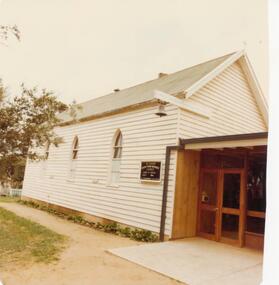
... phillip island St John's Church Cowes Uniting Church Cowes Phillip Island St John's Uniting Church, Chapel Street, Cowes. Large wooden structure combining Church and Hall. In 1971 the building committee commissioned an architect who designed the building with an unusual roof structure which reflected the concept of a keel of a ship - appropriate for the setting of a building by the sea. The bell is from the wrecked ...The land in Chapel Street was granted by the Presbyterian Church in 1869. A church was finally built by Alex McLardy at a cost of £127 and was dedicated in august 1895. The first Presbyterian Church services held on Phillip Island in 1889 were conducted under a tree in the open air. May 1890 Dr. Alexander Robb was appointed the first Minister and continued until his death 11 years later. 1929 an annex was built providing more accommodation. 1968 the joint Presbyterian and Methodist congregation was formed. In 1975 a new building was dedicated.St John's Uniting Church, Chapel Street, Cowes. Large wooden structure combining Church and Hall. In 1971 the building committee commissioned an architect who designed the building with an unusual roof structure which reflected the concept of a keel of a ship - appropriate for the setting of a building by the sea. The bell is from the wrecked ship "The Speke".local history, photographs, buildings, historic, buildings - historical, coloured photograph, john cook, phillip island, st john's church cowes, uniting church cowes phillip island -
 Phillip Island and District Historical Society Inc.
Compass box, 19th Century
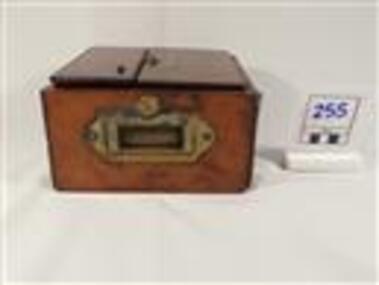
... phillip island...ship wreck...ship Speke which ran aground on the coast of Phillip Island on the 22nd of February 1906. The ships captain gave the compass box to the Harris family. The Speke was an all steel ship built in Wales in 1891. She was delivering wheat to Geelong and confused a bushfire in Cowes for navigation lights. Many local people salvaged goods from the resulting wreckage. phillip island ship wreck ...Saved from the ship Speke which ran aground on the coast of Phillip Island on the 22nd of February 1906. The ships captain gave the compass box to the Harris family.The Speke was an all steel ship built in Wales in 1891. She was delivering wheat to Geelong and confused a bushfire in Cowes for navigation lights. Many local people salvaged goods from the resulting wreckage.Square wooden compass box with wooden lid, made of mahogany, brass hinges, handles and lock.phillip island, ship wreck, compass box, speke, kitty miller bay -
 Phillip Island and District Historical Society Inc.
Ship's rigging block, 1891
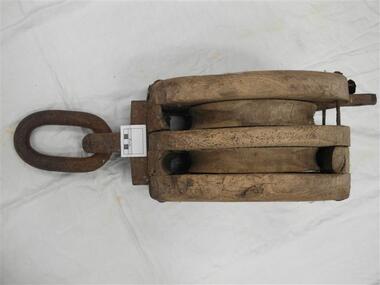
... Rigging block from the 3-masted full-rigged ship Speke wrecked on Phillip Island 22 February 1906....Rigging block from the 3-masted full-rigged ship Speke wrecked on Phillip Island 22 February 1906. The Speke was the second largest 3-masted full-rigged ship in the world. ...Rigging block from the 3-masted full-rigged ship Speke wrecked on Phillip Island 22 February 1906.The Speke was the second largest 3-masted full-rigged ship in the world.Double block -
 Phillip Island and District Historical Society Inc.
Photograph, 23/02/1906
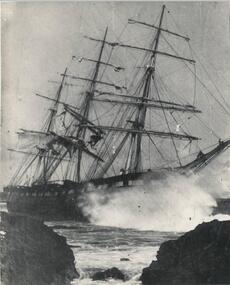
... One of a collection of over 400 photographs in an album commenced in 1960 and presented to the Phillip Island & Westernport Historical Society by the Shire of Phillip Island local history photography photographs maritime technology ship relics wreck of the sailing ship "speke" black & white photograph shipping wrecks the speke john jenner bryant west Photograph of the"Speke" taken 23/02/1906 the morning after the wreck. ...One of a collection of over 400 photographs in an album commenced in 1960 and presented to the Phillip Island & Westernport Historical Society by the Shire of Phillip IslandPhotograph of the"Speke" taken 23/02/1906 the morning after the wreck.local history, photography, photographs, maritime technology, ship relics, wreck of the sailing ship "speke", black & white photograph, shipping, wrecks, the speke, john jenner, bryant west -
 Phillip Island and District Historical Society Inc.
Photograph, 1936
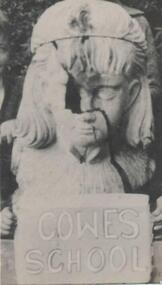
... One of a collection of over 400 photographs in an album commenced in 1960 and presented to the Phillip Island & Westernport Historical Society by the Shire of Phillip Island local history photography photographs maritime technology ship relics figure head of the "speke" black & white photograph shipping wrecks the speke figure head john jenner bryant west Photograph of the Figure Head of The "Speke" as found in a shed in 1936. ...One of a collection of over 400 photographs in an album commenced in 1960 and presented to the Phillip Island & Westernport Historical Society by the Shire of Phillip IslandPhotograph of the Figure Head of The "Speke" as found in a shed in 1936.local history, photography, photographs, maritime technology, ship relics, figure head of the "speke", black & white photograph, shipping, wrecks, the speke figure head, john jenner, bryant west -
 Phillip Island and District Historical Society Inc.
Photograph, 02/1906
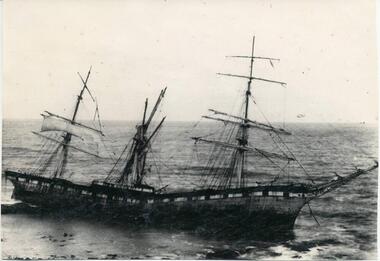
... One of a collection of over 400 photographs in an album commenced in 1960 and presented to the Phillip Island & Westernport Historical Society by the Shire of Phillip Island local history photography photographs film maritime technology ship relics wreck of the sailing ship "speke" black & white photograph shipping wrecks the speke john jenner bryant west Photograph of The "Speke" taken several days after the wreck. ...One of a collection of over 400 photographs in an album commenced in 1960 and presented to the Phillip Island & Westernport Historical Society by the Shire of Phillip IslandPhotograph of The "Speke" taken several days after the wreck.local history, photography, photographs, film maritime technology, ship relics, wreck of the sailing ship "speke", black & white photograph, shipping, wrecks, the speke, john jenner, bryant west -
 Phillip Island and District Historical Society Inc.
Photograph, 02/1906
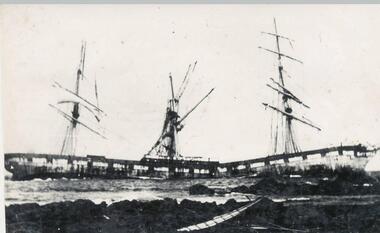
... One of a collection of over 400 photographs in an album commenced in 1960 and presented to the Historical Society by the Shire of Phillip Island local history photography photographs film maritime technology ship relics wreck of the sailing ship "speke" black & white photograph shipping wrecks the speke John Jenner Bryant West Photograph of The "Speke" taken days after the wreck Photograph Bryant West ...One of a collection of over 400 photographs in an album commenced in 1960 and presented to the Historical Society by the Shire of Phillip IslandPhotograph of The "Speke" taken days after the wrecklocal history, photography, photographs, film maritime technology, ship relics, wreck of the sailing ship "speke", black & white photograph, shipping, wrecks, the speke, john jenner, bryant west -
 Phillip Island and District Historical Society Inc.
Photograph, 1930's
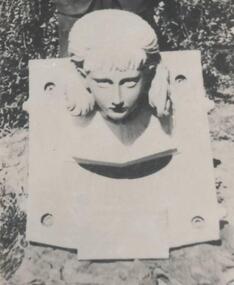
... One of a collection of over 400 photographs in an album commenced in 1960 and presented to the Phillip Island & Westernport Historical Society by the Shire of Phillip Island local history photography photographs maritime technology ship relics figure head of the "speke" black & white photograph shipping wrecks the speke figure head john jenner bryant west Photograph of the Figure Head of The "Speke" after restoration by School Boys and their Teacher. ...One of a collection of over 400 photographs in an album commenced in 1960 and presented to the Phillip Island & Westernport Historical Society by the Shire of Phillip IslandPhotograph of the Figure Head of The "Speke" after restoration by School Boys and their Teacher.local history, photography, photographs, maritime technology, ship relics, figure head of the "speke", black & white photograph, shipping, wrecks, the speke figure head, john jenner, bryant west -
 Phillip Island and District Historical Society Inc.
Photograph
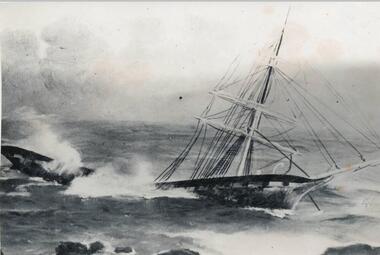
... One of a collection of over 400 photographs in an album commenced in 1960 and presented to the Phillip Island & Westernport Historical Society by the Shire of Phillip Island local history photography photographs maritime technology ship relics wreck of the sailing ship "speke" black & white photograph shipping wrecks the speke john jenner bryant west Photograph of a painting of the wreck of The "Speke" with only one mast standing. ...One of a collection of over 400 photographs in an album commenced in 1960 and presented to the Phillip Island & Westernport Historical Society by the Shire of Phillip IslandPhotograph of a painting of the wreck of The "Speke" with only one mast standing.local history, photography, photographs, maritime technology, ship relics, wreck of the sailing ship "speke", black & white photograph, shipping, wrecks, the speke, john jenner, bryant west -
 Phillip Island and District Historical Society Inc.
Photograph
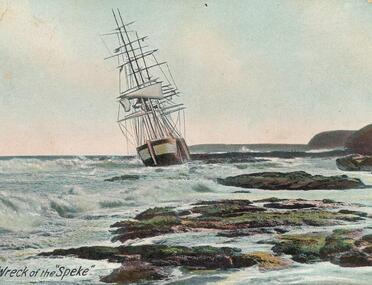
... One of a collection of over 400 photographs in an album commenced in 1960 and presented to the Phillip Island & Westernport Historical Society by the Shire of Phillip Island local history photography photographs ship relics wreck of the sailing ship "speke" colour touched photograph shipping wrecks the speke john jenner bryant west Re touched coloured Photograph of the wreck of The "Speke" stern end view. ...One of a collection of over 400 photographs in an album commenced in 1960 and presented to the Phillip Island & Westernport Historical Society by the Shire of Phillip IslandRe touched coloured Photograph of the wreck of The "Speke" stern end view.local history, photography, photographs, ship relics, wreck of the sailing ship "speke", colour touched photograph, shipping, wrecks, the speke, john jenner, bryant west -
 Phillip Island and District Historical Society Inc.
Photograph, 1906
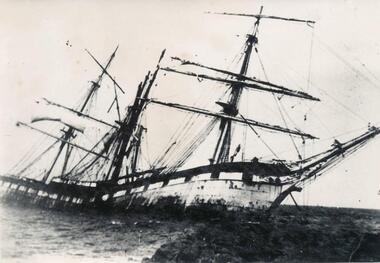
... One of a collection of over 400 photographs in an album commenced in 1960 and presented to the Phillip Island & Westernport Historical Society by the Shire of Phillip Island local history photography photographs maritime technology ship relics wreck of the sailing ship "speke" black & white photograph shipping wrecks the speke john jenner bryant west Photograph of the wreck of the "Speke" with two and a half masts remaining Photograph Bryant West ...One of a collection of over 400 photographs in an album commenced in 1960 and presented to the Phillip Island & Westernport Historical Society by the Shire of Phillip IslandPhotograph of the wreck of the "Speke" with two and a half masts remaininglocal history, photography, photographs, maritime technology, ship relics, wreck of the sailing ship "speke", black & white photograph, shipping, wrecks, the speke, john jenner, bryant west -
 Phillip Island and District Historical Society Inc.
Photograph, 1940
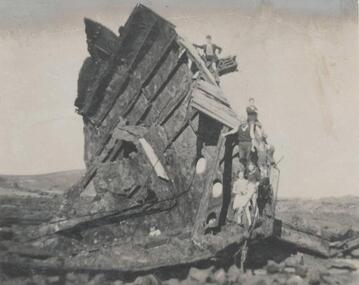
... One of a collection of over 400 photographs in an album commenced in 1960 and presented to the Phillip Island & Westernport Historical Society by the Shire of Phillip Island local history photography photographs ship relics wreck of the sailing ship "speke" black & white photograph shipping wrecks the speke john jenner bryant west Photograph of a remnant of the "Speke" taken in 1940 with people all over it! ...One of a collection of over 400 photographs in an album commenced in 1960 and presented to the Phillip Island & Westernport Historical Society by the Shire of Phillip IslandPhotograph of a remnant of the "Speke" taken in 1940 with people all over it!local history, photography, photographs, ship relics, wreck of the sailing ship "speke", black & white photograph, shipping, wrecks, the speke, john jenner, bryant west -
 Phillip Island and District Historical Society Inc.
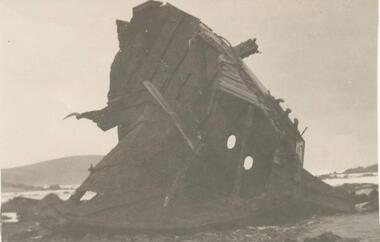
Photograph, 1942
... One of a collection of over 400 photographs in an album commenced in 1960 and presented to the Phillip Island & Westernport Historical Society by the Shire of Phillip Island local history photography photographs ship relics wreck of the sailing ship "speke" shipping wrecks the speke john jenner bryant west Photograph of a remnant of the Sailing Ship "Speke" taken in 1942 Photograph Bryant West ...One of a collection of over 400 photographs in an album commenced in 1960 and presented to the Phillip Island & Westernport Historical Society by the Shire of Phillip IslandPhotograph of a remnant of the Sailing Ship "Speke" taken in 1942local history, photography, photographs, ship relics, wreck of the sailing ship "speke", shipping, wrecks, the speke, john jenner, bryant west -
 Phillip Island and District Historical Society Inc.
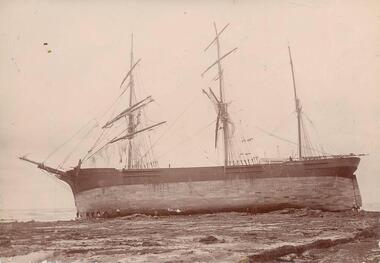
Photograph, 1901
... One of a collection of over 400 photographs in an album commenced in 1960 and presented to the Phillip Island & Westernport Historical Society by the Shire of Phillip Island local history photography photographs wrecks sailing ship "artisan" wrecked at cape paterson sepia photograph shipping ship wrecks sailing ship artisan cape paterson john jenner bryant west Sepia photograph taken from port side showing the Three Masted Barque "Artisan" high and dry on the rocks at Cape Paterson. 1901. ...One of a collection of over 400 photographs in an album commenced in 1960 and presented to the Phillip Island & Westernport Historical Society by the Shire of Phillip IslandSepia photograph taken from port side showing the Three Masted Barque "Artisan" high and dry on the rocks at Cape Paterson. 1901.local history, photography, photographs, wrecks, sailing ship "artisan" wrecked at cape paterson, sepia photograph, shipping, ship wrecks, sailing ship artisan, cape paterson, john jenner, bryant west
