
Showing 11 items matching "phonology"
-
 Victorian Aboriginal Corporation for Languages
Book, Koormundum Ida Bishop, Ngun? Koongurrukun? =? Speak Koongurrukun?, 2000
... Gives Phonology, grammatical interpretations and lexicon. ...Fitzmaurice Daly River Muluk Muluk Colour photographs, word lists Gives Phonology, grammatical interpretations and lexicon. ...Gives Phonology, grammatical interpretations and lexicon. Provides complex detail of the above.Colour photographs, word listskoongurrukun?, fitzmaurice, daly river, muluk muluk -
Victorian Aboriginal Corporation for Languages
Book, Peter Sutton et al, Revised linguistic fieldwork manual for Australia, 1979
... Excellent fieldwork manual detailing methods of collecting and analysing Australian languages, including chapters on phonology, lexicon & semantics, grammatical categories, and syntax. ...Information on phonological transcription uses symbols that are now generally obsolete, but are found in many key studies conducted around the time of publication. ...Excellent fieldwork manual detailing methods of collecting and analysing Australian languages, including chapters on phonology, lexicon & semantics, grammatical categories, and syntax. Contains an English target wordlist of basic vocabulary (with scientific names of flora and fauna). Information on phonological transcription uses symbols that are now generally obsolete, but are found in many key studies conducted around the time of publication.word listslinguistics, language fieldwork, audio recording -
 Victorian Aboriginal Corporation for Languages
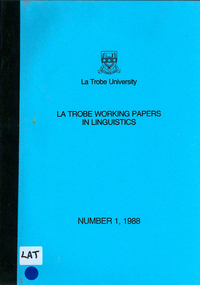
Periodical, La Trobe University Department of Linguistics, La Trobe working papers in linguistics, 1988
... Phonology in Australian Aboriginal languages; Aboriginal Languages of the Gascoyne-Ashburton region; Warlpiri; Tagalog and the Manila-Mt Isa axis; Gooniyandi narrative; general linguistics...linguistics warlpiri Phonology in Australian Aboriginal languages; Aboriginal Languages of the Gascoyne-Ashburton region; Warlpiri; Tagalog and the Manila-Mt Isa axis; Gooniyandi narrative; general linguistics La Trobe working papers in linguistics Periodical La Trobe University Department of Linguistics ...Phonology in Australian Aboriginal languages; Aboriginal Languages of the Gascoyne-Ashburton region; Warlpiri; Tagalog and the Manila-Mt Isa axis; Gooniyandi narrative; general linguisticslinguistics, warlpiri -
Victorian Aboriginal Corporation for Languages
Book, RMW Dixon, Australian languages: their nature and development, 2002
... Numerous maps, isoglosses, tables, comparative grammar, phonology, semantics, etc. 1. The language situation in Australia 2. ...Numerous maps, isoglosses, tables, comparative grammar, phonology, semantics, etc. 1. The language situation in Australia 2. ...Very comprehensive technical linguistic introduction to the Australian language family, a follow-up to Dixon?s ?The Languages of Australia? (1980). Numerous maps, isoglosses, tables, comparative grammar, phonology, semantics, etc. 1. The language situation in Australia 2. Modelling the language situation 3. Overview 4. Vocabulary 5. Case and other nominal suffixes 6. Verbs 7. Pronouns 8. Bound pronouns 9. Prefixing and fusion 10. Generic nouns, classifiers, genders and noun classes 11. Ergative/?accusative morphological and syntactic profiles 12. Phonology 13. Genetic subgroups and small linguistic areas 14. Summary and conclusion.Mapslinguistics, language surveys -
 Expression Australia
Papaers, Information (Relating to the Deaf)
... This binders contains a collection of papers with information on a range of Deaf related subjects: Hearing Loss In Paget's Disease of Bone, Hearing Aids, Access Issues (for the Deaf), Hearing Aids and Mobile Phones, Audio-Psycho-Phonology, Medications used in treatment of Meniere's Disease, Perfect Pitch, Musicians earplugs and Monitors, etc...This binders contains a collection of papers with information on a range of Deaf related subjects: Hearing Loss In Paget's Disease of Bone, Hearing Aids, Access Issues (for the Deaf), Hearing Aids and Mobile Phones, Audio-Psycho-Phonology, Medications used in treatment of Meniere's Disease, Perfect Pitch, Musicians earplugs and Monitors, etc White A4 Binder containing papers Information (Relating to the Deaf) Papaers ...This binders contains a collection of papers with information on a range of Deaf related subjects: Hearing Loss In Paget's Disease of Bone, Hearing Aids, Access Issues (for the Deaf), Hearing Aids and Mobile Phones, Audio-Psycho-Phonology, Medications used in treatment of Meniere's Disease, Perfect Pitch, Musicians earplugs and Monitors, etcWhite A4 Binder containing papers -
 Victorian Aboriginal Corporation for Languages
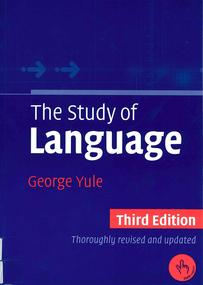
Book, George Yule, The study of Language, 2006
... Issues in language study: origin of language, animals & human language, writing, phonetics, phonology, words & word-formation processes, morphology, grammar, syntax, semantics, pragmatics, discourse analysis, language and the brain, language acquisition, gestures and sign languages, languages and regional variation, language and social variation, language and culture....linguistics sociolinguistics history and language B&w illustrations, b&w photographs, maps Issues in language study: origin of language, animals & human language, writing, phonetics, phonology, words & word-formation processes, morphology, grammar, syntax, semantics, pragmatics, discourse analysis, language and the brain, language acquisition, gestures and sign languages, languages and regional variation, language and social variation, language and culture. ...Issues in language study: origin of language, animals & human language, writing, phonetics, phonology, words & word-formation processes, morphology, grammar, syntax, semantics, pragmatics, discourse analysis, language and the brain, language acquisition, gestures and sign languages, languages and regional variation, language and social variation, language and culture.B&w illustrations, b&w photographs, mapslinguistics, sociolinguistics, history and language -
 Victorian Aboriginal Corporation for Languages
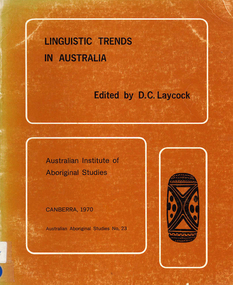
Book, Donald Laycock, Linguistic trends in Australia : papers presented to the A.I.A.S. Linguistics Group May 1968, 1970
... ...phonology...Daly Gugada Wirangu Dieri Tyemeri Mulluk linguistics grammatical theory phonology Maps, word lists Various authors: technical linguistic studies of genetic classification of Australian languages, Daly family languages, and some language-specific notes on South Australian languages. ...Various authors: technical linguistic studies of genetic classification of Australian languages, Daly family languages, and some language-specific notes on South Australian languages.Maps, word listsdaly, gugada, wirangu, dieri, tyemeri, mulluk, linguistics, grammatical theory, phonology, -
 Victorian Aboriginal Corporation for Languages
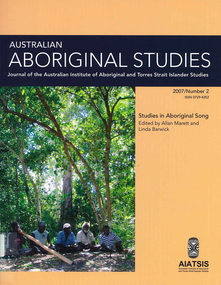
Periodical, Australian Institute of Aboriginal and Torres Strait Islander Studies, Australian Aboriginal studies : journal of the Australian Institute of Aboriginal and Torres Strait Islander Studies, 2007
... Drawing upon a set of songs from the Arandic language group, I describe the CA song as having three independent obligatory components (text, rhythm and melody) and specify how text is set to rhythm within a rhythmic and a phonological constraint. I show how syllable counting, for the purposes of text setting, reflects a feature of the Arandic sound system. ...Drawing upon a set of songs from the Arandic language group, I describe the CA song as having three independent obligatory components (text, rhythm and melody) and specify how text is set to rhythm within a rhythmic and a phonological constraint. I show how syllable counting, for the purposes of text setting, reflects a feature of the Arandic sound system. ...1. Musical and linguistic perspectives on Aboriginal song Allan Marett and Linda Barwick Song brings language and music together. Great singers are at once musicians and wordsmiths, who toss rhythm, melody and word against one another in complex cross-play. In this paper we outline some initial findings that are emerging from our interdisciplinary study of the musical traditions of the Cobourg region of western Arnhem Land, a coastal area situated in the far north of the Australian continent 350 kilometres northeast of Darwin. We focus on a set of songs called Jurtbirrk, sung in Iwaidja, a highly endangered language, whose core speaker base is now located in the community of Minjilang on Croker Island. We bring to bear analytical methodologies from both musicology and linguistics to illuminate this hitherto undocumented genre of love songs. 2. Iwaidja Jurtbirrk songs: Bringing language and music together Linda Barwick (University of Sydney), Bruce Birch and Nicholas Evans (University of Melbourne) Song brings language and music together. Great singers are at once musicians and wordsmiths, who toss rhythm, melody and word against one another in complex cross-play. In this paper we outline some initial findings that are emerging from our interdisciplinary study of the musical traditions of the Cobourg region of western Arnhem Land, a coastal area situated in the far north of the Australian continent 350 kilometres northeast of Darwin. We focus on a set of songs called Jurtbirrk, sung in Iwaidja, a highly endangered language, whose core speaker base is now located in the community of Minjilang on Croker Island. We bring to bear analytical methodologies from both musicology and linguistics to illuminate this hitherto undocumented genre of love songs. 3. Morrdjdjanjno ngan-marnbom story nakka, ?songs that turn me into a story teller?: The morrdjdjanjno of western Arnhem Land Murray Garde (University of Melbourne) Morrdjdjanjno is the name of a song genre from the Arnhem Land plateau in the Top End of the Northern Territory and this paper is a first description of this previously undocumented song tradition. Morrdjdjanjno are songs owned neither by individuals or clans, but are handed down as ?open domain? songs with some singers having knowledge of certain songs unknown to others. Many morrdjdjanjno were once performed as part of animal increase rituals and each song is associated with a particular animal species, especially macropods. Sung only by men, they can be accompanied by clap sticks alone or both clap sticks and didjeridu. First investigations reveal that the song texts are not in everyday speech but include, among other things, totemic referential terms for animals which are exclusive to morrdjdjanjno. Translations from song language into ordinary register speech can often be ?worked up? when the song texts are discussed in their cultural and performance context. The transmission of these songs is severely endangered at present as there are only two known singers remaining both of whom are elderly. 4. Sung and spoken: An analysis of two different versions of a Kun-barlang love song Isabel O?Keeffe (nee Bickerdike) (University of Melbourne) In examining a sung version and a spoken version of a Kun-barlang love song text recorded by Alice Moyle in 1962, I outline the context and overall structure of the song, then provide a detailed comparative analysis of the two versions. I draw some preliminary conclusions about the nature of Kun-barlang song language, particularly in relation to the rhythmic setting of words in song texts and the use of vocables as structural markers. 5. Simplifying musical practice in order to enhance local identity: Rhythmic modes in the Walakandha wangga (Wadeye, Northern Territory) Allan Marett (University of Sydney) Around 1982, senior performers of the Walakandha wangga, a repertory of song and dance from the northern Australian community of Wadeye (Port Keats), made a conscious decision to simplify their complex musical and dance practice in order to strengthen the articulation of a group identity in ceremonial performance. Recordings from the period 1972?82 attest to a rich diversity of rhythmic modes, each of which was associated with a different style of dance. By the mid-1980s, however, this complexity had been significantly reduced. I trace the origin of the original complexity, explore the reasons why this was subsequently reduced, and trace the resultant changes in musical practice. 6. ?Too long, that wangga?: Analysing wangga texts over time Lysbeth Ford (University of Sydney) For the past forty or so years, Daly region song-men have joined with musicologists and linguists to document their wangga songs. This work has revealed a corpus of more than one hundred wangga songs composed in five language varieties Within this corpus are a few wangga texts recorded with their prose versions. I compare sung and spoken texts in an attempt to show not only what makes wangga texts consistently different from prose texts, but also how the most recent wangga texts differ from those composed some forty years ago. 7. Flesh with country: Juxtaposition and minimal contrast in the construction and melodic treatment of jadmi song texts Sally Treloyn (University of Sydney) For some time researchers of Centralian-style songs have found that compositional and performance practices that guide the construction and musical treatment of song texts have a broader social function. Most recently, Barwick has identified an ?aesthetics of parataxis or juxtaposition? in the design of Warumungu song texts and musical organisation (as well as visual arts and dances), that mirrors social values (such as the skin system) and forms 'inductive space' in which relationships between distinct classes of being, places, and groups of persons are established. Here I set out how juxtaposition and minimal contrast in the construction and melodic treatment of jadmi-type junba texts from the north and north-central Kimberley region similarly create 'inductive space' within which living performers, ancestral beings, and the country to which they are attached, are drawn into dynamic, contiguous relationships. 8. The poetics of central Australian Aboriginal song Myfany Turpin (University of Sydney) An often cited feature of traditional songs from Central Australia (CA songs) is the obfuscation of meaning. This arises partly from the difficulties of translation and partly from the difficulties in identifying words in song. The latter is the subject of this paper, where I argue it is a by-product of adhering to the requirements of a highly structured art form. Drawing upon a set of songs from the Arandic language group, I describe the CA song as having three independent obligatory components (text, rhythm and melody) and specify how text is set to rhythm within a rhythmic and a phonological constraint. I show how syllable counting, for the purposes of text setting, reflects a feature of the Arandic sound system. The resultant rhythmic text is then set to melody while adhering to a pattern of text alliteration. 9. Budutthun ratja wiyinymirri: Formal flexibility in the Yol?u manikay tradition and the challenge of recording a complete repertoire Aaron Corn (University of Sydney) with Neparr? a Gumbula (University of Sydney) Among the Yol?u (people) of north-eastern Arnhem Land, manikay (song) series serve as records of sacred relationships between humans, country and ancestors. Their formal structures constitute the overarching order of all ceremonial actions, and their lyrics comprise sacred esoteric lexicons held nowhere else in the Yol?u languages. A consummate knowledge of manikay and its interpenetrability with ancestors, country, and parallel canons of sacred y�ku (names), bu?gul (dances) and miny'tji (designs) is an essential prerequisite to traditional leadership in Yol?u society. Drawing on our recordings of the Baripuy manikay series from 2004 and 2005, we explore the aesthetics and functions of formal flexibility in the manikay tradition. We examine the individuation of lyrical realisations among singers, and the role of rhythmic modes in articulating between luku (root) and bu?gul'mirri (ceremonial) components of repertoire. Our findings will contribute significantly to intercultural understandings of manikay theory and aesthetics, and the centrality of manikay to Yol?u intellectual traditions. 10. Australian Aboriginal song language: So many questions, so little to work with Michael Walsh Review of the questions related to the analysis of Aboriginal song language; requirements for morpheme glossing, component package, interpretations, prose and song text comparison, separation of Indigenous and ethnographic explanations, candour about collection methods, limitations and interpretative origins.maps, colour photographs, tablesyolgnu, wadeye, music and culture -
Koorie Heritage Trust
Book, Blake, Barry J, Australian Aboriginal Languages : a general introduction, 1991
... . | Language - Linguistics - Phonology and phonetics | Language - Kriol | Language - Sociolinguistics - Secret and special languages | Language - Vocabulary - Human classification | Language - Vocabulary - Word lists Non-technical introduction covering phonology, grammar, vocabulary, sociolinguistics, language relationships pidgin and Aboriginal English, loan words in English, wordlists in Tiwi, Malak-Malak, Alyawarre, Walmajarri, Nyungar, Pitjantjatjara, Wemba-Wemba, Dharawal, Bidyara, Pitta-Pitta, Kalkatungu and Mayi-Yabi. ...Non-technical introduction covering phonology, grammar, vocabulary, sociolinguistics, language relationships pidgin and Aboriginal English, loan words in English, wordlists in Tiwi, Malak-Malak, Alyawarre, Walmajarri, Nyungar, Pitjantjatjara, Wemba-Wemba, Dharawal, Bidyara, Pitta-Pitta, Kalkatungu and Mayi-Yabi. In 1788 Australia had more than 200 such languages -- as different from each other as English is from French. Today, more than 100 are extinct and many of the rest are under threat. Professor Blake describes the sounds, spelling and location of the different languages, and dispels many popular myths.viii, 138 p. : ill., map. ; 21 cm.Non-technical introduction covering phonology, grammar, vocabulary, sociolinguistics, language relationships pidgin and Aboriginal English, loan words in English, wordlists in Tiwi, Malak-Malak, Alyawarre, Walmajarri, Nyungar, Pitjantjatjara, Wemba-Wemba, Dharawal, Bidyara, Pitta-Pitta, Kalkatungu and Mayi-Yabi. In 1788 Australia had more than 200 such languages -- as different from each other as English is from French. Today, more than 100 are extinct and many of the rest are under threat. Professor Blake describes the sounds, spelling and location of the different languages, and dispels many popular myths.australian languages. | aboriginal australians -- languages. | language - linguistics - phonology and phonetics | language - kriol | language - sociolinguistics - secret and special languages | language - vocabulary - human classification | language - vocabulary - word lists -
Koorie Heritage Trust
Journal - Serials, Department of Pacific and Southeast Asian History, Australian National University, Aboriginal History - Volume 09. 1-2 1985, 1985
... . | Animals - Birds - Brolgas | Stories and motifs - Emu | Indigenous knowledge - Botany | Indigenous knowledge - Zoology | Language - Change | Language - Linguistics - Language classification | Language - Linguistics - Phonology and phonetics | Language - Semantics | Language - Texts and translations - Aboriginal to non-Aboriginal language | Crime - Bushrangers and outlaws | Law enforcement - Police - Native police | Law enforcement - Police trackers | Indigenous peoples - Pacific | Language - Kriol - Pidgins and creoles - Torres Strait Creole | A series of articles by leading writers on Aboriginal History. 240 P.; footnotes; appendices; maps; ports.; bibs.; 24 cm. ...A series of articles by leading writers on Aboriginal History.240 P.; footnotes; appendices; maps; ports.; bibs.; 24 cm.A series of articles by leading writers on Aboriginal History.aboriginal australians -- periodicals. | ethnology -- australia -- periodicals. | animals - birds - brolgas | stories and motifs - emu | indigenous knowledge - botany | indigenous knowledge - zoology | language - change | language - linguistics - language classification | language - linguistics - phonology and phonetics | language - semantics | language - texts and translations - aboriginal to non-aboriginal language | crime - bushrangers and outlaws | law enforcement - police - native police | law enforcement - police trackers | indigenous peoples - pacific | language - kriol - pidgins and creoles - torres strait creole | -
Koorie Heritage Trust
Journal - Serials, Aboriginal History Inc, Aboriginal History - Volume 23. 1999, 1999
... White Isabel (Sally) - Anthropologist | Demography - Population mobility | Settlement and contacts - Resettlement and removals | Defence - Missile and weapons testing - Nuclear weapons | Language - Linguistics - Language elicitation | Language - Vocabulary - Word lists | Language - Linguistics - Phonology and phonetics | History - Biographies - Indigenous | Colonisation | Race relations - Racial discrimination - Women | Music - Vocal - Group - Children | Music - Education | Music - Analysis - Vocal A series of articles by leading writers on Aboriginal History. iiv-xii; 151 P.; refs.; footnotes; plates; 25 cm. ...A series of articles by leading writers on Aboriginal History.iiv-xii; 151 P.; refs.; footnotes; plates; 25 cm.A series of articles by leading writers on Aboriginal History.aboriginal australians -- periodicals. | ethnology -- australia -- periodicals | language, aboriginal-upper murray vic. - pallangamiddang., unaipon, david-interview., white, isabel (sally) - anthropologist | demography - population mobility | settlement and contacts - resettlement and removals | defence - missile and weapons testing - nuclear weapons | language - linguistics - language elicitation | language - vocabulary - word lists | language - linguistics - phonology and phonetics | history - biographies - indigenous | colonisation | race relations - racial discrimination - women | music - vocal - group - children | music - education | music - analysis - vocal
