
Showing 10 items matching "piano score"
-
 Tatura Irrigation & Wartime Camps Museum
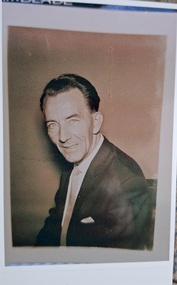
Photograph, Wilhelm Heinrich WALLBAUM
... ...piano score...He loved the piano and whilst interned composed a march which he called "Seige" and wrote the piano score. "Seige" was later changed to "Under the Southern Cross". ...William Heinrich Wallbaum Bathurst goal Dentistry Dental nurse piano score brass band score Black and white photograph of a man wearing a tie and suit sitting side on. ...Wilhelm was rounded up by the CIB in Sydney in 1939 and put into Bathurst goal and later transferred to Tatura, where he spent nearly 5 years. He helped out in the dentistry facility as a Dental nurse. He loved the piano and whilst interned composed a march which he called "Seige" and wrote the piano score. "Seige" was later changed to "Under the Southern Cross". It was later written for a full brass band. Black and white photograph of a man wearing a tie and suit sitting side on. Plain backgroundwilliam heinrich wallbaum, bathurst goal, dentistry, dental nurse, piano score, brass band score -
 Federation University Historical Collection
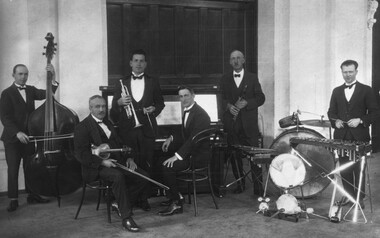
Photograph, Richards & Co, Photo, Frank Wright and his Coliseum Orchestra, 1) Nov 25th 1926, .2) 1926, .3) October 1925
... Scoring and conducted at the Guildhall of Music and Drama. Frank was often invited to adjudicate Brass Band Championships around Europe, in Australia, including South Street and in New Zealand. The Frank Wright Medal at the Royal South Street competition is awarded to an individual recognized as making an outstanding contribution to brass music in Australia. frank wright coliseum orchestra city hall ballarat cornet piano clarinet banjo violin xylophone trombone drums w. morris e. bentley roy ogilvie c. mills t. mcmannamy ballarat town hall ballarat town hall interior "a" hall .1) on back - Richards & Co, Photo, Ballarat, Post Card, Kodak Australia; handwritten - "Frank Wright and his Coliseum Orchestra", Left to Right - W. ...Frank Wright was a renown resident of Smeaton, where he was born. He lived at Laura Villa, and attended Smeaton State School. His father William was a gold miner and his mother's name was Sarah. Their family won many singing and instrumental awards. Frank was tutored by Percy Code and became the Australian Open Cornet Champion by the age of eighteen. A year later, Frank conducted the City of Ballarat Band, and later the Ballarat Soldiers’ Memorial Band. He formed the Frank Wright Frisco Band and Frank Wright and his Coliseum Orchestra. These bands won many South Street awards, and Frank as conductor won many awards in the Australian Band Championship contest. In 1933 Frank Wright sailed to England to conduct the famous St Hilda’s Band and was later appointed Musical Director of the London County Council, where he organized many amazing concerts in parks, in and around the London district. He was made Professor of Brass and Military Band Scoring and conducted at the Guildhall of Music and Drama. Frank was often invited to adjudicate Brass Band Championships around Europe, in Australia, including South Street and in New Zealand. The Frank Wright Medal at the Royal South Street competition is awarded to an individual recognized as making an outstanding contribution to brass music in Australia..1) black and white photograph of six men dressed in formal attire - one standing beside a double bass, one holding a violin, one holding a trumpet, one seated in front of a piano, one holding a clarinet, and one standing behind a xylophone. They are situated in the Ballarat Town Hall's A Hall. Frank Wright (cornet), Roy Ogilvey (piano), E.L. Bentley (violin), C. Mills (clarionet), William Morris (Bass), T. McManamny (drums). .2) sepia photograph of six men dressed in formal attire - one standing beside a double bass, one holding a violin, one holding a trumpet, one seated in front of a piano, one holding a clarinet, and one standing behind a xylophone. They are situated in the Ballarat Town Hall's A Hall. .3) sepia photograph of seven men dressed in formal attire - one holding a flute, two holding cornets, one holding a violin, one seated in front of a piano, one holding a clarinet and one holding drum sticks. They are situated in front of a backdrop of a large painting and curtains at the Coliseum, Ballarat. .4) black and white photograph of six men dressed in formal attire - one is steated holding a clarinet, with two banjos and other clarinets on the floor in front, another is seated holding a violin. Both have saxophones on their knees. Another man is standing holding a trombone, one is seated in front of a piano, one is holding a cornet, and one is standing behind a xylophone with drum kit beside. They are situated in the Ballarat Town Hall's A Hall. .1) on back - Richards & Co, Photo, Ballarat, Post Card, Kodak Australia; handwritten - "Frank Wright and his Coliseum Orchestra", Left to Right - W. Morris Bass, E. Bentley Violin, Frank Wright Trumpet - MD, Roy Ogilvie Piano, C. Mills Clarinet, T. McMannamy Drums, Taken City Hall Nov 25th 1926 .2) on front - City Hall-Ballarat,1926 .3) on front - Coliseum-Ballarat, October 1925, on back - Richards & Co, Photo, Ballarat .4) on back - Richards & Co., Photographers, Ballarat, Proofs not returned charged for; handwritten - Ballarat Town Hall, probably Coliseum Orchestra?frank wright, coliseum orchestra, city hall ballarat, cornet, piano, clarinet, banjo, violin, xylophone, trombone, drums, w. morris, e. bentley, roy ogilvie, c. mills, t. mcmannamy, ballarat town hall, ballarat town hall interior, "a" hall -
 Mission to Seafarers Victoria
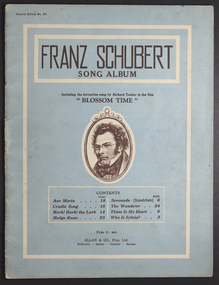
Booklet - Music Score, Franz Schubert Song Album, c. 1950
... The 'song album' is one of several musical score publications in the MTSV collection regularly used for entertainment of seafarers either in formal performances (scheduled and provided by volunteers from the 19th Century onwards) or as a resource also available for use by seafarers who wished to play the piano while staying at or visiting the Mission....The 'song album' is one of several musical score publications in the MTSV collection regularly used for entertainment of seafarers either in formal performances (scheduled and provided by volunteers from the 19th Century onwards) or as a resource also available for use by seafarers who wished to play the piano while staying at or visiting the Mission. ...Commercially printed Song book with blue cover featuring small portrait of composer. Contains words and music scores for 8 songs by Franz Schubert.non-fictionmusic, sheet-music, entertainment, indigenous songs, songs, franz schubert, allan and co music -
 Federation University Historical Collection
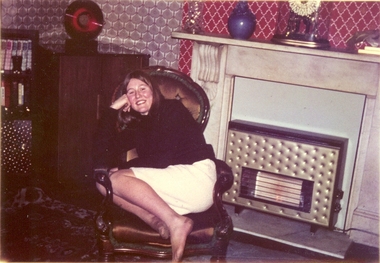
Photograph, Frank Wright and friends, 1960's
... Scoring and Conducting and was a Fellow of the Guildhall School of Music and Drama. Frank was often invited to adjudicate Brass Band Championships around Europe, in Australia, including South Street and in New Zealand. Frank was awarded an M.B.E. in 1967 and he died in November 1970. The Frank Wright Medal at the Royal South Street competition is awarded to an individual recognized as making an outstanding contribution to brass music in Australia. frank wright morris minor grand piano ...Frank Wright was a renown resident of Smeaton, where he was born in 1901. He lived at Laura Villa, and attended Smeaton State School. His father William was a gold miner and his mother's name was Sarah. He was the youngest of eleven children. Their family won many singing and instrumental awards. Frank was tutored by Percy Code and was awarded a gold medal for the highest marks in the ALCM examinations in the British Colonies at the age of seventeen years. He became the Australian Open Cornet Champion by the age of eighteen. A year later, Frank conducted the City of Ballarat Band, and later the Ballarat Soldiers’ Memorial Band. He formed the Frank Wright Frisco Band and Frank Wright and his Coliseum Orchestra. These bands won many South Street awards, and Frank as conductor won many awards in the Australian Band Championship contest. In 1933 Frank Wright sailed to England to conduct the famous St Hilda’s Band and was appointed in 1934 as the Musical Director of the London County Council (the GLC or Greater London Council), where he organized many amazing concerts in most of the 150 parks, in and around the London district. He was also responsible for some of London’s major concerts at Kenwood, the Crystal Palace and Holland Park. He was made Professor of Brass and Military Band Scoring and Conducting and was a Fellow of the Guildhall School of Music and Drama. Frank was often invited to adjudicate Brass Band Championships around Europe, in Australia, including South Street and in New Zealand. Frank was awarded an M.B.E. in 1967 and he died in November 1970. The Frank Wright Medal at the Royal South Street competition is awarded to an individual recognized as making an outstanding contribution to brass music in Australia.8 photographs - 4 are in the room of a home with a grand piano, some young people and Frank Wright. 2 are groups of people, including Frank Wright sitting around tables at a dinner. 1 is of a man, Frank Wright standing beside a car, possibly a Morris Minor and feeding two horses over a barbed wire fence. 1 is of a man, Frank Wright standing with a group of men at a function in Kerkrade.Only 1 has an inscription written in pencil on back - Kerkrade Aug 1966frank wright, morris minor, grand piano, feeding horses -
 Warrnambool and District Historical Society Inc.
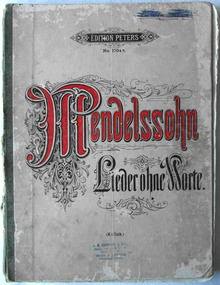
Document - Music Folio, Mendelsshon Lieder ohne Worte, Circa 1900
... They sold pianos and other musical instruments as well as doing repairs and tuning and lessons. This collection of music scores by Mendelssohn is significant firstly because it is still used by music students 160 years after it was written and secondly this copy has local significance as it was owned by Grace Rome who was born in 1902 and was the daughter of one of Warrnambool’s most successful and longest living business people Thomas Rome, who incidently made one of the earliest sound recordings in Australia. warrnambool mendelssohn lieder ohne worte edition peters grace rome Kullak printed on front cover. ...This collection of works, “songs without words” was written in the 1830’s by Mendellson. He was of the opinion that the music should stand alone and hence no need for words. This collection of his work for piano solos is still on the music syllabus today. The stamp on the front cover J.B. Shepherd and Son relates the Shepherd family music store in Liebig Street, which operated around the turn of the 20th century . They sold pianos and other musical instruments as well as doing repairs and tuning and lessons.This collection of music scores by Mendelssohn is significant firstly because it is still used by music students 160 years after it was written and secondly this copy has local significance as it was owned by Grace Rome who was born in 1902 and was the daughter of one of Warrnambool’s most successful and longest living business people Thomas Rome, who incidently made one of the earliest sound recordings in Australia.Cream coloured card cover with dark green cloth binding with the title Mendelssohn in red text with black flourish. Other text on cover is black. Edition Peters at the top of cover in black text. Pages contain music scores .132 pages. Kullak printed on front cover. Light blue stamp, “J. E. Shepherd & Son, Piano, organ & music Warehouse. Tuners & repairers Warrnambool. Written in Black ink but scrubbed out with blue ink on inside fly is Grace Rome P.L.C. 1921. 1. Similarly un unknown name is scrubbed on front top right corner of cover. warrnambool, mendelssohn, lieder ohne worte, edition peters, grace rome -
 Bendigo Historical Society Inc.
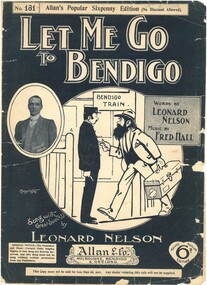
Document - Let Me Go to Bendigo (No. 181 Allan's Popular Sixpenny Edition), 1908
... Sheet Music Leonard Nelson Fred Hall Allan's Popular Sixpenny Edition Bendigo Piano songs and Music Frederick Fifield Hall The front cover contains a handwritten name in the top right-hand corner "Mrs Sinclair" No. 181 Allan's popular sixpenny edition "Sung with great success by Leonard Nelson" Allan & Co. Pty Ltd. Melbourne, Bendigo & Geelong 1 score ...Frederick "Fred" Fifield Hall was born in Carlton, Victoria in 1878. Son of Frederick Hall and Jessie Wallace Hall (nee Lloyd), Fred would marry Elsa May Daegner in 1899 with whom he had a son named Anthony. Hall died on 27th September 1956 in Mont Albert, Victoria and was buried at the Box Hill Cemetery. Hall was known as a solo pianist and the first conductor of the Station Orchestra at 3LO (ABC Radio Station). He was also a notable music editor at Allan & Co. Earning early recognition at 16 years of age when he conducted the Sydney Orchestra, Hall was a versatile composer having written in a variety of styles including solos for the piano, violin and cello, operas, foxtrots and orchestral suites. Publications indicate that between 300 and 400 of his compositions were published. The most famous of which was "Goodbye Melbourne Town" which he wrote with Lyricist Leonard Nelson. "Let Me Go to Bendigo" was another of their joint compositions. Leonard Nelson Snell, professionally known as Leonard Nelson, was born c. 1874 in Melbourne and grew up in Kew (he was 76 in 1950). Nelson married Lily Maud Haight in Victoria in 1897 and had six children named Roy, Dorothy, Leonard, Lionel, Austin and Marie. Nelson died on the 13 August 1962 in Blackheath, NSW and was buried at the local cemetery. Nelson had a varied resume including Cattle station work, song writing and public speaking. Nelson was known for his enjoyment of Australian poetry having known many of the greats personally and could recite works from memory. In his later life, Nelson worked as an entertainer for hire at banquets and other social gatherings. No. 181 Allan's popular sixpenny edition "Sung with great success by Leonard Nelson" Allan & Co. Pty Ltd. Melbourne, Bendigo & Geelong 1 score A B4 size document containing sheet music titled "Let Me Go to Bendigo". The document has a black and white cover with bold lettering and a cartoon of a man boarding the Bendigo Train. The music was written by Fred Hall and the lyrics were written and sung by Leonard Nelson who is pictured on the cover. The music covers 3 pages (1 double sided page and 1 single side) making up this 3-page document including the cover.The front cover contains a handwritten name in the top right-hand corner "Mrs Sinclair"sheet music, leonard nelson, fred hall, allan's popular sixpenny edition, bendigo, piano, songs and music, frederick fifield hall -
 Tatura Irrigation & Wartime Camps Museum
Document - music score, Under The Southern Sun
... 3 plastic sleeves containing music scores - conductors score, complete band instrumental parts and original piano composition....William Heinrich Bathurts Goal Tatura Internment camp Siege Under the Southern Cross 3 plastic sleeves containing music scores - conductors score, complete band instrumental parts and original piano composition. ...Music score written by William Henrich Wallbaum, who emigrated to Australia, settled in Manly and worked for an importing firm in Sydney NSW. He was interned in 1939 in Bathurst Goal and then transferred to Tatura. Whils in Tatura camp he wrote "Siege" later to be known as "Under the Southern Cross".3 plastic sleeves containing music scores - conductors score, complete band instrumental parts and original piano composition.william heinrich, bathurts goal, tatura internment camp, siege, under the southern cross -
 Mont De Lancey
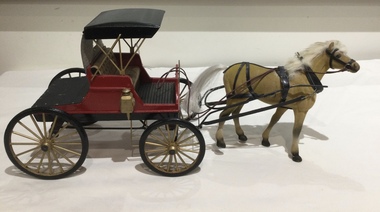
Decorative object - Horse Piano Box Buggy Model, Chas W Davis, Unknown
... There could have been scores of different Piano Box buggies....There could have been scores of different Piano Box buggies. Decorative object Horse Piano Box Buggy Model Chas W Davis ...The collection of thirteen model horse drawn vehicles were carefully handmade by Mr Chas W Davis 1925 - 2002. He was a talented artist and saw doctor. This model of a horse drawn Piano Box Buggy replicates the vehicle that enjoyed respect from the public during the 1880 and early 1900's. A model of a red and black Piano Box Buggy c.1860 which was a lightweight two wheeled one passenger open horse drawn carriage with a black canopy roof where the driver sat behind. It has two large and two smaller gold painted spoked wheels with black rims, brown painted seating, two gold coach lamps and a black patterned footrest in front of the driver. The canopy has thin gold struts to open and close it depending on the weather. There are two long brown wooden shafts on each side to surround the horse. It has a model of a biscuit coloured horse with a white tail and mane with the necessary horse tack for carriage use to help the driver communicate with the horse. It was also known as the 'Bonner Buggy' and had many variations. Coach builders designed and made their own style, giving it their own name. There could have been scores of different Piano Box buggies.replicas, models, scale models, vehicles, carriages, horse drawn vehicles, toy horses -
 Royal Australian Air Force Band
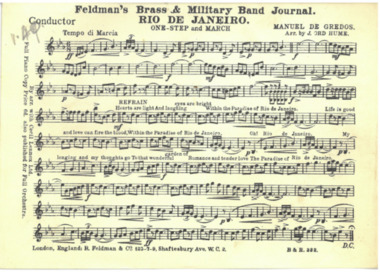
March Card, de Gredos, Manuel (Composer) et al, Rio de Janeiro, Composed: 1930 ?
... Full Piano Copy Price 6d. also published for Full Orchestra Refrain lyrics included on Conductor's score Instrumentation: Conductor Flute & Piccolo Eb Oboe Eb Clarinet 1st Bb Clarinet 2nd Bb Clarinet 3rd Bb Clarinet Bassoon Eb Alto Saxophone 1st Bb Baritone & Tenor Saxophone Bb 1st Eb Horn or Solo Tenor 2nd Eb Horn or 1st Tenor 3rd Eb Horn or 2nd Tenor 4th Eb Horn Bb Repiano Solo Cornet Bb 2nd Cornet Bb 1st Trombone (Alto Clef) 2nd Trombone (Alto Clef) Bass Trombone (Bass Clef) Euphonium (Bass Clef) Basses Drums...Full Piano Copy Price 6d. also published for Full Orchestra Refrain lyrics included on Conductor's score Instrumentation: Conductor Flute & Piccolo Eb Oboe Eb Clarinet 1st Bb Clarinet 2nd Bb Clarinet 3rd Bb Clarinet Bassoon Eb Alto Saxophone 1st Bb Baritone & Tenor Saxophone Bb 1st Eb Horn or Solo Tenor 2nd Eb Horn or 1st Tenor 3rd Eb Horn or 2nd Tenor 4th Eb Horn Bb Repiano Solo Cornet Bb 2nd Cornet Bb 1st Trombone (Alto Clef) 2nd Trombone (Alto Clef) Bass Trombone (Bass Clef) Euphonium (Bass Clef) Basses Drums Rio de Janeiro March Card de Gredos, Manuel (Composer) Hume, J. ...In 1932 the call was put out to the ABC to start a military band. The band’s task was to record music to play on air four times a week, and to perform live concerts for the public. By November 1933 a band was put together with 40 musicians from around Australia. The band was initially conducted by Captain H. E. Adkins, Director of the Royal Military School of Music, Kneller Hall, London. After the tour, Adkins returned to his position at Kneller Hall, and Stephen Yorke, a retired bandmaster of the Gloucestershire Regiment, was brought out to Australia to become the permanent director and conductor of the band, which he did until the band closed in 1951. During the band’s 17 year history they presented a sizable program of music. Their final concert received a standing ovation from its audience of 1500, with a teary-eyed Yorke. 23 parts Concert Band instrumentation One-Step and March Key Signature: Db Major Feldman's Brass & Military Band Journal By arr. with Cecil Lennox Ltd. Full Piano Copy Price 6d. also published for Full Orchestra Refrain lyrics included on Conductor's score Instrumentation: Conductor Flute & Piccolo Eb Oboe Eb Clarinet 1st Bb Clarinet 2nd Bb Clarinet 3rd Bb Clarinet Bassoon Eb Alto Saxophone 1st Bb Baritone & Tenor Saxophone Bb 1st Eb Horn or Solo Tenor 2nd Eb Horn or 1st Tenor 3rd Eb Horn or 2nd Tenor 4th Eb Horn Bb Repiano Solo Cornet Bb 2nd Cornet Bb 1st Trombone (Alto Clef) 2nd Trombone (Alto Clef) Bass Trombone (Bass Clef) Euphonium (Bass Clef) Basses DrumsOn envelope: QM174, March + One Step, Rio de Janeiro, Q148, Scrubbed out 401 Stamped on the reverse of each card: Australian Broadcasting Commission Sydneybrass band, australian broadcasting commission, marching band, concert band -
Federation University Historical Collection
Music Scores, Boosey & Hawkes Ltd, Handwritten sheet music, mid twentieth century
... 'G's pl piano study 27/2/52 Handwritten sheet music Music Scores Boosey & Hawkes Ltd Frank Wright ...Frank Wright was a renown resident of Smeaton, where he was born on 2 August 1901. He lived at Laura Villa, and attended Smeaton State School. His father William was a gold miner and his mother's name was Sarah. Their family won many singing and instrumental awards. Frank was tutored by Percy Code and was awarded a gold medal for the highest marks in the ALCM examinations in the British Colonies at the age of seventeen years. He became the Australian Open Cornet Champion by the age of eighteen. A year later, Frank conducted the City of Ballarat Band, and later the Ballarat Soldiers’ Memorial Band. He formed the Frank Wright Frisco Band and Frank Wright and his Coliseum Orchestra. These bands won many South Street awards, and Frank as conductor won many awards in the Australian Band Championship contest. In 1933 Frank Wright sailed to England to conduct the famous St Hilda’s Band and was later appointed Musical Director of the London County Council, where he organized many amazing concerts in parks, in and around the London district. He was made Professor of Brass and Military Band Scoring and conducted at the Guildhall of Music and Drama. Frank was often invited to adjudicate Brass Band Championships around Europe, in Australia, including South Street and in New Zealand. The Frank Wright Medal at the Royal South Street competition is awarded to an individual recognized as making an outstanding contribution to brass music in Australia.Handwritten music scores by Frank Wright, some in his hand. 1). 'The Merry Peasant' by Schumann and arranged in parts for brass band by Frank Wright - 3 pages. 2). 'Threshold' by Frank Wright -9 pages. 3). 'Around the Campfire' in parts - 10 pages. 4).'March (Judas Maccabaeus) by Handel and arranged by Frank Wright for the Boys Brigade (a) is written by Frank in pencil, (b) is written in pen with a brown paper cover. 5). 'Anthony & Cleopatra' arranged for the Boys Brigade (a) in written in pencil, (b) is written in pen. 6). 'O Give Me the Hills' written in pencil - 2 pages 7). 'Beneath this Turf' music by Frank Wright and words written in 1842 by Unknown Author - 3 pages. 8). 'If When that Hour Recalling' music by Frank Wright and poem by Thomas Moore, written in pen for 4 brass parts plus violin - 6 pages. 9). 'So Long', Brass Band arrangement by Frank Wright, written in pencil - 2 pages. 10). 'Gluck: March' arrangement by Frank Wright and written in pencil - 2 pages. 11). 'Occasional March' by Handel, arrangement by Frank Wright and written in pen - 5 pages (3 pages of band parts plus a separate Solo Cornet page). 12). 'Bugle Command: Ceremonial March for Bugles and Brass Band' written by Frank Wright - (a) 6 pages of bands parts plus a separate Solo Cornet page written in pen (b) 4 pages written in pencil and pen. 13). 'Scena' & 'Idyll' - Grade 4 Trombone written by Frank Wright in pen - 2 pages. 14). 'Green Corn' Brass Band arrangement by Frank Wright, written in pencil - 1 page. 15). 'Syrian Air' by Geoffrey Allen and arrangement by Frank Wright, with a buff cover (a) written in pencil - 2 pages (b) photo copy of parts - 2 pages (c) single sheet of music written in pencil, blue pen and red pen with some sections crossed out. 16). 'Gavotte: from the Opera "Rodrigo"' by Handel and arrangement by Frank Wright with a brown paper cover (a) 3 pages written in pencil (b) 3 pages written in pen. 17). 'Tales of Hoffman' arranged by Frank Wright for Brass Band 32 page printed booklet in a buff envelope. 18). 'Will Your Anchor Hold' arranged by Frank Wright for The Boy's Brigade - (a) 2 pages written in pencil with a buff cover plus a page with both pen and pencil notes (b) 2 pages written in pen plus a photo copied page for Solo Cornet. 19). Buff folder of 3 pieces of music written in pen - '1. Riverside', '2. Cenotaph' & '3. London Lights' - 7 pages. 20). 'Preludio Marziale (Martial Prelude)' by Frank Wright (a) written in pencil - 2 pages (b) written in pen - 7 pages (c) 7 page printed copy 21). 'Rondo Theme' (a) music written in pencil on the front of a buff envelope (b) 1 page written in pencil 22). Buff folder with two poems set to music by Frank Wright and written in pen - (a) 'My Heart and Lute' by Thomas Moore - 3 pages plus another 3 pages which may be part of this piece (b) 'The Rose' by Thos Croft (bart) - 3 pages. (c) a Musical Pitch Relation Chart for Pipe Organ. 23). 'Purcellian Suite', Purcell arranged by Frank Wright - 3 pages written in pencil and 4 photocopied pages 24). 'G's pl piano study 27/2/52All hand written 8). Written in pencil on front - You can return this score. Keep parts. 9). Notes to musicians written in pen on page 1. 11). Notes to musicians in pencil on page 4. 13). a correction written in red pencil.
