
Showing 11 items matching "piece of slate"
-
 Anglesea and District Historical Society
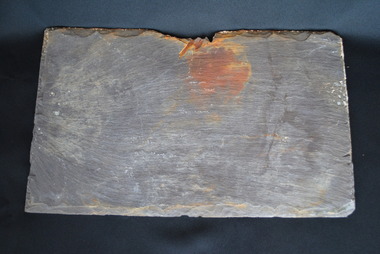
Piece of Slate
... Piece of Slate......piece of slate...Piece of slate from the wreck of the "Victoria Towers" off Torquay. ...victoria towers piece of slate None. Piece of slate from the wreck of the "Victoria Towers" off Torquay. ...Piece of slate from the wreck of the "Victoria Towers" off Torquay. Cargo included building materials and roofing slate.None.victoria towers, piece of slate -
 Flagstaff Hill Maritime Museum and Village
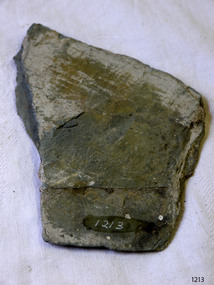
Slate
... Small piece of slate of indeterminate origin....Flagstaff Hill Warrnambool Shipwrecked-coast Flagstaff-Hill Flagstaff-Hill-Maritime-Museum Maritime-Museum Shipwreck-coast Flagstaff-Hill-Maritime-Village Small piece of slate of indeterminate origin. Slate ...Small piece of slate of indeterminate origin.flagstaff hill, warrnambool, shipwrecked-coast, flagstaff-hill, flagstaff-hill-maritime-museum, maritime-museum, shipwreck-coast, flagstaff-hill-maritime-village -
 Upper Yarra Museum
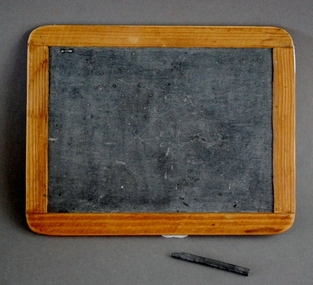
Writing slate
... Wooden framed piece of slate used for erasable writing using chalk...school wood frame slate writing primary erasable rock chalk Wooden framed piece of slate used for erasable writing using chalk Writing slate ...Wooden framed piece of slate used for erasable writing using chalkschool, wood, frame, slate, writing, primary, erasable, rock, chalk -
 Bright & District Historical Society operating the Bright Museum
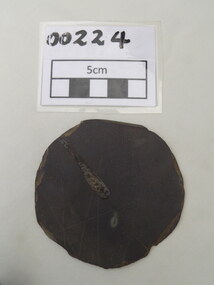
Slate
... Circular piece of slate, broken in two and glued. Linear markings scratched onto surface....slate chinese harrietville goldfields Circular piece of slate, broken in two and glued. Linear markings scratched onto surface. ...Circular piece of slate, broken in two and glued. Linear markings scratched onto surface.slate, chinese, harrietville, goldfields -
 Orbost & District Historical Society
slates
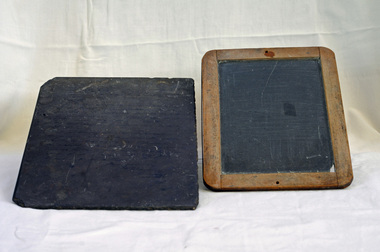
... The board was made from a piece of quarry slate set in a wooden frame. In early times a slate pencil (not chalk) was used to form the letters. ...The board was made from a piece of quarry slate set in a wooden frame. In early times a slate pencil (not chalk) was used to form the letters. ...The board was made from a piece of quarry slate set in a wooden frame. In early times a slate pencil (not chalk) was used to form the letters. This slate pencil was often sharpened on the school wall. The advantage of slates over paper was that they could be wiped clean and used again and again. Children had to bring a dampened cloth or sponge to school so that they could clean the slate and start again but often they would use their own spit and the cuff of their sleeve! Two rectangular slate writing boards used in schools. .1 is plain black and is unframed. .2 is wooden-framed.education slate school-equipment -
 City of Moorabbin Historical Society (Operating the Box Cottage Museum)
Education kit - School Writing Slate early 20thC, 20thC
... When about 6, they progressed onto writing on slates . The board was made from a piece of quarry slate set in a wooden frame. ...When about 6, they progressed onto writing on slates . The board was made from a piece of quarry slate set in a wooden frame. ...School children learned to write using a slate From 1880’s to mid 1950’s in most schools, very young children first learned to write their letters in sand trays using their fingers or a stick. When about 6, they progressed onto writing on slates . The board was made from a piece of quarry slate set in a wooden frame. A slate pencil (not chalk) was used to form the letters. This slate pencil was often sharpened on the school wall. The advantage of slates over paper was that they could be wiped clean and used again and again. Until the mid 20thC paper was expensive . After the pupil wrote on the Slate, the work was checked by the teacher and then erased for a new task Children had to bring a dampened cloth or sponge to school so that they could clean the slate and start again. The pioneer settlers in the Moorabbin Shire area valued education and established schools for their children in Cheltenham and East Brighton c1860's This writing slate is typical of the type used up to the mid 20th Century in preparatory classes.A writing slate in a wood frame used by school children from c1880s to c1950sschools, education, writing equipment, slate writing boards, victoria melbourne, market gardeners, pioneer, settlers, cheltenham state school no. 84., bentleigh east state school no. 2083, st stephens c of e school tucker road east brighton -
 Flagstaff Hill Maritime Museum and Village
Slate pencil, Made on or before May 1891
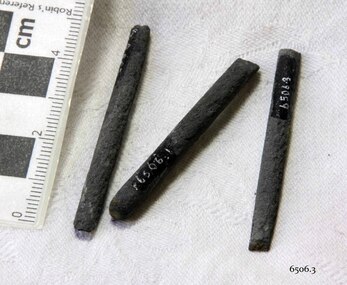
... Remnants of a black slate pencil salvaged from the wreck of the Fiji. Pencil has no casing and is in three pieces. One piece...Criterion B: Possession of uncommon, rare or endangered aspects of Victoria’s cultural history Criterion C: Potential to yield information that will contribute to an understanding of Victoria’s cultural history. flagstaff hill warrnambool shipwrecked coast flagstaff hill maritime museum maritime museum shipwreck coast flagstaff hill maritime village great ocean road slate pencil pencil slate board writing stationery Remnants of a black slate pencil salvaged from the wreck of the Fiji. Pencil has no casing and is in three pieces. One piece ...Slate pencils were made from a rod of soft slate material and used for writing on thin slate boards. The slate boards were approximately 9cm x 12cm used in schools for writing practice in place of pencil and paper, which were more expensive and less durable. They could be used then easily erased for re-use. In work places, slate boards were sometimes bound into slate books The three-masted iron barque Fiji had been built in Belfast, Ireland, in 1875 by Harland and Wolfe for a Liverpool based shipping company. The ship departed Hamburg on 22nd May 1891 bound for Melbourne, under the command of Captain William Vickers with a crew of 25. The ship’s manifest shows that she was loaded with a cargo of 260 cases of dynamite, pig iron, steel goods, spirits (whisky, schnapps, gin, brandy), sailcloth, tobacco, coiled fencing wire, concrete, 400 German pianos (Sweet Hapsburg), concertinas and other musical instruments, artists supplies including brushes, porcelain, furniture, china, and general cargo including candles. There were also toys in anticipation for Christmas, including wooden rocking horses, miniature ships, dolls with china limbs and rubber balls. On September 5th, one hundred days out from Hamburg in squally and boisterous south west winds the Cape Otway light was sighted on a bearing differing from Captain Vickers’ calculation of his position. At about 2:30am, Sunday 6th September 1891 land was reported 4-5 miles off the port bow. The captain tried to put the ship on the other tack, but she would not respond. He then tried to turn her the other way but just as the manoeuvre was being completed the Fiji struck rock only 300 yards (274 metres) from shore. The place is known as Wreck Bay, Moonlight Head. Blue lights were burned and rockets fired whilst an effort was made to lower boats but all capsized or swamped and smashed to pieces. Two of the younger crewmen volunteered to swim for the shore, taking a line. One, a Russian named Daniel Carkland, drowned after he was swept away when the line broke. The other, 17 year old able seaman Julius Gebauhr, a German, reached shore safely on his second attempt but without the line, which he had cut lose with his sheath-knife when it become tangled in kelp. He rested on the beach a while then climbed the steep cliffs in search of help. At about 10am on the Sunday morning a party of land selectors - including F. J. Stansmore, Leslie Dickson (or Dixon) and Mott - found Gebauhr. They were near Ryans Den, on their travels on horseback from Princetown towards Moonlight Head, and about 5km from the wreck. Gebauhr was lying in the scrub in a poor state, bleeding and dressed only in singlet, socks and a belt with his sheath-knife, ready for all emergencies. At first they were concerned about his wild and shaggy looking state and what seemed to be gibberish speech, taking him to be an escaped lunatic. They were reassured after he threw his knife away and realised that he was speaking half-English, half-German. They gave him food and brandy and some clothing and were then able to gain information about the wreck. Some of the men took him to Rivernook, a nearby guest house owned by John Evans, where he was cared for. Stansmore and Dickson rode off to try and summon help. Others went down to the site of the wreck. Messages for rescuing the rest of the crew were sent both to Port Campbell for the rocket rescue crew and to Warrnambool for the lifeboat. The S.S. Casino sailed from Portland towards the scene. After travelling the 25 miles to the scene, half of the Port Campbell rocket crew and equipment arrived and set up the rocket tripod on the beach below the cliffs. By this time the crew of the Fiji had been clinging to the jib-boom for almost 15 hours, calling frantically for help. Mr Tregear from the Rocket Crew fired the line. The light line broke and the rocket was carried away. A second line was successfully fired across the ship and made fast. The anxious sailors then attempted to come ashore along the line but, with as many as five at a time, the line sagged considerably and some were washed off. Others, nearly exhausted, had to then make their way through masses of seaweed and were often smothered by waves. Only 14 of the 24 who had remained on the ship made it to shore. Many onlookers on the beach took it in turns to go into the surf and drag half-drowned seamen to safety. These rescuers included Bill (William James) Robe, Edwin Vinge, Hugh Cameron, Fenelon Mott, Arthur Wilkinson and Peter Carmody. (Peter Carmody was also involved in the rescue of men from the Newfield.) Arthur Wilkinson, a 29 year old land selector, swam out to the aid of one of the ship’s crewmen, a carpenter named John Plunken. Plunken was attempting to swim from the Fiji to the shore. Two or three times both men almost reached the shore but were washed back to the wreck. A line was thrown to them and they were both hauled aboard. It was thought that Wilkinson struck his head on the anchor before s they were brought up. He remained unconscious. The carpenter survived this ordeal but Wilkinson later died and his body was washed up the next day. It was 26 year old Bill Robe who hauled out the last man, the captain, who had become tangled in the kelp. The wreck of the Fiji was smashed apart within 20 minutes of the captain being brought ashore, and it settled in about 6m of water. Of the 26 men on the Fiji, 11 in total lost their lives. The remains of 7 bodies were washed onto the beach and their coffins were made from timbers from the wrecked Fiji. They were buried on the cliff top above the wreck. The survivors were warmed by fires on the beach then taken to Rivernook and cared for over the next few days. Funds were raised by local communities soon after the wreck in aid of the sufferers of the Fiji disaster. Captain Vickers was severely reprimanded for his mishandling of the ship. His Masters Certificate was suspended for 12 months. At the time there was also a great deal of public criticism at the slow and disorganised rescue attempt to save those on board. The important canvas ‘breech buoy’ or ‘bucket chair’ and the heavy line from the Rocket Rescue was in the half of the rocket outfit that didn’t make it in time for the rescue: they had been delayed at the Gellibrand River ferry. Communications to Warrnambool were down so the call for help didn’t get through on time and the two or three boats that had been notified of the wreck failed to reach it in time. Much looting occurred of the cargo that washed up on the shore, with nearly every visitor leaving the beach with bulky pockets. One looter was caught with a small load of red and white rubber balls, which were duly confiscated and he was ‘detained’ for 14 days. Essence of peppermint mysteriously turned up in many settlers homes. Sailcloth was salvaged and used for horse rugs and tent flies. Soon after the wreck “Fiji tobacco” was being advertised around Victoria. A Customs officer, trying to prevent some of the looting, was assaulted by looters and thrown over a steep cliff. He managed to cling to a bush lower down until rescued. In 1894 some coiled fencing wire was salvaged from the wreck. Hundreds of coils are still strewn over the site of the wreck, encrusted and solidified. The hull is broken but the vessel’s iron ribs can be seen along with some of the cargo of concrete and pig iron. Captain Vickers presented Bill Robe with his silver-cased pocket watch, the only possession that he still had, as a token for having saved his life and the lives of some of the crew. (The pocket watch came with 2 winding keys, one to wind it and one to change the hands.) Years later Bill passed the watch to his brother-in-law Gib (Gilbert) Hulands as payment of a debt and it has been passed down the family to Gilbert Hulands’ grandson, John Hulands. Seaman Julius Gebauhr later gave his knife, in its hand crafted leather sheath, to F. J. Stansmore for caring for him when he came ashore. The knife handle had a personal inscription on it. A marble headstone on the 200m high cliffs overlooking Wreck Beach, west of Moonlight Head, paying tribute to the men who lost their lives when Fiji ran aground. The scene of the wreck is marked by the anchor from the Fiji, erected by Warrnambool skin divers in 1967. Amongst the artefacts salvaged from the Fiji are china miniature animals, limbs from small china dolls, rubber balls, a slate pencil, a glass bottle, sample of rope from the distress rocket and a candlestick holder. These items are now part of the Fiji collection at Flagstaff Hill Maritime Museum, along with Captain Vickers’ pocket watch and Julius Gebauhr’s sheath knife. Flagstaff Hill’s Fiji collection is of historical significance at a State level because of its association with the wreck Fiji, which is on the Victorian Heritage Register VHR S259. The Fiji is archaeologically significant as the wreck of a typical 19th century international sailing ship with cargo. It is educationally and recreationally significant as one of Victoria's most spectacular historic shipwreck dive sites with structural features and remains of the cargo evident. It also represents aspects of Victoria’s shipping history and its potential to interpret sub-theme 1.5 of Victoria’s Framework of Historical Themes (living with natural processes). The Fiji collection meets the following criteria for assessment: Criterion A: Importance to the course, or pattern, of Victoria’s cultural history. Criterion B: Possession of uncommon, rare or endangered aspects of Victoria’s cultural history Criterion C: Potential to yield information that will contribute to an understanding of Victoria’s cultural history. Remnants of a black slate pencil salvaged from the wreck of the Fiji. Pencil has no casing and is in three pieces. One piece is broken laterally and has a rounded end. The other two pieces have a longitudinal break and fit together. (The nature of the break indicates a material of natural formation, for example sedimentary rock such as slate.) flagstaff hill, warrnambool, shipwrecked coast, flagstaff hill maritime museum, maritime museum, shipwreck coast, flagstaff hill maritime village, great ocean road, slate pencil, pencil, slate board, writing, stationery -
 Warrnambool and District Historical Society Inc.
Souvenir - Shipwreck item, Falls of Halladale, 1886
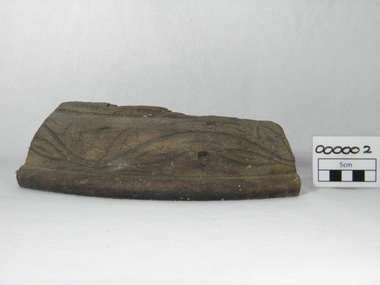
... There are a number of photographs of the wreck as it founded on the rock and hence is an image with which many people are familiar. melbourne shipwrecks flagstaff hill maritime village warrnambool falls of halladale barques peterborough victoria roofing slates captain thomson thomson court of marine enquiry Hand painted in red paint on inside bottom edge 'PETERBOROUGH'. Hand painted in white paint on bottom 'FALLS OF HALLADALE/WRECKED/PETERBOROUGH/VIC/NOV. 1908' Curved piece of timber with flat base from the wreck of the ship Falls of Halladale. ...The Falls of Halladale was a four-masted iron-hulled barque built for the long-distance bulk carrier trade. In dense fog on the night of 14 November 1908 she was sailed onto rocks off Peterborough due to a navigational error. The 29 crew abandoned ship safely and reached shore by boat. The ship was left foundering with sails unfurled. For weeks afterwards large crowds gathered to view the ship as she gradually broke up and sank in the shallow water. Shortly after the accident the ship's master, Captain Thomson, faced a Court of Marine Enquiry in Melbourne. He was found guilty of a gross act of misconduct, having carelessly navigated the ship, neglected to take proper soundings and failing to place the ship on a port tack before it became too late to avoid shipwreck. Thomson's punishment included a small fine and six months suspension of his Master's Certificate of Competency. The hull lies on its starboard side about 300 metres off-shore in 3-15 metres of water. The original cargo included 56,763 roofing slates and coils of barbed wire. 22,000 slates were salvaged in the 1980s and used as roofing at Flagstaff Hill Maritime Village, Warrnambool.This item has historical significance as it came from one of the known shipwrecks along the South West coast of Victoria. There are a number of photographs of the wreck as it founded on the rock and hence is an image with which many people are familiar. Curved piece of timber with flat base from the wreck of the ship Falls of Halladale. Inside is recessed with slight ledge near back. A chunk of timber is missing on the top. The face has swirled carvings with leaf and seed design and base curved to the edge.Hand painted in red paint on inside bottom edge 'PETERBOROUGH'. Hand painted in white paint on bottom 'FALLS OF HALLADALE/WRECKED/PETERBOROUGH/VIC/NOV. 1908'melbourne, shipwrecks, flagstaff hill maritime village, warrnambool, falls of halladale, barques, peterborough victoria, roofing slates, captain thomson, thomson, court of marine enquiry -
 Narre Warren and District Family History Group
Programme, Masonic Temple Dandenong Lodge of Sincerity, No 179. Installation for Bro. Norman A Taylor Thursday 11th August 1932
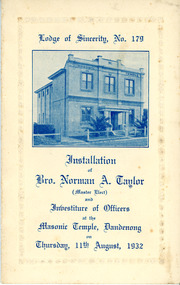
... J Abbott F B Aumann A W Bowman W K Bowman R B Brooks H W Brown E C Butler Rupert Clark H Cox J T Cubbin F A Facey F J P Facey F A E Goodrich W R Hands H Hartley James Hillard George Keys R G Keys S H Keys Lodge of Sincerity No 179 K McLennan Murray L H H Oldmeadow F J Parkinson James Ramsay W H A Rodd J H Ross W F Roulston J R Sharkie H Q Shepley Harry Shepley G W Slater P H Smale L G Taylor Norman A Taylor B Tharle E C Thomson H F Tonkin A Toyne One thickened piece of cream paper folded in half to make the program . ...One thickened piece of cream paper folded in half to make the program . The front has a raised border around the picture and wording. Inside the border it has a picture of the Masonic Temple and writing all using shades of blue and different fonts and sizes.j abbott, f b aumann, a w bowman, w k bowman, r b brooks, h w brown, e c butler, rupert clark, h cox, j t cubbin, f a facey, f j p facey, f a e goodrich, w r hands, h hartley, james hillard, george keys, r g keys, s h keys, lodge of sincerity no 179, k mclennan, murray l h, h oldmeadow, f j parkinson, james ramsay, w h a rodd, j h ross, w f roulston, j r sharkie, h q shepley, harry shepley, g w slater, p h smale, l g taylor, norman a taylor, b tharle, e c thomson, h f tonkin, a toyne -
 Hume City Civic Collection
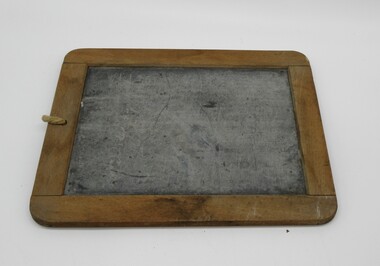
Functional object - Writing slate
... A small slate framed with wood and a piece of string through a hole at the top and knotted....The children wrote on the slate with a special slate pencil. school education teaching writing george evans collection A small slate framed with wood and a piece of string through a hole at the top and knotted. ...Slates were used in the junior grades at primary school probably from the 1900's to the early 1940's. The children wrote on the slate with a special slate pencil. A small slate framed with wood and a piece of string through a hole at the top and knotted.school, education, teaching, writing, george evans collection -
 Returned Nurses RSL Sub-branch
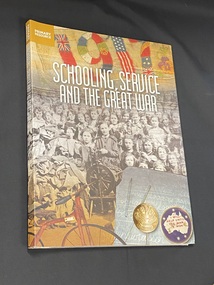
Book - Spiral bound paperback book, Department of Veterans' Affairs, Canberra, Schooling, service and the Great War, 2014
... Above the photo is a piece of fabric with '1917' colourfully embroidered on it. At the bottom of the page are images of chalk and slate, a bicycle, and two badges from 1916-18....Above the photo is a piece of fabric with '1917' colourfully embroidered on it. At the bottom of the page are images of chalk and slate, a bicycle, and two badges from 1916-18. ...This inquiry-based resource investigates how the Great War affected Australian schools and local communities and prompted service responses of different kinds - Back cover.Spiral bound paperback book. The title is printed across the front in white print, as well as along the spine.There is a brown text box in the top left corner that wraps around the spine with the words 'primary resource' printed inside in white text. The background of the cover is a black and white photo of a large group of children knitting, they are standing around a lady with a spinning wheel, at the front left there is a large pile of clothing. Above the photo is a piece of fabric with '1917' colourfully embroidered on it. At the bottom of the page are images of chalk and slate, a bicycle, and two badges from 1916-18.non-fictionThis inquiry-based resource investigates how the Great War affected Australian schools and local communities and prompted service responses of different kinds - Back cover. great war, world war 1914-1918, war and education, children and war, world war 1914-1918 social aspects, war and society
