
Showing 14 items matching "piracy"
-
 Port Melbourne Historical & Preservation Society
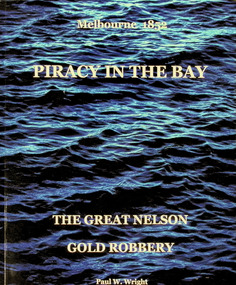
Book, Paul W WRIGHT, Piracy in the Bay, 2025
... Piracy in the Bay ...The blue covered book "Melbourne 1852, Piracy on the Bay, The Great Nelson Gold Robbery" tells the story of the 1852 theft of 8,000 ounces of gold from the barque Nelson....Piracy in the Bay Book Paul W WRIGHT ...The donor's great-great uncle pf Captain Walter WRIGHT, master of the barque, Nelson. from which the gold was stolen. The 22 gold robbers stole two whaleboats belong to Wilbraham LIARDET, owner of the Pier Hotel.The blue covered book "Melbourne 1852, Piracy on the Bay, The Great Nelson Gold Robbery" tells the story of the 1852 theft of 8,000 ounces of gold from the barque Nelson.barque nelson, captain walter wright, law, transport - shipping, wilbraham liardet, pier hotel -
 Williamstown Historical Society Inc
Book - Book - Piracy in the Bay, Wright, Paul W, Piracy in the Bay, Melbourne 1852. The Great Nelson Gold Robbery. Paul.W. Wright, 2025
... Piracy in the Bay, Melbourne 1852. The Great Nelson Gold Robbery. ......Piracy...HMS Nelson Nelson Gold Robbery Piracy Transportation Gold Rush Hobsons Bay Gold Heist From blub - "It remains the greatest act of theft in Australian history. ...From blub - "It remains the greatest act of theft in Australian history. On a moolit night in 1852, the barque Nelson, was riding at anchor in Hobson's Bay in the then young colony of Victoria. Aboard the vessel was an 8,000 ounce gold consignment bound for London. In an audacious assault, a band of heavily armed pirates took possession of the ship, shooting her chief officer and imprisoning her crew. The pirates then helped themselves to the gold. In today's money, their heist would be worth more than 35 million dollars. This makes the value of their theft three times greater than the famed Eugowra Gold Robbery. The ramifications of the Nelson piracy were enormous. It was an incident that capped widespread lawlessness throughout Victoria during the early gold rush years. With crime rampant, and the government held accountable, it was perhaps the final straw that saw a hapless Governor Charles La Trobe resign his tenure. And it was the main factor in instigating the end of convict transportation - at least to Tasmania. The author of this boook is the great-grandson of Captain Walter Wright, the commander of the Nelson at the time of the piracy.Softcover, 127 pages. Ocean image with text in whitenon-fictionFrom blub - "It remains the greatest act of theft in Australian history. On a moolit night in 1852, the barque Nelson, was riding at anchor in Hobson's Bay in the then young colony of Victoria. Aboard the vessel was an 8,000 ounce gold consignment bound for London. In an audacious assault, a band of heavily armed pirates took possession of the ship, shooting her chief officer and imprisoning her crew. The pirates then helped themselves to the gold. In today's money, their heist would be worth more than 35 million dollars. This makes the value of their theft three times greater than the famed Eugowra Gold Robbery. The ramifications of the Nelson piracy were enormous. It was an incident that capped widespread lawlessness throughout Victoria during the early gold rush years. With crime rampant, and the government held accountable, it was perhaps the final straw that saw a hapless Governor Charles La Trobe resign his tenure. And it was the main factor in instigating the end of convict transportation - at least to Tasmania. The author of this boook is the great-grandson of Captain Walter Wright, the commander of the Nelson at the time of the piracy.hms nelson, nelson gold robbery, piracy, transportation, gold rush, hobsons bay, gold heist -
 Whitehorse Historical Society Inc.
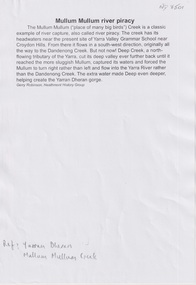
Document, Mullum Mullum River Piracy, 2025
... Mullum Mullum River Piracy...Yarran Dheran Mullum Mullum Creek The history of Mullum Mullum Creek A4 8p Mullum Mullum River Piracy Document ...The history of Mullum Mullum CreekA4 8pnon-fictionThe history of Mullum Mullum Creekyarran dheran, mullum mullum creek -
Whitehorse Historical Society Inc.
Article, Return to harbour for piracy author, 2006
... Return to harbour for piracy author...Return to harbour for piracy author Article Article ...Author Kelly Gardiner launches her new childrens' book 'Ocean without end' at Antonio Park Primary School (photo).Author Kelly Gardiner launches her new childrens' book 'Ocean without end' at Antonio Park Primary School (photo).Author Kelly Gardiner launches her new childrens' book 'Ocean without end' at Antonio Park Primary School (photo).antonio park primary school, gardiner, kelly -
 Port Melbourne Historical & Preservation Society
Mixed media - Placard, Anti-amalgamation protests, 1993
... "Stop This Economic Piracy"..."Stop This Economic Piracy" Mixed media Placard, Anti-amalgamation protests ...Made by the City of Port Melbourne for the demonstrations before and after the forced amalgamation by the Jeff Kennett State Government of the City of Port Melbourne with the Cities of South Melbourne and St Kilda to form the City of Port Phillip. First demonstation was against the City of Melbourne Act which excised 42% of Port Melbourne's rate base (Fishermens Bend) and so laid the groundwork for amalgamation afterwards because Port Melbourne could not survive on the remaining rates. Refer to Pat Grainger, Liana and David ThompsonWhite cardboard attached to a wooden stick with hand lettered anti-amalgamation slogan in black. "Stop This Economic Piracy"public action campaigns, amalgamation, local government - city of port melbourne -
 Kew Historical Society Inc
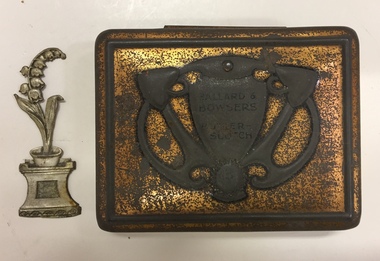
Container, Ballard and Bowsers, Ballard & Bowsers, Butterscotch Tin, Nineteenth Century
... Perhaps it is a late Victorian example of piracy of trade names. ...Perhaps it is a late Victorian example of piracy of trade names. tin international exhibition 1862 Old lolly tin with an art nouveau design in a darker metal on the lid. ...Trove contains one newspaper reference to a firm called Ballard & Bowsers. This is in a report on the International Exhibition of 1862. So the company predates the English firm of Callard & Bowsers. Perhaps it is a late Victorian example of piracy of trade names. Old lolly tin with an art nouveau design in a darker metal on the lid. The interior contains a floral spray of lily of the valley made from pressed metal. The title is definitely Ballard & Bowsers rather than Callard and Bowsers. tin, international exhibition 1862 -
 Bendigo Historical Society Inc.
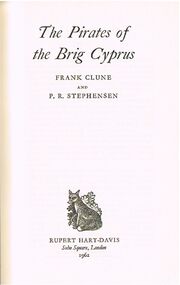
Book - ALEC H CHISHOLM COLLECTION: BOOK ''THE PIRATES OF THE BRIG CYPRUS'' BY FRANK CLUNE & P.R.STEPHENSEN
... ... PIRACY...BOOKS Collections history ALEC H CHISHOLM COLLECTION BRIG CYPRUS PIRACY PIRATES FRANK CLUNE P.R.STEPHENSEN Frank Clune & P. ...Book. ALEC H CHISHOLM COLLECTION. 205 page hardcover book by Frank Clune and P. R. Stephensen being the true story of the seizure of the Brig 'Cyprus' by Tasmanian convicts in 1829 and sailing it to the South China Sea. Published in 1962 Rupert Hart-Davis, London. Printed by Ebenezer Baylis and Son Ltd, The Trinity Press, Worcester and London. Catalogue sticker ''2210 CLU'' on spine. Handwritten in biro on flyleaf ''To Alec H. Chisholm, OBE, FRAHS Para Avis. Ornithologist, Historian, Editor and Author. Ornithorbyneus Paradacus Australiensis. From Percy R. Stephensen at Sydney 1962'' Inserts - a single page roneoed book announcement by the Publishers with opinions by English reviewers. Between pages 28 & 29 is a newspaper cutting from the Sydney Daily Telegraph April 21 1962 Book review by Ross Campbell.Frank Clune & P. R. Stephensenbooks, collections, history, alec h chisholm collection, brig cyprus, piracy, pirates, frank clune, p.r.stephensen -
 Mission to Seafarers Victoria
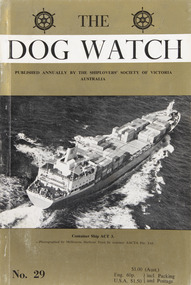
Journal (item) - Periodicals-Annual, Shiplovers' Society of Victoria, The Annual Dog Watch
... R. Peterson - 119 Piracy On The China Coast - Capt. W. E. Eglen - 123 Book Reviews - - 125 Glossary - - 129...R. Peterson - 119 Piracy On The China Coast - Capt. W. E. Eglen - 123 Book Reviews - - 125 Glossary - - 129 The Annual Dog Watch Journal Periodicals-Annual Shiplovers' Society of Victoria ...This journal provides the reader with glimpses of the adventures and hardships of a seaman's life. Many of the stories are of sailing ships.Contributes to our knowledge of the importance of shipping and places on record those stories of the sea which would otherwise be lost.Contents Foreword - P. C. Kelly, F.C.I.T. - 9 The Pamir's Last Australian Voyage - Ross Osmond - 13 Store of the "Wyatt Earp" - - 19 The Old Ship - C. E. Bonwick - 24 Rescue From Skull Rock - Jane Brett Hilder, F.R.G.S - 25 The End of H.M.A.S. Canberra - D. J. Bull - 31 Monkey Business - Constance Gurd Taylor - 37 The s.s. Great Britain Comes Home - L. W. Rogers - 41 Pearling Off the Aru Islands - Capt. W. J. Cowling - 47 The Wreck of the Jane Lovett - J. M. MacKenzie - 59 Captain Dale's Torpedo - C. Halls - 61 After Thoughts - - 71 Two Incidents - 73 More Light On The Early P.P. Pilots - 74 Lighthouses of U.S.A. - N. S. Smith - 78 Voyage In The s.s. Orange Branch -- 1918 - I. L. Barton - 85 A Dramatic Rescue - - 98 A New Record Discovered In Australia / America Passages - W. G. Watson - 99 Some Highlights of Western Ports Maritime History - Arthur E. Woodley - 103 Going To Sea In The Last Of The British Sailing Ships - Lionel Adams - 108 More About Willemein - E. W. R. Peterson - 119 Piracy On The China Coast - Capt. W. E. Eglen - 123 Book Reviews - - 125 Glossary - - 129sailing ships, steamships, shipping, seafaring life, shiplovers' society of victoria, dog watch -
 Plutarch Project
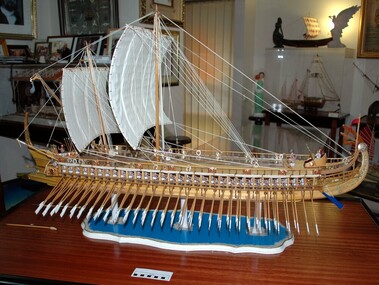
Trireme Replica, Paralos, circa 2005
... Poliykrates realised he would be able to use the Triremes for his own benefit against invading pirates, as well as to engage in activities of piracy himself. The Athenians built 200 Triremes for the battle of Salamis, all constructed over a period of eighteen months. ...Poliykrates realised he would be able to use the Triremes for his own benefit against invading pirates, as well as to engage in activities of piracy himself. The Athenians built 200 Triremes for the battle of Salamis, all constructed over a period of eighteen months. ...The name Trireme comes from its distinct three rows of oars/oarsmen. The first tier of rowers were known as the Thranites, translating to Thrones. They were the most prestigious, and worked the hardest because their oars were furthest away from the water and therefore had to work harder. They were usually younger and they were paid one and a half drachma per day, half a drachma more than the other two tiers of rowers who were paid one drachma per day. After a few years working as Thranites, each was moved down into the second tier, the Zygites. Zygites derives from the word balance, as the second tier was balanced in the middle. After more years again, oarsmen were moved down into the third and final tier, known as the Thalamites. The Thalamites were consistently wet due to the proximity of their tier to the water. The water would leak through the gaps where the oars entered the ships despite the leather skins used to close the openings.This is a unique specimen made by D. Paraskevatos, in that it is the only one of its kind in the world that has been built to the exact specifications of the Athenian vessel. It was built in Melbourne and it also has historic and artistic valueWooden replica model ship that is an exact replica of the ancient Athenian trireme making it unique in the world since there's no other such replica made. Great care was exercised to ensure that it will include all functionality and detail of the ancient ship used to by the Athenians to fight in the Sea battle of Salamis and beyond. Mr Denis Paraskevatos constructed the Paralos Trireme over a period of eighteen months. Mr Paraskevatos relayed the history of his Trireme. The first Trireme was constructed in Greece by the shipbuilder Aminoklis in 704BC, originating from Corinth. The first four Triremes he constructed were ordered by a Poliykrates from Samos, thus the ships were known as Samines. Poliykrates realised he would be able to use the Triremes for his own benefit against invading pirates, as well as to engage in activities of piracy himself. The Athenians built 200 Triremes for the battle of Salamis, all constructed over a period of eighteen months. This was a huge feat, on average a new ship was build every second day. Triremes were primarily used in sea battles, however there were two unique Triremes, the Salaminia and the Paralos, which were considered Holy and only used for Ambassadors and Consulates on overseas trips. Mr Paraskevatos’ Trireme is the Paralos. The term Paralos derives from the Greek social class from the shores, or the merchant classes. Greece was divided into three basic social classes. The mountain region, the plateaus or fields bound to agriculture, and those from the shores. Paralia translates to from the shore. The Paralia were an important class in influencing the democracy. They were divergent group who would deliberately vote on the contrary to everyone else. This is how the Trireme was born. Every Trireme held between 20-50 soldiers, and either 170 or 174 oarsmen. Mr Paraskevatos’ Trireme is a 174 oarsmen ship. The role of the oarsmen was difficult and specialised. When engaged in sea battle and the wind was not enough, the navy would remove the masts and leave them on shore and solely use the oarsmen, leaving the deck clear. However when there were sufficient winds and both the sails and oars were in use the oarsmen had to show great skill in manoeuvrability. When the oarsmen were not needed to manoeuvre the ship they also engaged in battle. model, replica, paraskevatos, plutarch, ship, trireme, παρασκευάτος, πανομοιότυπο -
 Flagstaff Hill Maritime Museum and Village
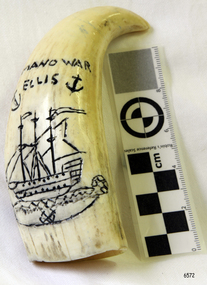
Craft - Scrimshaw, Late 20th century
... After receiving a letter of "marque” on the 3rd of June 1793, that allowed any armed vessel to commit acts on the high seas which would otherwise have constituted piracy. Thus the Ellis began to operate as a combat ship under the endorsement of the British navy. ...After receiving a letter of "marque” on the 3rd of June 1793, that allowed any armed vessel to commit acts on the high seas which would otherwise have constituted piracy. Thus the Ellis began to operate as a combat ship under the endorsement of the British navy. ...The ship “Ellis” started life as the Clementina, launched in America in 1781. The vessel was first listed in Lloyd's Register in 1784 and under this name began serving as a slave ship sailing out of Liverpool. A Lloyd’s database records of slave-trading voyages by vessels from Liverpool makes it clear that Clementina was a slave trader. The next year Captain J. Elworthy sailed her to West Central Africa and St Helena. He transported his slaves to South Carolina. Then in 1785 Elworthy gathered slaves in the Bight of Biafra and the Gulf of Guinea Islands for delivery to Jamaica. In 1786 Bent & Co. purchased the Clementina and renamed her Ellis, presumably after the then owner Ellis Bent. She remained in the slave trade and In 1788 Captain John Ford sailed the now renamed Ellis to the Bight of Biafra and the Gulf of Guinea to gather slaves. He delivered this batch of slaves to the island of Grenada. The next year, 1789 the Ellis was almost completely rebuilt, and from the change in subsequent reports of her cargo loading or (burthen), she was enlarged. In 1791, Captain Joseph Matthews became master and sailed the Ellis to the Gold Coast then delivering his consignment of slaves to the island of St Vincent. During this voyage, some misfortune may have befallen Matthews because records show the Ellis command was transferred to Thomas Given. In 1792, Given sailed to the Bight of Biafra and the Islands in the Gulf of Guinea, again collecting slaves for delivery to Jamaica. There is a parallel record, also for 1793, that the Ellis under the command of Thomas Heart, undertook the same journey and with the same itinerary and cargo. In 1793, Bent & Co. decided to use the Ellis as a privateer with John Levingston as the master. After receiving a letter of "marque” on the 3rd of June 1793, that allowed any armed vessel to commit acts on the high seas which would otherwise have constituted piracy. Thus the Ellis began to operate as a combat ship under the endorsement of the British navy. The Ellis was three times captured first by the French frigate Gracieuse, under the command of Captain Chevillard on 22 July 1793. The French took her into service and renamed her as ”Elise”. Later that summer the Spanish captured her and in November ownership returned to the French who then renamed her the “Esperance”. On the 8th of June 1794, Esperance arrived in Jacmel, Saint-Domingue (present-day Haiti), from France with the official proclamation of the abolition of slavery. Leger-Felicite Sonthonax was one of the Civil Commissioners of Saint-Domingue and he had already unilaterally proclaimed the island for the French colony the year before amid a slave rebellion and attacks from British and Spanish forces. Ironically, Esperance also brought the news to the Civil Commissioners that the National Convention of France had impeached them on 16th July 1793 and ordered them to return promptly to France. On 8 January 1795, HMS Argonaut, under the command of Captain Alexander John Ball, captured Esperance while she was on the North America station. At this time the Esperance was armed with 22 guns (4 and 6-pounders) and had a crew of 130 men. She was under the command of Lieutenant de vaisseau De St. Laurent and had been out at sea for 56 days from Rochfort, bound for the American Chesapeake Bay area. The French ambassador to the United States registered a complaint with the President of the United States that Argonaut, by stating that by entering Lynnhaven bay, either before she captured Esperance or shortly thereafter, had violated a treaty between France and the United States. The French also accused the British of having brought the Esperance into Lynnhaven for refitting for a cruise. The British Consul replied that the capture had taken place some 10 leagues offshore as the bad weather had forced Argonaut and her prize to shelter within the Chesapeake area for some days, but that they had left as soon as practicable. Furthermore, Argonaut had paroled her French prisoners on arrival at Lynnhaven, and if she had entered American territorial waters solely to parole her French prisoners no one would have thought that objectionable. Royal Navy Service: Because the Esperance was captured in good order and sailed well, Rear Admiral George Murray, the British commander in chief of the North American station, put a British crew aboard and sent the Esperance out on patrol with HMS Lynx, under the command of John Poo Beresford, on 31st January. On 1st March the two vessels captured the Cocarde Nationale (or National Cockade), a privateer from Charleston, South Carolina, of 14 guns, six swivel cannons and a crew of 80 men. Esperance and the lynx went on to recaptured the ship Norfolk, of Belfast, and the brig George, of Workington. On 20 July, Esperance, in company with frigates Thetis and Hussar, intercepted the American vessel Cincinnatus, of Wilmington, sailing from Ireland to Wilmington. They pressed many men on board into service, narrowly missing the Irish revolutionary Wolfe Tone, who was on his way to Philadelphia. Esperance was formally commissioned in 1795 into the Royal Navy in August under the Command of Jonas Rose. On 4 May 1796 Esperance was sailing in company with HMS Spencer and Bonetta when they sighted a suspicious vessel. Spencer set off in chase while shortly thereafter Esperance saw two vessels, a schooner and a sloop, and she and Bonetta set off after them. Spencer sailed south by south-east and the other two British vessels sailed south-west by west, with the result that they lost sight of each other. Spencer captured the French gun-brig Volcan, while Bonetta and Esperance captured the French schooner Poisson Volant. The Esperance eventually arrived at Portsmouth on the 3rd of November 1797, the crew was paid off and on 31st May 1798 the Admiralty listed the Esperance for sale and she was sold in June 1798 for £600.The subject scrimshaw is a modern reproduction crudely done of a historic vessel and the scene is believed to be engraved onto a synthetic substance. Scrimshaw art crudely carved into non-natural material in the shape of a tooth. The line artwork is an image of a three-masted sailing ship with a poop deck, and anchors, are coloured black. Inscription is engraved into tooth.Engraved "Man o War Ellis" warrnambool, flagstaff-hill, flagstaff-hill-maritime-museum, maritime-museum, shipwreck-coast, flagstaff-hill-maritime-village, scrimshaw, ellis, esperance, clementina, elise, hms ship, man of war, leter of marque, privateer, slave ship, slavery, ellis bent, american war of inderpendance, marine art, marine artifact, whale tooth, ivory tooth, resin, plastic, craft, engraving, carving -
 Mission to Seafarers Victoria
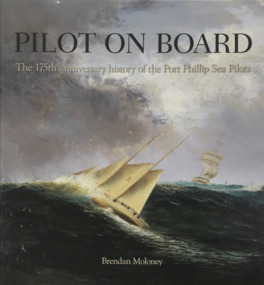
Book, Brendan Moloney, Pilot on Board, The 175th anniversary history of the Port Phillip Sea Pilots, 2018
... Donated as a sign of appreciation to the Mission. port phillip sea pilots port phillip bay george tobin brendan moloney port phillip sea pilots interest group The age of sails Piracy in Port Phillip Lost at sea The threat of war and much more. 250-page hardcover book with colour photos and illustrations; On the dust jacket paiting of a cutter in wild weather Pilot on Board, The 175th anniversary history of the Port Phillip Sea Pilots Book Brendan Moloney ...The age of sails Piracy in Port Phillip Lost at sea The threat of war and much more.250-page hardcover book with colour photos and illustrations; On the dust jacket paiting of a cutter in wild weathernon-fictionThe age of sails Piracy in Port Phillip Lost at sea The threat of war and much more.port phillip sea pilots, port phillip bay, george tobin, brendan moloney, port phillip, sea pilots, interest group -
 Mrs Aeneas Gunn Memorial Library
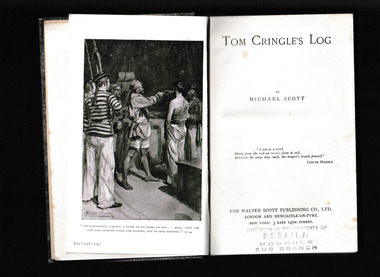
Book, Michael Scott, Tom Cringle's log, 1904
... In the West Indies, where war, piracy, smuggling, and slave-running are the order of the day, the hero of the tale advances from midshipman to lieutenant to a command of his own: the audacious little 'Wasp'. ...Nothing will start your blood quicker or give a more real and fascinating picture of early 19th-century Royal Navy life than this famous adventure. In the West Indies, where war, piracy, smuggling, and slave-running are the order of the day, the hero of the tale advances from midshipman to lieutenant to a command of his own: the audacious little 'Wasp'.Ill, p.245.fictionNothing will start your blood quicker or give a more real and fascinating picture of early 19th-century Royal Navy life than this famous adventure. In the West Indies, where war, piracy, smuggling, and slave-running are the order of the day, the hero of the tale advances from midshipman to lieutenant to a command of his own: the audacious little 'Wasp'. juvenile fiction, great britain - royal navy -
 Flagstaff Hill Maritime Museum and Village
Book - Fictional stories, Sir Walter Scott, Waverley Novels The Pirate- 2 Vol 25, 1838
... The Pirate is Walter Scott’s historical novel set in 17th-century Shetland and Orkney, centred on a shipwreck, piracy, family conflict, and rival love interests. ...The subject volume “Waverley Novels Vol 46” published by Fisher Son & Co (1838) is part of a collected edition of Sir Walter Scott's works, containing stories from the "Tales of My Landlord" series. "Tales of My Landlord" forms a key subset of Scott's Waverley Novels, presented as fictional tales gathered by characters like Peter Pattieson from the landlord of the Wallace “Inn at Gandercleugh”. The series spans multiple books across four sub-series, including “The Black Dwarf” (1707 setting), “Old Mortality” (1679–1689), “The Heart of Midlothian” (1736), “The Bride of Lammermoor” (1709–1711), “A Legend of Montrose” (1644–1645), “Count Robert of Paris” (1097), and “Castle Dangerous” (1307). Vol 25 in the 1838 Fisher edition reprints later entries like “Count Robert of Paris” or “Castle Dangerous” from the fourth series, as these stories originally appeared in Scott's Magnum Opus collected volume editions, the first from 1816. With the influential 48-volume “Magnum Opus” edition from 1829–1833 by Robert Cadell, serving as the basis for later collected published sets like Fisher's. The Pirate is Walter Scott’s historical novel set in 17th-century Shetland and Orkney, centred on a shipwreck, piracy, family conflict, and rival love interests. It’s typically presented as a three set novel. In this edition, volume 25 is the second part of “The Pirate”, and the work continues across the surrounding other two volumes in the set. The story follows the Troil family and a shipwrecked captain Cleveland along with Mordaunt, whose relationships with Minna and Brenda Troil drive much of the plot. As Cleveland’s pirate identity is revealed, the novel shifts into rescue, capture, and reconciliation, ending with the pirates subdued and the family ties resettled. The novel itself is commonly divided into three volumes or parts in standard editions, and the Waverley Novels collected edition spreads it across multiple numbered volumes.Waverley Novels The Pirate- 2 Vol 25, Light brown hardcover lettering in black text. Author: Sir Walter Scott Publisher: Fisher Son & Co Date: 1838fictionThe subject volume “Waverley Novels Vol 46” published by Fisher Son & Co (1838) is part of a collected edition of Sir Walter Scott's works, containing stories from the "Tales of My Landlord" series. "Tales of My Landlord" forms a key subset of Scott's Waverley Novels, presented as fictional tales gathered by characters like Peter Pattieson from the landlord of the Wallace “Inn at Gandercleugh”. The series spans multiple books across four sub-series, including “The Black Dwarf” (1707 setting), “Old Mortality” (1679–1689), “The Heart of Midlothian” (1736), “The Bride of Lammermoor” (1709–1711), “A Legend of Montrose” (1644–1645), “Count Robert of Paris” (1097), and “Castle Dangerous” (1307). Vol 25 in the 1838 Fisher edition reprints later entries like “Count Robert of Paris” or “Castle Dangerous” from the fourth series, as these stories originally appeared in Scott's Magnum Opus collected volume editions, the first from 1816. With the influential 48-volume “Magnum Opus” edition from 1829–1833 by Robert Cadell, serving as the basis for later collected published sets like Fisher's. The Pirate is Walter Scott’s historical novel set in 17th-century Shetland and Orkney, centred on a shipwreck, piracy, family conflict, and rival love interests. It’s typically presented as a three set novel. In this edition, volume 25 is the second part of “The Pirate”, and the work continues across the surrounding other two volumes in the set. The story follows the Troil family and a shipwrecked captain Cleveland along with Mordaunt, whose relationships with Minna and Brenda Troil drive much of the plot. As Cleveland’s pirate identity is revealed, the novel shifts into rescue, capture, and reconciliation, ending with the pirates subdued and the family ties resettled. The novel itself is commonly divided into three volumes or parts in standard editions, and the Waverley Novels collected edition spreads it across multiple numbered volumes.warrnambool, shipwrecked-coast, flagstaff-hill, flagstaff-hill-maritime-museum, maritime-museum, shipwreck-coast, flagstaff-hill-maritime-village, shipwrecked-artefact, book, waverley novels vol 46 tales of my landlord, sir walter scott, pattison collection, warrnambool library, warrnambool mechanics’ institute, ralph eric pattison, corangamite regional library service, warrnambool city librarian, mechanics’ institute library, victorian library board, warrnambool books and records, warrnambool children’s library -
 Flagstaff Hill Maritime Museum and Village
Book - Fictional Story, John Masefield, The Midnight Folk, 1930-1940
... The story seamlessly weaves together British folklore, nautical high adventure, piracy, and childhood wonder. The label on the spine with typed text PAT FIC MAS No other labels or writing visible. ...The Midnight Folk (first published in 1927) is a celebrated fantasy novel for young readers written by John Masefield. The story centres on a young, lonely orphan named Kay Harker, who lives in a country house guarded by his stern governess. Kay learns that his great-grandfather, Captain Harker, lost a valuable treasure—the plunder of the Santa Barbara—that was entrusted to him. Kay sets out on a quest to locate the lost treasure. Guided by his cat, Nibbins, and an assortment of talking animals, witches, goblins, and nocturnal creatures (the titular 'Midnight Folk'), Kay journeys through magical, dream-like realms. The story seamlessly weaves together British folklore, nautical high adventure, piracy, and childhood wonder.Hard cover book. The Midnight Folk Author: John Masefield Publisher: William Heinemann Ltd Date: 1930-1940 Further Information: Two-tone quarter binding dark green/black spine and quarter shelf-back with red cloth sides, with hand-lettered ink text on the spine "The Midnight Folk / Masefield"). The spine has a Library label with an inscription.fictionThe Midnight Folk (first published in 1927) is a celebrated fantasy novel for young readers written by John Masefield. The story centres on a young, lonely orphan named Kay Harker, who lives in a country house guarded by his stern governess. Kay learns that his great-grandfather, Captain Harker, lost a valuable treasure—the plunder of the Santa Barbara—that was entrusted to him. Kay sets out on a quest to locate the lost treasure. Guided by his cat, Nibbins, and an assortment of talking animals, witches, goblins, and nocturnal creatures (the titular 'Midnight Folk'), Kay journeys through magical, dream-like realms. The story seamlessly weaves together British folklore, nautical high adventure, piracy, and childhood wonder.warrnambool, shipwrecked-coast, flagstaff-hill, flagstaff-hill-maritime-museum, maritime-museum, shipwreck-coast, flagstaff-hill-maritime-village, shipwrecked-artefact, book, the midnight folk, john masefield, warrnambool mechanics’ institute, pattison collection, warrnambool library, ralph eric pattison, corangamite regional library service, warrnambool city librarian, mechanics’ institute library, victorian library board, warrnambool books and records, warrnambool children’s library
