
Showing 14 items matching "pitjantjatjara"
-
 Victorian Aboriginal Corporation for Languages
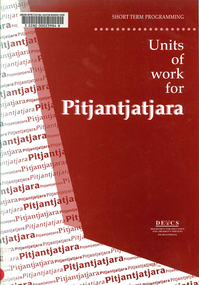
Book, Department for Education and Children's Services, Units of work for Pitjantjatjara, 1997
... Units of work for Pitjantjatjara...Pitjantjatjara...Unit and lesson notes on Pitjantjatjara language from South Australia....Victorian Aboriginal Corporation for Languages 33 Saxon Street Brunswick melbourne Pitjantjatjara South Australia curriculum development unit programming course planning LOTE tables Unit and lesson notes on Pitjantjatjara language from South Australia. ...Unit and lesson notes on Pitjantjatjara language from South Australia.tablespitjantjatjara, south australia, curriculum development, unit programming, course planning, lote -
 Victorian Aboriginal Corporation for Languages
CD-ROM, Pitjantjatjara
... Pitjantjatjara...Victorian Aboriginal Corporation for Languages 33 Saxon Street Brunswick melbourne Pitjantjatjara CD-ROM ... -
 Victorian Aboriginal Corporation for Languages
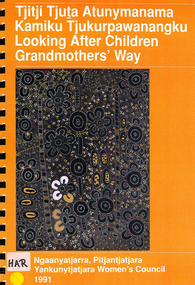
Book, Jo Harrison, Tjitji tjuta atunymanama kamiku tjukurpawanangku =? looking after children grandmothers' way : report to the Child Protection Policy and Planning Unit, S.A., on the Child Protection Project, 1991
... Pitjantjatjara...This report presents the results of a project that looked at the attitudes to child protection of Pitjantjatjara women living on the AP lands in South Australia. ...Victorian Aboriginal Corporation for Languages 33 Saxon Street Brunswick melbourne Pitjantjatjara child abuse child welfare social policy colour illustrations, maps This report presents the results of a project that looked at the attitudes to child protection of Pitjantjatjara women living on the AP lands in South Australia. ...This report presents the results of a project that looked at the attitudes to child protection of Pitjantjatjara women living on the AP lands in South Australia. It also looks at the implications of the views and experiences discussed by the women interviewed.colour illustrations, mapspitjantjatjara, child abuse, child welfare, social policy -
 National Wool Museum
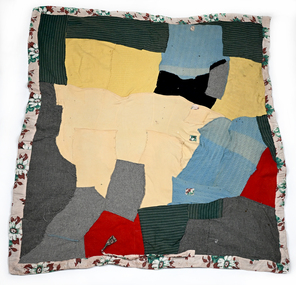
Textile - Wagga, Gwenyth Fletcher, c.1950s
... Ernabella, Pitjantjatjara Yankunytjatjara Lands, South Australia, Australia ...Gwenyth Fletcher (nee Thompson) was born in 1922 in Burwood. At six months of age her family moved to Blackheath where she lived until her marriage to John Fletcher. When Gwenyth was four years old, her grandfather was the mayor of Blackheath and as such, he had to welcome the Duke and Duchess of Kent to the town. Gwenyth presented the future King George VI and his wife Elizabeth with a posy of flowers as part of the welcoming ceremony. John and Gwenyth were married in 1951 and in 1952 they moved to Canowindra. John was working for the Presbyterian Church and they needed an assistant sheep worker at Ernabella (now Pukatja), a remote First Nations community, in the far North West of South Australia and he had worked there prior to his marriage. The work involved sheep, vehicles and general handy man work, and trips to Finke (railway 200 miles east). After marriage John was again asked to work at Ernabella. He and Gwenyth left for Ernabella in 1953 and returned in November. They then bought a property in Canowindra and the family stayed for four years before returning to Ernabella. Two children were born whilst they were in Canowindra. The family stayed for eight years at Ernabella from 1958 to April 1966. During the time at Ernabella and Fregon, three more children were born. In May 1966, the family returned to the farm in Canowindra. John and Gwenyth retired from the farm in 1985 and moved to South Canowindra. The Wagga was probably made during the time at Ernabella from children's knits and other leftovers. John had to camp out from the home a lot in order to muster sheep and the desert nights are cold. There is evidence (ties) that Gwenyth made the wagga into a swag-like product that John could easily carry. There were few resources available to her in the remote region, so she used what she had. Gwenyth was known for her reuse of everything – she never threw anything out. Everything was repurposed or recycled. Gwenyth Fletcher was my mother-in-law. Because I was interested in quilts/quilting and patchwork she gave me the blanket instead of throwing it out. She gave it to me during the 1990s. - Donor, November 2025Wagga blanket with base made from two different beige/light khaki blankets. One of the blankets is lightly striped. The top is made up of random, non-geometrical pieces of cardigans and jumpers and other blankets that are machine stitched to the bottom blankets. The cardigans are different colours - light blue, red, navy, yellow and light yellow and are knitted with different patterns. The top blanket pieces are different greys. The cardigan pieces include a pocket, button holes and one of the blanket patches has some of a blanket stitched border. The top also has some green striped material patches. The whole blanket/quilt is bordered by a wide brown patterned material. Some of this material is also used as smaller patches on holes in the cardigans. There are also some hand stitched repairs.wagga, remote community, gwenyth fletcher, king george vi, canowindra, ernabella, pukatja, swag, blanket, sheep, rural life -
![Work on paper - Printmaking, Tji Tji Kutjara [Two Children], c1996](/media/collectors/530576742162ef0fa09a2288/items/534748159821f420f8c036d4/item-media/5f0b066a21ea6722d43998cc/item-fit-380x285.jpg?cb=6) Federation University Art Collection
Federation University Art CollectionWork on paper - Printmaking, Tji Tji Kutjara [Two Children], c1996
... ...pitjantjatjara...Nyukana BAKER (1943-2016) Born Ernabella, South Australia Country: Kanypi Language: Pitjantjatjara A Pitjantjatjara artist from Ernabella who began painting, designing and weaving in 1963 and producing batik in 1971. ...Federation University Art Collection Artworks are displayed at Federation University Australia campuses at Ballarat, Gippsland (Churchill), Stawell and Horsham. goldfields Nyukana BAKER (1943-2016) Born Ernabella, South Australia Country: Kanypi Language: Pitjantjatjara A Pitjantjatjara artist from Ernabella who began painting, designing and weaving in 1963 and producing batik in 1971. ...Nyukana BAKER (1943-2016) Born Ernabella, South Australia Country: Kanypi Language: Pitjantjatjara A Pitjantjatjara artist from Ernabella who began painting, designing and weaving in 1963 and producing batik in 1971. Founded in 1949 Ernabella Arts is the longest running Aboriginal arts centre in Australia. It was established o create employment opportunities for young women from the local Pitjantjatjara people. Nyukana Baker died 17 April 2016 at Alice Springs, Northern Territory. This item is part of the Federation University Art Collection. The Art Collection features over 2000 works and was listed as a 'Ballarat Treasure' in 2007.Framed limited edition print. 6/20 Tjitji Kutjara Two Children Nyukana Baker Feb 1996art, artwork, printmaking, linoprint, nyukana baker, pitjantjatjara, kanypi, aboriginal, ernabella -
 Victorian Aboriginal Corporation for Languages
DVD, Suzy Bates, Nothing rhymes with Ngapartji, 2010
... Pitjantjatjara...In presenting the material in both Pitjantjatjara and English, it raises the important issue of stories needing to be told in languages that are central to different Australians' understanding of the world. ...Victorian Aboriginal Corporation for Languages 33 Saxon Street Brunswick melbourne Pitjantjatjara theatre music performance Big hART DVD, online study guide Nothing Rhymes with Ngapartji follows the journey of acclaimed Pitjantjatjara actor Trevor Jamieson, as he returns to his traditional country to perform his hit stage show Ngapartji Ngapartji to an all-Indigenous audience in the remote Australian Aboriginal community of Ernabella, South Australia. ...Nothing Rhymes with Ngapartji follows the journey of acclaimed Pitjantjatjara actor Trevor Jamieson, as he returns to his traditional country to perform his hit stage show Ngapartji Ngapartji to an all-Indigenous audience in the remote Australian Aboriginal community of Ernabella, South Australia. Nothing Rhymes with Ngapartji is a film about performing a multi-faceted drama to audiences who speak different languages, who are of different cultures and who have varying expectations. Offers an insight into Indigenous perspectives on the consequences of white settlement for Aboriginal cultures. In presenting the material in both Pitjantjatjara and English, it raises the important issue of stories needing to be told in languages that are central to different Australians' understanding of the world. The film is part of Big hART?s Ngapartji Ngapartji project, which is a collaborative work in progress between Indigenous and white Australians that pools their skills, experiences and resources to tell an important story about Indigenous history, culture, language and the experience of several generations.DVD, online study guidepitjantjatjara, theatre, music performance, big hart -
 Victorian Aboriginal Corporation for Languages
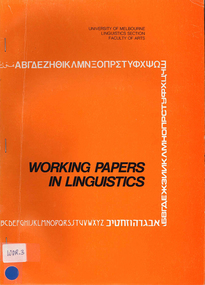
Periodical, University of Melbourne Linguistics Section, Working papers in linguistics, 1985
... Pitjantjatjara...Victorian Aboriginal Corporation for Languages 33 Saxon Street Brunswick melbourne Pitjantjatjara linguistics Collection of papers on a variety of Linguistic aspects. ...Collection of papers on a variety of Linguistic aspects.pitjantjatjara, linguistics -
Victorian Aboriginal Corporation for Languages
Video, Leo Papademetre, Consider language and culture teaching teachers' practice, perspectives, reflections, 2000
... Pitjantjatjara...Victorian Aboriginal Corporation for Languages 33 Saxon Street Brunswick melbourne Pitjantjatjara language studies teaching language multicultural education language and culture teaching videocassette Video on education using the practice of language and culture teaching. ...Video on education using the practice of language and culture teaching.videocassettepitjantjatjara, language studies, teaching language, multicultural education, language and culture teaching -
Victorian Aboriginal Corporation for Languages
DVD, Australian Electoral Commission, Your vote matters : understanding the federal electoral system
... Pitjantjatjara...Victorian Aboriginal Corporation for Languages 33 Saxon Street Brunswick melbourne Pitjantjatjara Western Kriol Walmajarri Torres Strait Creole Jaru Information on why we vote, how to register to vote and what to do with the ballot papers. ...Information on why we vote, how to register to vote and what to do with the ballot papers. It also explains the special arrangements for absent, mobile an dearly voting. Includes tracks in 5 languages as well as English.pitjantjatjara, western kriol, walmajarri, torres strait creole, jaru -
 Federation University Art Collection
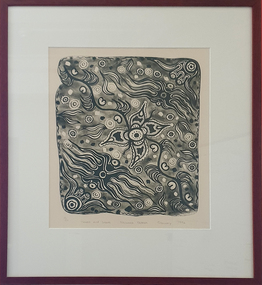
Work on paper - Printmaking, 'Flowers and Leaves' by Nyuwara Tapaya, 1996
... Nyuwara Tapaya (5 August 1971-c2005) Born Ernabella, South Australia Pitjantjatjara speaker Nyuwara Tapaya had distinguished career in print media and textiles (batik). ...Federation University Art Collection Artworks are displayed at Federation University Australia campuses at Ballarat, Gippsland (Churchill), Stawell and Horsham. goldfields Nyuwara Tapaya (5 August 1971-c2005) Born Ernabella, South Australia Pitjantjatjara speaker Nyuwara Tapaya had distinguished career in print media and textiles (batik). ...Nyuwara Tapaya (5 August 1971-c2005) Born Ernabella, South Australia Pitjantjatjara speaker Nyuwara Tapaya had distinguished career in print media and textiles (batik). She trained at Ernabella Arts and studied dye technique in Indonesia. This item is part of the Federation University Art Collection. The Art Collection features over 1000 works and was listed as a 'Ballarat Treasure' in 2007.Framed limited edition lithograph print. If you can provide information on this artist or artwork please use the comment box below.Edition 11/17art, artwork, nyuwara tapaya, printmaking, ernabella -
 Victorian Aboriginal Corporation for Languages
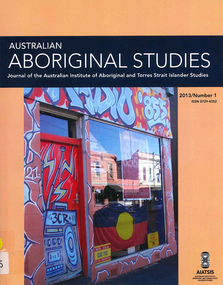
Periodical, Australian Institute of Aboriginal and Torres Strait Islander Studies, Australian Aboriginal studies : journal of the Australian Institute of Aboriginal and Torres Strait Islander Studies, 2013
... ...Pitjantjatjara...Following brief outlines of Pitjantjatjara traditional life, including burial practices, and of the establishment of Ernabella Mission in 1937 and its policy of respect for Pitjantjatjara cultural practices and language, the history of these changes which commenced in 1973 are recorded. ...Following brief outlines of Pitjantjatjara traditional life, including burial practices, and of the establishment of Ernabella Mission in 1937 and its policy of respect for Pitjantjatjara cultural practices and language, the history of these changes which commenced in 1973 are recorded. ...We don?t leave our identities at the city limits: Aboriginal and Torres Strait Islander people living in urban localities Bronwyn Fredericks Aboriginal and Torres Strait Islander people who live in cities and towns are often thought of as ?less Indigenous? than those who live ?in the bush?, as though they are ?fake? Aboriginal people ? while ?real? Aboriginal people live ?on communities? and ?real? Torres Strait Islander people live ?on islands?. Yet more than 70 percent of Australia?s Indigenous peoples live in urban locations (ABS 2007), and urban living is just as much part of a reality for Aboriginal and Torres Strait Islander people as living in remote discrete communities. This paper examines the contradictions and struggles that Aboriginal and Torres Strait Islander people experience when living in urban environments. It looks at the symbols of place and space on display in the Australian cities of Melbourne and Brisbane to demonstrate how prevailing social, political and economic values are displayed. Symbols of place and space are never neutral, and this paper argues that they can either marginalise and oppress urban Aboriginal and Torres Strait Islander people, or demonstrate that they are included and engaged. Juggling with pronouns: Racist discourse in spoken interaction on the radio Di Roy While the discourse of deficit with regard to Australian Indigenous health and wellbeing has been well documented in print media and through images on film and on television, radio talk concerning this discourse remains underresearched. This paper interrogates the power of an interactive news interview, aired on the Radio National Breakfast program on ABC Radio in 2011, to maintain and reproduce the discourse of deficit, despite the best intentions of the interview participants. Using a conversation-analytical approach, and membership categorisation analysis in particular, this paper interrogates the spoken interaction between a well-known radio interviewer and a respected medical researcher into Indigenous eye health. It demonstrates the recreation of a discourse emanating from longstanding hegemonies between mainstream and Indigenous Australians. Analysis of firstperson pronoun use shows the ongoing negotiation of social category boundaries and construction of moral identities through ascriptions to category members, upon which the intelligibility of the interview for the listening audience depended. The findings from analysis support claims in a considerable body of whiteness studies literature, the main themes of which include the pervasiveness of a racist discourse in Australian media and society, the power of invisible assumptions, and the importance of naming and exposing them. Changes in Pitjantjatjara mourning and burial practices Bill Edwards, University of South Australia This paper is based on observations over a period of more than five decades of changes in Pitjantjatjara burial practices from traditional practices to the introduction of Christian services and cemeteries. Missions have been criticised for enforcing such changes. However, in this instance, the changes were implemented by the Aboriginal people themselves. Following brief outlines of Pitjantjatjara traditional life, including burial practices, and of the establishment of Ernabella Mission in 1937 and its policy of respect for Pitjantjatjara cultural practices and language, the history of these changes which commenced in 1973 are recorded. Previously, deceased bodies were interred according to traditional rites. However, as these practices were increasingly at odds with some of the features of contemporary social, economic and political life, two men who had lost close family members initiated church funeral services and established a cemetery. These practices soon spread to most Pitjantjatjara communities in a manner which illustrates the model of change outlined by Everett Rogers (1962) in Diffusion of Innovations. Reference is made to four more recent funerals to show how these events have been elaborated and have become major social occasions. The world from Malarrak: Depictions of South-east Asian and European subjects in rock art from the Wellington Range, Australia Sally K May, Paul SC Ta�on, Alistair Paterson, Meg Travers This paper investigates contact histories in northern Australia through an analysis of recent rock paintings. Around Australia Aboriginal artists have produced a unique record of their experiences of contact since the earliest encounters with South-east Asian and, later, European visitors and settlers. This rock art archive provides irreplaceable contemporary accounts of Aboriginal attitudes towards, and engagement with, foreigners on their shores. Since 2008 our team has been working to document contact period rock art in north-western and western Arnhem Land. This paper focuses on findings from a site complex known as Malarrak. It includes the most thorough analysis of contact rock art yet undertaken in this area and questions previous interpretations of subject matter and the relationship of particular paintings to historic events. Contact period rock art from Malarrak presents us with an illustrated history of international relationships in this isolated part of the world. It not only reflects the material changes brought about by outside cultural groups but also highlights the active role Aboriginal communities took in responding to these circumstances. Addressing the Arrernte: FJ Gillen?s 1896 Engwura speech Jason Gibson, Australian National University This paper analyses a speech delivered by Francis James Gillen during the opening stages of what is now regarded as one of the most significant ethnographic recording events in Australian history. Gillen?s ?speech? at the 1896 Engwura festival provides a unique insight into the complex personal relationships that early anthropologists had with Aboriginal people. This recently unearthed text, recorded by Walter Baldwin Spencer in his field notebook, demonstrates how Gillen and Spencer sought to establish the parameters of their anthropological enquiry in ways that involved both Arrernte agency and kinship while at the same time invoking the hierarchies of colonial anthropology in Australia. By examining the content of the speech, as it was written down by Spencer, we are also able to reassesses the importance of Gillen to the ethnographic ambitions of the Spencer/Gillen collaboration. The incorporation of fundamental Arrernte concepts and the use of Arrernte words to convey the purpose of their 1896 fieldwork suggest a degree of Arrernte involvement and consent not revealed before. The paper concludes with a discussion of the outcomes of the Engwura festival and the subsequent publication of The Native Tribes of Central Australia within the context of a broader set of relationships that helped to define the emergent field of Australian anthropology at the close of the nineteenth century. One size doesn?t fit all: Experiences of family members of Indigenous gamblers Louise Holdsworth, Helen Breen, Nerilee Hing and Ashley Gordon Centre for Gambling Education and Research, Southern Cross University This study explores help-seeking and help-provision by family members of Indigenous people experiencing gambling problems, a topic that previously has been ignored. Data are analysed from face-to-face interviews with 11 family members of Indigenous Australians who gamble regularly. The results confirm that substantial barriers are faced by Indigenous Australians in accessing formal help services and programs, whether for themselves or a loved one. Informal help from family and friends appears more common. In this study, this informal help includes emotional care, practical support and various forms of ?tough love?. However, these measures are mostly in vain. Participants emphasise that ?one size doesn?t fit all? when it comes to avenues of gambling help for Indigenous peoples. Efforts are needed to identify how Indigenous families and extended families can best provide social and practical support to assist their loved ones to acknowledge and address gambling problems. Western Australia?s Aboriginal heritage regime: Critiques of culture, ethnography, procedure and political economy Nicholas Herriman, La Trobe University Western Australia?s Aboriginal Heritage Act 1972 (WA) and the de facto arrangements that have arisen from it constitute a large part of the Aboriginal ?heritage regime? in that state. Although designed ostensibly to protect Aboriginal heritage, the heritage regime has been subjected to various scholarly critiques. Indeed, there is a widespread perception of a need to reform the Act. But on what basis could this proceed? Here I offer an analysis of these critiques, grouped according to their focus on political economy, procedure, ethnography and culture. I outline problems surrounding the first three criticisms and then discuss two versions of the cultural critique. I argue that an extreme version of this criticism is weak and inconsistent with the other three critiques. I conclude that there is room for optimism by pointing to ways in which the heritage regime could provide more beneficial outcomes for Aboriginal people. Read With Me Everyday: Community engagement and English literacy outcomes at Erambie Mission (research report) Lawrence Bamblett Since 2009 Lawrie Bamblett has been working with his community at Erambie Mission on a literacy project called Read With Me. The programs - three have been carried out over the past four years - encourage parents to actively engage with their children?s learning through reading workshops, social media, and the writing and publication of their own stories. Lawrie attributes much of the project?s extraordinary success to the intrinsic character of the Erambie community, not least of which is their communal approach to living and sense of shared responsibility. The forgotten Yuendumu Men?s Museum murals: Shedding new light on the progenitors of the Western Desert Art Movement (research report) Bethune Carmichael and Apolline Kohen In the history of the Western Desert Art Movement, the Papunya School murals are widely acclaimed as the movement?s progenitors. However, in another community, Yuendumu, some 150 kilometres from Papunya, a seminal museum project took place prior to the completion of the Papunya School murals and the production of the first Papunya boards. The Warlpiri men at Yuendumu undertook a ground-breaking project between 1969 and 1971 to build a men?s museum that would not only house ceremonial and traditional artefacts but would also be adorned with murals depicting the Dreamings of each of the Warlpiri groups that had recently settled at Yuendumu. While the murals at Papunya are lost, those at Yuendumu have, against all odds, survived. Having been all but forgotten, this unprecedented cultural and artistic endeavour is only now being fully appreciated. Through the story of the genesis and construction of the Yuendumu Men?s Museum and its extensive murals, this paper demonstrates that the Yuendumu murals significantly contributed to the early development of the Western Desert Art Movement. It is time to acknowledge the role of Warlpiri artists in the history of the movement.b&w photographs, colour photographsracism, media, radio, pitjantjatjara, malarrak, wellington range, rock art, arrernte, fj gillen, engwura, indigenous gambling, ethnography, literacy, erambie mission, yuendumu mens museum, western desert art movement -
Victorian Aboriginal Corporation for Languages
Book, Senior Secondary Assessment Board of South Australia, Australia's Indigenous languages in practice, 1996
... ...Pitjantjatjara...Victorian Aboriginal Corporation for Languages 33 Saxon Street Brunswick melbourne Kaurna Pitjantjatjara Yankunytjatjara Antikirinya Yolgnu Pilbara language and culture bilingual education linguistics language and technology teaching programs b&w illustrations, tables, word lists, sample programs and examination papers Based on the Australian Indigenous Languages Framework. ...Based on the Australian Indigenous Languages Framework.b&w illustrations, tables, word lists, sample programs and examination paperskaurna, pitjantjatjara, yankunytjatjara, antikirinya, yolgnu, pilbara, language and culture, bilingual education, linguistics, language and technology, teaching programs, -
 The Beechworth Burke Museum
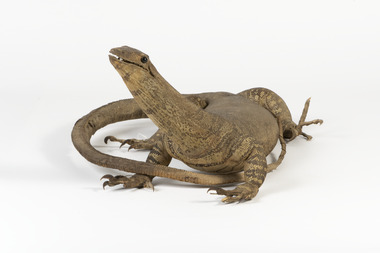
Animal specimen - Sand Goanna, Trustees of the Australian Museum, 1860-1880
... In some Aboriginal languages, the sand goanna is called "bungarra"; a term also commonly used by non-Aboriginal people in Western Australia. In Pitjantjatjara and other central Australian languages, goannas are called "tingka". ...In some Aboriginal languages, the sand goanna is called "bungarra"; a term also commonly used by non-Aboriginal people in Western Australia. In Pitjantjatjara and other central Australian languages, goannas are called "tingka". ...Sand goannas are the second largest species of carnivorous lizards found across mainland Australia. They can grow up to 160cm in length and can weigh as much as 6kg. Their common name is derived from "iguana", since early European bush settlers in Australia likened goannas to the South American lizards. Goannas retain special cultural and historic significance within Australian folklore and Indigenous culture. They were an important traditional native food source and are commonly represented in Aboriginal Dreamtime stories. In some Aboriginal languages, the sand goanna is called "bungarra"; a term also commonly used by non-Aboriginal people in Western Australia. In Pitjantjatjara and other central Australian languages, goannas are called "tingka". This specimen is part of a collection of almost 200 animal specimens that were originally acquired as skins from various institutions across Australia, including the Australian Museum and the National Museum of Victoria, as well as individuals such amateur anthropologist Reynell Eveleigh Johns between 1860-1880. These skins were then mounted by members of the Burke Museum Committee and put-on display in the formal space of the Museum’s original exhibition hall where they continue to be on display. This display of taxidermy mounts initially served to instruct visitors to the Burke Museum of the natural world around them, today it serves as an insight into the collecting habits of the 19th century. This specimen is part of a significant and rare taxidermy mount collection in the Burke Museum. This collection is scientifically and culturally important for reminding us of how science continues to shape our understanding of the modern world. They demonstrate a capacity to hold evidence of how Australia’s fauna history existed in the past and are potentially important for future environmental research. This collection continues to be on display in the Museum and has become a key part to interpreting the collecting habits of the 19th century.Small goanna with a streamlined body and textured scaly skin in different shades of olive and brown. It has a long neck and a long tail which narrows towards the tip. The goanna has four short, stocky legs which meet with large, curled claws. Its mouth is slightly slightly open, and it has two black glass eyes.On tag: BMM / 5892 /taxidermy mount, taxidermy, animalia, burke museum, beechworth, australian museum, skin, reynell eveleigh johns, lizard, goanna, sand goanna, monitor lizard, various gouldii -
Koorie Heritage Trust
Book, Blake, Barry J, Australian Aboriginal Languages : a general introduction, 1991
... . | Language - Linguistics - Phonology and phonetics | Language - Kriol | Language - Sociolinguistics - Secret and special languages | Language - Vocabulary - Human classification | Language - Vocabulary - Word lists Non-technical introduction covering phonology, grammar, vocabulary, sociolinguistics, language relationships pidgin and Aboriginal English, loan words in English, wordlists in Tiwi, Malak-Malak, Alyawarre, Walmajarri, Nyungar, Pitjantjatjara, Wemba-Wemba, Dharawal, Bidyara, Pitta-Pitta, Kalkatungu and Mayi-Yabi. ...Non-technical introduction covering phonology, grammar, vocabulary, sociolinguistics, language relationships pidgin and Aboriginal English, loan words in English, wordlists in Tiwi, Malak-Malak, Alyawarre, Walmajarri, Nyungar, Pitjantjatjara, Wemba-Wemba, Dharawal, Bidyara, Pitta-Pitta, Kalkatungu and Mayi-Yabi. In 1788 Australia had more than 200 such languages -- as different from each other as English is from French. Today, more than 100 are extinct and many of the rest are under threat. Professor Blake describes the sounds, spelling and location of the different languages, and dispels many popular myths.viii, 138 p. : ill., map. ; 21 cm.Non-technical introduction covering phonology, grammar, vocabulary, sociolinguistics, language relationships pidgin and Aboriginal English, loan words in English, wordlists in Tiwi, Malak-Malak, Alyawarre, Walmajarri, Nyungar, Pitjantjatjara, Wemba-Wemba, Dharawal, Bidyara, Pitta-Pitta, Kalkatungu and Mayi-Yabi. In 1788 Australia had more than 200 such languages -- as different from each other as English is from French. Today, more than 100 are extinct and many of the rest are under threat. Professor Blake describes the sounds, spelling and location of the different languages, and dispels many popular myths.australian languages. | aboriginal australians -- languages. | language - linguistics - phonology and phonetics | language - kriol | language - sociolinguistics - secret and special languages | language - vocabulary - human classification | language - vocabulary - word lists
