
Showing 4 items matching "plain tales from the hills"
-
 Flagstaff Hill Maritime Museum and Village
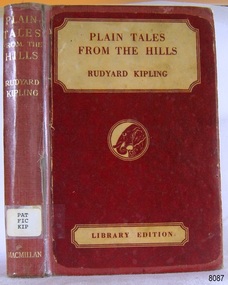
Book, Plain Tales from The Hills
... Plain Tales from The Hills......Plain Tales from The Hills...Plain Tales from The Hills Author: Rudyard Kipling Publisher: MacMillan & Co Date: 1949...The Warrnambool Mechanics' Institute’s publication collection is of both local and state significance. warrnambool shipwrecked-coast flagstaff-hill flagstaff-hill-maritime-museum maritime-museum shipwreck-coast flagstaff-hill-maritime-village shipwrecked-artefact book pattison collection warrnambool library warrnambool mechanics’ institute ralph eric pattison corangamite regional library service warrnambool city librarian mechanics’ institute library victorian library board warrnambool books and records warrnambool children’s library great ocean road Plain Tales from The Hills Rudyard Kipling Label on spine cover with typed text PAT FIC KIP Pastedown front endpaper has sticker from Warrnambool Children’s Library covered by a sticker from Corangamite Regional Library Service Front loose endpaper has a stamp from Corangamite Regional Library Service Plain Tales from The Hills Author: Rudyard Kipling Publisher: MacMillan & Co Date: 1949 Plain Tales from The Hills Book ...This item is from the ‘Pattison Collection’, a collection of books and records that was originally owned by the Warrnambool Mechanics’ Institute, which was founded in Warrnambool in 1853. By 1886 the Warrnambool Mechanics’ Institute (WMI) had grown to have a Library, Museum and Fine Arts Gallery, with a collection of “… choice productions of art, and valuable specimens in almost every branch and many wonderful national curiosities are now to be seen there, including historic relics of the town and district.” It later included a School of Design. Although it was very well patronised, the lack of financial support led the WMI in 1911 to ask the City Council to take it over. In 1935 Ralph Pattison was appointed as City Librarian to establish and organise the Warrnambool Library as it was then called. When the WMI building was pulled down in 1963 a new civic building was erected on the site and the new Warrnambool Library, on behalf of the City Council, took over all the holdings of the WMI. At this time some of the items were separated and identified as the ‘Pattison Collection’, named after Ralph Pattison. Eventually the components of the WMI were distributed from the Warrnambool Library to various places, including the Art Gallery, Historical Society and Flagstaff Hill. Later some were even distributed to other regional branches of Corangamite Regional Library and passed to and fro. It is difficult now to trace just where all of the items have ended up. The books at Flagstaff Hill Maritime Village generally display stamps and markings from Pattison as well as a variety of other institutions including the Mechanics’ Institute itself. RALPH ERIC PATTISON Ralph Eric Pattison was born in Rockhampton, Queensland, in 1891. He married Maude Swan from Warrnambool in 1920 and they set up home in Warrnambool. In 1935 Pattison accepted a position as City Librarian for the Warrnambool City Council. His huge challenge was to make a functional library within two rooms of the Mechanics’ Institute. He tirelessly cleaned, cleared and sorted a disarrayed collection of old books, jars of preserved specimens and other items reserved for exhibition in the city’s museum. He developed and updated the library with a wide variety of books for all tastes, including reference books for students; a difficult task to fulfil during the years following the Depression. He converted all of the lower area of the building into a library, reference room and reading room for members and the public. The books were sorted and stored using a cataloguing and card index system that he had developed himself. He also prepared the upper floor of the building and established the Art Gallery and later the Museum, a place to exhibit the many old relics that had been stored for years for this purpose. One of the treasures he found was a beautiful ancient clock, which he repaired, restored and enjoyed using in his office during the years of his service there. Ralph Pattison was described as “a meticulous gentleman whose punctuality, floorless courtesy and distinctive neat dress were hallmarks of his character, and ‘his’ clock controlled his daily routine, and his opening and closing of the library’s large heavy doors to the minute.” Pattison took leave during 1942 to 1945 to serve in the Royal Australian Navy, Volunteer Reserve as Lieutenant. A few years later he converted one of the Museum’s rooms into a Children’s Library, stocking it with suitable books for the younger generation. This was an instant success. In the 1950’s he had the honour of being appointed to the Victorian Library Board and received more inspiration from the monthly conferences in Melbourne. He was sadly retired in 1959 after over 23 years of service, due to the fact that he had gone over the working age of council officers. However he continued to take a very keen interest in the continual development of the Library until his death in 1969. The Pattison Collection, along with other items at Flagstaff Hill Maritime Village, was originally part of the Warrnambool Mechanics' Institute’s collection. The Warrnambool Mechanics’ Institute Collection is primarily significant in its totality, rather than for the individual objects it contains. Its contents are highly representative of the development of Mechanics' Institute libraries across Australia, particularly Victoria. A diversity of publications and themes has been amassed, and these provide clues to our understanding of the nature of and changes in the reading habits of Victorians from the 1850s to the middle of the 20th century. The collection also highlights the Warrnambool community’s commitment to the Mechanics’ Institute, reading, literacy and learning in the regions, and proves that access to knowledge was not impeded by distance. These items help to provide a more complete picture of our community’s ideals and aspirations. The Warrnambool Mechanics Institute book collection has historical and social significance for its strong association with the Mechanics Institute movement and the important role it played in the intellectual, cultural and social development of people throughout the latter part of the nineteenth century and the early twentieth century. The collection of books is a rare example of an early lending library and its significance is enhanced by the survival of an original collection of many volumes. The Warrnambool Mechanics' Institute’s publication collection is of both local and state significance. Plain Tales from The Hills Author: Rudyard Kipling Publisher: MacMillan & Co Date: 1949Label on spine cover with typed text PAT FIC KIP Pastedown front endpaper has sticker from Warrnambool Children’s Library covered by a sticker from Corangamite Regional Library Service Front loose endpaper has a stamp from Corangamite Regional Library Servicewarrnambool, shipwrecked-coast, flagstaff-hill, flagstaff-hill-maritime-museum, maritime-museum, shipwreck-coast, flagstaff-hill-maritime-village, shipwrecked-artefact, book, pattison collection, warrnambool library, warrnambool mechanics’ institute, ralph eric pattison, corangamite regional library service, warrnambool city librarian, mechanics’ institute library, victorian library board, warrnambool books and records, warrnambool children’s library, great ocean road, plain tales from the hills, rudyard kipling -
 Mrs Aeneas Gunn Memorial Library
Book, Rudyard Kipling, Plain tales from the hills, 1903
... Plain tales from the hills...England - Fiction England - Short stories A collection of short stories p.336. Plain tales from the hills Book Rudyard Kipling McMillan ...A collection of short storiesp.336.fictionA collection of short storiesengland - fiction, england - short stories -
 Flagstaff Hill Maritime Museum and Village
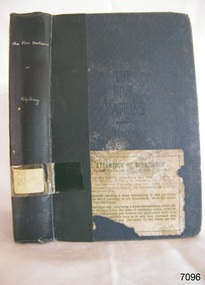
Book - Collection of Poetry, Rudyard Kipling, The Five Nations, 1903
... He returned to India in 1882 as a journalist on the Civil and Military Gazette in Lahore, where the sketches and verse he wrote for the paper became Departmental Ditties (1886) and Plain Tales from the Hills (1888). Back in London by 1889, he became famous almost overnight with Barrack-Room Ballads (1892). ...He returned to India in 1882 as a journalist on the Civil and Military Gazette in Lahore, where the sketches and verse he wrote for the paper became Departmental Ditties (1886) and Plain Tales from the Hills (1888). Back in London by 1889, he became famous almost overnight with Barrack-Room Ballads (1892). ...The Five Nations is a collection of poems by Rudyard Kipling, first published in late 1903 in both the United Kingdom and the United States. Some poems were new; others had appeared before most notably "Recessional" of 1897 sometimes in different versions. The volume is in two parts: an untitled first section covering a wide range of subjects, and a second titled "Service Songs", mostly concerning the real or imagined experiences of common British soldiers around the turn of the twentieth century. The book is dominated by the Second Anglo-Boer War (1899–1902). Kipling had immersed himself in South African affairs after the conflict erupted in October 1899, and "The Old Issue", later collected here, was issued as a political warning. Well-known pieces include "Boots", "The Islanders", "The Lesson", "Stellenbosch", "The Broken Men", "The Sea and the Hills" and "The White Man's Burden". Kipling placed "Recessional" as the very last poem in the book, following the "Service Songs" suite about how combatants had been changed by the war. The title itself has been debated. In 1903 the United Kingdom consisted of four nations England, Ireland, Scotland and Wales and it was soon suggested that Kipling's "five nations" were Canada, Australia, New Zealand, South Africa (Cape Colony) and "the islands of the sea", meaning the British Isles. Interestingly, no commentator seems to have suggested that India was among them.Hard cover book. The Five Nations Author: Rudyard Kipling Publisher: Methuen & Co Date: 1903 Further Information:Dark Blue Cloth hardcover with lettering and patterning to spine in white texter. The spine has a Library label with an inscription.fictionThe Five Nations is a collection of poems by Rudyard Kipling, first published in late 1903 in both the United Kingdom and the United States. Some poems were new; others had appeared before most notably "Recessional" of 1897 sometimes in different versions. The volume is in two parts: an untitled first section covering a wide range of subjects, and a second titled "Service Songs", mostly concerning the real or imagined experiences of common British soldiers around the turn of the twentieth century. The book is dominated by the Second Anglo-Boer War (1899–1902). Kipling had immersed himself in South African affairs after the conflict erupted in October 1899, and "The Old Issue", later collected here, was issued as a political warning. Well-known pieces include "Boots", "The Islanders", "The Lesson", "Stellenbosch", "The Broken Men", "The Sea and the Hills" and "The White Man's Burden". Kipling placed "Recessional" as the very last poem in the book, following the "Service Songs" suite about how combatants had been changed by the war. The title itself has been debated. In 1903 the United Kingdom consisted of four nations England, Ireland, Scotland and Wales and it was soon suggested that Kipling's "five nations" were Canada, Australia, New Zealand, South Africa (Cape Colony) and "the islands of the sea", meaning the British Isles. Interestingly, no commentator seems to have suggested that India was among them.warrnambool, shipwrecked-coast, flagstaff-hill, flagstaff-hill-maritime-museum, maritime-museum, shipwreck-coast, flagstaff-hill-maritime-village, shipwrecked-artefact, book, the five nations, rudyard kipling -
 Flagstaff Hill Maritime Museum and Village
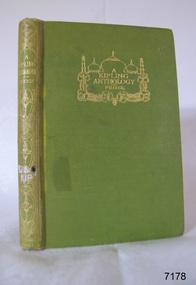
Book - Collection of Various Kipling Prose, Macmillan and Co. Limited, A Kipling Anthology Prose, 1922
... He returned to India in 1882 as a journalist on the Civil and Military Gazette in Lahore, where the sketches and verse he wrote for the paper became Departmental Ditties (1886) and Plain Tales from the Hills (1888). Back in London by 1889, he became famous almost overnight with Barrack-Room Ballads (1892). ...Rather than presenting complete short stories, the volume organises memorable excerpts thematically (such as Adventure, Service, India, the Sea and Reflections) from major works including The Jungle Book, Kim, Plain Tales from the Hills, Captains Courageous and Puck of Pook's Hill, accompanied by a detailed index at the rear. ...A Kipling Anthology: Prose (published in 1922) is a curated, pocket-sized anthology of notable passages, extracts and quotations drawn from Rudyard Kipling's extensive body of prose fiction, journalism and travel writing. Rather than presenting complete short stories, the volume organises memorable excerpts thematically (such as Adventure, Service, India, the Sea and Reflections) from major works including The Jungle Book, Kim, Plain Tales from the Hills, Captains Courageous and Puck of Pook's Hill, accompanied by a detailed index at the rear. This 1922 volume was compiled directly from Kipling's existing Macmillan & Co editions with the author's approval. Note Kipling's facsimile signature and personal swastika emblem printed on the facing page; he used the swastika as a good-luck symbol prior to its appropriation by the Nazi Party in the 1930s.Hard cover book. A Kipling Anthology Prose Author: Rudyard Kipling Publisher: Macmillan & Co., Ltd. Date: 1922 Further Information:Light Green Cloth hardcover with a gilt-stamped Islamic/Mughal architectural motif on the front cover & spine patterning and lettering in gilt. The spine has a Library label with an inscription.fictionA Kipling Anthology: Prose (published in 1922) is a curated, pocket-sized anthology of notable passages, extracts and quotations drawn from Rudyard Kipling's extensive body of prose fiction, journalism and travel writing. Rather than presenting complete short stories, the volume organises memorable excerpts thematically (such as Adventure, Service, India, the Sea and Reflections) from major works including The Jungle Book, Kim, Plain Tales from the Hills, Captains Courageous and Puck of Pook's Hill, accompanied by a detailed index at the rear. This 1922 volume was compiled directly from Kipling's existing Macmillan & Co editions with the author's approval. Note Kipling's facsimile signature and personal swastika emblem printed on the facing page; he used the swastika as a good-luck symbol prior to its appropriation by the Nazi Party in the 1930s.shipwrecked-coast, flagstaff-hill, flagstaff-hill-maritime-museum, warrnambool, maritime-museum, shipwreck-coast, flagstaff-hill-maritime-village, shipwrecked-artefact, book, pattison collection, warrnambool library, warrnambool mechanics’ institute, ralph eric pattison, corangamite regional library service, warrnambool city librarian, mechanics’ institute library, victorian library board, warrnambool books and records, warrnambool children’s library, great ocean road, a kipling anthology prose, rudyard kipling
