
Showing 6 items matching "plant pathologist"
-
 University of Melbourne, Burnley Campus Archives
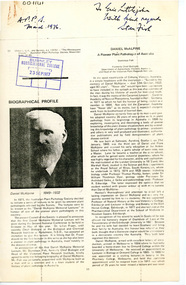
Article - Biography, Australian Plant Pathology Society, Daniel McAlpine: A Pioneer Plant Pathologist of Australia, March 1976
... Daniel McAlpine: A Pioneer Plant Pathologist of Australia......plant pathologist...Part of copy of biographical profile from the Australian Plant Pathology Newsletter pp11-13 of David McAlpine, who officially opened the college in 1891. Daniel McAlpine was the government Vegetable Pathologist. ...Daniel McAlpine daniel mcalpine plant pathologist apps australian plant pathology society vegetable pathologist biography A.P.P.S. ...Daniel McAlpinePart of copy of biographical profile from the Australian Plant Pathology Newsletter pp11-13 of David McAlpine, who officially opened the college in 1891. Daniel McAlpine was the government Vegetable Pathologist. The profile was written by Stanislaus Fish, former Head of the Victorian Plant Research Institute. There is a photograph of Daniel McAlpine accompanying the profile. Daniel McAlpine's dates are 1849-1932.A.P.P.S. March 1976, To Eric Littlejohn with kind regards Stan Fish Stamp: Burnley Horticultural College 23 SEP 1077daniel mcalpine, plant pathologist, apps, australian plant pathology society, vegetable pathologist, biography -
 University of Melbourne, Burnley Campus Archives
Newspaper - Newspaper Cutting, Agriculture Medal to Dr Stubbs, 1966
... ...plant pathologist...Stubbs, Principal Plant Pathologist at the Victorian Plant Research institute at Burnley, and his work developing virus-free stock...dr. l.l. stubbs plant pathologist plant research institute australian institute of agricultural science strawberries carrots viruses Article about Dr L. ...Article about Dr L. L. Stubbs, Principal Plant Pathologist at the Victorian Plant Research institute at Burnley, and his work developing virus-free stockdr. l.l. stubbs, plant pathologist, plant research institute, australian institute of agricultural science, strawberries, carrots, viruses -
 Warrnambool and District Historical Society Inc.
Artefact, Egg Specimens, Early 20th century
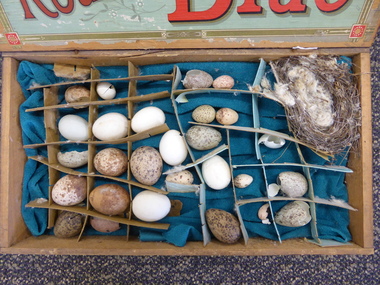
... He was the Government Plant Pathologist for Victoria from 1913 to 1924. ...He was the Government Plant Pathologist for Victoria from 1913 to 1924. ...These birds’ eggs were collected by Charles Brittlebank before 1910 but at this stage it is not known from which area they came. English-born Charles Brittlebank was a naturalist interested in ornithology, geology and mycology. He was the Government Plant Pathologist for Victoria from 1913 to 1924. He was the first to discover evidence of glaciation in the Werribee Gorge and published many papers on this subject and other aspects of natural history. It is not known when Charles Brittlebank was in the Warrnambool area or the origin of the birds’ eggs but it a very interesting (and perhaps rare) historical collection. .1 Birds’ Eggs - There are 27 eggs, either whole or partial specimens, contained in a box with home–made cardboard partitions. Ten are intact and the rest are broken. Eight are white and the remainder are speckled. The eggs are resting on a turquoise-coloured piece of material .2 Nest – This is woven from hair and fine twigs and is filled with white wool-like fragments .3 Letter – These are two sheets of writing paper with handwritten information in blue ink. .4 Envelope - This is a small envelope which contained the sheets of paper (.3 above) and the front has handwritten material in blue ink..3 ‘To whom it may concern – I hereby declare that these eggs were collected before 1910, and were part of a collection of the late Charles Brittlebank which is now in the Melbourne Museum. Fred. A. Shirrefs.’ .4 ‘To whom it may concern’ charles brittlebank, history of warrnambool -
University of Melbourne, Burnley Campus Archives
Booklet (item), F. R. Drake et al, Lawns and Playing Fields and Pests and Diseases of Lawns, 1974
... Millikan, Senior Plant Pathologist and Deputy Biologist....Millikan, Senior Plant Pathologist and Deputy Biologist. Lawns and Playing Fields and Pests and Diseases of Lawns Booklet F. ...lawns, playing fields, f.r. drake, c.j.r. johnston, c.r. millikan, pests, diseases, turf -
 Ringwood and District Historical Society
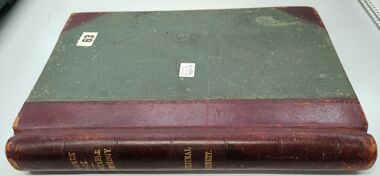
Administrative record, Agricultural Department, Large ledger, dark green cover, red leather spine with inscription. Bitter Pit investigation. Tracking fruit sent to coolstores 3-Jul-1911 to 30-Aug-1916. From Agricultural Department, fruit from all over the state - not just Ringwood. Some is from N.S.W, 1911 - 1916
... From https://researchworks.oclc.org/archivegrid/archiveComponent/1013459255: Australia's first plant pathologist. Lecturer in Biology at Melbourne University from 1884. ...From https://researchworks.oclc.org/archivegrid/archiveComponent/1013459255: Australia's first plant pathologist. Lecturer in Biology at Melbourne University from 1884. ...From https://researchworks.oclc.org/archivegrid/archiveComponent/1013459255: Australia's first plant pathologist. Lecturer in Biology at Melbourne University from 1884. In 1890 Daniel McAlpine was appointed to the Victorian Department of Agriculture as vegetable pathologist 'to attend to all diseases of plants that might form the subject of inquiry'. In 1911 McAlpine was assigned to the Commonwealth and State governments for four years to undertake researches into bitter pit of apples, a disease he had reported in 1900. Realising the difficulties such an investigation posed, he was reluctant to accept the post but did so 'for the credit of Australia'. He made detailed observations of the disease and published five reports but, unable to discover the cause, found himself arrayed against the Victorian government botanist Professor A. J. Ewart, who mistakenly attributed bitter pit to traces of poison in the soilLarge ledger, dark green cover, red leather spine with inscription. Bitter Pit investigation. Tracking fruit sent to coolstores 3-Jul-1911 to 30-Aug-1916. From Agricultural Department, fruit from all over the state - not just Ringwood. Some is from N.S.W. Only pages 1 & 2 scanned as examples. Specimen Book; Vegetable Pathology; Agricultural Department; Coolstore -
 Ringwood and District Historical Society
Document, Property Research Notes - Reaghill, Ringwood East, Victoria. Appendix 4 - Plan of Subdivision No. 41463 and history notes by Ian and Margaret McKellar - 1996
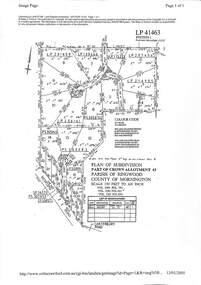
... While there he earned the gratitude of his fellows by his innovative use of available plants to treat tropical diseases. After this war Geoffrey returned to Melbourne and worked as a pathologist at the. ...While there he earned the gratitude of his fellows by his innovative use of available plants to treat tropical diseases. After this war Geoffrey returned to Melbourne and worked as a pathologist at the. ...Plan of Subdivision LP41463 - Part of Crown Allotment 43, Parish of Ringwood, County of Mornington. Map includes Bedford Road, Homebush Court, Vista Avenue and Vista Court, Heathmont. Allotments include LP201659, LP139446, LP115253, LP207494, LP216905, PS335874, LP206161, PS305345, PS300083, LP92899."Reaghill”; a 30 acre property in Bedford Road, Heathmont was bought from the Blood family about 1910 by Mr Seymour Davies as a weekend retreat from his busy life as a manager with the Glenferrie (or Hawthorn) branch of the English, Scottish and Australian (ES&A) Bank. He and his family came by train to Ringwood and then drove a pony cart up Bedford Road to a gateway at about number 139 and then a long drive, which wound up to the top of the hill. There was a wonderful view of Mount Dandenong which later became obliterated by tall eucalyptus trees. The land which became “Reaghill” was part of an 80 acre crown land sale to Mr Robert Blood on 12 March 1872. More information on the Blood family involvement with the area is given on pages 13-17 of the original 1974 edition of Hugh Anderson, Ringwood, Place of Many Eagles. Another section of this land was bought by Mr Frank L Walker and subsequently became "Wombalano Park". There is a quarry on the property from which stone was used for the long driveway. The garden was mainly left natural although we have two large Liquidamber trees which were planted by his wife Dora Davies (nee Hall). Surely these were some of the first to be planted in Melbourne gardens. A small weatherboard, galvanised iron roofed cottage was built on the top of the hill. At the time the house was built there was a strike of plasterers - as a result it was lined with timber, an unusual combination at that time. The Davies had a daughter and two sons - Dora (born 1897), Geoffrey (1900), John (1902). All studied medicine at Melbourne and practised, Geoffrey in Sydney, John in general practice Melbourne while Dora went to England in the 1930s and never returned. John and Dora married in 1933 and 1938 respectively and had families. Soon after the beginning of the 1939-45 war Geoffrey enlisted in the AIF as a Medical Officer and was in Singapore when it fell to the Japanese. He spent the remaining war years in various POW camps, including Changi and others in Malaya and Thailand. While there he earned the gratitude of his fellows by his innovative use of available plants to treat tropical diseases. After this war Geoffrey returned to Melbourne and worked as a pathologist at the. Heidelberg Repatriation Hospital while living for part of the time at "Reaghill". Seymour Davies died in October 19-35 and his wife, Dora, in February 1945. Of their children, John died in 1976, Dora in 1985 and Geoffrey in 1986. In July 1968 Geoffrey moved to East Ringwood and the two acre house block* and an adjacent one were sold to Dr James Hamilton Kelly, then of New York State, USA (Title Vol 8740 folio 991). As far as is known he never lived there. The house was let to a Mr and Mrs Ingamels for some years. The relatively fertile lower slopes on the south side of the land were cleared and farmed by descendants of the Blood family. At the time of the 1957 subdivision there were clear signs of the ploughed area. It was said that they used to grow strawberries in those paddocks. In about 1955 Dr Geoff Davies decided to sub-divide the property, he was unmarried and found it too large to maintain. Initially five of the seven normal house sized blocks fronting Bedford Road were sold and in about 1957 the remainder, was divided into 15 blocks (averaging nearly two acres) and put on the market. These were sold for £1000 ($2000) per acre. Homebush Court and Vista Court were formed to give access to- these blocks. The Homebush Court blocks have close access to Heathmont and the others to East Ringwood although all are lumped into East Ringwood by the municipal and postal authorities. The name "Reaghill" possibly comes from the Davies family's Irish origins. Homebush Court was named by Geoff Davies from the Sydney suburb of that name where he had lived in the 1930s. It was originally the name of a property owned by one of the early NSW Governors. Vista was a reminder to Geoff Davies of the once-grand views he remembered seeing from the hilltop. The earlier history in this article was recounted by my mother, a niece of Mr Seymour Davies, who remembered coming on a great outing to "Reaghill" as a child. Other recollections are from our own conversations with Geoff Davies. Ian and Margaret McKellar. 16 January, 1996
