
Showing 138 items matching "plant species"
-
 Flagstaff Hill Maritime Museum and Village
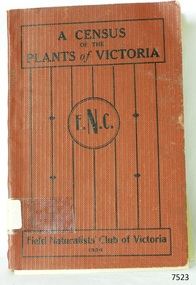
Book - Referance Book, Field Naturalist Club of Victoria, A Census of The Plants of Victoria, 1928
... ...plant species...Warrnambool Shipwreck Coast Flagstaff Hill Maritime Museum Flagstaff Hill Maritime Village Book A Census of The Plants of Victoria Field Naturalists' Club of Victoria plant names plant species distribution of plants Victoria's plants plant identification The book, 'A Census of the Plants of Victoria', is a comprehensive reference book of plant varieties and their distribution in the Australian State of Victoria. ...The book, 'A Census of the Plants of Victoria', is a comprehensive reference book of plant varieties and their distribution in the Australian State of Victoria. This second edition was published by the Field Naturalists' Club of Victoria, and printed in Melbourne. It contains indexes to aid the students, botanists and plant enthusiasts in their search for information.Orange-brown front cover with black printed text, vertical lines and rectangular borders around the upper title, and lower publishing group, and a central circular logo of the publishing group, Field Naturalists' Club of Victoria. Title: (in full) A Census of the Plants of Victoria With their Regional Distributions and the Vernacular Names as adopted by the Plant Names Committee of the Field Naturalists' Club of Victoria. Publisher: Field Naturalists Club of Victoria Edition: Second Edition Date: 1928non-fictionThe book, 'A Census of the Plants of Victoria', is a comprehensive reference book of plant varieties and their distribution in the Australian State of Victoria. This second edition was published by the Field Naturalists' Club of Victoria, and printed in Melbourne. It contains indexes to aid the students, botanists and plant enthusiasts in their search for information.warrnambool, shipwreck coast, flagstaff hill maritime museum, flagstaff hill maritime village, book, a census of the plants of victoria, field naturalists' club of victoria, plant names, plant species, distribution of plants, victoria's plants, plant identification -
 Whitehorse Historical Society Inc.
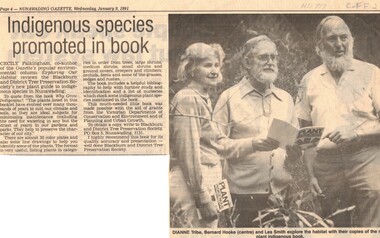
Article, Indigenous species promoted in book, 9/01/1991 12:00:00 AM
... 'Exploring our habitat' reviewing the Blackburn Tree Preservation Society's plant guide to indigenous species in Nunawading:'Why grow indigenous'....An article written by Cecily Falkingham, co-author, Nunawading Gazette column, 'Exploring our habitat' reviewing the Blackburn Tree Preservation Society's plant guide to indigenous species in Nunawading:'Why grow indigenous'....An article written by Cecily Falkingham, co-author, Nunawading Gazette column, 'Exploring our habitat' reviewing the Blackburn Tree Preservation Society's plant guide to indigenous species in Nunawading:'Why grow indigenous'. ...An article written by Cecily Falkingham, co-author, Nunawading Gazette column.An article written by Cecily Falkingham, co-author, Nunawading Gazette column, 'Exploring our habitat' reviewing the Blackburn Tree Preservation Society's plant guide to indigenous species in Nunawading:'Why grow indigenous'.An article written by Cecily Falkingham, co-author, Nunawading Gazette column. environment, blackburn and district tree preservation society, native plants, tribe, dianne, hooke, bernard, smith, les -
 Whitehorse Historical Society Inc.
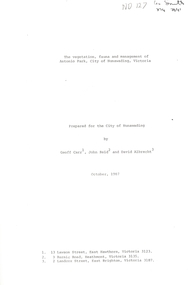
Work on paper - Report, The Vegetation, fauna and management of Antonio Park, City of Nunawading, Victoria, 1/10/1987 12:00:00 AM
... Photocopy of a detailed report prepared for the Nunawading City Council on the vegetation, fauna and management of Antonio Park. Lists of 320 plant species were made. A broad indigenous community: 'Grassy Open Forest' is described. ...Photocopy of a detailed report prepared for the Nunawading City Council on the vegetation, fauna and management of Antonio Park. Lists of 320 plant species were made. A broad indigenous community: 'Grassy Open Forest' is described. ...Photocopy of a detailed report prepared for the Nunawading City Council on the vegetation, fauna and management of Antonio Park.Photocopy of a detailed report prepared for the Nunawading City Council on the vegetation, fauna and management of Antonio Park. Lists of 320 plant species were made. A broad indigenous community: 'Grassy Open Forest' is described. Lists of butterflies, reptiles, birds and mammals. Weed infestation and degradation processes are identified. A range of management issues are identified and recommendations made. ca 120 pages. Photographs. Plans.Photocopy of a detailed report prepared for the Nunawading City Council on the vegetation, fauna and management of Antonio Park.antonio park, mitcham, animals, native plants, birds, wildlife -
 Croydon Conservation Society Inc.
Archive, Ringwood Lake Park - Archive Collection - Parent Record
... Several locally rare plant species persist in the reserve, one of which occurs nowhere else in Maroondah. ...Several locally rare plant species persist in the reserve, one of which occurs nowhere else in Maroondah. ...3.5 hectares of remnant native vegetation are managed for conservation at Ringwood Lake Park. Several locally rare plant species persist in the reserve, one of which occurs nowhere else in Maroondah. The site provides important habitat for many waterbirds, as well as small marsupials, lizards, bats and invertebrates. -
Croydon Conservation Society Inc.
Archive, Cheong Wildflower Sanctuary Croydon - Archive Records - Parent Record
... Originally donated to the public by the Cheong Family, the Cheong Wildflower Sanctuary supports 1.2 hectares of Valley Heathy Forest vegetation and a large range of locally very rare plant species. It provides habitat for a range of possums, lizards, birds and bats, as well as a range of invertebrates, and is an important component of the Wicklow Ridgeline and Belgrave Railway habitat corridors....Originally donated to the public by the Cheong Family, the Cheong Wildflower Sanctuary supports 1.2 hectares of Valley Heathy Forest vegetation and a large range of locally very rare plant species. It provides habitat for a range of possums, lizards, birds and bats, as well as a range of invertebrates, and is an important component of the Wicklow Ridgeline and Belgrave Railway habitat corridors. ...Originally donated to the public by the Cheong Family, the Cheong Wildflower Sanctuary supports 1.2 hectares of Valley Heathy Forest vegetation and a large range of locally very rare plant species. It provides habitat for a range of possums, lizards, birds and bats, as well as a range of invertebrates, and is an important component of the Wicklow Ridgeline and Belgrave Railway habitat corridors. -
Whitehorse Historical Society Inc.
Map, Yarran Dheran Landscaping, 1974
... Yarran Dheran Landscape Development January 1974 Paul Thompson - 6 sheets Detailed planting and named species of plants - 14 sheets One hand painted watercolour...Yarran Dheran Landscape Development January 1974 Paul Thompson - 6 sheets Detailed planting and named species of plants - 14 sheets One hand painted watercolour Yarran Dheran Thompson Paul Landscape Planning Charts relating to landscaping Yarran Dheran Charts of various dimensions Yarran Dheran Landscaping Map Thompson, Paul ...Charts relating to landscaping Yarran DheranCharts of various dimensionsnon-fictionCharts relating to landscaping Yarran Dheranyarran dheran, thompson paul, landscape planning -
 Bendigo Historical Society Inc.
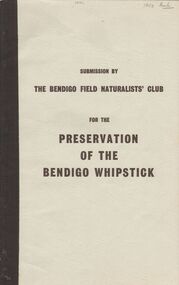
Book - 'PRESERVATION OF THE BENDIGO WHIPSTICK'' (SUBMISSION)
... Supportive material includes listings of various categories e.g. flora i.e Whipstick native plants; Additional Plant Species; Species of Birds; Mammals of the Whipstick; historical summary; Whipstick nuggets; Bendigo Whipstick 'Statistics'. ....Supportive material includes listings of various categories e.g. flora i.e Whipstick native plants; Additional Plant Species; Species of Birds; Mammals of the Whipstick; historical summary; Whipstick nuggets; Bendigo Whipstick 'Statistics'. . ...Preservation of the Bendigo Whipstick'' (Third Edition of a Submission by the Bendigo Field Naturalists' Club 1971). An application to the Forests Commission for two areas to be declared Forest Parks under the Appropriate Act. (The two areas are indicated on a map submitted under separate cover). Supportive material includes listings of various categories e.g. flora i.e Whipstick native plants; Additional Plant Species; Species of Birds; Mammals of the Whipstick; historical summary; Whipstick nuggets; Bendigo Whipstick 'Statistics'. .Bendigo Field Naturalist Club.government, state, whipstick, bendigo whipstick, the bendigo field naturalists club. shire of lodden map. -
Croydon Conservation Society Inc.
Archive, Eastfield Road Park Croydon - Archive Collection - Parent
... Nevertheless, the site still supports several locally rare plant species as well as a range of animals and contributes significantly to conservation value of the Taralla Creek habitat corridor....Nevertheless, the site still supports several locally rare plant species as well as a range of animals and contributes significantly to conservation value of the Taralla Creek habitat corridor. ...Eastfield Park supports 5.5 hectares of remnant vegetation from two vegetation types which are Endangered in the bioregion – Valley Heathy Forest and Swampy Woodland. Severe canopy decline across much of the site threatens understorey diversity, as does the presence of a soil-borne plant disease. Nevertheless, the site still supports several locally rare plant species as well as a range of animals and contributes significantly to conservation value of the Taralla Creek habitat corridor.Archival Collection of Eastfield Road Croydon park photographs, documents, planning etc -
 Whitehorse Historical Society Inc.
Newspaper - Article, Give a hand, 25/08/1993
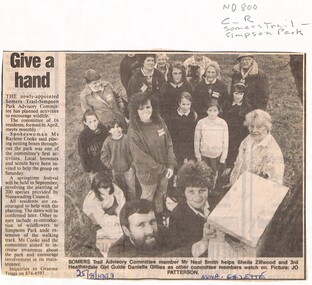
... Residents support sought by Somers Trail - Simpson Park advisory committee in the maintenance of the park, planting of native species and placement of nesting boxes....somers trail simpson park advisory committee smith neal zillwood sheila gillies danielle cooke raylene parks and reserves Residents support sought by Somers Trail - Simpson Park advisory committee in the maintenance of the park, planting of native species and placement of nesting boxes. ...Residents support sought by Somers Trail - Simpson Park advisory committee in the maintenance of the park, planting of native species and placement of nesting boxes.somers trail, simpson park advisory committee, smith, neal, zillwood, sheila, gillies, danielle, cooke, raylene, parks and reserves -
 Glenelg Shire Council Cultural Collection
Drawing - Drawing, botanical, Collin Elwyn Woolcock, Cotula coronopifolia (Water Buttons). Podolepis jaceoides (Showy Podolepis), 1985
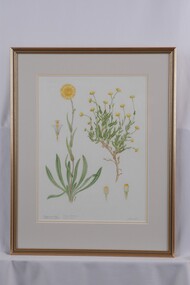
... Drawings of cuttings and flower details of two plant species with yellow flowers and green foliage. ...Part of "Woolcock Gallery Collection" exhibition 1989 CEMA Woolcock CEMA botanical Front: CEW/85 (vertical next to stem) Podolepis jaceoides (Showy Podolepis) Cotula coronopifolia (Water Buttons) (lower left) CEWoolcock (lower right) Back: 22 (upper left) Drawings of cuttings and flower details of two plant species with yellow flowers and green foliage. ...Part of "Woolcock Gallery Collection" exhibition 1989 CEMADrawings of cuttings and flower details of two plant species with yellow flowers and green foliage. Five drawings including one flower detail (yellow and pencil), one cutting of tall yellow (Daisy-like) flower with a red-brown stem and long green leaves along stem and at base, one cutting with many flowers (no petals, button-like) on thin green stems with green flower details. The work is on white paper mounted on apricot (first layer) and pale grey (second layer) cardboard. It is framed under glass in a gold and grey-green frame.Front: CEW/85 (vertical next to stem) Podolepis jaceoides (Showy Podolepis) Cotula coronopifolia (Water Buttons) (lower left) CEWoolcock (lower right) Back: 22 (upper left)woolcock, cema, botanical -
University of Melbourne, Burnley Campus Archives
Book - Register, Plants for Disposal-Winter, 1968, 1968-1972
... plant propagation...trees...shrubs...indoor plants...species...Glasshouse Propagated Trees and Shrubs & B. Indoor Plants Species (4 x roneo foolscap sheets) plus Section C Trees available from Open Nursery-Winter, 1968, Ornamental Trees and Shrubs (3 x roneo foolscap sheets)...Nursery lists for stock and sales glasshouse plant propagation trees shrubs indoor plants species open nursery ornamental plants Burnley College of Horticulture Plants for disposal 1968 (1) List of plants: A. ...Nursery lists for stock and sales(1) List of plants: A. Glasshouse Propagated Trees and Shrubs & B. Indoor Plants Species (4 x roneo foolscap sheets) plus Section C Trees available from Open Nursery-Winter, 1968, Ornamental Trees and Shrubs (3 x roneo foolscap sheets). (2) A collection of 2 x advertisements for plants sales for Students and Staff. Handwritten roneo advertisement for Pre Easter Plant Sale dated 11 April 1968 and price list. Typed/handwritten advertisement for Plant Sale dated 23 June 1972 compiled by I G McCure. Burnley College of Horticulture Plants for disposal 1968glasshouse, plant propagation, trees, shrubs, indoor plants, species, open nursery, ornamental plants -
 Glenelg Shire Council Cultural Collection
Drawing, Collin Elwyn Woolcock, Olearia asterotricha (Rough Daisy-bush). Olearia ramulosa (Twiggy Daisy-bush), 1984
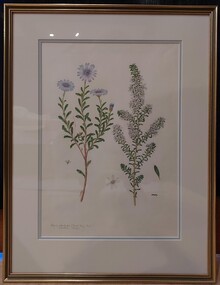
... Drawings of cuttings and flower details of two plant species. Six drawings include single cutting of Olearia asteroticha with brown stems, bright green long leaves and blue (daisy-like) flowers with purple and yellow centre, a single cutting of O. ramulosa with green-brown stem, dark green long leaves and white (daisy-like) flowers with pink and yellow centres, one small flower detail (left), one white flower detail (centre) and two leaf details (right). ...Collin Woolcock Woolcock Collection Botanical Drawing Botanical CEMA Front: Olearia asterotricha (Rough Daisy-bush) " ramulosa (Twiggy " " ) (lower left) (pencil) CEW/84 (lower left in image, next to stem) (maroon pencil) Back: 42 (upper left) (pen) Drawings of cuttings and flower details of two plant species. Six drawings include single cutting of Olearia asteroticha with brown stems, bright green long leaves and blue (daisy-like) flowers with purple and yellow centre, a single cutting of O. ramulosa with green-brown stem, dark green long leaves and white (daisy-like) flowers with pink and yellow centres, one small flower detail (left), one white flower detail (centre) and two leaf details (right). ...Part of "Woolcock Gallery Collection". Exhibited CEMA 1989.Drawings of cuttings and flower details of two plant species. Six drawings include single cutting of Olearia asteroticha with brown stems, bright green long leaves and blue (daisy-like) flowers with purple and yellow centre, a single cutting of O. ramulosa with green-brown stem, dark green long leaves and white (daisy-like) flowers with pink and yellow centres, one small flower detail (left), one white flower detail (centre) and two leaf details (right). The work is mounted in a double matt (off-white on pale blue), framed under glass in a gold and grey-green frame.Front: Olearia asterotricha (Rough Daisy-bush) " ramulosa (Twiggy " " ) (lower left) (pencil) CEW/84 (lower left in image, next to stem) (maroon pencil) Back: 42 (upper left) (pen)collin woolcock, woolcock collection, botanical drawing, botanical, cema -
Federation University Historical Collection
Document - Report, University of Ballarat Canadian Wetlands Project Report, 2000, 04/2000
... - Waterbirds move in and the germination of native wetland plant species begins 2000 - Stage 2 plans developed, including additional walkways, bird hides and interpretation. ... - Waterbirds move in and the germination of native wetland plant species begins 2000 - Stage 2 plans developed, including additional walkways, bird hides and interpretation. ballarat technology park canadian wetlands ian howe mount helen Mount Helen Campus Three page report on the University of Ballarat Canadian Wetlands Project. ...1992 - Property purchased fronting Geelong Road, Mount Helen 1994 - Additional adjoining property purchased 1995 - Wetlands included in the Corporate Plan for the area 1997 - Launch of Wetlands Development by Minister Maclennan 1998 - Preliminary planning and plant identification underway - Contract signed for funding 1999 - Stage 1; Planning finalised, earthworks undertaken and weed infestation assaulted - "Work for the Dole" project undertaken - Deluge of rain on Boxing Day provides the centrepiece f the project, the just-completed dam, with a body of water to overflowing level. - Waterbirds move in and the germination of native wetland plant species begins 2000 - Stage 2 plans developed, including additional walkways, bird hides and interpretation. Three page report on the University of Ballarat Canadian Wetlands Project. Direct funding for the project was provided by the University of Ballarat; The Department of Employment, Workplace Relations and Small Business and the Corangamite Catchment Authority.ballarat technology park, canadian wetlands, ian howe, mount helen, mount helen campus -
 Wooragee Landcare Group
Photograph, 5 September 2004
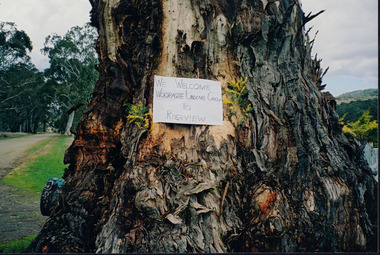
... The organisation's work has included public awareness and education campaigns to control invasive, introduced species and protect native wildlife, such as campaigns to replant native plant species to improve soil integrity and restore habitat for flora and fauna. ...The organisation's work has included public awareness and education campaigns to control invasive, introduced species and protect native wildlife, such as campaigns to replant native plant species to improve soil integrity and restore habitat for flora and fauna. ...Wooragee Landcare was formed in 1989 to promote sustainable conservation and land-use practices in the North-East region of Victoria. The organisation's work has included public awareness and education campaigns to control invasive, introduced species and protect native wildlife, such as campaigns to replant native plant species to improve soil integrity and restore habitat for flora and fauna. The organisation has drawn on the work of a variety of Government and academic experts to ensure best practice approaches are utilised. This photograph was taken at Riverview Farm, Victoria on Sunday the 5th of September as part of a day trip by the Wooragee Landcare Group. The event was about looking at land use on small farms and as a social get-together for the Group. Wooragee was also researching how small landholders could run some enterprises around the time of the trip. This photograph is a great example of the type of events that Wooragee Landcare Group has organized, while educating the public about the importance of land use management.Landscape colour photograph printed on gloss paper. Reverse: WAN NA E0NA2N2. NNN+ 4 4240/ [PRINTED] (No. 24) / 377wooragee, wooragee landcare group, wooragee landcare's collection, land use, social, riverview farm, animals, pests, indigo shire, tatong, samaria, north-east victoria -
 University of Melbourne, Burnley Campus Archives
Plant specimen - Pressed Plant Collection, Mary Connors (née Lee), Burnley College student pressed and hand decorated plant collection of 13 Families, 1952-1953
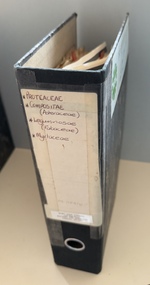
... Latin identification and Labels for 13 Plant families, Genus, Species, Common Name, Locality, Collector and Remarks. ...Her daughter has rearranged the pages into 2 A4 lever arch ring binders. plant specimen mary connors (née lee) 1953 Student assignments Burnley College Certificate of Comptency Latin identification and Labels for 13 Plant families, Genus, Species, Common Name, Locality, Collector and Remarks. ...Plant specimens collected and pressed by Mary Connors (née Lee) who graduated in 1953 with Certificate of Competency. Her daughter has rearranged the pages into 2 A4 lever arch ring binders. Collection depicting 13 families. 2 A4 Lever arch files with 25.5 x 20.5 cm plain paper sheets 1 pressed plant to a page arranged by families. Title page for each family with hand drawn and coloured examples. Specimens (faded) attached with cellotape. Some photocopied information sheets about certain families added after 1950's. Latin identification and Labels for 13 Plant families, Genus, Species, Common Name, Locality, Collector and Remarks. Some photocopied information sheets of plant families. A Proteaceae, Compositae, Leguminosae, Myrtaceae and B Orchidaceae, Graminaeae, Liliaceae, Amaryllidaceae, Iridaceae, Cruciferae, Rosaceae, Solanaceae, Scrophulariaceae plant specimen, mary connors (née lee), 1953, student assignments, burnley college, certificate of comptency -
 Linton and District Historical Society Inc
Photograph, Gordon Clarke on his Birthday Pony
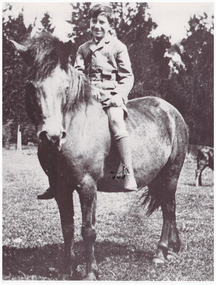
... Gordon Clarke purchased land between Piggoreet and Linton, known as the 'Bird Paddock', and began to intensively plant indigenous species, with a view to providing habitat for native birds. ...Gordon Clarke purchased land between Piggoreet and Linton, known as the 'Bird Paddock', and began to intensively plant indigenous species, with a view to providing habitat for native birds. ...Gordon Clarke (1906-1996) was the grandson of David Clarke who bought Piggoreet West in 1855. His parents were John Clarke and Mary Jane Newcomen. Gordon Clarke purchased land between Piggoreet and Linton, known as the 'Bird Paddock', and began to intensively plant indigenous species, with a view to providing habitat for native birds. This land was afterwards expanded and is now known as the Clarkesdale Bird Sanctuary. In the 1970s, Gordon donated the sanctuary to the Bird Observers Club of Australia.Black and white copy of original photograph a boy sitting bareback on a horse with no bridle.horses, gordon clarke -
 Bendigo Historical Society Inc.
Document - PETER ELLIS COLLECTION: NEWSPAPER ARTICLE, 23rd May, 2015
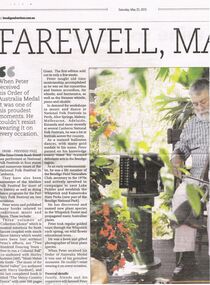
... He has discovered and named new plant species in the Whipstick Forest and propagated many Australian plants. ...He has discovered and named new plant species in the Whipstick Forest and propagated many Australian plants. ...Colour photocopy of article from Bendigo Advertiser. Dated Saturday, May 23, 2015. FAREWELL, MA.. When Peter received his Order of Australia Medal it was one of his proudest moments. He couldn’t resist wearing it on every occasion. FROM - PREVIOUS PAGE The Emu Creek Bush Band has performed at National Folk Festivals in four states and numerous times at the National Folk Festival in Canberra. They have also been mainstays of the Maldon Folk Festival for most of its history as well as doing dance programs for the Port Fairy Folk Festival on two occasions. Peter wrote and published many books related to traditional music and dance. These include: Three volumes of 'Collector's Choice' which is musical notations for bush dances coupled with much dance history which would have been lost without Peter's efforts, are 'Two Hundred Dancing Years- How to run a Colonial Ball' (Co-authored with Shirley Andrews (AM), 'Music Makes Me Smile- The Music of the Nariel Valley' (Co-authored with Harry Gardner), and his last completed book is titled 'The Merry Country Dance' with over 300 pages.. .. .. Grant. The first edition sold out in only a few weeks. Peter taught old time musicianship, accomplished as he was on the concertina and button accordion, tin whistle, and harmonica, as well as the Swanee whistle, piano and ukulele. In demand for workshops in music and dance at National Folk Festivals in Perth, Alice Springs, Maleny, Melbourne, Adelaide, Kuranda and more recently at several Canberra National Folk Festivals, he was a hit at festivals across the country. As a trained ballroom dancer, with many gold medals to his name, Peter passed on his knowledge every time he trained debutante sets in the Bendigo region. As an early environmentalist, he was a life member of the Bendigo Field Naturalists Club, secretary in the 1970's and actively involved in campaigns to save Lake Pedder and establish the Whipstick and Kamarooka State Parks (now part of the Bendigo National Park). He has discovered and named new plant species in the Whipstick Forest and propagated many Australian plants. Peter took regular guided tours through the Whipstick each spring, on wildflower educational tours. He was a keen and gifted photographer of local plant species. When Peter received his Order of Australia Medal it was one of his proudest moments. He couldn’t resist wearing it on every occasion. Funeral details. Family, friends and his supporters will farewell Peter.. .. .. ..person, individual, peter ellis oam -
Friends of Ballarat Botanical Gardens History Group
Work on paper - Simon Grant: Part 5 of the Explorers, David Douglas in the Land of Giants, Published 1998
... David Douglas (1799-1834) journeyed to the Pacific North-West as well as to other parts of the New World looking for new species of plants. The Royal Horticultural Society of London hoped to introduce new and exciting plants to its gardens....David Douglas (1799-1834) journeyed to the Pacific North-West as well as to other parts of the New World looking for new species of plants. The Royal Horticultural Society of London hoped to introduce new and exciting plants to its gardens. ...David Douglas (1799-1834) journeyed to the Pacific North-West as well as to other parts of the New World looking for new species of plants. The Royal Horticultural Society of London hoped to introduce new and exciting plants to its gardens.After Douglas's explorations in the New World, hundreds of new species became available. As a result flower beds and theme gardens with new exotic specimens and aboreta became fashionable. This information gives some perspective on the planning and development of the Ballarat Botanical Gardens.2 pages of print in columns. There is a black and white photograph of David Douglas halfway down the page on the lefthand side of p.1. On p.2 there is a black and white photograph of the Douglas Fir on the lefthand side of the page and lower down a photograph of Lupinus polyphyllus.none.john garner, doctor john garner, ballarat botanic gardens, friends of ballarat botanical gardens, david douglas, royal horticultural society, kew gardens, douglas fir, sitka spruce, radiata pine, john claudius loudon, joseph banks, john garner collection, gardens, ballarat -
 Orbost & District Historical Society
magazine, Botanical Exploration of East Gippsland, early - mid 20th century
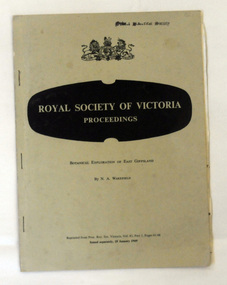
... He described many new species of plants.(info. Wikipedia)...He described many new species of plants.(info. Wikipedia) This is a useful research tool. botany-East-Gippsland Wakefield-Norman Royal-Society-Victoria on front cover is a stamp of "Orbost Historical Society" A thin magazine a light green cover. ...The Royal Society of Victoria convenes Victoria’s science community. It is the State’s oldest learned society and a part of Australia’s intellectual life since 1854. The Proceedings of the Royal Society of Victoria is their refereed journal, published twice annually.(Royal Society of Victoria web-site) Norman Arthur Wakefield (28 November 1918 – 23 September 1972) was an Australian teacher, naturalist, paleontologist and botanist, notable as an expert on ferns. He described many new species of plants.(info. Wikipedia)This is a useful research tool.A thin magazine a light green cover. It has the royal coat - of - arms in black / dark green print at the top above "Royal Society of Victoria Proceedings" on black. Underneath this is "Botanical Exploration of East Gippsland by N.a. Wakefield in black print.on front cover is a stamp of "Orbost Historical Society"botany-east-gippsland wakefield-norman royal-society-victoria -
 Bendigo Historical Society Inc.
Newspaper - Kangaroo Flat Gold Mine Collection: mine revegetation
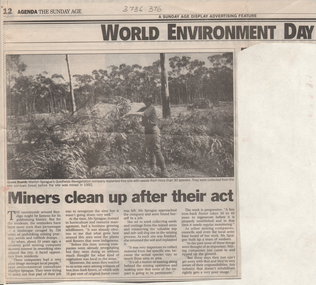
... Marilyn Sprague collected seeds from 36 different species of plants to revegetate land disturbed by mining. ...Marilyn Sprague collected seeds from 36 different species of plants to revegetate land disturbed by mining. ...Sunday Age article, 26th May, 1996, in 'Agenda' titled 'World Environment Day and subtitled 'Miners clean up after their act'. Marilyn Sprague collected seeds from 36 different species of plants to revegetate land disturbed by mining. She stated ' it is very important to collect material from the specific site, because the actual species vary so much from area to area.' Black and white photo shows Marily Sprague collecting seeds from felled trees in the Box-Ironbark forest. gold mining, bendigo, box-ironbark forest, marilyn sprague, goldfields revegetation company, revegetation, bendigo mining -
 Bendigo Historical Society Inc.
Administrative record - Ex-Fortuna Survey Association Collection: Conservation Management Plans, 1994-96
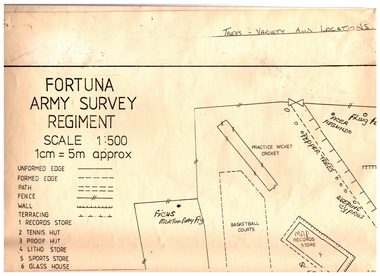
... Maintain plant health and species diversity to enhance the area's character. 2 Address financial constraints, human use, military requirements, and stakeholder engagement. 3 Employ qualified experts to prepare the plan. 4 Address historical significance, plant health, heritage value, remedial works, and visual character (including maintaining views and screening modern structures). 5 Restore garden design to its original character where possible. 6 Recommend measures for future works to protect garden health and significant trees. 7 Identify and map significant plants and recommend suitable species for replanting. ...Maintain plant health and species diversity to enhance the area's character. 2 Address financial constraints, human use, military requirements, and stakeholder engagement. 3 Employ qualified experts to prepare the plan. 4 Address historical significance, plant health, heritage value, remedial works, and visual character (including maintaining views and screening modern structures). 5 Restore garden design to its original character where possible. 6 Recommend measures for future works to protect garden health and significant trees. 7 Identify and map significant plants and recommend suitable species for replanting. ...'Fortuna' was developed by George Lansell, the 'Quartz King', from the 1870s to 1906. The estate features a mansion, a notable Italian water garden with imported elements, and a large lake originally used for mining. The property covers 6.7 hectares and contains many mature trees, including palms, poplars, pepper trees, Norfolk Island pines, and various specimen trees. Since 1942 to the 1980s, the Department of Defence has owned and maintained the property. General Considerations are to: 1 Preserve and restore the heritage value and history of the gardens to complement historic buildings. Maintain plant health and species diversity to enhance the area's character. 2 Address financial constraints, human use, military requirements, and stakeholder engagement. 3 Employ qualified experts to prepare the plan. 4 Address historical significance, plant health, heritage value, remedial works, and visual character (including maintaining views and screening modern structures). 5 Restore garden design to its original character where possible. 6 Recommend measures for future works to protect garden health and significant trees. 7 Identify and map significant plants and recommend suitable species for replanting. Consultant to start in September 1994 and complete by December 1994 with Regular meetings with a steering committee and encourage public involvement. The plan aims to ensure the long-term preservation, enhancement, and appropriate use of the heritage gardens, balancing historical, ecological, recreational, and military needs. In 1996 Fancine Gilfedder and Associates produced the Garden Conservation Management Plan for the Department of Defence: This Conservation Management Plan for the historic Fortuna Bendigo Garden outlines its historical development, significance, and strategies for preservation and management. 1. The plan was commissioned by the Department of Defence and prepared by Francine Gilfedder & Associates in 1996. It covers the Fortuna Garden site, its heritage status, and the methodology used for assessment. 2. Historical OverviewProvides a detailed chronology of the garden's development and its phases. Identifies significant materials, features, and architectural elements. 3. Site AssessmentSurveys existing site conditions, including plant and tree inventories.Documents architectural features and general landscape conditions. 4. Assesses the garden's heritage value using established criteria (e.g., Burra Charter, AHC criteria). Identifies elements of significance and provides comparative analysis with similar sites. 5. Summarizes the heritage value and unique aspects of the Fortuna Garden. 6. Outlines statutory and non-statutory requirements, user needs, and physical constraints affecting management. 7. Recommends general and component-specific policies for conservation. 8. Implementation Provides guidelines and specific recommendations for development and ongoing management. 9. Details best practices for tree, shrub, rose, and lawn care, as well as maintenance of paths and structures.Fortuna Villa Conservation Management Plans This Document Contains the following Items: 11231.4a This document is a draft brief by the army, 1994. It outlines the brief for a conservation management plan for the heritage gardens and surrounds of Fortuna Villa in Bendigo. It's three pages outlines Purpose, Background History and General Considerations, requirements and a summary. Seven first pages reproduced here. 11231.4b This Conservation Management Plan for the historic Fortuna Bendigo Garden outlines its historical development, significance, and strategies for preservation and management. Black Fabric Binding of approximately 110 pages (printed on both sides), photocopy with photos and plans. The first four pages showing the cover and index are shown here. 11231.4c Undated. This document is a horticultural report providing suggestions for improving the grounds and gardens at 'Fortuna', a historic estate now used by the Army Survey Regiment in Bendigo. The black and white report of approx 100 pages is "Spiralex" bound. It contains - it is compiled for the army by Karl Liffman (TAFE horticulture department) and Ian Huxley (experienced horticulturist and garden designer), with input from gardening apprentices. It contains many photos with new suggestions overlyared on top of them. The report addresses only the grounds and gardens visible to visitors: main drive, car parks, front garden, and areas around the lake. Recommendations are from a horticultural perspective, emphasizing plant variety and practical maintenance over formal landscape architecture.PurposeAims to guide the Army in developing and maintaining Fortuna’s gardens, recognizing the property's heritage and its value for public relations. 11231.4d An unbound copy of the above 11231.4e A letter to Range Control, Department of Defence, Puckapunyal, from Francine Gilfedder and Associates, Landscape Architect and Horticulturist, 15 Dover St Richmond; and a 18 page management plan. The plan aims to guide the conservation and management of the Fortuna Villa gardens, focusing on heritage values and preservation needs. May 1995. 11231.4f March 1996 five page document which outlines a conservation and restoration proposal for the Pompeii Fountain and adjacent heritage structures at Fortuna, Golden Square, Victoria. The fountain's steel column was severely rusted; rendered surfaces and marble font were deteriorating; adjacent garden walls and staircases were failing. 11231.4g Copy of above 11231.4h A five page document which contains key points from the conservation and restoration plan for Fortuna Villa. 1990s. 11231.4i A 30 page document. Part of the conservation policy and management plan for the Fortuna estate: 11231.4j A six page document is a conservation management plan and tree health report for Fortuna Villa in Bendigo, focusing on diagnosing tree diseases, assessing tree conditions, and recommending removal or treatment actions. Prepared by Francine Gilfedder and Associates, Landscape Architect and Horticulturist, 15 Dover St Richmond for the army. 11231.4k The one page document is a tree inspection report for a Sierra Redwood at Fortuna Villa, Bendigo, prepared in response to concerns about the tree's stability after the removal of a nearby specimen. Prepared by Trevor Lawrence Tree Surgeon, 830 Barkley St Ballarat. July 1995 11231.4l A 15 page document which provides an interpretive plan and historical overview for Fortuna Villa, a heritage site in Bendigo, focusing on its history, significance, and strategies for visitor engagement. 1995 prepared by Dianne Bish, Eaglehawk 11231.4m A large army plan of the Fortuna Grounds with prominent trees marked.bendigo, fortuna villa, history, army survey regiment, gardens, conservation management -
 Federation University Historical Collection
Book, Mount Helen campus Development Plan 1970, 1970
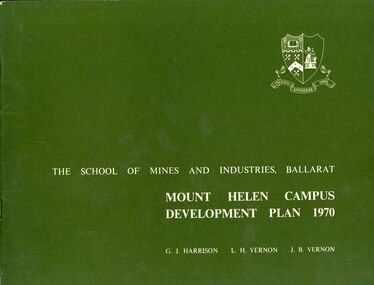
... It was proposed that the trees present on the site should not be removed until development plans have been studied in greater detail, with an early step being to reinforce existing material with suitable broad-scale planting, mainly of native species, such as selected eucalyptus and wattles, to give broad coherence between the various element on the site and to define its boundaries. ...It was proposed that the trees present on the site should not be removed until development plans have been studied in greater detail, with an early step being to reinforce existing material with suitable broad-scale planting, mainly of native species, such as selected eucalyptus and wattles, to give broad coherence between the various element on the site and to define its boundaries. university of ballarat ballarat institute of advanced education mount helen master plan landscape harrison vernon great hall geoff harrison john vernon m.b. john contour map student accomodation landscaping development plan campus plan Green and white soft covered booklet of 48 pages. ...Green and white soft covered booklet of 48 pages. SMB Crest is on the front cover. The content include the Mt Helen site, site planning, student residences, sporting facilities, roads and parking, pedestrian circulation, engineering services, and landscaping. Illustrations include: Plan of Mt Helen Site (July 1969, existing buildings, Functional relationship, Roads and Parking, Pedestrian Circulation, engineering Services, Landscaping, Development Plan, Plan of Academic area, Library and union Courtyards, Birds Eye View of Academic Area from north-west, etc. the master plan projects student numbers.non-fictionuniversity of ballarat, ballarat institute of advanced education, mount helen, master plan, landscape, harrison, vernon, great hall, geoff harrison, john vernon, m.b. john, contour map, student accomodation, landscaping, development plan, campus plan -
 National Wool Museum
Artwork, other - Paper Taxidermy, Mary-Jane Walker, Plains Wanderer, 2020
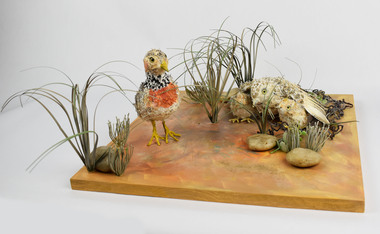
... species is continuing to survive in the native grasslands of Victoria. Managing these habitats for the plains-wanderer can also support the conservation of many other threatened plant and animal species. ...species is continuing to survive in the native grasslands of Victoria. Managing these habitats for the plains-wanderer can also support the conservation of many other threatened plant and animal species. ...The world’s most ecologically distinct bird lives in the native grasslands of Victoria - but only just. The plains-wanderer is a small bird that was once widespread across the grasslands of south-eastern Australia. Today there are fewer than 1000 mature birds in the wild. The plains-wanderer is under threat due to habitat loss caused by overgrazing, cropping and suburban sprawl. Unlike most other birds, female wanderers are larger and more colourful and the males take care of the chicks. They are only about 15cm tall and weigh between 40-80g for the male and 55-90g for the female. Their intricate plumage mirrors the colours of their grassland home so they blend in perfectly with their surroundings. The plains-wanderer’s origins date back to when Australia was part of the Gondwana supercontinent over 60 million years ago. They are so biologically distinct that their extinction would result in the loss of a branch of the tree of life. A fussy grass dweller, they like neither too much nor too little grass. That is where sheep grazing can help. After years of low numbers in Victoria, plains-wanderer populations have been increasing in Terrick Terrick National Park in north west Victoria, as sheep grazing maintains the grass in the park at a suitable level. With the right management, this ecologically important bird species is continuing to survive in the native grasslands of Victoria. Managing these habitats for the plains-wanderer can also support the conservation of many other threatened plant and animal species. Object: Nest of plains-wanderers by Mary-Jane Walker, 2020. Outer made from upcycled paper, internal structure steel. Nest of plains-wanderers by Mary-Jane Walker, 2020. Outer made from up cycled paper, internal structure steel. native grasslands, plains-wanderer, terrick terrick national park -
 Bendigo Historical Society Inc.
Document - PETER ELLIS COLLECTION: ORDER OF AUSTRALIA
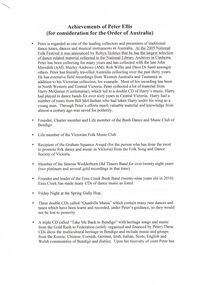
... He has discovered and named new plant species in the Whipstick Forest and propagates Australian plants. ...He has discovered and named new plant species in the Whipstick Forest and propagates Australian plants. ...4 page A4 printed document. Achievements of Peter Ellis (for consideration for the Order of Australia) Peter is regarded as one of the leading collectors and presenters of traditional dance tunes, dances and musical instruments in Australia. At the 2005 National Folk Festival it was announced by Robyn Holmes that he has the largest selection of dance related material collected in the National Library Archives in Canberra. Peter has been collecting for many years and has collected with the late John Meredith (AM), Shirley Andrews (AM), Rob Willis and Dave Di Santi amongst others. Peter has literally travelled Australia collecting over the past thirty years. He has extensive field recordings from Western Australia and Tasmania in addition to his Victorian collection, for example. Most of his recording has been in North Western and Central Victoria. Peter collected a lot of his material from Harry McQueen ( Castlemaine), which led to a double CD of Harry's music. Harry had played in dance bands for over sixty years in Central Victoria. Harry had a number of tunes from Bill McGlashan who had taken Harry under his wing as a young man. Through Peter's efforts much valuable material and knowledge from almost a century ago was saved for posterity. Founder, Charter member and life member of the Bush Dance and Music Club of Bendigo. Life Member of the Victorian Folk Music Club. Recipient of the Graham Squance award (for the person who has done the most to promote folk dance and music in Victoria)) from the Folk Song and Dance Society of Victoria. Member of the famous Wedderburn Old Timers Band for over twenty-eight years (two platinum and several gold recordings in that time). Founder and leader of the Emu Creek Bush Band (twenty-nine years old in 2010) Emu Creek has made many CDs of dance music as listed. Friday Night at the Spring Gully Hop, Three double CDs called 'Quadrille Mania' which contain many rare dances and tunes which have been learnt and recorded, under Peter's guidance, so they would not be lost to posterity. A triple CD called 'Take Me Back To Bendigo' with heritage songs and music from the Gold Rush to Federation (solely organised and financed by Peter) These CDs show the multicultural heritage in Bendigo and include music and groups from the Koorie, Chinese, Cornish, German, Irish, Italian, Scots, English and Welsh communities of Bendigo and district. Upon his recovery of costs Peter has handed over copyright to the Bendigo Community so future profits go back into the community. Three double CDs called 'The Merry Country Dance' with dances and tunes going back to the time of Governor Lachlan Macquarie's Ball in 1804. Most of the tracks are performed by Emu Creek Following much practice under Peter's tutelage. For further authenticity Peter liaised with other musicians to record some tracks which were revived from almost two hundred years ago and have now been recorded using the instruments of the time. A three volume set of Bush Concert recordings (Vol 1 Goornong (launched Australia Day 2006 with any profits going to the Soldier's Memorial Hall Committee), Vol 2 Heywood and Vol 3 Maldon/Sutton Grange, already recorded and to be released as money from other projects becomes available. NOTE: None of these CDs have led to any profit. All money raised is put back into the community and further heritage recordings, books and videos through the Bush Dance and Music Club of Bendigo Inc. In 2009 a full collection of all Peter's book and CDs was donated to the John Gorton Library as part of the recognition of the fifty year career of the Gay Charmers Dance Band from Lake Charm. 'Music of the Diggings' (4 tracks by Peter or Emu Creek). In addition the Emu Creek Band, under Peter's leadership, has appeared on a CD backing Bruce Watson on his song, 'The Old Bush Dance'. Emu Creek has performed at National Folk Festivals in four states and several times at the National Folk Festival in Canberra. They have also been mainstays of the Maldon Folk Festival for over twenty years as well as doing dance programs for the Port Fairy Folk Festival on two occasions. Peter has written and published many books related to traditional music and dance. These include Three volumes of 'Collectors Choice' which is musical notation for bush dances coupled with much dance history which would have been lost without Peter's efforts. 'Two Hundred Dancing Years - How to run a Colonial Ball: (co-authored with Shirley Andrews (A.M.), 'Music Makes Me Smile - The Music of the Nariel Valley' (co-authored with Harry Gardner). The Merry Country Dance' (292 pages) a companion to the three double CDs. He has also been a contributor to Verandah Music' authors Rob Willis and Graham Seal and 'The Oxford Companion to Australia Folklore' Ed Graham Seal. Peter is also a regular contributor to 'Trad and Now' Magazine. His latest completed book is titled 'The Merry Country Dance' and is over three hundred pages of social history, recipes and dance instructions. It was completed with the assistance of a Victorian Government Heritage Grant. The first edition sold out in only a few weeks. Peter has taught many children about old time musicianship through the junior bands which have functioned over the years with many children joining Emu Creek and then going on to follow their own musical inclinations. He has trained several young concertina and button accordion players over the years. Peter has been a regular tutor with Continuing Education in tin whistle, harmonica and old time dancing for many years. Peter has conducted workshops in music dance at National Folk Festivals in Perth, Alice Springs, Maleny, Melbourne, Adelaide, Kuranda and more recently at several Canberra National folk Festivals. He has also done this at Maldon for many years, Port Fairy, Glen Innes, Jamberoo and Kiama Festivals. For over thirty years Peter has been a guest player and MC for the dances at the Nariel Folk Festival (Australia's oldest continuing Folk Festival) Peter is very well known in the Corryong area as a collector and the co-author of the book, Music Makes Me Smile, about the Klippel/Simpson dynasty in the Nariel Creek Band. This book is currently being revised for re-issue as more material has come to light since the original publication. For many years Peter trained Debutante Sets in the Bendigo District. Peter was an instigator of the annual Dinki Di Ball held each September in Eaglehawk for the past thirteen years. At this ball three bands play for a quarter of the night and then join together for the final part of the evening. The bands are Emu Creek, The Wedderburn Old Timers and the Gay Charmers. Up to four hundred dancers, many in heritage costumes have attended this dance. The ball also pays tribute to, and involves, the old MC's. Through this example their skills have been passed down to a younger generation of MC's. All profits are returned to the Dance Club to foster our musical heritage. Each Ball includes presentations designed to promote social dancing in Australia. Over the years several young musicians have been presented with musical instruments at the Ball, libraries have been given copies of Peter's books and CDs and one year a keen young dancer was presented a pair of dancing shoes. Peter is a trained ballroom dancer and has gained gold medal status in this field. Peter is an accomplished musician and is one of Australia's foremost button accordion players. He is also highly accomplished on the tin whistle, bones and harmonica. He is the only exponent of the Swanee whistle that I have seen. Peter also plays the piano and ukulele. Thirty six years membership of the Bendigo Field Naturalists Club, Secretary in the 1970s and actively involved in campaigns to save Lake Pedder and establish the Whipstick and Kamarooka State Parks (now part of the Bendigo National Park). Peter was also extremely active in the establishment of the Salomon's Gully and Jackass Flat Flora Reserves in Bendigo which have now been saved for posterity. Peter has also been involved in efforts to save One Tree Hill and this area has now been included in the Greater Bendigo National Park. He has discovered and named new plant species in the Whipstick Forest and propagates Australian plants. Peter takes regular guided tours of interested people through the Whipstick each Spring on wild flower educational tours. He is a keen and gifted photographer of local plant species. Life member of the Bendigo Field Naturalists. Peter contributed text and photographs to their publication 'Wildflowers of Bendigo'. When the Victorian State Parliament had its first historical sitting outside Melbourne Emu Creek played during lunch for the guests and public. They have also played at functions such as the Centenaries of Federation, the Bendigo Post Office, the Shamrock Hotel and the opening of the new Melbourne Museum and the Federation Museum in Bendigo. The band regularly plays for Seniors week and at homes for the aged such as Bethlehem, Mirridong, Bignold Park, Bendigo Village and others. Peter has been instrumental in getting the band to play for fundraisers such as schools, scouts and environmental groups. The band plays many charitable 'gigs'. The band supports the Bendigo Easter Fair and the Eaglehawk Fair when able and has appeared in several parades over the years. The above list shows the invaluable contribution that Peter Ellis has made towards the collecting and distributing of Australia's musical and dance heritage. No one has done more than Peter in this area. He has also been active locally and nationally in his endeavours towads saving the natural environment. He has put many years of time and energy into both area's and has many on going projects in mind for the years ahead. The awarding of an honour from Australia would be just reward for a man who has preserved so much of our musical and dance heritage for future generations. Knowing Peter I have no doubt he would treasure such an honour as he has given so much to preserve Australia's music and dance heritage over most of his sixty plus years. Compiled by John Williams. Handwritten notes at bottom of last page reads: Referees Jacinta Allan MLA Steve Gibbons MHR Willie Carney ex Mayor of Bendigo Supporting letter Mary Smith Sec. Bush Dance + Music Club.person, individual, peter ellis oam -
 Conservation Volunteers
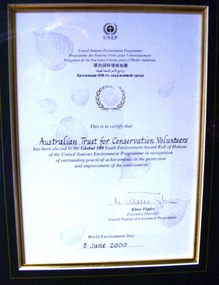
Award: Honour Roll, United Nations Environment Program (UNEP) - 1 June 2000 - The UNEP announced that the Australian Trust of Conservation Volunteers of Australia (ATCV), has been elected to the prestigious ranks of its Global 500 Roll of Honour for outstanding contributions to the protection of the environment, Award:United Nations Environment Program (UNEP) - 1 June 2000 - UNEP announced today that the ATCV has been elected to the prestigious ranks of its Global 500 Roll of Honour for outstanding contributions to the protection of the environment
... Activities range from bush regeneration, tree planting, seed collection, endangered species protection, weed control, flora and fauna surveys, walking trail construction, fencing, environmental monitoring and the protection of world heritage areas. ...Activities range from bush regeneration, tree planting, seed collection, endangered species protection, weed control, flora and fauna surveys, walking trail construction, fencing, environmental monitoring and the protection of world heritage areas. ...THE AUSTRALIAN TRUST OF CONSERVATION VOLUNTEERS, ONE OF 14 INDIVIDUALS AND ORGANIZATIONS, TO RECEIVE UNITED NATIONS ENVIRONMENT AWARD NAIROBI, 1 June 2000 - The United Nations Environment Programme (UNEP) announced today that the Australian Trust of Conservation Volunteers of Australia (ATCV), has been elected to the prestigious ranks of its Global 500 Roll of Honour for outstanding contributions to the protection of the environment. ATCV is one of 14 individuals and organizations to receive this honour in 2000. Founded in 1982, ATCV is a national, not-for-profit community organization, whose mission is to attract and manage a force of volunteers in practical conservation projects for the betterment of the Australian environment. ATCV completes more than 4000 week-long conservation projects in urban, regional and remote areas of Australia each year. Activities range from bush regeneration, tree planting, seed collection, endangered species protection, weed control, flora and fauna surveys, walking trail construction, fencing, environmental monitoring and the protection of world heritage areas. ATCV community participation has resulted in more than 1.8 million trees being planted in 1999, and in more than 7.3 million trees planted over the past 10 years. Community involvement totalled 200,000 project days in 1999 and more than 700,000 days since 1989. To encourage the involvement of young people, ATCV developed and manages the federal government-funded programme Green Corps. Green Corps is a six-month traineeship for 17 to 20 year-olds, which incorporates conservation projects and accredited training. Since 1997, more than 4,000 trainees have completed the Green Corps programme. ATCV is a founding member of the International Conservation Alliance, which brings together organizations working in conservation volunteering, and is a member of the World Conservation Union (IUCN). " The award will be presented in Adelaide, Australia, at the World Environment Day ceremonies on 4 June 2000. World Environment Day, which is celebrated in some 120 countries around the world on 5 June, was established by the United Nations General Assembly in 1972 to focus global attention and action on environmental issues. Some 701 individuals and organizations, in both the adult and youth categories, have been honoured since UNEP launched the Global 500 award in 1987. Among prominent past winners are: French Marine explorer Jacques Cousteau; Sir David Attenborough, producer of environmental television programmes; Gro Harlem Brundtland, former Prime Minister of Norway; Anil Aggarwal, the prominent environmentalist from India; Ken Saro-Wiwa, the environmental and human rights activist from Nigeria who was executed for leading the resistance of the Ogoni People against the pollution of their Delta homeland; the World Wide Fund for Nature (WWF), Jimmy Carter, former President of the United States; Jane Goodall of the United Kingdom whose research on wild chimpanzees and olive baboons provided insight into the lives of non-human primates; and the late Chico Mendes, the Brazilian rubber tapper who was murdered during his fight to save the Amazon forest. To forge global links and to implement ideas, which can contribute to a more sustainable future, a network of all Global 500 laureates has been formed. Information about this unique network can be obtained at http://www.global500.org. The winners of UNEP's Global 500 Roll of Honour are members of a broad and growing environmental movement that is flourishing around the world. They have taken the path that most of us hesitate to take for want of time or caring," says UNEP's Executive Director, Klaus Toepfer. "In honouring the Global 500 laureates, UNEP hopes that others will be inspired by their extraordinary deeds."Certificatecva, conservation volunteers, conservation volunteers australia, conservation volunteers new zealand, colin jackson, better earth, environmental conservation, volunteers, volunteering, corporate volunteering, education – environmental, carbon footprint, climate change, ballarat, safety, training, partnerships, victoria, vic, nsw, queensland, act, australian capital territory, nt, northern territory, western australia, wa, south australia, sa, tasmania, new zealand, california conservation corps, atcv, unep, unep honour roll, united nations environment program -
 Eltham District Historical Society Inc
Photograph - Digital Photograph, Alan King, Blue Lake, Plenty Gorge Park, 2008
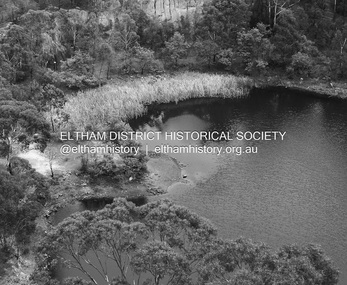
... species. The park, established in 1986, consists of around 1350 hectares, and extends 11 kilometres along the Plenty River, from Greensborough to Mernda. It provides a wildlife corridor for around 500 native plant...species. The park, established in 1986, consists of around 1350 hectares, and extends 11 kilometres along the Plenty River, from Greensborough to Mernda. It provides a wildlife corridor for around 500 native plant ...A quarry was transformed into the Blue Lake. Published: Nillumbik Now and Then / Marguerite Marshall 2008; photographs Alan King with Marguerite Marshall.; p179 The dramatic steep-sided Plenty Gorge lies along the divide of two geological areas, and separates the Nillumbik Shire and the City of Whittlesea. On the Nillumbik side are undulating hills and sedimentary rock, and in Whittlesea, lies a basalt plain formed by volcanic action up to two million years ago. This provides the Plenty Gorge Park with diverse vegetation and habitats, making it one of Greater Melbourne’s most important refuges for threatened and significant species. The park, established in 1986, consists of around 1350 hectares, and extends 11 kilometres along the Plenty River, from Greensborough to Mernda. It provides a wildlife corridor for around 500 native plant and 280 animal species. The area’s plentiful food and water attracted the Wurundjeri Aboriginal people and then European settlers. By 1837 squatters had claimed large runs of land for their sheep and cattle. The Plenty Valley was among the first in the Port Phillip District to be settled - mainly in the less heavily timbered west - and was proclaimed a settled district in 1841.But by the late 1880s, the settlers’ extensive land clearing for animal grazing, then agriculture, depleted the Wurundjeri’s traditional food sources, which helped to drive them away. Many Wurundjeri artefacts remain (now government protected), and so far 57 sites have been identified in the park, including scarred trees, burial areas and stone artefacts. Pioneer life could be very hard because of isolation, flooding, bushfires and bushrangers. Following the Black Thursday bushfires of 1851, basalt was quarried to build more fire-resistant homes. Gold discoveries in the early 1850s swelled the population, particularly around Smugglers Gully; but food production made more of an impact. In the late 1850s wheat production supplanted grazing. In the 1860s the government made small holdings available to poorer settlers. These had the greatest effect on the district, particularly in Doreen and Yarrambat, where orchards were established from the 1880s to 1914. Links with a prominent early family are the remains of Stuchbery Farm, by the river’s edge bounded by Smugglers Gully to the north and La Trobe Road, Yarrambat, to the east. The Stuchberys moved to the valley in 1890, and the family still lives in the area. In 1890, Alfred and Ada first lived in a tent where four children were born, then Alfred built the house and outbuildings around 1896. They planted an orchard, then a market garden, and developed a dairy. The family belonged to the local Methodist and tennis communities. Their grandson Walter, opened the Flying Scotsman Model Railway Museum in Yarrambat, which his widow, Vi, continues to run. Wal was also the Yarrambat CFA Captain for 22 years until 1987. Walter sold 24 hectares in 1976 for development - now Vista Court - and in 1990, the remaining 22.6 hectares for the park. Remaining are an early stone dairy and remnants of a stone barn, a pig sty and a well. Until it was destroyed by fire in 2003, a slab hut stood on the Happy Hollow Farm site, at the southern end of the park. The hut is thought to have been built in the Depression around 1893. This was a rare and late example of a slab hut with a domestic orchard close to Melbourne. Emmet Watmough and his family first occupied the hut, followed by a succession of families, until the Bell family bought it around 1948. There they led a subsistence lifestyle for 50 years, despite encroaching Melbourne suburbia. The Yellow Gum Recreation Area includes the Blue Lake, coloured turquoise at certain times of the year. Following the 1957 bushfires, this area was quarried by Reid Quarries Pty Ltd for Melbourne’s first skyscrapers, then by Boral Australia. However in the early 1970s water began seeping into the quarry forming the Blue Lake and the quarry was closed. The State Government bought the site in 1997 and opened it as a park in 1999.This collection of almost 130 photos about places and people within the Shire of Nillumbik, an urban and rural municipality in Melbourne's north, contributes to an understanding of the history of the Shire. Published in 2008 immediately prior to the Black Saturday bushfires of February 7, 2009, it documents sites that were impacted, and in some cases destroyed by the fires. It includes photographs taken especially for the publication, creating a unique time capsule representing the Shire in the early 21st century. It remains the most recent comprehenesive publication devoted to the Shire's history connecting local residents to the past. nillumbik now and then (marshall-king) collection, blue lake, plenty gorge park -
 Eltham District Historical Society Inc
Photograph - Digital Photograph, Marguerite Marshall, Stuchbery Farm dairy, 14 March 2008
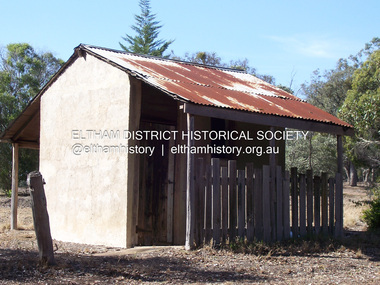
... It provides a wildlife corridor for around 500 native plant and 280 animal species. The area’s plentiful food and water attracted the Wurundjeri Aboriginal people and then European settlers. ...It provides a wildlife corridor for around 500 native plant and 280 animal species. The area’s plentiful food and water attracted the Wurundjeri Aboriginal people and then European settlers. ...Stuchbery Farm was situated on the Plenty River bounded by Smugglers Gully to the north and La trobe Road, Yarrambat, to the east. Alan and Ada Stutchbery moved to the valley in 1890, first living in a tent where four children were born. Alfred built a home and outbuildings around 1896. They planted an orchard, then a market garden and developed a dairy. Published: Nillumbik Now and Then / Marguerite Marshall 2008; photographs Alan King with Marguerite Marshall.; p179 The dramatic steep-sided Plenty Gorge lies along the divide of two geological areas, and separates the Nillumbik Shire and the City of Whittlesea. On the Nillumbik side are undulating hills and sedimentary rock, and in Whittlesea, lies a basalt plain formed by volcanic action up to two million years ago. This provides the Plenty Gorge Park with diverse vegetation and habitats, making it one of Greater Melbourne’s most important refuges for threatened and significant species. The park, established in 1986, consists of around 1350 hectares, and extends 11 kilometres along the Plenty River, from Greensborough to Mernda. It provides a wildlife corridor for around 500 native plant and 280 animal species. The area’s plentiful food and water attracted the Wurundjeri Aboriginal people and then European settlers. By 1837 squatters had claimed large runs of land for their sheep and cattle. The Plenty Valley was among the first in the Port Phillip District to be settled - mainly in the less heavily timbered west - and was proclaimed a settled district in 1841. But by the late 1880s, the settlers’ extensive land clearing for animal grazing, then agriculture, depleted the Wurundjeri’s traditional food sources, which helped to drive them away. Many Wurundjeri artefacts remain (now government protected), and so far 57 sites have been identified in the park, including scarred trees, burial areas and stone artefacts. Pioneer life could be very hard because of isolation, flooding, bushfires and bushrangers. Following the Black Thursday bushfires of 1851, basalt was quarried to build more fire-resistant homes. Gold discoveries in the early 1850s swelled the population, particularly around Smugglers Gully; but food production made more of an impact. In the late 1850s wheat production supplanted grazing. In the 1860s the government made small holdings available to poorer settlers. These had the greatest effect on the district, particularly in Doreen and Yarrambat, where orchards were established from the 1880s to 1914. Links with a prominent early family are the remains of Stuchbery Farm, by the river’s edge bounded by Smugglers Gully to the north and La Trobe Road, Yarrambat, to the east. The Stuchberys moved to the valley in 1890, and the family still lives in the area. In 1890, Alfred and Ada first lived in a tent where four children were born, then Alfred built the house and outbuildings around 1896. They planted an orchard, then a market garden, and developed a dairy. The family belonged to the local Methodist and tennis communities. Their grandson Walter, opened the Flying Scotsman Model Railway Museum in Yarrambat, which his widow, Vi, continues to run. Wal was also the Yarrambat CFA Captain for 22 years until 1987. Walter sold 24 hectares in 1976 for development - now Vista Court - and in 1990, the remaining 22.6 hectares for the park. Remaining are an early stone dairy and remnants of a stone barn, a pig sty and a well. Until it was destroyed by fire in 2003, a slab hut stood on the Happy Hollow Farm site, at the southern end of the park. The hut is thought to have been built in the Depression around 1893. This was a rare and late example of a slab hut with a domestic orchard close to Melbourne. Emmet Watmough and his family first occupied the hut, followed by a succession of families, until the Bell family bought it around 1948. There they led a subsistence lifestyle for 50 years, despite encroaching Melbourne suburbia. The Yellow Gum Recreation Area includes the Blue Lake, coloured turquoise at certain times of the year. Following the 1957 bushfires, this area was quarried by Reid Quarries Pty Ltd for Melbourne’s first skyscrapers, then by Boral Australia. However in the early 1970s water began seeping into the quarry forming the Blue Lake and the quarry was closed. The State Government bought the site in 1997 and opened it as a park in 1999.This collection of almost 130 photos about places and people within the Shire of Nillumbik, an urban and rural municipality in Melbourne's north, contributes to an understanding of the history of the Shire. Published in 2008 immediately prior to the Black Saturday bushfires of February 7, 2009, it documents sites that were impacted, and in some cases destroyed by the fires. It includes photographs taken especially for the publication, creating a unique time capsule representing the Shire in the early 21st century. It remains the most recent comprehenesive publication devoted to the Shire's history connecting local residents to the past. nillumbik now and then (marshall-king) collection, ada stuchbery, alan stuchbery, dairy, stuchbery farm, farm buildings, yarrambat, plenty gorge park -
 Federation University Historical Collection
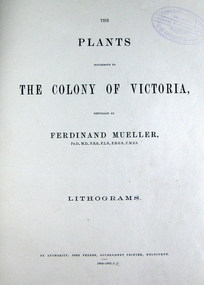
Book, The Plants Indigenous to the Colony of Victoria, 1865 (exact); "1864-1865, CR"
... The book illustrates Victorian plants and outlines the principal characters of those species. This book is No 1290 in the Original Register of Books (Cat. ...The book illustrates Victorian plants and outlines the principal characters of those species. This book is No 1290 in the Original Register of Books (Cat. ...Baron Sir Ferdinand Jacob Heinrich von Mueller was born in Germany on 30 June 1825. Ferdinand was a German-Australian physician, geographer, and a botanist. After passing the pharmaceutical examinations he studied botany at Kiel University. In 1847 he received the degree of Doctor of Philosophy from Kiel University.when he was 21 years old for a thesis on the flora of Schleswig-Holstein. In 1847, he moved to Adelaide, Australia and worked as a chemist. From 1848 to 1852 he travelled through the colony, discovering and describing a large number of unknown to Western science plants. He wrote a few papers to German periodicals on botanical subjects. In 1851, Mueller moved to Melbourne, capital of the new colony of Victoria. In 1853, He was appointed Government Botanist for Victoria by Governor Charles La Trobe. In 1873, Ferdinand received an honorary doctorate of the University of Rostock. In 1883, he was awarded the Clarke Medal by the Royal Society of New South Wales. He published many volumes on the Victorian plants. Many of Australian geographical features were named after him such as: the Mueller Ranges (WA), Muellers Range (Qld), Mount Mueller (in WA, NT, Tas and Vic) and many more. Mueller died in Melbourne on 10 October 1896 and is buried in the St. Kilda Cemetery A green cloth hard cover book. Title and author's name is engraved in gold on spine. It includes an introduction, a table of contents and plates. Lithograms in b/w. Each plate accompanied by a page with descriptive print. Number of plates XIII-LXXI. No. of supplement plates XII-XVII. The book illustrates Victorian plants and outlines the principal characters of those species. This book is No 1290 in the Original Register of Books (Cat. No. 005)Hand written pencil notes on contents page. Stamped throughout with "The School of Mines, Industries & Science, Ballarat. Ingenio Effodere Opes. In the University of Melbourne."australia, botany victoria, plants, ferdinand mueller, ferdinand von mueller, biodiversity, flora -
 Federation University Historical Collection
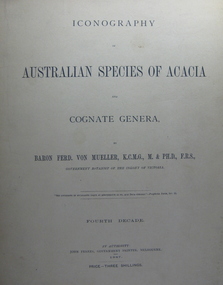
Book, Baron Ferdinand Von Mueller, Iconography of Australian Species of Acacia and Cognate Genera by Ferdinand Von Mueller
... plants, including valued grasses of interest and use to agriculturalists and graziers generally' to SMB over many years. Ferdinand von Mueller's entry on the University of Ballarat Honour Roll can be found at http://www.ballarat.edu.au/curator/honour-roll/honourroll_von_mueller.shtml botany ferdinand von mueller von mueller botanic illustrations government botanist acacia Large format, brown, soft covered books with beautiful line drawings. Set contains 6 of 13 parts, Part 1 covers the fourth decade, Part 2 the fifth decade, Part 3 the eight decade, Part 4 the ninth decade, Part 5 the tenth decade and Part 6 the eleventh decade. Iconography of Australian Species ...Ferdinand von Mueller was an examiner of botany at the Ballarat School of Mines (SMB) between 1880 and 1888. During that era he was active in donating related items to the School. When the Ballarat School of Mines Council agreed to introduce pharmacy and botany classes in 1879, it was apparent students would require access to botanical specimens in order to further their studies. Council members, who were inspired by the work of Baron Ferdinand von Mueller, authorised development of an area along the School's northern boundary, fronting Lydiard Street South, and oversaw the establishment of the new Botanical Gardens. Baron von Mueller took a practical role the development of SMB's Botanical Gardens from the beginning. He became a generous benefactor who 'donated collections of seeds and leguminous fodder plants, including valued grasses of interest and use to agriculturalists and graziers generally' to SMB over many years. Ferdinand von Mueller's entry on the University of Ballarat Honour Roll can be found at http://www.ballarat.edu.au/curator/honour-roll/honourroll_von_mueller.shtml Large format, brown, soft covered books with beautiful line drawings. Set contains 6 of 13 parts, Part 1 covers the fourth decade, Part 2 the fifth decade, Part 3 the eight decade, Part 4 the ninth decade, Part 5 the tenth decade and Part 6 the eleventh decade.botany, ferdinand von mueller, von mueller, botanic illustrations, government botanist, acacia -
 The Beechworth Burke Museum
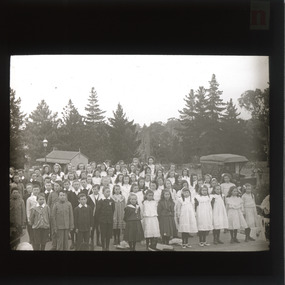
Photograph - Lantern Slide, c1900
... planted in 1861 and have since been heritage listed on the National Trust's register of significant trees. There are nine trees located in Queen Victoria Park that are currently on the National Trust's register. These are the Loblolly Pine, Italian Cypress, Shore Pine, and the Big Cone Pine. These trees hold significance as they date back to 1875 and show rare and localised examples of these types of species...planted in 1861 and have since been heritage listed on the National Trust's register of significant trees. There are nine trees located in Queen Victoria Park that are currently on the National Trust's register. These are the Loblolly Pine, Italian Cypress, Shore Pine, and the Big Cone Pine. These trees hold significance as they date back to 1875 and show rare and localised examples of these types of species ...This glass slide depicts a group of school children standing in Queen Victoria Park (previously Beechworth Botanic Gardens), circa 1900. Queen Victoria Park was first secured in 1858 by the Beechworth Council with the assistance of the Central Board of Health (CBH). The CBH was a firm believer in the socially beneficial effects of parks and other recreation areas which is why they aided the council in securing the parkland. the council held a local competition for the design of the park and decided on a plan called "Better late than never" by Hungarian nobleman, J.A. Rochlitz. The first non-native trees were planted in 1861 and have since been heritage listed on the National Trust's register of significant trees. There are nine trees located in Queen Victoria Park that are currently on the National Trust's register. These are the Loblolly Pine, Italian Cypress, Shore Pine, and the Big Cone Pine. These trees hold significance as they date back to 1875 and show rare and localised examples of these types of species which are not seen in many other places in Victoria. The trees in the background of the glass slide depict a species of the pine tree and may be some of the trees still standing in Queen Victoria Park today.This glass slide captures social and historical significance as it not only captures a moment in time of these school children, but it also shows environmental significance for the heritage trees depicted in the background.burke museum, beechworth, lantern slide, slide, glass slide, plate, burke museum collection, photograph, monochrome, queen victoria park, indigo shire, school, j.a. rochlitz, beechworth council
