
Showing 8 items matching "pocket compass"
-
 Flagstaff Hill Maritime Museum and Village
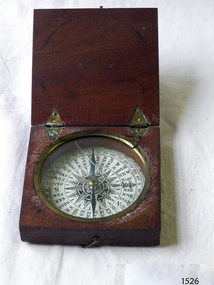
Instrument - Compass, c. 1839
... ...pocket compass...Did Charles Gray acquire the pocket compass in Leith, perhaps as a gift or a souvenir of his motherland? ...Pocket compass, brass, set into a square wooden case with hinged lid and small hook catch. ...Pocket compass, brass, set into a square wooden case with hinged lid and small hook catch. ...This magnetic compass is a good size to fit easily into a person's pocket or personal luggage and is protected from knocks by its wooden case. It could have been used for reference when travelling on land or sea. There is no visible manufacturer's mark, which may mean that it was not of high monetary value. Leith is a district of Edinburgh in the country of Scotland, the U.K. It was once the Port of Edinburgh and many migrant ships departed from here bound for the Australian colony. It had a busy shipbuilding industry, with wet and dry docks. It appears from the inscription on the case "Chas Gray, LEITH, 1839" that this pocket compass once belonged to Charles M. Gray (Chas is a common abbreviation for the name Charles). The inscription coincides with the name, place and date that the Western Victorian pioneer Charles M. Gray left Scotland and arrived in Australia. Charles Gray was born in Anstruther, Scotland, in 1818. His family was connected with the Royal Marines, which may have created his nautical instruments such as this pocket compass. Charles Gray arrived in Hobson's Bay on 15 June 1839 on the ship “Midlothian”. That same ship had departed from Leith, Scotland on February 15th 1839. Did Charles Gray acquire the pocket compass in Leith, perhaps as a gift or a souvenir of his motherland? Charles Gray was an early squatter and went on to become a very successful settler as a sheep pastoralist in the Western District of what is now Victoria (originally the colony of New South Wales). He and his wife had a large property called “Nareeb Nareeb”, Green Hill Creek District (now Glenthompson), Victoria, from 1840-1886. He was also a local Councillor and Justice of the Peace, and had an interest in the local indigenous people; he named his property after their tribe. Charles returned to England in 1890 and died there in 1905. Charles Gray had written an account in 1890 of his life at Nareeb Nareeb, called Western Victoria in the Forties: "REMINISCENCES OF A PIONEER The Western District in the 1840's By Charles Gray" , a valuable historical reference to colonial Victoria. His book was published by the Hamilton Spectator in 1932. Charles Gray's photograph is one of 713 historical photographs of early Victorian settlers, created as a montage by Thomas Foster Chuck in 1872. The State Library of Victoria holds the framed montage titled “The Explorers and Early Colonists of Victoria”. To qualify for inclusion on this montage the Settlers must have arrived in Victoria before 1843. Charles Gray's photograph is number 349! The pocket compass is associated with Charles Gray, one of the early squatters and settlers in Western Victoria, possibly given to him as a parting gift on his emigration to Van Diemans land in 1839. The item is very significant as it's connection with one of Victoria's early pioneers is well provenanced by the inscriptions on the wooden case. Pocket compass, brass, set into a square wooden case with hinged lid and small hook catch. Compass is marked with 360 degrees and compass points and has two pointers; one to show magnetic north and one to set the direction of travel. Hinges are triangular and inset into the wood. The lid has an attached brass plaque with the inscription "Chas Gray, Leith, 1839" (It likely belonged to Charles Gray, Leith, UK, who migrated to Port Philip Australia in 1839 and became a successful pastoralist.) “Chas Gray / LEITH / 1839” engraved on brass plaque on lid.flagstaff hill, warrnambool, shipwrecked coast, flagstaff hill maritime museum, maritime museum, shipwreck coast, flagstaff hill maritime village, great ocean road, magnetic compass, pocket compass, charles m. gray, chas gray, migrrant from leith 1839, charles gray anstruther, scottland, ship midlothian 1839, squatter western victoria, settler western victoria, hobson's bay port phillip australia, charles gray nareeb nareeb - green hill creek district, western victoria in the forties: reminiscences of a pioneer by charles m. gray 1890, leith edinburgh u.k., western victoria in the forties: reminiscences of a pioneer - montage by thomas foster chuck 1872, charles gray, reminiscences of a pioneer, the western district in the 1840's, compass, scientific instrument, nautical instrument, direction, directional compass, navigation -
 Montmorency–Eltham RSL Sub Branch
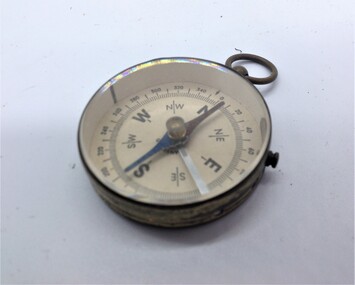
Equipment - Compass
... World War I pocket compass given to Australian Officers & NCOs....World War I pocket compass given to Australian Officers & NCOs. ...World War I pocket compass given to Australian Officers & NCOs.Magnetic 'marching' compass -
 Bendigo Military Museum
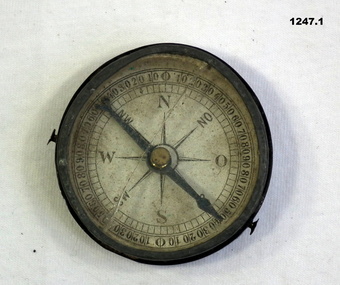
Equipment - COMPASS, PROTRACTOR, RULER, Est WWI
... .1) Pocket compass, metal and glass, mirror backed. .2) Protractor-wooden, metal stud and ring. .3) Ruler, wood, in 2 parts....Part of the Grinton collection which included hundreds of negatives and developed photos that he took during the War. instruments-measuring surveyors-terrestrial .2) "Veare wood" .3) One inch and centimetre increments. .1) Pocket compass, metal and glass, mirror backed. .2) Protractor-wooden, metal stud and ring. .3) Ruler, wood, in 2 parts. ...The 3 items belonged to Sgt Jack Grinton No 1043, 38th Batt AIF. The ruler was broken by a small piece of shrapnel which then passed through a wallet containing photos. Refer Cat No 1280 for service details. Refer 1317P, 1320P, 1241.22P, 1278.2. Part of the Grinton collection which included hundreds of negatives and developed photos that he took during the War..1) Pocket compass, metal and glass, mirror backed. .2) Protractor-wooden, metal stud and ring. .3) Ruler, wood, in 2 parts..2) "Veare wood" .3) One inch and centimetre increments.instruments-measuring, surveyors-terrestrial -
 Frankston RSL Sub Branch
Compass, Marching, 1918
... A pocket sized marching compass enclosed in a wooden container with a hinged lid. ...The compass container is marked J. WARDALE & Co., LONDON, 1918 No 6341. A pocket sized marching compass enclosed in a wooden container with a hinged lid. ...A pocket sized marching compass enclosed in a wooden container with a hinged lid. This is a dry type compass with a floating rotary dial marked with the major and minor compass points and an outer circular dial marked from 0 to 360 degrees in 10 degrees increments. The compass container is marked J. WARDALE & Co., LONDON, 1918 No 6341. -
 Moorabbin Air Museum
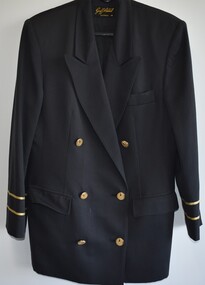
Uniform (item) - Compass Airlines Senior Purser Jacket
... Black, double breasted jacket with six front gold toned Compass insignia buttons. It has a single left hand breast pocket, with two lower pockets with flaps, it has Senior Purser rank braid, two stripes on lower part of both sleeves....Black, double breasted jacket with six front gold toned Compass insignia buttons. It has a single left hand breast pocket, with two lower pockets with flaps, it has Senior Purser rank braid, two stripes on lower part of both sleeves. ...Manufactured by Geoff Riddell Australia Size:10 -
 Ballarat RSL Sub-Branch Inc.
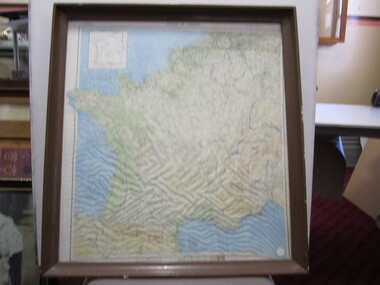
Photograph - "Zones of France"
... On back - "R.A.F. aircrew escape map in World War II, printed on silk, carried in trousers knee pocket, and used with compass built into brass button (left-hand thread). ...Photo/Pictures Ballarat RSL Ballarat On back - "R.A.F. aircrew escape map in World War II, printed on silk, carried in trousers knee pocket, and used with compass built into brass button (left-hand thread). ...On back - "R.A.F. aircrew escape map in World War II, printed on silk, carried in trousers knee pocket, and used with compass built into brass button (left-hand thread). The object was to set the aviator in the right direction for nephoto/pictures, ballarat rsl, ballarat -
 Vision Australia
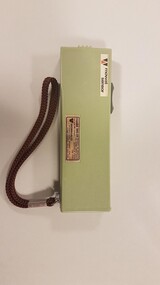
Equipment - Object, Wormald International Sensory Aids Ltd, Mowat sensor, 197
... pocket or purse. As a facility intended for partially sighted people, the compass also includes an in-built color indicator (visible through the semi-transparent enclosure), which indicates the direction using a combination of three colours. ...pocket or purse. As a facility intended for partially sighted people, the compass also includes an in-built color indicator (visible through the semi-transparent enclosure), which indicates the direction using a combination of three colours. ...The Mowat Sensor model MS 01, is a pale green, palm-sized, plastic battery-operated device with a darker green switch on top. It is partially open at one end with two grilles. A microphone plugs into the other end with a wrist strap. It came with a brown vinyl carry case and owner's manual, which are not included. This handheld device for the visually impaired uses high frequency sound to detect objects within a narrow beam. The sensor vibrates if an object is present, responds to closest object within the beam. The vibration rate increases as user approaches object. There are two range settings: short, responds to objects less than 1 meter away (indoor use) and long, responds to objects of sufficient size up to 4 meters. The sensor can be handheld or carried in pocket or purse. As a facility intended for partially sighted people, the compass also includes an in-built color indicator (visible through the semi-transparent enclosure), which indicates the direction using a combination of three colours. Weight: 185 grams. Comes with dark brown vinyl case.1 pale green coloured plastic rectangle sensor with a brown nylon, plaited wrist strap Model MS01assistive devices, orientation and mobility -
 Moorabbin Air Museum
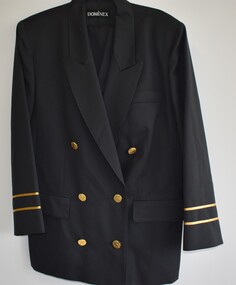
Uniform (item) - Compass Airlines Senior Purser Jacket, Compass Airlines Senior Purser Jacket
... Black, double breasted jacket with six front gold toned Compass insignia buttons. It has single left breast pocket with two lower pockets with flaps, with Senior Purser rank braid, two stripes on sleeve. ...Black, double breasted jacket with six front gold toned Compass insignia buttons. It has single left breast pocket with two lower pockets with flaps, with Senior Purser rank braid, two stripes on sleeve. ...
