
Showing 23 items matching "port phillip herald"
-
 University of Melbourne, Burnley Campus Archives
Article - Photocopy, Port Phillip Gazette, Victoria Horticultural Society, 1848-1850
... ...port phillip gazette...port phillip herald...Port Phillip Gazette 28.11.1848: "Formation of a Horticultural Society." 2. Supplement to Port Phillip Herald 14.12.1848: "Horticultural Society." 3. ...Port Phillip Gazette...Port Phillip Herald...Victoria Horticultural Society John Pascoe Fawkner port phillip gazette port phillip herald melbourne morning herald horticultural society Photocopies of newspaper articles on formation of the (Victoria) Horticultural Society 1. ...Photocopies of newspaper articles on formation of the (Victoria) Horticultural Society 1. Port Phillip Gazette 28.11.1848: "Formation of a Horticultural Society." 2. Supplement to Port Phillip Herald 14.12.1848: "Horticultural Society." 3. Melbourne Morning Herald 10.08.1850: "Victoria Horticultural Society."victoria horticultural society, john pascoe fawkner, port phillip gazette, port phillip herald, melbourne morning herald, horticultural society -
Port Melbourne Historical & Preservation Society
Newspaper - Death Notice for Port Melbourne as an independent municipal district, Terry Keenan, 23 Jun 1994
... local government - city of port phillip...herald...Written by Terry Keenan and put into the Herald Sun at the time of the Port Melbourne Council amalgamation with South Melbourne and St Kilda into Port Phillip, 1994...Written by Terry Keenan and put into the Herald Sun at the time of the Port Melbourne Council amalgamation with South Melbourne and St Kilda into Port Phillip, 1994 amalgamation local government - city of port melbourne local government - city of port phillip herald sun terry keenan Death Notice for Port Melbourne! ...Written by Terry Keenan and put into the Herald Sun at the time of the Port Melbourne Council amalgamation with South Melbourne and St Kilda into Port Phillip, 1994Death Notice for Port Melbourne! Inserted by Terry Keenan. "Born 1860. Died 1994. Aged 134 years. Known affectionately far and wide as 'The Borough' . Died fighting game to the last, succumbed eventually to the marauding barbarians. Deeply mourned by her countless sons and daughters. R.I.P."amalgamation, local government - city of port melbourne, local government - city of port phillip, herald sun, terry keenan -
Clunes Museum
Newspaper, 1990
... AN ARTICLE FROM THE PORT PHILLIP HERALD FRIDAY JANUARY 3RD 1840 ON THE RIGHT OF THE COLOURED PICTURES AND AN ARTICLE FROM THE HERALD WEDNESDAY JANUARY 3, 1900 ON THE LEFT SIDE....LOCAL HISTORY DOCUMENTS NEWSPAPER NEWSPAPER AN ARTICLE FROM THE PORT PHILLIP HERALD FRIDAY JANUARY 3RD 1840 ON THE RIGHT OF THE COLOURED PICTURES AND AN ARTICLE FROM THE HERALD WEDNESDAY JANUARY 3, 1900 ON THE LEFT SIDE. ...A SPECIAL EDITION OF 'THE HERALD' FOR THE 150TH ANNIVERSARY. THE FRONT PAGE SHOWS AN OIL ON CANVAS BY HENRY BORN C.1807-1884 REPRESENTING A PAINTING OF THE SWANSON STREET BRIDGE. BELOW IS A PHOTOGRAPH OF PRINCES BRIDGE TODAY.AN ARTICLE FROM THE PORT PHILLIP HERALD FRIDAY JANUARY 3RD 1840 ON THE RIGHT OF THE COLOURED PICTURES AND AN ARTICLE FROM THE HERALD WEDNESDAY JANUARY 3, 1900 ON THE LEFT SIDE.local history, documents, newspaper, newspaper -
Glen Eira Historical Society
Article - MURRUMBEENA FOOTBALL CLUB
... Articles are from Glen Eira News, Caulfield Port Phillip Leader, Herald Sun and www.murrumbeenafc.org...Articles are from Glen Eira News, Caulfield Port Phillip Leader, Herald Sun and www.murrumbeenafc.org Murrumbeena Football Club Murrumbeena Rovers Murrumbeena Park Gould Ross Ormsby Noreen Ormsby Brian Football Club Lloyd-Griffiths Emrys Niclasen Mark Niclasen Michelle Potter Mick Minister Coulson John Walker Jacqui Spawlding Cath McDonough Jan Roy Lesley McSwain Margaret Felkel Charlie MacDonald Paul MacDonald Mark MacDonald Tim Jungwirth Ken Scott Greg O’Dea Peter Jones Matt Smith Joshua Douma Jesse Gheller Tom Kennedy Tim McCall Pete Cieslak Luke Siegert Tom Zara Phil Rodwell Kyle Shirley James Davidson Nathan Jones Chris Wolder Mitch Pratt Benny Rowlands Ash Kolb Kris Downing Kane Jones Matt Murphy Dave McCormack Mick Jones Chris Ahmad Mansor Lint Marcus Van Bold Andrew Christie Dale Pratt Ben Hargrave Cory Lello Matt Farthing Michael Sissons Jeremy ‘Siss’ Black Graham Hawking Shawn Fenton Boby Walder Mitch Spaulding Rob Gould Ross Venturini Micah Walker Warren Osmol Jack Ray Steven Aspens Dean Niclasen Mark Spanos Dean Kappler Darren Ambrosini Paul Black David Trigellis-Smith Colin Valenta Tom Hargreaves Josh Porter Steve Porter Luke Willis Daniel Hargrave Cory Magdis Andrew Cornish Jason Dickson Tom Ziebell Rob McGinley Daniel Kirk-Williams Callum Spanos Dean Douma Jesse Gheller Tom Evans Chris Coulson John Farthing Mick Semmell Jake Beamish Blair Ando Justin Ricketson Josh Kinsella Michael Wills Daniel Article MURRUMBEENA FOOTBALL CLUB ...35 newspaper articles on Murrumbeena Football Club, includes results of football matches from September 2010, to 6/08/2013. Articles are from Glen Eira News, Caulfield Port Phillip Leader, Herald Sun and www.murrumbeenafc.orgmurrumbeena football club, murrumbeena rovers, murrumbeena park, gould ross, ormsby noreen, ormsby brian, football club, lloyd-griffiths emrys, niclasen mark, niclasen michelle, potter mick, minister, coulson john, walker jacqui, spawlding cath, mcdonough jan, roy lesley, mcswain margaret, felkel charlie, macdonald paul, macdonald mark, macdonald tim, jungwirth ken, scott greg, o’dea peter, jones matt, smith joshua, douma jesse, gheller tom, kennedy tim, mccall pete, cieslak luke, siegert tom, zara phil, rodwell kyle, shirley james, davidson nathan, jones chris, wolder mitch, pratt benny, rowlands ash, kolb kris, downing kane, jones matt, murphy dave, mccormack mick, jones chris, ahmad mansor, lint marcus van, bold andrew, christie dale, pratt ben, hargrave cory, lello matt, farthing michael, sissons jeremy ‘siss’, black graham, hawking shawn, fenton boby, walder mitch, spaulding rob, gould ross, venturini micah, walker warren, osmol jack, ray steven, aspens dean, niclasen mark, spanos dean, kappler darren, ambrosini paul, black david, trigellis-smith colin, valenta tom, hargreaves josh, porter steve, porter luke, willis daniel, hargrave cory, magdis andrew, cornish jason, dickson tom, ziebell rob, mcginley daniel, kirk-williams callum, spanos dean, douma jesse, gheller tom, evans chris, coulson john, farthing mick, semmell jake, beamish blair, ando justin, ricketson josh, kinsella michael, wills daniel -
 Ballarat Tramway Museum
Book, H.P. James, "In Other Days", late 1930's
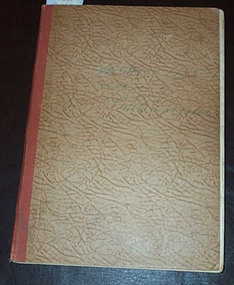
... Item 2505. 53 - Newspaper cutting "100 years ago", Port Phillip Herald for 1840. 54 - Black and white photo of a gathering of people (tramway?) ...Item 2505. 53 - Newspaper cutting "100 years ago", Port Phillip Herald for 1840. 54 - Black and white photo of a gathering of people (tramway?) ...ESCo Employee Hours Work Record book that has been used by an ESCo/SEC inspector, H. P. James as a record / note book for his personal collection or papers or journal titled "In Other Days". Book sewn with string in 36 page sections, blank end papers, board covers with stipple paper out sides and Rexene cloth binding. Comprising plain paper end papers and 104 printed pages (52 leaves), with each sheet printed in black on feint ruled paper for recording the hours worked and other details of drivers and conductors employed by ESCo. Printed for daily use, with Day and date page headings - made out for the 1930's. Text generically printed feint ruled paper. Images: Book - i1 Inside front cover - i2 Members Certificate - i3 Photo of H.P. James and index page - i4 Has been used to gather mementos such as photos, articles, newspaper clippings, letters and other miscellaneous documents on Ballarat local history. Newspaper cuttings etc often have side notes written by Mr. James. Inside front cover has certificate recording Mr. James membership to the Ballarat Historical Society (on Australasian Historical Record Society paper) for 1937 - 1938. A side note records Mr. James elected as Vice President in 1939. Receipt signed by Edward Crimmins (See Reg. Item 2486) Has a table of contents for pages 1 to 65. Opposite is a photograph of Mr. James dressed for the Ballarat Tramways Social Club function - See Reg. Item No. 506 Primary items are: 1 - Newspaper cutting "A stroll along Bridge St. 50 years ago" - Nathan F. Speilvogel. 3 - Newspaper cutting "What I Remember of Early Ballarat" - James Sainsberry. 4 - Newspaper cutting "Magnet that Made Ballarat - New Monument Marks Gold Discovery" 7 - Newspaper cutting "Romance of a Ballarat Street Block" - Speilvogel 9 - Newspaper cutting "Sixty years of Dana St. School"- Speilvogel 11 - Newspaper cutting "The White Flat - its Transitions of Service - Historical Review" - J. Hargreaves 15 - Newspaper cutting "Memories of Russell Square - Fireman's Carnivals" - James 16 - Notes on the Alfred Hall 17 - Newspaper cutting - "Alfred Hall" - James 21 - Letter re Russell Square dated 24/2/38, J. McLeish 23 - Newspaper cutting "The First Train to Ballarat" 25 - Newspaper cutting "Story of Ballarat's Horse Trams 1887 to 1913", James - see Reg. Item 2489. 27 - Photos and Newspaper cutting of items re horse trams, and photo of ESCo No. 18 - See Reg. Items 2490, 2491 and 2492. 28 - ESCo opening ticket (See other Reg. Items 608 for examples of this) ticket No. 1595. 29 - Newspaper cutting "Story of Ballarat's Electric Trams", James, See Reg. Item 2493. 30 - Poster - SEC - Ballarat "The New System of Fares and Sections" - 3/10/1997 - See Reg. Item 2494. SEC - Tourist Ticket - See Reg. Item 2495 ESCo - 3d check ticket - See Reg. Item 2496 31 - Tickets and handwritten notes - with reference to page 51 ESCo 1d - See Reg. Item 2497 (2 No.) ESCo/SEC? - lunch hour weekly ticket - See Reg. Item 2498 ESCo/SEC? - Morning and evening weekly ticket - See Reg. Item 2499 ESCo/SEC? - 3d Adult Transfer - See Reg. Item 2500 ESCo/SEC? - 2d child Transfer - See Reg. Item 2501 ESCo - 1.1/2 child ticket - See Reg. Item 2502 ESCo - 3d Adult ticket - See Reg. Item 2503 Extract of an item titled "History of Ballarat Tramways", SEC Magazine, Feb. 1939 - See Reg. Item 2504 2d ESCo token (See other reg items 1794 and 1943 for details of this object) - sewn into page. 33 - Handwritten notes "Alfred Hall" 35 - Handwritten notes "Russell Square" 36, 37 - miscellaneous cuttings from the Courier for 1939 and 1940 39 - Newspaper cutting "South Street Band Contests" - cutting dated 27/10/1932. (See images - i5 to 41, 43, - ditto - contest results 44 - Photo of the Tramway Shelter in Sturt Street being removed - Courier dated 18/12/1923 - see Reg Item 2523. 45 - Extract of April 1938 from SEC Magazine, photos of the launch of the illuminated Ballarat Centenary tram - see Reg Item 2524. 47 - Newspaper cutting "Peeps into the Past" 48 - Listing of "Members of Returned Soldiers Band", Ballarat, dated 18/11/1919. 49 - Newspaper cutting "Ballarat, The Home of the Band Contests", dated 27/10/1932. 51 - Handwritten notes - "Tram Fares methods of collection" - See Reg. Item 2505. 53 - Newspaper cutting "100 years ago", Port Phillip Herald for 1840. 54 - Black and white photo of a gathering of people (tramway?) at the Showgrounds - See Reg. Item 2506 55 - Six black and white photos with handwritten notes ESCo 19 or 20 - See Reg. Item 2507 Group of ESCo employees by ESCo tram - See Reg. Item 2508 Photo of ESCo employee, Si Barker - See Reg. Item 2509 Photo of ESCo company bus - See Reg. Item 2510 (See also Reg Item 3813) Photo of No. 25 - Barkly St - See Reg. Item 2511 Photo of two ESCo employees - See Reg. Item 2512 56 - Loose newspaper cutting "San Francisco Struggle Buggies" - cable trams - The Age 15/3/1947 57 - Letter from Mr. Pringle of ESCo to Inspector James and Handwritten notes on ESCo management - See Reg. Item 2513 Handwritten notes on the token systems - See Reg. Item 2514 59 - Page titled "Bundy clocks and meters" but no notes 61 - Hand drawn map of Ballarat tramways with notes on tracks - horse, SEC and ESCo and loops - See Reg. Item 2515. 63 - Miscellaneous newspaper cuttings and photo of the Arch of Victory 64 - Photo of W. J.K. Dunstan ??? (has notes written on back, but difficult to read)* - Notes on rear of photo p64. "49 years in service W.J.K. Dunstan Office Manager Ballarat Branch Retired 18/3/46" 65 - Newspaper cutting "Old Victorian Schooldays, letters and reminiscences by past scholars". 67 - Newspaper cuttings - photo of Ballarat Choral Union and Urquhart St. school 69 - Newspaper cutting "Saint with a top hat" 71, 73 - Newspaper cutting "District Mining Disasters of By-Gone Days" - John Hargreaves 75 - Newspaper cutting "The Ballarat Courier" banners for 2/9/1939 - outbreak of World War Two - normal and a special edition. 77, 79 - Newspaper cutting "My Youth in Ballarat" - T.P. Long. 81 - Two photos and handwritten notes showing trams in Sturt St and the line up of horse trams - See Reg Item 2516. 83 - Newspaper cutting "Theatrical History - The Charlie Napier" - Speilvogel 85, 87 - Newspaper cutting "Story of the Eureka Stockade Monument" - Speilvogel 89 - Newspaper cutting "The Beginning of Buninyong" - Speilvogel 91 - Newspaper cutting "St. David's Day" 93, 95 - Newspaper cutting "From 1856 to 1894, Ballarat's Foremost Citizen Major (William Collard) Smith Recalled - J. Hargreaves. 97 - Newspaper cutting "All Electrical Exhibition / Ballarat's Electric Supply, its development" - 1936, See Reg. Item 2517. 98 - Loose photo of the ESCo Power station chimney and steeplejacks - See Reg. Item 2518. 98 - Loose sheet of paper about the origin of the ESCo trams - See Reg. Item 2525. 99 - Newspaper cutting - about Electricity in Ballarat and tramway services, and handwritten notes on ESCo Inspectors - See Reg. Item 2519 100, 101 - Newspaper cuttings - "Mr. Melbourne Day by Day" cartoon series and the artist's death notice dated 22/8/1939. 102 - Poster - Dana Street School Jubilee Re-union, has N. Speilvogel and H. James as joint secretaries. 103 - Newspaper cutting of various photos and a scene of a gold train at Bendigo 104 - Newspaper cuttings - Bob Menzies and Adolph Hitler and backs of Melbourne tram tickets - "School Boy Howlers". 105 - Letter in an envelope to H.P. James dated 11/10/1937, by a person about the building of the tram sheds at Wendouree - See Reg. Item 2520. Newspaper cutting of the opening of the tramway to Lydiard St. North from Gregory St. - See Reg. Item 2521 Loose item - 1/- SEC Tourist Ticket No. A2676 - See Reg. Item 2522.Many in pencil and inktrams, tramways, h.p. james, esco, horse trams, ballarat, civic history -
 Mission to Seafarers Victoria
Photograph, circa 1935
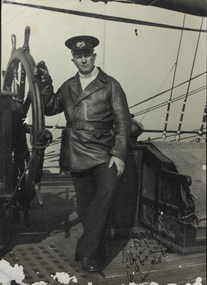
... Herald, Tuesday 27 April 1937, page 12: "The C. B. Pedersen was built in 1891. It has visited Australia several times, the most recent occasion having been in 1935, when It was anchored in Port Phillip Bay, Victoria, for several weeks, awaiting a suitable cargo. ...Herald, Tuesday 27 April 1937, page 12: "The C. B. Pedersen was built in 1891. It has visited Australia several times, the most recent occasion having been in 1935, when It was anchored in Port Phillip Bay, Victoria, for several weeks, awaiting a suitable cargo. ...In 1935, the CB Pedersen arrived on the 13th of April after 198 days at sea. The ship left on the 18th June (date written on the photograph) after two months in Melbourne. Captain Dalhstrom had been its skipper for 13 years. In the Sydney Morning Herald, Tuesday 27 April 1937, page 12: "The C. B. Pedersen was built in 1891. It has visited Australia several times, the most recent occasion having been in 1935, when It was anchored in Port Phillip Bay, Victoria, for several weeks, awaiting a suitable cargo. At length the master, (Captain Hjalmar Dahlström) announced that, as no cargo could be obtained he would be prepared to carry passengers in a voyage to Gothenburg, via Torres Strait. Eight persons, including three women and a small boy were accepted as passengers, and signed on as members of the crew at salaries of 1/ a month". Artist Violet Teague was one of the passengers. She painted during the voyage and exhibited her work in 1938. Built in 1891 the C.B Pedersen, a four-masted steel barque (2142 tons) was used as a training Barque. The ship foundered in April 1937, the crew was saved.The C.B. Pedersen was one of the last windjammers sailing in the 1930s with the Herzogin Cecilie and the Grace Harwar. Black and white photographLower right corner front in black ink: H. Dahlström / June 13th 1935 / On board the CBP / in Hobson's Bayc.b. pedersen, captain hjalmar dahlström, violet teague, windjammer, sweden -
 Mission to Seafarers Victoria
Photograph, Peckham Photographic Studios, Geo Beachcroft, Capt Dahlström and 2nd mate of the C.B. Pedersen, c. 1935
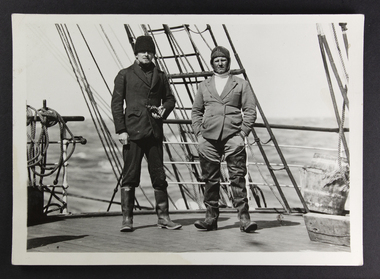
... Herald, Tuesday 27 April 1937, page 12: "The C. B. Pedersen was built in 1891. It has visited Australia several times, the most recent occasion having been in 1935, when It was anchored in Port Phillip Bay, Victoria, for several weeks, awaiting a suitable cargo. ...Herald, Tuesday 27 April 1937, page 12: "The C. B. Pedersen was built in 1891. It has visited Australia several times, the most recent occasion having been in 1935, when It was anchored in Port Phillip Bay, Victoria, for several weeks, awaiting a suitable cargo. ...In the Sydney Morning Herald, Tuesday 27 April 1937, page 12: "The C. B. Pedersen was built in 1891. It has visited Australia several times, the most recent occasion having been in 1935, when It was anchored in Port Phillip Bay, Victoria, for several weeks, awaiting a suitable cargo. At length the master, (Captain Hjalmar Dahlström) announced that, as no cargo could be obtained he would be prepared to carry passengers in a voyage to Gothenburg, via Torres Strait. Eight persons, including three women and a small boy were accepted as passengers, and signed on as members of the crew at salaries of 1/ a month". Artist Violet Teague was one of the passengers. She painted during the voyage and exhibited her work in 1938. Built in 1891 the C.B Pedersen, a four-masted steel barque (2142 tons) was used as a training Barque. The ship foundered in April 1937, the crew was saved. Several photographs of the C.B. Pedersen taken by the same studio are held at the State Library of Victoria.see links aboveBlack and white photograph depicting two sailors in attire on the deck of a ship.verso in Black ink; Photographic studio stampcrew, c.b pedersen, captain hjalmar dahlström, violet teague, windjammer -
![Photograph - Photograph, Black and white, Peckham Photographic Studios, Geo Beachcroft, Hanging on up aloft [the] C.B. Pedersen, c. 1935](/media/collectors/4f729f5897f83e0308601603/items/4f72bbce97f83e03086061e1/item-media/581a839ad0cdd11ed4ac0ec3/item-fit-380x285.jpg?cb=6) Mission to Seafarers Victoria
Mission to Seafarers VictoriaPhotograph - Photograph, Black and white, Peckham Photographic Studios, Geo Beachcroft, Hanging on up aloft [the] C.B. Pedersen, c. 1935
... Herald, Tuesday 27 April 1937, page 12: "The C. B. Pedersen was built in 1891. It has visited Australia several times, the most recent occasion having been in 1935, when It was anchored in Port Phillip Bay, Victoria, for several weeks, awaiting a suitable cargo. ...Herald, Tuesday 27 April 1937, page 12: "The C. B. Pedersen was built in 1891. It has visited Australia several times, the most recent occasion having been in 1935, when It was anchored in Port Phillip Bay, Victoria, for several weeks, awaiting a suitable cargo. ...Snapshot in time of tall ship and the relaxed clambering about the rigging by sailors. The C.B. Pedersen is also referred to as a Training Ship for Swedish seamen and cadets. A reference in Annual reports and in Jottings from our log notes that classes in Swedish amongst other languages were offered by the LHLG to members and some of the earliest photographs note Swedish sailors relaxing. The first officer and captain of the C.B. Pedersen are depicted in photograph (0706) on permanent display. In the Sydney Morning Herald, Tuesday 27 April 1937, page 12: "The C. B. Pedersen was built in 1891. It has visited Australia several times, the most recent occasion having been in 1935, when It was anchored in Port Phillip Bay, Victoria, for several weeks, awaiting a suitable cargo. At length the master, (Captain Hjalmar Dahlström) announced that, as no cargo could be obtained he would be prepared to carry passengers in a voyage to Gothenburg, via Torres Strait. Eight persons, including three women and a small boy were accepted as passengers, and signed on as members of the crew at salaries of 1/ a month". Artist Violet Teague was one of the passengers. She painted during the voyage and exhibited her work in 1938. Built in 1891 the C.B Pedersen, a four-masted steel barque (2142 tons) was used as a training Barque. The ship foundered in April 1937, the crew was saved. Several other photographs of the C.B. Pedersen taken by the same studio are held at the State Library of Victoria.Training of seamen has always been of of keen interest to the Mission to Seamen and many cadets have been welcomed over the 20th Century when widespread training was undertaken by a number of seafaring nations. Black and white photograph of 9 men hanging from ropes in the rigging. One man is upside down, another is holding his hat out. The mast is off to the right-hand side of the photograph and there are several ropes and chains.On the back of the photograph in the top left-hand corner is an ink stamp with the text "Peckham Photographic Studios/Geo Beachcroft/Propr./21 Charlotte St./Richmond/Victoria, Australia". In black pen is the text "Hanging on up aloft/C.B.Pedersen".richmond, chains, rope, seafarers, rigging, peckham photographic studios, geo beachcroft propr, cb pedersen, tall ships, captain hjalmar dahlström, windjammer -
 Flagstaff Hill Maritime Museum and Village
Craft - Ship Model, after 1850
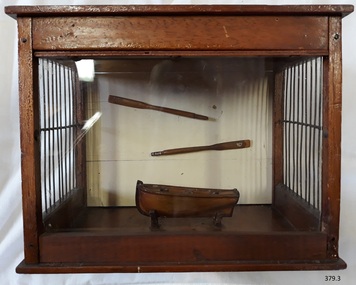
... Port Phillip, Victoria, in 1850. Henry had worked in the Bank of England in London. In Australia, he worked for the Morning Herald and was a business partner in the Geelong Daily News. ...Port Phillip, Victoria, in 1850. Henry had worked in the Bank of England in London. In Australia, he worked for the Morning Herald and was a business partner in the Geelong Daily News. ...This little model dinghy or rowing boat, together with its two oars and its display case, was made by Edward Richter using timber from the New Zealand-built schooner, the Enterprise, wrecked in Lady Bay, Warrnambool, in 1850 after only three years of sailing. The dinghy was originally presented to the old Warrnambool Museum and transferred to Flagstaff Hill along with its two descriptive card tags. EDWARD RICHTER (1853-1937) Edward Richter was the son of Henry and Charlotte Richter, who migrated from London and arrived in Port Phillip, Victoria, in 1850. Henry had worked in the Bank of England in London. In Australia, he worked for the Morning Herald and was a business partner in the Geelong Daily News. He served in the Volunteer Corps and had the honour of being one of the 500 Volunteers in the firing party at the grave of Sir Charles Hotham, Governor of Victoria. In Warrnambool, Henry was the Host/Licensee of the Royal Archer Hotel. He was also connected with Sheldrich's brewery (the Western Brewery) there. Henry and Charlotte’s son Edward was born in Collingwood, a Melbourne suburb, in 1853. The family moved to Warrnambool in 1867. In 1878 Edward married Susan (nee Saltz) and they had a family of twelve children. Sadly their son, Edward Henry Richter, died from drowning in Warrnambool’s Shelly Beech in 1907, aged 29 years. Edward was a prominent Warrnambool citizen. He worked as a coach painter and his hobbies included model making. He made this model dinghy and presented it to the old Warrnambool Museum in the late 1800s. He also made some model violins that are now in the care of the Warrnambool and District Historical Society. After the museum closed, this model was eventually transferred to Flagstaff Hill. Edward’s son, Herman, was also a model maker, making model boats and even boats in bottles. Edward passed away in Warrnambool in 1937. THE ENTERPRISE 1847-1850 The wooden, two-masted schooner Enterprise was built in New Zealand in 1847 and registered in Melbourne, Australia. The Enterprise carried cargos of agricultural produce and other commodities for trade between the ports of the Colony. On September 14, 1850, the Enterprise was at anchor in Lady Bay under its Master, James Gardiner Caughtt, loaded with a cargo of wheat and potatoes. A strong south-easterly wind caused the vessel to drag on its only anchor and the rudder was lost. The gale-force wind blew it sideways and it became grounded. A local indigenous Buckawall, braved the rough sea to take a line from the shore to the Enterprise. All five members of the crew were able to make it safely to land. The Enterprise was wrecked. The Enterprise wreck was in an area called Tramway Jetty in Lady Bay. Since then the area became the location of the Lady Bay Hotel and now, in 2019, it is in the grounds of the Deep Blue Apartments. In fact, with the constantly changing coastline through built-up sand, the wreck site is now apparently under the No 2 Caravan Park on Pertobe Road, perhaps 150 metres from the high tide. Its location was found by Ian McKiggan (leader of the various searches in the 1980s for the legendary Mahogany Ship). DIFFERENTIATING the New Zealand Schooner “Enterprise” from John Fawkner’s “Enterprize“ Dr Murray Johns, Melbourne, says in his article The Mahogany Ship Story “… As I documented in 1985, the Warrnambool wreck was of an entirely different ship, also called Enterprize [with the spelling ‘Enterprise’], but built in New Zealand in 1847. Fawkner’s ship had already been sold to Captain Sullivan in 1845 and was wrecked on the Richmond Pier in northern New South Wales early in 1847. “ - (further details are in NOTES: and FHMV documents)The model of a dinghy is significant for its association wreck of the schooner Enterprise, now on the Victorian Heritage List VHR S238, being a New Zealand built but Australian owned coastal trader. The wreck is also significant, by connection with the Enterprise, for its association with indigenous hero Buckawall who saved the lives of the five crew on board. The maker of the model, Edward Richter, is significant as a member of one of Warrnambool’s pioneering families, which has contributed to the growth of the community in several ways over the years, living, working and bringing up their families in the coastal city. Ship model; model of a small wooden boat or dinghy and wooden two oars, displayed in timber case with open sides that have vertical wire strands from top to bottom. The model was made by Mr Edward Richter from the timber of the schooner Enterprise, built in New Zealand 1847 and wrecked three years later in Lady Bay, Warrnambool.Handwritten tag in pen and ink: "Model of Boat made from the timber of the schooner "Enterprise" wrecked at Warrnambool" Type written tag "MODEL DINGEY Made from Timber of Schooner "Enterprise". Made and presented by Mr Edward Richter."flagstaff hill, warrnambool, shipwrecked coast, flagstaff hill maritime museum, maritime museum, shipwreck coast, flagstaff hill maritime village, great ocean road, wooden ship building, carpentry, ship modelling hobby, dinghy, dingey, dingy, edward richter, enterprise, lady bay warrnambool, schooner enterprise, wreck of the enterprise 1850, richter family, warrnambool history, buckawall -
Glen Eira Historical Society
Article - Brighton Cemetery, North Road, Caulfield South
... This file contains two items about war graves. 1/A two-page newspaper article from the "Herald Sun" of 31/07/2011 concerning the neglected state of the graves of some Victoria Cross winners and other war heroes at several cemeteries in Melbourne including Brighton Cemetry. The article notes that the Dept of Veterans' Affairs and other authorities are not adequately maintaining the graves. Includes photographs. 2/A newspaper article from Glen Eira/Port Phillip...This file contains two items about war graves. 1/A two-page newspaper article from the "Herald Sun" of 31/07/2011 concerning the neglected state of the graves of some Victoria Cross winners and other war heroes at several cemeteries in Melbourne including Brighton Cemetry. The article notes that the Dept of Veterans' Affairs and other authorities are not adequately maintaining the graves. Includes photographs. 2/A newspaper article from Glen Eira/Port Phillip ...This file contains two items about war graves. 1/A two-page newspaper article from the "Herald Sun" of 31/07/2011 concerning the neglected state of the graves of some Victoria Cross winners and other war heroes at several cemeteries in Melbourne including Brighton Cemetry. The article notes that the Dept of Veterans' Affairs and other authorities are not adequately maintaining the graves. Includes photographs. 2/A newspaper article from Glen Eira/Port Phillip Leader dated 12/02/2013. The article makes mention that a Gallipoli soldier will finally receive an official war grave and commemorative service in April 2013. Local war historian Carl Johnson stepped in to help and the Australian War Graves will install a grave marker to Pte. Jack Alexander Johnson.brighton cemetery, caulfield south, buckley maurice, joynt william donovan, newland james ernest, peeler walter, graves, cemetries, medals, war veterans, monuments and memorials, war memorials, world war 1914-1918 world war 1939-1945, johnson jack alexander, caulfield military hospital, hospitals, johnson carl, johnson bill, historical markers -
Glen Eira Historical Society
Article - St Aloysius Church, Caulfield
... The second is a colour advertisement regarding the open day, and enrolment at, St Aloysius Primary School, dated 14/02/2012 and placed in the Caulfield/Port Phillip Leader. The last is a black and white article in the Sunday Herald Sun, dated 25/03/2012, profiling a couple, Lindsay and Rosemary Shannon, who were married at St Aloysius Catholic Church on 07/10/1961. ...The second is a colour advertisement regarding the open day, and enrolment at, St Aloysius Primary School, dated 14/02/2012 and placed in the Caulfield/Port Phillip Leader. The last is a black and white article in the Sunday Herald Sun, dated 25/03/2012, profiling a couple, Lindsay and Rosemary Shannon, who were married at St Aloysius Catholic Church on 07/10/1961. ...Includes three miscellaneous newspaper article clippings. The first, features in the Caulfield leader, dated 03/08/2010, details the opening of new school buildings at St Aloysius Primary School in Caulfield. The second is a colour advertisement regarding the open day, and enrolment at, St Aloysius Primary School, dated 14/02/2012 and placed in the Caulfield/Port Phillip Leader. The last is a black and white article in the Sunday Herald Sun, dated 25/03/2012, profiling a couple, Lindsay and Rosemary Shannon, who were married at St Aloysius Catholic Church on 07/10/1961. All articles include photographs of various sizes, in both colour and black and white.st aloysius primary school, caulfield/port phillip leader, caulfield, balaclava road, catholic schools, caulfield south, caulfield leader, primary schools, ormond, st aloysius church, davies andrew, cromwell street, catholic church, danby michael m. p., shardey helen m. p., tang steven, sammon jason, shannon lindsay, shannon rosemary, parliamentary representatives, weddings, mayors, local officials and employees, principals, advertisements, building construction, construction (events and activities), classrooms, libraries -
 Queenscliffe Maritime Museum
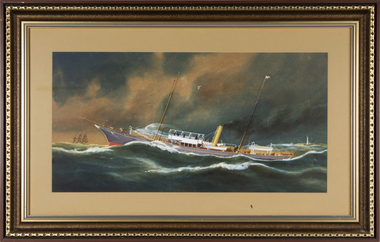
Painting - Painting of Pilot Vessel Alvina, A V Gregory
... The Sydney Morning Herald 29 July 1903 THE NEW MELBOURNE PILOT STEAMER. ALVINA The new pilot steamer Alvina, which was recently purchased by the Port Phillip Sea pilots, was inspected on Thursday last by the members of the Victorian Marine Board and a number of gentlemen representing the leading shipping companies in Melbourne. ...Painting donated by Mr P Boyle, grandson of former pilot Harry Trueman who served on the PV Alvina. The Sydney Morning Herald 29 July 1903 THE NEW MELBOURNE PILOT STEAMER. ALVINA The new pilot steamer Alvina, which was recently purchased by the Port Phillip Sea pilots, was inspected on Thursday last by the members of the Victorian Marine Board and a number of gentlemen representing the leading shipping companies in Melbourne. The Alvina was formally the private yacht of Mr Marmaduke Fox a wealthy Yorkshire gentleman and is a trim craft of 145 tons register and a length of 18ft overall. Hitherto the sea pilots have managed to do their work with one steamer, the Victoria but it has long been apparent that a second vessel was required. The pilots upon whom the obligation of providing and maintaining their vessels devolves, thereupon made a successful bid for the yacht and, by an additional outlay of 700 pound, had her overhauled and refitted in Deane's Dock, Williamstown. On Thursday last the vessel made a trial trip to Point Cook for the purpose of satisfying the Marine Board and the underwriters as to her fitness for the work. She showed a speed of 11 knots and steamed smoothly and satisfactorily. During the trip the visitors assembled in the saloon and drank success to the new steamer. Captain Carrie, president of the Marine Board, congratulated the pilots on their acquisition, and said that the service was now second to none in the world. The new vessel which has been in the charge of Captain Wills is handsomely fitted up and contains two staterooms and four cabins for the pilots and sleeping accommodation for a crew of eight. In future one steamer will remain on the pilot grounds inside the Heads while the other will steam about outside Queenscliff. A framed and mounted water colour painting of the Pilot Vessel Alvina under glasspainting, alvina, pilot vessel -
Glen Eira Historical Society
Article - South Metro Junior Football League
... Port Phillip Leader... Glen Eira News... Herald...This file contains five items An article from the Caulfield/Port Phillip leader on the development of the South Metro Junior Football League, dated 21/02/2012 An article from the Glen Eira News on the South Metro Junior Football League providing girls with an opportunity to be involved in football, dated May 2012 An article from the Herald Sun on the increase of interest of girls in playing football, dated 24/05/2012 A flyer for a “Chick Kick” Day to encourage young girls to get involved in Australian Rules football in the South Metro Junior Football League An article from the Caulfield/Port Phillip leader on the resignation of the Southern Football Leagues CEO, dated 19/06/2012...This file contains five items An article from the Caulfield/Port Phillip leader on the development of the South Metro Junior Football League, dated 21/02/2012 An article from the Glen Eira News on the South Metro Junior Football League providing girls with an opportunity to be involved in football, dated May 2012 An article from the Herald Sun on the increase of interest of girls in playing football, dated 24/05/2012 A flyer for a “Chick Kick” Day to encourage young girls to get involved in Australian Rules football in the South Metro Junior Football League An article from the Caulfield/Port Phillip leader on the resignation of the Southern Football Leagues CEO, dated 19/06/2012 Glen Eira Clubs Associations Societies Football Clubs Football Associations Sporting Clubs Sports Recreations Competitions Leisure Cultural events Cultural activities Cannizzo David South Metro Junior Football League Cultural establishments Australian Rules Football AFL Auskick 'Chick Kick' Day Caulfield/Port Phillip Leader Glen Eira News Herald Sun Kurdas Chyloe Southern Football League Holdsworth Wayne Seymour Mark Children's sports Moorabbin Women in sports Moorabbin Saints Junior Football League Article South Metro Junior Football League ...This file contains five items An article from the Caulfield/Port Phillip leader on the development of the South Metro Junior Football League, dated 21/02/2012 An article from the Glen Eira News on the South Metro Junior Football League providing girls with an opportunity to be involved in football, dated May 2012 An article from the Herald Sun on the increase of interest of girls in playing football, dated 24/05/2012 A flyer for a “Chick Kick” Day to encourage young girls to get involved in Australian Rules football in the South Metro Junior Football League An article from the Caulfield/Port Phillip leader on the resignation of the Southern Football Leagues CEO, dated 19/06/2012glen eira, clubs, associations, societies, football clubs, football associations, sporting clubs, sports, recreations, competitions, leisure, cultural events, cultural activities, cannizzo david, south metro junior football league, cultural establishments, australian rules football, afl auskick, 'chick kick' day, caulfield/port phillip leader, glen eira news, herald sun, kurdas chyloe, southern football league, holdsworth wayne, seymour mark, children's sports, moorabbin, women in sports, moorabbin saints junior football league -
Glen Eira Historical Society
Article - SHELFORD GIRLS’ SCHOOL AND KINDERGARTEN
... Contains a colour photograph of Shelford music students, photography by Jason Sammon. 5/ 1 newspaper article from the ‘Caulfield/Port Phillip Leader’ titled ‘Shelford is winning awards, and all that jazz’ about Shelford Teacher Mat Duniam winning the music director’s award at the Mount Gambier Festival Generations in Jazz competition, 31/05/2011, author unknown. Contains a colour photograph of teachers Mat Duniam and Gemma Horbury, as well as Shelford jazz ensemble students, photograph by Marcella Davie. 6/ 1 newspaper article from the ‘Herald Sun’ titled ‘I am doing it for Dad’ about the basketball debut of Sienna Simpson, daughter of deceased Shelford teacher Paul Simpson, written by Amelia Harris, 04/02/2012. ...Contains a colour photograph of Shelford music students, photography by Jason Sammon. 5/ 1 newspaper article from the ‘Caulfield/Port Phillip Leader’ titled ‘Shelford is winning awards, and all that jazz’ about Shelford Teacher Mat Duniam winning the music director’s award at the Mount Gambier Festival Generations in Jazz competition, 31/05/2011, author unknown. Contains a colour photograph of teachers Mat Duniam and Gemma Horbury, as well as Shelford jazz ensemble students, photograph by Marcella Davie. 6/ 1 newspaper article from the ‘Herald Sun’ titled ‘I am doing it for Dad’ about the basketball debut of Sienna Simpson, daughter of deceased Shelford teacher Paul Simpson, written by Amelia Harris, 04/02/2012. ...This file contains 6 items relating to newspaper articles about the school: 1/ 1 newspaper article from the ‘Caulfield Leader’ titled ‘Ultimate sacrifice’ about the death of Shelford school teacher Paul Simpson, written by Jenny Ling, Natalie White and Marty Shevelove, 08/03/2011. Contains 2 colour photographs, 1 of a Shelford student at Southside beach and 1 of Paul Simpson, photography by Eliza Sum. 2/ 1 newspaper article from the “Caulfield/Port Phillip Leader’ titled ‘Emotional farewell’ about the funeral of Shelford teacher Paul Simpson, written by Jenny Ling and Natalie White, 15/03/2011. Contains 2 colour photographs, one of the pallbearers and one of students at the funeral, photography by Jason Sammon. 3/ 1 newspaper article from the ‘Caulfield/Port Phillip Leader’ titled ‘Students hunger to help’ about Shelford students taking part in the charity event ‘Care Australia’s Walk In Her Shoes Campaign’ raising awareness of the hardships facing women in developing countries, 29/03/2011, author unknown. Contains a colour photograph of Shelford students, photographer unknown. 4/ 1 newspaper article from the ‘Caulfield/Port Phillip Leader’ titled ‘Music to their ears’ about the opening of Shelford’s Performing Arts Centre 03/04/2011, published 12/04/2011, author unknown. Contains a colour photograph of Shelford music students, photography by Jason Sammon. 5/ 1 newspaper article from the ‘Caulfield/Port Phillip Leader’ titled ‘Shelford is winning awards, and all that jazz’ about Shelford Teacher Mat Duniam winning the music director’s award at the Mount Gambier Festival Generations in Jazz competition, 31/05/2011, author unknown. Contains a colour photograph of teachers Mat Duniam and Gemma Horbury, as well as Shelford jazz ensemble students, photograph by Marcella Davie. 6/ 1 newspaper article from the ‘Herald Sun’ titled ‘I am doing it for Dad’ about the basketball debut of Sienna Simpson, daughter of deceased Shelford teacher Paul Simpson, written by Amelia Harris, 04/02/2012. Contains 2 colour photographs, one of Paul Simpson and the other of Sienna Simpson and her friend Camille Letts, photography by George Salpigtidis.shelford girls’ school and kindergarten, simpson paul, ling jenny, white natalie, shevelove marty, shelford girls grammar, caulfield, drowning, camping, sum eliza, science, schools, secondary education, basketball, students, parents, smith chloe, flanagan poly, quinn fiona, funerals, rescues, sammon jason, charitable organisations, care australia’s walk in her shoes, fundraising events, fleming lyrian, music, theatres, dancing, art, danby michael, southwick david, esakoff margaret, openings (events), duniam mat, horbury gemma, davie marcella, musical ensembles, musical events and activities, awards, festivals, audiences, letts camille, harris amelia, salpigtidis george, primary education, death and dying, simpson sienna -
 Bendigo Historical Society Inc.
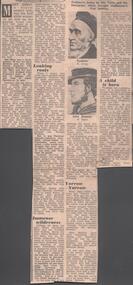
Newspaper - LYDIA CHANCELLOR COLLECTION: MELBOURNE'S FIRST CHRISTMAS
... Herald newspaper article titled 'Melbourne's First Christmas by John Lahey.' This is Lahey's account of the first year of settlement of Melbourne. Six people landed first in Melbourne - Mary Gilbert, the first white woman to land in Melbourne plus five men landed from Fawkner's boat in August 1835. Mary gave birth to the first white child born in Melbourne - John Port Phillip...MELBOURNE Lydia Chancellor Collection collection Melbourne Melbourne history history Mary Gilbert woman female John Batman John Pascoe Fawkner John Port Phillip Gilbert A Herald newspaper article titled 'Melbourne's First Christmas by John Lahey.' ...A Herald newspaper article titled 'Melbourne's First Christmas by John Lahey.' This is Lahey's account of the first year of settlement of Melbourne. Six people landed first in Melbourne - Mary Gilbert, the first white woman to land in Melbourne plus five men landed from Fawkner's boat in August 1835. Mary gave birth to the first white child born in Melbourne - John Port Phillip Gilbert. The trials and tribulations of the first settlers in Melbourne are outlined in this article. There are photos or illustrations of Fawkner's house by the Yarra, John Pascoe Fawkner and John Batman. 24/12/1960.melbourne, lydia chancellor collection, collection, melbourne, melbourne history, history, mary gilbert, woman, female, john batman, john pascoe fawkner, john port phillip gilbert -
Port Melbourne Historical & Preservation Society
Newspaper - Clipping, Herald-Sun, Mayor Scoots into Action, 10 May 1996
... Front page Herald Sun, Friday, May 10 1996, featuring Mayor of Port Phillip Liana THOMPSON on her Vespa motor scooter...Transport - Motor Vehicles City of Port Phillip Liana THOMPSON Mayors Front page Herald Sun, Friday, May 10 1996, featuring Mayor of Port Phillip Liana THOMPSON on her Vespa motor scooter Mayor Scoots into Action Newspaper Clipping, Herald-Sun Herald and Weekly Times ...Front page Herald Sun, Friday, May 10 1996, featuring Mayor of Port Phillip Liana THOMPSON on her Vespa motor scootertransport - motor vehicles, city of port phillip, liana thompson, mayors -
Port Melbourne Historical & Preservation Society
Book, J J Mouritz, Port Phillip Directory 1847, 1847
... Port Phillip "Signadon" Dominion College of Advanced Education, Canberra. PO Box 256, Dickson ACT 2602. Stamp binding has library catalogue description 994.51 POR. In pencil on title page HBG-4919 85/3254 Port Phillip Directory 1847. Small book, red cover, Port Phillip almanac and directory for 1847, 150 pages. Facsimile reprint Port Phillip Directory 1847 Book J J Mouritz Herald ...Port Phillip Directory 1847. Small book, red cover, Port Phillip almanac and directory for 1847, 150 pages. Facsimile reprint"Signadon" Dominion College of Advanced Education, Canberra. PO Box 256, Dickson ACT 2602. Stamp binding has library catalogue description 994.51 POR. In pencil on title page HBG-4919 85/3254transport - shipping, local government, province of port phillip -
 Narre Warren and District Family History Group
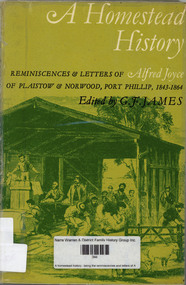
Book, Alfred Joyce, A homestead history : being the reminiscences and letters of Alfred Joyce of Plaistow and Norwood, Port Phillip, 1843 to 1864, 1969
... Herald). (back cover) A homestead history : being the reminiscences and letters of Alfred Joyce of Plaistow and Norwood, Port Phillip, 1843 to 1864 Book Alfred Joyce Gwyndd Francis James Oxford University Press ...A HOMESTEAD HISTORY Alfred Joyce began a pastoral partnership with his brother in the Upper Loddon early in 1844. His reminiscences reveal events of the venture, from the departure from Melbourne with the completion of a roomy homestead, from the threat of bankruptcy, to substantial success within a decade. In writing them, he was not dependent upon his memories; the many letters he had written to his parents in London had eventually been returned to him, and those written between 1851 and his mother's death in 1858 form a continuation of his own narrative. They describe in vivid detail the upheavals that followed the discovery of gold, the transformation of both town and country, the dissolution of the Joyce brothers' partnership, and Alfred's activities as pastoralist, farmer and miller at Norwood on die Bet Bet Creek. In this third edition, for which a much wider range of illustrations is available, an epilogue continues the story of George Joyce at Plaistow and Alfred Joyce at Norwood until both properties had passed into other hands. Domestic tragedy overwhelmed the one, while droughts and mortgages eventually ruined the other. It is a record which, in the words of the American Historical Review, 'would serve as script for a first-class documentary film and deserves high rank, in the literature of pastoral pioneering'. Other reviewers have been equally emphatic: 'The real history of Australia is written very largely in such records as this' (Australian Quarterly); 'of historical documents such as diese we cannot have too many' (Sydney Morning Herald). (back cover)non-fictionA HOMESTEAD HISTORY Alfred Joyce began a pastoral partnership with his brother in the Upper Loddon early in 1844. His reminiscences reveal events of the venture, from the departure from Melbourne with the completion of a roomy homestead, from the threat of bankruptcy, to substantial success within a decade. In writing them, he was not dependent upon his memories; the many letters he had written to his parents in London had eventually been returned to him, and those written between 1851 and his mother's death in 1858 form a continuation of his own narrative. They describe in vivid detail the upheavals that followed the discovery of gold, the transformation of both town and country, the dissolution of the Joyce brothers' partnership, and Alfred's activities as pastoralist, farmer and miller at Norwood on die Bet Bet Creek. In this third edition, for which a much wider range of illustrations is available, an epilogue continues the story of George Joyce at Plaistow and Alfred Joyce at Norwood until both properties had passed into other hands. Domestic tragedy overwhelmed the one, while droughts and mortgages eventually ruined the other. It is a record which, in the words of the American Historical Review, 'would serve as script for a first-class documentary film and deserves high rank, in the literature of pastoral pioneering'. Other reviewers have been equally emphatic: 'The real history of Australia is written very largely in such records as this' (Australian Quarterly); 'of historical documents such as diese we cannot have too many' (Sydney Morning Herald). (back cover)alfred joyce, upper loddon -
Glen Eira Historical Society
Article - Murrumbeena State School No. 3449
... One article from Herald – Sun 05/07/1967 written by Mrs Hazel Swan with reference to class v 1919. Three articles from the Caulfield/ Port Phillip Leader, one dated 28/06/2011, two dated 07/02/2012 and three dated 17/04/2012 regarding pupils and event, sporting or otherwise respectively....One article from Herald – Sun 05/07/1967 written by Mrs Hazel Swan with reference to class v 1919. Three articles from the Caulfield/ Port Phillip Leader, one dated 28/06/2011, two dated 07/02/2012 and three dated 17/04/2012 regarding pupils and event, sporting or otherwise respectively. ...One article from Herald – Sun 05/07/1967 written by Mrs Hazel Swan with reference to class v 1919. Three articles from the Caulfield/ Port Phillip Leader, one dated 28/06/2011, two dated 07/02/2012 and three dated 17/04/2012 regarding pupils and event, sporting or otherwise respectively.murrumbeena state school, murrumbeena road, twins, herald sun, presbyterian church hall, melina aynes, hazel swan, sean wroe, victorian school sports awards, mr mac donald, debby wall, jayah matthews, miss philbrich, australian sprinter, school sports., kalerina grosdanis, weetbix tryathalon, school sport australian soccer championships, murrumbeena primary school community. -
 Tatura Irrigation & Wartime Camps Museum
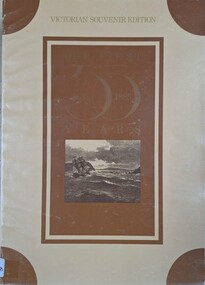
Book, Our First Fifty Years 1835-1885, 1835
... The "Lady Nelson" entering Port Phillip. Our First Fifty Years 1835-1885 Book Book Herald Sun Southbank Printing Services ...History of Victoria. A reproduction of an historical Australian book published in 1835. It depicts Victoria at the end of first 50 years of settlement.Beige and brown cover. Victorian souvenir edition. Print of a ship in rough seas on front cover. The "Lady Nelson" entering Port Phillip.victorian history -
 Kew Historical Society Inc
Print, Sands & Kenny, Dights Mill, 1856
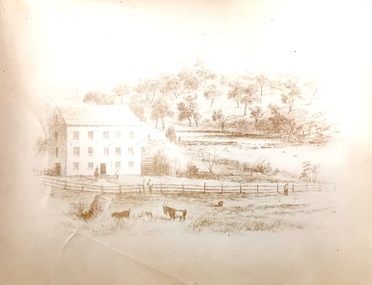
... Port Phillip land sales held in Sydney. Dight was already in the business of flour milling and had a mill near Campbell Town in New South Wales called ‘Ceres’. In April 1840, he notified his customers through The Sydney Herald...Port Phillip land sales held in Sydney. Dight was already in the business of flour milling and had a mill near Campbell Town in New South Wales called ‘Ceres’. In April 1840, he notified his customers through The Sydney Herald ..."In 1839 John Dight purchased Melbourne block 88, which included 26 acres of land along the Yarra River for £481 at the Port Phillip land sales held in Sydney. Dight was already in the business of flour milling and had a mill near Campbell Town in New South Wales called ‘Ceres’. In April 1840, he notified his customers through The Sydney Herald that he was leaving to go to Port Phillip. The first steam powered flour mill was constructed in Melbourne in 1841. Dight built his water powered mill, soon after, from bricks bought over from Tasmania. Dight used the river to power his mill: Water flowed along an inlet channel to turn an undershot water wheel. In order to regulate flow or to ensure flow for times when river levels were low, Dight constructed a rough stone weir." (Melbourne Water)Dights Mill. Reproduction of a book plate from an original wood engraving, showing Dights Mill and Falls on the River Yarra. The image was originally published in Sands & Kenny, Melbourne & Sydney.Annotation on reverse: "Dights Flour".dights mill, yarra river -
 Kew Historical Society Inc
Print, Dight's Mill, Yarra Yarra
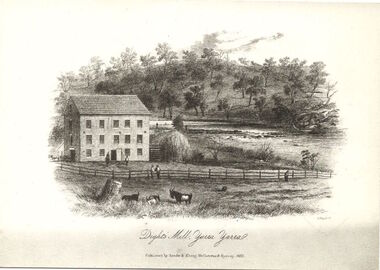
... Port Phillip land sales held in Sydney. Dight was already in the business of flour milling and had a mill near Campbell Town in New South Wales called ‘Ceres’. In April 1840, he notified his customers through The Sydney Herald...Port Phillip land sales held in Sydney. Dight was already in the business of flour milling and had a mill near Campbell Town in New South Wales called ‘Ceres’. In April 1840, he notified his customers through The Sydney Herald ..."In 1839 John Dight purchased Melbourne block 88, which included 26 acres of land along the Yarra River for £481 at the Port Phillip land sales held in Sydney. Dight was already in the business of flour milling and had a mill near Campbell Town in New South Wales called ‘Ceres’. In April 1840, he notified his customers through The Sydney Herald that he was leaving to go to Port Phillip. The first steam powered flour mill was constructed in Melbourne in 1841. Dight built his water powered mill, soon after, from bricks bought over from Tasmania. Dight used the river to power his mill: Water flowed along an inlet channel to turn an undershot water wheel. In order to regulate flow or to ensure flow for times when river levels were low, Dight constructed a rough stone weir. " (https://www.melbournewater.com.au/whatwedo/projectsaroundmelbourne/Documents/A_Short_History_of_Dights_Falls_Fact_Sheet.pdf) This work forms part of the collection assembled by the historian Dorothy Rogers, that was donated to the Kew Historical Society by her son John Rogers in 2015. The manuscripts, photographs, maps, and documents were sourced by her from both family and local collections or produced as references for her print publications. Many were directly used by Rogers in writing ‘Lovely Old Homes of Kew’ (1961) and 'A History of Kew' (1973), or the numerous articles on local history that she produced for suburban newspapers. Most of the photographs in the collection include detailed annotations in her hand. The Rogers Collection provides a comprehensive insight into the working habits of a historian in the 1960s and 1970s. Together it forms the largest privately-donated collection within the archives of the Kew Historical Society.An engraving of Dight's Mill on the Yarra. The image was originally published in Sands & Kenny, Melbourne & Sydney. Dorothy Rogers reproduced the print in 'A History of Kew' (1973). It faces page 8.Published by Sands & Kenny, Melbourne & Sydney, 1856dight's mill, dorothy rogers, dight's falls, yarra river, kew, john dight -
 City of Melbourne Libraries
Photograph, Bull, Hugh Jones, 1897-1993, Princes Bridge Centenary pylons under construction
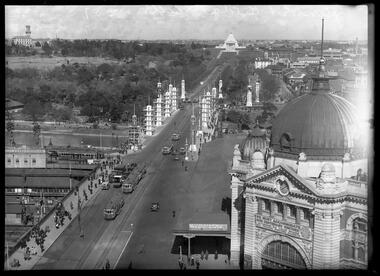
... Retrieved September 21, 2023, from http://nla.gov.au/nla.news-article205880269 'Flinders Street railway station', Wikipedia, https://en.wikipedia.org/wiki/Flinders_Street_railway_station 'St Joseph’s Foundling Hospital (1901-75)', Finding Records, Department of Health and Human Services, State of Victoria, https://www.findingrecords.dhhs.vic.gov.au/collectionresultspage/St-JosephsFoundling-Hospital-Babies-Home#departmental-administration 'Alexandra Gardens', City of Melbourne, https://www.melbourne.vic.gov.au/community/parks-open-spaces/major-parks-gardens/Pages/alexandra-gardens.aspx 'Wirths Circus', Wikipedia, https://en.wikipedia.org/wiki/Wirth's_Circus 'Roy Prentice: Centenary Architect', Built Heritage Pty Ltd, Simon Reeves, https://www.builtheritage.com.au/downloads/prentice.pdf 'Princes Bridge', Heritage Council Victoria, https://vhd.heritagecouncil.vic.gov.au/places/817 PORT PHILLIP. (1846, April 1). The Sydney Morning Herald (NSW : 1842 - 1954), p. 3. ...Retrieved September 21, 2023, from http://nla.gov.au/nla.news-article205880269 'Flinders Street railway station', Wikipedia, https://en.wikipedia.org/wiki/Flinders_Street_railway_station 'St Joseph’s Foundling Hospital (1901-75)', Finding Records, Department of Health and Human Services, State of Victoria, https://www.findingrecords.dhhs.vic.gov.au/collectionresultspage/St-JosephsFoundling-Hospital-Babies-Home#departmental-administration 'Alexandra Gardens', City of Melbourne, https://www.melbourne.vic.gov.au/community/parks-open-spaces/major-parks-gardens/Pages/alexandra-gardens.aspx 'Wirths Circus', Wikipedia, https://en.wikipedia.org/wiki/Wirth's_Circus 'Roy Prentice: Centenary Architect', Built Heritage Pty Ltd, Simon Reeves, https://www.builtheritage.com.au/downloads/prentice.pdf 'Princes Bridge', Heritage Council Victoria, https://vhd.heritagecouncil.vic.gov.au/places/817 PORT PHILLIP. (1846, April 1). The Sydney Morning Herald (NSW : 1842 - 1954), p. 3. ...Princes Bridge Centenary pylons under construction Possibly taken from Young and Jacksons Hotel (formerly Princes Bridge Hotel) on the corner of Flinders and Swanston streets, Flinders Street Station’s clocks and main entrance dominate, along with its distinctive copper dome and decorative façade. The time on the main clock is 1.40pm, and the sign underneath, reflecting Melbourne’s upcoming Centenary reads, “We must accommodate our Centenary visitors! Citizens! Do your share by taking paying guests.” At left is the original Princes Bridge Station, today the site of Federation Square. The riverside tram terminus advertises a Café/Tobacconist/Refreshment Room selling cigars & cigarettes, fountain drinks & confectionery, and in smaller text: “Leave your boot repairs here”. Nearly everyone is dressed in dark suits, coats and hats. The footpaths are wide and there are no traffic lights. The roadway stretches towards the Shrine of Remembrance, not yet dedicated but very dominant on the skyline. Government House is clearly visible across the wide parkland that would come to be known as Kings Domain and that is an area of deep importance to the people of the Eastern Kulin. Originally, Birrarung was part of a network of swamps and lagoons linked to the course of the river. From 1896, Public Works Department engineer Carlo Catani, oversaw a new channel to straighten the river and the swamps and lagoons were filled with spoil from the channel works. From the same vantage point today, only the top of the tower of Government House would be visible. The photo captures the pylons along Princes Bridge, mid-construction and being installed to mark Melbourne’s Centenary. The pylons were not without controversy. Both The Argus and The Age bemoaned them for being “made almost entirely of imported softwood timber”, denying work to native hardwood timber workers and sawmillers, and leading visitors to think Australia did not have its own exceptional native hardwoods. The pylons were also variously described in their incomplete state, as unimaginative and resembling an oilfield. Published: The Age 5 September 1934 Featured in "Newsworthy: Melbourne in photographs 1933-1936" exhibition at East Melbourne Library, October to December 2023. Exhibition caption by project volunteer, Louise McKenzie Photographer notations on slide: "Pylons + St Kilda Rd C57" Published: Age (Melbourne, Vic. : 1854 - 1954), Wednesday 5 September 1934, page 11 Published title: DECORATIONS -- THEN AND NOW. Published caption: "Although not completed yet, some impression of the effect of the decorations on Princes-bridge may be obtained from the first picture which shows the majestic sweep of St Kilda road with the Shrine of Remembrance and Government House dominating the horizon. The area to the left of St. Kilda-road and in front of Government House is portion of the area which it is proposed to call the King's Domain, which extends to Domain-road and Anderson-street..." Description: East-facing, elevated view of Flinders Street Station and Princes Bridge, featuring partially completed pylons erected for Melbourne's Centenary celebrations. The Shrine of Remembrance and Government House can be seen in the distance. In the foreground are trams, cars and trucks, pedestrians, Batman Avenue tram terminus and refreshment rooms. Signage on Flinders Street Station encourages citizens to accommodate Centenary visitors. The Melbourne Centenary was held 1934-35 in celebration John Batman's proclamation that Melbourne "the place for a village". Centenary events included a visit by Prince Henry, Duke of Gloucester. A Centenary Cake measuring 50 feet in height and ten tons in weight was cut into 250,000 pieces and sold at 1 shilling per piece for charity. Spectacular floodlighting of city landmarks, the creation of the Pioneer Women's Memorial Garden, and the MacRobertson Air Race from London, were other notable activities. Research by project volunteer, Louise McKenzie: The photo in The Age collage of 5 September 1934 has a slightly cropped foreground. The original photo has been taken from an elevated vantage point, most probably the roof of the Nicholas Building on the corner of Flinders and Swanston streets. The right foreground is dominated by the main “clocks” entrance to Flinders Street Station, showing its distinctive copper dome and decorative façade. The time on the main clock is 1.40 pm. The main sign on the front of the Station reads, "We Must Accommodate our Centenary Visitors! Citizens! Do your share by taking paying guests. Write to The Official Centenary Accommodation Bureau, 436 Collins St. City. Tel M 4671”. Another sign at eye level at the main entrance says: “Cheap Trips on Sundays”. The sign on the end of the roof along the eastern side of the station reads, “The Babies Need Your Help! Support Broadmeadows Foundling Hospital Appeal. July and August”. Run by the Sisters of St Joseph of the Sacred Heart, St Joseph’s Foundling Hospital was a purpose built infants’ home for up to 300 babies, plus accommodation for expectant mothers, mainly single women. In the early 1930s, the department (Victorian Children’s Welfare Department) contracted St Joseph’s Foundling Hospital to care for an additional 60 infant state wards, and up to 175 non wards at any given time. In 1931 it also operated a mothercraft training school. The centre foreground shows the commencement of Princes Bridge. Beneath the left side of the bridge was the site of the original Princes Bridge Station, by this time incorporated into Flinders Street Station, and today the area is the site of Federation Square. It was linked to Flinders Street station by the railway tracks that ran underneath the northern approach to the bridge. This photo shows a tram terminus which has a Café/Tobacconist/Refreshment Room, selling cigars & cigarettes, fountain drinks & confectionary, and a sign: Leave your boot repairs here. In the foreground is a wide roadway running south/north, comprising two vehicle lanes each heading north/south, and a central section containing two sets of tram tracks. There are cars, buses and delivery vans on the roadway. The trams visible are Glen Iris (Route No. 6; tram no. 448), Toorak (Route No. 8, tram no. 333), ? (No. 7), ? (No. 1), and ? (No. 2A). The footpaths are extremely wide. There is a square newspaper/magazine stand on the eastern side footpath. And also a “Ferry” sign. There are no traffic lights, but a policeman is visible on the roadway. There are pedestrians – men, women, children, a porter with trolley, women with prams. Clothing comprises dark suits, coats and hats for nearly everyone. There are double headed “Collins Street” lights along the side of the roadway, and along the northern riverbank. The roadway in the foreground is an extension of Swanston Street, which becomes Princes Bridge, then St Kilda Road, stretching towards the Shrine of Remembrance, and diverting past it. The Shrine had not yet been officially dedicated, and looks very white and dominant on the skyline. On the LHS of St Kilda Road, Government House is clearly visible across the wide parkland to be known as Kings Domain. The Kings Domain area is important to the people of the Eastern Kulin nation, and also has historical importance for its association with the early settlement of Melbourne and the foundation of British colonial administration in Victoria. On the southern side of the Yarra River (Birrarung) an historic rowing boathouse is visible, located adjacent to the Alexandra Gardens. Originally Birrarung was part of a network of swamps and lagoons linked to the course of the river. From 1896, under the guidance of engineer Carlo Catani* a new channel to straighten the river was created and the swamps and lagoons were filled with spoil from the channel works. The gardens were then created and completed in time for a Royal visit by the Duke of York in May 1901. The gardens are named after Alexandra of Denmark, the wife of King Edward VII. Both these areas, plus the Royal Botanic Gardens Victoria, Shrine of Remembrance Reserve, Sidney Myer Music Bowl, Government House, and the Queen Victoria Gardens together form the Domain Parklands. The extent of the subsequent plantings is evident today, where from the same vantage point only the top of the tower of Government House would be visible. *Catani was born in Florence in 1852, but after arriving in Melbourne worked as a civil engineer for the Victorian Government. His last major project was the reclamation of the foreshore of St Kilda, envisaged in the style of a European resort, complete with a split level esplanade, bathing pavilions, dance halls, amusements and a French-Italian style of landscape complete with palms. The gardens at the end of Fitzroy Street, St Kilda, now bear his name. The historic boathouse visible across the Yarra is another glimpse into Melbourne’s past. “Boathouse Row” comprises 7 amateur rowing clubs, the first established in 1859 (Melbourne University Boat Club). Other Clubs were Richmond, Melbourne, Banks, Melbourne Grammar School, Yarra Yarra and Mercantile. South of the river and west of the bridge is an area today developed into the Melbourne arts precinct of Hamer Hall and the Arts Centre. But at this time it was the home of Wirths Olympia Circus, which comprised Wirths Pleasure Park (an amusement park), a 5,000 seat auditorium – Hippodrome, a roller skating rink, a glaciarium, a cinema, and the Green Mill Dance Hall. Dog shows were also held at Olympia. The Green Mill Dance Hall closed in 1950, and the remainder of the Wirth buildings on site were destroyed by fire in December 1953. The feature of the photo is the pylons erected along Princes Bridge to mark Melbourne’s Centenary in 1934. The sixteen plastered pylons were designed by Roy Prentice, the second person to qualify as an architect at The University of Melbourne’s Bachelor of Architecture degree, in 1933, aged 27. Simon Reeves in his article marking the 100th birthday of Roy Prentice on 20 June 2006 reports that the State Electricity Commission sponsored this work, and the Argus reported that “… the pylons were “illuminated from within to give the effect of soft radiance”. Australia Home Beautiful 1 Oct 1934 reports in a very detailed and comprehensive article: The 10 taller pylons, including flagpole, were 48 ft, with a base of 8 ft. Timber-framed and faced with fibrous plaster and galvanised sheet iron, each structure was securely bolted to a concrete foundation three feet in depth. Panels of glass let into the shaft of each pylon were indirectly lit by 40, 100 watt lamps, and the upper bank of internal lamps were dyed so as to flood the panels with a deep red light. The decorative painted shields and flagpoles/pennants were illuminated by three 200 watt projectors concealed in the roof of each pylon, and were part of an electric night light decoration scheme involving 28 miles of wire to supply more than 20,000 lights. An article in the Argus on 18 October 1934 provided minute detail of the lighting erected in Melbourne for the Centenary, converting it “… into a coloured fairyland by night.” The estimated cost of 10 pounds per hour the lights were on. The display included 800 standard light poles 30 feet high which were tiered with electric bulbs concealed in inverted cones, 138 specially designed “Venetian poles” draped in flags trophies and streamers. The streets included in the electric night light decoration scheme were Bourke Street from Spring to William, the entire length of Collins Street, Flinders Street from Elizabeth to Spring, Lonsdale Street from Elizabeth to Swanston, Swanston and Elizabeth Streets from Flinders to Lonsdale, and parts of Springs and Spencer Streets. Together with the Princes Bridge pylons, approximately 28 miles of wire was required to supply power to the more than 20,000 lights. And that is just in the city of Melbourne. It was estimated the same amount of lighting was duplicated among other local councils. The pylons were not without controversy. The Argus on 28 August 1934 in an article headed “Imported Timber in Pylons” reported that the Princes Bridge pylons are “made almost entirely of imported softwood timber”, and have therefore denied work to native hardwood timber workers and sawmillers. The same day the Melbourne Age ran a similar story, bemoaning the fact that foreign oregon had been used which may lead tourists to think Australia did not have its own exceptional native hardwoods. A Camberwell City Councillor described the pylons as unimaginative, and the Herald reported that skeletons of pylons for the Centenary decorations in their present form led the area to resemble an oilfield! The Yarra River and Princes Bridge have long been a focal point of Melbourne life. In the early days of European settlement in Melbourne a rope-hauled punt carried people across the Yarra River. A surge in population and increased shipping traffic created a need for a bridge. There was difficulty in agreeing on a suitable site for the bridge (options were crossing at Elizabeth, Swanston, Queen or Market Streets), but the NSW Government favoured Swanston Street and the Melbourne Town Council decided on a temporary bridge across the Yarra spanning from the foot of Swanston Street. This first bridge was a single span timber toll bridge designed by Scottish born bridge designer David Lennox, and completed in 1845. It was 120 feet long, had a roadway of 17 feet wide, and a footpath on one side of 4 feet. It was leased to the Melbourne Bridge Company in the name of Robert A Balbirnie. The tollhouse was on the north side of the river and the toll keeper, Patrick Doherty, was credited with saving nine lives during the four years he was in charge of the toll station. The second bridge was stone (completed 1850), and named Prince’s Bridge after the HRH Prince of Wales, later Edward VII. It was designed with an elliptical single arc and an exceedingly small rise in proportion to the span. However, this design created an obstacle for flood waters, and together with Melbourne’s increasing population it was quickly apparent that a new bridge was required. At its opening on 15 November 1850 coincided with the imminent declaration of Victoria as a separate colony, it provided a moment of great celebration for Melbournians and “The opening ceremony was described as the grandest processional display witnessed in the colony.” (ToMelbourne.com.au) Princes Bridge in its present form, as depicted in this photograph, was designed by Jenkins, D’Ebro and Grainger, and constructed in 1886-88 by David Munro. John Grainger (father of Australian composer Percy Grainger) did the majority of the design work for the bridge. The structure was to have three arches each 96 feet wide measured across the river, and the banks on both sides were raised to allow more space for floodwater to flow. St Kilda Road was originally many feet below the current level. The bridge is of architectural significance for its substantial size, giant half columns, extensive use of wrought and cast iron, decorative elements (cast-iron lamps) and the skilled stonemasonry in the construction of the abutments and piers. Its main design features are similar to those of Blackfriars Bridge in London (1870). The bluestones were quarried from Footscray, the Malmsbury stones were from quarries at Kyneton, and the granite from Harcourt. The cost was met by the State of Victoria, City of Melbourne, and six out of seven of its municipalities, and their coats of arms feature on the bridge. The building of the bridge reflected the boom period of Melbourne, including the Victorian gold rush 1851- late 1860s, and its contractor, David Munro, was also responsible for the construction of Queens Bridge and Sandridge Railway Bridge. The Centenary pylons are no longer in place, but today this intersection still plays a major part in Melbourne’s daily life: people still meet “under the clocks” at Flinders Street station, and the route in and out of the city along St Kilda Road is often a feature of parades such as Moomba, the Grand Final Parade, and of course the Anzac Day Parade which commences at the Princes Bridge intersection and finishes at the Shrine of Remembrance. There are many tram routes, which cross the Bridge, and it directs pedestrians towards the Arts Precinct, the various components of Domain Park, plus the Southbank restaurant and rowing precincts. Even though this is a street scene, it feels very intimate; the viewer is instantly immersed in the activity of a Melbourne afternoon, looking down St Kilda Road from a viewpoint near today’s Federation Square. References: DECORATIONS -- THEN AND NOW. (1934, September 5). The Age (Melbourne, Vic. : 1854 - 1954), p. 11. Retrieved September 21, 2023, from http://nla.gov.au/nla.news-article205880269 'Flinders Street railway station', Wikipedia, https://en.wikipedia.org/wiki/Flinders_Street_railway_station 'St Joseph’s Foundling Hospital (1901-75)', Finding Records, Department of Health and Human Services, State of Victoria, https://www.findingrecords.dhhs.vic.gov.au/collectionresultspage/St-JosephsFoundling-Hospital-Babies-Home#departmental-administration 'Alexandra Gardens', City of Melbourne, https://www.melbourne.vic.gov.au/community/parks-open-spaces/major-parks-gardens/Pages/alexandra-gardens.aspx 'Wirths Circus', Wikipedia, https://en.wikipedia.org/wiki/Wirth's_Circus 'Roy Prentice: Centenary Architect', Built Heritage Pty Ltd, Simon Reeves, https://www.builtheritage.com.au/downloads/prentice.pdf 'Princes Bridge', Heritage Council Victoria, https://vhd.heritagecouncil.vic.gov.au/places/817 PORT PHILLIP. (1846, April 1). The Sydney Morning Herald (NSW : 1842 - 1954), p. 3. Retrieved September 21, 2023, from http://nla.gov.au/nla.news-article12886251 'Edward VII', Wikipedia, https://en.wikipedia.org/wiki/Edward_VII 'Princes Bridge', ToMelbourne.com, https://tomelbourne.com.au/princes-bridge/ 'Princes Bridge', eMelbourne, https://www.emelbourne.net.au/biogs/EM01189b.htm 'Princes Bridge', Australia for everyone, http://australiaforeveryone.com.au/files/melbourne/princes-bridge.html 'Victorian gold rush', Wikipedia, https://en.wikipedia.org/wiki/Victorian_gold_rush IMPORTED TIMBER IN PYLONS (1934, August 28). The Argus (Melbourne, Vic. : 1848 - 1957), p. 9. Retrieved September 21, 2023, from http://nla.gov.au/nla.news-article10952507 Princes-Bridge Pylons. (1934, August 28). The Age (Melbourne, Vic. : 1854 - 1954), p. 7. Retrieved September 21, 2023, from http://nla.gov.au/nla.news-article205532235 Pylons Appear Near Princes Bridge (1934, August 18). The Herald (Melbourne, Vic. : 1861 - 1954), p. 1. Retrieved September 21, 2023, from http://nla.gov.au/nla.news-article243104375 PRINCES-BRIDGE PYLONS. (1934, September 20). The Age (Melbourne, Vic. : 1854 - 1954), p. 10. Retrieved September 21, 2023, from http://nla.gov.au/nla.news-article205873535 28 Miles of Wire (1934, October 18). The Argus (Melbourne, Vic. : 1848 - 1957), p. 1 (The Junior Argus). Retrieved September 21, 2023, from http://nla.gov.au/nla.news-article10977836 'Historical references for Boathouse Row, Melbourne', http://boathouserowmelbourne.com.au/history/ 'ITALIAN DELEGATION TO HONOUR CARLO CATANI, DESIGNER OF THE ST KILDA FORESHORE, St Kilda Historical Society, 2001, https://web.archive.org/web/20070928061938/http://www.skhs.org.au/~SKHSarticles/articles/Carlo_Catani.html# HISTORY IN LIGHTS (1934, July 12). The Herald (Melbourne, Vic. : 1861 - 1954), p. 16. Retrieved September 21, 2023, from http://nla.gov.au/nla.news-article243172436 'Dressing Melbourne for the Duke', The Australian home beautiful: a journal for the home builder. Vol 12 No. 10 (1 October 1934), page 21, 58. Retrieved September 14, 2023, from http://nla.gov.au/nla.obj-2950922209Photographer notations on slide: "Pylons + St Kilda Rd C57".centenaries, bridges, lighting, flinders street railway station
