
Showing 5 items matching "portable suction"
-
 Alfred Hospital Nurses League - Nursing History Collection
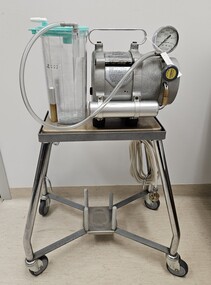
Equipment - Portable electric suction machine, Clements Suction and Pressure Pump
... Portable electric suction machine......portable suction...He became interested in anaesthesia equipment and from the 1920s Clements worked on improving ether apparatus and manufacturing portable suction machines for use in hospital operating theatres. ...Portable Clements Suction & Pressure Pump built by H I Clements & Son Ltd Consists of motor with attached carry handle, attached pressure regulator, attached disposable drainage cannister with tubing and power cable mounted on a trolley with castors....Clements Suction and Pressure Pump Equipment Portable electric suction machine ...This equipment was located in the outpatients department (Philip Block) until September 2021 when it was deemed obsolete by Infection Prevention. Hubert Ingham Clements (1886-1969) was an Australian engineer who established his own engineering business in NSW in 1908 manufacturing combustion engines. He became interested in anaesthesia equipment and from the 1920s Clements worked on improving ether apparatus and manufacturing portable suction machines for use in hospital operating theatres. The latter machines were to earn an unrivalled reputation for reliability; many remained in service over thirty years after their date of production. The business became H. I. Clements & Son when his son William joined the company. (https://adb.anu.edu.au/biography/clements-hubert-ingham-12846)Item is an example of equipment from its time period and is of historic significance.Portable Clements Suction & Pressure Pump built by H I Clements & Son Ltd Consists of motor with attached carry handle, attached pressure regulator, attached disposable drainage cannister with tubing and power cable mounted on a trolley with castors.H I Clements & Son Pty. Ltd. Metal Manufacturing label with: Serial Number 1725FS and SAA Certificate Number BCG/4S/60194 on motor (front side) Ward 11 engraved on motor handle AH Biomedical Engineering orange test due sticker and AH Biomedical blue test sticker (reverse side)suction, clements, portable suction, respiratory, pressure pump, surgical drainage -
 Royal Australian and New Zealand College of Obstetricians & Gynaecologists (RANZCOG)
Obstetric and Gynaecological Ephemera
... - Item 1: Annotated diagram with comical reference to human anatomy - Item 2: Newspaper article from 26 August 1990 regarding St George's Hospital birthing centre - Item 3: Advertising poster for Livingstone Conductive Gel - Item 4: Victorian Folate Campaign 1999 Public Health Information Leaflet - Item 5: Advertisement for Cervagem removed from a publication - Item 6: IUD Multiload CU250 range medical advertising removed from a publication - Item 7: Fetal Cardio-phonograph Toitu product literature - Item 8: Estraderm and how to use it pharmacopoeia - Item 9: Copy of letter sent in 1980 regarding a donation to the RANZCOG Museum of a 1930's enamel douching instrument - Item 10: Museum display labels on Arthur Wilson / A.M Wilson - Item 11: The IUD Intrauterine Device Public Health Information Leaflet - Item 12: Obstetric Record Patient record [2 x] - Item 13: Planosec Dry Pregnancy Test Medical Advertising - Item 14: A Guide to using Ortho Diaphragms and Spermicides Pharmacopoeia [2 x ] - Item 15: Maison Luer Gynaecological and Obstetric instrument catalogue from 1930,Paris - Item 16: Medicine Recent Acquisitions Rare book brochure with drawing of a pregnant woman on the front cover - Item 17: Feeding Bottle Museum object display material - Item 18: Letter sent from Mr P.W Mitchell, 31/08/1961 regarding Moller Colposcope instruments - Item 19: Sugiview Single Use Laparoscope Advertising - Item 20: Multiload CU375 IUD Advertising - Item 21: Soneryl Drug Advertising - Item 22: Cyclonal Sodium Soluble Hexobarbitone Drug Advertising - Item 23: Aludrox Drug Advertising - Item 24: Veganin Tablets Drug Advertising - Item 25: Priscol Drug Advertising - Item 26: Neocursal Salt Advertising - Item 27: Portable Intra-Uterine Suction Apparatus Medical Advertising - Item 28: The VUC Instrument Medical Advertising... - Item 1: Annotated diagram with comical reference to human anatomy - Item 2: Newspaper article from 26 August 1990 regarding St George's Hospital birthing centre - Item 3: Advertising poster for Livingstone Conductive Gel - Item 4: Victorian Folate Campaign 1999 Public Health Information Leaflet - Item 5: Advertisement for Cervagem removed from a publication - Item 6: IUD Multiload CU250 range medical advertising removed from a publication - Item 7: Fetal Cardio-phonograph Toitu product literature - Item 8: Estraderm and how to use it pharmacopoeia - Item 9: Copy of letter sent in 1980 regarding a donation to the RANZCOG Museum of a 1930's enamel douching instrument - Item 10: Museum display labels on Arthur Wilson / A.M Wilson - Item 11: The IUD Intrauterine Device Public Health Information Leaflet - Item 12: Obstetric Record Patient record [2 x] - Item 13: Planosec Dry Pregnancy Test Medical Advertising - Item 14: A Guide to using Ortho Diaphragms and Spermicides Pharmacopoeia [2 x ] - Item 15: Maison Luer Gynaecological and Obstetric instrument catalogue from 1930,Paris - Item 16: Medicine Recent Acquisitions Rare book brochure with drawing of a pregnant woman on the front cover - Item 17: Feeding Bottle Museum object display material - Item 18: Letter sent from Mr P.W Mitchell, 31/08/1961 regarding Moller Colposcope instruments - Item 19: Sugiview Single Use Laparoscope Advertising - Item 20: Multiload CU375 IUD Advertising - Item 21: Soneryl Drug Advertising - Item 22: Cyclonal Sodium Soluble Hexobarbitone Drug Advertising - Item 23: Aludrox Drug Advertising - Item 24: Veganin Tablets Drug Advertising - Item 25: Priscol Drug Advertising - Item 26: Neocursal Salt Advertising - Item 27: Portable Intra-Uterine Suction Apparatus Medical Advertising - Item 28: The VUC Instrument Medical Advertising Obstetric and Gynaecological Ephemera ...A series of ephemera including information leaflets, advertising, and pharmacopoeia collated by Museum Curator at RANZCOG. There are 28 items. - Item 1: Annotated diagram with comical reference to human anatomy - Item 2: Newspaper article from 26 August 1990 regarding St George's Hospital birthing centre - Item 3: Advertising poster for Livingstone Conductive Gel - Item 4: Victorian Folate Campaign 1999 Public Health Information Leaflet - Item 5: Advertisement for Cervagem removed from a publication - Item 6: IUD Multiload CU250 range medical advertising removed from a publication - Item 7: Fetal Cardio-phonograph Toitu product literature - Item 8: Estraderm and how to use it pharmacopoeia - Item 9: Copy of letter sent in 1980 regarding a donation to the RANZCOG Museum of a 1930's enamel douching instrument - Item 10: Museum display labels on Arthur Wilson / A.M Wilson - Item 11: The IUD Intrauterine Device Public Health Information Leaflet - Item 12: Obstetric Record Patient record [2 x] - Item 13: Planosec Dry Pregnancy Test Medical Advertising - Item 14: A Guide to using Ortho Diaphragms and Spermicides Pharmacopoeia [2 x ] - Item 15: Maison Luer Gynaecological and Obstetric instrument catalogue from 1930,Paris - Item 16: Medicine Recent Acquisitions Rare book brochure with drawing of a pregnant woman on the front cover - Item 17: Feeding Bottle Museum object display material - Item 18: Letter sent from Mr P.W Mitchell, 31/08/1961 regarding Moller Colposcope instruments - Item 19: Sugiview Single Use Laparoscope Advertising - Item 20: Multiload CU375 IUD Advertising - Item 21: Soneryl Drug Advertising - Item 22: Cyclonal Sodium Soluble Hexobarbitone Drug Advertising - Item 23: Aludrox Drug Advertising - Item 24: Veganin Tablets Drug Advertising - Item 25: Priscol Drug Advertising - Item 26: Neocursal Salt Advertising - Item 27: Portable Intra-Uterine Suction Apparatus Medical Advertising - Item 28: The VUC Instrument Medical Advertising -
 Flagstaff Hill Maritime Museum and Village
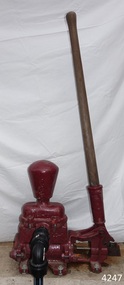
Equipment - Pump, circa 1930's - 1940's
... suction pump...agricultural hand pump...plumber’s hand pump...portable...The former McPherson’s Pty Ltd building in Collins Street Melbourne is now on the Victorian Heritage Register VHR H0942 This pump is representative of mechanical pumps popular in the early to mid-1900’s and still used today. flagstaff hill warrnambool flagstaff hill maritime museum shipwreck coast flagstaff hill maritime village great ocean road ajax pump works tottenham melbourne ajax pump factory kyneton william edward mcpherson thomas mcpherson of melbourne mcpherson’s pty ltd melbourne acme bolt company tool equipment co. pty. ltd associated machine tools australia pty ltd ajax bolt and rivet co. pty ltd new zealand forrers company ipswich queensland ksb ajax pumps ksb australia pty ltd macson lathes tool manufacturer early to mid- 20th century ajax double acting hand pump ajax type l2 series a pump qisjax pumps water pump 1940’s fuel pump 1940’s hand operated constant flow pressure pump reciprocating suction pump agricultural hand pump plumber’s hand pump portable hand pump Embossed on lower section of pump "L2 - 10", "L2 - -1", "AJAX" “(?) ...This pump is an Ajax Type L2 Series A model, made and sold by McPherson’s Pty Ltd of Melbourne circa 1930’s to 1940’s, is a mechanical, hand operated, constant flow pressure pump. It would have been used to pump fluids from one area to another, for example from a dam to a tank or used as a bilge pump on a small vessel, mounted on the vessel’s bulkhead, floor or deck. This type of hand pump is sometimes called a ‘Reciprocating Suction Pump’. It has a mechanical pumping action of the lever moves the piston inside the pump up and down. The water is lifted from below the pump through the inlet pipe and into the pump’s cylinder. This action causes the lower valve to close and the piston’s valve opens and the pressure within the pump forces the water out of the pump through the exit pipe. The limitation of this type of pump is that it can only raise the water a maximum of about 7 metres from beneath the ground and yields 24-26 Litres per minute. This type of pump could be used for many purposes such as pumping water or fuel. McPherson’s 1940’s advertisement proclaims “For all jobs on the land – irrigation, spraying, tank, plumbing, fire-fighting – there’s a suitable “Ajax” pump. Send us the details of you pumping problem. Our Expert’s advice will help you choose the right pump – the one that will give you most years of PROFITABLE PUMPING.” (The Australasian (Melbourne) Sat. 26th October 1940.) McPherson’s Pty Ltd, the manufacturer, advertised a similar pump to this one in The Australasian (Melbourne) in 1936, calling it the Ajax Double Acting Hand Pump. In 1942 another advertisement advised that a representative for a fire-fighting equipment supplier was visiting the western district of Victoria. The company could now supply double-action two-spray Ajax pumps at lower prices than similar pumps the district had recently purchased from Adelaide. McPHERSON’S FOUNDER and COMPANY TIMELINE 1860 – Thomas McPherson, a Scottish immigrant (c. 1853 ), founded McPherson’s in Melbourne, supplying pig iron (lead ingots imported as ballast in ships) to local manufacturers. 1882 – Thomas McPherson established a warehouse in Collins St Melbourne and included tools, steam fittings and machinery in his wares. The business expanded to include steam saw mills and became known as Thomas McPherson and Sons (William Murray and Edward). 1888 – Thomas passed away and his sons inherited the business. In 1896 William Murray became the sole proprietor after his brother Edward’s death. 1900 – The firm expanded, establishing Acme Bolt Company to manufacture nuts and bolts. 1912 – McPhersons Pty Ltd established a machinery warehouse and showroom in 554-556 Collins St Melbourne. McPherson’s went on to establish branches in Sydney (1911), Adelaide (1921) and Perth (1930) 1917 - McPherson’s supplied ‘dog spikes’ for the transcontinental railway, running from Eastern to Western Australia. 1918 – A tool works set up in Kensington, Melbourne, manufacturing Macson lathes and made machine tools that previously had to be imported. 1924 – The Bolt Works was transferred to a new building in Melbourne. McPhersons began making pumps. 1929 – McPherson retired. His son (Sir) William Edward McPherson (known as ‘WE’), was born in Hawthorne, Melbourne, in 1898. After his education he began work in his father’s Melbourne hardware and machinery business He took over as governing director when his father retired. 1929-1932 – McPherson’s supplied thousands of tons of rivets from its Richmond (Melbourne) Bolt Works for the construction of the Sydney Harbour Bridge. 1936 – McPherson’s Pty Ltd is advertising Ajax Pumps in newspapers 1934 – McPhersons purchased the property adjoining the warehouse in Collins Street, and during 1935-1936 built a new office and showrooms on the site of 546-445 Collins St. 1939 - McPherson’s acquired the Tool Equipment Co. Pty. Ltd and Associated Machine Tools Australia Pty Ltd was formed to separate McPherson’s machine-tool manufacturing and merchandising interests. 1939 – Ajax Pump Works, a foundry and pump manufacturing plant, was established in Tottenham, Melbourne, and the Ajax Bolt and Rivet Co Pty Ltd began manufacturing in New Zealand. 1944 - McPherson’s became a public company, McPherson’s Ltd. 1948 - The Ajax Pump Foundry opened at Kyneton, Victoria and in the post war years it grew to became a large manufacturer. 1980’s – Ajax Pumps brochure lists the address as 6 Buckhurst St, South Melbourne, Vic 3205 with the Telephone number 03 669 3588 1988 - Ajax Pumps acquired the Forrers Company, which was established in 1921. Manufacturing in Ipswich, Queensland, specialising in submersible sewage pumps. 1991 – KSB Ajax was formed, bringing together the companies KSB and Ajax Pumps 1993 – Manufacturing was moved to state-of-the-art premises in Tottenham, Victoria 2001 - The Forrers facility was moved to Tottenham. 2007 - Company name KSB Ajax Pumps was changed to KSB Australia Pty Ltd. 2009 - KSB Australia opened a branch in Townsville, Queensland. 2011 - KSB Australia moved to its dedicated Water and Waste Water Competence Centre in Bundamba, Queensland. DISPLAY OF THIS AJAX PUMP This pump was installed at Flagstaff Hill Maritime Village as part of a working display in the village by the Friends of Flagstaff Hill, in acknowledgement of the dedicated involvement of one of its long serving members, Bob Crossman. The display was officially opened 31st March 2018 and incorporates a restored Furphy Tank and Water Pipe Stand. The pump is used to draw water from the lake, through the water stand pipe and into the reconditioned Furphy Tank. This Ajax pump made by McPherson’s Pty Ltd is significant for its association with McPherson’s, a prominent manufacturer of hardware in Victoria. McPherson’s is famous for supplying ‘dog-spikes’ for the transcontinental railway (eastern to western Australia, 1917) and rivets for the Sydney Harbour Bridge (1929-1932). The Ajax pump is also of significance because of its association with McPherson’s Governing Director (Sir) William McPherson, former premier and treasurer in Victoria 1928-1929. The former McPherson’s Pty Ltd building in Collins Street Melbourne is now on the Victorian Heritage Register VHR H0942 This pump is representative of mechanical pumps popular in the early to mid-1900’s and still used today. Hand operated pressure pump, double acting. Cast metal case, painted red, with steel hose attachments and long metal lever. Pump is bolted to wooden plank. Model of pump is AJAX, Type L2, Series A pump. Embossed on lower section of pump "L2 - 10", "L2 - -1", "AJAX" “(?) –2-1” Embossed on lower handle “3-7” “L – 4” Embossed on attached plate “FOR SPARE PARTS / TYPE L2 / SERIES A / PUMP ASSEMBLED BY T R” Manufactured by McPherson’s Pty Ltd of Melbourne circa 1930’s - 1940’s.flagstaff hill, warrnambool, flagstaff hill maritime museum, shipwreck coast, flagstaff hill maritime village, great ocean road, ajax pump works tottenham melbourne, ajax pump factory kyneton, william edward mcpherson, thomas mcpherson of melbourne, mcpherson’s pty ltd melbourne, acme bolt company, tool equipment co. pty. ltd, associated machine tools australia pty ltd, ajax bolt and rivet co. pty ltd new zealand, forrers company ipswich queensland, ksb ajax pumps, ksb australia pty ltd, macson lathes, tool manufacturer early to mid- 20th century, ajax double acting hand pump, ajax type l2 series a pump, qisjax pumps, water pump 1940’s, fuel pump 1940’s, hand operated constant flow pressure pump, reciprocating suction pump, agricultural hand pump, plumber’s hand pump, portable hand pump -
 Eltham District Historical Society Inc
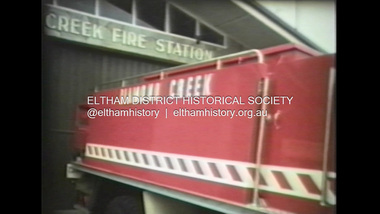
Film - Video (VHS), Diamond Creek Fire Brigade, c.1955-1987
... portable lighting plant, an Oxy Viva resuscitator to revive smoke inhalation victims and forcible entry tools to gain access to structure fires. Views of the main pump and control panel on the vehicle. As well as the main pump, the vehicle is equipped with an auxiliary pump which allows the facility to pump whilst moving. Fire fighters must undergo constant training and hone their skills, Scenes of a training exercise using the pumper to pump from static water. First, the short lengths of suction...portable lighting plant, an Oxy Viva resuscitator to revive smoke inhalation victims and forcible entry tools to gain access to structure fires. Views of the main pump and control panel on the vehicle. As well as the main pump, the vehicle is equipped with an auxiliary pump which allows the facility to pump whilst moving. Fire fighters must undergo constant training and hone their skills, Scenes of a training exercise using the pumper to pump from static water. First, the short lengths of suction ...Combination of three movie films. Movie One (1950s): 00:00 – 13:14 Black and white footage of Diamond Creek firemen practising in Diamond Street in the 1950s for forthcoming demonstrations of abilities. Mentions of Gordon Brandy and Joe Hislop Running out hoses from old hose reels along Diamond Street, Diamond Creek Displays from various brigades running out and connecting hoses. Also scenes from the 1950s of Diamond Creek Fire Brigade competing in various locations around Victoria and Tasmania. Mentions of Brigade members Dave Kidd, Bruce Hackett, Ron Kirkbride, Jack Marks, Graham Upton who are prominent in these events. Members of Kyneton Fire Brigade also present. Members competing in running out hose reels, connecting hoses togethers and to hydrants then climbing towers to direct water from hose or at a target hanging above the road. Diamond Creek members identified wearing a diamond on their chest and back. Includes scenes of Scottish pipe bands at the events and significant crowds of spectators. Footage of Mel Stone and Beryl Marks, Stan Redpath and Ron Kirkbride, then Ron Kirkbride and Eric Holt viewing flower displays. Film changes to colour at Diamond Creek oval for practice with fire engine entering oval. Members depicted include Bill May, Jack Sinclair, Jim Cox, Bob Beale, Dave Kidd, Bruce Hackett and Captain Clarrie Stone. Reverts to black and white in the 1950s where the Brigade joins forces with the Diamond Valley Community Hospital for a Gala Day on the Diamond Creek Oval. Changes to colour again, possibly same event and scenes of children on bikes and scooters or with prams and carts racing around the oval. Mention of young lad Brian Laurie who has his own fire truck. Dart throwing, pony rides. Scenes with Dr Don Cordner, Gus Lyons, Vic Cohn (?) and spinning wheel and Diamond Creek School children entertain a large crowd with Maypole dancing. Movie Two (1950s): 13:25 – 19:00 This black and white film was taken by a TV film crew in the 1950s depicts a typical call out for the Diamond Creek Fire Brigade. In this case the careless action of a member of the public throwing a lighted match from a car, which can cause extensive damage. Footage features the Shire of Eltham War Memorial tower at Kangaroo Ground before it was modified with a fire spotter’s cabin. Discusses fire spotting operations from the tower. Shows a fire spotter walking around the top of the tower. A fire is detected, and the information is relayed to the nearest fire station, in this case, Diamond Creek. The telephone call is received, and the alarm sounded. Captain Clarrie Stone and firemen May and Shaw leave their workplaces and prepare for action. Scenes of running across the Main Hurstbridge road showing the shops (Shell service station and Chemist prominent). Scenes entering the fire station which has a pictorial warning covering the entire door “Only you can prevent forest fires – If you’re careless – we’re homeless!” Eric Holt pinpoints the location of the fire while Captain Clarrie Stone and Fireman Shaw take note. The advance vehicle (an FE Holden ute, rego GTE-696) leaves to assess the extent of the fire. Having assessed the fire, Fireman Shaw communicates with base showing radio with call sign VL3JZ. Eric Holt takes the call. In the meantime, Captain Clarrie Stone and Fireman Shaw undertake some limited action to address the fire. Firemen Bill May, Jim Bates and Hugh Bar (?) man the tanker. A photo portrait of Queen Elizabeth is visible hanging on the wall. They are later joined by Firemen Jim Cox, Eric DeBuse (?) and Jack Marks. The tanker is seen departing the station and diverging off before the bridge. Captain Clarrie Stone and Fireman Shaw are seen pumping water on the flames with hand pumps when the tanker arrives. The hose is unreeled, and water turned on the flames. Jack Sinclair joins the action. Jim Cox directs water to the high stuff. The fire put out, Jack Marks and Eric DeBuse wind in the hoses and the team head back to town. It’s peaceful again at the memorial tower. Movie Three (1969-1987): 19:14 – 34:34 Colour film “Fired with Dedication”, Country Fire Authority Victoria, produced by I.L. Wadeson, Commentary by A.M. Hem. Credits with CFA Victoria emblem and then placed over a view of an old-style ladder engine. Opens with the scene of a fire engine outside the Diamond Creek Fire Station then various trophies reflecting the competition success of the brigade in various track and disciplined events. Two trophies shown of particular pride to the brigade were for first place in the Torchlight Procession at the State Championships in Mildura in 1986 and also at Swan Hill in 1981. Still photo scenes of ex Captain Clarrie Stone, Brigade Captain for 21 years; ex Captain Jack Marks, 10 years; ex Captain Ian Douglas, 10 years. Cuts to scene of radio control room, January 1969, and news of a fire on the northern side of the township of Diamond Creek. With scenes of flames in bush, the narration explains that until the early 1960s the area was an orchard district which protected the town against the savagery of bushfires. But due to competition from other areas more suitable for orcharding and easier transport to Melbourne the district could no longer remain competitive, and orchards were replaced by grassed areas, which together with the bush areas were a feeding ground for fire. On 8th January 1969, high temperatures and strong north winds, were, with the carelessness of some individual all that was necessary to produce the worst fire the district had seen. Cuts to scene of blackened fields and cattle - Hundreds of hectares of grass land were blackened, and cattle had to be transported to other areas for agistment. Scene of destroyed buildings in the township – 13 houses and the public hall in the town were destroyed as was the theatre equipment which was owned by the fire brigade. The Church of England Hall and bell tower were badly damaged. The whole town could have been burnt out but for the determination, skill, and courage of the Diamond Creek Fire Brigade. Scenes of all that was left of the home on the hill on the west side of the Church of England. Also, the remains of the old Pisy (?) home on the top of the same hill near Lambert Street, and the ruined Crocker home. Cuts to a scene in the mid-1970s to mid-1980s of a house fire in Haley Street attended by the Diamond Creek Fire Brigade. Although the house was severely damaged, it was saved. Mentions that whilst assistance is appreciated, in some circumstances, those doing so are not properly dressed for fighting fires. Breathing apparatus is a must in structure fire attack. Next scene (either on Mangarook or Coventry oval) showing off four Diamond Creek Fire Brigade efficient and very expensive firefighting units. Features a forward control vehicle Toyota 4WD used for conveying task force personnel to the required areas; a Hino Model 3.2 tanker, diesel powered and carries 3,000 litres of water and has a 16 HP petrol driven pump which delivers 900 litres of water per minute; an International tanker (registration TCM-418) which carries 3,000 litres of water with pumping capacity of 600 litres per minute. The Ford diesel powered pumper (registration MXE-754) is a well-equipped vehicle with a water capacity of 1,000 litres and capable of pumping 1,900 litres of water per minute from the main pump, has many lockers which hose equipment such as breathing apparatus and various types of hose nozzles and foam making equipment. The vehicle carries 360m of 64mm diameter hose which can be laid out from the rear lockers and a portable lighting plant, an Oxy Viva resuscitator to revive smoke inhalation victims and forcible entry tools to gain access to structure fires. Views of the main pump and control panel on the vehicle. As well as the main pump, the vehicle is equipped with an auxiliary pump which allows the facility to pump whilst moving. Fire fighters must undergo constant training and hone their skills, Scenes of a training exercise using the pumper to pump from static water. First, the short lengths of suction hose are coupled, a strainer fitted to ensure debris does not foul the pump. Gauges must be constantly monitored to ensure manageable water pressures are maintained. Pressures are normally controlled to allow two fire fighters to work at each nozzle outlet. Two nozzles are tested, one adjustable jet fog type which is used on flammable gasses or within a structure fire to absorb heat. A straight jet nozzle to project water long distances to protect exposed surfaces close to a fire radiated heat. The pumper is quite a versatile vehicle in handling structure fires, but it also carries specialist equipment needed in containing hazardous chemical incidents. Cuts to scene of parade – the Diamond Creek Fire Brigade has with other neighbouring brigades participated in most town fairs and earns the respect of the watching public. It can be seen why this brigade has been so successful at disciplined contests. Views of Plenty Fire Brigade Road Rescue unit which is equipped with the “Jaws of Life” Scenes of athletic competitions – many neighbouring brigades indulge in friendly but keen competition at the Diamond Creek Town Fair. The young are also encouraged to participate in all aspects of Junior Fire Brigade activities and become tomorrow’s generation of volunteer fire fighters. Scene of the 1986 Diamond Creek Town Fair which was the last time veteran Captain Clarrie Stone BEM marched with the brigade. Clarrie was awarded the British Empire Medal for his service to the Country Fire Authority. Also, scenes of vehicles in the parade. Cuts to scene of brigade members in drill formation for inspection by Acting Chief Harry Rothsay (?) on the occasion of the opening of the new fire station extensions on August 29, 1987. Rudy Libel (?) Captain at the time. Scenes of crowds including many dignitaries of neighbouring brigades present including Lieutenant Gordon Grandy (who came down from Queensland for the occasion) and ex-Secretary David Kidd and wife Betty, also ex Captain Clarrie Stone and Mrs Nel Stone, a life member of the Ladies Auxiliary, the Reverend Jock Ryan, son of J.L Ryan, founder of the Diamond Creek Fire Brigade, Foundation Captain of the fire brigade, Keith Bradbury and Mrs Bradbury. Pauline Dick accepts a community service award for services to the CFA. Recognising over 47 and a half years of service, a presentation is made by Mr Neil Marshall, Acting Chairman of the CFA to ex Captain Clarrie Stone with response by Clarrie. Other members of the official party include Cr. Martin Wright, Shire President Wayne Phillips and local Member of Parliament, Mrs Pauline Toner. Ex foreman John Bennett is presented with a life member’s awards by Captain Rudy Libel. The camera also catches Gwen Cox, Jean Ryan and Bessie Layton (?) Provides historic footage of people, places and equipment and a record of the worst fires expoerienced in Diamond Creek in 1969BASF Standard Quality SQ E-180 VHS dubbing (poor quality) of three films Converted to MP4 file format 0:34:38, 1.85GBOn label: "Donation - August 2000 Diamond Creek Unit Old films made up from Fire Brigade shows at competitions - also Kangaroo Ground Tower being used"video recording, diamond creek fire brigade, 1986 diamond creek town fair, a.m. hem, acting chief harry rothsay, athletic competitions, beryl marks, bessie layton, betty kidd, bill may, bob beale, brian laurie, bruce hackett, captain clarrie stone, chemist, church of england hall, clarrie stone, clarrie stone bem, country fire authority victoria, coventry oval, cr. martin wright, crocker home, dart throwing, dave kidd, david kidd, diamond creek, diamond creek fire station, diamond creek oval, diamond creek school, diamond creek town fair, diamond street, diamond valley community hospital, dr don cordner, eric debuse, eric holt, fe holden ute, fire damage – buildings, fire spotter, fire spotter’s cabin, fire station extension, fired with dedication (film), firefighting units, fireman shaw, firemen jim cox, ford pumper, foundation captain, gala day, gordon brandy, gordon grandy, graham upton, gus lyons, gwen cox, haley street, hino model 3.2 tanker, house fire, i.l. wadeson, ian douglas, international tanker, j.l ryan, jack marks, jack sinclair, january 1969, jaws of life, jean ryan, jim bates and hugh bar, jim cox, joe hislop, john bennett, kangaroo ground, kangaroo ground tower, keith bradbury, kyneton fire brigade, lambert street, main hurstbridge road, mangarook oval, maypole dancing, mel stone, mildura 1986, mrs bradbury, mxe754 vic registration, neil marshall, nel stone, orchard district, oxy viva resuscitator, pauline dick, pauline toner mp, pisy home, plenty fire brigade road rescue unit, pony rides, radio control room, reverend jock ryan, ron kirkbride, rudy libel, shell service station, shire of eltham war memorial, shire president wayne phillips, spinning wheel, stan redpath, state championships, swan hill 1981, tcm418 vic registration, torchlight procession, toyota 4wd, trophies, vic cohn, victorian bushfires - 1969, vl3jz -
 Wodonga & District Historical Society Inc
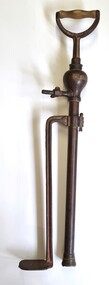
Functional object - Brass Stirrup Pump
... portable reciprocating water pump used to extinguish or control small fires. It is operated by hand. The operator places a foot on a stirrup-like bracket at the bottom of the pump to hold the pump steady. The bottom of the suction...portable reciprocating water pump used to extinguish or control small fires. It is operated by hand. The operator places a foot on a stirrup-like bracket at the bottom of the pump to hold the pump steady. The bottom of the suction ...A stirrup pump is a portable reciprocating water pump used to extinguish or control small fires. It is operated by hand. The operator places a foot on a stirrup-like bracket at the bottom of the pump to hold the pump steady. The bottom of the suction cylinder was placed inside a bucket of water. Water was drawn by pumping the handle up and down to create suction. The pumps were used in a variety of settings to enable quick action if a small fire broke out. They were a vital tool in London during the Blitz of World War 11. On the local level they were also used for spraying fruit trees, plants and vines. The Crescent Tool Company was founded in 1907. The Crescent brand has changed ownership multiple times. It is currently owned by Apex Tool Group but still also trades as Crescent in Australia. This pump was donated by Geoff Williams of Wodonga and was used at "Orange Vale" farm at Oxley Flats near Wangaratta. "Orange Vale" was owned by Mr. Robert Williams. Widely known as "Uncle Bob". in the 1940s Mr. Williams opened up the family property, established in the 1860s, as a camp for young people from Wangaratta. By 1951, this had extended to catering to group camps for children from Victoria, New South Wales and Queensland. 250 children could be accommodated at one time and as many as 3,000 children enjoyed the facilities each year.These pumps were important in fire fighting in a range of settings and were adapted for use in agricultural and small farm settings,A brass stirrup pump with wooden handle. It consists of 2 parallel brass pieces, one with a foot piece attached to keep the pump steady. The base of the pump is fitted with a pierced metal filter that prevents grit and debris being drawn into the pump and fouling it. 2 butterfly screws enable adjustment of height and securing a hose.crescent tools, orange vale, fire equipment
