
Showing 5 items matching "portex"
-
 Royal Australian and New Zealand College of Obstetricians & Gynaecologists (RANZCOG)
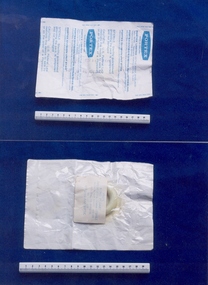
Ring pessary associated with Dr Geoff Bishop, c. 1977, Portex Ltd, England, c1977
... As well as the UK, Portex had divisions in the USA and Canada. ...Portex brand ring pessary in original packaging. ...Portex Ltd, England...As well as the UK, Portex had divisions in the USA and Canada. ...This pessary came from Professor Geoff Bishop's rooms, Mollison House, 386 Albert Street, East Melbourne. As well as the UK, Portex had divisions in the USA and Canada. The pessary was originally regarded as an instrument and made from cork, ivory, hard rubber or gum-elastic. In later times, they were made from black vulcanite, flexible tin, soft copper wire covered with Indian rubber, and celluloid. The form of the pessary was and still is variable -either round, oval, or moulded in some cases combining three or four curves depending on the size of the pessary. In ancient times, medicated pessaries were made from emollient. astringent and aperient. Several of these are still used, but in more modem times are called vaginal suppositories. Anal suppositories are still used to suppress the pain of haemorrhoids. Portex brand ring pessary in original packaging. Consists of circular ring of cream vinyl, in sterile sealed pouch with transparent plastic at back. Stamped on pouch "PORTEX ENGLAND", and the text "USE BY FEB 77" and "CONTROL No F/1 505". The ring is size 700/300/056 - 56mm. A sticker on the back of pouch gives instruction for cleaning the pessary.pessary, intrauterine device -
 Royal Australian and New Zealand College of Obstetricians & Gynaecologists (RANZCOG)
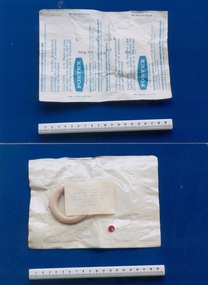
Ring pessary associated with Dr Geoff Bishop, c. 1977, Portex Ltd, England, before 1977
... As well as the UK, Portex had divisions in the USA and Canada. ...Portex brand ring pessary in original packaging. ...Portex Ltd, England...As well as the UK, Portex had divisions in the USA and Canada. ...This pessary came from Professor Geoff Bishop's rooms, Mollison House, 386 Albert Street, East Melbourne. As well as the UK, Portex had divisions in the USA and Canada. The pessary was originally regarded as an instrument and made from cork, ivory, hard rubber or gum-elastic. In later times, they were made from black vulcanite, flexible tin, soft copper wire covered with Indian rubber, and celluloid. The form of the pessary was and still is variable -either round, oval, or moulded in some cases combining three or four curves depending on the size of the pessary. In ancient time, medicated pessaries were made from emollient. astringent and aperient. Several of these are still used, but in more modem times are called vaginal suppositories. Anal suppositories are still used to suppress the pain of haemorrhoids.Portex brand ring pessary in original packaging. Consists of circular ring of cream vinyl, in sterile sealed pouch with transparent plastic at back. Stamped on pouch "PORTEX/MADE IN ENGLAND", and the text "USE BY JAN 77" and "CONTROL No 06 88". The ring is size 700/300/065 - 65mm. A sticker on the back of pouch gives instruction for cleaning the pessary. A red dot is also stuck to the back of the pouch.pessary, intrauterine device -
 Royal Australian and New Zealand College of Obstetricians & Gynaecologists (RANZCOG)
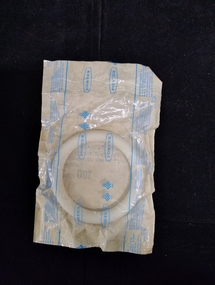
Portex rubber ring pessary, 100mm, Portex Ltd, England, c.1985-1986
... Top of packaging printed with logos of the manufacturer (Portex) and contact information in multiple languages. ...Portex Ltd, England...Expiry date printed on back says 'OCT 86'. Portex rubber ring pessary, 100mm Portex Ltd, England ...White ring pessary in sterile packaging. Unused. Top of packaging is clear, showing the pessary inside. Top of packaging printed with logos of the manufacturer (Portex) and contact information in multiple languages. Back of packaging printed with the text 'PVC RING PESSARY', usage instructions, and the size of the pessary - 100mm. Expiry date printed on back says 'OCT 86'.gynaecology -
 Kiewa Valley Historical Society
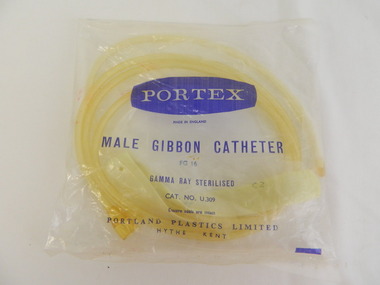
Catheter - Medical
... ...portex...Bag: Portex / Made in England / Male Gibbon Catheter / FG 16 / Gamma Ray Sterilised...Provenance: Used in the Tawonga District General Hospital which was remote and therefore required good equipment. good condition and good interpretation capacity. catheter medical hospital portex sterilisation Bag: Portex / Made in England / Male Gibbon Catheter / FG 16 / Gamma Ray Sterilised Plastic opaque yellowish tube in clear plastic sterilised bag with blue writing on it. ...This medical / hospital equipment was used in the Tawonga District General Hospital which was built in the 1950's specifically for the increase in population due to the Kiewa Hydro Scheme.Historical: Shows the development of scientific hospital equipment including sterilisation. Provenance: Used in the Tawonga District General Hospital which was remote and therefore required good equipment. good condition and good interpretation capacity.Plastic opaque yellowish tube in clear plastic sterilised bag with blue writing on it.Bag: Portex / Made in England / Male Gibbon Catheter / FG 16 / Gamma Ray Sterilisedcatheter, medical, hospital, portex, sterilisation -
 Emerald Museum & Nobelius Heritage Park
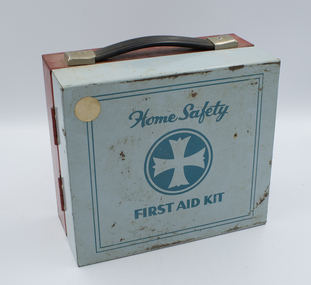
Functional object - First Aid Kit, William Wallace & Co, c. late 1950s
... . - Five sachets of Bex Powder (a mix of caffeine, aspirin, and phenacetin) - A cardboard box containing a squeeze tube of 'Portex Medicated Plastic Skin' (likely a combination painkiller and liquid bandage) - A carboard box containing an eye dropper - Several bandages - A eye dust remover - A plastic cup.... - Five sachets of Bex Powder (a mix of caffeine, aspirin, and phenacetin) - A cardboard box containing a squeeze tube of 'Portex Medicated Plastic Skin' (likely a combination painkiller and liquid bandage) - A carboard box containing an eye dropper - Several bandages - A eye dust remover - A plastic cup Functional object First Aid Kit William Wallace & Co ...This kit most likely originates from the late 1950s. The enclosed St Johns Ambulance first aid guide was published in 1955 (the 8th impression of the 40th Edition). It belonged to Doug Twaits , presumably first when he lived in Kew; while a residence in Kew is not recorded in biographical information about him, this too would most likely have occurred in the late 1950s after he returned from Papua New Guinea and before he lived in Essendon. Twaits had previously lived in Emerald, and would return later in life. The first aid book was not originally included in the kit and may not be contemporaneous with the box it is now stored in. However, based on the items stored within the kit it is unlikely to originate from much later, and it most likely did originate at a similar time to the enclosed book. In particular, Dex Powder was banned in the 1970s due to health risks, placing a hard limit on how late it could be from.This kit represents the state of home healthcare in the mid-20th century.The metal box is a rectangular prism in two equal halves, one painted blue and the other red. The blue side - the front - features a cross and text announcing it as a home first aid kit. On the left are two hinges connecting the two parts; on the right is a metal clasp closing the box. A carrying handle is attached to the top of the box, on the red rear section. The box still contains many elements of the first aid kit itself: - Three first aid guidebooks (a 283-page textbook published by St Johns Ambulance Association, a 27-page booklet published by Smith & Nephew, and a 15-page booklet published by Savlon) - Tubes of "strangulator tubing," cotton wool, boracic (boric) acid, sodium bicarbonate, and salt tablets - Vials of Sal Volatile (smelling salts), Acriflavine antiseptic, calamine lotion, castor oil, and benzethonium chloride germicide. - Five sachets of Bex Powder (a mix of caffeine, aspirin, and phenacetin) - A cardboard box containing a squeeze tube of 'Portex Medicated Plastic Skin' (likely a combination painkiller and liquid bandage) - A carboard box containing an eye dropper - Several bandages - A eye dust remover - A plastic cupBox: "Home Safety / FIRST AID KIT" Black Book: "FIRST AID / TO THE INJURED / THE ST. JOHN AMBULANCE ASSOCIATION" Black Book, handwritten inside cover: "D. TWAITS / 101 BARKERS ROAD / KEW" Red Booklet, Front Cover: "FIRST AID / S&N" Red Booklet, Rear Cover: "S&N / Published by / SMITH & NEPHEW LTD / Welwyn Garden City, Herts., England / Manufacturers of / Elastoplast Products / Gypsona P.O.P. Bandages / Surgical Dressings, etc. / PRINTED IN ENGLAND 893EL" Blue Booklet: "HANDBOOK OF / FIRST AID / 'Savlon'"medical & health, 1950s
