
Showing 13 items matching "portland institutions"
-
 Glenelg Shire Council Cultural Collection
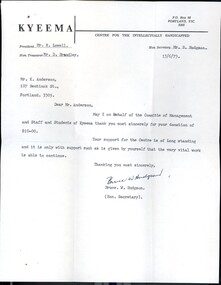
Letter - Letter from Kyeema to K. S. Anderson, Bruce W. Hudgson, 1973
... ...Portland Institutions...Anderson Glenelg Shire cultural collection Community Portland Institutions Typed letter on cream paper. ...Kyeema is an established organisation within Portland and K. S. Anderson was responsible for the building of a deep water port at Portland and he became chairman of the Portland Harbour Trust in 1950. He dedicated himself to supporting his community which included fund raising and donations to organisations such as Kyeema.This letter is part of the K.S. Anderson Collection. It represents the history of the development of Kyeema within Portland.Typed letter on cream paper. The letter is headed on the left hand side - Kyeema. The letter is signed by Bruce Hudgson, secretary, and addressed to Mr Anderson. The letter thanks Mr Anderson for the donation of $10. It is dated 1973. Affixed to the back of the letter by staple is a small receipt. The letter is dated 13 June 1973 and the receipt is dated 1 June 1973.portland, portland harbour, kyeema, k. s. anderson, glenelg shire cultural collection, community, portland institutions -
 Glenelg Shire Council Cultural Collection
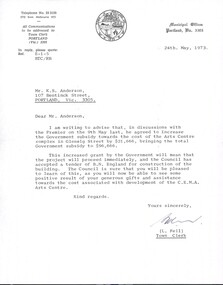
Letter - Letter to K. S. Anderson from Portland Town Clerk, 1973, L. Fell, 24/05/1973
... Portland...public life and institutions...K S Anderson town clerk Portland public life and institutions Portland Arts Centre CEMA CEMA Arts Centre Letter from L. ...K.S. Anderson Collection. This letter also relates to the history of the Portland Council for the Encouragement of the Arts (CEMA) and the Portland Arts Centre.This letter is part of the personal archives of K. S. Anderson who built Portland Harbour but also worked hard for the establishment of the Arts Centre in Portland. It realtes to the funding and building of the Arts Centre and to the history of the Portland CEMA Group.Letter from L. Fell, Portland Town Clerk to K.S. Anderson, 24 May 1973. Typed on grey Town of Portland letterhead paper. Also envelope, Town of Portland stamp, 7c purple stamp, typed address. The letter advises K. S. Anderson that an increase in Government subsidy had been agreed towards the cost of the Arts Centre on Glenelg Street (now the Portland Arts Centre).k s anderson, town clerk portland, public life and institutions, portland arts centre, cema, cema arts centre -
 Glenelg Shire Council Cultural Collection
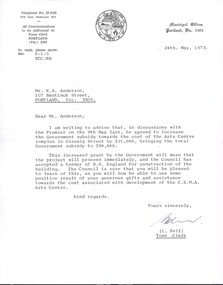
Letter - Letter to K. S. Anderson from Portland Town Clerk, 1973, L. Fell, 24/05/1973
... Portland...public life and institutions...K S Anderson town clerk Portland public life and institutions Portland Arts Centre CEMA CEMA Arts Centre Letter from L. ...K.S. Anderson Collection. This letter also relates to the history of the Portland Council for the Encouragement of the Arts (CEMA) and the Portland Arts Centre.This letter is part of the personal archives of K. S. Anderson who built Portland Harbour but also worked hard for the establishment of the Arts Centre in Portland. It realtes to the funding and building of the Arts Centre and to the history of the Portland CEMA Group.Letter from L. Fell, Portland Town Clerk to K.S. Anderson, 24 May 1973. Typed on grey Town of Portland letterhead paper. Also envelope, Town of Portland stamp, 7c purple stamp, typed address. The letter advises K. S. Anderson that an increase in Government subsidy had been agreed towards the cost of the Arts Centre on Glenelg Street (now the Portland Arts Centre).k s anderson, town clerk portland, public life and institutions, portland arts centre, cema, cema arts centre -
 Glenelg Shire Council Cultural Collection
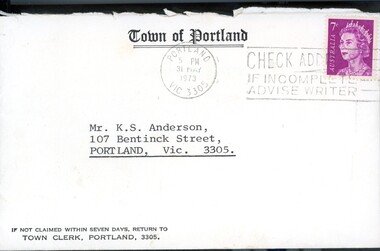
Letter - Envelope, L. Fell, 24/05/1973
... Portland...public life and institutions...K S Anderson town clerk Portland public life and institutions Portland Arts Centre CEMA CEMA Arts Centre Town of Portland / Mr. ...K.S. Anderson Collection. This letter also relates to the history of the Portland Council for the Encouragement of the Arts (CEMA) and the Portland Arts Centre.This letter is part of the personal archives of K. S. Anderson who built Portland Harbour but also worked hard for the establishment of the Arts Centre in Portland. It realtes to the funding and building of the Arts Centre and to the history of the Portland CEMA Group.Envelope which contained a letter from L. Fell, Portland Town Clerk to K.S. Anderson, 24 May 1973. The envelope bears the name of the Town of Portland at the very top. Below which it is addressed to K. S. Anderson. It has a purple stamp in the top right corner which has the image of Queen Elizabeth II on it along with 7c. The is a circular stamp indicating that it was posted in Portland on 31 May 1973.Town of Portland / Mr. K. S. Anderson / 107 Bentinck Street / Portland, Vic. 3305 / If not claimed within seven days, return to / Town Clerk, Portland, 3305k s anderson, town clerk portland, public life and institutions, portland arts centre, cema, cema arts centre -
 Flagstaff Hill Maritime Museum and Village
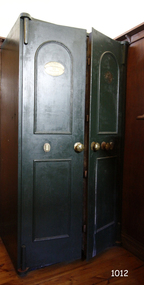
Functional object - Safe, W. Marr, Circa 1855
... portland bank...w marr...william w marr...financial institution...The bank was an integral part of the establishment and growth of commerce in Colonial Victoria. flagstaff hill warrnambool shipwreck coast flagstaff hill maritime museum flagstaff hill maritime village maritime museum great ocean road shipwreck artefact safe bank safe vault security finances anz bank portland bank w marr william w marr financial institution savings gold exchange loans investments safety safe maker lock maker iron box strong-room Text embossed on plaque: "W. ...This strong, heavy bank safe was made by W. Marr in London. It was formerly owned by the ANZ Bank in Portland, Victoria. Portland’s ANZ Bank was originally a branch of the Bank of Australasia, which first came to Australia in 1835, opening in Sydney. Portland’s Bank of Australasia began in a bluestone building built on the north corner of Julia and Bentinck Streets by stonemason William Robb in 1855, around the time of Australia’s Gold Rush. Eventually, in 1951, the Bank of Australasia merged with the Union Bank to become the Australia & New Zealand Bank, known as the ANZ. Portland’s branch of the Bank of Australasia then moved into the old Union Bank building at 44 Percy Streets; both bank buildings were built around the same. The maker of this safe, W. (William) Marr, obtained a patent in 1834 for what is believed to be the first fire-retarding patent, building this into the lining of strong boxes. Others made further design improvements such as hardening the metal plates used to make the boxes. In about 1840 Thomas Milner, a Sheffield tinsmith, made the earliest safes that could safely protect their contents from a surrounding fire. This was achieved by including tubes of a substance between the inner and outer walls of the safe that would react to the heat and the contents would put the fire out. In 1851 an Exhibition at London’s Crystal Palace included fire-proof safes from different vendors. William Marr was listed under Fireproof Box Makers in the 1842 London Trades Directory, at 33 Broad Street, and 52 Cheapside. William Marr & Son were appointed to supply Her Majesty’s National Debt Office and other departments in 1860, with the address 9 Walbrook, Vulcan Safe Works, Skin Yard, Bankside, Southwark, London. 1n 1870 the address for William Marr listed under Safe Makers and Agents in the London Trades Directory was 67 Cannon Street. The manufacturer, W Marr, is significant as an inventor of a way to make a strong box fireproof, then patented his secure safe. This invention indicates that security of money was of great importance in the mid-1800s as it continues to be today. The secure safe would have given much comfort to those with investments and savings, as well as to the bank itself, the custodian of other people's money. This safe was made in London and exported to colonial Australia, giving significance to the safe as an item that was high in the list of the needs of the early Australians and their businesses. The safe has local historical significance as it was used by the original Bank of Australasia in Portland, which was built in 1855 and went on to become the ANZ Bank, still in operation today. The bank was an integral part of the establishment and growth of commerce in Colonial Victoria.Safe; heavy metal bank safe, painted green. Double doors each have top and bottom external hinges, and two front panels; the top panels are arched. The thick doors have five sliding locks. Inside is a fixed metal compartment with a locked sliding metal drawer, and several fitted shelves plus some temporary removable shelving. Both doors have a decorative brass knob near the centre opening. Left door has an oval artificial keyhole and a space where another fitting has been attached. The right door has a second brass knob and an oval keyhole. The top panels of the left door has an oval plaque with an inscription; the right door has evidence that there was an oval attachment. Made by W. Marr, London.Text embossed on plaque: "W. MARR / PATENTEE & MANUFACTURER / 52 / /CHEAPSIDE / LONDON" flagstaff hill, warrnambool, shipwreck coast, flagstaff hill maritime museum, flagstaff hill maritime village, maritime museum, great ocean road, shipwreck artefact, safe, bank safe, vault, security, finances, anz bank, portland bank, w marr, william w marr, financial institution, savings, gold exchange, loans, investments, safety, safe maker, lock maker, iron box, strong-room -
 Federation University Historical Collection
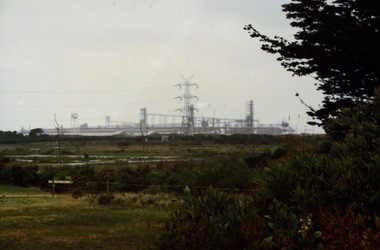
Photograph - Photograph - Colour, VIOSH: University of Ballarat; BP Portland Presentations, November 1997
... Institution was known as the Ballarat College of Advanced Education. In 1990 it became known as Ballarat University College, then in 1994 as University of Ballarat. It was 2014 that it became Federation University. VIOSH Australia students are safety managers, senior advisors and experienced OHS professionals. They come from all over Australia and industry. Students are taught active research and enquiry; rather than textbook learning and a one-size fits all approach. VIOSH accepts people into the Graduate Diploma of Occupational Hazard Management who have no undergraduate degree - on the basis of extensive work experience and knowledge. BP Portland ...Victorian Institute of Occupational Safety and Health (VIOSH) Australia is the Asia-Pacific centre for teaching and research in occupational health and safety (OHS) and is known as one of Australia's leaders in the field. VIOSH has a global reputation for its innovative approach within the field of OHS management. VIOSH had its first intake of students in 1979. At that time the Institution was known as the Ballarat College of Advanced Education. In 1990 it became known as Ballarat University College, then in 1994 as University of Ballarat. It was 2014 that it became Federation University. VIOSH Australia students are safety managers, senior advisors and experienced OHS professionals. They come from all over Australia and industry. Students are taught active research and enquiry; rather than textbook learning and a one-size fits all approach. VIOSH accepts people into the Graduate Diploma of Occupational Hazard Management who have no undergraduate degree - on the basis of extensive work experience and knowledge.Twelve coloured photographs of presentation relating to BP Portland.bp portland, electricity, viosh -
 Federation University Historical Collection
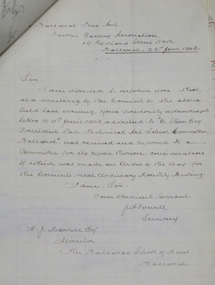
Letter - Correspondence, Inwards correspondence to the Ballarat School of Mines, 1908, 07/01908
... It is a predecessor institution of Federation University Australia. ballarat school of mines frederick martell ballarat fine art gallery j.a. powell art gallery of ballarat gallery association charles j. morris ballarat fine art public gallery association telegram c.h. clark l. ditchburn alumni examinations w.g. taylor london bank of australia limited bealiba thomas r. lyle jessie chalmers signor steffani arundel orchard w.f. coltman e.e. hobson j.t. mooney queanbeyan p.e. marmion willaim m. robertson assay e.e. brook lloyd copper mines h.b. silberberg & co. education department melbourne c. james w. west haddon warragul bakers reef gold mning company letterhead victorian portland cement works d. mitchell electric lighting and traction co. australia ltd austral otis engineering comapny ltd melbourne glass bottle works company cuming, smith & co. pty ltd excursions metropolitan gas company jaques bros manufacturing engineers victoria iron works a. victor leggo co leggo's metallurgical works melbourne hydraulic power company limited mount lyell mining and railway coy ltd victorian railways telegraph land surveying j. brittain g. fitzgerald hamilton cochran and co wynne-grant antimony reduction company mt egerton and gordons mining co e. hogan e.c. connell a.d. galoway metallurgy h.b. silberberg Specific Gravity Balance and Weights Union Bank of Australia (Ballarat) Bullarto Bush Inn, Bullarto W. ...The Ballarat School of Mines was the first school of Mines in Australasia, and was established in 1870. It is a predecessor institution of Federation University Australia.Correspondence to the Ballarat School of Mines for the month of July 1908. Letter 162 Ballarat Fine Art Public Gallery Association 19 Lydiard Street North Ballarat, 26th June 1908 Sir, I am directed to inform you that at a meeting of the Council of the above held last evening, your previously acknowledged letter of 11th June 1908, addressted to "E. [Stoer?] Esq, President Late Technical Art School Committee", was received and referred to a committee for its report thereon, cousi directions of which was made are the Order of the Day for the Councils next Ordinary Monthly Meeting. I am, Sir, Your Obedient Servant, J.A. Powell Secretary F.J. Martell Esq Director The Ballarat School of Mines Ballarat ballarat school of mines, frederick martell, ballarat fine art gallery, j.a. powell, art gallery of ballarat, gallery association, charles j. morris, ballarat fine art public gallery association, telegram, c.h. clark, l. ditchburn, alumni, examinations, w.g. taylor, london bank of australia limited, bealiba, thomas r. lyle, jessie chalmers, signor steffani, arundel orchard, w.f. coltman, e.e. hobson, j.t. mooney, queanbeyan, p.e. marmion, willaim m. robertson, assay, e.e. brook, lloyd copper mines, h.b. silberberg & co., education department melbourne, c. james, w. west, haddon, warragul, bakers reef gold mning company, letterhead, victorian portland cement works, d. mitchell, electric lighting and traction co. australia ltd, austral otis engineering comapny ltd, melbourne glass bottle works company, cuming, smith & co. pty ltd, excursions, metropolitan gas company, jaques bros manufacturing engineers, victoria iron works, a. victor leggo co, leggo's metallurgical works, melbourne hydraulic power company limited, mount lyell mining and railway coy ltd, victorian railways, telegraph, land surveying, j. brittain, g. fitzgerald, hamilton, cochran and co, wynne-grant antimony reduction company, mt egerton and gordons mining co, e. hogan, e.c. connell, a.d. galoway, metallurgy, h.b. silberberg, specific gravity balance and weights, union bank of australia (ballarat), bullarto, bush inn, bullarto, w. harrington, prospective student, book donaton from smithsonian institution, e. la t. armstrong, department of mines and forests, melbourne, snake valley, r. hall-jones, c. calaby, clementston, thomas ramsay, w.d. thompson, longmans, green and co, selwyn chase, missionary exhibition, aboriginal court of the missionary exhibition, examination results, leslie coulter, hnery j. saw, thomas ramsay, virgil tucker, leslie c. blick, thomas r. williams, oliver w. williams, thomas r. williams, leo m. seward, david w. bonar, louis w.g. buchner, leo m. seward, albert j. robin, james a. chambers, james d. brokenshire, william kingston, edgar c. hurdsfield, virgil tucker, oliver w. williams, william g. sides, herbert hawkesworth, colin c. corrie, henry j. saw, thomas h. trengrove, thomas r. prigdeon, harold b. herbert, viola p. jackson, lionel s. davies, stanley w. tompkins, arthur m. lilburne -
 Glenelg Shire Council Cultural Collection
Administrative record - Quote for labour and materials - Portland Free Library, 1911
... Handwritten specifications of labour and materials required in carrying out painting repairs at the POrtland Free Library, for the Committee of that Institution'. Signed by A H Andrews, architect 18/5/11 Handwritten note bottom of second paged signed by J Popley 29/5/11, agreeing to complete the work for £7.7.0...Glenelg Shire Council archives Portland Free Library quote Front: Purple stamp: 'Portland Free Library, Museum & Literary Institute' Handwritten specifications of labour and materials required in carrying out painting repairs at the POrtland Free Library, for the Committee of that Institution'. Signed by A H Andrews, architect 18/5/11 Handwritten note bottom of second paged signed by J Popley 29/5/11, agreeing to complete the work for £7.7.0 Administrative record Quote for labour and materials - Portland Free Library ...Front: Purple stamp: 'Portland Free Library, Museum & Literary Institute'glenelg shire council archives, portland free library, quote -
Glenelg Shire Council Cultural Collection
Photograph - Photograph - Portland Lifeboat, n.d
... Portland Lifeboat was overseen by Harbour Master Charles Ferguson. It is understood to have been constructed from the same moulds used to build the Port Fairy Lifeboat, designed by William White, in 1857. Both boats are similar to the lifeboats designed in England by James Peake and adopted by the Royal National Lifeboat Institution (RNLI) in the UK. ...Portland Lifeboat was overseen by Harbour Master Charles Ferguson. It is understood to have been constructed from the same moulds used to build the Port Fairy Lifeboat, designed by William White, in 1857. Both boats are similar to the lifeboats designed in England by James Peake and adopted by the Royal National Lifeboat Institution (RNLI) in the UK. ...Built in 1858 at the Port and Harbour Master's yard in Williamstown Victoria, the Portland Lifeboat was overseen by Harbour Master Charles Ferguson. It is understood to have been constructed from the same moulds used to build the Port Fairy Lifeboat, designed by William White, in 1857. Both boats are similar to the lifeboats designed in England by James Peake and adopted by the Royal National Lifeboat Institution (RNLI) in the UK. The Portland Lifeboat's 9.14 m (30 ft) long hull is double diagonally planked in New Zealand kauri, and many of the planks run from gunwale to gunwale in one piece under the inner keel section. Eucalyptus and oregon were used elsewhere and the local blacksmith made the iron work. The fastenings are copper. There are two flotation or buoyancy tanks at either end, with prominent whaleback style decking. Under the thwarts is a deck with scuppers so that the craft is both buoyant and self draining whenever large waves are taken aboard in rough conditions. The lifeboat was oar-powered with a sailing rig. The original rig was a lug mainsail, but this was replaced with a lug and headsail rig taken from a fishing boat in 1903. The lifeboat was manned by volunteer crews, mostly local fishermen from Portland. They maintained this service until 1915 when the boat was replaced with a new motorised craft. The lifeboat's most outstanding service was to the steamer ADMELLA in 1859 when the ship grounded on a reef off Cape Banks in South Australia, 150 km to the west of Portland. Survivors clung to the rigging in heavy seas for over a week and 89 people lost their lives in the shipwreck. Taken to the scene by the steamer LADY BIRD, the Portland Lifeboat was unable to assist until eight days after the ADMELLA's grounding when the seas abated enough for the lifeboat to manoeuvre close to the ship and rescue the last 19 survivors. Since its retirement in 1915 the lifeboat has been a memorial to those who manned it and those it rescued. For a long period it was on display in the Portland Gardens, first in the open and then under a canopy. In 2008 it was on display inside the Portland Maritime Discovery Centre, still in original condition complete with the rig from 1915. It is one of the oldest vessels of its type in Australia, and the world.Portland LifeboatPhotograph showing the Portland Lifeboatphotography, portland lifeboat, admella -
 Glenelg Shire Council Cultural Collection
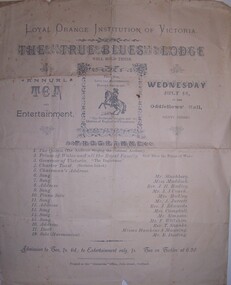
Programme - Programme - Loyal Orange Institution of Victoria "True Blues" Lodge Annual Tea and Entertainment Programme, c. 1900
... Institution of Victoria...The "Observer", Portland...Loyal Orange Institution of Victoria "True Blues" Lodge Annual Tea and Entertainment Programme Programme Programme - Loyal Orange Institution of Victoria "True Blues" Lodge Annual Tea and Entertainment Programme Loyal Orange Institution of Victoria The "Observer", Portland ...The Loyal Orange Institution of Victoria was established in 1843. As a society composed of Protestants, it works to support and defend the Protestant faith. The Institution is named in honour of King William III, Prince of Orange (1650-1702) and his achievements for civil and religious liberty. The first Orange Lodge in Victoria was founded in 1843, following a sectarian protest in Elizabeth Street Melbourne over the election of a Protestant candidate to the Legislative Council. By the 1890s there were 169 branches in Victoria, engaged in political lobbying for mainstream Protestant issues like temperance, Sunday observance, opposition to state aid for church schools, and opposition to any expansion of the political influence of Roman Catholics. The monthly meetings had an element of secrecy, as members wore regalia and followed a simple ritual. No Catholics could join. Women were admitted to Lodges in 1903.Single-sided sheet printed in blue ink containing program details. Decorative title at top of page, with central image of cavalier on rearing horse within a decorative ribbon and floral border, containing a Protestant oath. Loyal Orange Institution of Victoria "True Blues" Lodge Annual Tea and Entertainment Programmeloyal orange institution, protestant, societies, religion -
Glenelg Shire Council Cultural Collection
Card - Card - War census wealth and income card, n.d
... War census wealth and income card, completed on behalf of the Portland Fee Library, museum and Literary Institute by John H Row, Hon. Treasurer of the above institution...War census wealth and income card, completed on behalf of the Portland Fee Library, museum and Literary Institute by John H Row, Hon. Treasurer of the above institution Card Card - War census wealth and income card ...Commonwealth of Australia. War census wealth and income card, completed on behalf of the Portland Fee Library, museum and Literary Institute by John H Row, Hon. Treasurer of the above institution -
Glenelg Shire Council Cultural Collection
Book - Book - The Quest For Peace As I Have Known It In Australia, Moore, Eleanor M, The Quest For Peace As I Have Known It In Australia, 1949
... Donated by the Women's International League for Peace and Freedom, Australian Section to the Portland Free Library Museum and Literary Institution....Donated by the Women's International League for Peace and Freedom, Australian Section to the Portland Free Library Museum and Literary Institution. Front: Label attached to the first page 'with compliments from the Women's International League for Peace and Freedom, Australian Section' Hon. ...Blue cloth-covered board covers and spine. Black text on front cover and spine. -
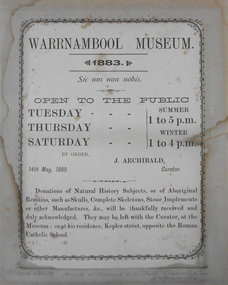 Warrnambool and District Historical Society Inc.
Administrative record - Advertising item, Warrnambool Museum 1883, 1889
... institution in Warrnambool for 80 years. Warrnambool Museum Mechanics Institute Warrnambool courthouse WARRNAMBOOL MUSEUM 1883 Edward Henty arrived at Portland in the " Thistle" schooner 68 tons 19th November 1834 A piece of light card with a decorative border and black lettering. ...This card was produced in 1889 to advertise the Warrnambool Museum which was shifted in April 1889 from its original site in the Mechanics Institute in Liebig Street to the old Warrnambool courthouse in Timor Street. ( This building no longer exists.) The Museum remained in Timor Street until 1912 when it went back to the Mechanics Institute until its closure in 1963. The Museum was founded in 1883 by the retired Police Inspector Joseph Archibald. The card shows that the museum was open three afternoons per week and was asking for donations. The pencil writing at the bottom of the card is Joseph Archibald's writing. This card is of considerable significance as it is an original document and an important memento of the old Warrnambool Museum, a much loved institution in Warrnambool for 80 years.A piece of light card with a decorative border and black lettering. It is torn on the edges and water stained. The base has been cut for its insertion into another folder. There is pencil writing at the bottom of the card, WARRNAMBOOL MUSEUM 1883 Edward Henty arrived at Portland in the " Thistle" schooner 68 tons 19th November 1834warrnambool museum, mechanics institute, warrnambool courthouse
