
Showing 10 items matching "possible site locations"
-
 Moorabbin Air Museum
Book - Sydney second airport, Department of Aviation Second Sydney Airport Site Selection Programme Draft Environmental Impact Statement
... ...Possible site locations...Sydney second airport Selection of short listed sites Role & nature of a second airport Possible site locations Site selection methodology Site characteristics The proposal at Badgery's Creek The socio-economic environment & effects of the proposal The physical /biological effects of the proposal The proposal at Wilton Socio-economic/physical/biological effects of the proposal Comparison of both sites Draft environmental impact statement for location of second Sydney airport, circa 1985 Department of Aviation Second Sydney Airport Site Selection Programme Draft Environmental Impact Statement Book Sydney second airport ...Draft environmental impact statement for location of second Sydney airport, circa 1985non-fiction Draft environmental impact statement for location of second Sydney airport, circa 1985 selection of short listed sites, role & nature of a second airport, possible site locations, site selection methodology, site characteristics, the proposal at badgery's creek, the socio-economic environment & effects of the proposal, the physical /biological effects of the proposal, the proposal at wilton, socio-economic/physical/biological effects of the proposal, comparison of both sites -
Warrnambool and District Historical Society Inc.
Memorabilia (Collection) - Des Williams' Collection (Mahogany Ship Research Material), Mahogany Ship Committee, Warrnambool, Des Williams Collection, early 21st century
... It includes a sheet containing original writings and a newspaper article (1892) about the location of the Mahogany Ship by Joseph Archibald, curator of the old Warrnambool Museum and an important researcher of the Mahogany Ship story, a copy of Edmund Gill's book, Coastal Processes and the Sanding of Warrnambool Harbour, Warrnambool Agricultural Society Show tickets and a 1918 service for Australian war dead in World War One. Des Williams was an important Mahogany Ship researcher in the late 20th century, spending several years using a hand auger to drill holes up to 30 feet in the possible ship site...It includes a sheet containing original writings and a newspaper article (1892) about the location of the Mahogany Ship by Joseph Archibald, curator of the old Warrnambool Museum and an important researcher of the Mahogany Ship story, a copy of Edmund Gill's book, Coastal Processes and the Sanding of Warrnambool Harbour, Warrnambool Agricultural Society Show tickets and a 1918 service for Australian war dead in World War One. Des Williams was an important Mahogany Ship researcher in the late 20th century, spending several years using a hand auger to drill holes up to 30 feet in the possible ship site ...Material originally collected by Warrnambool Mahogany Ship Committee Material collected for research and commemorative purposes A3 archival box containing folders of paper material Mahogany Ship material and other memorabilia of Des Williams mahogany ship, joseph archibald, des williams mahogany ship, joseph archibald, des williams -
 Bendigo Military Museum
photograph - Fortuna - 1st Year of Army Occupation in Bendigo, 1942
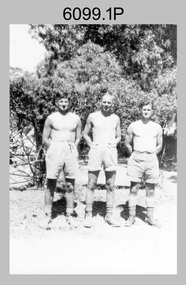
... site. The annotation on the back of Photo .17P is incorrect. The location of HQ 5th Army Troop was ‘Reynard St, Coburg.’ By late 1941 as Japan extended its control throughout Indo-China, resolving the accommodation problem of AHQ Cartographic Company located in Melbourne became more urgent. The steady Japanese advance made the bombing of Melbourne no longer a remote possibility, and in accordance with a general policy of dispersion, the Deputy Chief of the General Staff, Major General Sidney Rowell instructed Major William Sarll, in the interests of security of plant and to provide against possible damage of air attack, to investigate suitable safer inland accommodation for AHQ Cartographic Company. ...site. The annotation on the back of Photo .17P is incorrect. The location of HQ 5th Army Troop was ‘Reynard St, Coburg.’ By late 1941 as Japan extended its control throughout Indo-China, resolving the accommodation problem of AHQ Cartographic Company located in Melbourne became more urgent. The steady Japanese advance made the bombing of Melbourne no longer a remote possibility, and in accordance with a general policy of dispersion, the Deputy Chief of the General Staff, Major General Sidney Rowell instructed Major William Sarll, in the interests of security of plant and to provide against possible damage of air attack, to investigate suitable safer inland accommodation for AHQ Cartographic Company. ...This is a set of 17 photographs taken during the first year of Army occupation at Fortuna, Bendigo in 1942. The photos provide an insight into the preparatory work performed on the Fortuna Villa and surrounding buildings, by the Working Party 5th Army Troop and Ordnance Training Depot, before its occupation by personnel from LHQ Cartographic Company, Royal Australian Survey Corps. The annotation on the back of Photos .9P and .10P is misspelt. The correct spelling is ‘Nell Gwynne’. The poppet head of the Central Nell Gwynne mine is still an iconic landmark in Bendigo, lying just down the road from the poppet head lookout at Victoria Hill. The Central Nell Gwynne was the premier mine of Bendigo's 1930s mining revival and is of high historical value, due to the extensive and relatively intact features which remain at the site. The annotation on the back of Photo .17P is incorrect. The location of HQ 5th Army Troop was ‘Reynard St, Coburg.’ By late 1941 as Japan extended its control throughout Indo-China, resolving the accommodation problem of AHQ Cartographic Company located in Melbourne became more urgent. The steady Japanese advance made the bombing of Melbourne no longer a remote possibility, and in accordance with a general policy of dispersion, the Deputy Chief of the General Staff, Major General Sidney Rowell instructed Major William Sarll, in the interests of security of plant and to provide against possible damage of air attack, to investigate suitable safer inland accommodation for AHQ Cartographic Company. Major Sarll inspected many properties before finding one that would meet the requirements of the Cartographic Company. In late 1941, he came to inspect Fortuna, a rambling old mansion with about fifteen acres of ground in central Bendigo. Initially there was no intention to occupy the site beyond the end of the war, although Major Sarll's report to the Director of Survey noted many advantages in moving the Company to Bendigo. Major General Rowell quickly approved the selection of Fortuna before other authorities, which were investigating the evacuation of school children, could get in ahead of the Cartographic Company. On 23 March 1942, the Commonwealth of Australia, under the provisions of the National Security Act of 1939, took possession of the house, the old battery buildings and the fifteen acres of grounds. Under Warrant Officer J. Trist’s direction, over fifty Parks and Works tradesmen completed building works necessary to accommodate the Survey Corps’ military, map making and printing requirements. The building program was still under way when the first officer, Lieutenant Ralph Westgarth, arrived in May 1942 with the advance party which received and positioned all equipment as it came up from Melbourne in semi-trailers. Once the equipment was installed the rest of the Cartographic Company completed its shift to Bendigo by 11th June 1942. The first year of the Survey Corps’ occupation of Fortuna is covered in more detail with additional historic photographs, in pages 17-22 of Valerie Lovejoy’s book 'Mapmakers of Fortuna – A history of the Army Survey Regiment’ ISBN: 0-646-42120-4. This is a set of 17 photographs taken during the first year of Army Occupation at Fortuna, Bendigo in 1942. The black and white photographs were printed on photographic paper and are part of the Army Survey Regiment’s Collection. The photographs were scanned at 300 dpi. .1) - Photo, black & white, 1942. Bendigo Parks and Works tradesmen at Fortuna. L to R: Cliff Day, Ernie Arnold, Norm? .2) - Photo, black & white, 1942. “Don” - possibly SGT Don Sutcliffe. Fortuna, Bendigo. .3) - Photo, black & white, 1942. Parks and Works tradesmen in garden at Fortuna, Bendigo. L to R: Fred & Ernie. .4) - Photo, black & white, 1942. Benny Jack Williams at Fortuna, Bendigo. Accommodation tents were erected above the lake, which later became the parade ground. .5) - Photo, black & white, 1942. Working dress - Giggle suits. Parks and Works tradesmen at Fortuna, Bendigo. L to R: Cliff and Harry on big roof. .6) - Photo, black & white, 1942. Parks and Works tradesmen at Fortuna, Bendigo. Ted on big roof. .7) - Photo, black & white, 1942. Gold crusher battery just behind Fortuna. .8) - Photo, black & white, 1942. Scene of Bendigo from Fortuna. .9) - Photo, black & white, 1942. Nell Gwynne Mine from mullock heap at Victoria Hill near Fortuna, Bendigo. .10) - Photo, black & white, 1942. Nell Gwynne Mine and crusher near Fortuna, Bendigo. .11) - Photo, black & white, 1942. Sluicing for gold at Eaglehawk. .12) - Photo, black & white, 1942. Fortuna, Bendigo taken from the far side of tennis courts. .13) - Photo, black & white, 1942. Fortuna, Bendigo & its reflection from across the lake. .14) - Photo, black & white, 1942. Fortuna, Bendigo from the fishpond. .15) - Photo, black & white, 1942. Fortuna, Bendigo. .16) - Photo, black & white, 1942. First Fortuna Football Team at unknown location. L to R: 5th Bob Wright, 11th SGT Don Sutcliffe. .17) - Photo, black & white, 1942. Working Party from 5th Army Troop and Ordnance Training Depot at Fortuna, Bendigo. Some personnel are identified. Annotated with date within photos. .1) – Annotated on back ‘Cliff, Ernie, Norm, Dec ‘42. Cliff Day - dairy farmer, plasterers’ labourer. Ernie Arnold – hard plasterer. Norm? - QM Store for tools etc. QM Store was the Stables.’ .2) - Annotated on back ‘Don. Fortuna 1942’ .3) - Annotated on back ‘Fred & Ernie. Dec 1942. Carpenters. Note the state of the gardens.’ .4) - Annotated on back ‘Benny Jack Williams Fortuna Bendigo. Tents were erected where present day parade ground is above the lake.’ .5) - Annotated on back ‘Working dress - Giggle suits. June 42. Cliff and Harry on big roof. This photo was taken as the ventilating ridge was being installed on the building housing the printing machines. The machines were installed later by civilian labour when building was complete.’ .6) - Annotated on back ‘Ted on big roof Fortuna Bendigo.’ .7) - Annotated on back ‘Gold crusher battery – Bendigo for slay heap – 1942. 12 stamp battery. Just behind Fortuna. Was working at night when the “Army” came to Bendigo. Later removed to “Coolgardie - WA. Present site of Southern Cross TV.’ .8) - Annotated on back ‘Scene of Bendigo from Fortuna. June 1942.’ .9) - Annotated on back ‘Nell Gwyne Mine from mullock heap (Victoria Hill) Sept 1942.’ .10) - Annotated on back ‘Nell Gwyne Mine and crusher September 1942.’ .11) - Annotated on back ‘Sluicing for gold at Eaglehawk. August 1942.’ .12) - Annotated on back ‘Fortuna Bendigo 1942. Taken from far side of tennis courts.’ .13) - Annotated on back ‘ “Fortuna” across the lake & reflection.’ .14) - Annotated on back ‘Fortuna from fishpond June 1942.’ .15) - Annotated on back ‘Fortuna Dec 1942.’ .16) - Annotated on front ‘X’ x2. Annotated on back First Fortuna Football Team 1942‘Bob Wright’, ‘SGT Don Sutcliffe’. .17) - Annotated ‘Working Party at Fortuna before one of the drafts’, Working Party 5th Army Troop and Ordnance Training Depot Showgrounds, now the Sportsground Bendigo’, ‘HQ of 5th Army Troop was Reynards Rd, Coburg.’ royal australian survey corps, rasvy, army survey regiment, army svy regt, fortuna, asr -
 Narre Warren and District Family History Group
Document, Society of Australian Genealogists, Waverley & South Head General Cemeteries transcriptions, 2005
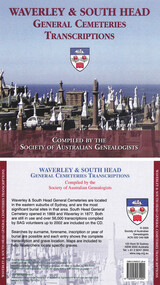
... sites in that area. South Head General Cemetery opened in 1869 and Waverley in 1877. Both are still in use and over 56,000 transcriptions compiled by SAG volunteers up to 2002 are included on the CD. Searches by surname, forename, inscription or year of burial are possible and each entry shows the complete transcription and grave location. ...Waverley & South Head General Cemeteries are located in the eastern suburbs of Sydney, and are the most significant burial sites in that area. South Head General Cemetery opened in 1869 and Waverley in 1877. Both are still in use and over 56,000 transcriptions compiled by SAG volunteers up to 2002 are included on the CD. Searches by surname, forename, inscription or year of burial are possible and each entry shows the complete transcription and grave location. Maps are included to help researchers locate specific graves.1 optical disc non-fiction Waverley & South Head General Cemeteries are located in the eastern suburbs of Sydney, and are the most significant burial sites in that area. South Head General Cemetery opened in 1869 and Waverley in 1877. Both are still in use and over 56,000 transcriptions compiled by SAG volunteers up to 2002 are included on the CD. Searches by surname, forename, inscription or year of burial are possible and each entry shows the complete transcription and grave location. Maps are included to help researchers locate specific graves. new south wales, cemetery transcriptions, waverley cemetery (nsw), south head cemetery (nsw) -
Ballarat Tramway Museum
Document - Report, Connell Wagner, "Ballarat Heritage Tram Route Concept Engineering Assessment", Mar. 2002
... Has an introduction, looks at the concept for each section of the route with a photograph showing possible route, features, looks at passing loop locations, tram stop locations, substations, potential depot sites, concept construction costs and has maps of preferred route and alternative routes, depot options. ...Has an introduction, looks at the concept for each section of the route with a photograph showing possible route, features, looks at passing loop locations, tram stop locations, substations, potential depot sites, concept construction costs and has maps of preferred route and alternative routes, depot options. ...Seventy Seven page A4 size document, bound with clear plastic cover, black coloured card back cover using a black comb binder, titled "Ballarat Heritage Tram Route Concept Engineering Assessment". Produced by Connell Wagner for Booz Allen Hamilton as part of the project study for the return of trams to the central part of the City of Ballarat. Draft Document, dated 1/3/2002. Has an introduction, looks at the concept for each section of the route with a photograph showing possible route, features, looks at passing loop locations, tram stop locations, substations, potential depot sites, concept construction costs and has maps of preferred route and alternative routes, depot options. Note folio page 40 assumes the track in the pavement at Armstrong St was the original track - not the replica crossing to the Phoenix foundry. Has an index. trams, tramways, ballarat city tramway, ballarat revival, civil engineering, depot -
Ballarat Tramway Museum
Document - Report, Connell Wagner, "Ballarat Heritage Tram Route Concept Engineering Assessment", 22/03/2002 12:00:00 AM
... Has an introduction, looks at the concept for each section of the route with a photograph showing possible route, features, looks at passing loop locations, tram stop locations, substations, potential depot sites, concept construction costs and has maps of preferred route and alternative routes, depot options, concept construction costs, typical track cross sections and costing detail. ...Has an introduction, looks at the concept for each section of the route with a photograph showing possible route, features, looks at passing loop locations, tram stop locations, substations, potential depot sites, concept construction costs and has maps of preferred route and alternative routes, depot options, concept construction costs, typical track cross sections and costing detail. ...Forty Eight sheet A4 size document, unbound, printed mainly double sided "Ballarat Heritage Tram Route Concept Engineering Assessment". Produced by Connell Wagner for Booz Allen Hamilton as part of the project study for the return of trams to the central part of the City of Ballarat. Document, dated 1/3/2002. See Reg, Item 2273 for a bound draft version of this document. Has an introduction, looks at the concept for each section of the route with a photograph showing possible route, features, looks at passing loop locations, tram stop locations, substations, potential depot sites, concept construction costs and has maps of preferred route and alternative routes, depot options, concept construction costs, typical track cross sections and costing detail. Has an index. trams, tramways, ballarat city tramway, ballarat revival, civil engineering, depot -
 The Beechworth Burke Museum
Photograph - Photograph - Reproduction, c.1870s
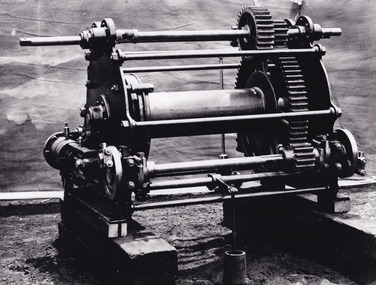
... locations. Mining can have a largely detrimental impact to the environment and therefore, the study of machinery like the one depicted in this photograph can help researches to reconstruct the methods and technologies used in the late 1800s and early 1900s. This particular item appears to have been removed from it's original site where it would have been used to assist with mining. It is possible...locations. Mining can have a largely detrimental impact to the environment and therefore, the study of machinery like the one depicted in this photograph can help researches to reconstruct the methods and technologies used in the late 1800s and early 1900s. This particular item appears to have been removed from it's original site where it would have been used to assist with mining. It is possible ...This photograph shows a piece of gold mining equipment identified as a mine winch, possibly an air winch cylinder of 1870s RG Ford's Patent design. Throughout the history of mining for gold and other precious materials, the windlass or winch (pictured) was used to bring up buckets full of soil from the bottom of a mine. This soil was then searched for gold/metals before being relocated to a different area. Due to the size and complexity of this particular piece of equipment, this winch may have been used to raise and lower mine carts to the entrance of the mine (often used in coal mining) and could have been used in raising cages up and down (acting as elevators) containing miners if the mine was particularly deep. The actual use of this particular item in the Beechworth locality is undocumented but these are some possibilities based on the use of these pieces of equipment in other mining locations. Mining can have a largely detrimental impact to the environment and therefore, the study of machinery like the one depicted in this photograph can help researches to reconstruct the methods and technologies used in the late 1800s and early 1900s. This particular item appears to have been removed from it's original site where it would have been used to assist with mining. It is possible that this photograph has been taken for recording purposes or as part of a machinery exhibition. Prior documentation records that this piece of equipment had connections to the Rocky Mountains Mining Company. Today, the Rocky Mountains Gold Mining company is famous in Beechworth for having been instrumental in the creation of the Rocky Mountain tunnel. Construction for this tunnel began in 1859 when a group of 12 men blasted a 400ft long tailrace though the rock beneath the town of Beechworth. Today, the 800ft tunnel, completed in 1871, is a popular tourist attraction but during the decades of gold mining, the purpose of this tunnel was to divert water away from the main sluicing operations so miners could better access gold and precious materials. The tunnel was used for this purpose for many years, later becoming useful for the Zwar Brother's tannery and currently as an outfall drain for Lake Sambell. This area continued to be mined until the early 1900s. The period when this item was in use is unclear but it is estimated to have been in the 1870s based on the design and appearance of the image. The gold works at the Rocky Mountain Tunnel closed in the early 1920s but the impact of mining remains in Beechworth today and therefore the study of photographs like this one which contain mining equipment can further understanding of mining in this region. This photograph has historic and research potential for study on the gold mining of the Beechworth region and types of equipment used to locate gold after the initial gold rush of 1853-1854 which resulted in the discovery of the surface gold and required miners to dig deeper to access precious metals. The clarity of the photo, and its good preserved condition, means it can continue to be used for research. This photo is part of a collection of six photos all within the Burke Museum Collection which depict mining equipment. Square black and white photograph on card. 7793.1 beechworth, mining, goldmining, goldmining equipment, beechworth burke museum -
 City of Greater Bendigo - Civic Collection
Uniform - Postal Workers Uniform, c. 1890
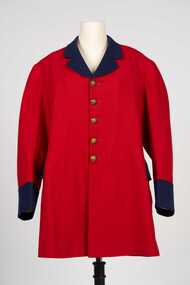
... site at this Pall Mall location from 1887 until 1997. Early on the building housed a variety of government services included sub treasury, police, water, lands, post and telegraph and quarters for the resident postmaster. With federation in 1901 the building became the Commonwealth Postmaster - General's Department's Bendigo Post Office. In 1975 postal services were taken over by the Australian Postal Commission and in 1989 Australia Post was corporatised. Australia post City of Bendigo Post Office City of Greater Bendigo Commerce Any possible ...The post office was situated on site at this Pall Mall location from 1887 until 1997. Early on the building housed a variety of government services included sub treasury, police, water, lands, post and telegraph and quarters for the resident postmaster. With federation in 1901 the building became the Commonwealth Postmaster - General's Department's Bendigo Post Office. In 1975 postal services were taken over by the Australian Postal Commission and in 1989 Australia Post was corporatised. Colonial era postal uniform possibly worn by the Post Master at the Bendigo Post Office. Single breasted frock coat. Scarlet jacket with contrasting royal blue collar, lapel cuffs and pocket flap. Body and skirt section lined with lighter red cotton fabric, pockets lined with cream coloured cotton fabric, sleeves lined with brown, blue and white striped cotton fabric. Five brass buttons on front, two brass buttons on the top of the centre back pleat, each button with a crown and VR. Typically of frock coats of the 19th century the coat has a two distinct sections, a top jacket and skirt. The shoulder seam is bias cut and runs at an angle down the back. The back is cut in four sections and the skirt in two sections. There are no side seams in the coat, instead there is a seam placed further back than the actual side of the wearer. Any possible text on the label on inner top of collar has disappeared. australia post, city of bendigo post office, city of greater bendigo commerce -
Surrey Hills Historical Society Collection
Work on paper - Vertical File, Koori Heritage
... Sites in the City of Whitehorse. Undated. (pamphlet) 4. Aboriginal use of Water related resources (16 page book undated) 5. Tribes, Clan and Boundaries – Koorie Social Organisation. Undated. (double sided page) 6. ‘The Traditional Owners of the Whitehorse Region’ Gary Presland 1997 (2 pages) 7. Notes from Alan J Holt’s research on ‘Possible Aboriginal Occupation: Camberwell – Box Hill Area’ August 1987. (2 pages) 8. Recollection of Bert Legg re: Beckett Park. Undated (1 page) 9. Photocopy and original of The Age article and map re: location...Sites in the City of Whitehorse. Undated. (pamphlet) 4. Aboriginal use of Water related resources (16 page book undated) 5. Tribes, Clan and Boundaries – Koorie Social Organisation. Undated. (double sided page) 6. ‘The Traditional Owners of the Whitehorse Region’ Gary Presland 1997 (2 pages) 7. Notes from Alan J Holt’s research on ‘Possible Aboriginal Occupation: Camberwell – Box Hill Area’ August 1987. (2 pages) 8. Recollection of Bert Legg re: Beckett Park. Undated (1 page) 9. Photocopy and original of The Age article and map re: location ...Koori Heritage 1. The Wurundjeri National Museum of Victoria Education service. Undated (double sided pamphlet) 2. Doncaster and Templestowe Aboriginal Sites of Archaeological Significance. Undated (pamphlet) 3. Kori Sites in the City of Whitehorse. Undated. (pamphlet) 4. Aboriginal use of Water related resources (16 page book undated) 5. Tribes, Clan and Boundaries – Koorie Social Organisation. Undated. (double sided page) 6. ‘The Traditional Owners of the Whitehorse Region’ Gary Presland 1997 (2 pages) 7. Notes from Alan J Holt’s research on ‘Possible Aboriginal Occupation: Camberwell – Box Hill Area’ August 1987. (2 pages) 8. Recollection of Bert Legg re: Beckett Park. Undated (1 page) 9. Photocopy and original of The Age article and map re: location of aboriginal relics around Melbourne. 29 September 1976. (3 pages) 10. Christmas card with 3 aboriginal paintings on bark to Miss Sanger from Ruth Trask. Undated. (1 item) 11. Copy of talk on “Once upon a Koori Time – the Surrey Hills area before white settlement” (23 pages) given by Robin Palton to SHHS on 20 October 1997. koori heritage -
 Emerald Museum & Nobelius Heritage Park
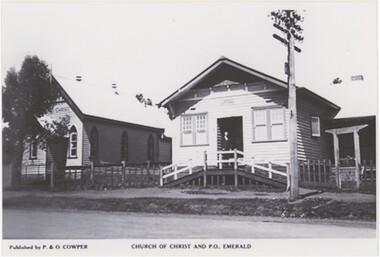
Photograph, P. & O. Cowper, Church of Christ and P.O. Emerald, c. Mid 20th Century
... possible either that none of their work has made its way online, or that they were locals publishing on a small scale capacity. If the latter is true, "P. Cowper" could have been Mr. P. Cowper who participated in forming the Emerald Co-operative Society in 1945. The Emerald Church of Christ operated from 1913 until 1964 on the site (and building) now part of Fernlea Community House. The old post office was on that location...possible either that none of their work has made its way online, or that they were locals publishing on a small scale capacity. If the latter is true, "P. Cowper" could have been Mr. P. Cowper who participated in forming the Emerald Co-operative Society in 1945. The Emerald Church of Christ operated from 1913 until 1964 on the site (and building) now part of Fernlea Community House. The old post office was on that location ..."P. & O. Cowper" does not appear in internet research as a known publishing company; it is possible either that none of their work has made its way online, or that they were locals publishing on a small scale capacity. If the latter is true, "P. Cowper" could have been Mr. P. Cowper who participated in forming the Emerald Co-operative Society in 1945. The Emerald Church of Christ operated from 1913 until 1964 on the site (and building) now part of Fernlea Community House. The old post office was on that location from the 1910s until after the Church stopped operating, although by the 1960s there were telephone booths in front of the post office. This image could date from 1913 until the 1950s, although it is likely toward the later end of that range in the 1940s or 50s. This copy was produced in 2006 from the original. This photograph captures two long-standing Emerald institutions from the first half of the 20th century, one of which is no longer in operation and the other which has moved and had its place replaced with an unrecognisable new structure. This black and white photograph is printed on glossy modern photo paper. Its lower margin is occupied by printed text explaining the publisher and the subject matter. The photograph itself centres on two buildings, each constructed from wooden planks with sloped, likely tin rooves. A power pole stands to the right in front of the rightmost building. The ege of a road is visible in the foreground, indicating that this picture was taken from on or across the road. The reverse has printed technical information about the photograph, typical of a digital printed photograph. Obverse: Left, Typed: "Published by P. & O. COWPER" Centre, Typed: "CHURCH OF CHRIST AND P.O. EMERALD" Sign in Image, Left: "[obscured] CHRIST" Reverse: "10 27 PCEMER~4.JPG 6 16.12.06 18.12.06" emerald, 1940s, 1950s, emerald post office, emerald church of christ
