
Showing 36 items matching "post basic nursing course"
-
 Alfred Hospital Nurses League - Nursing History Collection
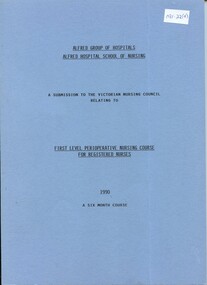
Document - Post Basic Nursing Course Document, Alfred Hospital School of Nursing, Alfred Hospital submission to the Victorian Nursing Council relating to first level perioperative nursing course, 1990, 1990
... Post Basic Nursing Course Document......Post Basic Nursing Course...This submission was part of a historical period when nurse education was transitioning from hospital based training to the tertiary (university ) sector for a six monht post basic trainining nursing course. Includes operating theatre statistcs...This submission was part of a historical period when nurse education was transitioning from hospital based training to the tertiary (university ) sector for a six monht post basic trainining nursing course. Includes operating theatre statistcs Of significance to the AHNL as this was an Alfred Hospital post basic nursing course Alfred Hospital Alfred Hospital School of Nursing Nursing Perioperative Nursing Post Basic Nursing Course Operating Theatre Small rectangular white sticker at top right of front cover on which previous catalogue number is written [black ink] Glue bound booklet with blue cover. ...This submission was part of a historical period when nurse education was transitioning from hospital based training to the tertiary (university ) sector for a six monht post basic trainining nursing course. Includes operating theatre statistcsOf significance to the AHNL as this was an Alfred Hospital post basic nursing courseGlue bound booklet with blue cover. Title in black print on front coverSmall rectangular white sticker at top right of front cover on which previous catalogue number is written [black ink]alfred hospital, alfred hospital school of nursing, nursing, perioperative nursing, post basic nursing course, operating theatre -
 Alfred Hospital Nurses League - Nursing History Collection
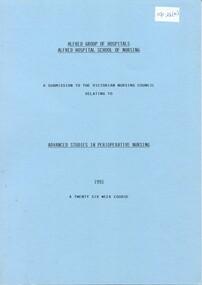
Document - Post Basic Nursing Course Document, Alfred Hospital School of Nursing, Alfred Hospital submission to the Victorian Nursing Council relating to advance studies in perioperative nursing course, 1991, 1991
... Post Basic Nursing Course Document......Post Basic Nursing Course...This submission was part of a historical period when nurse education was transitioning from hospital based training to the tertiary (university ) sector for a six month post basic trainining nursing course. This course was designed to compliment the first level course...This submission was part of a historical period when nurse education was transitioning from hospital based training to the tertiary (university ) sector for a six month post basic trainining nursing course. This course was designed to compliment the first level course Of significance to the AHNL as this was an Alfred Hospital post basic nursing course Alfred Hospital Alfred Hospital School of Nursing Nursing Perioperative Nursing Post Basic Nursing Course Operating Theatre Small rectangular white sticker at top right of front cover on which previous catalogue number is written [black ink] Glue bound booklet with blue cover. ...This submission was part of a historical period when nurse education was transitioning from hospital based training to the tertiary (university ) sector for a six month post basic trainining nursing course. This course was designed to compliment the first level courseOf significance to the AHNL as this was an Alfred Hospital post basic nursing courseGlue bound booklet with blue cover. Title in black print on front coverSmall rectangular white sticker at top right of front cover on which previous catalogue number is written [black ink]alfred hospital, alfred hospital school of nursing, nursing, perioperative nursing, post basic nursing course, operating theatre -
 Alfred Hospital Nurses League - Nursing History Collection
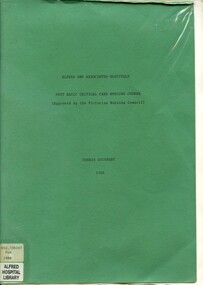
Document - Post Basic Nursing Course Document, Paul Crockford et al, Alfred and Associated Hospitals post basic critical care nursing course (approved by the Victorian nursing Council) Course Document,1988, 1988
... Post Basic Nursing Course Document ...Alfred and Associated Hospitals post basic critical care nursing course (approved by the Victorian nursing Council) Course Document,1988...The first post basic critical care nursing courses commenced at the Alfred in 1969, (Renal Intensive Care, Respiratory Intensive Care And Cardiac Nusring course) eah of 8 monts duration. ...Title on front Alfred and Associated Hospitals post basic critical care nursing course (approved by the Victorian nursing Council) Course Document,1988 Document Post Basic Nursing Course Document Paul Crockford Alfred Hospital Gael O'Connor ...The first post basic critical care nursing courses commenced at the Alfred in 1969, (Renal Intensive Care, Respiratory Intensive Care And Cardiac Nusring course) eah of 8 monts duration. In 1977 the renal and respiratory courses were combined into the Renal-Respiratory course of 52 weeks duration. The cardiac nursing course was also extended to 52 weeks. In 1984 the Critical Care Nursing Course was developed and commenced in 1985 (replacing the intensive care and cardiac nursing courses) The new course consisted of both a core component and majors in intensive care and cardiac nursingOf significance to AHNL as it was a post-basic nursing course undertaken at the Alfred HospitalBooklet with green cover. Title on frontnon-fictionAt lower left of front cover are two small white stickers. one with library ID, the other printed 'Alfred Hospital Library' Hand written in ink top right of title page is the previous catalogue number, at top left of this page is a printed library bar code. At bottom right of this page is an Alfred Hospital - Health Sciences library stamp detailing author, title Call no. Accession No, This has been overstamped 'cancelled' in redalfred hospital, nursing, critical care nursing, intensive care nursing, alfred hospital school of nursing -
 Alfred Hospital Nurses League - Nursing History Collection
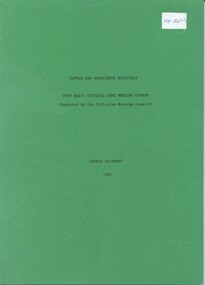
Document - Post Basic Nursing Course Document, Paul Crockford et al, Alfred and Associated Hospitals post basic critical care nursing course (approved by the Victorian nursing Council) Course Document, 1988, 1988
... Post Basic Nursing Course Document...Alfred and Associated Hospitals post basic critical care nursing course (approved by the Victorian nursing Council) Course Document, 1988...The first post basic critical care nursing courses commenced at the Alfred in 1969, (Renal Intensive Care, Respiratory Intensive Care And Cardiac Nusring course) eah of 8 monts duration. ...Title printed on front cover [black ink] Alfred and Associated Hospitals post basic critical care nursing course (approved by the Victorian nursing Council) Course Document, 1988 Document Post Basic Nursing Course Document Paul Crockford Alfred Hospital Gael O'Connor ...The first post basic critical care nursing courses commenced at the Alfred in 1969, (Renal Intensive Care, Respiratory Intensive Care And Cardiac Nusring course) eah of 8 monts duration. In 1977 the renal and respiratory courses were combined into the Renal-Respiratory course of 52 weeks duration. The cardiac nursing course was also extended to 52 weeks. In 1984 the Critical Care Nursing Course was developed and commenced in 1985 (replacing the intensive care and cardiac nursing courses) The new course consisted of both a core component and majors in intensive care and cardiac nursingOf significance to AHNL as it was a post-basic nursing course undertaken at the Alfred HospitalGlue bound booklet with green cover. Title printed on front cover [black ink]non-fictionAt top right of the front cover is a small rectangular white sticker on which the previous catalogue number is written [black ink]alfred hospital, nursing, critical care nursing, intensive care nursing, alfred hospital school of nursing -
 Alfred Hospital Nurses League - Nursing History Collection
Document - Post Basic Nursing Course Document, Paul Crockford et al, Alfred and Associated Hospitals post basic critical care nursing course (approved by the Victorian nursing Council) Course Document,1986, 1986
... Post Basic Nursing Course Document...Alfred and Associated Hospitals post basic critical care nursing course (approved by the Victorian nursing Council) Course Document,1986...The first post basic critical care nursing courses commenced at the Alfred in 1969, (Renal Intensive Care, Respiratory Intensive Care And Cardiac Nusring course) eah of 8 monts duration. ...Title printed on front cover [black ink] Alfred and Associated Hospitals post basic critical care nursing course (approved by the Victorian nursing Council) Course Document,1986 Document Post Basic Nursing Course Document Paul Crockford Alfred Hospital Gael O'Connor ...The first post basic critical care nursing courses commenced at the Alfred in 1969, (Renal Intensive Care, Respiratory Intensive Care And Cardiac Nusring course) eah of 8 monts duration. In 1977 the renal and respiratory courses were combined into the Renal-Respiratory course of 52 weeks duration. The cardiac nursing course was also extended to 52 weeks. In 1984 the Critical Care Nursing Course was developed and commenced in 1985 (replacing the intensive care and cardiac nursing courses) The new course consisted of both a core component and majors in intensive care and cardiac nursingOf significance to AHNL as it was a post-basic nursing course undertaken at the Alfred HospitalGlue bound booklet with light brown cover. Title printed on front cover [black ink]non-fictionAt top right of the front cover is a small rectangular white sticker on which the previous catalogue number is written [black ink]alfred hospital, nursing, critical care nursing, intensive care nursing, alfred hospital school of nursing -
 Alfred Hospital Nurses League - Nursing History Collection
Document - Post Basic Nursing Course Document, Paul Crockford et al, Alfred and Associated Hospitals post basic critical care nursing course (approved by the Victorian nursing Council) Course Document,1987, 1987
... Post Basic Nursing Course Document...Alfred and Associated Hospitals post basic critical care nursing course (approved by the Victorian nursing Council) Course Document,1987...The first post basic critical care nursing courses commenced at the Alfred in 1969, (Renal Intensive Care, Respiratory Intensive Care And Cardiac Nusring course) eah of 8 monts duration. ...Title printed on front cover [black ink] Alfred and Associated Hospitals post basic critical care nursing course (approved by the Victorian nursing Council) Course Document,1987 Document Post Basic Nursing Course Document Paul Crockford Alfred Hospital Gael O'Connor ...The first post basic critical care nursing courses commenced at the Alfred in 1969, (Renal Intensive Care, Respiratory Intensive Care And Cardiac Nusring course) eah of 8 monts duration. In 1977 the renal and respiratory courses were combined into the Renal-Respiratory course of 52 weeks duration. The cardiac nursing course was also extended to 52 weeks. In 1984 the Critical Care Nursing Course was developed and commenced in 1985 (replacing the intensive care and cardiac nursing courses) The new course consisted of both a core component and majors in intensive care and cardiac nursingOf significance to AHNL as it was a post-basic nursing course undertaken at the Alfred HospitalGlue bound booklet with yellow cover. Title printed on front cover [black ink]non-fictionAt top right of the front cover is a small rectangular white sticker on which the previous catalogue number is written [black ink] At bottom right of back cover there is a rectangular white sticker with 'ALFRED NURSES ARCHIVES' [stamped in black ink] and previous catalogue number and 'Box 20 NURSING EDUCATION' [handwritten in black ink]alfred hospital, nursing, critical care nursing, intensive care nursing, alfred hospital school of nursing -
 Alfred Hospital Nurses League - Nursing History Collection
Document - Post Basic Nursing Course Document, Alfred Hospital, Alfred Hospital critical care nursing course 1991, 1991
... Post Basic Nursing Course Document...The first post basic critical care nursing courses commenced at the Alfred in 1969, (Renal Intensive Care, Respiratory Intensive Care And Cardiac Nusring course) eah of 8 monts duration. ...The first post basic critical care nursing courses commenced at the Alfred in 1969, (Renal Intensive Care, Respiratory Intensive Care And Cardiac Nusring course) eah of 8 monts duration. ...The first post basic critical care nursing courses commenced at the Alfred in 1969, (Renal Intensive Care, Respiratory Intensive Care And Cardiac Nusring course) eah of 8 monts duration. In 1977 the renal and respiratory courses were combined into the Renal-Respiratory course of 52 weeks duration. The cardiac nursing course was also extended to 52 weeks. In 1984 the Critical Care Nursing Course was developed and commenced in 1985 (replacing the intensive care and cardiac nursing courses) The new course consisted of both a core component and majors in intensive care and cardiac nursing. In this edition the course was reviewed in collaboration with the higher education sectorOf significance to AHNL as it was a post-basic nursing course undertaken at the Alfred HospitalGlue bound booklet with light blue cover. Title printed on front cover [black ink]non-fictionAt top right of the front cover is a small rectangular white sticker on which the previous catalogue number is written [black ink]alfred hospital, nursing, critical care nursing, intensive care nursing, alfred hospital school of nursing -
 Alfred Hospital Nurses League - Nursing History Collection
Document - Learning Package, Alfred Hospital, The Alfred Group of Hospitals Perioperative Nursing Course Pre-Learning Package, December 1993, 1983
... Post Basic Nursing Course...Nurses wishing to undertake the perioperative nusing course at the Alfred Hopital were required to complete this learning package prior to commencement, topics covered were physics and regional anatomy Insight into post basic nursing wducation in the 1980's Post Basic Nursing Course Post Basic Nursing Education perioperative nursing anatomy physics previous catalogue number hadnwritten [black ink] at top right of front cover. ...Nurses wishing to undertake the perioperative nusing course at the Alfred Hopital were required to complete this learning package prior to commencement, topics covered were physics and regional anatomyInsight into post basic nursing wducation in the 1980'sIllustrated printed document with blue front and back cover pages. Title printed on front cover. The document is bound with white tape threaded through two holes. previous catalogue number hadnwritten [black ink] at top right of front cover. Throught the book answers to questions have been handwritten [black ink]post basic nursing course, post basic nursing education, perioperative nursing, anatomy, physics -
 Royal District Nursing Service (now known as Bolton Clarke)
Photograph - Photograph, black and white, Barry Sutton, 14.09.1972
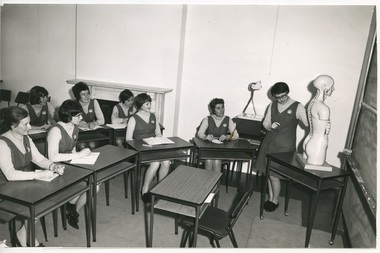
... This black and white photograph shows a group of RDNS Sisters who are part of the Post Basic Community Nursing Course. They are receiving education from Sr. ...This black and white photograph shows a group of RDNS Sisters who are part of the Post Basic Community Nursing Course. They are receiving education from Sr. ...This black and white photograph shows a group of RDNS Sisters who are part of the Post Basic Community Nursing Course. They are receiving education from Sr. Pat (Paddy) Rowley, RDNS Principal Nurse Educator. The session is being held in the Education Department at the Royal District Nursing Service Headquarters, 452 St. Kilda Rd, Melbourne.The RDNS winter uniform worn is a blue/grey skivvie under a blue/grey V neck tunic style herringbone winter material frock.Melbourne District Nursing Service ran its first Post-Basic Course for community nurses in 1962. Sisters attended the course for 12 weeks. The course ran annually until the mid 1990s. Education was an integral part of Melbourne District Nursing Society (MDNS), from its inception in 1885, later, in 1966, called Royal District Nursing Service, (RDNS). From 1885, only Trained nurses (Nurses) through the Hospital training system, were employed by the Society, and on visits to patients they taught the necessity of hygiene and cleanliness, as well as the need for a good diet, to bring about good health. Doctor’s lectures were later given at the MDNS home to instruct patients and their families on prevention of disease. Education to patients continued throughout the years regarding health care and the use of equipment in the home. In 1961, Education programs commenced at MDNS with their Trained nurses (Sisters) receiving In-service education. Sr. Pat (Paddy) Rowley was a leader in In-service Education and established the RDNS Department of Community Nursing Education in 1962. Staff could also apply for scholarships to further their education outside of RDNS. Many of their senior Sisters received Postgraduate diplomas from the College of Nursing in Community Health Nursing, Education, and Administration, and several travelled overseas visiting nursing organizations viewing their public health and District nursing systems. At RDNS many programs were run, including: a Post Basic Course, Cardiac Rehabilitation Nursing, Haematology/Oncology Nursing, Palliative Care program, Diabetic Stabilization Program, Leg Ulcer Management Program, Wound Care Specialist Program, HIV/AIDS Nursing Care, Cystic Fibrosis Home Support, Veterans Home Care Program, Breast Cancer Support Program, Continence Management Program, Stomal Therapy Program, In-Home Lactation Support Program and the Homeless Persons Program. RDNS staff attended several hospitals to observe and learn special care needed to some patients, e.g. to the Austin Hospital to learn the care required for paraplegic and quadriplegic patients at home, and to Mount Royal Hospital to observe the care of patients in the Rehabilitation ward. A Community Nursing Education Program was extended to student nurses from hospitals and to other nursing organizations. These Education programs kept the RDNS Sisters abreast of new techniques, such as changes in technology for e.g. new testing methods in detecting glucose levels in Diabetic patients. Sr. Nan Deakin obtained a Post Basic Certificate in Psychiatric Nursing and included this area in her Education lectures. Sr. Daphne Geldard specialized in the area of Alzheimer’s disease and Dementia. These Sisters visited patients in District areas with the regular RDNS Sister when required. Every member of staff, both professional and non professional staff, received regular education in the Education Department. In 1980, a Home Health Aide pilot study, funded by the Federal Government, the Brotherhood of St. Laurence and RDNS, with the program written and taught by Sr. Rowley, was evaluated as successful, and Home Health Aides were employed and worked in RDNS Centres under the supervision of RDNS Sisters. This black and white photograph is of a group of seven Royal District Nursing Service (RDNS) Sisters sitting in a semi-circle in two rows at single small two shelf tables. There are open white paged books or papers on each table and some of the Sisters have pens in their hands. The Sister sitting in the front far right is Sr. Affleck, who has dark short curly hair. The other Sisters have dark short hair in various styles. Further right in the photograph stands Sr. Rowley, who has dark short hair and is wearing glasses. She has her left hand supporting a torso of an anatomical model which is sitting on a table slightly to her left. She and the Sisters are looking at the vertebrae down the spine of the model. Another empty table is in front of the semi-circle and it sits in the centre foreground of the photograph. In the rear between Sr. Affleck and Sr. Rowley, a piece of equipment stands on a table. To the right of the photograph part of a large blackboard can be seen. The Sisters are wearing light grey skivvies under a darker V neck tunic style frock with the RDNS insignia on its upper left.Photographers stamp. Quote No. LD 8rdns education, rdns uniform, royal district nursing service, sister pat (paddy) rowley, sister margaret affleck -
 Federation University Historical Collection
Document - Folder, Margaret Stevens Nursing (Clinical Experience) Folder, 1981-1986
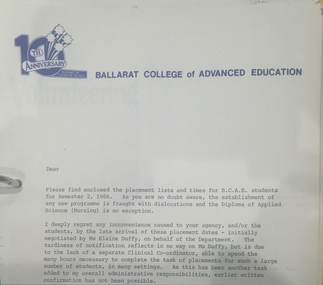
... course was commenced in 1986 and the transition successfully achieved, thanks largely to Margaret's diligence. In 1987 the Review of Registration of Health Practitioners interim report was published by the Health Department Victoria. Margaret Stevens was appointed by the Health Minister to represent the College of Nursing, Australia. This was a landmark review with long-reaching implications. At the time of her death on 23 March 2015 she was a member of the Board of Ballarat Community Health, and was identified as follows R.N.; B.App.Sc (Nursing); Post Basic...course was commenced in 1986 and the transition successfully achieved, thanks largely to Margaret's diligence. In 1987 the Review of Registration of Health Practitioners interim report was published by the Health Department Victoria. Margaret Stevens was appointed by the Health Minister to represent the College of Nursing, Australia. This was a landmark review with long-reaching implications. At the time of her death on 23 March 2015 she was a member of the Board of Ballarat Community Health, and was identified as follows R.N.; B.App.Sc (Nursing); Post Basic ...Margaret Stevens was the inaugural Head of Nursing at the Ballarat College of Advanced Education from June 1985 until her retirement in 1989. During the 1980s there was a growing acceptance around Australia that Nurse Education needed to be more science based to allow nurses to cope with the vastly increased appearance of technological devices in the hospital wards. The response was to shift such training into Higher Education institutions. The State Government decided that Nurse Training in Ballarat should move from the Hospital to Ballarat College of Advanced Education. in 1986. Margaret Stevens had been a senior Nurse Educator at the Ballarat Base Hospital for many years and was selected by mutual agreement between the two institutions to devise the new course and plan its implementation so that it would gain the approval of the Nurse Registration authority. In addition to consulting widely with other Nurse Education specialists and supporting departments in Ballarat College of Advanced Education, Margaret negotiated with over 70 medical establishments to work out arrangements by which the students would be placed in work experience as required by the course. She was also involved in the required additional staff appointments and in planning for a new building on Campus. The course was commenced in 1986 and the transition successfully achieved, thanks largely to Margaret's diligence. In 1987 the Review of Registration of Health Practitioners interim report was published by the Health Department Victoria. Margaret Stevens was appointed by the Health Minister to represent the College of Nursing, Australia. This was a landmark review with long-reaching implications. At the time of her death on 23 March 2015 she was a member of the Board of Ballarat Community Health, and was identified as follows R.N.; B.App.Sc (Nursing); Post Basic: DipEd(N); Kellogg Fellow (USA 1984-85), M.Ed. (USA) & 1st program of M.Ethics Grey lever arch folder of notes, faxes and timetables relating to the teaching of the Diploma pf Applied Science (Nursing) at Ballarat College of Advanced Education (now Federation University Australia). Includes a letter of Ballarat College on Advanced Education 10th Anniversary letterhead, student lists, student placement, timetablesnursing, anniverary, letterhead, ballarat college of advanced education, elaine duffy, jan drennan, university women -
 Alfred Hospital Nurses League - Nursing History Collection
Booklet - Glue bound booklet, Alfred Hospital School of Nursing, Prospectus : Post-basic courses in Cardiac and Intensive Care Nursing, August 1982
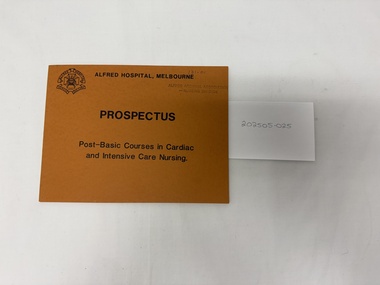
... Nursing Course information '131-01.' [black ink top right hand corner of front cover] 'ALFRED ARCHIVAL ASSOCIATION / - NURSING DIVISION' [black inked stamp top right hand corner of front cover] A slightly larger than A5 booklet with a sand coloured cover. The cover has black printed text, printed emblem, handwriting and stamp on it. The booklet is bound by glue and the back sand colooured cover has detatched. Prospectus : Post-basic ...Booklet containing information on the two critical care courses conducted by the Alfred Hospital School of Nursing [ca. 1982/83]. These are listed as an Intensive Care Nursing Course and a Cardiac Nursing Course to support the four Alfred Hospital critical care units: general intensive care, cardio-thoracic surgical intensive care, coronary care and the renal unit. The index of the booklet is listed as: - Features common to both courses - Course specifics -- Cardiac nursing course -- Intensive care nursing course - Book list (common to both courses)This booklet was donated directly from the producer and has excellent provenance and strong information on the intensive nursing care requirements of the early 1980's.A slightly larger than A5 booklet with a sand coloured cover. The cover has black printed text, printed emblem, handwriting and stamp on it. The booklet is bound by glue and the back sand colooured cover has detatched.'131-01.' [black ink top right hand corner of front cover] 'ALFRED ARCHIVAL ASSOCIATION / - NURSING DIVISION' [black inked stamp top right hand corner of front cover]intensive care nursing, alfred hospital school of nursing, course information -
 Alfred Hospital Nurses League - Nursing History Collection
Booklet, Alfred Hospital, Alfred Hospital, Melbourne, Prospectus- Post-Basic Courses in Cardiac and Intensive Care Nursing, 1982
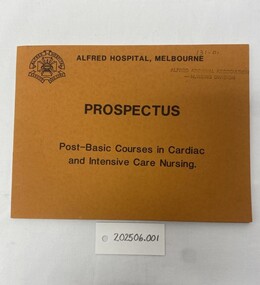
... Significant to the AHNL as this is the Prospectus for a post basic nursing course at the Alfred Hospital. ALFRED HOSPITAL SCHOOL OF NURSING Intensive Care Cardiac nursing Printed booklet containing the prospectus from 1981 for Alfred Hospital Cardiac and Intensive care nursing courses. ...Printed booklet containing the prospectus from 1981 for Alfred Hospital Cardiac and Intensive care nursing courses.Booklet with brown cover and black print, title on front along with Alfred Hospital logo.non-fictionPrinted booklet containing the prospectus from 1981 for Alfred Hospital Cardiac and Intensive care nursing courses.alfred hospital school of nursing, intensive care, cardiac nursing -
 Alfred Hospital Nurses League - Nursing History Collection
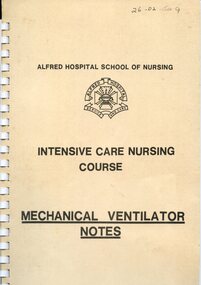
Booklet - Illustrated Booklet, Paul Crockford et al, Alfred Hospital School of Nursing Intensive Care Nursing Course Mechanical Ventilator Notes, 1980
... Thes notes were written for post basic critical care nursing students to provide information about mechanical ventilation and equipment used [ca.1980] Of significance to the AHNL as this course was conducted at the Alfred Hospital mechanical ventilation intensive care nursing critical care nursing Alfred Hospital Alfred Hospital School of Nursing Booklet comprises two sections. ...Booklet comprises two sections. Section A provides information about The Bird Respirator - Mark 8 ( a pressure cycled respirator). Section B has information about volume cycled ventilatorsIllustrated book with cream cover and black print. Front cover has the title and Alfred Hospital logo. The book is bound with a white plastic comb.non-fictionBooklet comprises two sections. Section A provides information about The Bird Respirator - Mark 8 ( a pressure cycled respirator). Section B has information about volume cycled ventilatorsmechanical ventilation, intensive care nursing, critical care nursing, alfred hospital, alfred hospital school of nursing -
 Alfred Hospital Nurses League - Nursing History Collection
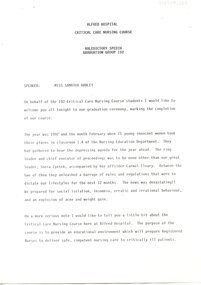
Document - Valedictory Speech, Samantha Hanley, Alfred Hospital Critical Care Nursing Course Valedictory Speech Graduation Group 192, January 1993
... Valedictory speech given at Graduation Ceremony 29th January 1993 Of significance to the AHNL as this was a post basic course undertaken at the Alfred Hospital Alfred Hospital Critical Care Nursing Post graduate nursing education Previous catalogue number written at top right of cover page. ...Valedictory speech given at Graduation Ceremony 29th January 1993Of significance to the AHNL as this was a post basic course undertaken at the Alfred HospitalUnbound valedictory speech, black print on white background. Also has a plain blue cover sheetPrevious catalogue number written at top right of cover page. Marks at top left of all pages where a staple has been removedalfred hospital, critical care nursing, post graduate nursing education -
 Alfred Hospital Nurses League - Nursing History Collection
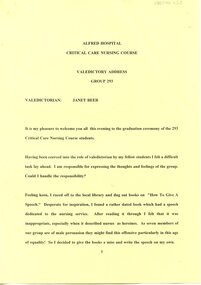
Document - Valedictory Speech, Janet Beer, Alfred Hospital Critical Care Nursing Course Valedictory Speech Graduation Group 293, January 1994
... Valedictory speech given at Graduation Ceremony 29th January 1994 Of significance to the AHNL as this was a post basic course undertaken at the Alfred Hospital Alfred Hospital Critical Care Nursing Post graduate nursing education Previous catalogue number written at top right of cover page. ...Valedictory speech given at Graduation Ceremony 29th January 1994Of significance to the AHNL as this was a post basic course undertaken at the Alfred HospitalUnbound valedictory speech, black print on yellow background. Also has a plain red cover sheetPrevious catalogue number written at top right of cover page. Marks at top left of all pages where a staple has been removedalfred hospital, critical care nursing, post graduate nursing education -
 Alfred Hospital Nurses League - Nursing History Collection
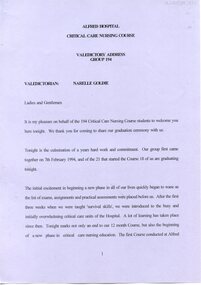
Document - Valedictory Speech, Narelle Goldie, Alfred Hospital Critical Care Nursing Course Valedictory Speech Graduation Group 194, January 1995
... course. From 1995 Latrobe university provided a Graduate Diploma in Advaced Nursing (Critical Care) in collaboration with the Alfred Hospital where students continued to gain there clinical experience Of significance to the AHNL as this was a post basic course undertaken at the Alfred Hospital Alfred Hospital Critical Care Nursing Post graduate nursing education Previous catalogue number written at top right of cover page. ...Valedictory speech given at Graduation Ceremony 29th January 1994. This was the last hospital based course. From 1995 Latrobe university provided a Graduate Diploma in Advaced Nursing (Critical Care) in collaboration with the Alfred Hospital where students continued to gain there clinical experienceOf significance to the AHNL as this was a post basic course undertaken at the Alfred HospitalUnbound valedictory speech, black print on pale mauve background. Also has a plain mauve cover sheetPrevious catalogue number written at top right of cover page. Marks at top left of all pages where a staple has been removedalfred hospital, critical care nursing, post graduate nursing education -
 Alfred Hospital Nurses League - Nursing History Collection
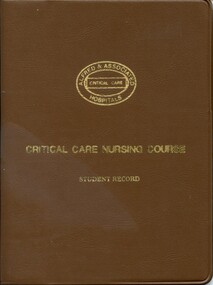
Booklet, Alfred Hospital School of Nursing, Alfred & Associated Hospitals Critical Care Nursing Course Student Record, [ca. 1980]
... Used by students of the Critical Care Course conducted by the Alfred & Associatd Hospitals to record skills developed and mastered in clinical areas, and a record of both clinical and academic achievements Of significance to the AHNL as this was a booklet used for a post-basic course conducted by the Alfred Hospital School of Nursing Alfred Hospital Alfred Hospital School of Nursing Nurring Critical Care Nursing Education Post Basic Nursing Education Orevious cataloue number at top left of title page[handwritten in black ink] Stapled booklet, white pages, black print, tan cover, and a protective brown plastic cover on which the title is printed in gilt Alfred & Associated Hospitals Critical Care Nursing Course Student Record Booklet Booklet Alfred Hospital School of Nursing ...Used by students of the Critical Care Course conducted by the Alfred & Associatd Hospitals to record skills developed and mastered in clinical areas, and a record of both clinical and academic achievementsOf significance to the AHNL as this was a booklet used for a post-basic course conducted by the Alfred Hospital School of NursingStapled booklet, white pages, black print, tan cover, and a protective brown plastic cover on which the title is printed in giltOrevious cataloue number at top left of title page[handwritten in black ink]alfred hospital, alfred hospital school of nursing, nurring, critical care nursing education, post basic nursing education -
 Royal District Nursing Service (now known as Bolton Clarke)
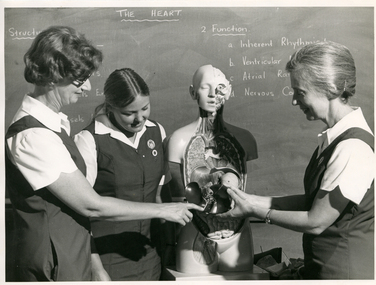
Photograph - Photograph, black and white, Barry Sutton, 25.03.1974
... nursing systems. At RDNS many programs were run, including: a Post Basic Course, Cardiac Rehabilitation Nursing, Haematology/Oncology Nursing, Palliative Care program, Diabetic Stabilization Program, Leg Ulcer Management Program, Wound Care Specialist Program, HIV/AIDS Nursing Care, Cystic Fibrosis Home Support, Veterans Home Care Program, Breast Cancer Support Program, Continence Management Program, Stomal Therapy Program, In-Home Lactation Support Program and the Homeless Persons Program. ...The RDNS Sisters are named in the photograph, L-R - Sister Megan Margaret Day who works in the Domiciliary Infant Maternal Care (DIMC) section of RDNS. The next Sister's name is unknown, and on the right is Sister Ruth Eileen McKeon who is a Nurse Educator with RDNS. The photograph is taken in the Education Department of Royal District Nursing Service, and the two Sisters are receiving instruction on the function of the organs of the human body from Sister McKeon. The Sisters are wearing the RDNS summer uniform of a white short sleeve blouse under a royal blue V neck tunic style frock. Education was an integral part of Melbourne District Nursing Society (MDNS), from its inception in 1885, later, in 1966, called Royal District Nursing Service, (RDNS). From 1885, only Trained nurses (Nurses), through the Hospital training system, were employed by the Society, and on visits to patients they taught the necessity of hygiene and cleanliness, as well as the need for a good diet, to bring about good health. Doctor’s lectures were later given at the MDNS home to instruct patients and their families on prevention of disease. Education to patients continued throughout the years regarding health care and the use of equipment in the home. In 1961, Education programs commenced at MDNS with Trained nurses (Sisters) receiving In-service education. Sr. Pat (Paddy) Rowley was a leader in In-service Education and established the RDNS Department of Community Nursing Education in 1962. Staff could also apply for scholarships to further their education outside of RDNS. Many of their senior Sisters received Postgraduate diplomas from the College of Nursing in Community Health Nursing, Education, and Administration, and several travelled overseas visiting nursing organizations viewing their public health and District nursing systems. At RDNS many programs were run, including: a Post Basic Course, Cardiac Rehabilitation Nursing, Haematology/Oncology Nursing, Palliative Care program, Diabetic Stabilization Program, Leg Ulcer Management Program, Wound Care Specialist Program, HIV/AIDS Nursing Care, Cystic Fibrosis Home Support, Veterans Home Care Program, Breast Cancer Support Program, Continence Management Program, Stomal Therapy Program, In-Home Lactation Support Program and the Homeless Persons Program. RDNS staff attended several hospitals to observe and learn special care needed to some clients, e.g. to the Austin Hospital to learn the care required for paraplegic and quadriplegic patients at home, and to Mount Royal Hospital to observe the care of patients in the Rehabilitation ward. A Community Nursing Education Program was extended to student nurses from hospitals and to other nursing organizations. These Education programs kept the RDNS Sisters abreast of new techniques, such as changes in technology for e.g. new testing methods in detecting glucose levels in Diabetic patients. Sr. Nan Deakin obtained a Post Basic Certificate in Psychiatric Nursing and included this area in her Education lectures. Sr. Daphne Geldard specialized in the area of Alzheimer’s disease and Dementia. These Sisters visited patients in District areas with the regular RDNS Sister when required. Every member of staff, both professional and non professional staff, received regular education in the Education Department. In 1980, a Home Health Aide pilot study, funded by the Federal Government, the Brotherhood of St. Laurence and RDNS, with the program written and taught by Sr. Rowley, was evaluated as successful, and Home Health Aides were employed and worked in RDNS Centres under the supervision of the RDNS Sisters. On the left of this black and white photograph is Royal District Nursing Service (RDNS), Sister Megan Day, who has curled short dark hair and is wearing glasses. She is standing side-on facing to the right of the photograph. The index finger of her right hand is pointing to an area on the internal frontal view of a Human Torso Model which is sitting on a table to her right. Between her and the model is another Sister who has her long dark hair drawn back. She is looking at the internal organs in the Model. To the right of the Model is Sister Ruth McKeon, who has her long light colour hair drawn back into a French Twist. She is standing side-on facing to the left of the photograph, and is smiling as she holds one of the organs taken from the Model. When looking at the photograph, the left side of the Model's face is seen, and on the right side the Internal organs of the face are seen. The internal organs of the neck and torso of the Model are seen. A blackboard with writings about the function of 'The Heart' is In the background. The Sisters are all wearing their RDNS uniforms of a short sleeve white blouse under a V neck tunic style dress which has the RDNS logo on its upper left.Barry Sutton LY 66 namesrdns, rdns education, royal district nursing service, sister megan margaret day, sister ruth eileen mckeon -
 Royal District Nursing Service (now known as Bolton Clarke)
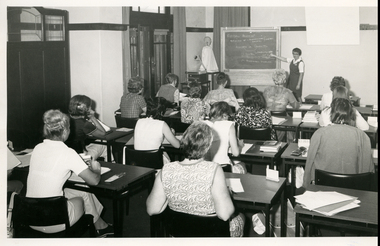
Photograph - Photograph, black and white, Barry Sutton, 25.03.1974
... nursing systems. At RDNS many programs were run, including: a Post Basic Course, Cardiac Rehabilitation Nursing, Haematology/Oncology Nursing, Palliative Care program, Diabetic Stabilization Program, Leg Ulcer Management Program, Wound Care Specialist Program, HIV/AIDS Nursing Care, Cystic Fibrosis Home Support, Veterans Home Care Program, Breast Cancer Support Program, Continence Management Program, Stomal Therapy Program, In-Home Lactation Support Program and the Homeless Persons Program. ...The photograph shows a group of Royal District Nursing Service (RDNS) Sisters receiving a lecture on 'Physical Handicap' given by Sr. Rowley in the Education Department at RDNS Headquarters 452 St. Kilda Road, Melbourne. Sr. Rowley is the Principal Nurse Educator at RDNS.Education was an integral part of Melbourne District Nursing Society (MDNS), from its inception in 1885, later, in 1966, called Royal District Nursing Service, (RDNS). From 1885, only Trained nurses (Nurses), through the Hospital training system, were employed by the Society, and on visits to patients they taught the necessity of hygiene and cleanliness, as well as the need for a good diet, to bring about good health. Doctor’s lectures were later given at the MDNS home to instruct patients and their families on prevention of disease. Education to patients continued throughout the years regarding health care and the use of equipment in the home. In 1961, Education programs commenced at MDNS with Trained nurses (Sisters) receiving In-service education. Sr. Pat (Paddy) Rowley was a leader in In-service Education and established the RDNS Department of Community Nursing Education in 1962. Staff could also apply for scholarships to further their education outside of RDNS. Many of their senior Sisters received Postgraduate diplomas from the College of Nursing in Community Health Nursing, Education, and Administration, and several travelled overseas visiting nursing organizations viewing their public health and District nursing systems. At RDNS many programs were run, including: a Post Basic Course, Cardiac Rehabilitation Nursing, Haematology/Oncology Nursing, Palliative Care program, Diabetic Stabilization Program, Leg Ulcer Management Program, Wound Care Specialist Program, HIV/AIDS Nursing Care, Cystic Fibrosis Home Support, Veterans Home Care Program, Breast Cancer Support Program, Continence Management Program, Stomal Therapy Program, In-Home Lactation Support Program and the Homeless Persons Program. RDNS Sisters attended several hospitals to observe and learn special care needed to some patients, e.g. to the Austin Hospital to learn the care required for paraplegic and quadriplegic patients at home, and to Mount Royal Hospital to observe the care of patients in the Rehabilitation ward. A Community Nursing Education Program was extended to student nurses from hospitals and to other nursing organizations. These Education programs kept the RDNS Sisters abreast of new techniques, such as changes in technology for e.g. new testing methods in detecting glucose levels in Diabetic patients. Sr. Nan Deakin obtained a Post Basic Certificate in Psychiatric Nursing and included this area in her Education lectures. Sr. Daphne Geldard specialized in the area of Alzheimer’s disease and Dementia. These Sisters visited patients in District areas with the regular RDNS Sister when required. Every member of staff, both professional and non professional staff, received regular education in the Education Department. In 1980, a Home Health Aide pilot study, funded by the Federal Government, the Brotherhood of St. Laurence and RDNS, with the program written and taught by Sr. Rowley, was evaluated as successful, and Home Health Aides were employed and worked in RDNS Centres under the supervision of the RDNS Sisters. This black and white photograph shows the back view of four rows of Royal District Nursing Service (RDNS) Sisters sitting at small tables and looking toward Sister Pat (Paddy) Rowley who is facing them. She is in the rear centre of the photograph. The 16 Sisters, some partly hidden, are wearing a variety of summer day clothes. Spectacle cases, pens, sheets of paper, and some books are on the tables in front of them. Sister Rowley who wears glasses; has short straight dark hair, is wearing a white short sleeve blouse under a dark V neck tunic style dress. She is looking at the group and her right hand is pointing to writing on a large blackboard standing to her right. To the left of the blackboard, a draped Human Torso Model sits on a table. A long dark curtain hangs behind part of the blackboard. Running along the left of the photograph is a wooden door with glass panels at the top, some light colour wall with a dark picture rail, and a set of double glass doors with long grey curtains either side. To the right of Sr. Rowley part of a large white board is seen hanging above and below the dark picture rail on the wall.Barry Sutton LY 69rdns, royal district nursing service, rdns education, sister pat (paddy) rowley -
 Royal District Nursing Service (now known as Bolton Clarke)
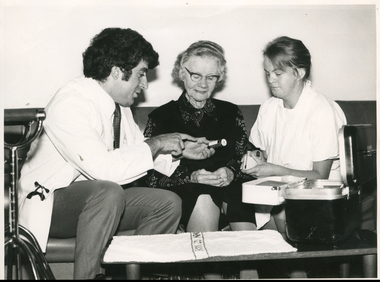
Photograph - Photograph, black and white, Barry Sutton, 24.04.1974
... Nursing Education in 1962. Staff could also apply for scholarships to further their education outside of RDNS. At RDNS many programs were run, including: a Post Basic Course, Cardiac Rehabilitation Nursing, Haematology/Oncology Nursing, Palliative Care program, Diabetic Stabilization Program, Leg Ulcer Management Program, Wound Care Specialist Program, HIV/AIDS Nursing Care, Cystic Fibrosis Home Support, Veterans Home Care Program, Breast Cancer Support Program, Continence Management Program, Stomal Therapy Program, In-Home Lactation Support Program. ...A Medical Student is explaining the use of a bottle of testing tablets to a lady who is a patient of RDNS. The Royal District Nursing Service (RDNS) Sister is holding testing equipment; i.e. the eye dropper and test tube in the receptacle, in her hands, and is observing the Medical Student giving instructions to the lady. The photograph is taken in the lady's home.Education was an integral part of Melbourne District Nursing Society (MDNS) from its inception in 1885, later called Royal District Nursing Service, (RDNS). Only Trained nurses (Nurses) were employed by the Society, and on visits to patients they taught the necessity of hygiene and cleanliness, as well as the need for a good diet, to bring about good health. Doctor’s lectures were later given at the MDNS home to instruct patients and their families on prevention of disease. Education to patients continued throughout the years regarding health care and the use of equipment in the home. In 1961 Education programs commenced at MDNS with Trained nurses (Sisters) receiving In-service education. Sr. Pat (Paddy) Rowley was a leader in In-service Education and established the RDNS Department of Community Nursing Education in 1962. Staff could also apply for scholarships to further their education outside of RDNS. At RDNS many programs were run, including: a Post Basic Course, Cardiac Rehabilitation Nursing, Haematology/Oncology Nursing, Palliative Care program, Diabetic Stabilization Program, Leg Ulcer Management Program, Wound Care Specialist Program, HIV/AIDS Nursing Care, Cystic Fibrosis Home Support, Veterans Home Care Program, Breast Cancer Support Program, Continence Management Program, Stomal Therapy Program, In-Home Lactation Support Program. RDNS Sisters attended several hospitals to observe and learn special care needed to some patients, e.g. to the Austin Hospital to learn the care required for paraplegic and quadriplegic patients at home and to Mount Royal Hospital to observe the care of patients in the rehabilitation ward. RDNS moved its Education Department from 452 St. Kilda Road to 448 St. Kilda Road in 1974. A Community Nursing Education Program was extended to student nurses from hospitals and to other nursing organizations. These Education programs kept the RDNS Sisters abreast of new techniques, such as changes in technology for e.g. new testing methods for detecting glucose levels in Diabetic patients. Sr. Nan Deakin obtained a Post Basic Certificate in Psychiatric Nursing and included this area in her Education lectures. Sr. Daphne Geldard specialized in the area of Alzheimer’s disease and Dementia. These Sisters visited patients in District areas with the regular RDNS Sister when required. Every member of staff, both professional and non professional staff, received regular education in the Education Department. In 1980, a Home Health Aide pilot study, funded by the Federal Government, the Brotherhood of St. Laurence and RDNS, with the program written and taught by Sr. Rowley, was evaluated as successful, and Home Health Aides were employed and worked in RDNS Centres under the supervision of the RDNS Sisters.In the left foreground of this black and white photograph is the partial view of two metal 4 prong sticks.To their right, seated on a long dark vinyl type couch, is a Medical Student who has short curly black hair; is wearing a white hospital coat over grey trousers, a white shirt, and a tie with small black and white squares. A stethoscope is folded in the pocket of his coat. He is turned toward the right of the photograph and is holding, on its side, a small bottle in his left hand and is pointing his right index finger to writing on its label. An elderly lady who is wearing glasses and has wavy grey hair is sitting to his right and is looking at the label on the bottle. She is wearing a black skirt and black sleeveless jacket over a black and white patterned blouse. Her hands are clasped in her lap. Sitting to her right, and facing the lady, is a Royal District Nursing Service (RDNS) Sister who has her long dark hair drawn back. She is wearing a white short sleeve gown over her uniform, and is holding a white oblong receptacle which holds a test tube, which has dark fluid in the bottom, and an eye dropper. In front of her, is a white 'inner tray' which is clipped onto the front edge of an open oblong black RDNS nursing case which is in the right foreground of the photograph sitting on a long, narrow, low table. On the table and to the left of the case a small white hospital drape runs along the table.Barry Sutton MA 24royal district nursing service, rdns, rdns patient care, rdns education -
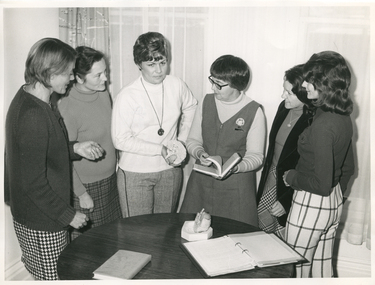 Royal District Nursing Service (now known as Bolton Clarke)
Photograph - Photograph, black and white, Barry Sutton, 1972
... nursing systems. At RDNS many programs were run, including: a Post Basic Course, Cardiac Rehabilitation Nursing, Haematology/Oncology Nursing, Palliative Care program, Diabetic Stabilization Program, Leg Ulcer Management Program, Wound Care Specialist Program, HIV/AIDS Nursing Care, Cystic Fibrosis Home Support, Veterans Home Care Program, Breast Cancer Support Program, Continence Management Program, Stomal Therapy Program, In-Home Lactation Support Program and the Homeless Persons Program. ...This photograph is taken in the Education Department at Royal District Nursing Service (RDNS). Principal Nurse Educator, Sister Pat (Paddy) Rowley is instructing the group in the Anatomy of the Brain. Jan Turski is a Trained nurse (Sister) working in the Domiciliary Infant and Maternal Care (DIMC) section of RDNS. Pat Walker is a Sister from Geelong, Lynne Lambert is a Sister from Qld, Paula McBreen is a Sister from St. Vincent's Hospital and Liz Seymour-Smith is a Sister from Qld. Sister Pat (Paddy) Rowley is wearing the RDNS winter uniform of a blue/grey skivvie under a blue/grey V neck tunic style frock made out of herringbone winter material.Education was an integral part of Melbourne District Nursing Society (MDNS), from its inception in 1885, later, in 1966, called Royal District Nursing Service, (RDNS). From 1885, only Trained Nurses (Nurses), through the Hospital training system, were employed by the Society, and on visits to patients they taught the necessity of hygiene and cleanliness, as well as the need for a good diet, to bring about good health. Doctor’s lectures were later given at the MDNS home to instruct patients and their families on prevention of disease. Education to patients continued throughout the years regarding health care and the use of equipment in the home. In 1961, Education programs commenced at MDNS with Trained nurses (Sisters) receiving In-service education. Sr. Pat (Paddy) Rowley was a leader in In-service Education and established the RDNS Department of Community Nursing Education in 1962. Sisters could also apply for scholarships to further their education outside of RDNS. Many of their senior Sisters received Postgraduate diplomas from the College of Nursing in Community Health Nursing, Education, and Administration, and several travelled overseas visiting nursing organizations viewing their public health and District nursing systems. At RDNS many programs were run, including: a Post Basic Course, Cardiac Rehabilitation Nursing, Haematology/Oncology Nursing, Palliative Care program, Diabetic Stabilization Program, Leg Ulcer Management Program, Wound Care Specialist Program, HIV/AIDS Nursing Care, Cystic Fibrosis Home Support, Veterans Home Care Program, Breast Cancer Support Program, Continence Management Program, Stomal Therapy Program, In-Home Lactation Support Program and the Homeless Persons Program. RDNS Sisters attended several hospitals to observe and learn special care needed to some patients, e.g. to the Austin Hospital to learn the care required for paraplegic and quadriplegic patients at home, and to Mount Royal Hospital to observe the care of patients in the Rehabilitation ward. A Community Nursing Education Program was extended to student nurses from hospitals and to other nursing organizations. These Education programs kept the RDNS Sisters abreast of new techniques, such as changes in technology for e.g. new testing methods in detecting glucose levels in Diabetic patients. Sr. Nan Deakin obtained a Post Basic Certificate in Psychiatric Nursing and included this area in her Education lectures. Sr. Daphne Geldard specialized in the area of Alzheimer’s disease and Dementia. These Sisters visited patients in District areas with the regular RDNS Sister when required. Every member of staff, both professional and non professional staff, received regular education in the Education Department. In 1980, a Home Health Aide pilot study, funded by the Federal Government, the Brotherhood of St. Laurence and RDNS, with the program written and taught by Sr. Rowley, was evaluated as successful, and Home Health Aides were employed and worked in RDNS Centres under the supervision of the RDNS Sisters. This black and white photograph shows, standing L-R, a side-on view of Jan Turski, who has short, straight light hair and is wearing a dark cardigan and white and black hound's-tooth check skirt; she is facing right. Next is Pat Walker, who has short dark hair and is wearing a grey jumper over a check skirt. Then, Lynne Lambert, who has short wavy dark hair, and is wearing a white jumper, with a pendant hanging down it, over grey slacks. She is holding half of an Anatomical brain in her right hand. Next is Royal District Nursing Service (RDNS) Principal Nurse Educator, Pat (Paddy) Rowley, who is looking towards the left of the photograph at the Anatomical brain held by Lynne Lambert. She is wearing glasses, has short dark hair and is wearing a light grey skivvie under a darker V neck tunic style frock. She is holding an open book in her hands. Next is Paula McBreen, who has shoulder length dark hair and is wearing a dark cardigan over a grey skivvie, with a pendant hanging down it, and a check skirt. She is smiling and looking to her right toward the others. On the far right, side-on and facing the others on the left of the photograph, is Liz Seymour-Smith who has shoulder length dark hair and is wearing a dark grey skivvie, and white, with dark check, slacks. In front of the group is a round dark wooden top table, which has a book and open folder on it, as well as a round white plastic base with the other half of the anatomical brain sitting in it.Barry Sutton MB 30royal district nursing service, rdns, rdns education, sister jan turski, sister pat (paddy) rowley, sister lynne lambert, sister pat walker, sister paula mcbreen, sister liz seymour-smith -
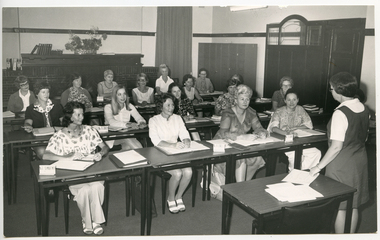 Royal District Nursing Service (now known as Bolton Clarke)
Photograph - Photograph, black and white, Barry Sutton, 1974
... nursing systems. At RDNS many programs were run, including: a Post Basic Course, Cardiac Rehabilitation Nursing, Haematology/Oncology Nursing, Palliative Care program, Diabetic Stabilization Program, Leg Ulcer Management Program, Wound Care Specialist Program, HIV/AIDS Nursing Care, Cystic Fibrosis Home Support, Veterans Home Care Program, Breast Cancer Support Program, Continence Management Program, Stomal Therapy Program, In-Home Lactation Support Program and the Homeless Persons Program. ...Sr. Pat (Paddy) Rowley is the Principal Nurse Educator at RDNS and is giving a lecture to RDNS Sisters in the Education Department at 452 St. Kilda Rd, Melbourne. She is wearing the RDNS summer uniform of a white short sleeve blouse under a royal blue V neck tunic style frock with the RDNS insignia on the upper left.Education was an integral part of Melbourne District Nursing Society (MDNS), from its inception in 1885, later, in 1966, called Royal District Nursing Service, (RDNS). From 1885, only Trained Nurses (Nurses), through the Hospital training system, were employed by the Society, and on visits to patients they taught the necessity of hygiene and cleanliness, as well as the need for a good diet, to bring about good health. Doctor’s lectures were later given at the MDNS home to instruct patients and their families on prevention of disease. Education to patients continued throughout the years regarding health care and the use of equipment in the home. In 1961, Education programs commenced at MDNS with Trained nurses (Sisters) receiving In-service education. Sr. Pat (Paddy) Rowley was a leader in In-service Education and established the RDNS Department of Community Nursing Education in 1962. Staff could also apply for scholarships to further their education outside of RDNS. Many of their senior Sisters received Postgraduate diplomas from the College of Nursing in Community Health Nursing, Education, and Administration, and several travelled overseas visiting nursing organizations viewing their public health and District nursing systems. At RDNS many programs were run, including: a Post Basic Course, Cardiac Rehabilitation Nursing, Haematology/Oncology Nursing, Palliative Care program, Diabetic Stabilization Program, Leg Ulcer Management Program, Wound Care Specialist Program, HIV/AIDS Nursing Care, Cystic Fibrosis Home Support, Veterans Home Care Program, Breast Cancer Support Program, Continence Management Program, Stomal Therapy Program, In-Home Lactation Support Program and the Homeless Persons Program. RDNS Sisters attended several hospitals to observe and learn special care needed to some patients, e.g. to the Austin Hospital to learn the care required for paraplegic and quadriplegic patients at home, and to Mount Royal Hospital to observe the care of patients in the Rehabilitation ward. A Community Nursing Education Program was extended to student nurses from hospitals and to other nursing organizations. These Education programs kept the RDNS Sisters abreast of new techniques, such as changes in technology for e.g. new testing methods in detecting glucose levels in Diabetic patients. Sr. Nan Deakin obtained a Post Basic Certificate in Psychiatric Nursing and included this area in her Education lectures. Sr. Daphne Geldard specialized in the area of Alzheimer’s disease and Dementia. These Sisters visited patients in District areas with the regular RDNS Sister when required. Every member of staff, both professional and non professional staff, received regular education in the Education Department. In 1980, a Home Health Aide pilot study, funded by the Federal Government, the Brotherhood of St. Laurence and RDNS, with the program written and taught by Sr. Rowley, was evaluated as successful, and Home Health Aides were employed and worked in RDNS Centres under the supervision of the RDNS Sisters. This black and white photograph shows Royal District Nursing Service (RDNS) Sister Pat (Paddy) Rowley and seventeen (some partly hidden), Royal District Nursing Service (RDNS) Sisters. The bulk of the photograph shows the front view of three rows of RDNS Sisters sitting at tables which have books and sheets of paper on them. The Sisters are wearing a variety of day clothes. In the right foreground of the Photograph is a table containing papers, and standing to its right, facing the group, is the back view of Sr. Rowley, who has short dark hair and glasses. She has her left hand on a sheet of paper on the table. She is wearing her RDNS uniform of a white short sleeve blouse under a dark tunic style frock. In the rear of the photograph a brick fireplace can be seen with some books and a vase of flowers on the mantelpiece. On the right is a long curtain, some lockers and an open wooden door with glass panel. Some of the Sisters named are:- Ann Greenwood, Judy Peter, Ethel Fullarton, Barbara Lovell, Shirley Lewis, Jane Ball..Barry Sutton Stamp. Quote LY 68royal district nursing service (1966-2017), rdns, rdns education, sister ethel fullerton, sister barbara lovell, sister shirley lewis, sister jane ball, sister pat (paddy) rowley, sister ann greenwood, sister judy peter -
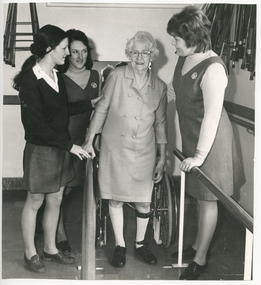 Royal District Nursing Service (now known as Bolton Clarke)
Photograph - Photograph, black and white, Barry Sutton, 20.07.1972
... nursing organizations. These Education programs kept the RDNS Sisters abreast of new techniques, such as changes in technology for e.g. new testing methods in detecting glucose levels in Diabetic patients. Sr. Nan Deakin did a Post Basic Course ...The photograph is taken in the Physiotherapy Department at Mount Royal Hospital. RDNS Sr. Sue Revill is from RDNS Moorabbin Centre and Sr. Helen Watt is from Footscray Centre, They are attending an Education session on Rehabilitation at Mount Royal. Hospital. They are wearing the RDNS winter uniform of a blue/grey skivvie under a V neck tunic style herringbone winter material dress with the RDNS insignia emblazoned on its upper left.Education was an integral part of Melbourne District Nursing Society (MDNS), from its inception in 1885, later, in 1966, called Royal District Nursing Service, (RDNS). From 1885, only Trained Nurses (Nurses) who trained through the Hospital training system were employed by the Society, and on visits to patients they taught the necessity of hygiene and cleanliness, as well as the need for a good diet, to bring about good health. Doctor’s lectures were later given at the MDNS home to instruct patients and their families on prevention of disease. Education to patients continued throughout the years regarding health care and the use of equipment in the home. In 1961, Education programs commenced at MDNS with their Trained nurses (Sisters) receiving In-service education. Sister Pat (Paddy) Rowley was a leader in this In-service Education and established the MDNS, later called RDNS, Department of Community Nursing Education in 1962. Staff could also apply for scholarships to further their education outside of RDNS. Many of their senior Sisters received Postgraduate diplomas from the College of Nursing in Community Health Nursing, Education, and Administration, and several travelled overseas visiting nursing organizations viewing their public health and district nursing systems. Many programs were run at RDNS, including: a Post Basic Course, Cardiac Rehabilitation Nursing, Haematology/Oncology Nursing, Palliative Care program, Diabetic Stabilization Program, Leg Ulcer Management Program, Wound Care Specialist Program, HIV/AIDS Nursing Care, Cystic Fibrosis Home Support, Veterans Home Care Program, Breast Cancer Support Program, Continence Management Program, Stomal Therapy Program, In-Home Lactation Support Program and the Homeless Persons Program. RDNS staff attended several hospitals to observe and learn special care needed to some clients, e.g. to the Austin Hospital to learn the care required for paraplegic and quadriplegic clients at home, and to Mount Royal Hospital to observe the care of clients in the Rehabilitation ward. A Community Nursing Education Program was extended to Student nurses from Hospitals and to other nursing organizations. These Education programs kept the RDNS Sisters abreast of new techniques, such as changes in technology for e.g. new testing methods in detecting glucose levels in Diabetic patients. Sr. Nan Deakin did a Post Basic Course in Psychiatric Nursing and included this area in her education lectures. Sr. Daphne Geldard specialized in the area of Alzheimer’s disease and Dementia. These Sisters visited patients in District areas with the regular RDNS Sister when required. Every member of staff, both professional and non professional staff, received regular education in the Education Department. In 1980, a Home Health Aide pilot study, funded by the Federal Government, the Brotherhood of St. Laurence and RDNS, with the program written and taught by Sr. Rowley, was evaluated as successful, and Home Health Aides were employed and worked in RDNS Centres under the supervision of the RDNS Registered Nurses. Black and white photograph depicting, on the left, a side-on view of a Hospital Physiotherapist with her long hair drawn back in a pony tail, and wearing a grey V neck dress over a white blouse and a dark cardigan who is facing right. She has her left hand on the arm of a standing lady and her right hand on the lady's hand which is on a walking rail. To the right rear of the Physiotherapist is Royal District Nursing Service (RDNS) Sister Sue Revill who has shoulder length dark hair and is looking at the lady. To her right the elderly lady who is wearing glasses; has wavy white hair and is wearing a light grey frock, is standing in front of a wheelchair with her right hand on the walking rail. Her left arm hangs loosely by her side. To her right is a walking rail and standing to its right is Sr. Helen Watt who is looking towards the lady. She has short dark wavy hair, and has her right arm around the back of the lady and her left hand is on the walking rail. In the background of the photograph, the lower section of several 4 prong walking stick are seen hanging on the wall. Barry Sutton photographer's stamp. Quote KY 78rdns, royal district nursing service, rdns uniform, rdns education, sister sue revill, sister helen watt -
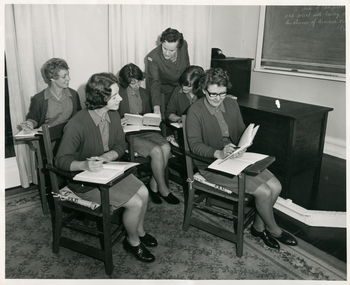 Royal District Nursing Service (now known as Bolton Clarke)
Photograph - Photograph, black and white, 07 06 1967
... nursing systems. At RDNS many programs were run, including: a Post Basic Course, Cardiac Rehabilitation Nursing, Haematology/Oncology Nursing, Palliative Care program, Diabetic Stabilization Program, Leg Ulcer Management Program, Wound Care Specialist Program, HIV/AIDS Nursing Care, Cystic Fibrosis Home Support, Veterans Home Care Program, Breast Cancer Support Program, Continence Management Program, Stomal Therapy Program, In-Home Lactation Support Program and the Homeless Persons Program. ...Miss Evans, Director of Nursing of Royal District Nursing Service, (RDNS), is holding an Education session with RDNS staff. Her uniform is a grey skirt and jacket with the RDNS badge emblazoned on her right shoulder. The badge has a white background and black writing. The RDNS Sisters are wearing their grey uniform frocks and red cardigans. Education was an integral part of Melbourne District Nursing Society (MDNS), from its inception in 1885, later, in 1966, called Royal District Nursing Service, (RDNS). From 1885, only Trained Nurses, through the hospital training system, were employed by the Society, and on visits to patients they taught the necessity of hygiene and cleanliness, as well as the need for a good diet, to bring about good health. Doctor’s lectures were later given at the MDNS home to instruct patients and their families on prevention of disease. Education to patients continued throughout the years regarding health care and the use of equipment in the home. In 1961, Education programs commenced at MDNS with Sisters receiving In-service education. Sr. Pat (Paddy) Rowley was a leader in In-service Education and established the RDNS Department of Community Nursing Education in 1962. Staff could also apply for scholarships to further their education outside of RDNS. Many of their senior trained nurses received Postgraduate diplomas from the College of Nursing in Community Health Nursing, Education, and Administration and several travelled overseas visiting nursing organizations viewing their public health and district nursing systems. At RDNS many programs were run, including: a Post Basic Course, Cardiac Rehabilitation Nursing, Haematology/Oncology Nursing, Palliative Care program, Diabetic Stabilization Program, Leg Ulcer Management Program, Wound Care Specialist Program, HIV/AIDS Nursing Care, Cystic Fibrosis Home Support, Veterans Home Care Program, Breast Cancer Support Program, Continence Management Program, Stomal Therapy Program, In-Home Lactation Support Program and the Homeless Persons Program. RDNS staff attended several hospitals to observe and learn special care needed to some clients, e.g. to the Austin Hospital to learn the care required for paraplegic and quadriplegic clients at home, and to Mount Royal Hospital to observe the care of clients in the Rehabilitation ward. A Community Nursing Education Program was extended to student nurses from hospitals and to other nursing organizations. These Education programs kept the RDNS Sisters abreast of new techniques, such as changes in technology for e.g. new testing methods in detecting glucose levels in Diabetic patients. Sr. Nan Deakin obtained a Post Basic Certificate in Psychiatric Nursing and included this area in her education lectures. Sr. Daphne Geldard specialized in the area of Alzheimer’s disease and Dementia. These Sisters visited patients in District areas with the regular RDNS Sister when required. Every member of staff, both professional and non professional staff, received regular education in the Education Department. In 1980, a Home Health Aide pilot study, funded by the Federal Government, the Brotherhood of St. Laurence and RDNS, with the program written and taught by Sr. Rowley, was evaluated as successful, and Home Health Aides were employed and worked in RDNS Centres under the supervision of the RDNS Registered Nurses. Black and white photograph showing Miss Mary Evan standing in the centre rear of the photograph. She is with five RDNS Sisters who have short hair, three with curly hair and two with straight hair, who are sitting on chairs with white paged books resting on 'over the lap' tables. Three Sisters are seated in front of Miss Evans, and another two Sisters are sitting in the foreground. Miss Evans, who has short dark curled hair, is wearing her grey uniform jacket which can be seen with the RDNS cloth badge visible at the top of her right sleeve. She is bending over one of the Sisters and has her right hand pointing to something on the Sister's book. Closed light curtains are seen in the rear of the photograph and a dark desk to the right. On the wall above this, part of a blackboard can be seen.Photographers stamp. Quote No. GF 28rdns, royal district nursing service, rdns education, miss mary evans, rdns d.o.n -
 Royal District Nursing Service (now known as Bolton Clarke)
Photograph - Photograph, black and white, c.1967
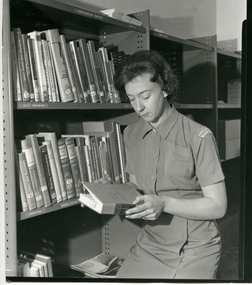
... nursing organizations. These Education programs kept the RDNS Sisters abreast of new techniques, such as changes in technology for e.g. new testing methods in detecting glucose levels in Diabetic patients. Sr. Nan Deakin did a Post Basic Course ...Sister Rignall is undergoing In-service education at RDNS and is wearing the grey RDNS uniform of that era.Education was an integral part of Melbourne District Nursing Society (MDNS), from its inception in 1885, later, in 1966, called Royal District Nursing Service, (RDNS). From 1885, only Trained Nurses who trained through the Hospital training system were employed by the Society, and on visits to patients they taught the necessity of hygiene and cleanliness, as well as the need for a good diet, to bring about good health. Doctor’s lectures were later given at the MDNS home to instruct patients and their families on prevention of disease. Education to patients continued throughout the years regarding health care and the use of equipment in the home. In 1961, Education programs commenced at MDNS with nurses receiving In-service education. Sr. Pat (Paddy) Rowley was a leader in this In-service Education and established the MDNS, later called RDNS, Department of Community Nursing Education in 1962. Staff could also apply for scholarships to further their education outside of RDNS. Many of their senior trained nurses received Postgraduate diplomas from the College of Nursing in Community Health Nursing, Education, and Administration, and several travelled overseas visiting nursing organizations viewing their public health and district nursing systems. Many programs were run at RDNS, including: a Post Basic Course, Cardiac Rehabilitation Nursing, Haematology/Oncology Nursing, Palliative Care program, Diabetic Stabilization Program, Leg Ulcer Management Program, Wound Care Specialist Program, HIV/AIDS Nursing Care, Cystic Fibrosis Home Support, Veterans Home Care Program, Breast Cancer Support Program, Continence Management Program, Stomal Therapy Program, In-Home Lactation Support Program and the Homeless Persons Program. RDNS staff attended several hospitals to observe and learn special care needed to some clients, e.g. to the Austin Hospital to learn the care required for paraplegic and quadriplegic clients at home, and to Mount Royal Hospital to observe the care of clients in the Rehabilitation ward. A Community Nursing Education Program was extended to student nurses from hospitals and to other nursing organizations. These Education programs kept the RDNS Sisters abreast of new techniques, such as changes in technology for e.g. new testing methods in detecting glucose levels in Diabetic patients. Sr. Nan Deakin did a Post Basic Course in Psychiatric Nursing and included this area in her education lectures. Sr. Daphne Geldard specialized in the area of Alzheimer’s disease and Dementia. These Sisters visited patients in District areas with the regular RDNS Sister when required. Every member of staff, both professional and non professional staff, received regular education in the Education Department. Black and white photograph showing Royal District Nursing Service (RDNS), Sister J. Rignall using the Library facilities at RDNS. Sister Rignall has short curly hair and is wearing her short sleeve grey uniform frock; the RDNS insignia is seen at the top of her left sleeve. She is standing and looking down at a book she is holding. Shelves of library books are seen running behind her on her left hand side.Photographers Stamp and Quote No. GW 94melbourne district nursing society, mdns, royal district nursing service, rdns, rdns education, rdns library, sister j. rignall -
 Royal District Nursing Service (now known as Bolton Clarke)
Photograph - Photograph, black and white, c.1967
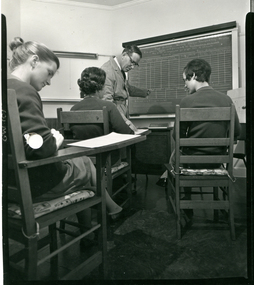
... Bralsford,the Transport Manager at Royal District Nursing Service (RDNS), is instructing RDNS staff in the responsibilities of driving an RDNS vehicle. The Sisters were undergoing a Post Basic Course given by RDNS Educators, ...Bralsford,the Transport Manager at Royal District Nursing Service (RDNS), is instructing RDNS staff in the responsibilities of driving an RDNS vehicle. The Sisters were undergoing a Post Basic Course given by RDNS Educators, Car maintenance was necessary from 1937 when a car was donated by the Rotary Club to Melbourne District Nursing Society, (MDNS). ...Mr. Bralsford,the Transport Manager at Royal District Nursing Service (RDNS), is instructing RDNS staff in the responsibilities of driving an RDNS vehicle. The Sisters were undergoing a Post Basic Course given by RDNS Educators, Car maintenance was necessary from 1937 when a car was donated by the Rotary Club to Melbourne District Nursing Society, (MDNS). Another car was donated, by General Motors-Holden, via the Duchess of Gloucester, in 1947, and the fleet began to grow from 1950 with seven Ford Prefects being provided by the Hospital and Charities Commission. For many years Melford Motors in South Melbourne maintained the MDNS fleet, until the fleet grew to the point of, the now named, Royal District Nursing Service (RDNS) providing its own Car Maintenance Division to service the cars regularly. The Royal Automobile Club of Victoria, (RACV), attended any breakdowns which occurred when nursing staff were on the road. Each new Sister employed by the Service was taken out for a driving test before she drove a District car. Royal District Nursing Service (RDNS) has had various modes of transport over the last 130 plus years. At first, from 1885 as Melbourne District Nursing Society (MDNS), their Trained nurses (Nurses) walked the streets and lane ways amid the slums of central Melbourne. As the Society expanded public transport was used; bicycles were bought by the Society in 1903 and used in inner areas until 1945. During the Spanish flu epidemic, in 1919, MDNS appealed for assistance to procure Motor vehicles so the Nurses could visit an influx of cases. Through trusts, grants and donations four 'Ford T Model' cars were procured which enabled the Nurses to triple their visits. Through constant use the cars were in such a poor state they were sold in 1927. A Motor Auxiliary was formed in 1929 to take Sisters to patients, and some Sisters used their own cars; even a motorcycle was used by one Sister in 1933. All these forms of transport were intermingled until, having received Royal patronage; the now Royal District Nursing Service (RDNS) had its own full fleet of vehicles by the mid 1960s. In many areas there were unsealed roads, in various conditions, which the Sisters negotiated to reach their patients to give care. Seat-belts had been introduced to Victoria in 1959 and District fitted them to their cars from 1962, even though they did not become compulsory until 1970. The Melways Directory of maps was introduced in 1966 which was a boon to the Sisters, though it was a few years before it went beyond Seville, so those that did the Warburton and Powelltown area worked off a large paper map. By 2009 there were 598 cars in the fleet and the Sisters travelled 9 million 200,000 kilometres – this is equivalent to 12 trips to the moon and back. Black and white photograph showing Mr. Bralsford instructing RDNS staff. In the left foreground is Sister (Sr) Liz Thomson who has her dark hair drawn back, is looking down at a piece of white paper resting on the arm of the wooden chair on which she is sitting. In front of her are the back views of Sr. Betty McDonald with curled dark hair and to her right is Sister Joanne Wilkinson. Mr. Bralsford, who has short dark hair; is wearing glasses, and wearing a grey coat, is standing in front of them pointing to a blackboard with his extended left arm and hand. He is looking down, and has his right hand on a piece of white paper on a desk. A strip heater is high on the left hand wall.Photographers stamp and Quote No. GW 101royal district nursing service, rdns, rdns transport, rdns education, melford motors, racv, sister liz thomson, sister betty mcdonald, sister joanne wilkinson, mr bralsford -
 Royal District Nursing Service (now known as Bolton Clarke)
Photograph - Photograph, colour, c.1975
... nursing organizations. These Education programs kept the RDNS Sisters abreast of new techniques, such as changes in technology for e.g. new testing methods in detecting glucose levels in Diabetic patients. Sr. Nan Deakin did a Post Basic Course ...This photograph is taken in Mrs. McDonald's home and she is reading information provided to her by Sister Faye Cook of the Royal District Nursing Service (RDNS) who is visiting to provide her with nursing care. Written communication is required between Mrs. McDonald and Sr. Cook. Sisters from the Royal District Nursing Service (RDNS) used various means to communicate with their patients who had various health conditions. Sometimes this was by written word, using interpreters or using digital devices. The RDNS Education department wrote instructions for patients to follow for various conditions and treatments to assist them in their care. The attending Sister discussed the instructions and left the leaflet with the patient. Examples of instruction included on how to sterilize dressings and equipment in the home and another giving information and instructions on diabetic care.. Education was an integral part of Melbourne District Nursing Society (MDNS), from its inception in 1885, later, in 1966, called Royal District Nursing Service, (RDNS). From 1885, only Trained Nurses (Nurses) who trained through the Hospital training system were employed by the Society, and on visits to patients they taught the necessity of hygiene and cleanliness, as well as the need for a good diet, to bring about good health. Doctor’s lectures were later given at the MDNS home to instruct patients and their families on prevention of disease. Education to patients continued throughout the years regarding health care and the use of equipment in the home. In 1961, Education programs commenced at MDNS with their Trained nurses (Sisters) receiving In-service education. Sr. Pat (Paddy) Rowley was a leader in this In-service Education and established the MDNS, later called RDNS, Department of Community Nursing Education in 1962. Staff could also apply for scholarships to further their education outside of RDNS. Many of their senior Sisters received Postgraduate diplomas from the College of Nursing in Community Health Nursing, Education, and Administration, and several travelled overseas visiting nursing organizations viewing their public health and district nursing systems. Many programs were run at RDNS, including: a Post Basic Course, Cardiac Rehabilitation Nursing, Haematology/Oncology Nursing, Palliative Care program, Diabetic Stabilization Program, Leg Ulcer Management Program, Wound Care Specialist Program, HIV/AIDS Nursing Care, Cystic Fibrosis Home Support, Veterans Home Care Program, Breast Cancer Support Program, Continence Management Program, Stomal Therapy Program, In-Home Lactation Support Program and the Homeless Persons Program. RDNS staff attended several hospitals to observe and learn special care needed to some clients, e.g. to the Austin Hospital to learn the care required for paraplegic and quadriplegic clients at home, and to Mount Royal Hospital to observe the care of clients in the Rehabilitation ward. A Community Nursing Education Program was extended to student nurses from hospitals and to other nursing organizations. These Education programs kept the RDNS Sisters abreast of new techniques, such as changes in technology for e.g. new testing methods in detecting glucose levels in Diabetic patients. Sr. Nan Deakin did a Post Basic Course in Psychiatric Nursing and included this area in her education lectures. Sr. Daphne Geldard specialized in the area of Alzheimer’s disease and Dementia. These Sisters visited patients in District areas with the regular RDNS Sister when required. Every member of staff, both professional and non professional staff, received regular education in the Education Department. In 1980, a Home Health Aide pilot study, funded by the Federal Government, the Brotherhood of St. Laurence and RDNS, with the program written and taught by Sr. Rowley, was evaluated as successful, and Home Health Aides were employed and worked in RDNS Centres under the supervision of the RDNS Registered Nurses. Coloured photograph of Sister Faye Cook of the Royal District Nursing Service (RDNS), sitting with Mrs McDonald who is reading the top page of a white writing pad. On the left, sitting 'side on' looking at Mrs McDonald, is Sister Cook who has short dark hair, and is wearing her pale blue RDNS apron over her RDNS royal blue V neck tunic style frock which is over her short sleeve white blouse; she is wearing blue stockings. She is seated on a striped low stool in Mrs. McDonald's room. Mrs.McDonald is to her right, and is seated in a bone and brown patterned lounge chair with wooden arms. She has a bone coloured wrap over her hair, and is wearing a dark brown V neck jumper over a deep pink frock. She is hoding a magnifying glass in her right hand and is reading information on a white writing pad which she is holding in her left hand. In the rear of the photograph is a gas type fire set into a fireplace. A white cupboard with a drawer is seen to the right hand side. The wall behind is vertical boards.Red coloured 'Kodak' stamps. Handwritten information.royal district nursing service, rdns, rdns education, mrs mcdonald, sister faye cook -
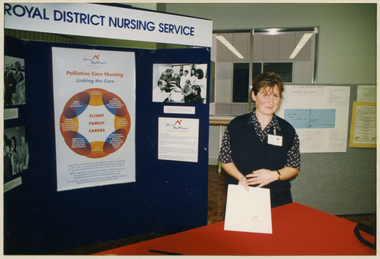 Royal District Nursing Service (now known as Bolton Clarke)
Photograph - Photograph, colour, c.2000
... nursing systems. At RDNS many programs were run, including: a Post Basic Course, Cardiac Rehabilitation Nursing, Haematology/Oncology Nursing, Palliative Care program, Diabetic Stabilization Program, Leg Ulcer Management Program, Wound Care Specialist Program, HIV/AIDS Nursing Care, Cystic Fibrosis Home Support, Veterans Home Care Program, Breast Cancer Support Program, Continence Management Program, Stomal Therapy Program, In-Home Lactation Support Program and the Homeless Persons Program. ...This photograph shows some of the information documents displayed on boards during an Education session on Palliative Care run by the Royal District Nursing Service Education Department.Education was an integral part of Melbourne District Nursing Society (MDNS), from its inception in 1885, later, in 1966, called Royal District Nursing Service, (RDNS). From 1885, only Trained Nurses (Nurses), through the Hospital training system, were employed by the Society, and on visits to patients they taught the necessity of hygiene and cleanliness, as well as the need for a good diet, to bring about good health. Doctor’s lectures were later given at the MDNS home to instruct patients and their families on prevention of disease. Education to patients continued throughout the years regarding health care and the use of equipment in the home. In 1961, Education programs commenced at MDNS with their Trained nurses (Sisters) receiving In-service education. Sr. Pat (Paddy) Rowley was a leader in In-service Education and established the RDNS Department of Community Nursing Education in 1962. Staff could also apply for scholarships to further their education outside of RDNS. Many of their senior Sisters received Postgraduate diplomas from the College of Nursing in Community Health Nursing, Education, and Administration and several travelled overseas visiting nursing organizations viewing their public health and district nursing systems. At RDNS many programs were run, including: a Post Basic Course, Cardiac Rehabilitation Nursing, Haematology/Oncology Nursing, Palliative Care program, Diabetic Stabilization Program, Leg Ulcer Management Program, Wound Care Specialist Program, HIV/AIDS Nursing Care, Cystic Fibrosis Home Support, Veterans Home Care Program, Breast Cancer Support Program, Continence Management Program, Stomal Therapy Program, In-Home Lactation Support Program and the Homeless Persons Program. RDNS staff attended several hospitals to observe and learn special care needed to some clients, e.g. to the Austin Hospital to learn the care required for paraplegic and quadriplegic clients at home, and to Mount Royal Hospital to observe the care of clients in the Rehabilitation ward. A Community Nursing Education Program was extended to student nurses from hospitals and to other nursing organizations. These Education programs kept the RDNS Sisters abreast of new techniques, such as changes in technology for e.g. new testing methods in detecting glucose levels in Diabetic patients. Sr. Nan Deakin obtained a Post Basic Certificate in Psychiatric Nursing and included this area in her Education lectures. Sr. Daphne Geldard specialized in the area of Alzheimer’s disease and Dementia. These Sisters visited patients in District areas with the regular RDNS Sister when required. Every member of staff, both professional and non professional staff, received regular education in the Education Department. In 1980, a Home Health Aide pilot study, funded by the Federal Government, the Brotherhood of St. Laurence and RDNS, with the program written and taught by Sr. Rowley, was evaluated as successful, and Home Health Aides were employed and worked in RDNS Centres under the supervision of the RDNS SistersColoured photograph of a Royal District Nursing Service (RDNS) Sister standing in front of a Palliative Nursing Display board. The board has a white banner across the top with the dark blue words 'Royal District Nursing Service' written in capital letters. There are several light coloured background posters displayed on the large dark coloured display board. The Sister, who has her dark hair drawn up, is wearing a RDNS blue and white patterned blouse and short sleeve V neck dark blue jumper with a name badge attached on the upper left. The Sister is holding.a white sheet of paper. Part of a red covered table is seen in front of her. A mid green board with documents attached to it is behind and to the right of the Sister. Behind this is a pale green wall with part of a bench and two large windows showing a room beyond.royal district nursing service, rdns, rdns palliative care nursing, rdns education -
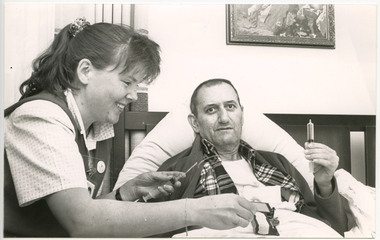 Royal District Nursing Service (now known as Bolton Clarke)
Photograph - Photograph, black and white, c.1990
... Nursing Service (RDNS) Sisters to patients in their own homes. Specialized treatments were taught to RDNS Sisters by the RDNS Education Department. At times RDNS Sisters visited hospitals to learn special techniques which were to be used to care for the patient after their discharge. The RDNS Education department ran many programs for their staff including: a Post Basic Course ...RDNS Sister Marilyn Harper is giving medication via a syringe and tube to a male client..Medications ordered by Doctors in Hospitals was given by Royal District Nursing Service (RDNS) Sisters to patients in their own homes. Specialized treatments were taught to RDNS Sisters by the RDNS Education Department. At times RDNS Sisters visited hospitals to learn special techniques which were to be used to care for the patient after their discharge. The RDNS Education department ran many programs for their staff including: a Post Basic Course, Cardiac Rehabilitation Nursing, Haematology/Oncology Nursing, Palliative Care program, Diabetic Stabilization Program, Leg Ulcer Management Program, HIV/AIDS Nursing Care, Cystic Fibrosis Home Support, Veterans Home Care Program, Breast Cancer Support Program, Continence Management Program, Stomal Therapy Program, In-Home Lactation Support Program and a Community Nursing Education Program extended to student nurses from hospitals and to other nursing organizations. RDNS staff attended several hospitals to observe and learn special care needed to some clients, e.g. to the Austin Hospital to learn the care required for paraplegic and quadriplegic clients at home and to Mount Royal Hospital to observe the care of clients in the rehabilitation ward.On the left of the black and white photograph is the side view of Royal District Nursing (RDNS) Sister Marilyn Harper, who is smiling. She has drawn back long curly hair and is wearing a white patterned short sleeve blouse under a dark V neck tunic style frock. Her right arm is extended onto a piece of equipment resting on top of the bedclothes of a male client who is lying in bed. Her left hand is holding a partly emptied syringe which is attached to a clear coloured tube attached to the man. The male client, whose head and shoulders are resting on a boomerang pillow on his bed, has short dark hair and is wearing a tartan shirt and cardigan over a white T-shirt. He is holding an upright filled syringe in his left hand. In the background you can see part of the wooden bedhead and part of a picture on the pale coloured wall behind it.Courtesy of the 'Western Independent'royal district nursing service, rdns, rdns care - medication, sister marilyn harper -
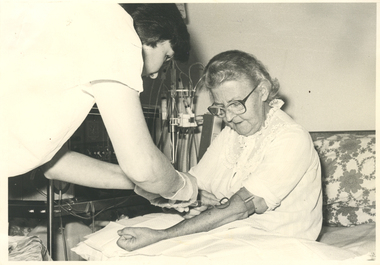 Royal District Nursing Service (now known as Bolton Clarke)
Photograph - Photograph, black and white, 1978
... At RDNS many programs were run, including: a Post Basic Course, Cardiac Rehabilitation Nursing, Haematology/Oncology Nursing, Palliative Care program, Diabetic Stabilization Program, Leg Ulcer Management Program, HIV/AIDS Nursing Care, Cystic Fibrosis Home Support, Veterans Home Care Program, Breast Cancer Support Program, Continence Management Program, Stomal Therapy Program, In-Home Lactation Support Program and a Community Nursing Education Program extended to student nurses from hospitals and to other nursing organizations. ...This photograph is showing a procedure performed by an RDNS Sister in the home of an elderly lady.Education was an integral part of Melbourne District Nursing Society (MDNS) from its inception in 1885, later called Royal District Nursing Service, (RDNS). Only Trained Nurses were employed by the Society, and on visits to patients they taught the necessity of hygiene and cleanliness, as well as the need for a good diet, to bring about good health. Doctor’s lectures were later given at the MDNS home to instruct patients and their families on prevention of disease. Education to patients continued throughout the years regarding health care and the use of equipment in the home. In 1961 Education programs commenced at MDNS with Sisters receiving In-service education. Staff could also apply for scholarships to further their education outside of RDNS. At RDNS many programs were run, including: a Post Basic Course, Cardiac Rehabilitation Nursing, Haematology/Oncology Nursing, Palliative Care program, Diabetic Stabilization Program, Leg Ulcer Management Program, HIV/AIDS Nursing Care, Cystic Fibrosis Home Support, Veterans Home Care Program, Breast Cancer Support Program, Continence Management Program, Stomal Therapy Program, In-Home Lactation Support Program and a Community Nursing Education Program extended to student nurses from hospitals and to other nursing organizations. RDNS staff attended several hospitals to observe and learn special care needed to some clients, e.g. to the Austin Hospital to learn the care required for paraplegic and quadriplegic clients at home and to Mount Royal Hospital to observe the care of clients in the rehabilitation ward.This Black and white photograph is showing Sister Liddalow, of the Royal District Nursing Service (RDNS), linking up a home dialysis unit into the left arm of an elderly lady. The lady who wears glasses and has wavy hair, is wearing a white nightdress with lace at the neck and down the centre front. Her left arm is resting on top of a surgical cover and she is clenching her left fist and has a tourniquet above her elbow. She is sitting against a flower patterned pillow on her bed watching the procedure. Sister Liddalow has short dark hair and is wearing a white gown over her uniform. She has a glove on her right hand and a syringe in her hand. In the left rear IV apparatus, with two syringes and a trolley on which a machine can be seen.date of photographroyal district nursing service, rdns, patient care - home dialysis, sister liddalow,
