
Showing 100 items matching "postcards -- uk"
-
 Melbourne Legacy
Postcard, Postcards of the UK
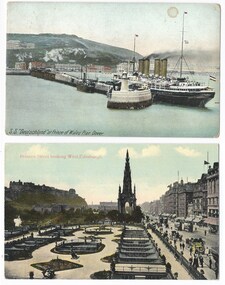
... Postcards of the UK...Postcards x 3 with images from Edinburgh and Stirling in Scotland, and the pier in Dover. Postcards of the UK Postcard ...Postcards were a common form of souvenirs for soldiers who were travelling either during World War 1, or just after, or while returning to Australia. These postcard scenes are from Scotland and England so could have been places visited. These were with other World War 1 memorabilia that has come from Private John Basil McLean, 2nd Reinforcements, 37th Battalion, A.I.F. There was a large collection of postcards so he may have been collecting them as souvenirs (none of these have been written on or posted). J.B. McLean (Service No. 13824) was from near Maffra, Victoria and enlisted on 22 January 1916. He embarked on 16 December 1916 for Europe. His full war record is available from AWM. He spent time with the Australian Field Artillery (Pack Section). At the end of the war he worked for a year at the A.I.F. Headquarters in London before returning to Australia on the 'Ceramic', arriving Portsea in 1920.Postcards were a very common form of communication in the first World War. Postcards as souvenirs or as correspondence would have been familiar to the first Legatees as they had served in World War 1. Postcards x 3 with images from Edinburgh and Stirling in Scotland, and the pier in Dover.01140.1 S.S. Deutschland at Prince of Wales Pier, Dover. 01140.2 Princes Street looking West, Edinburgh 01140.3 View from Gowan Hill, Stirling Each one has the word POST CARD on the reverse with room for an address and an area for Correspondence. Different makers.souvenir, world war one -
 Kew Historical Society Inc
Postcard, Kew Gardens, The Rockery, 1902-1912
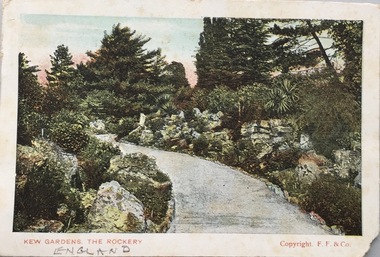
... postcards -- uk...However, other postcards produced after this date do not always conform to this print layout. postcards -- uk postcards -- kew gardens kew gardens -- the rockery Front - Kew Gardens, The Rockery / Copyright F.F. & Co. ...The Kew Historical Society's postcard collection includes views of Kew, Melbourne and Greater Melbourne as well as those including overseas scenes sent or received from Europe or the Middle East. They date from the 1890s to the 2000s. These postcards may or may not include the name of the publisher or printer. A number of the cards were published as parts of popular series. A way of dating early postcards is to identify whether the reverse was divided by a central line which became the norm after 1902 in the United Kingdom. However, other postcards produced after this date do not always conform to this print layout.Colour postcard of the Rockery, in Kew Gardens, London. Front - Kew Gardens, The Rockery / Copyright F.F. & Co. Reverse - POST CARD / FOR INLAND POSTAGE THIS SPACE, AS WELL AS THE BACK, MAY NOW BE USED FOR COMMUNICATION. FOR FOREIGN POSTAGE THE BACK ONLY (Post Office Regulation) /THE ADDRESS ONLY TO BE WRITTEN HERE. Dear Henry. Many thanks for Birthday greetings received today the first one to remember me. Hope you are well as this leaves all. Thi sis the only postcard in Sea Lake so excuse. No more just now with kind regards from Estherpostcards -- uk, postcards -- kew gardens, kew gardens -- the rockery -
 Kew Historical Society Inc
Postcard, Shanklin: The Village, c.1928
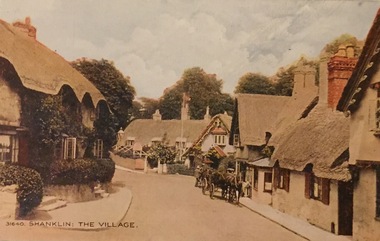
... ...postcards -- uk...Those postcards which are early views of Melbourne must have been produced commercially for some decades from the early part of the 20th century. postcards george and edith weir shanklin - isle of wight postcards -- uk weir collection "31640 / Shanklin: The Village" Shanklin is a popular seaside resort and civil parish on the Isle of Wight, England , located on Sandown Bay. ...Collection of thirty-nine postcards donated by Jillian Rigby which had been owned by her grandparents, George and Edith Weir, who from c.1917 lived at 84 Princess Street, Kew. The mostly 'mint' postcards were purchased in Victoria and while travelling overseas. The sole dated postcard is dated from 1929. The postcards are numbered sequentially from 2017.0058.01-39. The remainder of the collection donated by Jill Rigby which was once owned by the Weirs of Broken Hill and Kew consist of costumes, costume accessories, photographs, and documents.The postcards in the Weir collection, especially those purchased on a trip or trips to the mother country, i.e. United Kingdom, represent a representative sample of sites that were considered significant to those Australians undertaking a reverse grand tour by member of the erstwhile colonies. Those postcards which are early views of Melbourne must have been produced commercially for some decades from the early part of the 20th century.Shanklin is a popular seaside resort and civil parish on the Isle of Wight, England , located on Sandown Bay. The postcard was probably purchased by George and Edith Weir on a trip to England and Scotland, circa 1928."31640 / Shanklin: The Village"postcards, george and edith weir, shanklin - isle of wight, postcards -- uk, weir collection -
 Kew Historical Society Inc
Postcard, Shanklin: The Village, c.1928
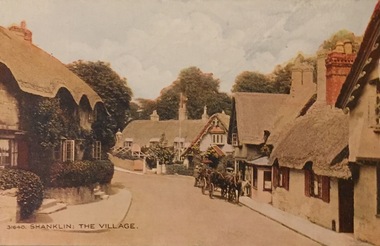
... ...postcards -- uk...Those postcards which are early views of Melbourne must have been produced commercially for some decades from the early part of the 20th century. postcards george and edith weir shanklin - isle of wight postcards -- uk weir collection "31640 / Shanklin: The Village" Shanklin is a popular seaside resort and civil parish on the Isle of Wight, England , located on Sandown Bay. ...Collection of thirty-nine postcards donated by Jillian Rigby which had been owned by her grandparents, George and Edith Weir, who from c.1917 lived at 84 Princess Street, Kew. The mostly 'mint' postcards were purchased in Victoria and while travelling overseas. The sole dated postcard is dated from 1929. The postcards are numbered sequentially from 2017.0058.01-39. The remainder of the collection donated by Jill Rigby which was once owned by the Weirs of Broken Hill and Kew consist of costumes, costume accessories, photographs, and documents.The postcards in the Weir collection, especially those purchased on a trip or trips to the mother country, i.e. United Kingdom, represent a representative sample of sites that were considered significant to those Australians undertaking a reverse grand tour by member of the erstwhile colonies. Those postcards which are early views of Melbourne must have been produced commercially for some decades from the early part of the 20th century.Shanklin is a popular seaside resort and civil parish on the Isle of Wight, England , located on Sandown Bay. The postcard was probably purchased by George and Edith Weir on a trip to England and Scotland, circa 1928."31640 / Shanklin: The Village"postcards, george and edith weir, shanklin - isle of wight, postcards -- uk, weir collection -
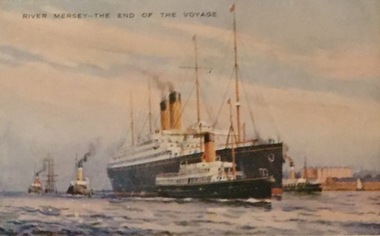 Kew Historical Society Inc
Postcard, Valentine's Series, River Mersey - The End of the Voyage, c.1928
... ...postcards -- uk...Those postcards which are early views of Melbourne must have been produced commercially for some decades from the early part of the 20th century. postcards george and edith weir river mersey postcards -- uk weir collection "River Mersey - The End of the Voyage" River Mersey - The End of the Voyage. ...Collection of thirty-nine postcards donated by Jillian Rigby which had been owned by her grandparents, George and Edith Weir, who from c.1917 lived at 84 Princess Street, Kew. The mostly 'mint' postcards were purchased in Victoria and while travelling overseas. The sole dated postcard is dated from 1929. The postcards are numbered sequentially from 2017.0058.01-39. The remainder of the collection donated by Jill Rigby which was once owned by the Weirs of Broken Hill and Kew consist of costumes, costume accessories, photographs, and documents.The postcards in the Weir collection, especially those purchased on a trip or trips to the mother country, i.e. United Kingdom, represent a representative sample of sites that were considered significant to those Australians undertaking a reverse grand tour by member of the erstwhile colonies. Those postcards which are early views of Melbourne must have been produced commercially for some decades from the early part of the 20th century.River Mersey - The End of the Voyage. One of a set of three [originally six] 'High Class Postcards of Memories of the Mersey, Beautifully Reproduced in Nature Colours', in their original brown envelope. The postcard was probably purchased by George and Edith Weir on a trip to England and Scotland, circa 1928."River Mersey - The End of the Voyage"postcards, george and edith weir, river mersey, postcards -- uk, weir collection -
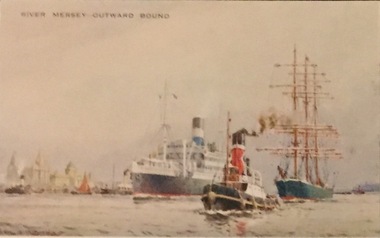 Kew Historical Society Inc
Postcard, Valentine's Series, River Mersey - Outward Bound, c.1928
... ...postcards -- uk...Those postcards which are early views of Melbourne must have been produced commercially for some decades from the early part of the 20th century. postcards george and edith weir river mersey postcards -- uk weir collection "River Mersey - Outward Bound" River Mersey - Outward Bound. ...Collection of thirty-nine postcards donated by Jillian Rigby which had been owned by her grandparents, George and Edith Weir, who from c.1917 lived at 84 Princess Street, Kew. The mostly 'mint' postcards were purchased in Victoria and while travelling overseas. The sole dated postcard is dated from 1929. The postcards are numbered sequentially from 2017.0058.01-39. The remainder of the collection donated by Jill Rigby which was once owned by the Weirs of Broken Hill and Kew consist of costumes, costume accessories, photographs, and documents.The postcards in the Weir collection, especially those purchased on a trip or trips to the mother country, i.e. United Kingdom, represent a representative sample of sites that were considered significant to those Australians undertaking a reverse grand tour by member of the erstwhile colonies. Those postcards which are early views of Melbourne must have been produced commercially for some decades from the early part of the 20th century.River Mersey - Outward Bound. One of a set of three [originally six] 'High Class Postcards of Memories of the Mersey, Beautifully Reproduced in Nature Colours', in their original brown envelope. The postcard was probably purchased by George and Edith Weir on a trip to England and Scotland, circa 1928."River Mersey - Outward Bound"postcards, george and edith weir, river mersey, postcards -- uk, weir collection -
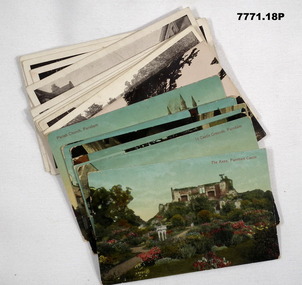 Bendigo Military Museum
Postcard - POSTCARD, FARNHAM, U.K, Valentine's Series, cWW1
... Postcards...Farnham UK...Baron Cooper Collection Postcards Farnham UK 1. The Keep, Farnham Castle. Handwritten in black ink on back: 'This is one of the pretty places around Farnham. ...1. Florrie is a relative living in Farnham. 2. R.H. Baron married Elsie Keast in 1921. All cards relate to R.H. Baron's visits to Farnham whilst on leave to see Florrie. Part of the 'Robert H. Baron', no.3596 and Cooper Collection. See Catalogue No. 1981P for details of Baron's service.1. Coloured scene of a ruined castle and surrounding gardens. 2. Coloured scene of a garden with building and ruins in background. 3. Coloured photograph of a red brick building with battlement. 4. Coloured street scene with buildings, horse drawn transport and pedestrians. 5. Coloured photograph of the nave of a church looking towards the alter. 6. Coloured street scene with buildings and horse drawn transport. 7. Coloured view across a street to a white walled building with horse drawn transport. 8. Coloured photograph of a church, graveyard in foreground. 9. Black and white photograph of a castle surrounded by trees. 10. Black and white photograph of a forest scene with people standing on a bridge. 11. Black and white photograph of a street scene with buildings, horse drawn transport and people. 12. Black and white photograph of the tower of a church. Graveyard in the foreground. 13. Black and white photograph of a street scene with buildings, horse drawn transport and pedestrians. Castle on the hill in background. 14. Black and white photograph of a street scene with buildings, motor cars and pedestrians. 15. Black and white photograph of a street scene with buildings, motor cars, horse drawn transport and pedestrians. 16. Black and white photograph of a wooded valley. Houses on a hill in the background. 17. Black and white photograph of an avenue of trees. 18. Black and white photograph taken in a park. Three people standing on a bridge over a stream.1. The Keep, Farnham Castle. Handwritten in black ink on back: 'This is one of the pretty places around Farnham. I was all once here with Florrie. Bob' 2. In Castle grounds, Farnham. Handwritten in black ink on back: 'Dear Elsie, these are some places that visit... when I was down at Flories place. Bob xxxxxx' 3. Farnham Castle. 4. West Street, Farnham. 5. Parish Church, Farnham. 6. Castle Street, Farnham. 7. The Church House, Farnham. 8. Parish Church, Farnham. 9. Farnham Castle. 10. Red Hill Hanger, Farnham. Handwritten in black ink on back: 'Letter to R.H. Baron's sister - no date.' 11. South Street, Farnham. Handwritten in black ink on back: 'this part of the place I spent my leave at this is where Florrie is.' 12. Farnham Parish Church. Handwritten in black ink on back: 'Letter to R.H. Baron's mother - dated 24 July 1918.' 13. Castle Street, Farnham. Handwritten in black ink on back. 'I think you will know where this is as I have told you quite a lot about Farnham, it is where Florrie is. I spent my leave here. This is Castle Street and the castle is right on the top of the hill.' 14. Borough, Farnham. Handwritten in black ink on back. ' This is the place where Florrie lives. I spent my last leave their (sic), Bob.' 15. West Street, Farnham. Handwritten in pencil on back. 'Pte R.H. Baron, 57 Battalion, Australian Imperial Forces Abroad.' 16. Lower Bourne Valley, Farnham. Handwritten in black ink on back: 'Partial letter from R.H. Baron to his sweetheart.' 17. The Avenue, Farnham. Handwritten in black ink on back: 'Partial letter from R.H. Baron to his mother.' 18. Recreation Ground, Farnham. Handwritten in black ink on back: 'Letter to Doris from R.H. Baron - no date.' robert h. baron, cooper collection, postcards, farnham uk -
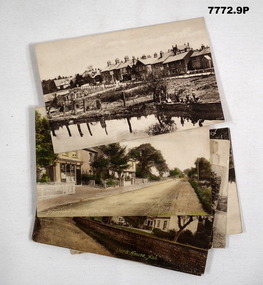 Bendigo Military Museum
Postcard - POSTCARD, ASH, U.K, F. Frith and Co, c. WW1
... ...Postcards...Ash UK...UK. c.Nov 1918. Part of the "Robert H. Baron", No. 3596 and Cooper Collections. See Catalogue No. 1981P for details of Baron's service. Robert H. Baron Cooper Collection Postcards ...Cards collected by R.H. Baron when visiting his Uncle who lived near the village of ASH, UK. c.Nov 1918. Part of the "Robert H. Baron", No. 3596 and Cooper Collections. See Catalogue No. 1981P for details of Baron's service.1. Coloured photograph of a street featuring building including a Post Office. 2. Coloured photograph of a house fronting a gravel road. 3. Sepia toned photograph of a gravel road, vegetation and trees. 4. Sepia toned photograph of a row of houses fronting a gravel road. 5. Sepia toned photograph of a row of houses. Man standing next to a horse and cart. Large pond in foreground. 6. Sepia toned photograph of a row of houses. Man standing next to a horse and cart. Large pond in foreground. 7. Sepia toned photograph of a river with boats moored on bank. Buildings on far side of river. 8. Sepia toned photograph of a row of houses fronting a road. 9. Sepia toned photograph featuring people on a wharf. Row of houses in back ground.1. Pinewood Post Office, Ash. Handwritten in faded black ink on back: 'This is the road Uncle lives in. he live just about opposite the cross (or house in middle) I made on the card, Bob'. 2. York House, Ash. Handwritten in black ink on back: 'Just near my Uncle's place in Ash, Bob.' 3. Fox Hills, Ash. Handwritten in faded black ink on back: 'Letter from R.H. Baron to his brother Freddy - no date.' 4. Ash Common, Victoria Hall, etc. Handwritten in faded black ink on back: ' Of course you will know Ash as you have wrote it bit when writing to Uncle, Bob'. 5. Ash Village & Pond: Handwritten in faded black ink on back: 'This is Ash Village - is about 1 mile from where Uncle lives. Bob.' 6. Ash Village and Pond: Handwritten in faded black ink on back: 'Letter to Elsie from R.H. Baron - no date.' 7. Ash Vale. The Wharf. Handwritten in faded black ink on back: 'Letter to Elsie from R.H. Baron - no date.' 8. Ash Vale. The Wharf. Handwritten in faded black ink on back: 'Partial letter to R.H. Baron's brother - c.Armistice Day. 9. Ash Vale. Handwritten in faded black ink on back: 'Another view of Ash, Bob.'robert h. baron, cooper collection, postcards, ash uk, ww1 -
 Bendigo Military Museum
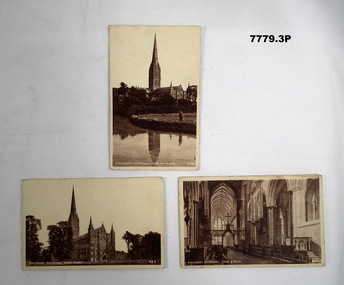
Postcard - POSTCARD - SALISBURY, UK, J Welch and Sons, c. WW1
... POSTCARD - SALISBURY, UK...Postcards...Salisbury UK...Postcard POSTCARD - SALISBURY, UK J Welch and Sons ...Postcards sent by R.H. Baron to his mother, sisters and Elsie. Part of the "Robert H. Baron" No 3596 and Cooper Collections. See Catalogue No. 1981P for details of Baron's service.1. Sepia toned photograph of the exterior of a gothic style cathedral with spire and two lantern towers. 2. Sepia toned photograph of a cathedral with spire from a river location. 3. Sepia toned photograph of the nave and choir of a gothic style cathedral.1. Salisbury Cathedral, West front. Handwritten in pencil on back: 'Letter to R.H. Baron's sisters' - no date. 2. Salisbury Cathedral from the River. Handwritten in pencil and black ink: ' Letter to R. H. Baron's mother. Ink section indecipherable. - no date. 3. Salisbury Cathedral, choir and nave. Handwritten in black ink: 'Dear Elsie etc'.robert h. baron, cooper collection, postcards, salisbury uk, ww1 -
 Bendigo Military Museum
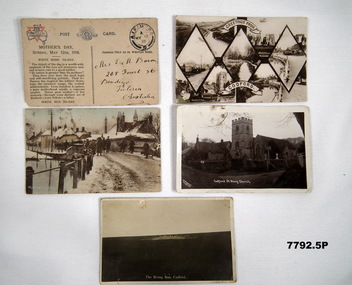
Postcard - POSTCARD - CODFORD UK, YMCA, 1. 9 May 1918. 2. 13 July 1918. 3. 1 September 1918
... POSTCARD - CODFORD UK...Postcards...Codford UK...Baron Cooper Collection Postcards Codford UK AIF Camp - WW1 1. Handwritten in black ink on back: 'Letter to R.H. ...Postcards sent by R.H. Baron depicting scenes of Codford when the AIF was encamped during WW1. Part of the Robert H. Baron, No. 3596 and Cooper Collections. See Catalogue No. 1981P for details of Baron's service.1. Plain postcard with no photograph. Front has printed Mother's Day message. Y.M.C.A. logo and Rising Sun badge printed at top. Space for written address. Postmark top R.H. Corner. 2. Collation of black and white photographs of scenes from a village. 3. Coloured photograph of a group of soldiers in winter uniform and standing on a snow covered road. Buildings in background. 4. Black and white photograph of a church with square tower, Houses next door. Graveyard next to church. 5. Black and white photograph of a Rising Sun badge carved into a hill side.1. Handwritten in black ink on back: 'Letter to R.H. Baron's mother, dated 9 May 1918'. 2. Greetings from Codford. Handwritten in black ink on back: Letter to R.H. Baron's mother dated 13 July 1918. 3. Winter at Codford. Handwritten in black ink on back: 'Letter from R.H. Baron to Doris dated 1 September 1918'. 4. Codford, St Mary Church. Handwritten in black ink on back: This is a church in the centre of our camp. Bob'. 5. The Rising Sun, Codford. Handwritten in black ink on back: 'Dear Elsie, This Rising Sun was made by an Australian Soldier some time back. Bob'. robert h. baron, cooper collection, postcards, codford uk, aif camp - ww1 -
 Kew Historical Society Inc
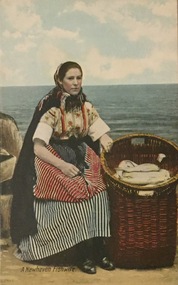
Postcard, A Newhaven Fishwife, c.1928
... ...postcards — England — UK...Those postcards which are early views of Melbourne must have been produced commercially for some decades from the early part of the 20th century. postcards george and edith weir newhaven - east sussex, fishwife series Weir Collection postcards — England — UK "A Newhaven Fishwife" Newhaven is in Edinburgh, Scotland. ...Collection of thirty-nine postcards donated by Jillian Rigby which had been owned by her grandparents, George and Edith Weir, who from c.1917 lived at 84 Princess Street, Kew. The mostly 'mint' postcards were purchased in Victoria and while travelling overseas. The sole dated postcard is dated from 1929. The postcards are numbered sequentially from 2017.0058.01-39. The remainder of the collection donated by Jill Rigby which was once owned by the Weirs of Broken Hill and Kew consist of costumes, costume accessories, photographs, and documents.The postcards in the Weir collection, especially those purchased on a trip or trips to the mother country, i.e. United Kingdom, represent a representative sample of sites that were considered significant to those Australians undertaking a reverse grand tour by member of the erstwhile colonies. Those postcards which are early views of Melbourne must have been produced commercially for some decades from the early part of the 20th century.Newhaven is in Edinburgh, Scotland. Portraits of fishwives were popular subjects for postcards due to the colourful, layered, striped outfits that they wore. The fishwife sits on rocks beside a basket of fish. The postcard would appear to be a studio portrait. The postcard was probably purchased by George and Edith Weir on a trip to England and Scotland, circa 1928."A Newhaven Fishwife"postcards, george and edith weir, newhaven - east sussex, fishwife series, weir collection, postcards — england — uk -
 Kew Historical Society Inc
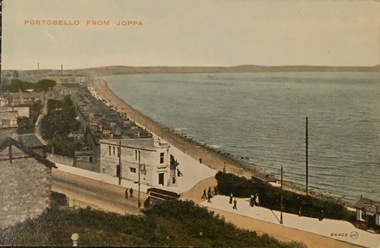
Postcard, Portabello From Joppa, c.1928
... ...postcards -- scotland (UK)...Those postcards which are early views of Melbourne must have been produced commercially for some decades from the early part of the 20th century. postcards george and edith weir portobello, joppa, edinburgh postcards -- scotland (UK) weir collection Portabello From Joppa / 8400 J.V. ...Collection of thirty-nine postcards donated by Jillian Rigby which had been owned by her grandparents, George and Edith Weir, who from c.1917 lived at 84 Princess Street, Kew. The mostly 'mint' postcards were purchased in Victoria and while travelling overseas. The sole dated postcard is dated from 1929. The postcards are numbered sequentially from 2017.0058.01-39. The remainder of the collection donated by Jill Rigby which was once owned by the Weirs of Broken Hill and Kew consist of costumes, costume accessories, photographs, and documents.The postcards in the Weir collection, especially those purchased on a trip or trips to the mother country, i.e. United Kingdom, represent a representative sample of sites that were considered significant to those Australians undertaking a reverse grand tour by member of the erstwhile colonies. Those postcards which are early views of Melbourne must have been produced commercially for some decades from the early part of the 20th century.Portabello From Joppa. Joppa is an eastern suburb of Edinburgh. The postcard was probably purchased by George and Edith Weir on a trip to England and Scotland, circa 1928. Portabello From Joppa / 8400 J.V.postcards, george and edith weir, portobello, joppa, edinburgh, postcards -- scotland (uk), weir collection -
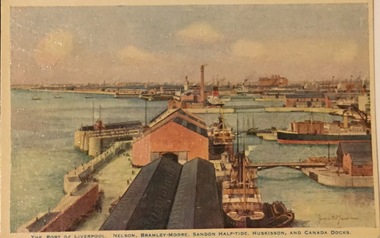 Kew Historical Society Inc
Postcard, The Port of Liverpool : Nelson, Bramley-Moore, Sandon Half-tide, Huskisson and Canada Docks, c.1928
... ...postcards -- liverpool (uk)...Those postcards which are early views of Melbourne must have been produced commercially for some decades from the early part of the 20th century. postcards george and edith weir the port of liverpool postcards -- liverpool (uk) weir collection The Port of Liverpool. ...Collection of thirty-nine postcards donated by Jillian Rigby which had been owned by her grandparents, George and Edith Weir, who from c.1917 lived at 84 Princess Street, Kew. The mostly 'mint' postcards were purchased in Victoria and while travelling overseas. The sole dated postcard is dated from 1929. The postcards are numbered sequentially from 2017.0058.01-39. The remainder of the collection donated by Jill Rigby which was once owned by the Weirs of Broken Hill and Kew consist of costumes, costume accessories, photographs, and documents.The postcards in the Weir collection, especially those purchased on a trip or trips to the mother country, i.e. United Kingdom, represent a representative sample of sites that were considered significant to those Australians undertaking a reverse grand tour by member of the erstwhile colonies. Those postcards which are early views of Melbourne must have been produced commercially for some decades from the early part of the 20th century.The Port of Liverpool. Coloured postcard. The postcard was probably purchased by George and Edith Weir on a trip to England and Scotland, circa 1928.postcards, george and edith weir, the port of liverpool, postcards -- liverpool (uk), weir collection -
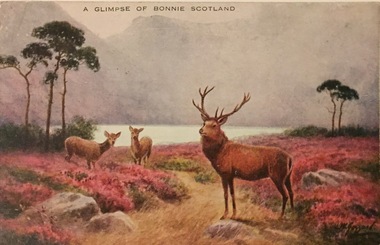 Kew Historical Society Inc
Postcard, A Glimpse of Bonnie Scotland, c.1928
... ...postcards -- scotland (uk)...Those postcards which are early views of Melbourne must have been produced commercially for some decades from the early part of the 20th century. postcards george and edith weir postcards -- scotland (uk) weir collection "To Jack / From Inverness 21-8-1928" Coloured postcard of highland scenes produced as part of the "Fine Art" Series. ...Collection of thirty-nine postcards donated by Jillian Rigby which had been owned by her grandparents, George and Edith Weir, who from c.1917 lived at 84 Princess Street, Kew. The mostly 'mint' postcards were purchased in Victoria and while travelling overseas. The sole dated postcard is dated from 1929. The postcards are numbered sequentially from 2017.0058.01-39. The remainder of the collection donated by Jill Rigby which was once owned by the Weirs of Broken Hill and Kew consist of costumes, costume accessories, photographs, and documents.The postcards in the Weir collection, especially those purchased on a trip or trips to the mother country, i.e. United Kingdom, represent a representative sample of sites that were considered significant to those Australians undertaking a reverse grand tour by member of the erstwhile colonies. Those postcards which are early views of Melbourne must have been produced commercially for some decades from the early part of the 20th century.Coloured postcard of highland scenes produced as part of the "Fine Art" Series. Valentines Series. The postcard was purchased by George and Edith Weir on a trip to England and Scotland, circa 1928."To Jack / From Inverness 21-8-1928"postcards, george and edith weir, postcards -- scotland (uk), weir collection -
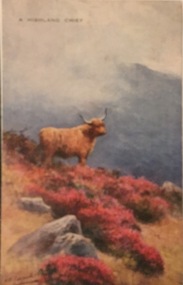 Kew Historical Society Inc
Postcard, A Highland Chief, c.1928
... ...postcards --- scotland (uk)...Those postcards which are early views of Melbourne must have been produced commercially for some decades from the early part of the 20th century. postcards george and edith weir postcards --- scotland (uk) weir collection "A Highland Chief" Coloured postcard of highland scenes produced as part of the "Fine Art" Series. ...Collection of thirty-nine postcards donated by Jillian Rigby which had been owned by her grandparents, George and Edith Weir, who from c.1917 lived at 84 Princess Street, Kew. The mostly 'mint' postcards were purchased in Victoria and while travelling overseas. The sole dated postcard is dated from 1929. The postcards are numbered sequentially from 2017.0058.01-39. The remainder of the collection donated by Jill Rigby which was once owned by the Weirs of Broken Hill and Kew consist of costumes, costume accessories, photographs, and documents.The postcards in the Weir collection, especially those purchased on a trip or trips to the mother country, i.e. United Kingdom, represent a representative sample of sites that were considered significant to those Australians undertaking a reverse grand tour by member of the erstwhile colonies. Those postcards which are early views of Melbourne must have been produced commercially for some decades from the early part of the 20th century.Coloured postcard of highland scenes produced as part of the "Fine Art" Series. Valentines Series. The postcard was probably purchased by George and Edith Weir on a trip to England and Scotland, circa 1928."A Highland Chief"postcards, george and edith weir, postcards --- scotland (uk), weir collection -
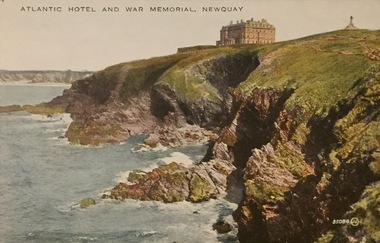 Kew Historical Society Inc
Postcard, Atlantic Hotel and War Memorial, Newquay, c.1928
... ...postcards -- Newquay (uk)...Those postcards which are early views of Melbourne must have been produced commercially for some decades from the early part of the 20th century. postcards george and edith weir atlantic hotel - new quay, war memorial - new quay postcards -- Newquay (uk) weir collection "Atlantic Hotel and War Memorial, Newquay" Atlantic Hotel and War Memorial, Newquay, Cornwall. ...Collection of thirty-nine postcards donated by Jillian Rigby which had been owned by her grandparents, George and Edith Weir, who from c.1917 lived at 84 Princess Street, Kew. The mostly 'mint' postcards were purchased in Victoria and while travelling overseas. The sole dated postcard is dated from 1929. The postcards are numbered sequentially from 2017.0058.01-39. The remainder of the collection donated by Jill Rigby which was once owned by the Weirs of Broken Hill and Kew consist of costumes, costume accessories, photographs, and documents.The postcards in the Weir collection, especially those purchased on a trip or trips to the mother country, i.e. United Kingdom, represent a representative sample of sites that were considered significant to those Australians undertaking a reverse grand tour by member of the erstwhile colonies. Those postcards which are early views of Melbourne must have been produced commercially for some decades from the early part of the 20th century.Atlantic Hotel and War Memorial, Newquay, Cornwall. The postcard was probably purchased by George and Edith Weir on a trip to England and Scotland, circa 1928."Atlantic Hotel and War Memorial, Newquay"postcards, george and edith weir, atlantic hotel - new quay, war memorial - new quay, postcards -- newquay (uk), weir collection -
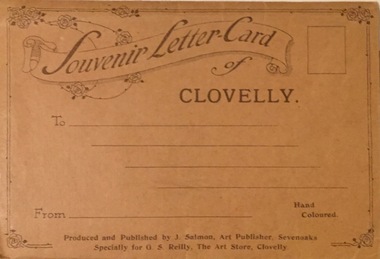 Kew Historical Society Inc
Postcard, J Salmon, Souvenir Letter Card of Clovelly, c.1928
... ...postcards -- clovelly (uk)...Those postcards which are early views of Melbourne must have been produced commercially for some decades from the early part of the 20th century. postcards george and edith weir postcards -- clovelly (uk) weir collection SOUVENIR LETTER CARD OF CLOVELLY / PRODUCED AND PUBLISHED BY J SALMON, ART PUBLISHER, SEVENOAKS / SPECIALLY FOR G S REILLY, THE ART STORE, CLOVELLY Souvenir Letter Card of Clovelly containing eight hand-coloured postcards, joined concertina-like, published and produced by J. ...Collection of thirty-nine postcards donated by Jillian Rigby which had been owned by her grandparents, George and Edith Weir, who from c.1917 lived at 84 Princess Street, Kew. The mostly 'mint' postcards were purchased in Victoria and while travelling overseas. The sole dated postcard is dated from 1929. The postcards are numbered sequentially from 2017.0058.01-39. The remainder of the collection donated by Jill Rigby which was once owned by the Weirs of Broken Hill and Kew consist of costumes, costume accessories, photographs, and documents.The postcards in the Weir collection, especially those purchased on a trip or trips to the mother country, i.e. United Kingdom, represent a representative sample of sites that were considered significant to those Australians undertaking a reverse grand tour by member of the erstwhile colonies. Those postcards which are early views of Melbourne must have been produced commercially for some decades from the early part of the 20th century.Souvenir Letter Card of Clovelly containing eight hand-coloured postcards, joined concertina-like, published and produced by J. Salmon, Art Publisher, Sevenoaks especially for G. S. Reilly, The Art Store, Clovelly. The letter card was probably purchased by George and Edith Weir on a trip to England and Scotland, circa 1928.SOUVENIR LETTER CARD OF CLOVELLY / PRODUCED AND PUBLISHED BY J SALMON, ART PUBLISHER, SEVENOAKS / SPECIALLY FOR G S REILLY, THE ART STORE, CLOVELLYpostcards, george and edith weir, postcards -- clovelly (uk), weir collection -
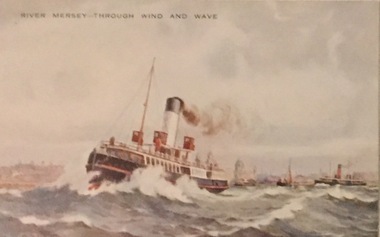 Kew Historical Society Inc
Postcard, Valentine's Series, River Mersey - Through Wind and Wave, c.1928
... ...postcards -- England (uk)...Those postcards which are early views of Melbourne must have been produced commercially for some decades from the early part of the 20th century. postcards george and edith weir river mersey postcards -- England (uk) weir collection River Mersey - Through Wind and Wave. ...Collection of thirty-nine postcards donated by Jillian Rigby which had been owned by her grandparents, George and Edith Weir, who from c.1917 lived at 84 Princess Street, Kew. The mostly 'mint' postcards were purchased in Victoria and while travelling overseas. The sole dated postcard is dated from 1929. The postcards are numbered sequentially from 2017.0058.01-39. The remainder of the collection donated by Jill Rigby which was once owned by the Weirs of Broken Hill and Kew consist of costumes, costume accessories, photographs, and documents.The postcards in the Weir collection, especially those purchased on a trip or trips to the mother country, i.e. United Kingdom, represent a representative sample of sites that were considered significant to those Australians undertaking a reverse grand tour by member of the erstwhile colonies. Those postcards which are early views of Melbourne must have been produced commercially for some decades from the early part of the 20th century.River Mersey - Through Wind and Wave. One of a set of three [originally six] 'High Class Postcards of Memories of the Mersey, Beautifully Reproduced in Nature Colours', in their original brown envelope.The postcard was probably purchased by George and Edith Weir on a trip to England and Scotland, circa 1928. postcards, george and edith weir, river mersey, postcards -- england (uk), weir collection -
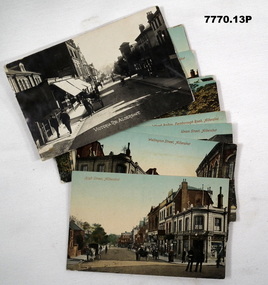 Bendigo Military Museum
Postcard - POSTCARD, ALDERSHOT, UK, Valentine's Series, c 1914 - 1918
... POSTCARD, ALDERSHOT, UK...UK...Postcards...Postcard POSTCARD, ALDERSHOT, UK Valentine's Series S.G.G. Military Series ...R..H. Baron took leave from Herdcott Camp between 4.10.19918 and 8.10.1918 to visit Aldershot. See Catalogue No. 7743 for leave pass details. Relatives lived in the Aldershot area. Part of the 'Robert H. Baron', No.3596 and Cooper Collections. See Catalogue No. 19819 for details of Baron's service.1. Coloured street scene with buildings, groups of people and horse drawn transport. 2. Coloured street scene with buildings, groups of people and horse drawn transport. 3. Coloured street scene with buildings, groups of people. 4. Coloured scene features a canal with boat, tow path, bridge and house. 5. Coloured, Band marching down a street. Spectators lining the road. Church in background. 6. Coloured Group of soldiers in uniform marching along the road. Spectators, church in background. 7. Coloured statue of a man on a horse. Statue located on a hill 8. Coloured scene of gardens surrounded by buildings and a church. Groups of women. 9. Coloured - Large building with a clock tower. 10. Coloured column of uniformed soldiers on horseback. Buildings lining road. Horse drawn transport sharing road. 11. Coloured street scene with red brick building and pedestrians. 12. Coloured Monument with inscription. Buildings in background. 13. Black and wgite street scene. Street lined with buildings. Horse drawn transport. Pedestrians.1. High Street, Aldershot. 2. Wellington Street, Aldershot. 3. Union Street, Aldershot. Handwritten in black ink on back: (Notice how narrow the streets are). 4. Wharf Bridge, Farnborough Road, Aldershot. Handwritten in black ink on back: "I was all over these places with Uncle. I had a good time in Aldershot, Bob. 5. Wellington Avenue (Church Parade), Aldershot. Handwritten in black ink: 'One of the Aldershot bands', R.H. Baron.' 6. Queens Avenue and St. George's Church, Aldershot. Handwritten in black ink on back: 'Soldiers going to church". 7. Wellington Monumental, Aldershot. Handwritten on back in black ink: 'I was right up around this place!' 8. Municipal Gardens, Aldershot. Handwritten on back in black ink: 'This place is very pretty, Bob'. 9. Cambridge Hospital, Aldershot. Handwritten on back in black ink "This is a fine place!". 10. Hospital Hill, Aldershot. 11. Smith Dorrien Home, Aldershot. Handwritten on back in black ink. 'I was all over Aldershot with Uncle. I have saw all these places. Bob.' 12. R.A.M.C. Memorial, Aldershot. 13. Victoria Rd, Aldershot.robert h. baron, cooper collection, aldershot uk, postcards -
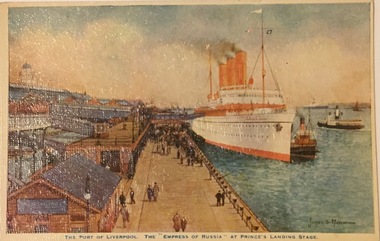 Kew Historical Society Inc
Postcard, The Port of Liverpool : The "Empress of Russia" at Prince's Landing Stage, c.1928
... ...postcards -- liverpool -- England (Uk)...Those postcards which are early views of Melbourne must have been produced commercially for some decades from the early part of the 20th century. postcards george and edith weir the port of liverpool postcards -- liverpool -- England (Uk) weir collection "The Port of Liverpool : The "Empress of Russia" at Prince's Landing Stage" The Port of Liverpool. ...Collection of thirty-nine postcards donated by Jillian Rigby which had been owned by her grandparents, George and Edith Weir, who from c.1917 lived at 84 Princess Street, Kew. The mostly 'mint' postcards were purchased in Victoria and while travelling overseas. The sole dated postcard is dated from 1929. The postcards are numbered sequentially from 2017.0058.01-39. The remainder of the collection donated by Jill Rigby which was once owned by the Weirs of Broken Hill and Kew consist of costumes, costume accessories, photographs, and documents.The postcards in the Weir collection, especially those purchased on a trip or trips to the mother country, i.e. United Kingdom, represent a representative sample of sites that were considered significant to those Australians undertaking a reverse grand tour by member of the erstwhile colonies. Those postcards which are early views of Melbourne must have been produced commercially for some decades from the early part of the 20th century.The Port of Liverpool. Coloured postcard. The postcard was probably purchased by George and Edith Weir on a trip to England and Scotland, circa 1928."The Port of Liverpool : The "Empress of Russia" at Prince's Landing Stage"postcards, george and edith weir, the port of liverpool, postcards -- liverpool -- england (uk), weir collection -
 Kew Historical Society Inc
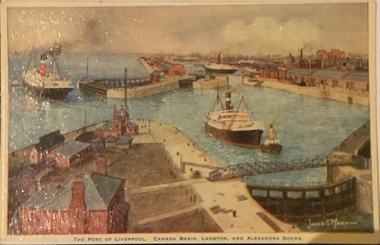
Postcard, The Port of Liverpool : Canada Basin, Langton, and Alexandra Docks, c.1928
... ...postcards -- liverpool -- England (uk)...Those postcards which are early views of Melbourne must have been produced commercially for some decades from the early part of the 20th century. postcards george and edith weir the port of liverpool postcards -- liverpool -- England (uk) Weir Collection "The Port of Liverpool : Canada Basin, Langton, and Alexandra Docks" The Port of Liverpool. ...Collection of thirty-nine postcards donated by Jillian Rigby which had been owned by her grandparents, George and Edith Weir, who from c.1917 lived at 84 Princess Street, Kew. The mostly 'mint' postcards were purchased in Victoria and while travelling overseas. The sole dated postcard is dated from 1929. The postcards are numbered sequentially from 2017.0058.01-39. The remainder of the collection donated by Jill Rigby which was once owned by the Weirs of Broken Hill and Kew consist of costumes, costume accessories, photographs, and documents.The postcards in the Weir collection, especially those purchased on a trip or trips to the mother country, i.e. United Kingdom, represent a representative sample of sites that were considered significant to those Australians undertaking a reverse grand tour by member of the erstwhile colonies. Those postcards which are early views of Melbourne must have been produced commercially for some decades from the early part of the 20th century.The Port of Liverpool. Coloured postcard. The postcard was probably purchased by George and Edith Weir on a trip to England and Scotland, circa 1928."The Port of Liverpool : Canada Basin, Langton, and Alexandra Docks"postcards, george and edith weir, the port of liverpool, postcards -- liverpool -- england (uk), weir collection -
 Bendigo Military Museum
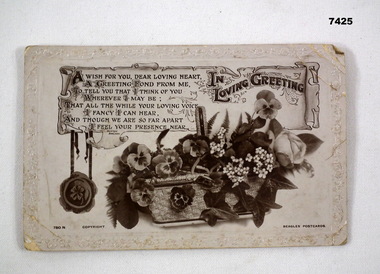
Postcard - POSTCARD, WW1
... Postcard written from UK or France in WW1. From PATRICK JOSEPH FRAWLEY No. 563. ...Postcard written from UK or France in WW1. From PATRICK JOSEPH FRAWLEY No. 563. ...Postcard written from UK or France in WW1. From PATRICK JOSEPH FRAWLEY No. 563. Refer Cat No 7424.4 for his service details.Purple/white front with imprinted edges. Image on front is a picture of a basket of poppies and roses. Above it is written a poem and in bigger letters "In Loving Greeting". Back of card paper faded yellow with short message.Written on card "From Paddy to Mabel, Best Love”, Also, a stamp saying "Printed in England" by “J Beagles & Co. Ltd, London E.G." postcard, ww1 -
 Bendigo Military Museum
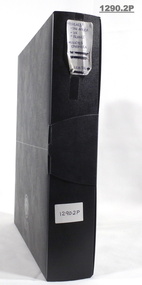
Mixed media - ARCHIVAL BOX - GRINTON COLLECTION, Miss Jean Grinton, Photographs and Ephemera 1916 - 1919 and Folder c. 2009
... The postcards document Grinton's visits to various UK, French and European sites of interest. ....1) Each section divider is labelled in blue ink: 'P/Cs CAPE TOWN', 'P/Cs ENGLAND & SCOTLAND', 'P/Cs FRANCE & EUROPE', 'ASSORTED EPHEMERA' .2) On spine label handwritten in blue ink: 'POSTCARDS - Sth AFRICA, UK, FRANCE, ASSORTED EPHEMERA, JEAN GRINTON'. ...See also 1291.2P and 4528.2P. 38th Battalion Books - albums Western Front John 'Jack' Grinton Grinton Collection .1) Each section divider is labelled in blue ink: 'P/Cs CAPE TOWN', 'P/Cs ENGLAND & SCOTLAND', 'P/Cs FRANCE & EUROPE', 'ASSORTED EPHEMERA' .2) On spine label handwritten in blue ink: 'POSTCARDS - Sth AFRICA, UK, FRANCE, ASSORTED EPHEMERA, JEAN GRINTON'. ...Items relate to Jack Grinton No 1043, 38th Batt AIF. The postcards document Grinton's visits to various UK, French and European sites of interest. The ephemera in the last section include booklets, sketches, souvenirs, programmes, paper money, photo wallets, letters, pay slips and Grinton's discharge certificate. Part of the Grinton Collection which included hundreds of negatives and developed photos taken by Jack Grinton during WW1. Refer Cat No 1280 for service details. See also 1291.2P and 4528.2P. Black three ringed plastic folder in a rectangular black plastic box. Folder is divided into labelled sections each of which contains a number of postcards and assorted ephemera. Postcards and ephemera are housed in clear plastic pockets. A handwritten label is taped to the spine of the box..1) Each section divider is labelled in blue ink: 'P/Cs CAPE TOWN', 'P/Cs ENGLAND & SCOTLAND', 'P/Cs FRANCE & EUROPE', 'ASSORTED EPHEMERA' .2) On spine label handwritten in blue ink: 'POSTCARDS - Sth AFRICA, UK, FRANCE, ASSORTED EPHEMERA, JEAN GRINTON'. 38th battalion, books - albums, western front, john 'jack' grinton, grinton collection -
 Flagstaff Hill Maritime Museum and Village
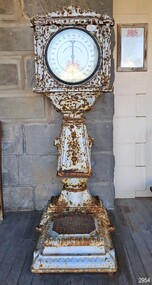
Instrument - Scale, Weighing Machine, G. Salter & Co, 1884-1909
... UK, makers of scales since 1760. It is protected by Queen Victoria’s Royal Letters Patent, signed in 1900. The scale stood outside the Warrnambool Post Office in Timor Street from around 1909 to 1966, as shown on postcards and photographs held at the State Library of Victoria. ...UK, makers of scales since 1760. It is protected by Queen Victoria’s Royal Letters Patent, signed in 1900. The scale stood outside the Warrnambool Post Office in Timor Street from around 1909 to 1966, as shown on postcards and photographs held at the State Library of Victoria. ...This ornate, Victorian-era automatic weighing machine was made in England around 1884-1909, by George Salter and Co. of West Bromwich, UK, makers of scales since 1760. It is protected by Queen Victoria’s Royal Letters Patent, signed in 1900. The scale stood outside the Warrnambool Post Office in Timor Street from around 1909 to 1966, as shown on postcards and photographs held at the State Library of Victoria. The scale is identified by the Serial Number '665', and was installed by the distributors, the Australasian Automatic Weighing Machine Co. Ltd.. The scale’s weight measurements were in Imperial stones and pounds up to 20 stone (127 kg). The scale’s face included charts of average weights, for men, women, boys and girls, by various heights, in feet and inches. The coin slot and its face were converted to metric measurements by the Eastern Scale Company Pty. Ltd; that firm was registered on October 2, 1974. The Australasian Automatic Weighing Machine Co. Ltd was a large supplier of weighing scales in Australia and held the Royal Letters patent for their machines, distributing them in prominent locations. In 1902, the firm was listed under the Import Entries Passed at His Majesty’s Customs, importing into Sydney, NSW, eight cases of scales. In 1911, the company asked permission from the Port Pirie Corporation to install a machine in Alexander Street. In 1913, the company applied to the City of Sydney to install machines around the city, including at the tram depot. One application mentions “… three machines in three places for three pounds per year”. In 1923, the firm tendered for the right to place Automatic Weighing Machines on railway and tram premises throughout New South Wales, subsequently for five-year terms, in return for a fixed payment per machine and a portion of the revenue to the NSW Government. In 1928, the Sydney Harbour Trust gave the firm the right to place the weighing machines on various ferry jetties. The firm was still operating in 1941, advertising for two boys aged 14-16 for the workshop and messages, at the Rialto building, 497 Collins St., Melbourne. On December 21, 1946, the Commonwealth government invited offers to tender for the right to place automatic weighing machines on postal premises throughout the six states; the successful company then made arrangements with the federal Postmaster General's Department to place machines outside post offices across the country. A few years later, on September 11, 1950, the firm's Adelaide branch ceased trading. From 11th July 1950, the Australian and Eastern Engineering Company Pty. Ltd took over at the same premises, at 179 Pirie Street, Adelaide. The Perth branch ceased business in WA on July 6th, 1950. Percival Everitt invented and patented the automatic, coin-operated personal scale design. Everitt was a Norfolk-born engineer and regarded as the father of the coin-operated industry. As a young man in 1877, he invented a hay and corn pitcher, a turnip thinner in 1878 and an Automatic Travelling Anchor in 1880. But his fame came in 1883 with the first postcard-vending machine, over a hundred of which he distributed around London. In 1884, he patented one of his many inventions, the coin-operated scales for use in public places; for many people, it was their first exposure to coin-operated machines. His success prompted the formation of the Weighing Machine Company in 1885. Further inventions followed: a blow tester in 1887, the machine for testing a person's grip in 1888, and in 1889, the dispensing machine for hiring out opera glasses, and a device for shutting down the coin entry slot if the machine was empty. In 1890, he invented a fortune-telling machine. Everitt sadly did not make his fortune; he died suddenly in February 1893, in his late forties, with £71 to his name. George Salter & Co., West Bromwich, England, produced automatic weighing scale machines from Everitt’s patented design, and advertised them as suitable for hotels, pleasure gardens, theatres, exhibition halls, clubs, baths and places of public resort. The company was established in 1760 by brothers Richard and William Salter, and manufactured springs and pocket steelyards (spring balances). After several generations, the company was taken over in 1855 by a nephew, George, and renamed George Salter & Co. In 1884, Salter registered the trademark of a Staffordshire knot pierced by an arrow. The company's expanded range of products included the first coin-operated public weighing machines in the 1880s and, in 1895, the first English-made typewriter. In 1915, Salter became a limited company, Geo. Salter & Co. Ltd. When the last George Salter died in 1917, the company passed into the hands of other relatives, but continued to grow before being bought out by Staveley Industries in 1973. Despite several subsequent mergers, the Salter name continues to be seen on household products such as digital scales. This patented, coin-operated weight machine is significant for its association with Percival Everitt, the inventor of the world’s first slot machine, with the renowned maker of scales, G. Salter & Co., which began operating in 1760, and also with the Australasian Automatic Weighing Scale Co., which imported and widely distributed the scales throughout Australia from the early-to-mid 20th century. It is a rare example of an early vending machine used in public places from the late 19th through to the mid-20th century. These machines were the early step in the evolution of coin-in-the-slot machines, which are still used today. The scales give a glimpse into our history; they became quickly popular with the public, which, until then, had little access to weight scales apart from those at medical services. They also provided inexpensive entertainment for families, especially while waiting for trains or visiting the post office. The machines were also attractive and lucrative to the distributors; once installed, they required very little maintenance, and their low cost to customers kept the money coming in. This automatic weighing machine is also significant for its decades of service to the local and regional community of Warrnambool, for personal and commercial purposes. A public coin-operated weighing scale, also called a penny scale. It is a large, silver-painted cast metal stand with a square top on a pedestal that flares outwards to join a rectangular platform base with posts on the side and corners that may have had fitted wheels. The round, white face on top has red and black measurements and inscriptions. A slim indicator with a point at one end and an arc at the other is attached to the face’s centre. The coin slot is above the face, on the left, and the scale’s identification number is engraved on an oval plate on the right. Moulded motifs decorate the pedestal’s front and are repeated on its sides; they depict a tall, narrow urn with a bowl on top and fancy scrolls on either side. There is a decorative panel across the front top of the stand. The top of the pedestal has a small keyhole. The size of the coin slot fitted a penny coin, and the weight measurements on the face were in Imperial stones and pounds. Quite some time after 1966, when Australia introduced new decimal weights, measurements and currency, the scale was updated; the coin slot size was changed, and a new face with metric measurements was installed. The scale now accepts a $1 coin (one dollar) and the scale measures weight in kilograms and grams, from 0 to 125 kg.. The rear of the scale has a small, rectangular metal plate with printed text. The scale was made by G Salter & Co. of West Bromwich, UK, distributed by the Australasian Automatic Weighing Platform Co., and updated to metric measurements by Eastern Scale Co. Pty Ltd. It was previously installed at the Warrnambool Post Office. Engraved on an oval plate on the right: "665" Top centre of the face, in red: "$1 coin" Top of face: "EASTERN SCALE CO. PTY LTD" Base of face, in red: "[Royal Coat of Arms of Britain]" with words, below in red: "BY ROYAL LETTERS PATENT" Around the face, in black: "[numbers 0 to 125, in increments 5, and makes between the numbers for each 500g]" "kg" Below the face, moulded letters within a shield: "AUSTRALASIAN AUTOMATIC WEIGHING MACHINES CO. LTD." At the back of the weighing platform: "G SALTER & CO. / WEST BROMWICH", remnants of logo “[Staffordshire knot pierced by an arrow]” Plate on rear: THIS SCALE REMAINS THE PROPERTY OF EASTERN SCALE CO. PTY. LTD., 8 GEORGE COURT, GREENSBOROUGH, VIC, 3088. PHONE (03 ) _ 34 _ _ 33” (434 9333 ?_flagstaff hill, warrnambool, maritime village, maritime museum, flagstaff hill maritime museum and village, shipwreck coast, great ocean road, scale, weighing scale, salter, australasian, 1 dollar, $1 coin, 1p, 1 penny coin, penny scale, coin in slot scale, eastern scale co. pty. ltd., british royal coat of arms, royal letters patent, letters patent, health, ending machine, coin-operated machine, percival everett, weighing machine co., george salter & co., g salter & co, west bromwich, vending machine, weights & balances, measurements, slot machine, coin operated machine, penny-in-the-slot, coin fed, coin op scale, weights & measures, australasian automatic weighing machine co. ltd., warrnambool post office, machine 665, no. 665, blalnce technology, scales and weights, weights and measures, penny weight scales, vintage, weighing machine, coin in the slot, coin operated, public scale, public weighing machine, penny-weighing machines, penny weighing machines, penny scales, coin operated weighing machine, scale weighing machine -
 Mission to Seafarers Victoria
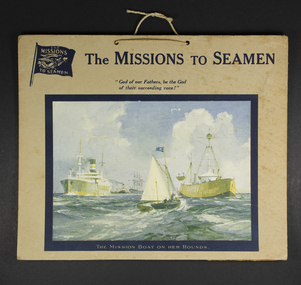
Functional object - Calendar frontispiece, The Mission Boat on her Rounds, early to mid 20th C
... postcards. He also designed for Churchill Cigar Boxes, and, alongside paintings demonstrating his first-hand experience of combat, produced illustrations for Illustrated London News and Sphere magazines. Many of his oil and watercolour paintings of the two World Wars are preserved in the collection of the National Maritime Museum, London, and at the Imperial War Museum, London." (The National Archives UK...postcards. He also designed for Churchill Cigar Boxes, and, alongside paintings demonstrating his first-hand experience of combat, produced illustrations for Illustrated London News and Sphere magazines. Many of his oil and watercolour paintings of the two World Wars are preserved in the collection of the National Maritime Museum, London, and at the Imperial War Museum, London." (The National Archives UK ..."Charles E. Turner was an artist who exhibited at the Royal Academy in London, and specialised in landscape and marine views. Having served in the Royal Air Force in the First World War, reaching the rank of Captain, Turner worked as a war artist during 1939-45. Turner painted pictures of the Queen Mary and Queen Elizabeth for Cunard, which were made into a series of popular postcards. He also designed for Churchill Cigar Boxes, and, alongside paintings demonstrating his first-hand experience of combat, produced illustrations for Illustrated London News and Sphere magazines. Many of his oil and watercolour paintings of the two World Wars are preserved in the collection of the National Maritime Museum, London, and at the Imperial War Museum, London." (The National Archives UK)Representative and promotional example of service by MTS to the variety of ships visiting ports in the first half of the 20th C. Cardboard frontispiece of a calendar published by the Missions to Seamen. A colour painting titled "Mission Boat on her Rounds" by artist Charles E. Turner, represents an imaginary image of the mission boat with the Flying Angel flag sailing towards several ships.Written in pencil at the back: "With best wishes from the Chaplain and the LHL Guild"calendar, frontispiece, charles e. turner (1883-1965), hlg, harbour lights guild, mtsuk -
 Lara RSL Sub Branch
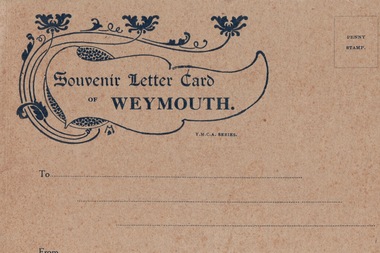
Postcards Booklet, Souvenir Letter Card of Weymouth
... A World War 1 Letter Card sent home by Australian troops repatriated in Weymouth, UK containing images of Weymouth and a picture of the Australian Base Camp. ymca uk australian base camp world war 1 ww1 aif army australian army westham littemoor weymouth melcombe regis cemetery anzac Front cover (see image) Souvenir Letter Card of Weymouth Inside are eight pictures of the Weymouth area including the YMCA Hut - Australian Base Camp Souvenir Letter Card of Weymouth Postcards Booklet ...Following the landing of Australian & New Zealand troops, the Anzacs, at Gallipoli on 25th April 1915, casualties mounted rapidly and were initially transported to their base in Egypt, which was soon unable to cope, with wounded being sent to England. Here the troops found that there was no Australian base to which they could report once they had been discharged from hospital; what was needed urgently was a base in England where troops could be sent to convalesce. So on 31st May 1915 a command depot was set up at Monte Video House in Chickerell, some two miles from Weymouth. Weymouth then became the Australian Imperial Forces (AIF) Command Depot No.2 which accommodated those men not expected to be fit for duty within six months, therefore, most of the Diggers repatriated as a result of wounds or sickness passed through Weymouth. During the years 1915-1919 over 120,000 Australian and New Zealand troops passed through Weymouth. In Spring & Summer, Weymouth Esplanade would be full of Anzac soldiers in wheelchairs, being wheeled along by their more able mates. The first contingent of 200 wounded men arrived in the first week of June 1915, and two weeks later a group of local ladies organised a cream tea for the newcomers, followed by a concert party 'The Frolics' at the camp. So began the close connection that was to grow between the soldiers and the villagers of Chickerell. The ANZAC Memorial on Weymouth seafront commemorates the Australian and New Zealand troops who were accommodated in three camps in the town during WW1: Monte Video, Westham and Littlemoor. In Weymouth and Melcombe Regis Cemetery there are about eighty-six graves of those Anzacs who were never to return to their homelands. Also in memory of these troops, there a number of roads close to the camps named after Australian cities and states.A World War 1 Letter Card sent home by Australian troops repatriated in Weymouth, UK containing images of Weymouth and a picture of the Australian Base Camp.Front cover (see image) Souvenir Letter Card of Weymouth Inside are eight pictures of the Weymouth area including the YMCA Hut - Australian Base Campymca, uk, australian base camp, world war 1, ww1, aif, army, australian army, westham, littemoor, weymouth, melcombe regis cemetery, anzac -
 Glenelg Shire Council Cultural Collection
Postcard - Postcard - Portland Bay, 1908
... Postmarked Portland, 18 May 1908 & Manchester UK 23 July 1908 Coloured photo postcard. View of Portland Bay, looking north east from Henty Beach. ...Coloured photo postcard. View of Portland Bay, looking north east from Henty Beach. Ocean Pier, Railway Pier, Fishermen's Breakwater, Couta Boat fishing fleet, remains of second Baths. Steamer at Ocean Pier and in bay. 'Portland Bay' - white print lower right edgeBack: Hand written message, black ink, from Rachel to Janice. Postmarked Portland, 18 May 1908 & Manchester UK 23 July 1908 -
 City of Moorabbin Historical Society (Operating the Box Cottage Museum)
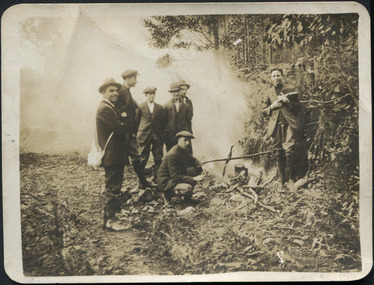
Photograph, postcard "Boiling the Billy" c1900, Early 1900's "Boiling the Billy", c1900
... UK and Ireland. It is widely accepted that the term "billycan" is derived from the large cans used for transporting bouilli or bully beef on Australia-bound ships or during exploration of the outback, which after use were modified for boiling water over a camp fire. Postcards...UK and Ireland. It is widely accepted that the term "billycan" is derived from the large cans used for transporting bouilli or bully beef on Australia-bound ships or during exploration of the outback, which after use were modified for boiling water over a camp fire. Postcards ...Early 1900's. "Boiling the billy". The term billy or billycan is particularly associated with Australian usage, but is also used in the UK and Ireland. It is widely accepted that the term "billycan" is derived from the large cans used for transporting bouilli or bully beef on Australia-bound ships or during exploration of the outback, which after use were modified for boiling water over a camp fire. Postcards developed out of the complex tradition of nineteenth-century printed calling cards, beginning with the advent of the Cartes-de-Visite in France. In the 1850s, Parisian photographer Andre Adolphe Eugene Disderi invented a photographic process involving egg white, albumen, and silver nitrate to create inexpensive portraits on paper cards. These photographic Cartes-de-Visites were 2 1/2 (75mm) by 4 inches (98mm) and became a popular, collectable form of "visiting cards" world-wide. Photographers would reprint portraits of famous individuals they had taken at their studios or during travel and sell them as collectable cards. Postcards as we know them now first began in 1861 as cards mailed by private post. In the 1870s picture postcards grew in popularity throughout the United States, Britain, Europe, and Japan. Cards were first permitted to have a "Divided Back," with text written on the left half of a dividing line and the address on the right half, beginning in England in 1902. Around 1900 the first postcards made of "Real Photos" rather than artwork began to circulate, aided in by advances in amateur photography equipment by companies such as Kodak. Kodak also introduced postcard paper for photographic development and photography studios began to offer portraits printed as postcards Many local town, countryside, and architectural images were captured during this period by local photographers, then printed and sold as postcards . Advances in amateur photography all contributed to a postcard craze that lasted from 1900 to the First World War. Postcards were the preferred means to send a quick note, whether across town or across a continent.Postcard with a black and white Photograph on the front and a 'Divided Back ' for the message and address. There are seven men surrounding the billy suspended over a camp fire. The ground has a lot of dead branches around. One man is bending down towards the billy. Two men on either side of the camp fire are carrying either a white bag across their shoulders or the fish in their hands. You can see, that there is some steam also coming out of the billy, which means that its hot. Court Post Card. / this space may be used for correspondence. / The address only to be written here.1900's, boiling the billy , postcards, photographers, england, hungary, america, cartes-de-visite, visiting cards, moorabbin, cheltenham, bentleigh, market gardeners, early settlers, pioneers, -
 Eltham District Historical Society Inc
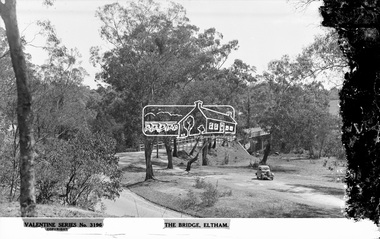
Negative - Photograph, The Rose Stereograph Company, The Bridge, Eltham, c.1939
... UK between 1934 and 1937. The Model C was released in Australia in 1935 https://en.wikipedia.org/wiki/Ford_Model_C_Ten This glass plate negative was used to manufacture postcards (1:1 printing) for commercial sale by the Rose Sterograph Company and its subsidiaries. ...UK between 1934 and 1937. The Model C was released in Australia in 1935 https://en.wikipedia.org/wiki/Ford_Model_C_Ten This glass plate negative was used to manufacture postcards (1:1 printing) for commercial sale by the Rose Sterograph Company and its subsidiaries. ...Looking west across the Main Road Bridge over the Diamond Creek at Eltham, c.1939. The car in the foreground, possibly the photographer's, is a Ford Model C Ten built by Ford UK between 1934 and 1937. The Model C was released in Australia in 1935. The Ford Model C Ten is a car that was built by Ford UK between 1934 and 1937. The Model C was released in Australia in 1935 https://en.wikipedia.org/wiki/Ford_Model_C_Ten This glass plate negative was used to manufacture postcards (1:1 printing) for commercial sale by the Rose Sterograph Company and its subsidiaries. George Rose founded the Rose Stereograph Company in 1880 and was joined by Herbert (Bert) Cutts in the early 20th Century. The pair formed a lifetime working partnership and strong personal friendship. Assisted by George’s two sons, Herbert George and Walter, and later by Neil Cutts, the Rose Stereograph Company continued its operations for more than 140 years. The company was initially built on stereographs, but as cinema took over and stereographs fell out of fashion, the Rose Stereograph Company developed Australia’s first commercially viable photographic postcard business. Specialising in postcards of iconic historical moments and significant landmarks, The Rose Stereograph Company became a staple of the Australian travel industry.This remarkable collection of glass plate negatives, transparencies, and postcards – arguably Australia’s most significant photography collection outside of public hands – has been passed down through the generations, surviving war, relocation, and the harsh Victorian climate. The historic Rose Stereograph collection is the culmination of George Rose’s dream of capturing and preserving precious moments in time and remains the legacy of the Rose and Cutts families. It is with great sadness that the Cutts family says goodbye to a collection that spans five generations and 140 years. The Cutts family understands that for these historically important pieces to rest with one family is to deny others the pleasure of their custodianship.Glass Plate Negative Size: 9 x 13.9 cmThe Bridge, Eltham, Valentine Series No. 3196, Copyrightpeter and elizabeth pidgeon collection, bridge, cars, diamond creek (creek), eltham, eltham south, ford model c ten, glass plate negative, main road, main road bridge, motor vehicles, postcard, rose stereograph, rose stereograph company, valentine series postcard -
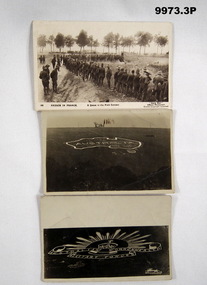 Bendigo Military Museum
Postcard - PHOTOGRAPHIC POSTCARDS WW1
... Two postcard signs likely taken on Salisbury Plains in UK. Other photo is of NZ Troops lined up in France for meals. ...Postcard format on back. 2P. Photo of image of map of Australia and the word "Australia" inside on a plain in the UK, most likely Salisbury. 3P. ...Two postcard signs likely taken on Salisbury Plains in UK. Other photo is of NZ Troops lined up in France for meals. ...Two postcard signs likely taken on Salisbury Plains in UK. Other photo is of NZ Troops lined up in France for meals. Photo taken by Daily Mail as Official War Photo.1P. Black and white photo of troops lined up in France for meals. Postcard format on back. 2P. Photo of image of map of Australia and the word "Australia" inside on a plain in the UK, most likely Salisbury. 3P. Photo of large scale image of the Australian Rising Sun Emblem laid out on a plain. Assumed to be Salisbury Plain.No writing on postcards.selby collection, photographic postcards
