
Showing 17 items matching "pot holder"
-
 Williamstown High School
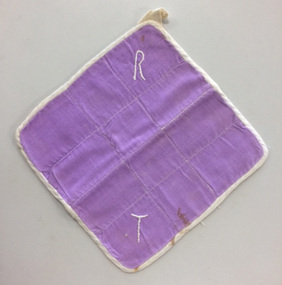
Pot holder
... Pot holder......pot holder...Lavender linen pot holder bound with white bias binding and embroidered with the letter RT. ...Williamstown High School Robyn Thomson Needlework 1960s pot holder Lavender linen pot holder bound with white bias binding and embroidered with the letter RT. ...Lavender linen pot holder bound with white bias binding and embroidered with the letter RT. This item was made in Needlework class at Williamstown High School in the 1960s by Robyn Thomson.williamstown high school, robyn thomson, needlework, 1960s, pot holder -
 Bendigo Historical Society Inc.
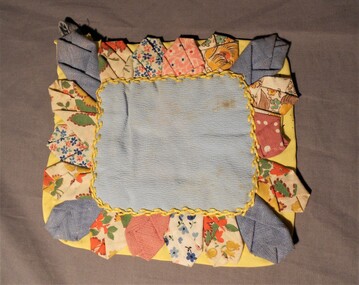
Domestic Object - MERLE HOULDEN COLLECTION: FABRIC POT HOLDER, 1940's-50's
... MERLE HOULDEN COLLECTION: FABRIC POT HOLDER......fabric pot holder...Square shaped pot holder. Centre panel, and back lining are made from pale blue "silky - type" (probably synthetic) fabric. ...DOMESTIC EQUIPMENT Food storage & preservation fabric pot holder Made by Merle's Grandmother Williamson. ...Square shaped pot holder. Centre panel, and back lining are made from pale blue "silky - type" (probably synthetic) fabric. This 9 X 11cm panel is surrounded by a band of yellow fabric, which also forms a binding around the edges. A blue and white check flannelette fabric forms the padding in the pot holder. Folded strips of floral cotton form a decorative band between the small and larger rectangles. This border is decorated by yellow stitchery. A fabric loop at one corner is for hanging purposes.Made by Merle's Grandmother Williamson.domestic equipment, food storage & preservation, fabric pot holder -
 Bendigo Historical Society Inc.
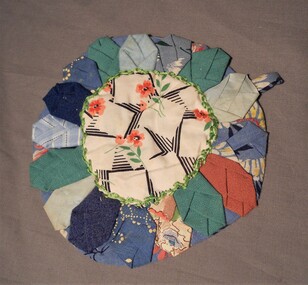
Domestic Object - MERLE HOULDEN COLLECTION: FABRIC POT HOLDER - CIRCULAR, 1940's-50's
... MERLE HOULDEN COLLECTION: FABRIC POT HOLDER - CIRCULAR......fabric pot holder- circular...Padded in the centre, the pot holder is backed with blue floral cotton fabric, and bound with the same around the outer edge....DOMESTIC EQUIPMENT Food storage & preservation fabric pot holder- circular Made by Merle's Grangmother Williamson. ...Centre panel of floral cotton, nine cms in diameter. Surrounded by folded strips of coloured cotton fabric, forming a "flower" type design. A row of embroidery in green stranded cotton edges the centre panel. Padded in the centre, the pot holder is backed with blue floral cotton fabric, and bound with the same around the outer edge.Made by Merle's Grangmother Williamson.domestic equipment, food storage & preservation, fabric pot holder- circular -
 Tatura Irrigation & Wartime Camps Museum
Pot Plant Holder
... Pot Plant Holder...Rustic wooden pot plant holder made from small branches off trees which have been cut and arranged into 8 sided holder. ...Made in one of the camps and sold to the local citizens. pot plant holders Rustic wooden pot plant holder made from small branches off trees which have been cut and arranged into 8 sided holder. ...Made in one of the camps and sold to the local citizens.Rustic wooden pot plant holder made from small branches off trees which have been cut and arranged into 8 sided holder. Held together with small nails. Small pieces of branch have been used as "feet" (3) on the bottom and smaller pieces around the top (10). A circle of tin forms the base.pot plant holders -
 Orbost & District Historical Society
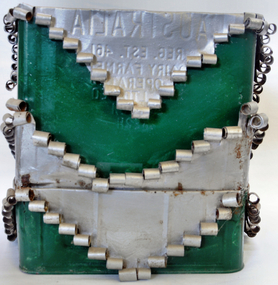
plant holder, Wilkinson, Dick
... Handmade ornamental metal pot plant holder made from painted milk tins. Curled metal decorations. ...This item was made by Dick Wilkinson as a copy of simuilar article made during the Depression. container milk-tin plant-holder handcrafts FRESH FROZEN PASTEURISED HOMOGENISED MILK. PRODUCT OF AUSTRALIA -inside DAIRY FARMERS CO-OPERATIVE LTD. Handmade ornamental metal pot ...This item was made by Dick Wilkinson as a copy of simuilar article made during the Depression.Handmade ornamental metal pot plant holder made from painted milk tins. Curled metal decorations. Lined with milk tin.FRESH FROZEN PASTEURISED HOMOGENISED MILK. PRODUCT OF AUSTRALIA -inside DAIRY FARMERS CO-OPERATIVE LTD.container milk-tin plant-holder handcrafts -
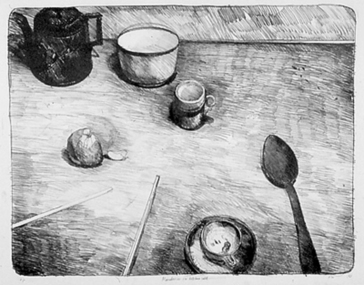 Nillumbik Shire Council
Print (lithograph) Peter WEGNER (b.1954 NZ - a.1958 AUS), Peter Wegner, Mandarin on Kitchen Table, 1983
... Details several kitchen/household items: spoon, tea pot, egg holder, cup and saucer, bowl, chop sticks and mandarin....Details several kitchen/household items: spoon, tea pot, egg holder, cup and saucer, bowl, chop sticks and mandarin. ...This work is by a local contemporary artist with a national and international reputation for figurative and portrait works. This lithograph comes from a series of still life by Wegner from the early 80's; a subject matter in which he has not returned to. Wegner is well known for his drawings and enjoys the immediate and directness of the process. He sees the drawn image as an experience of observation, with the content revealing the process of its making. Lithographic print - still life in black and white. Details several kitchen/household items: spoon, tea pot, egg holder, cup and saucer, bowl, chop sticks and mandarin.Lower far left: 'A/P'; Low centre: 'Mandarin on Kitchen Table'; Lower far right: 'PW 83'wegner, lithograph, still life, black and white, utensils, table, fruit, print -
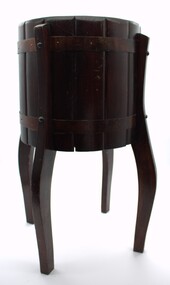 Friends of Westgarthtown
Furniture - Stand, pot plant
... wooden pot plant holder on four legs. Barrel-shaped with two metal belts at top and bottom, attached by nails. ...furniture domestic wood stand decoration wooden pot plant holder on four legs. Barrel-shaped with two metal belts at top and bottom, attached by nails. ...wooden pot plant holder on four legs. Barrel-shaped with two metal belts at top and bottom, attached by nails. Legs curved, running up the barrel sides for support.furniture, domestic, wood, stand, decoration -
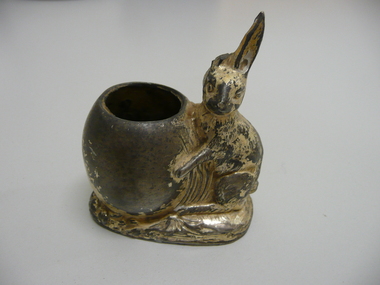 Bendigo Historical Society Inc.
Domestic Object - RABBIT TOOTH PICK HOLDER
... Silver plated pot metal tooth pick holder in shape of a rabbit holding an egg....DOMESTIC EQUIPMENT Containers tooth picks JB 220 Silver plated pot metal tooth pick holder in shape of a rabbit holding an egg. ...Silver plated pot metal tooth pick holder in shape of a rabbit holding an egg.JB 220domestic equipment, containers, tooth picks -
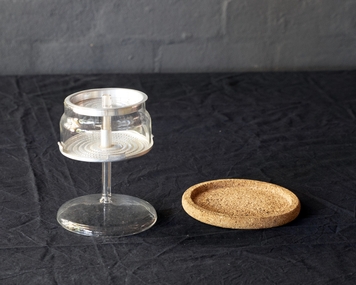 Robin Boyd Foundation
Functional object - Appliance
... It also had a lovely grey three cornered tea light holder/coffee pot warmer for keeping the coffee warm"....It also had a lovely grey three cornered tea light holder/coffee pot warmer for keeping the coffee warm". ...This is all that remains of a glass coffee percolator. Mandie Boyd recalls "Robin and Trish used this percolator at dinner parties. It also had a lovely grey three cornered tea light holder/coffee pot warmer for keeping the coffee warm".The internal filter from a coffee percolator. The only parts remaining. -
 Flagstaff Hill Maritime Museum and Village
Container - Ink Bottle & Case, 1934 – Mid 1950’s
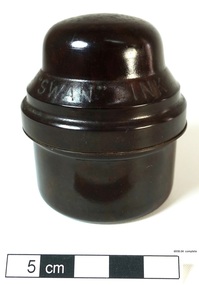
... holder...ink bottle case...ink bottle pot...The British Museum has an elaborately decorated bronze ink pot holder that is inlaid with turquoise. Today ink bottle cases are even available in fabric with loops to attach to a belt. ...Vintage brown Bakelite travelling ink bottle case (or holder, pot, well) containing glass ink bottle and original textured cardboard liner, made by Swan Ink, Mabie, Todd & Co. ...The British Museum has an elaborately decorated bronze ink pot holder that is inlaid with turquoise. Today ink bottle cases are even available in fabric with loops to attach to a belt. ...Pens, nib pens and later fountain pens, with suitable inks, were commonly used for writing communications from the 18th century to the mod 20th century. Fountain pens continue to be used and enjoyed. Dip pens with a wide variety of nibs are used for calligraphy writing, a hobby enjoyed by many people. The quality of the pen handle, the nib and the ink all work together to produce fine handwriting that expresses the character and mood of the writer. This Bakelite ink case has been specifically moulded to snugly contain an ink bottle, with just enough room to wrap the bottle with a padding or card or blotting paper. The screw top lid fits the case well and this container would be a good way to travel with ink because any spillage would be kept within the waterproof case. The Bakelite material is lightweight and strong. Ink bottle cases, or travelling cases, have been made as an accessory for nib pen writers. The first patent for a “pocket-case for bottles”, a wooden case, was applied for in the US in 1891. Other materials such as steel, pewter and aluminum as well as Bakelite have also been used. The British Museum has an elaborately decorated bronze ink pot holder that is inlaid with turquoise. Today ink bottle cases are even available in fabric with loops to attach to a belt. Bakelite, the material used for this ink bottle case, is made from synthetic materials and is an early form of plastic, developed in 1907 and used extensively until the 1940’s. It is still in used today for specific applications but has been largely replaced by more modern forms of plastics. This ink bottle case carries the imprint of Mabie, Todd & Co. (Aust.) Pty. Ltd. This form of company name was used from 1938 to the mid 1950’s. The Swan ink bottle’s information says it was made by Mabie, Todd & Co. Ltd., London and Sydney, so dates the ink bottle from about 1908 until 1934. (Australian newspapers display advertisements dated 1908 until 1934 for Sydney wholesalers and agents for Mabie, Todd & Co. Ltd.) ABOUT PERSONAL FOUNTAIN PENS (FOUNT PENS) A 1917 newspaper advertisement recommends that the owner of a “Swan” doesn’t lend it to anyone else to use due to its qualities of it personalised to the owner. It reads “Don’t lend your “Swan” fountpen, recommend it, but don’t let other people use it. You see, a good pen doesn’t wear, but its “tamper” (or spring) works into the writer’s pressure and manner of holding. Another person with a dashing style of writing may strain it do that it will no longer feel just like your own.” This personalisation of nib pens may be the reason that legal documents in the past being acceptable only if they were signed using a ‘wet ink’ pen. Forgeries of signatures could be easily detected as the nib takes on the character of the pen’s owner. A ballpoint pen was not acceptable. This is a strong contrast to modern times when a digital signature is widely accepted. ABOUT MABIE TODD Pty Ltd. The American company Mabie Todd began by making pencil cases in New York in the 1860’s. The Bard Brothers, makers of Gold nibs, joined Mabie Todd and the company was established in the 1870’s as Mabie Todd and Bard. In 1878 the company filed a patent for the design of a fountain pen and in 1884 the first Swan fountain pen was released. In 1884 a Mabie Todd and Bard office and showroom was established in London. In 1906 the company’s name changed to Mabie Todd & Co, New York. The UK offices also used this new name and in 1907 the UK began producing their own Swan pens. Manufacturing was going so well in England that New York sold their rights to European and Colonial business to the new Mabie Todd & Company Ltd of England. By the end of the 1930’s all components for the pens were being made in the UK; the pens in the London factory, the gold nibs in Birmingham and the ink in Liverpool. Newspaper articles from 1934 stated that Mabie Todd were large buyers of Tasmanian iridium, which had been welded with gold and used since 1834 for the tips of nib and fountain pens. Fountain pen points were the largest market buyers for Tasmanian iridium, which was classed as “the best in the world”. Production growth continued up until WWII times, when the headquarters and main factory were destroyed. Mabie Todd & Company Ltd of England rebuilt out of the inner city and by 1946 pen production began again. The market for nib and fountain pens was diminishing by this time, with people beginning to use the new ballpoint ‘Biro’ pens. The Mabie Todd bought shares in Biro Pens and in 1952 became Biro Swan. They went on to make more ballpoint pens than any other manufacturer in Britain. The ink refills that Biro-Swan produced came in five different viscosity or thickness xhoices, depending on the season and location of where the pen would be used . Along with the ballpoint pens, Biro-Swan also introduced a range of Calligraph pens to attract those following the new trend for italic writing. In 1948 Mr. T. Burke, a director for Mabie Todd & Co. (Aust.) Pty Ltd., announced that there would be a £40,000 factory built in Sydney in 1949 for the manufacture of ink. The plant for the factory would be imported from overseas. Sadly the company struggled against competition and in 1956 Mabie Todd closed business and no more Swan pens were produced. The ink bottle and container was donated to Flagstaff Hill Maritime Village by the family of Doctor William Roy Angus, Surgeon and Oculist. It is part of the “W.R. Angus Collection” includes historical medical equipment, surgical instruments and material once belonging to Dr Edward Ryan and Dr Thomas Francis Ryan, (both of Nhill, Victoria) as well as Dr Angus’ own belongings. The Collection’s history spans the medical practices of the two Doctors Ryan, from 1885-1926 plus that of Dr Angus, up until 1969. ABOUT THE “W.R.ANGUS COLLECTION” Doctor William Roy Angus M.B., B.S., Adel., 1923, F.R.C.S. Edin.,1928 (also known as Dr Roy Angus) was born in Murrumbeena, Victoria in 1901 and lived until 1970. He qualified as a doctor in 1923 at University of Adelaide, was Resident Medical Officer at the Royal Adelaide Hospital in 1924 and for a period was house surgeon to Sir (then Mr.) Henry Simpson Newland. Dr Angus was briefly an Assistant to Dr Riddell of Kapunda, then commenced private practice at Curramulka, Yorke Peninsula, SA, where he was physician, surgeon and chemist. In 1926, he was appointed as new Medical Assistant to Dr Thomas Francis Ryan (T.F. Ryan, or Tom), in Nhill, Victoria, where his experiences included radiology and pharmacy. In 1927 he was Acting House Surgeon in Dr Tom Ryan’s absence. Dr Angus had become engaged to Gladys Forsyth and they decided he further his studies overseas in the UK in 1927. He studied at London University College Hospital and at Edinburgh Royal Infirmary and in 1928, was awarded FRCS (Fellow from the Royal College of Surgeons), Edinburgh. He worked his passage back to Australia as a Ship’s Surgeon on the on the Australian Commonwealth Line’s T.S.S. Largs Bay. Dr Angus married Gladys in 1929, in Ballarat. (They went on to have one son (Graham 1932, born in SA) and two daughters (Helen (died 12/07/1996) and Berenice (Berry), both born at Mira, Nhill ) According to Berry, her mother Gladys made a lot of their clothes. She was very talented and did some lovely embroidery including lingerie for her trousseau and beautifully handmade baby clothes. Dr Angus was a ‘flying doctor’ for the A.I.M. (Australian Inland Ministry) Aerial Medical Service in 1928 . Its first station was in the remote town of Oodnadatta, where Dr Angus was stationed. He was locum tenens there on North-South Railway at 21 Mile Camp. He took up this ‘flying doctor’ position in response to a call from Dr John Flynn; the organisation was later known as the Flying Doctor Service, then the Royal Flying Doctor Service. A lot of his work during this time involved dental surgery also. Between 1928-1932 he was surgeon at the Curramulka Hospital, Yorke Peninsula, South Australia. In 1933 Dr Angus returned to Nhill and purchased a share of the Nelson Street practice and Mira hospital (a 2 bed ward at the Nelson Street Practice) from Dr Les Middleton one of the Middleton Brothers, the current owners of what previously once Dr Tom Ryan’s practice. Dr Tom and his brother had worked as surgeons included eye surgery. Dr Tom Ryan performed many of his operations in the Mira private hospital on his premises. He had been House Surgeon at the Nhill Hospital 1902-1926. Dr Tom Ryan had one of the only two pieces of radiology equipment in Victoria during his practicing years – The Royal Melbourne Hospital had the other one. Over the years Dr Tom Ryan had gradually set up what was effectively a training school for country general-practitioner-surgeons. Each patient was carefully examined, including using the X-ray machine, and any surgery was discussed and planned with Dr Ryan’s assistants several days in advance. Dr Angus gained experience in using the X-ray machine there during his time as assistant to Dr Ryan. When Dr Angus bought into the Nelson Street premises in Nhill he was also appointed as the Nhill Hospital’s Honorary House Surgeon 1933-1938. His practitioner’s plate from his Nhill surgery is now mounted on the doorway to the Port Medical Office at Flagstaff Hill Maritime Village, Warrnambool. When Dr Angus took up practice in the Dr Edward and Dr Tom Ryan’s old premises he obtained their extensive collection of historical medical equipment and materials spanning 1884-1926. A large part of this collection is now on display at the Port Medical Office at Flagstaff Hill Maritime Village in Warrnambool. In 1939 Dr Angus and his family moved to Warrnambool where he purchased “Birchwood,” the 1852 home and medical practice of Dr John Hunter Henderson, at 214 Koroit Street. (This property was sold in1965 to the State Government and is now the site of the Warrnambool Police Station. and an ALDI sore is on the land that was once their tennis court). The Angus family was able to afford gardeners, cooks and maids; their home was a popular place for visiting dignitaries to stay whilst visiting Warrnambool. Dr Angus had his own silk worm farm at home in a Mulberry tree. His young daughter used his centrifuge for spinning the silk. Dr Angus was appointed on a part-time basis as Port Medical Officer (Health Officer) in Warrnambool and held this position until the 1940’s when the government no longer required the service of a Port Medical Officer in Warrnambool; he was thus Warrnambool’s last serving Port Medical Officer. (Masters of immigrant ships arriving in port reported incidents of diseases, illness and death and the Port Medical Officer made a decision on whether the ship required Quarantine and for how long, in this way preventing contagious illness from spreading from new immigrants to the residents already in the colony.) Dr Angus was a member of the Australian Medical Association, for 35 years and surgeon at the Warrnambool Base Hospital 1939-1942, He served with the Australian Department of Defence as a Surgeon Captain during WWII 1942-45, in Ballarat, Victoria, and in Bonegilla, N.S.W., completing his service just before the end of the war due to suffering from a heart attack. During his convalescence he carved an intricate and ‘most artistic’ chess set from the material that dentures were made from. He then studied ophthalmology at the Royal Melbourne Eye and Ear Hospital and created cosmetically superior artificial eyes by pioneering using the intrascleral cartilage. Angus received accolades from the Ophthalmological Society of Australasia for this work. He returned to Warrnambool to commence practice as an ophthalmologist, pioneering in artificial eye improvements. He was Honorary Consultant Ophthalmologist to Warrnambool Base Hospital for 31 years. He made monthly visits to Portland as a visiting surgeon, to perform eye surgery. He represented the Victorian South-West subdivision of the Australian Medical Association as its secretary between 1949 and 1956 and as chairman from 1956 to 1958. In 1968 Dr Angus was elected member of Spain’s Barraquer Institute of Barcelona after his research work in Intrasclearal cartilage grafting, becoming one of the few Australian ophthalmologists to receive this honour, and in the following year presented his final paper on Living Intrasclearal Cartilage Implants at the Inaugural Meeting of the Australian College of Ophthalmologists in Melbourne In his personal life Dr Angus was a Presbyterian and treated Sunday as a Sabbath, a day of rest. He would visit 3 or 4 country patients on a Sunday, taking his children along ‘for the ride’ and to visit with him. Sunday evenings he would play the pianola and sing Scottish songs to his family. One of Dr Angus’ patients was Margaret MacKenzie, author of a book on local shipwrecks that she’d seen as an eye witness from the late 1880’s in Peterborough, Victoria. In the early 1950’s Dr Angus, painted a picture of a shipwreck for the cover jacket of Margaret’s book, Shipwrecks and More Shipwrecks. She was blind in later life and her daughter wrote the actual book for her. Dr Angus and his wife Gladys were very involved in Warrnambool’s society with a strong interest in civic affairs. He had an interest in people and the community They were both involved in the creation of Flagstaff Hill, including the layout of the gardens. After his death (28th March 1970) his family requested his practitioner’s plate, medical instruments and some personal belongings be displayed in the Port Medical Office surgery at Flagstaff Hill Maritime Village, and be called the “W. R. Angus Collection”. The ink bottle case is significant for its association with writing methods commonly used during the colonisation of Australia until the mid-20th century. The protective Bakelite case demonstrates the value placed on caring for the user’s supply of ink and protecting other belongings of the user, enabling writers to easily carry and safely transport their ink without the concern of spilling it. The case’s design is a good example of the use of new technology. The properties of Bakelite have enabled its moulded design and make it waterproof and lightweight, easily cleaned, closely fitted to the shape of the ink bottle within and lid and base join together using a smooth screwing action. The maker’s marks have also been moulded into the Bakelite, therefore not distracting from the simple but elegant design. This ink bottle case also represents the period of early to mid-20th century when handwriting materials for writers using ink and nib pens were imported into Australia and developed for the Australian market and sold by wholesalers on behalf of overseas companies. Vintage brown Bakelite travelling ink bottle case (or holder, pot, well) containing glass ink bottle and original textured cardboard liner, made by Swan Ink, Mabie, Todd & Co. (Aust) Pty.. Ltd. The Bakelite container is shaped to fit snugly around the ink bottle. It still retains its original shiny finish, the lid screws on and off perfectly. The maker’s name is embossed on lid and base of the Bakelite container. The inkwell contains a glass Ink bottle with a tiny amount of dried up ink Swan triple filtered ink inside. The bottle is cylindrical with curved shoulders tapering to a neck of around 2cm. The white metal screw-on lid and the white and red paper label on the side of the bottle both have a printed description of the ink and maker. Circa 1934-1950’sBAKELITE INK CASE - embossed on either side of the lid “ “SWAN” INK / ”SWAN” INK “ - embossed into base, written in a circle “MABIE TODD & Co (Aust.) PTY. LTD.” GLASS BOTTLE – printed on lid “SWAN”/ [corporate logo combining letters ‘M, T, co’]/TRIPLE FILTERED/ INK.” - printed on label “SWAN” INK /FOR FOUNTAIN & / STEEL PENS / A BLUE BLACK INK OF/ THE FINEST QUALITY/ MADE IN ENGLAND/ MABIE. TODD & CO LTD …….. LONDON. SYDNEY/ Makers of “SWAN” Pens, Gold Pens & Ink“ - moulded into the base of the ink bottle and written around the bottom outside edge of the bottle are the words “THIS BOTTLE ALWAYS REMAINS THE PROPERTY OF/ MABIE TODD/AUST”flagstaff hill, warrnambool, shipwrecked coast, flagstaff hill maritime museum, maritime museum, shipwreck coast, flagstaff hill maritime village, great ocean road, ink bottle holder, ink bottle case, ink bottle pot, travelling inkwell, portable inkwell, travelling ink pot, travelling ink bottle case, ink bottle, inkwell, ink well, swan ink, bakelite, dip pen ink, nib pen ink, fountain pen, fontpen, writing methods, stationery, mabie todd & co, swan fountain pens, biro-swan -
 Blacksmith's Cottage and Forge
Ink-well, ceramic insert, steel-nib pen
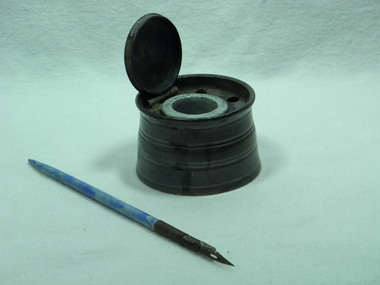
... pot. Two bands indented around top of lid. Insert designed to hold ink. Pen with marbled blue handle, metal nib holder and metal nib....pot. Two bands indented around top of lid. Insert designed to hold ink. Pen with marbled blue handle, metal nib holder and metal nib. ...This ink-well was used in the Bacchus Marsh Court House, possibly for book-keeping and/or for court records. This type of ink-well and pen were in use everywhere in schools, businesses, courts, etc before the invention of the type-writer and the ball-point pen. Clerks were usually male and a good copperplate hand-writing was admired. Ink was often mixed by hand used a powdered ink mixed with water.Of local significance in the history of the town of Bacchus Marsh.Round pewter ink-well, with hinged lid and ceramic insert. Five round holes pierced in inner rim of metal to hold pens. Two ribbed bands around exterior of pot. Two bands indented around top of lid. Insert designed to hold ink. Pen with marbled blue handle, metal nib holder and metal nib.Indecipherable imprint on bottom of pot, possibly machine markings. Illegible written marks on side of pewter pot. Ceramic insert marked on side and bottom by red and black ink.ink, ink well, hand writing, record keeping, pens, nibs, clerical work, court records -
 Warrnambool and District Historical Society Inc.
Toilet set, China toilet set, Early 20th century
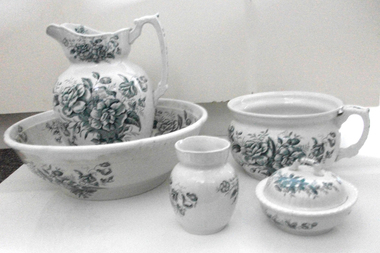
... The toothbrush holder has a vase-like shape with an indented rim with fluting on the top. The chamber pot is circular with a decorated handle and one crack. ...The toothbrush holder has a vase-like shape with an indented rim with fluting on the top. The chamber pot is circular with a decorated handle and one crack. ...A bathroom set would have been a common item in most households in the 19th century and up the mid 20th century. Not many of the bathroom sets, however, would have been as fine and as attractive as this one as this one would have belonged to a family with some wealth. Bathroom sets went out of common use once houses were sewered or had septic tanks and toilets and bathrooms were constructed inside the main house building. This set is of interest as an example of a common household item in houses 100 years ago or more. It will be useful for display.This is a five-piece china bathroom/ toilet set. The five pieces that comprise the set have a white background with a floral pattern in sage green monochrome with roses, carnations, sweet pea and dianthus. In the pattern are also tendrils and foliage. The jug is an elongated oval shape with a decorated handle. The interior of the lip is chipped. The circular bowl has an indented ridge at the top with interior and exterior decoration. The bowl is partly discoloured and there is some crazing. The toothbrush holder has a vase-like shape with an indented rim with fluting on the top. The chamber pot is circular with a decorated handle and one crack. The soap holder is circular and has three parts – the circular decorated base, the inset piece with a fluted edge and one large and six small holes for draining, and the decorated lid which is also fluted around the edge. The markings at the base of each item have a crown symbol as well as the lettering. Staffordshire England Camelia’ social history, bathroom set, china bathroom set -
 Kiewa Valley Historical Society
Lamp Table Kerosene, pre 1950s
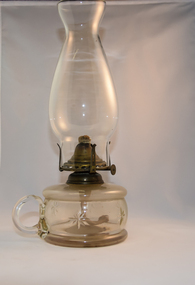
... On top of the bowl sits the metal (brass) wick holder with a small wheel protruding out one side for adjusting the wick length(increasing or decreasing the strength(regulating) of the amount of light projected. Four prongs rise from the circular base light fixture holding the windproof and refractive glass "pot belly" shield. ...On top of the bowl sits the metal (brass) wick holder with a small wheel protruding out one side for adjusting the wick length(increasing or decreasing the strength(regulating) of the amount of light projected. Four prongs rise from the circular base light fixture holding the windproof and refractive glass "pot belly" shield. ...This particular lamp was made for the dinner table or "parlour". This was the most effective indoor lighting before electrical lighting was introduced in the 1940's. These table lights would have still been used after this time as emergency lighting during electrical power shortages (outages). These emergency lighting lamps, including candles, were eventually replaced by battery power. The Kiewa Valley was supplied by electricity well before many other rural regions due to the State Electricity Commission constructing the Kiewa Hydro Electricity power turbines (late 1930's to mid 1950's). Petrol and diesel generators were used in other rural regions before state wide electricity was available.The significance of this kerosene lamp to the Kiewa Valley is that it provides the proof that before the Hydro electricity scheme was established in the valley, householder and commerce relied on candle/kerosene power. Although at certain times before battery and solar energy became the night time lighters the sole source of lighting was candle power and kerosene power. The supply of both however was still required by most of the population by supply from city and larger country town suppliers. This nearly fully glass made table lamp(kerosene) has a large glass bowl/basin like kerosene storage unit with a glass circular finger handle (similar to a ordinary cup). Formed single star like patterns (50mm apart) encircle the centre of the bowl. On top of the bowl sits the metal (brass) wick holder with a small wheel protruding out one side for adjusting the wick length(increasing or decreasing the strength(regulating) of the amount of light projected. Four prongs rise from the circular base light fixture holding the windproof and refractive glass "pot belly" shield. lamp table, kerosene lamp, household lighting (non electrical) -
 Bendigo Historical Society Inc.
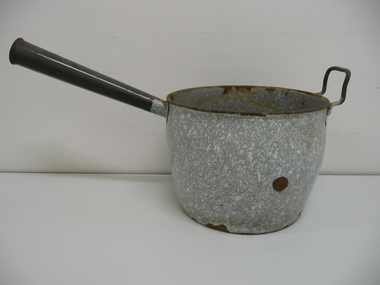
Domestic Object - ENAMELLED SAUCEPAN
... DOMESTIC EQUIPMENT Food preparation cooking pot K25 TS 20 Large grey speckled enamelled saucepan with handle & holder, no lid. ...Large grey speckled enamelled saucepan with handle & holder, no lid.TS 20domestic equipment, food preparation, cooking pot, k25 -
 Bendigo Historical Society Inc.
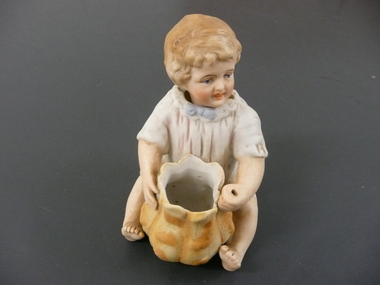
Domestic Object - BISQUE CHINA ORNAMENT
... Bisque china bobble head ornament, possibly tooth pick holder, in shape of small boy with pot between his legs....ORNAMENTS Ceramic figurine Bisque china bobble head ornament, possibly tooth pick holder, in shape of small boy with pot between his legs. Domestic Object BISQUE CHINA ORNAMENT ...Bisque china bobble head ornament, possibly tooth pick holder, in shape of small boy with pot between his legs.ornaments, ceramic, figurine -
 Warrnambool and District Historical Society Inc.
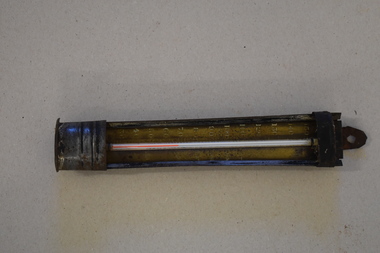
Water temperature reader, Early 20th century
... pot or bath. Water temperature gauges are still in use today. Although this item has no known local provenance it is retained as an example of a household item of the past – a water temperature gauge. Bath Thermometers Warrnambool history of warrnambool ‘Cold, Cool, Temp, Tepid, Warm, Hot’ ‘351’ This is a glass temperature gauge set into a metal holder with markings on each side of the thermometer. ...This temperature gauge would have been used in the past to take the temperature of water in a pot or bath. Water temperature gauges are still in use today. Although this item has no known local provenance it is retained as an example of a household item of the past – a water temperature gauge. This is a glass temperature gauge set into a metal holder with markings on each side of the thermometer. The holder has a metal clip at the top for hanging the object on a wall or cupboard. The holder is much rusted.‘Cold, Cool, Temp, Tepid, Warm, Hot’ ‘351’ bath thermometers, warrnambool, history of warrnambool -
 Mont De Lancey
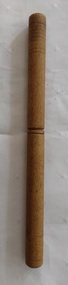
Domestic object - Knitting Needle Holder, c.1950's
... pots, pill boxes, or even cases for spectacles. Knitting accessories Knitting equipment Knitting needles Craft Handicrafts A vintage wooden turned two piece treen needle case with six rusted steel knitting needles inside the holder. ...Treen is defined as small, utilitarian wooden ware, often handmade by local turners or carpenters. A "treen wooden case" refers to a small, handmade container, box, or vessel crafted from wood, typically designed for functional household use rather than as furniture. These cases were historically used to store small, personal, or valuable items. Examples include snuff boxes, needle cases, sewing containers, spice pots, pill boxes, or even cases for spectacles.A vintage wooden turned two piece treen needle case with six rusted steel knitting needles inside the holder. knitting accessories, knitting equipment, knitting needles, craft, handicrafts
