
Showing 15 items matching "potter brothers"
-
 Bendigo Historical Society Inc.
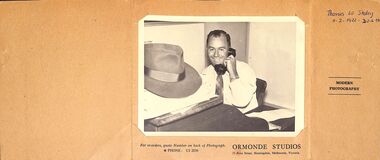
Photograph - Thomas and Valda Staley Collection: Photograph
... ...Potter Brothers...Bendigo Potter Brothers Williamson Street Staley Potter Bros (admin person) top of Williamson St. ...Black and white photograph of man (Thomas Staley) seated at desk with telephone receiver in left hand to ear. Seated at desk with hat and personal items in front of him. Photograph held into fawn mount by the four corners slipped into mount. Mount forms part of a 'envelope' with left and right flap folding over photograph. Name of photographer, along with address and phone number printed in black ink below photograph. 'Ormonde Studios' in big letters printed on to cardboard mount'/envelope'.Potter Bros (admin person) top of Williamson St. Cnr. Myer. Thomas W. Staley. 11.02.1922-22.6.2004.bendigo, potter brothers, williamson street, staley -
 Flagstaff Hill Maritime Museum and Village
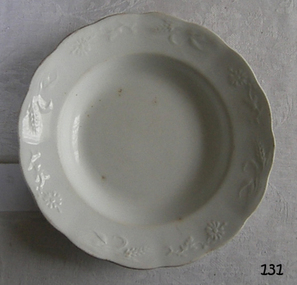
Ceramic - Dish, Johnson Bros, Circa 1883 (very early Mark)
... The four original "Johnson Brothers" were Alfred, Frederick, Henry, and Robert. Their father married the daughter of a master potter, Alfred Meakin. ...The four original "Johnson Brothers" were Alfred, Frederick, Henry, and Robert. Their father married the daughter of a master potter, Alfred Meakin. ...Johnson Brothers were a British tableware manufacturer and exporter that was noted for its early introduction of "semi-porcelain" tableware. It was among the most successful of the Staffordshire potteries which produced tableware, much of it exported from the 1890s through the 1960s. They were also important manufacturers of large bathroom ceramics. The company was founded in 1883, but from 1968 to 2015 it operated as a part of the Wedgwood Group. However, after the Wedgwood Group was acquired by Fiskars in 2015, the production of Johnson Brothers was discontinued. The company's name derives from the names of the company's founders. The four original "Johnson Brothers" were Alfred, Frederick, Henry, and Robert. Their father married the daughter of a master potter, Alfred Meakin. In 1883, Alfred and Frederick Johnson began production at defunct pottery, known as the Charles Street Works, that they had purchased at a bankruptcy sale in Hanley, Stoke-on-Trent. At first, they specialised in the manufacture of durable earthenware, which they called "White Granite". The success of this venture led to rapid expansion. In 1888, the Rev. Henry Johnson joined them, followed ten years later by a fourth brother, Robert Johnson. Having established a solid reputation producing basic "whiteware", the company developed a product known as "semi-porcelain", a range of pottery that had the characteristics of fine china, but the durability of ironstone ware. This kind of tableware soon became very popular in the United States due to its durability and low cost. In 1889, the Hanley pottery was opened, later the Alexander pottery, and in 1891 the Imperial Works Pottery. In 1896, the Trent Sanitary Works was opened for the production of non-tableware products, and Alfred Johnson left the business to establish his pottery. By 1898, Robert Johnson had relocated to New York City to manage Johnson Brothers' rapid expansion into the North American market. An item that gives a snapshot into the emerging market for tableware that was reasonably priced and serviceable. The company produced "whiteware" but the innervation of the pottery line called semi-porcelain changed the industry. This allowed potteries to produce fashionable pottery items that were affordable to all social classes of the time. Bowl white ceramic decorative with floral decoration around lip. On base, "Royal Ironside China, Johnson Bros England" & crest of lion and unicorn flagstaff hill, warrnambool, shipwrecked coast, flagstaff hill maritime museum, flagstaff hill maritime village, great ocean road, bowl, china bowl, lion and unicorn crest, table ware, kitchen ware, white ware, johnson brothers -
 Marysville & District Historical Society
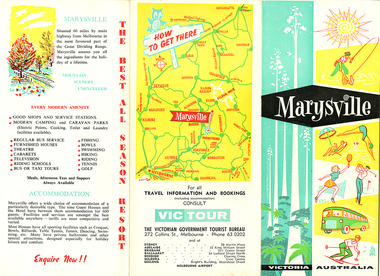
Ephemera (Item) - Tourist brochure, Victorian Government Tourist Bureau, Marysville Victoria Australia, Unknown
... A tourist brochure on Marysville and the surrounding area published by the Victorian Government Tourist Bureau for the Marysville Tourist and Progress Association. marysville victoria tourist brochure victorian government tourist bureau cumberland valley cumberland falls cora-lyn falls robart's lookout meeting of the waters warburton acheron way healesville launching place reefton spur upper yarra dam maroondah highway black spur maroondah dam alexandra mansfield jamieson wood's point eildon weir snob's creek rubicon lake mountain marysville tourist and progress association the cumberland kerami guest house kooringa guest house marylands guest house marylyn guesthouse marysville hotel mount kitchener house barton brothers' store fruit salad farm marysville dairy marysville caravan park marysville garage marysville riding school marysville theatre mckenzie's tourist services potters fruit and milk bar arosa holiday cottages scenic motel beauty spot walk red hill walk wishing well taggerty river mount gordon steavenson falls keppel's lookout keppel's falls A tourist brochure on Marysville and the surrounding area published by the Victorian Government Tourist Bureau for the Marysville Tourist and Progress Association. ...A tourist brochure on Marysville and the surrounding area published by the Victorian Government Tourist Bureau for the Marysville Tourist and Progress Association.A tourist brochure on Marysville and the surrounding area published by the Victorian Government Tourist Bureau for the Marysville Tourist and Progress Association.marysville, victoria, tourist brochure, victorian government tourist bureau, cumberland valley, cumberland falls, cora-lyn falls, robart's lookout, meeting of the waters, warburton, acheron way, healesville, launching place, reefton spur, upper yarra dam, maroondah highway, black spur, maroondah dam, alexandra, mansfield, jamieson, wood's point, eildon weir, snob's creek, rubicon, lake mountain, marysville tourist and progress association, the cumberland, kerami guest house, kooringa guest house, marylands guest house, marylyn guesthouse, marysville hotel, mount kitchener house, barton brothers' store, fruit salad farm, marysville dairy, marysville caravan park, marysville garage, marysville riding school, marysville theatre, mckenzie's tourist services, potters fruit and milk bar, arosa holiday cottages, scenic motel, beauty spot walk, red hill walk, wishing well, taggerty river, mount gordon, steavenson falls, keppel's lookout, keppel's falls -
 Marysville & District Historical Society
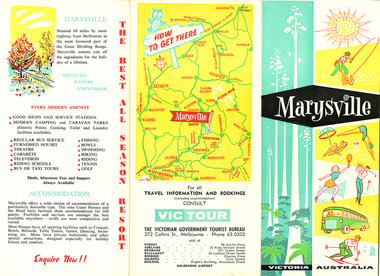
Ephemera (Item) - Tourist brochure, Victorian Government Tourist Bureau, Marysville Victoria Australia, Unknown
... A tourist brochure on Marysville and the surrounding area published by the Victorian Government Tourist Bureau for the Marysville Tourist and Progress Association. marysville victoria tourist brochure victorian government tourist bureau cumberland valley cumberland falls cora-lyn falls robart's lookout meeting of the waters warburton acheron way healesville launching place reefton spur upper yarra dam maroondah highway black spur maroondah dam alexandra mansfield jamieson wood's point eildon weir snob's creek rubicon lake mountain marysville tourist and progress association the cumberland kerami guest house kooringa guest house marylands guest house marylyn guesthouse marysville hotel mount kitchener house barton brothers' store fruit salad farm marysville dairy marysville caravan park marysville garage marysville riding school marysville theatre mckenzie's tourist services potters fruit and milk bar arosa holiday cottages scenic motel beauty spot walk red hill walk wishing well taggerty river mount gordon steavenson falls keppel's lookout keppel's falls A tourist brochure on Marysville and the surrounding area published by the Victorian Government Tourist Bureau for the Marysville Tourist and Progress Association. ...A tourist brochure on Marysville and the surrounding area published by the Victorian Government Tourist Bureau for the Marysville Tourist and Progress Association.A tourist brochure on Marysville and the surrounding area published by the Victorian Government Tourist Bureau for the Marysville Tourist and Progress Association.marysville, victoria, tourist brochure, victorian government tourist bureau, cumberland valley, cumberland falls, cora-lyn falls, robart's lookout, meeting of the waters, warburton, acheron way, healesville, launching place, reefton spur, upper yarra dam, maroondah highway, black spur, maroondah dam, alexandra, mansfield, jamieson, wood's point, eildon weir, snob's creek, rubicon, lake mountain, marysville tourist and progress association, the cumberland, kerami guest house, kooringa guest house, marylands guest house, marylyn guesthouse, marysville hotel, mount kitchener house, barton brothers' store, fruit salad farm, marysville dairy, marysville caravan park, marysville garage, marysville riding school, marysville theatre, mckenzie's tourist services, potters fruit and milk bar, arosa holiday cottages, scenic motel, beauty spot walk, red hill walk, wishing well, taggerty river, mount gordon, steavenson falls, keppel's lookout, keppel's falls -
 City of Moorabbin Historical Society (Operating the Box Cottage Museum)
Decorative object - Ornaments, Floral vase, Circa 1890 to 1900
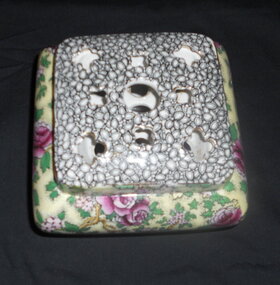
... He was soon joined in the business by his older brother, Sidney Richard, another potter. ...He was soon joined in the business by his older brother, Sidney Richard, another potter. The family of Daphne Sturt were early settlers in Moorabbin Shire grimwade leonard ceramics pottery stoke-on-trent early settlers craftwork moorabbin brighton ormond sturt lesley sturt daphne bentleigh On the bottom of the vase there is a Backstamp: Grimwade, Winton, Stoke-on-Trent, England. ...The Royal Winton brand has always been synonymous with quality and design and has roots in Stoke-on-Trent, England that go back over one hundred years. Originally known as Grimwade Brothers it was founded by Leonard Lumsden Grimwade. Leonard had shown a natural talent for modelling pottery and it was in this field that his infant business began, in 1885. He was soon joined in the business by his older brother, Sidney Richard, another potter. The family of Daphne Sturt were early settlers in Moorabbin ShireCirca 1890 to 1900. A Grimwade's floral and black-patterned ceramic vase with detachable "frog" for holding flowers in place. The rim of the vase is trimmed with gold. On the bottom of the vase there is a Backstamp: Grimwade, Winton, Stoke-on-Trent, England. Made in England. The Grimwade's makers -mark is also present.grimwade leonard, ceramics, pottery, stoke-on-trent, early settlers, craftwork, moorabbin, brighton, ormond, sturt lesley, sturt daphne, bentleigh -
 Flagstaff Hill Maritime Museum and Village
Ceramic - Teapot, Josiah Wedgwood & Sons Ltd, 1890
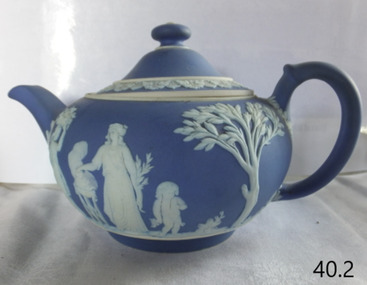
... Josiah Wedgwood (1730–95), came from an established family of potters and trained with his elder brother. He was in partnership with the leading potter Thomas Whieldon from 1754 until 1759 when a new green ceramic glaze he had developed encouraged him to start a new business on his own. ...Josiah Wedgwood (1730–95), came from an established family of potters and trained with his elder brother. He was in partnership with the leading potter Thomas Whieldon from 1754 until 1759 when a new green ceramic glaze he had developed encouraged him to start a new business on his own. ...Josiah Wedgwood (1730–95), came from an established family of potters and trained with his elder brother. He was in partnership with the leading potter Thomas Whieldon from 1754 until 1759 when a new green ceramic glaze he had developed encouraged him to start a new business on his own. Relatives leased him the Ivy House in Burslem, Stoke-on-Trent, and his marriage to Sarah Wedgwood, a distant cousin with a sizeable dowry, helped him launch his new venture. After an extensive and systematic program of experiment Wedgwood in 1765 created a new variety of creamware, a fine glazed earthenware, which was the main body used for his table wares thereafter. After he supplied Queen Charlotte with a tea set for twelve the same year, she gave official permission to call it "Queen's Ware" (from 1767). This new form, perfected as white pearlware (from 1780), sold extremely well across Europe, and to America. It had the additional advantage of being relatively light, saving on transport costs and import tariffs in foreign markets. Wedgwood developed several further industrial innovations for his company, notably a way of measuring kiln temperatures accurately, and several new ceramic bodies including the "dry-body" Stoneware, "black basalt" (by 1769), cane ware, and jasperware (the 1770s), all designed to be sold unglazed, like "biscuit porcelain". In the later 19th century the company returned to being a leader in the design and technical innovation, as well as continuing to make many of the older styles. Despite increasing local competition in its export markets, the business continued to flourish in the 19th and early 20th centuries, remaining in the hands of the Wedgwood family, but after World War II it began to contract, along with the rest of the English pottery industry. After buying several other Staffordshire ceramics companies, in 1987 Wedgwood merged with Waterford Crystal to create Waterford Wedgwood plc, an Ireland-based luxury brands group. After a 2009 purchase by KPS Capital Partners, a New York-based private equity firm. Wedgwood has always been associated with fine china, porcelain, and luxury accessories, the entrepreneur Josiah Wedgwood rapidly became successful and was soon one of the largest manufacturers of Staffordshire pottery. Wedgwood is a significant pottery manufacturer as the company is especially associated with the "dry-bodied" (unglazed) stoneware Jasperware in contrasting colours, and in particular that in "Wedgwood blue" and white that has become a trademark. Teapot and lid, Wedgwood blue Jasperware with white patternImpressed name Wedgewood and date letter "S" = 1890flagstaff hill, warrnambool, flagstaff hill maritime museum, maritime museum, shipwreck coast, flagstaff hill maritime village, great ocean road, teapot, wedgewood blue, wedgewood teapot, tea pot, kitchen ware, josiah wedgwood, staffordshire potteries -
 Bendigo Historical Society Inc.
Document - RANDALL COLLECTION: THE MOORE FAMILY TREE - WIFE OF 7782.92 BEAMENT
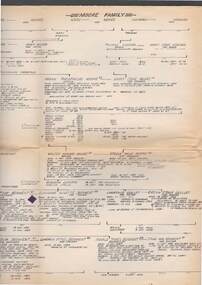
... Potter, Hockey. Asmore Family Tree:- Lord, Baradell, Provost, Wells, Baker, Bannister, Smith. Provost Family Tree:- Atkins, Bartlett, Elliot. Henry Ashmore of Chillwell, Geelong, Brother...Potter, Hockey. Asmore Family Tree:- Lord, Baradell, Provost, Wells, Baker, Bannister, Smith. Provost Family Tree:- Atkins, Bartlett, Elliot. Henry Ashmore of Chillwell, Geelong, Brother ...Document, The Moore Family Tree, marriage partner of 7782.92, which includes :- Noyes,Howard, Ashmore, Potter, Hockey. Asmore Family Tree:- Lord, Baradell, Provost, Wells, Baker, Bannister, Smith. Provost Family Tree:- Atkins, Bartlett, Elliot. Henry Ashmore of Chillwell, Geelong, Brother to William, Family Tree:- Lord, Marsh.Henry Ashmore of Jan Juc ( Relationship to William & Henry unknown). Noble, Duffield, Follet.genealogy, family, moore -
 Bendigo Historical Society Inc.
Document - INFORMATION: BILLY MIDWINTER AND MIDWINTER OVAL/INN, 1969
... PERSON Individual Billy Midwinter Borough Bulleton Advertiser Calafornia Gully Midwinters Inn (Shanty) Midwinters Oval Cricket Club Bell Toper Hill School David Scott Harry Boyle Auatralian Eleven Cricketer Almanac Day Brothers Sir Charles Napier Hotel James Barker Burt Newell Mr Sam McLlwraith George (Ishy) Forbes Will Hay's Drapery Emporium Jimmy Potters Barber Shop Camp Hotel Captain Moonlight. ...Information re Billy Midwinter (and Midwinter Oval/Inn - California Gully) provided by Lionel Newell (1967?) Reminiscence re Midwinters Inn (Shanty), Midwinters Oval and Midwinters Cricket Club. Father of author was licensee of Sir Charles Napier Hotel (Early and Thorn Sts.) Mention of names in team and opponents from Eaglehawk and North Bendigo teams. Covering handwritten letter from author.Lionel J. Newellperson, individual, billy midwinter, borough bulleton advertiser, calafornia gully, midwinters inn (shanty), midwinters oval cricket club, bell toper hill school, david scott, harry boyle, auatralian eleven cricketer, almanac, day brothers, sir charles napier hotel, james barker, burt newell, mr sam mcllwraith, george (ishy) forbes, will hay's drapery emporium, jimmy potters barber shop, camp hotel, captain moonlight. -
 Federation University Art Collection
Artwork - Ceramics, Ceramic Containers by Ailsa Adern, c1950
... Potters' Cottage at Warrandyte with friends Sylvia Halpern and Kate Janeba. She worked from a studio under the family home, exhibiting at the cottage and also through the Victorian Ceramic Group when it was set up in 1969. In 1980 she established a workshop at Tathra on the far south coast of NSW, sharing her time between Tathra and Warrandyte for the next 25 years. Amongst the work made at Tathra were some very large pieces which she fired in the Stafford Brothers...Potters' Cottage at Warrandyte with friends Sylvia Halpern and Kate Janeba. She worked from a studio under the family home, exhibiting at the cottage and also through the Victorian Ceramic Group when it was set up in 1969. In 1980 she established a workshop at Tathra on the far south coast of NSW, sharing her time between Tathra and Warrandyte for the next 25 years. Amongst the work made at Tathra were some very large pieces which she fired in the Stafford Brothers ...Ailsa ADERN (1918-2006) Born New Zealand Arrived Melbourne 1942 Elsa Ardern arrived in Melbourne in 1942 to earn money for a trip to the United Kingdon. After marrying she settled at Warrandyte. In 1954, after her two children started school, Adern studied Pottery at Melbourne Technical College under John Bernard Knight. In 1961 she joined the Potters' Cottage at Warrandyte with friends Sylvia Halpern and Kate Janeba. She worked from a studio under the family home, exhibiting at the cottage and also through the Victorian Ceramic Group when it was set up in 1969. In 1980 she established a workshop at Tathra on the far south coast of NSW, sharing her time between Tathra and Warrandyte for the next 25 years. Amongst the work made at Tathra were some very large pieces which she fired in the Stafford Brothers' wood-fired brick-kiln at Kalaru. Part of the clay for these came from the Staffords' clay-pits. With Sylvia Halpern and Gus McLaren Ailsa Asern celebrated her long association with the Potters' Cottage by exhibiting in its 45th anniversary exhibition in 2003. 2. Her works are signed with an incised 'Elsa Ardern' or 'EA'.Two thrown and handworked 'bottles' featuring verticle ridges on the edge of each form. Her pots are valued for their strong form , ed by her characteristically subtle wood-ash glazes. ceramics, ailsa adern, pottery -
Federation University Art Collection
Artwork - Ceramics, Ceramic Forms by Elsa Adern
... Potters' Cottage at Warrandyte with friends Sylvia Halpern and Kate Janeba. She worked from a studio under the family home, exhibiting at the cottage and also through the Victorian Ceramic Group when it was set up in 1969. In 1980 she established a workshop at Tathra on the far south coast of NSW, sharing her time between Tathra and Warrandyte for the next 25 years. Amongst the work made at Tathra were some very large pieces which she fired in the Stafford Brothers...Potters' Cottage at Warrandyte with friends Sylvia Halpern and Kate Janeba. She worked from a studio under the family home, exhibiting at the cottage and also through the Victorian Ceramic Group when it was set up in 1969. In 1980 she established a workshop at Tathra on the far south coast of NSW, sharing her time between Tathra and Warrandyte for the next 25 years. Amongst the work made at Tathra were some very large pieces which she fired in the Stafford Brothers ...Elsa ADERN (1918-2006) Born New Zealand Arrived Melbourne 1942 Elsa Ardern was living at Warrandyte in 1954 when she started studying pottery under John Bernard Knight at the Melbourne Technical College. In 1961 she was a founding member of Potters' Cottage at Warrandyte with friends Sylvia Halpern and Kate Janeba. She worked from a studio under the family home, exhibiting at the cottage and also through the Victorian Ceramic Group when it was set up in 1969. In 1980 she established a workshop at Tathra on the far south coast of NSW, sharing her time between Tathra and Warrandyte for the next 25 years. Amongst the work made at Tathra were some very large pieces which she fired in the Stafford Brothers' wood-fired brick-kiln at Kalaru. Part of the clay for these came from the Staffords' clay-pits. Elsa Adern is known for her strong form of her pots, enhanced by her characteristically subtle wood-ash glazes. Her works are signed with an incised 'Elsa Ardern' or 'EA'. (http://www.australianpotteryatbemboka.com.au/shop/index.php?manufacturers_id=32)available, elsa adern, available ceramics, ceramics -
 Federation University Art Collection
Ceramic, Gladys Reynell et al, Blue Bowl By Osrey, 1923
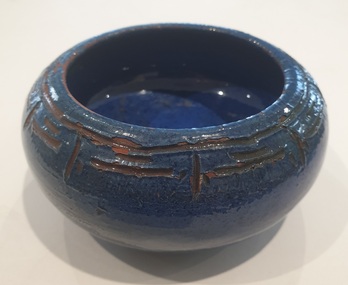
... potter and the first Australian artist to apply modernist principles to the crafts. For four years she worked from Ballarat. Osrey Pottery Ballarat operated between 1922 and 1926 by Gladys Reynell and George Osborne. The name of the pottery was an acronym formed from their surnames. Gladys Reynell, her sister Emily and brothers...potter and the first Australian artist to apply modernist principles to the crafts. For four years she worked from Ballarat. Osrey Pottery Ballarat operated between 1922 and 1926 by Gladys Reynell and George Osborne. The name of the pottery was an acronym formed from their surnames. Gladys Reynell, her sister Emily and brothers ...Gladys REYNELL (04/091881 - 16/11/1956) Born Glenelg, South Australia Gladys Reynell was South Australia's first studio potter and the first Australian artist to apply modernist principles to the crafts. For four years she worked from Ballarat. Osrey Pottery Ballarat operated between 1922 and 1926 by Gladys Reynell and George Osborne. The name of the pottery was an acronym formed from their surnames. Gladys Reynell, her sister Emily and brothers Rupert and Carew supported the war effort during World War One. Rupert Reynell was a neurologist who valued handicrafts in the rehabilitation of shell-shocked soldiers. He influenced Gladys and Margaret Rose (Rose) McPherson (later known as Margaret Preston) to learn pottery at the Camberwell School of Arts and Crafts, London, in 1916. Next year a friend sent Gladys some Kangaroo Island clay which excited her: 'I thought then that it could be the most delightful thing on earth to make pots in Australia from virgin clay'. In 1918 Gladys and Rose began teaching pottery to soldiers at Seale Hayne Neurological Hospital, Devon. In September 1919 Gladys Reynell came home in September due to her father's illness. She established the Reynella Pottery and became responsible for all stages of pottery production. Using a seasoned dump of buff-coloured clay from a well at nearby McLaren Vale Gladys Reynell built and fired her own kiln; threw simple, robust forms based on early European folk pottery; and decorated them with designs inspired by both Aboriginal art—one of the earliest to use this as a source. Gladys Reynell decorated her earthenware pottery with the characteristic rich 'Reynella blue' slip. On 14 August 1922 at St Mary's Church, Edwardstown, Gladys married George Samuel Osborne, an ex-serviceman and gardener at Reynella; they had no children. Between 1922 and 1926 they set up Osrey Pottery In Ballarat. Gladys produced pottery for sale at fairs with George as her assistant. She would throw her pots in the street, causing a sensation. In 1926 George contracted lead poisoning from lead in the glazes. They moved to rural Curdievale where Gladys resumed painting and making woodcuts. From 1939 Gladys and George lived in Melbourne. In World War II she worked in the army pay corps, in the Taxation Office, and as a translator of French. Gladys died of cancer on 16 November 1956; her husband scattered her ashes at Reynella. Her ceramics, the work of one of Australia's earliest studio potters, have been avidly collected since the late 1960s and are in most major art galleries. Small blue glazed ceramic bowl incised around the top with a decorative frieze. Incised on the base "(Dam Clay) Ballarat 1923, Osrey"gladys reynell, osrey pottery, blue bowl, incised bowl, australian studio pottery, ceramics, native clay -
 Whitehorse Historical Society Inc.
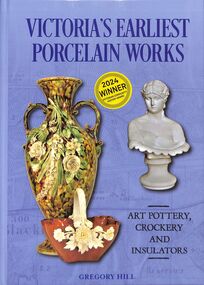
Book - Historical Reference, Gregory HILL, Victoria's Earliest Porcelain Works, 2023
... Potters" . The new book is a companion volume to the earlier book. Included is also a poster for Greg's talk on the Nunawading / Box Hill potteries referenced in the book and held at the WHS meeting on 7/6/2025. Pottery Dahlke Crockery HILL Gregory Springfield pottery White Brothers ...This book covers the formative years of Victoria's porcelain industry from 1857 to the late 20th century.With a glossy cover, this book details the history of Victorian Potteries illustrated by color photographs, maps, diagrams. non-fictionThis book covers the formative years of Victoria's porcelain industry from 1857 to the late 20th century.pottery, dahlke, crockery, hill gregory, springfield pottery, white brothers, commonwealth art pottery and insulator company, springfield road -
Whitehorse Historical Society Inc.
Document, A Family of Potters, the Dee Family, 1/10/2011 12:00:00 AM
... Dee Family Potteries White Brothers Vitclay The Dee family were employed to operate a pottery that had been established by the White brothers The Dee family were employed to operate a pottery that had been established by the White brothers A Family of Potters, the Dee Family Document Document ...The Dee family were employed to operate a pottery that had been established by the White brothersThe Dee family were employed to operate a pottery that had been established by the White brothersThe Dee family were employed to operate a pottery that had been established by the White brothersdee family, potteries, white brothers, vitclay -
 Wodonga & District Historical Society Inc
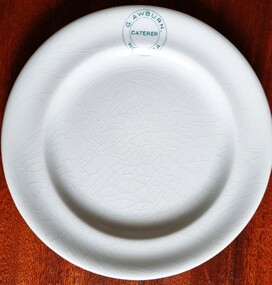
Functional object - G. Awburn Caterer Wodonga Plate
... Johnson Bros. was founded by two brothers named Alfred and Frederick who purchased a pottery factory in Hanley, England, in 1883. They were grandsons of a renowned English potter, Alfred Meakin. ...Johnson Bros. was founded by two brothers named Alfred and Frederick who purchased a pottery factory in Hanley, England, in 1883. They were grandsons of a renowned English potter, Alfred Meakin. ...Mr George Awburn Jr. arrived in Wodonga West with his parents by bullock dray when he was aged six years old. As a young man he went to Melbourne where he worked with the Melbourne Tramway and Omnibus Company. He drove the first through tram from Abbotsford to Balaclava. On he return to Wodonga, Mr. Awburn opened a bakery and grocery business in Sydney St., Wodonga which he conducted up till the time of his death in 1946. He was active in community affairs in roles including being a foundation member of the Library Committee, a committeeman of the Town Band and football club, a member of the Hibernian Lodge and an ardent worker for the Roman Catholic Church. Johnson Bros. was founded by two brothers named Alfred and Frederick who purchased a pottery factory in Hanley, England, in 1883. They were grandsons of a renowned English potter, Alfred Meakin. They were later joined in the business by their brothers Henry and Robert. Their business grew rapidly, as they were one of the world's largest pottery factories by the turn of the 20th century. By 1970, Johnson Bros. obtained the Royal Charter to become the official provider of china for Her Majesty Queen Elizabeth II. More than 1,300 patterns have been created throughout Johnson Brothers' history. Due to their growing success, manufacturing plants were established overseas including the establishment of a tableware factory, Johnson Brothers Australia in 1957 in Croydon, Victoria operated through a company known as Sovereign Pottery Ltd. Due to rising competition, Johnson Brothers became part of the Wedgewood Group in 1968. In 2015, following the acquisition of Wedgewood by Finnish company Fiskars, the Johnson Brothers branding was discontinued. The trademark on this bowl was used by Johnson Brothers between 1913 and 1942.This item originates from a well-known and respected Wodonga business.A round china plate imprinted with business name of G. Awburn Wodonga and Johnson Brothers on the back of the plate.On front: G. Awburn Caterer Wodonga On back: Hotelware / Johnson Bros/ Englandawburn family, wodonga businesses -
 Wodonga & District Historical Society Inc
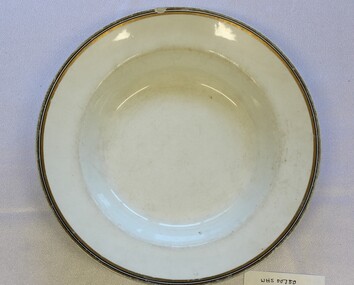
Domestic object - Shallow Vegetable Serving bowl, Johnson Brothers England, 1913 - 1942
... Johnson Bros. was founded by two brothers named Alfred and Frederick who purchased a pottery factory in Hanley, England, in 1883. They were grandsons of a renowned English potter, Alfred Meakin. ...Johnson Bros. was founded by two brothers named Alfred and Frederick who purchased a pottery factory in Hanley, England, in 1883. They were grandsons of a renowned English potter, Alfred Meakin. ...Johnson Bros. was founded by two brothers named Alfred and Frederick who purchased a pottery factory in Hanley, England, in 1883. They were grandsons of a renowned English potter, Alfred Meakin. They were later joined in the business by their brothers Henry and Robert. Their business grew rapidly, as they were one of the world's largest pottery factories by the turn of the 20th century. By 1970, Johnson Bros. obtained the Royal Charter to become the official provider of china for Her Majesty Queen Elizabeth II. More than 1,300 patterns have been created throughout Johnson Brothers' history. Due to their growing success, manufacturing plants were established overseas including the establishment of a tableware factory, Johnson Brothers Australia in 1957 in Croydon, Victoria operated through a company known as Sovereign Pottery Ltd. Due to rising competition, Johnson Brothers became part of the Wedgewood Group in 1968. In 2015, following the acquisition of Wedgewood by Finnish company Fiskars, the Johnson Brothers branding was discontinued. The trademark on this bowl was used by Johnson Brothers between 1913 and 1942. An item which reflects the changing market for tableware that was reasonably priced and serviceable. Their innovation of the pottery line called semi-porcelain changed the industry. This development allowed potteries to produce fashionable pottery items that were affordable to all social classes of the time. Their use became widespread in Australia, especially following their establishment of a tableware factory in Melbourne, Victoria. A shallow white bowl with gold trim, probably used for serving vegetables at the table. The underside of the bowl bears the mark of Johnson Bros England. The mark is composed of a green crown above the words "Johnson Bros England" also in green.On under side of bowl, beneath a green crown "Johnson Bros/England"johnson brothers ceramics, domestic utensils, kitchenware
