
Showing 12 items matching "pre war germany"
-
 Tatura Irrigation & Wartime Camps Museum
Book, Jackman & Burden Editors, The Muses Flee Hitler, 1983
... pre war germany...Printed by Smithsonian Institution Press. pre war germany Dunera Singapore group The Muses Flee Hitler Dark blue soft covered book. ...Studies issues of cultural transfer and adaptation as well as interaction between exiles and hosts. Printed by Smithsonian Institution Press.Dark blue soft covered book. Red/orange printing.The Muses Flee Hitlerpre war germany, dunera, singapore group -
Tatura Irrigation & Wartime Camps Museum
Document, Fritz Muller, 1939-1965
... 27 pages of documents relating to Fritz Muller, re German pre war life, rescue from the sinking Arandora Star, time in Camp 13 and his description of the sinking of the Arandora Star for journalists after the war. ...War. POW Camp 13 "Arandora Star" Fritz Muller "Dunera" 27 pages of documents relating to Fritz Muller, re German pre war life, rescue from the sinking Arandora Star, time in Camp 13 and his description of the sinking of the Arandora Star for journalists after the war. ...Information relating to Arandora Star, POW's and Fritz Muller. Donated by his daughter.27 pages of documents relating to Fritz Muller, re German pre war life, rescue from the sinking Arandora Star, time in Camp 13 and his description of the sinking of the Arandora Star for journalists after the war. Typed and hand written original lettersWar. POW Camp 13 "Arandora Star" Fritz Muller "Dunera"fritz muller, dunera, camp 13, arandora star -
 Flagstaff Hill Maritime Museum and Village
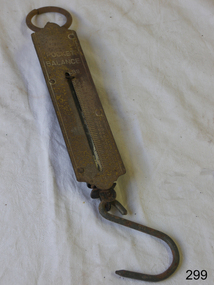
Equipment - Balance Scale, Rebure Germany, 1930s
... The subject item at this time cannot be associated with an historical event or person It is believed the item was manufactured in Germany pre World War ll, in the 1930s, as other examples from the period are on a number of internet sale & auction sites. ...A mass produced utilitarian item made for domestic use, there is no history or manufacturing provenance currently available.The subject item at this time cannot be associated with an historical event or person It is believed the item was manufactured in Germany pre World War ll, in the 1930s, as other examples from the period are on a number of internet sale & auction sites. This item is regarded as a collectors piece however information and company history regards the manufacturer "Rebure" has not yet been established. Balance spring scale elongated brass graduation scale to 100 Lbs hook at one end and a ring the otherRebure Pocket Balance. Made in Germany measures from 0 to 100LBSflagstaff hill, warrnambool, flagstaff-hill-maritime-museum, maritime-museum, shipwreck-coast, flagstaff-hill-maritime-village, spring balance scale, rebure scale company, rebure germany, domestic item, kitchen weighing scale -
 Eltham District Historical Society Inc
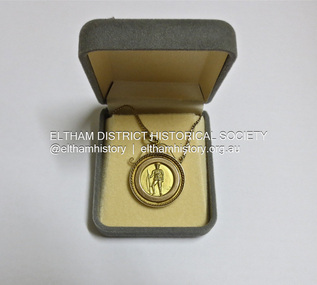
Photograph - Medal, Jim Connor, Welcome Home Medal awarded to Spr. W. H. Orford by Shire of Eltham Welcome Home Committee, 22 April 2014
... German strongpoints. At 3:10 a.m. on June 7, nearly 1,000,000 pounds of explosives (ammonal) were detonated, creating one of the largest pre-atomic explosions in history The explosions shattered German morale and destroyed defences, allowing Allied forces to take the ridge. Specifically, Australian miners placed, at great risk, two massive mines under the German-held Hill 60 and the nearby "Caterpillar" crater. Inscribed on the front of the medal is: SPR W.H. ORFORD FROM ELTHAM WE HONOUR YOU GREAT WAR...German strongpoints. At 3:10 a.m. on June 7, nearly 1,000,000 pounds of explosives (ammonal) were detonated, creating one of the largest pre-atomic explosions in history The explosions shattered German morale and destroyed defences, allowing Allied forces to take the ridge. Specifically, Australian miners placed, at great risk, two massive mines under the German-held Hill 60 and the nearby "Caterpillar" crater. Inscribed on the front of the medal is: SPR W.H. ORFORD FROM ELTHAM WE HONOUR YOU GREAT WAR ...Awarded to Spr. W. H. Orford by Shire of Eltham Welcome Home Committee Welcome Home Medal The Welcome Home Medal was issued to acknowledge service during World War 1. As groups of servicemen returned and were discharged a local welcome home function was held in their honour. The welcome home committee decided that to commemorate the occasion a medal should be presented to the returned servicemen and also to the nearest relations of those who had fallen during the conflict. The medal shown was presented to Sapper William Henry Orford, of the 2nd Australian Tunnelling Company, an uncle of Doug Orford, one of our members. Sapper Orford participated in an operation where on June 7, 1917, British and Australian tunnellers detonated 19 massive mines beneath German lines at Messines Ridge, Belgium, marking a pivotal moment in WWI underground warfare. The explosions, including those at the heavily contested Hill 60, created craters 60 feet deep, killed roughly 10,000 German troops, and were heard as far away as London. Tunnellers from Australian and British units worked for over a year (since 1916) in treacherous conditions—including quicksand and mud—to dig tunnels beneath German strongpoints. At 3:10 a.m. on June 7, nearly 1,000,000 pounds of explosives (ammonal) were detonated, creating one of the largest pre-atomic explosions in history The explosions shattered German morale and destroyed defences, allowing Allied forces to take the ridge. Specifically, Australian miners placed, at great risk, two massive mines under the German-held Hill 60 and the nearby "Caterpillar" crater. Inscribed on the front of the medal is: SPR W.H. ORFORD FROM ELTHAM WE HONOUR YOU GREAT WAR 1914 – 1919 On the back of the medal is the image of a soldier standing at ease with a rifle. Smaller than originally stated the Eltham Districts medal is midway between a 10 and 20 cent piece in size. The medal is a fine piece of craftsmanship and is understood to have cost £4 to make. On 22nd April 2014 Society members were pleased to attend an announcement by Mr Damien Drum, Victorian Minister for Veterans Affairs and Sport, of funding for installation of signage for the Eltham and Hurstbridge Avenues of Honour. Doug Orford was there and created much interest with his Welcome Home Medal, including from Minister Drum. See also EDHS Newsletter No. 216 May 2014spr. w.h. orford, welcome home committee, welcome home medal, world war 1, avenue of honour, jim connor collection, mr damien drum, victorian minister for veterans affairs and sport, william henry orford -
 Eltham District Historical Society Inc
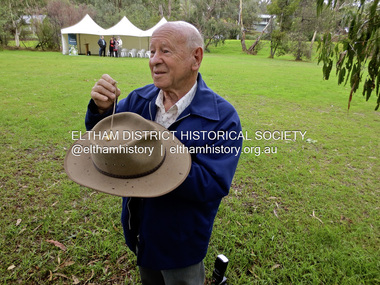
Photograph - Medal, Jim Connor, Doug Orford with the Welcome Home Medal awarded to Spr. W. H. Orford by Shire of Eltham Welcome Home Committee, 22 April 2014
... German strongpoints. At 3:10 a.m. on June 7, nearly 1,000,000 pounds of explosives (ammonal) were detonated, creating one of the largest pre-atomic explosions in history The explosions shattered German morale and destroyed defences, allowing Allied forces to take the ridge. Specifically, Australian miners placed, at great risk, two massive mines under the German-held Hill 60 and the nearby "Caterpillar" crater. Inscribed on the front of the medal is: SPR W.H. ORFORD FROM ELTHAM WE HONOUR YOU GREAT WAR...German strongpoints. At 3:10 a.m. on June 7, nearly 1,000,000 pounds of explosives (ammonal) were detonated, creating one of the largest pre-atomic explosions in history The explosions shattered German morale and destroyed defences, allowing Allied forces to take the ridge. Specifically, Australian miners placed, at great risk, two massive mines under the German-held Hill 60 and the nearby "Caterpillar" crater. Inscribed on the front of the medal is: SPR W.H. ORFORD FROM ELTHAM WE HONOUR YOU GREAT WAR ...Awarded to Spr. W. H. Orford by Shire of Eltham Welcome Home Committee Welcome Home Medal The Welcome Home Medal was issued to acknowledge service during World War 1. As groups of servicemen returned and were discharged a local welcome home function was held in their honour. The welcome home committee decided that to commemorate the occasion a medal should be presented to the returned servicemen and also to the nearest relations of those who had fallen during the conflict. The medal shown was presented to Sapper William Henry Orford, of the 2nd Australian Tunnelling Company, an uncle of Doug Orford, one of our members. Sapper Orford participated in an operation where on June 7, 1917, British and Australian tunnellers detonated 19 massive mines beneath German lines at Messines Ridge, Belgium, marking a pivotal moment in WWI underground warfare. The explosions, including those at the heavily contested Hill 60, created craters 60 feet deep, killed roughly 10,000 German troops, and were heard as far away as London. Tunnellers from Australian and British units worked for over a year (since 1916) in treacherous conditions—including quicksand and mud—to dig tunnels beneath German strongpoints. At 3:10 a.m. on June 7, nearly 1,000,000 pounds of explosives (ammonal) were detonated, creating one of the largest pre-atomic explosions in history The explosions shattered German morale and destroyed defences, allowing Allied forces to take the ridge. Specifically, Australian miners placed, at great risk, two massive mines under the German-held Hill 60 and the nearby "Caterpillar" crater. Inscribed on the front of the medal is: SPR W.H. ORFORD FROM ELTHAM WE HONOUR YOU GREAT WAR 1914 – 1919 On the back of the medal is the image of a soldier standing at ease with a rifle. Smaller than originally stated the Eltham Districts medal is midway between a 10 and 20 cent piece in size. The medal is a fine piece of craftsmanship and is understood to have cost £4 to make. On 22nd April 2014 Society members were pleased to attend an announcement by Mr Damien Drum, Victorian Minister for Veterans Affairs and Sport, of funding for installation of signage for the Eltham and Hurstbridge Avenues of Honour. Doug Orford was there and created much interest with his Welcome Home Medal, including from Minister Drum. See also EDHS Newsletter No. 216 May 2014spr. w.h. orford, welcome home committee, welcome home medal, world war 1, avenue of honour, jim connor collection, mr damien drum, victorian minister for veterans affairs and sport, william henry orford -
 Eltham District Historical Society Inc
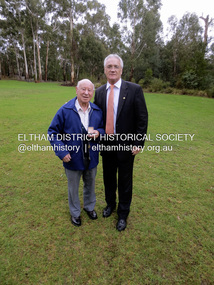
Photograph - Medal, Jim Connor, Doug Orford with Minister Damian Drum, Minister for Veterans' Affairs at Wingrove Park, Eltham, 22 April 2014
... German strongpoints. At 3:10 a.m. on June 7, nearly 1,000,000 pounds of explosives (ammonal) were detonated, creating one of the largest pre-atomic explosions in history The explosions shattered German morale and destroyed defences, allowing Allied forces to take the ridge. Specifically, Australian miners placed, at great risk, two massive mines under the German-held Hill 60 and the nearby "Caterpillar" crater. Inscribed on the front of the medal is: SPR W.H. ORFORD FROM ELTHAM WE HONOUR YOU GREAT WAR...German strongpoints. At 3:10 a.m. on June 7, nearly 1,000,000 pounds of explosives (ammonal) were detonated, creating one of the largest pre-atomic explosions in history The explosions shattered German morale and destroyed defences, allowing Allied forces to take the ridge. Specifically, Australian miners placed, at great risk, two massive mines under the German-held Hill 60 and the nearby "Caterpillar" crater. Inscribed on the front of the medal is: SPR W.H. ORFORD FROM ELTHAM WE HONOUR YOU GREAT WAR ...Awarded to Spr. W. H. Orford by Shire of Eltham Welcome Home Committee Welcome Home Medal The Welcome Home Medal was issued to acknowledge service during World War 1. As groups of servicemen returned and were discharged a local welcome home function was held in their honour. The welcome home committee decided that to commemorate the occasion a medal should be presented to the returned servicemen and also to the nearest relations of those who had fallen during the conflict. The medal shown was presented to Sapper William Henry Orford, of the 2nd Australian Tunnelling Company, an uncle of Doug Orford, one of our members. Sapper Orford participated in an operation where on June 7, 1917, British and Australian tunnellers detonated 19 massive mines beneath German lines at Messines Ridge, Belgium, marking a pivotal moment in WWI underground warfare. The explosions, including those at the heavily contested Hill 60, created craters 60 feet deep, killed roughly 10,000 German troops, and were heard as far away as London. Tunnellers from Australian and British units worked for over a year (since 1916) in treacherous conditions—including quicksand and mud—to dig tunnels beneath German strongpoints. At 3:10 a.m. on June 7, nearly 1,000,000 pounds of explosives (ammonal) were detonated, creating one of the largest pre-atomic explosions in history The explosions shattered German morale and destroyed defences, allowing Allied forces to take the ridge. Specifically, Australian miners placed, at great risk, two massive mines under the German-held Hill 60 and the nearby "Caterpillar" crater. Inscribed on the front of the medal is: SPR W.H. ORFORD FROM ELTHAM WE HONOUR YOU GREAT WAR 1914 – 1919 On the back of the medal is the image of a soldier standing at ease with a rifle. Smaller than originally stated the Eltham Districts medal is midway between a 10 and 20 cent piece in size. The medal is a fine piece of craftsmanship and is understood to have cost £4 to make. On 22nd April 2014 Society members were pleased to attend an announcement by Mr Damien Drum, Victorian Minister for Veterans Affairs and Sport, of funding for installation of signage for the Eltham and Hurstbridge Avenues of Honour. Doug Orford was there and created much interest with his Welcome Home Medal, including from Minister Drum. See also EDHS Newsletter No. 216 May 2014spr. w.h. orford, welcome home committee, welcome home medal, world war 1, avenue of honour, jim connor collection, mr damien drum, victorian minister for veterans affairs and sport, william henry orford -
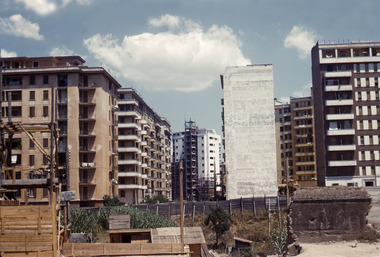 Robin Boyd Foundation
Slide, Robin Boyd, 1950
... Germany, Austria, Switzerland and Spain. Haddon Travelling Scholarship Haddon robin boyd slide Rome / Prewar Flats (All Handwritten) Colour slide in a mount. Pre-war ...Penleigh Boyd, Robin and Patricia Boyd's son, writes “Prior to 1950 Robin, like most other amateur or hobby photographers, took black and white printed photographs. The oldest slides date from 1950 when Robin and Patricia travelled to Europe on Robin’s Robert Haddon Travelling Scholarship.” In 1948 Robin Boyd was awarded ‘joint first place’ in the Robert Haddon competition for his design of Mildura art gallery. The scholarship helped fund their first overseas trip. Robin and Patricia were passengers on the Greek ship “Cyrenia” departing in May 1950, passing through the Suez Canal and landing in Genoa five weeks later. For six months, they travelled extensively throughout Europe (predominantly driving themselves) - France, Italy, United Kingdom, Sweden, Denmark, Germany, Austria, Switzerland and Spain.Colour slide in a mount. Pre-war flats, Rome, ItalyRome / Prewar Flats (All Handwritten)haddon travelling scholarship, haddon, robin boyd, slide -
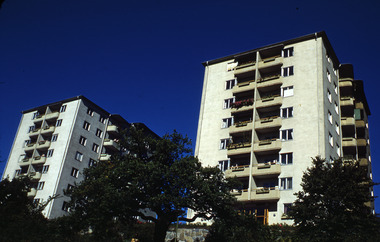 Robin Boyd Foundation
Slide, Robin Boyd, 1950
... Germany, Austria, Switzerland and Spain. Haddon Travelling Scholarship Haddon robin boyd slide Stockholm Flats / Flats / Flats-Prewar (All Handwritten) Colour slide in a mount. Pre-war ...Penleigh Boyd, Robin and Patricia Boyd's son, writes “Prior to 1950 Robin, like most other amateur or hobby photographers, took black and white printed photographs. The oldest slides date from 1950 when Robin and Patricia travelled to Europe on Robin’s Robert Haddon Travelling Scholarship.” In 1948 Robin Boyd was awarded ‘joint first place’ in the Robert Haddon competition for his design of Mildura art gallery. The scholarship helped fund their first overseas trip. Robin and Patricia were passengers on the Greek ship “Cyrenia” departing in May 1950, passing through the Suez Canal and landing in Genoa five weeks later. For six months, they travelled extensively throughout Europe (predominantly driving themselves) - France, Italy, United Kingdom, Sweden, Denmark, Germany, Austria, Switzerland and Spain.Colour slide in a mount. Pre-war social housing, possibly in Kungsklippan, Stockholm, Sweden. (Architect: Sven Wallander (?).)Stockholm Flats / Flats / Flats-Prewar (All Handwritten)haddon travelling scholarship, haddon, robin boyd, slide -
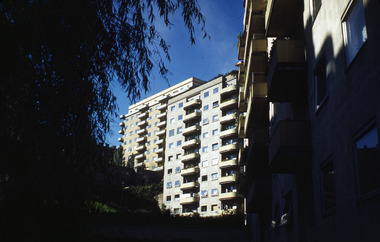 Robin Boyd Foundation
Slide, Robin Boyd, 1950
... Germany, Austria, Switzerland and Spain. Haddon Travelling Scholarship Haddon robin boyd slide Stockholm / Flats / Flats-Prewar (All Handwritten) Colour slide in a mount. Pre-war ...Penleigh Boyd, Robin and Patricia Boyd's son, writes “Prior to 1950 Robin, like most other amateur or hobby photographers, took black and white printed photographs. The oldest slides date from 1950 when Robin and Patricia travelled to Europe on Robin’s Robert Haddon Travelling Scholarship.” In 1948 Robin Boyd was awarded ‘joint first place’ in the Robert Haddon competition for his design of Mildura art gallery. The scholarship helped fund their first overseas trip. Robin and Patricia were passengers on the Greek ship “Cyrenia” departing in May 1950, passing through the Suez Canal and landing in Genoa five weeks later. For six months, they travelled extensively throughout Europe (predominantly driving themselves) - France, Italy, United Kingdom, Sweden, Denmark, Germany, Austria, Switzerland and Spain.Colour slide in a mount. Pre-war social housing, possibly in Kungsklippan, Stockholm, Sweden. (Architect: Sven Wallander (?).)Stockholm / Flats / Flats-Prewar (All Handwritten)haddon travelling scholarship, haddon, robin boyd, slide -
Moorabbin Air Museum
Machine - BA Swallow II VH-UUM, 1935
... pre-war civil open cockpit. Description: The BA Swallow was developed in England by the British Aircraft Manufacturing Company Limited and was based upon the German designed Klemm L25 light aircraft that first flew in 1927. ...pre-war civil open cockpit. Description: The BA Swallow was developed in England by the British Aircraft Manufacturing Company Limited and was based upon the German designed Klemm L25 light aircraft that first flew in 1927. ...Historical Details: The AARG BA Swallow is one of two examples surviving in Australia, along with a Klemm L.25 Swallow, although it is the only one in a public collection, while 4 airworthy survivors exist in the UK. It is a rare example of the pre-war civil open cockpit. Description: The BA Swallow was developed in England by the British Aircraft Manufacturing Company Limited and was based upon the German designed Klemm L25 light aircraft that first flew in 1927. A total of 133 were built and nine examples found their way to Austra. Level of Importance: National -
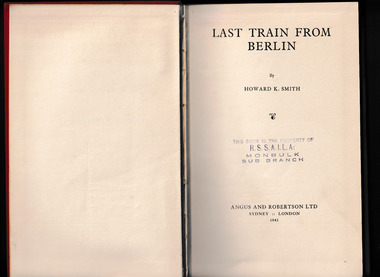 Mrs Aeneas Gunn Memorial Library
Book, Angus and Robertson, Last train from Berlin, 1943
... Germany - History - 1933-1943 World war 1939-1945 - Personal narratives - United States Memoirs of an American correspondent in pre-war berlin p.290. ...Memoirs of an American correspondent in pre-war berlinp.290.Memoirs of an American correspondent in pre-war berlingermany - history - 1933-1943, world war 1939-1945 - personal narratives - united states -
 The Beechworth Burke Museum
Photograph
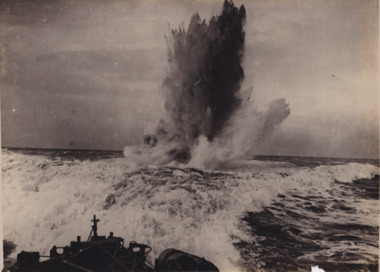
... War I being mainly between the German forces and the Great Britain forces. The naval war of World War I proved largely a disappointment to officials on both sides as it did not produce the decisive fleet actions envisioned in the pre-war years. ...Taken during World War I from the forecastle of a navy ship, the photograph depicts an eruption of water and smoke as a result of an underwater submarine being bombed from above.The naval war of World War I was a conflict unlike any previous one with the exception of the brief Russo-Japanese War (1904-1905), with naval warfare in World War I being mainly between the German forces and the Great Britain forces. The naval war of World War I proved largely a disappointment to officials on both sides as it did not produce the decisive fleet actions envisioned in the pre-war years. Nevertheless, the war at sea was a crucial part of World War I overall. The German use of the submarine against commerce not only threatened the Allied war effort, but also drew the United States into the conflict. In addition, the British economic blockade of Germany afforded by the Royal Navy’s command of the sea inflicted great damage on the war effort of Germany. Finally, the naval war held great ramifications for the future since many practices employed in the First World War were those pursued in the Second World War.Black and white rectangular reproduced photograph on matte photographic paperReverse: 6527/ (Crown copyright notice from the Imperial War Museum)/ Naval 23/ 23/ A99/ burke museum, world war 1, world war i, ww1, wwi, submarine, submarine warfare, navy, naval vessels
