
Showing 38 items matching "pregnancy"
-
 NMIT (Northern Melbourne Institute of TAFE)
Book: Antenatal English as a Second Language Program for Pregnancy and childbirth, written and published by Mercy Hospital for Women in collaboration with Northern Melbourne Institute of TAFE 2004
... Book: Antenatal English as a Second Language Program for Pregnancy and childbirth, written and published by Mercy Hospital for Women in collaboration with Northern Melbourne Institute of TAFE 2004...A4 size book with spiral binding and on cover 'Antenatal / English as a second / language program for / Pregnancy & Childbirth / Written and published by / Mercy Hospital for Women and / Northern Melbourne Institute of TAFE / illustrations by Laura Boselli / and Mirella Trevisan. ...Book: Antenatal English as a Second Language Program for Pregnancy and childbirth, written and published by Mercy Hospital for Women in collaboration with Northern Melbourne Institute of TAFE 2004 Book: Antenatal English as a Second Language Program for Pregnancy and childbirth, written and published by Mercy Hospital for Women in collaboration with Northern Melbourne Institute of TAFE 2004 ...A4 size book with spiral binding and on cover 'Antenatal / English as a second / language program for / Pregnancy & Childbirth / Written and published by / Mercy Hospital for Women and / Northern Melbourne Institute of TAFE / illustrations by Laura Boselli / and Mirella Trevisan. manuals, nmit -
 Royal Australian and New Zealand College of Obstetricians & Gynaecologists (RANZCOG)
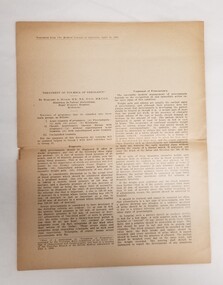
Document - Article, 'Treatment of Toxaemia of Pregnancy' by Dr Margaret Alison Mackie, Treatment of Toxaemia of Pregnancy, 1961
... Treatment of Toxaemia of Pregnancy...The article is entitled 'Treatment of Toxaemia of Pregnancy' and is printed double sided on a single piece of paper. ...Treatment of Toxaemia of Pregnancy Document Article, 'Treatment of Toxaemia of Pregnancy' by Dr Margaret Alison Mackie ...Dr Margaret Alison Mackie wrote this article in 1961 for The Medical Journal of Australia. It was a highly regarded article, for which Dr Mackie received a number of worldwide requests for copies of the article. See 2024.40.7.Dr Margaret Alison Mackie (1910-1991) was in active practice between 1936 and 1970. She was a Fellow of the College, and was appointed a Commander of the Order of St Michael and St George (CMG) for services to medicine in 1975. Reprint of an article written by Dr Margaret Alison Mackie for the Medical Journal of Australia, 1961. The article is entitled 'Treatment of Toxaemia of Pregnancy' and is printed double sided on a single piece of paper. Header of the page reads 'Reprinted from The Medical Journal of Australia, April 15, 1961.'obstetrics -
 Royal Australian and New Zealand College of Obstetricians & Gynaecologists (RANZCOG)
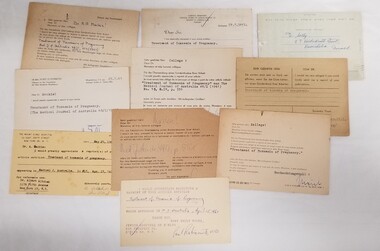
Document - Collection of requests for reprints of the article, 'Treatment of Toxaemia of Pregnancy', by Dr Margaret Alison Mackie, Treatment of Toxaemia of Pregnancy, 1961
... Treatment of Toxaemia of Pregnancy...Collection of ten notices (a-j) received by Dr Margaret Alison Mackie via mail from the United States, Germany, Hungary, and Israel requesting a copy of her published article 'Treatment of Toxaemia of Pregnancy.' Notes are either printed on cardboard or on paper. ...Clarmann, Munich, Germany, 20 June 1961 Treatment of Toxaemia of Pregnancy Document Collection of requests for reprints of the article, 'Treatment of Toxaemia of Pregnancy', by Dr Margaret Alison Mackie ...Requesting reprints of articles published overseas is a common medical practice, as can be seen by the templates used in this collection. See 2024.40.6 for a copy of the article that is being requested on these notices. Dr Margaret Alison Mackie (1910-1991) was in active practice between 1936 and 1970. She was a Fellow of the College, and was appointed a Commander of the Order of St Michael and St George (CMG) for services to medicine in 1975. Collection of ten notices (a-j) received by Dr Margaret Alison Mackie via mail from the United States, Germany, Hungary, and Israel requesting a copy of her published article 'Treatment of Toxaemia of Pregnancy.' Notes are either printed on cardboard or on paper. Requests are from the following: a. Paul Rabinowitz, MD, Jewish Hospital of Brooklyn, NY, United States, June 1961 b. Dr. Joachim Reich, Kinderklick der Karl Marx Universitat, Leipzig, Germany, August 1 1961 c. Dr. Judith Erneszt, Budapest, Hungary d. Dr. Reinhold Schwarz, Universitats Frauenklinik, Rostock, Germany e. Dr W. Selby, Beershiba, Israel f. Dr. Albert Altchek, Mount Sinai Hospital, NY, United States, May 29 1961 g. Dr. Horst Echtermeyer, Frauenklinik der. Med. Academie, Magdeburg, Germany, July 25 1961 h. Dr. H. Spitzbart, Universitats Frauenklinik, Leipzig, Germany, July 26 1961 i. Dr. G. Fekete, Scientific Department, Chemical Works of Gedeon Richter, Budapest, Hungary, July 29 1961 j. Dr. Max v. Clarmann, Munich, Germany, 20 June 1961 obstetrics -
 Alfred Hospital Nurses League - Nursing History Collection
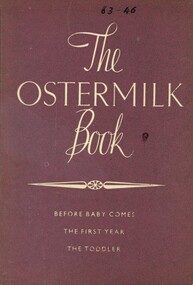
Booklet, Glaxo Laboratories LImited, The Ostermilk Book, 1954
... ...pregnancy...Vintage booklet providing practicl advice on topics like pregnancy, infant feeding, sleeping and general child care. ...Vintage booklet providing practicl advice on topics like pregnancy, infant feeding, sleeping and general child care. ...Vintage booklet providing practicl advice on topics like pregnancy, infant feeding, sleeping and general child care. Also promoted Ostermilk, a dried-milk baby formulaInsight into mothercaft practices in the 1950'sBound booklet, brown cover with white print detailing title. Previous catalogue number handwritten [black ink] at centre top of front cover. Handwritten at top right of title page 'P. Goble 1955' [black ink]mothercraft, pregnancy, infant nutrition, infant development, infant feeding -
 Bendigo Historical Society Inc.
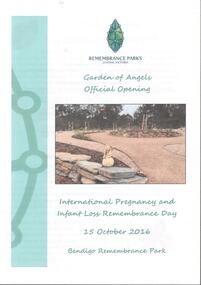
Document - BENDIGO CEMETERIES COLLECTION: BROCHURE GARDEN OF ANGELS OFFICIAL OPENING
... Garden of Angels Official Opening, International pregnancy and infant loss remembrance day 15 October 2016. ...Garden of Angels Official Opening, International pregnancy and infant loss remembrance day 15 October 2016. ...Colour brochure from Remembrance Parks Central Victoria. Garden of Angels Official Opening, International pregnancy and infant loss remembrance day 15 October 2016. Bendigo Remembrance Park.bendigo, cemetery, garden of angels -
 Royal Australian and New Zealand College of Obstetricians & Gynaecologists (RANZCOG)
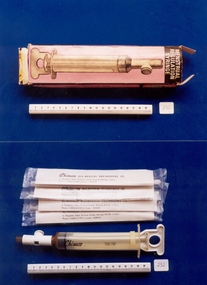
Chimco Menstrual Regulation syringe kit, Chimco
... This item is used to assist in the regulation of menstrual periods, as well as for medical termination of pregnancy. ...This item is used to assist in the regulation of menstrual periods, as well as for medical termination of pregnancy. Abortion Obstetrics Syringe kit, "Menstrual Regulation Syringe Kit". ...This item is used to assist in the regulation of menstrual periods, as well as for medical termination of pregnancy. Syringe kit, "Menstrual Regulation Syringe Kit". Made by Chimco. Consists of box [232.1] containing one plastic syringe [232.2], four canula in unopened sterile packets [232.3, 232.4, 232.5, 232.6] and manufacturer's instruction leaflet [232.7]. Syringe is a 50cc clear plastic syringe with plastic plunger. Syringe has a white plastic handle and tip with screw attachment, and a brown rubber underlay. Syringe and canula packets printed with the word 'Chimco'.abortion, obstetrics -
 Embroiderers Guild, Victoria
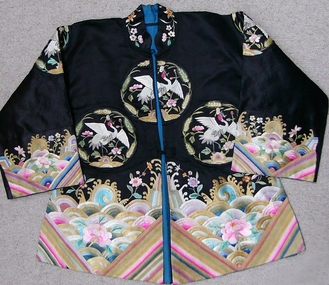
Clothing - Jacket, Ladies
... Probably made for a pregnancy. Bright blue lining....Probably made for a pregnancy. Bright blue lining. Clothing Jacket, Ladies ...In Chinese embroidery, the crane (He, 鹤) is a powerful symbol of longevity, wisdom, immortality, and good fortune, often depicted with other auspicious motifs like peaches, pine, or bamboo to enhance these meanings, and historically used on civil officials' rank badges (buzi) to denote high rank and virtue, reflecting aspirations for a long, prosperous, and wise life, linked to Daoist immortals and heavenly ascent. Black satin with rich silk embroidery around the hem, which means it may have been made for a lady of high rank. Circular motifs of cranes and storks. Probably made for a pregnancy. Bright blue lining.embroidery, silk embroidery, garments, china, oriental -
 Alfred Hospital Nurses League - Nursing History Collection
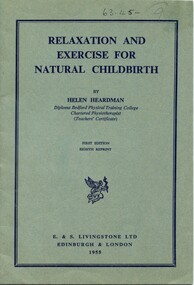
Booklet - Illustrated Booklet, Helen Heard, Relaxation and exercise for natural childbirth, 1955
... This helped shift the focus from treating pregnancy as an illness to a physiological process. ...This helped shift the focus from treating pregnancy as an illness to a physiological process. reflects change in attitude to pregnancy and childbirth prenatal exercise childbirth relaxation techniques labour Booklet covers prenatal exercises as well as labour Handwritten at top of front cover is the previous catalogue number [black ink]. ...Booklet covers prenatal exercises as well as labourStapled booklet, light blue cover with darker blue print detailing title, author, edition, reprint, publisher's logo, publisher, and publication date. There is a double line border around this informaton. non-fictionBooklet covers prenatal exercises as well as labourprenatal exercise, childbirth, relaxation techniques, labour -
![Front cover of 'Pre-natal booklet: a practical guide for every expectant mother' [c.1950's], Depatment of Health, Victoria](/media/collectors/50187a8f023fd7201471f198/items/69cb1db6f42e5f9dda44028b/item-media/69cd973f5c213022b0d32de3/item-fit-380x285.jpg?cb=6) Alfred Hospital Nurses League - Nursing History Collection
Alfred Hospital Nurses League - Nursing History CollectionBooklet - Illustrated Booklet, Department of Health, Victoria, Pre-natal booklet: a practical guide for every expectant mother, [ca.1950's]
... ...pregnancy...Vintage textbook served as a practical guide for expectant mothers and fathers Insight into health care practices in the 1950's Prenatal care pregnancy infant feeding Hand written on front cover is the previous catalogue number [b;ack ink] and B Satchell [blue ink] handwritten at base of title page 'Beverley Satchell/Tweedle baby Hospital/Melbourne/Match 1965 Illustrated stapled booklet wih white cover. ...Vintage textbook served as a practical guide for expectant mothers and fathersInsight into health care practices in the 1950'sIllustrated stapled booklet wih white cover. On front cover there is a coloured drawing of a baby by Betty Paterson. Printed in blue above this illustration are the publishers details and title below Hand written on front cover is the previous catalogue number [b;ack ink] and B Satchell [blue ink] handwritten at base of title page 'Beverley Satchell/Tweedle baby Hospital/Melbourne/Match 1965prenatal care, pregnancy, infant feeding -
 Northern District School of Nursing. Managed by Bendigo Historical Society Inc.
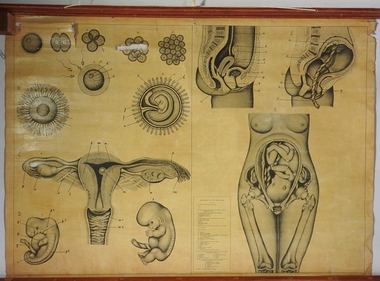
Poster - Development of the Foetus
... The chart has many diagrams showing development from early cell division to full term pregnancy with numbers and letters and a table with explanations. ...The chart has many diagrams showing development from early cell division to full term pregnancy with numbers and letters and a table with explanations. ...Educational teaching chart used at the Northern District School of Nursing, Rowan Street, Bendigo. The Northern District School of Nursing opened in 1950 in to address the issues around nurse recruitment, training and education that had previously been hospital based. The residential school was to provide theoretical and in-house education and practical training over three years. The students would also receive practical hands-on training in the wards of associated hospitals. The Northern District School of Nursing operated from Lister House, Rowan Street, Bendigo. It was the first independent school of nursing in Victoria and continued until it closed in 1989.Black drawings on yellow background educational chart of the Development of the Foetus. Gloss finished paper with wooden header and footer. Written on the wooden header - DEVELOPMENT OF THE FOETUS NO18. The chart has many diagrams showing development from early cell division to full term pregnancy with numbers and letters and a table with explanations. ndsn, femail reproductive system, educational chart -
 Royal Australian and New Zealand College of Obstetricians & Gynaecologists (RANZCOG)
Unknown - Two boxes of Provera 5mg medication, Upjohn, c. 1997
... Provera is used to treat endometriosis, the absence of menstrual periods (not due to pregnancy), abnormal bleeding from the uterus, certain types of cancer including cancer of the breast, kidney and endometrium, and in combination with an estrogen containing medicine to relieve symptoms of menopause in women with an intact uterus. ...Provera is used to treat endometriosis, the absence of menstrual periods (not due to pregnancy), abnormal bleeding from the uterus, certain types of cancer including cancer of the breast, kidney and endometrium, and in combination with an estrogen containing medicine to relieve symptoms of menopause in women with an intact uterus. ...Provera is used to treat endometriosis, the absence of menstrual periods (not due to pregnancy), abnormal bleeding from the uterus, certain types of cancer including cancer of the breast, kidney and endometrium, and in combination with an estrogen containing medicine to relieve symptoms of menopause in women with an intact uterus. (NPS MedicineWise)Two rectangular cardboard boxes containing strips of Provera 5mg tablets. Front of each box is printed with supply and use warnings, as well as the text '28 TABLETS/Provera Tablets/5 mg/Each tablet contains: MEDROXYPROGESTERONE ACETATE 5mg. Front of box is also labelled 'SAMPLE ONLY' and 'NEW/COLOUR/NEW FORMULATION/NEW SHAPE'. Manufacturer logo (Upjohn) at bottom right hand corner of the front of each box. Back of box is printed with dosage instructions, storage instructions, and tablet contents. Manufacturer logo (Upjohn) at bottom left on back of box. one end of box is imprinted with a batch number and an expiry date. Expiry date is 12/97. Tablet strips each contain 28 tablets, in four rows of seven. Front of tablet strip printed with the text 'Provera 5mh Tablets' at centre. Left hand side of tablet strip is printed with the text 'WEEK 1', 'WEEK 2', "WEEK 3', and 'WEEK 4', with each week label corresponding to a row of seven tablets. Abbreviations for the days of the week are printed on tablet strip next to each tablet. Right hand side of tablet strip is stamped with a batch number and an expiry date. Expiry date is 12/97. Tablet strip has silver foil on top surface, and blue foil on bottom surface. Blue foil on bottom of tablet strip printed with the repeated text 'Upjohn/Provera Tablets/MEDROXYPROGESTERONE/ ACETATE 5mg'.endometriosis, menopause -
Royal Australian and New Zealand College of Obstetricians & Gynaecologists (RANZCOG)
Book, Raynalde, Thomas et al, The byrth of mankynde otherwyse named the womans booke, 1560
... This was the first book on pregnancy and childbirth to be printed in English. ...This was the first book on pregnancy and childbirth to be printed in English. ...[26] p., cxxxi leaves, [2] l. of plates : ill ; 20 cm.non-fictionobstetrics, early works to 1800 -
 Bendigo Historical Society Inc.
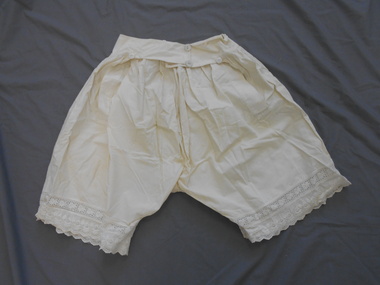
Clothing - WHITE COTTON LACE TRIMMED DRAWERS, 1890's- 1910
... This gathered panel may suggest that these drawers were worn during a pregnancy. The 75cm long legs are trimmed with two bands of floral embroidered, and cutwork lace-eight cm deep lace. waistband is 6.5cm deep. ...This gathered panel may suggest that these drawers were worn during a pregnancy. The 75cm long legs are trimmed with two bands of floral embroidered, and cutwork lace-eight cm deep lace. waistband is 6.5cm deep. ...Two 2cm cotton fabric covered buttons close the waistband of the drawers, at the centre front. A 33cm wide gathered panel at the centre front, fastens to the waistband with two 1.5cm plastic buttons-(possibly replacement for original buttons). This gathered panel may suggest that these drawers were worn during a pregnancy. The 75cm long legs are trimmed with two bands of floral embroidered, and cutwork lace-eight cm deep lace. waistband is 6.5cm deep. Machine stitched, no seams.costume, female, white cotton, lace trimmed drawers -
 Royal District Nursing Service (now known as Bolton Clarke)
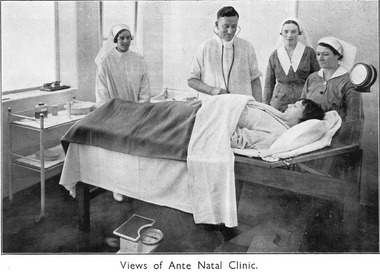
Photograph - Digital image, Barry Sutton, c.1930
... In 1930 the Society were pioneers in opening an Ante-Natal Clinic at the Melbourne District Nursing Society (MDNS) After-Care Home, setting a high standard with equipment, keeping records and providing leaflets with instructions in how to keep healthy during pregnancy, what complications to look for, and what to do when labour commenced. ...In 1930 the Society were pioneers in opening an Ante-Natal Clinic at the Melbourne District Nursing Society (MDNS) After-Care Home, setting a high standard with equipment, keeping records and providing leaflets with instructions in how to keep healthy during pregnancy, what complications to look for, and what to do when labour commenced. ...In 1930 the Society were pioneers in opening an Ante-Natal Clinic at the Melbourne District Nursing Society (MDNS) After-Care Home, setting a high standard with equipment, keeping records and providing leaflets with instructions in how to keep healthy during pregnancy, what complications to look for, and what to do when labour commenced. This image was taken in the Ante-Natal Clinic and shows some of the equipment used at that time and the uniforms worn by Trained nurses (Sisters) in the 1930s. Melbourne District Nursing Society (MDNS) was founded in 1885 and only nurses who had trained in a Hospital Training School and were fully qualified were employed by the Society. It commenced with one Trained nurse (Nurse), and another employed six months later; both walking amid the slums of inner Melbourne administering nursing care to the sick poor. The Society decided to commence a Midwifery Service and Nurse Fowler, who had previously worked for the Society, was re-employed as their first Trained Midwife. She began home births in August 1893 giving some Ante Natal care, taking midwifery bundles and providing clothes for the babe and mother as needed. Following birth, she gave Post-natal care to the mother and babe twice a day for three days and then daily for a week, and longer if required. She resigned after twelve months and Nurse Wilkie was appointed to the position. As well as walking, the Nurses used Public transport in the limited areas it ran, though a taxi was used by the Nurses and Midwife in emergencies and at night. As the Society expanded it rented premises until it was able to purchase it's own Nurses Home at 39 Victoria Parade, Collingwood in 1914. The Society were pioneers in recognizing the need for premises where patients too ill to be in their own home, but not ill enough to go to hospital, was needed. Land was procured next to No. 39, and the Society built the After-Care Home at 45 Victoria Parade, for these patients, and for patients from Hospitals. It was opened in July 1926 and the name of the Society then became ‘Melbourne District Nursing Society and After-Care Home’ (‘Hospital’ from 1934) The Ante-Natal Clinic at the Melbourne District Nursing Society After-Care Home was opened on the 23rd of September 1930 and MDNS Midwifery patients were encouraged to attend. Prior to the opening of the clinic Ante-natal care was not considered important, but within a short time 100 percent of MDNS Midwifery patients were attending. During 1934 the Women’s Welfare Clinic, including at the time a very controversial Family Planning Clinic, the first of its kind in Australia, was opened to support women at risk following multiple and difficult pregnancies. The Clinic gave advice on birth-control and was attended by their own patients at first, but then accepted patients from Melbourne public hospitals until their own clinics were opened.Digital image showing a Doctor and three Melbourne District Nursing Society (MDNS) Sisters attending a patient in the Ante-Natal Clinic at the After Care Hospital. In the forefront is a set of scales standing on the floor, behind which is the lady lying on a wooden framed bed with the base slightly raised at the top end supporting a white pillow and the lady's head. The lady has short dark hair and her frock can be seen to her waist; the rest of her body is covered by a white sheet and dark coloured blanket. Behind her and to the right of the image, are two Sisters wearing dark coloured long sleeved uniforms which have a belt and white collar; they are both wearing white veils over their short dart hair. To their left is a Doctor who has short dart wavy hair and is looking down at the lady. He is wearing a long white gown and has a stethoscope in his ears with the other end held in his right hand. To his left is another Sister who is wearing a white veil over her dark curled hair, and is wearing a long white gown. In the rear between the Doctor and Sister a hand basin can be seen. On the far left of the picture a trolley with two cloth covered shelves can be seen; a basin and squat bottle sits on the top shelf and kidney dish on the lower one. Behind this, part of a window can be seen.after- care hospital, 45 victoria parade collingwood, melbourne district nursing society (1885-1957), ante-natal clinic, after-care home, mdns midwifery, rdns, royal district nursing service -
 Royal Australian and New Zealand College of Obstetricians & Gynaecologists (RANZCOG)
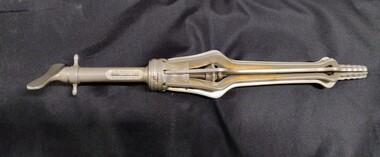
Instrument - Dührssen-style 8 bladed dilator, Unknown
... He was an advocate of institutional births for all pregnancies, and proposed that pregnant women undergo screening processes to uncover possible difficulties prior to giving birth. ...He was an advocate of institutional births for all pregnancies, and proposed that pregnant women undergo screening processes to uncover possible difficulties prior to giving birth. ...Alfred Dührssen (23 March 1862 – 11 October 1933) was a German gynecologist and obstetrician born in Heide, Schleswig-Holstein, at the time part of Denmark. He studied medicine at the University of Marburg, as well as the Kaiser-Wilhelm-Akademie für das militärärztliche Bildungswesen (Kaiser-Wilhelm-Academy for Military Physicians). In 1886, he became an obstetrical assistant to Adolf Gusserow (1836-1906) in Berlin, and in 1888 he began work as a lecturer at the University of Berlin. In 1892 he opened a private clinic for obstetrics and gynecological diseases. Dührssen was a prominent figure in modern German gynecology, being remembered for his pioneer work in surgical practices such as vaginal Caesarean section (vaginalen Kaiserschnitt). He was an advocate of institutional births for all pregnancies, and proposed that pregnant women undergo screening processes to uncover possible difficulties prior to giving birth. (Wikipedia) Metal uterine dilator consisting of a handle, a short shaft, and eight prongs. The prongs each have a bump/curve in the prong towards the top, to allow them to bend around the shaft of the instrument and meet at their tips. There is a second 'bump' in the prongs just before the tips. The tip of each prong has five ridges to assist with grip. The handle of the device is a flat, rounded handle, which is turned to open the prongs and set them at various degrees of diameter. There is a gauge on the shaft of the instrument which ranges from 0-12, showing the current setting of the instrument. There is also a pin and T-shaped slot arrangement located just above the start of the prongs, which has been engraved '8' on the left hand side, and '1' on the right hand side. Each prong is also engraved with a number at the base of the prong, reading '1' to '8'. gynaecology -
 Brighton Historical Society
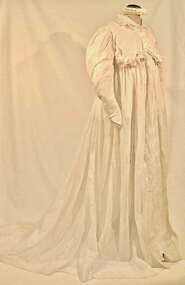
Clothing - Nightgown, Mid 19th Century
... Mrs Ward-Cole’s six pregnancies took place in 1843, 1844, 1845, 1847, 1849 and 1851. ...Mrs Ward-Cole’s six pregnancies took place in 1843, 1844, 1845, 1847, 1849 and 1851. ...This nightgown is believed to have belonged to Mrs Thomas Anne Ward Cole, an early Brighton resident and wife of George Ward Cole. The item appears to have been made or altered to accommodate a pregnant belly, however purpose made maternity clothing was not common at this time. Mrs Ward-Cole’s six pregnancies took place in 1843, 1844, 1845, 1847, 1849 and 1851. The style of this garment in particular the shape of the sleeves would indicate that it is most likely to have been constructed in circa 1860, so whilst it appears to be a maternity item, and historically has been referred to as thus, this purpose cannot be confirmed. George Ward Cole was an early member of the Victorian Parliament and the family featured prominently in Melbourne Society in their time. They established a substantial home known as “St Ninians” at 10 Miller Street in 1841. The family reportedly entertained Melbourne’s first Royal visitor The Duke Of Edinburgh, Queen Victoria’s second son, at St Ninians in 1867. In later years St Ninians was subsequently subdivided and later demolishedA hand sewn ivory cotton muslin nightgown, c. 1842–1850. The bodice is made of delicately embroidered muslin in a floral design. The open flat collar features a scalloped lace frill underneath. The bodice fastens with thirteen mother of pearl buttons down the centre front. After the fourth button, the remaining buttons are concealed beneath a full gathered modesty skirt, which falls from just below the bust line. The modesty panel is secured horizontally across the bodice by six mother of pearl buttons. The sleeves finish over the back and palm of the hand in two flattened peaks. The front of the gown consisting of the modesty front is full length. The modesty gown at both sides joins two panels that are an integrated part of the bodice. At the centre back there is a very full gathered panel with lace trim that falls to create a train. It is semi-attached to the bodice with a top section secured with mother of pearl buttons and small ties. The purpose of this design feature is unknown. st ninians, george ward cole, brighton, night gown, thomas anne ward cole -
Bendigo Historical Society Inc.
Literary work - Fortuna - Bendigo - A Demographic Portrait of A Victorian Provincial Town - extract from a book by Charles Fahey, 1881-1901
... Marriage patterns, birth and death rates, illegitimacy rates, bridal pregnancies, and de facto relationships are also explored.Population Bendigo experienced significant population growth from 28,577 in 1871 to 35,584 in 1881, driven by a mining boom and economic prosperity. ...Marriage patterns, birth and death rates, illegitimacy rates, bridal pregnancies, and de facto relationships are also explored.Population Bendigo experienced significant population growth from 28,577 in 1871 to 35,584 in 1881, driven by a mining boom and economic prosperity. ...Charles Fahey taught history at La Trobe University until his retirement in 2018. He has written on the history of Victorian gold mining, Victorian agriculture and working in Melbourne. This document provides a demographic analysis of Bendigo, a Victorian provincial city, during the late nineteenth century. Historical demographers have studied broad Australian population trends, but local studies like this one have been limited by inadequate records. Recent access to detailed manuscript birth, death, and marriage records allows for a more granular local demographic analysis. The study combines these records with published statistics and traditional sources (e.g., diaries). The paper examines the origins and occupations of Bendigo's late nineteenth-century immigrants.It analyzes population fluctuations and migration patterns, especially out-migration during economic downturns. Marriage patterns, birth and death rates, illegitimacy rates, bridal pregnancies, and de facto relationships are also explored.Population Bendigo experienced significant population growth from 28,577 in 1871 to 35,584 in 1881, driven by a mining boom and economic prosperity. The late 1880s saw a decline in mining yields, leading to economic depression, unemployment, and a population decrease to 34,089 by 1891 as residents left the city. The city's development and demographic changes are closely tied to the fortunes of its mining industry, reflecting broader patterns of boom and bust in Australian provincial towns during this era. These points collectively illustrate how economic cycles and migration shaped Bendigo's demographic landscape in the late nineteenth century.Fortuna - Bendigo 1881-1901 - A Demographic Portrait of A Victorian Provincial Town - extract from a book by Charles Fahey This item contains the following: 11217.55a Pages 88 to 107 of his book - Contact BHS for detailsnon-fictionbendigo, fortuna, george lansell, charles fahey -
 Returned Nurses RSL Sub-branch
Document - Photocopied pages of part of an annual report, Melbourne District Nursing Society, 1935
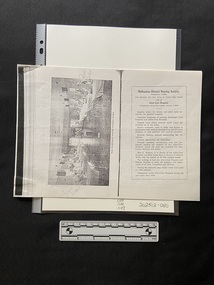
... During 1934 the Women’s Welfare Clinic including, at the time, a very controversial Family Planning Clinic, the first of its kind in Australia, was opened to support women at risk following multiple and difficult pregnancies. Major extensions occurred in 1936. ...During 1934 the Women’s Welfare Clinic including, at the time, a very controversial Family Planning Clinic, the first of its kind in Australia, was opened to support women at risk following multiple and difficult pregnancies. Major extensions occurred in 1936. ...'Melbourne District Nursing society opened the After-Care Home, situated at 39 Victoria Parade Collingwood in 1926 following a public appeal for funds. The name changed from 'Home' to 'Hospital' in 1934. The After-Care Home was originally established to provide nurse-managed convalescent care to poor and underprivileged people who could not look after themselves at home due to illness or on release from hospital. Opening in 1926, at a cost of £27,000, the home included maternity, children’s and adult wards as well as accommodation for Matron, twelve nurses and four domestic staff. In 1930 an ante-natal clinic was opened at the home. During 1934 the Women’s Welfare Clinic including, at the time, a very controversial Family Planning Clinic, the first of its kind in Australia, was opened to support women at risk following multiple and difficult pregnancies. Major extensions occurred in 1936. Each Ward in the After-Care Hospital at 45 Victoria Parade, Collingwood, had a Sun Room which was well lit by its many windows. Several donors gave money to furnish some of the Wards. Following Government intervention, the After-Care Hospital was separated from the Melbourne District Nursing Society in 1957. The District division of Melbourne District Nursing Society became the Melbourne District Nursing Service and moved to 452 St Kilda Road; later, in 1966, with Royal patronage this became Royal District Nursing Service (RDNS). The After-care hospital continued to operate at the same address in Collingwood until 1985 when it became the Melbourne Geriatric Centre. ' - taken from The Royal District Nursing Service. This document is part of the MDNS annual report, possibly the 50th, 1934-35. Photopcopied pages from an annual report taken in landscape position so two pages show to a sheet. Typed black print on white paper with pages divided by a solid black line down the middle. Paragraphs are separated by headings and subheadings, as well as two black and white images and a list of names divided into three columns.'Jean / Brown ' 'Hester Cutler[?]' [Handwritten in pencil on either side of the first image]australian army nursing service, australian military nurses, melbourne district nursing service, after-care hospital, c. wishart, edith lydia shaw, jean brown -
 Returned Nurses RSL Sub-branch
Document - Photocopied pages of an annual report, Melbourne District Nursing Society, Melbourne Diistrict Nursing Society Forty-ninth annual report, 1933-34, 1934
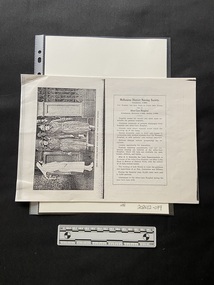
... During 1934 the Women’s Welfare Clinic including, at the time, a very controversial Family Planning Clinic, the first of its kind in Australia, was opened to support women at risk following multiple and difficult pregnancies. Major extensions occurred in 1936. ...During 1934 the Women’s Welfare Clinic including, at the time, a very controversial Family Planning Clinic, the first of its kind in Australia, was opened to support women at risk following multiple and difficult pregnancies. Major extensions occurred in 1936. ...The 49th annual report for the Melbourne District Nursing Society. 'Melbourne District Nursing society opened the After-Care Home, situated at 39 Victoria Parade Collingwood in 1926 following a public appeal for funds. The name changed from 'Home' to 'Hospital' in 1934. The After-Care Home was originally established to provide nurse-managed convalescent care to poor and underprivileged people who could not look after themselves at home due to illness or on release from hospital. Opening in 1926, at a cost of £27,000, the home included maternity, children’s and adult wards as well as accommodation for Matron, twelve nurses and four domestic staff. In 1930 an ante-natal clinic was opened at the home. During 1934 the Women’s Welfare Clinic including, at the time, a very controversial Family Planning Clinic, the first of its kind in Australia, was opened to support women at risk following multiple and difficult pregnancies. Major extensions occurred in 1936. Each Ward in the After-Care Hospital at 45 Victoria Parade, Collingwood, had a Sun Room which was well lit by its many windows. Several donors gave money to furnish some of the Wards. Following Government intervention, the After-Care Hospital was separated from the Melbourne District Nursing Society in 1957. The District division of Melbourne District Nursing Society became the Melbourne District Nursing Service and moved to 452 St Kilda Road; later, in 1966, with Royal patronage this became Royal District Nursing Service (RDNS). The After-care hospital continued to operate at the same address in Collingwood until 1985 when it became the Melbourne Geriatric Centre. ' - taken from The Royal District Nursing Service.Photopcopied pages from an annual report taken in landscape position so two pages show to a sheet. Typed black print on white paper with pages divided by a solid black line down the middle. Paragraphs are separated by headings and subheadings, as well as two black and white images and a list of names divided into three columns.melbourne district nursing service, after-care hospital, edith lydia shaw, nurses -
 Brighton Historical Society
Clothing - Dress, Day dress, circa 1875-1876
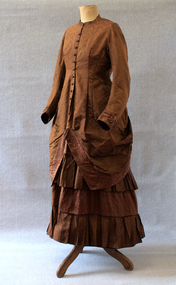
... The dress is believed to have been made for Jane in 1875 or 1876 during her early pregnancy, likely by a local dressmaker. Jane died in 1878 when Ethel was very young, and Ethel was then raised by her father and paternal grandmother. ...The dress is believed to have been made for Jane in 1875 or 1876 during her early pregnancy, likely by a local dressmaker. Jane died in 1878 when Ethel was very young, and Ethel was then raised by her father and paternal grandmother. ...This dress belonged to Ethel Nina Blundell (1876-1949), having been first made for her mother Jane Blundell (nee Burkitt, 1845-1878). Born in Dublin, Jane married James John Blundell Jr at the Black Street Congregational Church in Brighton on 16 March 1874. The Blundells were a socially prominent Brighton family who played an important role in the development of the area. James' father, publisher and bookseller James John Blundell Sr, served as a Brighton Borough Councillor between 1862 and 1867 when the local government was still in its formative years, including holding the position of Mayor in 1864. He was involved in the foundation of the Brighton Volunteer Rifle Corps and was also a strong supporter of the Brighton Ladies Benevolent Society. The Blundell family were active members of the Brighton Congregational Church and supported the construction of the Black Street church, where James Jr served as a deacon for sixty years, in addition to his work in the Crown Land and Survey Department. The dress is believed to have been made for Jane in 1875 or 1876 during her early pregnancy, likely by a local dressmaker. Jane died in 1878 when Ethel was very young, and Ethel was then raised by her father and paternal grandmother. As she never married, Ethel remained living in the family home of 'Eumana', 164 Church Street, and as an adult she assumed the role of hostess whenever she or her father had guests. On these occasions, she reportedly wore her mother's dress. The family home was sold on James Jr’s death in 1924 and Ethel was living at 52 Black Street Brighton when she died in 1949. In the 1930s, Ethel gifted the dress to a close family friend, Dr Jean Kelly. She told Jean that the garment held precious memories, perhaps due to the connection it provided to the mother she had never known. Jean donated the dress to the Merimbula Old School Museum in NSW in 1987, where it was on display for many years. The Museum donated the dress to Brighton Historical Society in 2023.This is a good example of a late nineteenth century day dress, made from two different patterns of russet brown silk brocade and featuring a lobster tail style bustle. The lack of boning combined with waist and hip measurements indicates it may have been made as a maternity dress. It is lined with beige leaf pattern cotton fabric. The princess line fitted bodice of herringbone pattern brocade has a high round neck with small 'mandarin' style collar and buttons down the front to below the waist where it forms an overskirt which is bordered with a band of coffee bean patterned brocade. The overskirt drops down to hem length at the back but from the centre front it is draped up to the back to a point below the waist level. Here it is sewn to the edge of the lobster tail style bustle which is also bordered by the coffee bean fabric. There is a concealed pocket with the opening under the right edge of the bustle. The buttons on the front of the dress have a decorative circlet of small blue flowers around a russet silk covered dome. The long sleeves are set in and slightly full with a contrasting three pleat band of coffee bean fabric with an ornamental turn back from the pleats sewn just above the wrist. The skirt section of the dress is in four 20 cm bands of alternate fabric patterns with the top and third band of coffee bean pattern slightly gathered and the second and fourth bands of herringbone forming pleated ruffles.1870s, ethel nina blundell, jane blundell, jane burkitt, eumana -
Northern District School of Nursing. Managed by Bendigo Historical Society Inc.
Tool - Northern District School of Nursing Graduates Association - Combistik Urine Test strips, 1950s
... Glucose: Essential for diabetes screening and management; Combistix is specific for glucose and does not react to lactose, making it reliable during pregnancy. Proteinuria is a key indicator of renal abnormalities, vascular disease, or pre-eclampsia. ...Glucose: Essential for diabetes screening and management; Combistix is specific for glucose and does not react to lactose, making it reliable during pregnancy. Proteinuria is a key indicator of renal abnormalities, vascular disease, or pre-eclampsia. ...The Northern District School of Nursing in Victoria, Australia Graduates Association: History of the School Managed by a committee including hospital administrators, medical professionals, and nursing leaders from several regional hospitals. Associated with major hospitals in the Northern District, including Bendigo Base, Mildura Base, Castlemaine, Echuca, Swan Hill, St. Arnaud, and Kyneton District Hospitals. Provide high-quality theoretical and practical nursing training. Raise the standard of nursing education in the region. Maintain the highest principles of nursing practice. Applicants must be at least 17 years old and hold a Proficiency Certificate or higher educational qualification. Application involves submitting forms, certificates, an interview, an aptitude test, and a medical examination. A three-month probationary period follows initial acceptance. Preliminary Training School: Four-week introductory course covering basic nursing, anatomy, hygiene, and practical skills. Practical experience in various hospital departments, guided by senior staff. Study Block Plan: Includes several blocks of theoretical and practical instruction throughout the three-year program. Regular school exams and two state exams (First Professional and Final State) are required for progression and graduation. Nurses work a 40-hour week with at least one or two days off per week and three weeks of annual leave. Accommodation is provided in comfortable hostels with good facilities. Uniforms are supplied free; nurses provide their own shoes and stockings. Salaries and allowances are regulated, with deductions for board and free medical care. Additional Information Post-Graduate Opportunities. Senior positions require further experience and additional certificates (e.g., Midwifery, Infant Welfare).Diploma courses available in administration, teaching, and specialized nursing fields. Bursaries are available for advanced study.Career Prospects: Graduates can pursue roles in administration, teaching, ward and departmental leadership, district and visiting nursing, industrial and school nursing, and more. Opportunities existed both within hospitals and in community or specialized settings.FAQs and Practical Details. Minimal training costs (mainly exam fees and personal items).Living out allowances and travel expenses are covered. Four training intakes per year; waiting periods are short if qualifications are met.Northern District School of Nursing Graduates Association - Combistik Urine Test strips - instruction booklet - 4 pages by the Ames Compant 65 Queens Road Melbourne This item contains the following document: 3792.11a Northern District School of Nursing Graduates Association - Combistik Urine Test strips - coloured instruction booklet Here are the key points from the document on Combistix urine test strips: Clinical Importance of UrinalysisUrinalysis is often underestimated but provides valuable diagnostic information.Simple to perform, yet highly informative for detecting urinary and metabolic conditions.Combistix is a combination test strip that rapidly screens for glucose, protein, and pH in urine. The test requires only one dip and 10 seconds to deliver three results, with no need for urine pre-treatment. Suitable for routine hospital urinalysis and large-scale screening, even by non-specialists due to its simplicity. Helps optimize laboratory workflow by allowing ancillary staff to perform basic tests, freeing technologists for more complex tasks. Useful for diagnosing and managing urinary tract infections, metabolic conditions, and monitoring therapy (e.g., sulphonamide therapy, chemotherapy for genito-urinary infections). Glucose: Essential for diabetes screening and management; Combistix is specific for glucose and does not react to lactose, making it reliable during pregnancy. Proteinuria is a key indicator of renal abnormalities, vascular disease, or pre-eclampsia. Its absence is reassuring. The test is sensitive and can be performed accurately by inexperienced users. The strip has three color-coded, reagent-impregnated areas separated by barriers for clear results.Simple procedure: dip, wait 10 seconds, and compare colors to a chart. Packaged in air-tight bottles of 100 strips, available through standard medical supply channels. Combistix offers a fast, reliable, and easy-to-use method for routine urine screening, supporting both clinical diagnosis and efficient laboratory operations.nurse training, lister house, ames company, combistix -
 Wodonga & District Historical Society Inc
Domestic object - Haeusler Collection Lactogen baby formula measuring spoon c.1920s
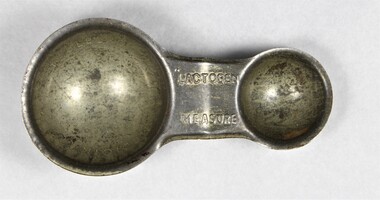
... They also used print advertisements to offer free product samples and instruction booklets advising on pregnancy and infant care for the same purpose. ...They also used print advertisements to offer free product samples and instruction booklets advising on pregnancy and infant care for the same purpose. ...The Wodonga Historical Society Haeusler Collection provides invaluable insight into life in late nineteenth and early twentieth century north east Victoria. The collection comprises manuscripts, personal artefacts used by the Haeusler family on their farm in Wodonga, and a set of glass negatives which offer a unique visual snapshot of the domestic and social lives of the Haeusler family and local Wodonga community. The Haeusler family migrated from Prussia (Germany) to South Australia in the 1840s and 1850s, before purchasing 100 acres of Crown Land made available under the Victorian Lands Act 1862 (also known as ‘Duffy’s Land Act’) in 1866 in what is now Wodonga West. The Haeusler family were one of several German families to migrate from South Australia to Wodonga in the 1860s. This item is a Nestlé Lactogen baby formula measuring scoop used in the preparation of formula for bottle feeding. It was used by Ilma Margaret Ernestine Haeusler (née Tasker, b.1900 in Tallangatta) to feed her son Alfred who was born in 1922. Ilma died in childbirth in 1928. This measuring spoon is one of several objects in the Haeusler Collection concerning early childhood that provide insight into family and home life in early twentieth century Wodonga. The first fully artificial infant milk formula, Farine Lactee, was developed in the 1860s. Companies continued to attempt to develop synthetic formulas which nutritionally replicated human breast milk in the decades that followed. Nestlé began producing Lactogen in 1921. It was marketed to women as a nutritionally superior substitute for breast milk, and as a nutritional supplement for breast feeding mothers. From the 1920s, when the Haeusler Collection measure was produced and used, Nestlé employed nurses in major Australian cities to promote Lactogen and its supposed health benefits to new mothers. They also used print advertisements to offer free product samples and instruction booklets advising on pregnancy and infant care for the same purpose. Nestlé was formed in 1905 by the merger of the Anglo-Swiss Milk Company, established in 1866 by brothers George and Charles Page, and Farine Lactée Henri Nestlé, founded in 1866 by Henri Nestlé. The company grew significantly during the First World War and again following the Second World War, expanding its offerings beyond its early condensed milk and infant formula products. In the twenty-first century, Nestlé has faced criticism and boycotts over its decision to market baby formula as an alternative to breastfeeding in developing countries. The adoption of bottle feeding in countries without access to clean water and sanitation infrastructure has contributed to high infant mortality rates. This item has well documented provenance and a known owner. It forms part of a significant and representative historical collection which reflects the local history of Wodonga. It contributes to our understanding of domestic and family life in early twentieth century Wodonga, as well as providing interpretative capacity for themes including local history, social history, and women’s history.Silver toned alloy measuring spoon for Lactogen infant formula, produced by food and drink manufacturing company Nestlé. Embossed with the Lactogen brand name, and teaspoon and tablespoon measurements. "LACTOGEN MEASURE" on central handle/"TABLESPOON" on large inner scoop/"TEASPOON" on small inner scoopchildren, babies, household, domestic, motherhood, family, kitchen -
Royal Australian and New Zealand College of Obstetricians & Gynaecologists (RANZCOG)
Obstetric and Gynaecological Ephemera
... - Item 1: Annotated diagram with comical reference to human anatomy - Item 2: Newspaper article from 26 August 1990 regarding St George's Hospital birthing centre - Item 3: Advertising poster for Livingstone Conductive Gel - Item 4: Victorian Folate Campaign 1999 Public Health Information Leaflet - Item 5: Advertisement for Cervagem removed from a publication - Item 6: IUD Multiload CU250 range medical advertising removed from a publication - Item 7: Fetal Cardio-phonograph Toitu product literature - Item 8: Estraderm and how to use it pharmacopoeia - Item 9: Copy of letter sent in 1980 regarding a donation to the RANZCOG Museum of a 1930's enamel douching instrument - Item 10: Museum display labels on Arthur Wilson / A.M Wilson - Item 11: The IUD Intrauterine Device Public Health Information Leaflet - Item 12: Obstetric Record Patient record [2 x] - Item 13: Planosec Dry Pregnancy Test Medical Advertising - Item 14: A Guide to using Ortho Diaphragms and Spermicides Pharmacopoeia [2 x ] - Item 15: Maison Luer Gynaecological and Obstetric instrument catalogue from 1930,Paris - Item 16: Medicine Recent Acquisitions Rare book brochure with drawing of a pregnant woman on the front cover - Item 17: Feeding Bottle Museum object display material - Item 18: Letter sent from Mr P.W Mitchell, 31/08/1961 regarding Moller Colposcope instruments - Item 19: Sugiview Single Use Laparoscope Advertising - Item 20: Multiload CU375 IUD Advertising - Item 21: Soneryl Drug Advertising - Item 22: Cyclonal Sodium Soluble Hexobarbitone Drug Advertising - Item 23: Aludrox Drug Advertising - Item 24: Veganin Tablets Drug Advertising - Item 25: Priscol Drug Advertising - Item 26: Neocursal Salt Advertising - Item 27: Portable Intra-Uterine Suction Apparatus Medical Advertising - Item 28: The VUC Instrument Medical Advertising... - Item 1: Annotated diagram with comical reference to human anatomy - Item 2: Newspaper article from 26 August 1990 regarding St George's Hospital birthing centre - Item 3: Advertising poster for Livingstone Conductive Gel - Item 4: Victorian Folate Campaign 1999 Public Health Information Leaflet - Item 5: Advertisement for Cervagem removed from a publication - Item 6: IUD Multiload CU250 range medical advertising removed from a publication - Item 7: Fetal Cardio-phonograph Toitu product literature - Item 8: Estraderm and how to use it pharmacopoeia - Item 9: Copy of letter sent in 1980 regarding a donation to the RANZCOG Museum of a 1930's enamel douching instrument - Item 10: Museum display labels on Arthur Wilson / A.M Wilson - Item 11: The IUD Intrauterine Device Public Health Information Leaflet - Item 12: Obstetric Record Patient record [2 x] - Item 13: Planosec Dry Pregnancy Test Medical Advertising - Item 14: A Guide to using Ortho Diaphragms and Spermicides Pharmacopoeia [2 x ] - Item 15: Maison Luer Gynaecological and Obstetric instrument catalogue from 1930,Paris - Item 16: Medicine Recent Acquisitions Rare book brochure with drawing of a pregnant woman on the front cover - Item 17: Feeding Bottle Museum object display material - Item 18: Letter sent from Mr P.W Mitchell, 31/08/1961 regarding Moller Colposcope instruments - Item 19: Sugiview Single Use Laparoscope Advertising - Item 20: Multiload CU375 IUD Advertising - Item 21: Soneryl Drug Advertising - Item 22: Cyclonal Sodium Soluble Hexobarbitone Drug Advertising - Item 23: Aludrox Drug Advertising - Item 24: Veganin Tablets Drug Advertising - Item 25: Priscol Drug Advertising - Item 26: Neocursal Salt Advertising - Item 27: Portable Intra-Uterine Suction Apparatus Medical Advertising - Item 28: The VUC Instrument Medical Advertising Obstetric and Gynaecological Ephemera ...A series of ephemera including information leaflets, advertising, and pharmacopoeia collated by Museum Curator at RANZCOG. There are 28 items. - Item 1: Annotated diagram with comical reference to human anatomy - Item 2: Newspaper article from 26 August 1990 regarding St George's Hospital birthing centre - Item 3: Advertising poster for Livingstone Conductive Gel - Item 4: Victorian Folate Campaign 1999 Public Health Information Leaflet - Item 5: Advertisement for Cervagem removed from a publication - Item 6: IUD Multiload CU250 range medical advertising removed from a publication - Item 7: Fetal Cardio-phonograph Toitu product literature - Item 8: Estraderm and how to use it pharmacopoeia - Item 9: Copy of letter sent in 1980 regarding a donation to the RANZCOG Museum of a 1930's enamel douching instrument - Item 10: Museum display labels on Arthur Wilson / A.M Wilson - Item 11: The IUD Intrauterine Device Public Health Information Leaflet - Item 12: Obstetric Record Patient record [2 x] - Item 13: Planosec Dry Pregnancy Test Medical Advertising - Item 14: A Guide to using Ortho Diaphragms and Spermicides Pharmacopoeia [2 x ] - Item 15: Maison Luer Gynaecological and Obstetric instrument catalogue from 1930,Paris - Item 16: Medicine Recent Acquisitions Rare book brochure with drawing of a pregnant woman on the front cover - Item 17: Feeding Bottle Museum object display material - Item 18: Letter sent from Mr P.W Mitchell, 31/08/1961 regarding Moller Colposcope instruments - Item 19: Sugiview Single Use Laparoscope Advertising - Item 20: Multiload CU375 IUD Advertising - Item 21: Soneryl Drug Advertising - Item 22: Cyclonal Sodium Soluble Hexobarbitone Drug Advertising - Item 23: Aludrox Drug Advertising - Item 24: Veganin Tablets Drug Advertising - Item 25: Priscol Drug Advertising - Item 26: Neocursal Salt Advertising - Item 27: Portable Intra-Uterine Suction Apparatus Medical Advertising - Item 28: The VUC Instrument Medical Advertising -
 Alfred Hospital Nurses League - Nursing History Collection
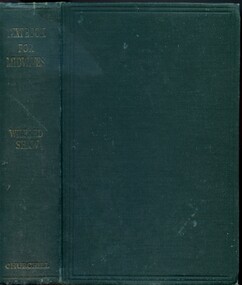
Book - Illustrated textbook, Wilfred Shaw 1897-1953, Textbook for midwives, 1948
... Author was a prominent obstetrican and midwifery examiner Gives insight into midwifery practice in the id 20th century Midwifery-study and teaching Midwifery-history Anatomy and physiology of pregnancy Historic textbook gives explanations behind midwifery pactice Iside front cover previous catalogue number is written [black ink] at top left at top right '22/-' [pencil], at bottom right is a bookseller's sticker, On front end page 'Margaret hanlon/433 Highett Rd/Highett S21/Sept 1948 [handwritten blue ink] Illustraed book with dark green cloth binding. ...Historic textbook gives explanations behind midwifery pacticeIllustraed book with dark green cloth binding. Front cover has a double line embossed border, otherwise plain Title, author and publisher stamped in gilt on spine [faded]non-fictionHistoric textbook gives explanations behind midwifery pacticemidwifery-study and teaching, midwifery-history, anatomy and physiology of pregnancy -
 South West Healthcare
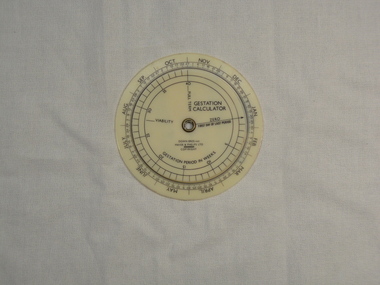
Gestation Calculator, Down Bros & Mayer & Phelps ltd, Medical equipment, 20th Century
... Pregnancy calender Gestational calculator "GESTATIONAL CALCULATOR" "DOWN BROS and MAYER & PHELPS LTD" "GESTATION PERIOD IN WEEKS" on reverse side; "NESTLE LACTOGEN" Plastic disc with moving inner wheel Medical equipment Gestation Calculator Down Bros & Mayer & Phelps ltd ...Plastic disc with moving inner wheel"GESTATIONAL CALCULATOR" "DOWN BROS and MAYER & PHELPS LTD" "GESTATION PERIOD IN WEEKS" on reverse side; "NESTLE LACTOGEN"pregnancy calender, gestational calculator -
Kew Historical Society Inc
Journal, Kewriosity : September 1988
... Community clean up [Boroondara Bushwalkers] / p4. Pregnancy support / p4. Teenage Disco [Youth Resource Centre] / p4. ...Council urges 'YES' vote on September 3 [Constitutional recognition for local government]/ p1-2. Meet the Mayor [Cr Allen Martin] / p1. Dates for September / p2. Kew Living launch [Bicentennial project] / p2. Commentary / Cr Allen Martin p3. Amnesty on dogs [registration] / p3. Election results / p3. Former Kew Councillor for County Court [Judge Chester Keon-Cohen] / p3. Willsmere Forum / p3. Notices [North Kew Tennis Club] / p4. Community clean up [Boroondara Bushwalkers] / p4. Pregnancy support / p4. Teenage Disco [Youth Resource Centre] / p4. Friendship and fun at playgroup [Highbury Grove Playgroup]/ p4. Friends of Kew Library / p4. Christmas cards for Kew / p4. Kew group to perform at Spoleto Festival [Elysium Ensemble] / p5. Community celebrations at Kew High School [State Education Week] / p5. Kew Community House / Judy Price p6. Student help / p6. Used furniture - can you help? [Belford Oaks Full Day Care Centre] / p6. Keeping you informed [Kew Citizens’ Advice Bureau] / p6. [Kew] Community Directory [1989] p6. Fun, fitness and family [Kew Little Athletics Centre] / p7. Community recreation for disabled [ Kew Recreation Integration Support Group] / p7. Footy News [Kew Football Club] / p8. Bowls season starts soon [Kew Bowling Club] / p8. Cricket Club invites new members [Deepdene Uniting Cricket Club] / p8. Spring into Spring with volleyball [Kew High School Sports Centre] / p8. 1st Kew Scouts ready to expand / p8.Kewriosity was a local newsletter combining Kew Council and community news. It was published between November 1983 and June 1994, replacing an earlier Kewriosity [broad] Sheet (1979-84). In producing Kewriosity, Council aimed to provide a range of interesting and informative articles covering its deliberations and decision making, together with items of general interest and importance to the Kew community and information not generally available through daily media outlets.non-fictionCouncil urges 'YES' vote on September 3 [Constitutional recognition for local government]/ p1-2. Meet the Mayor [Cr Allen Martin] / p1. Dates for September / p2. Kew Living launch [Bicentennial project] / p2. Commentary / Cr Allen Martin p3. Amnesty on dogs [registration] / p3. Election results / p3. Former Kew Councillor for County Court [Judge Chester Keon-Cohen] / p3. Willsmere Forum / p3. Notices [North Kew Tennis Club] / p4. Community clean up [Boroondara Bushwalkers] / p4. Pregnancy support / p4. Teenage Disco [Youth Resource Centre] / p4. Friendship and fun at playgroup [Highbury Grove Playgroup]/ p4. Friends of Kew Library / p4. Christmas cards for Kew / p4. Kew group to perform at Spoleto Festival [Elysium Ensemble] / p5. Community celebrations at Kew High School [State Education Week] / p5. Kew Community House / Judy Price p6. Student help / p6. Used furniture - can you help? [Belford Oaks Full Day Care Centre] / p6. Keeping you informed [Kew Citizens’ Advice Bureau] / p6. [Kew] Community Directory [1989] p6. Fun, fitness and family [Kew Little Athletics Centre] / p7. Community recreation for disabled [ Kew Recreation Integration Support Group] / p7. Footy News [Kew Football Club] / p8. Bowls season starts soon [Kew Bowling Club] / p8. Cricket Club invites new members [Deepdene Uniting Cricket Club] / p8. Spring into Spring with volleyball [Kew High School Sports Centre] / p8. 1st Kew Scouts ready to expand / p8. publications -- city of kew (vic.), kewriosity, council newsletters, community newsletters -
Kew Historical Society Inc
Journal, Kewriosity : July 1988
... Time capsule [Kew Bicentennial Committee] / p4. Pregnancy support [Caroline Chisholm Society] / p4. ...Can you keep our wheels turning [Meals on Wheels] / p1. Council elections / p1. Dates for July / p2. For the nimble fingered [Bicentennial tapestry] / p2. Traffic management update / p2. Commentary / Cr Jim Tutt p3. Ways to donate to Kew Library / p3. An apology [skateboarding] / p3. Notices p4. News from the Friends [of Kew Library] / p4. Community Recreation / p4. Child care for 3-5 year olds [Belford Oaks] / p4. [Kew] Philharmonic's second concert for the year / p4. Community education [MLC] / p4. Time capsule [Kew Bicentennial Committee] / p4. Pregnancy support [Caroline Chisholm Society] / p4. Senior Citizens at HKC ready to roll [Hawthorn-Kew-Camberwell Activities Centre] / p5. Community planting of urban forest [Stradbroke Park] / p5. May celebration for two old lions [Noel Lyell, Bert Stevens] / p5. Kew Community House / Judy Price p6. Do you know about EASE? / p6. Brush up your skills at Swinburne / p6. Integration through recreation for disabled / p7. 100th birthday for St Hilary's / p7. Footy News [Kew Football Club] / p8. Learn to ski or improve your skiing skills / p8. Keeping you informed [Kew Citizens’ Advice Bureau] / p8. More wins for Kew [Citizens'] Band players / p8. Good gardening / Bruce Schroder p8.Kewriosity was a local newsletter combining Kew Council and community news. It was published between November 1983 and June 1994, replacing an earlier Kewriosity [broad] Sheet (1979-84). In producing Kewriosity, Council aimed to provide a range of interesting and informative articles covering its deliberations and decision making, together with items of general interest and importance to the Kew community and information not generally available through daily media outlets.non-fictionCan you keep our wheels turning [Meals on Wheels] / p1. Council elections / p1. Dates for July / p2. For the nimble fingered [Bicentennial tapestry] / p2. Traffic management update / p2. Commentary / Cr Jim Tutt p3. Ways to donate to Kew Library / p3. An apology [skateboarding] / p3. Notices p4. News from the Friends [of Kew Library] / p4. Community Recreation / p4. Child care for 3-5 year olds [Belford Oaks] / p4. [Kew] Philharmonic's second concert for the year / p4. Community education [MLC] / p4. Time capsule [Kew Bicentennial Committee] / p4. Pregnancy support [Caroline Chisholm Society] / p4. Senior Citizens at HKC ready to roll [Hawthorn-Kew-Camberwell Activities Centre] / p5. Community planting of urban forest [Stradbroke Park] / p5. May celebration for two old lions [Noel Lyell, Bert Stevens] / p5. Kew Community House / Judy Price p6. Do you know about EASE? / p6. Brush up your skills at Swinburne / p6. Integration through recreation for disabled / p7. 100th birthday for St Hilary's / p7. Footy News [Kew Football Club] / p8. Learn to ski or improve your skiing skills / p8. Keeping you informed [Kew Citizens’ Advice Bureau] / p8. More wins for Kew [Citizens'] Band players / p8. Good gardening / Bruce Schroder p8.publications -- city of kew (vic.), kewriosity, council newsletters, community newsletters -
 Royal District Nursing Service (now known as Bolton Clarke)
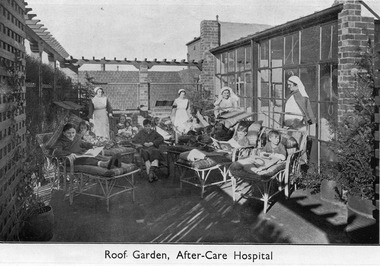
Photograph - Digital Image, c.1935
... That year the Society were pioneers in opening an Ante-Natal Clinic at the After-Care, setting a high standard with equipment, keeping records and providing leaflets with instructions in how to keep healthy during pregnancy, what complications to look for and what to do when labour commenced. ...This digital image shows the sun roof on the Melbourne District Nursing Society After-Care Hospital, 45 Victoria Parade, Collingwood. It shows some of the children nursed at the home. Many children were nursed there long term during the Poliomyelitis epidemic in the 1930s. It also shows uniforms worn by nurses and Sisters in the 1930s. The Melbourne District Nursing Society After-Care Home was originally established to provide nurse-managed convalescent care to poor and underprivileged patients who could not look after themselves at home due to illness, or on release from hospital. Opening in 1926 following a public appeal for funds, at a cost of £27,000, the Home included maternity, children’s and adult wards as well as accommodation for Matron, twelve Sisters and four domestic staff. Many children were nursed there, some long term, during the Polio epidemic and the Society employed two School Teachers. The Society now ran two divisions, the After-Care with its own Sisters and nurses and the District division. The Society were the first in Melbourne, in early 1928, to recognize some patients leaving the After-Care, and many at home, needed further social care and they set up ‘Almoners’ from their committee to visit these patients and be intermediaries in getting them social assistance. It was late the following year before the first training of Almoners took place in Melbourne. In 1930 the Society employed a full time kindergarten teacher to visit poor children in their homes. That year the Society were pioneers in opening an Ante-Natal Clinic at the After-Care, setting a high standard with equipment, keeping records and providing leaflets with instructions in how to keep healthy during pregnancy, what complications to look for and what to do when labour commenced. In 1934 the Society were pioneers again when they opened the first Women’s Welfare Clinic, including at the time a very controversial Family Planning Clinic, the first of its kind in Australia which was opened to support women at risk following multiple and difficult pregnancies, giving advice on birth-control. At first the clinic was attended by their own patients, but then accepting patients from public hospitals until their own clinics were opened. . Major extensions in 1934 led to the After-Care 'Home' having a name change to 'Hospital'. A trained Almoner was employed in 1934 but she resigned after twelve months due to the work load. Unable to procure another due to a shortage of trained Almoners, a Social Service Officer was employed at the After-Care who successfully gained better housing from the Housing Commission for families living under unsuitable conditions. Following Government intervention, the After-Care Hospital was separated from the Melbourne District Nursing Society in 1957. The After-care Hospital continued to operate at the same address until 1985 when it became the Melbourne Geriatric Centre. This digital Image shows two nurses and two Trained nurses (Sisters) supervising convalescing children in the roof garden of the Melbourne District Nursing Society After-Care Hospital . The two nurses are with the rear children, one on the left and one on the right. Both are wearing long white aprons over their long sleeved dark grey uniforms, and both are wearing white caps over their dark hair. On the right rear, in front of a row of glass windows, the upper portion of a Sister can be seen wearing a white uniform and white veil. In the right front is another Sister who is wearing glasses and is wearing a white uniform and dark coloured cape. She is wearing a white veil over her short dark hair. There are three boys and four girls resting on cane lounges; some are reading books and one girl is holding a doll. Another boy, who is wearing a dressing gown, is sitting on a cane chair. There is a trellis and a wall of windows on the left of the image and some brick work and a wall of windows on the right hand side behind the Sisters.. Some pots with low and tall plants can be seen.A tiled hip roof of a building can be seen in the rear of the image.mdns, melbourne district nursing society, after- care hospital, nurses uniforms -
 Royal District Nursing Service (now known as Bolton Clarke)
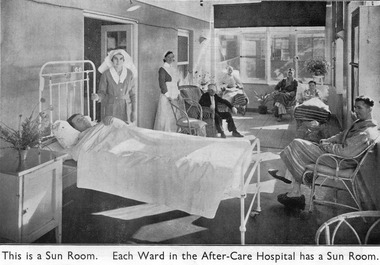
Photograph - Digital image, c.1935
... During 1934 the Women’s Welfare Clinic including, at the time, a very controversial Family Planning Clinic, the first of its kind in Australia, was opened to support women at risk following multiple and difficult pregnancies. Major extensions occurred in 1936. ...Each Ward in the Melbourne District Nursing Society After-Care Hospital, at 45 Victoria Parade, Collingwood, had a Sun Room which was well lit by its many windows. This digital image is taken in one of the Sun Rooms and shows the type of hospital beds, furniture and the uniforms worn by Sisters and nurses in the 1930s.Melbourne District Nursing society opened the After-Care Home, situated at 39 Victoria Parade Collingwood in 1926 following a public appeal for funds. The name changed from 'Home' to 'Hospital' in 1934. The After-Care Home was originally established to provide nurse-managed convalescent care to poor and underprivileged people who could not look after themselves at home due to illness or on release from hospital. Opening in 1926, at a cost of £27,000, the home included maternity, children’s and adult wards as well as accommodation for Matron, twelve nurses and four domestic staff. In 1930 an ante-natal clinic was opened at the home. During 1934 the Women’s Welfare Clinic including, at the time, a very controversial Family Planning Clinic, the first of its kind in Australia, was opened to support women at risk following multiple and difficult pregnancies. Major extensions occurred in 1936. Each Ward in the After-Care Hospital at 45 Victoria Parade, Collingwood, had a Sun Room which was well lit by its many windows. Several donors gave money to furnish some of the Wards. Following Government intervention, the After-Care Hospital was separated from the Melbourne District Nursing Society in 1957. The District division of Melbourne District Nursing Society became the Melbourne District Nursing Service and moved to 452 St Kilda Road; later, in 1966, with Royal patronage this became Royal District Nursing Service (RDNS). The After-care hospital continued to operate at the same address in Collingwood until 1985 when it became the Melbourne Geriatric Centre. This digital Image shows six men patients and nursing staff in a Sun Room in the Melbourne District Nursing Society After-Care Hospital. In the left foreground is a low bedside cupboard, beside it is a man with short dark hair lying in an iron framed hospital bed with a white cover pulled up to his shoulders. A Sister, who is looking at the camera, is wearing a grey uniform with a white collar, and a white veil over her short dark hair; she is standing behind, and at the head of the bed with her right hand holding the vertical bar of the bed frame. Behind her is an open door and then a nurse wearing a long white apron over her grey long sleeved uniform; she has a white cap over her shoulder length dark hair and is looking at the camera. Both of her hands are resting on an empty cane chair. Next along is a man with a bandage wrapped around his head and over his left eye. He is wearing dark clothing and is sitting on a padded cane chair, as are the rest of the men in the room. To the rear, in front of four long windows, are another two men, one on the left has short white hair and is wearing light clothing, and to his right is a man with short dark hair and is wearing a dark dressing gown over light colour pyjamas. On his right is a large vase of flowers on a tall white stand. On the right hand side of the photograph are another two men with short dark hair and wearing dressing gowns; part of a wall with windows can be seen behind them.mdns, after- care hospital, melbourne district nursing society, rdns, royal district nursing service -
 Royal District Nursing Service (now known as Bolton Clarke)
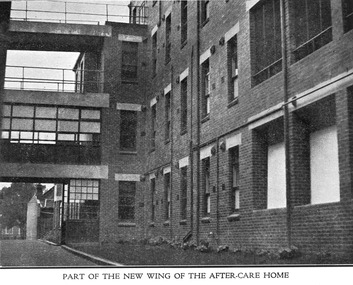
Photograph - Digital image, c.1930
... During 1934 the Women’s Welfare Clinic including, at the time, a very controversial Family Planning Clinic, the first of its kind in Australia, was opened to support women at risk following multiple and difficult pregnancies. Major extensions occurred in 1936. ...The name of the Melbourne District Nursing Society (MDNS) After-Care 'Home', changed to 'Hospital' in 1934 and major extensions occurred in 1936.Melbourne District Nursing society (MDNS) opened the After-Care Home, situated at 39 Victoria Parade Collingwood in 1926 following a public appeal for funds. The name changed from MDNS 'Home' to 'Hospital' in 1934. The After-Care Home was originally established to provide nurse-managed convalescent care to poor and underprivileged people who could not look after themselves at home due to illness or on release from hospital. Opening in 1926, at a cost of £27,000, the Home included maternity, children’s and adult wards as well as accommodation for Matron, twelve nurses and four domestic staff. In 1930 an ante-natal clinic was opened at the home. During 1934 the Women’s Welfare Clinic including, at the time, a very controversial Family Planning Clinic, the first of its kind in Australia, was opened to support women at risk following multiple and difficult pregnancies. Major extensions occurred in 1936. Following Government intervention, the After-Care Hospital was separated from the Melbourne District Nursing Society in 1957 and the District division of Melbourne District Nursing Society became the Melbourne District Nursing Service and relocated to 452 St Kilda Road, Melbourne. Following Royal patronage in 1966 this became the Royal District Nursing Service (RDNS). The After-care Hospital continued to operate at the same address in Collingwood until 1985 when it became the Melbourne Geriatric Centre. Black and white digital image taken of the rear of the Melbourne District Nursing Society (MDNS) After-Care Home showing, on the right, part of a three story section of the brick built new wing. Long windows are seen along each storey separated by brick work. Above each window is a wide light strip. Attached to this wing is a narrow three storey section with one long window, with light top strip, shown on each storey. Attached to the left of this are three walkways running to the left of the image. Tall metal handrails run along each walkway. In the background beyond the lowest walkway, part of a hip roof building and a leafy tree can be seen.melbourne district nursing society, after- care hospital, after care home, rdns, royal district nursing service
