
Showing 17 items matching "presbyterian church (nsw)"
-
 Narre Warren and District Family History Group
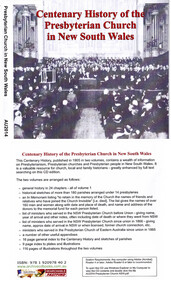
Document, James Cameron, Centenary history of the Presbyterian Church in NSW, 2004
... Centenary history of the Presbyterian Church in NSW......Presbyterian Church (NSW)...New South Wales Presbyterian Church (NSW) Centenary History of the Presbyterian Church in New South Wales This Centenary History, published in 1905 in two volumes, contains a wealth of information on Presbyterianism, Presbyterian churches and Presbyterian people in New South Wales. ...Centenary History of the Presbyterian Church in New South Wales This Centenary History, published in 1905 in two volumes, contains a wealth of information on Presbyterianism, Presbyterian churches and Presbyterian people in New South Wales. It is a valuable resource for church, local and family historians - greatly enhanced by full text searching on this CD edition. The two volumes are arranged as follows: ~ general history in 24 chapters - all of volume 1 ~ historical sketches of more than 180 parishes arranged under 14 presbyteries ~ an In Memoriam listing "to retain in the memory of the Church the names of friends and relatives who have joined the Church Invisible" [i.e. died]. The list gives the names of over 160 men and women along with date and place of death, and name and address of the donors to the memorial fund for each person listed. ~ list of ministers who served in the NSW Presbyterian Church before Union - giving name, year of arrival and other notes, often including date of death or where they went from NSW ~ list of ministers who served in the NSW Presbyterian Church since union in 1866 - giving name, approx date of arrival in NSW or when licensed, former church connection, etc. ~ ministers who served in the Presbyterian Church of Eastern Australia since union in 1865 ~ a number of other useful appendixes ~ 16 page general index to the Centenary History and sketches of parishes ~ 9 page index to plates and illustrations ~ 116 pages of illustrations throughout the two volumes1 optical disc non-fiction Centenary History of the Presbyterian Church in New South Wales This Centenary History, published in 1905 in two volumes, contains a wealth of information on Presbyterianism, Presbyterian churches and Presbyterian people in New South Wales. It is a valuable resource for church, local and family historians - greatly enhanced by full text searching on this CD edition. The two volumes are arranged as follows: ~ general history in 24 chapters - all of volume 1 ~ historical sketches of more than 180 parishes arranged under 14 presbyteries ~ an In Memoriam listing "to retain in the memory of the Church the names of friends and relatives who have joined the Church Invisible" [i.e. died]. The list gives the names of over 160 men and women along with date and place of death, and name and address of the donors to the memorial fund for each person listed. ~ list of ministers who served in the NSW Presbyterian Church before Union - giving name, year of arrival and other notes, often including date of death or where they went from NSW ~ list of ministers who served in the NSW Presbyterian Church since union in 1866 - giving name, approx date of arrival in NSW or when licensed, former church connection, etc. ~ ministers who served in the Presbyterian Church of Eastern Australia since union in 1865 ~ a number of other useful appendixes ~ 16 page general index to the Centenary History and sketches of parishes ~ 9 page index to plates and illustrations ~ 116 pages of illustrations throughout the two volumes new south wales, presbyterian church (nsw) -
 Whitehorse Historical Society Inc.
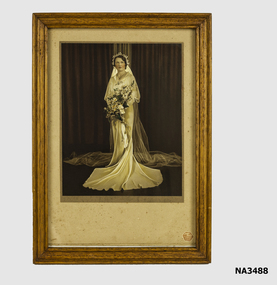
Photograph - Photo - Framed, 1929
... Taken at the wedding of Jean Margaret Mathie to John Caldwell Wells at Presbyterian Church, Burwood, NSW in 1929. Bride's daughter wore same dress at her wedding in 1954. ...Taken at the wedding of Jean Margaret Mathie to John Caldwell Wells at Presbyterian Church, Burwood, NSW in 1929. Bride's daughter wore same dress at her wedding in 1954. ...Taken at the wedding of Jean Margaret Mathie to John Caldwell Wells at Presbyterian Church, Burwood, NSW in 1929. Bride's daughter wore same dress at her wedding in 1954. See Photo NA3487 1929 Wedding photo in wood frame with glass. Photo hand tinted, photo of bride in front of brown curtain. See also NA3485.1.2 - Gloves; NA3484.1.2 - Headdress and veil; NA3483 - Wedding dress; NA3487 - Photo of daughter in bridal outfit Sidney Riley Studios Pitt St. Sydney photography, photographs / slides / film -
 Uniting Church Archives - Synod of Victoria
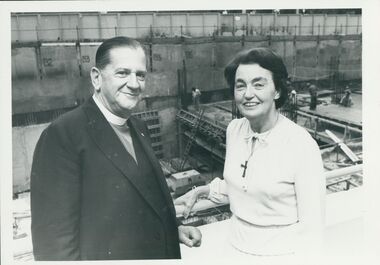
Photograph, Hector Dunn and Ethel Mitchell, 1979
... Hector Dunn was a continuing Presbyterian minister from Queensland & NSW. Ordained 1945. Served Grenfell NSW, Hobart, Warrnambool, 1977 was the first moderator of the continuing Presbyterian church. ...Hector Dunn was a continuing Presbyterian minister from Queensland & NSW. Ordained 1945. Served Grenfell NSW, Hobart, Warrnambool, 1977 was the first moderator of the continuing Presbyterian church. ...Hector Dunn was a continuing Presbyterian minister from Queensland & NSW. Ordained 1945. Served Grenfell NSW, Hobart, Warrnambool, 1977 was the first moderator of the continuing Presbyterian church. Mrs. Ethel Mitchell was the Moderator of the Synod of Victoria at the time. More information about Ethel Mitchell can be found in Proceedings of the Uniting Church Historical Society, Vol. 22, No. 1, June 2015. B & W photograph of Hector Dunn and Ethel Mitchell standing in front of a construction site. Names & C&N. dunn, hector, mitchell, ethel -
 Wodonga & District Historical Society Inc
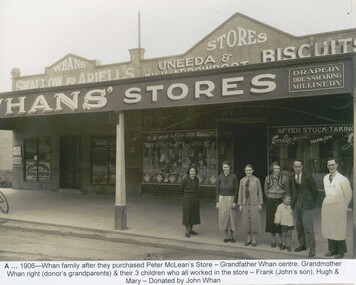
Photograph - Whans' Stores, Wodonga
... Frank was a dedicated member of the Presbyterian Church. The Whan General Store was purchased by Lincoln and Butterworth in 1945 and Francis and his family moved to Queensland He passed away in Lismore, NSW on 24 December 1975....Frank was a dedicated member of the Presbyterian Church. The Whan General Store was purchased by Lincoln and Butterworth in 1945 and Francis and his family moved to Queensland He passed away in Lismore, NSW on 24 December 1975. ...John Whan was born in Carlton of Irish parents and moved with them to Wodonga by bullock dray at the age of 12. After completing his education in Wodonga, John became manager of McLean Brothers and Rigg branch store in Sydney Street, Wodonga for a number of years after which he bought the business and operated Whan’s General Store in Sydney Road, Wodonga which at its peak employed his six children. John Whan was Wodonga Shire Councillor for 15 years, including a term as Shire President in 1904-5. He was also Chairman of the Wodonga Water Trust when it built the water tower in 1922 – 23. He had many other community involvements including the School board and the Library Committee, served as an honorary justice and Deputy Coroner. secretary of the Wodonga branch of the I.O.O.F., and the Wodonga Cemetery Trust and the Masonic Lodge. He was a foundation member of the Presbyterian Church in Wodonga. He died on 10 October 1933. After his death, Whan's store was operated by John's son Francis William Whan who was born in Wodonga on 1 September 1901. He also served the community as a Justice of the Peace and Magostrate. Frank was a caring gentleman who looked after many during the difficult times of the Depression and World War 11. He continued to provide outstanding service to the Wodonga community. Frank was a dedicated member of the Presbyterian Church. The Whan General Store was purchased by Lincoln and Butterworth in 1945 and Francis and his family moved to Queensland He passed away in Lismore, NSW on 24 December 1975. These photographs represent the business of a prominent Wodonga family and community member. 3 black and white photographs showing the Whan store in Wodonga at various stages in its development wodonga businesses, whan's store, whan family -
 Melton City Libraries
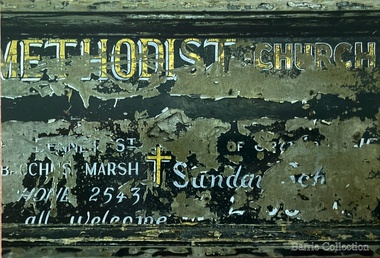
Photograph, Signboard, 1972
... We were members of the Presbyterian Church and also supported the Melton Sth Church during the 1950’s ...The family joined the Presbyterian Church. Evidenced in the Church Minute Book. 1920 What happened to the Methodist Church between 1910 – 1920? ...Edna Barrie handwritten notes – copied 18th October 2013 web The early story of the Wesleyan Methodist Church in Victoria At Melton between Bal [Ballarat] and Melb [Melbourne] was introduced by the Revd Wlm Blamires in 1862 ably seconded by the late Mrs Westlake (afterwards Mrs Spargo). Mr J James, the active and indefatigable Revd Eb Taylor and such workers as Atkinson Corr and Ferris. Mawson and John Dare 1867 the foundation stone of the present church was laid. Revd D Waugh 1867. Melton and Toolern Vale have benefited by the generous help of Mr J Browne esquire of White Hills Station Diggers Rest and are now comprised in the Sunshine Circuit. Written at a later date – Wesleyan 16-4-1867 then Methodist 3-10-1867. Bluestone building cost Lsd 350-13-6. Seating 40 pounds Rev Ken Moore Methodist opened at Brooklyn Rd Melton South c1940 closed c 1972. Timber Church shifted from Staughton Vale, prior to this Services held in Victoria Hall Melton South. The source of the information – ? and date notes were made On the Chart outlining Melton Churches the following additional notes- At opening (nil Plaster, nil ceiling) Slate roof. Closed 1910-1911- most likely from 1867 Express My research - Melton Express noted 15th Aug 1939 porch added to Church at Melton South making the date earlier than 1940. Photographs taken when the building was being used as the UC Opp Shop and demolition of the building showing the porch. Charles Ernest Barrie was prominent in the life of the Methodist Church and established a thriving Sunday School. He built the Chaff Mills at Melton South in 1900. In 1910 he sold the Mill to Glover Onians and moved to a farm at Trundle NSW, where he lived for about a year. In May 1911 he purchased “Darlingsford” in Melton when it came on the market. The address Elizabeth St Moonee Ponds appears in the family records during this period and during WW 1 they also lived at Ascot Vale where the Lang parents lived. On returning after the war to Melton to occupy the Darlingsford house, which had been occupied by a caretaker. The family joined the Presbyterian Church. Evidenced in the Church Minute Book. 1920 What happened to the Methodist Church between 1910 – 1920? How long did it exist while in the Bluestone building in Palmerston St (Heritage listed 2008) When did the church commence in Victoria Hall? Built 1910 on land donated by C E Barrie. I attended the Methodist Church Melton Sth when monthly services were held in the afternoons. We were members of the Presbyterian Church and also supported the Melton Sth Church during the 1950’s Signboard from Melton South Methodist Church churches -
 Melton City Libraries
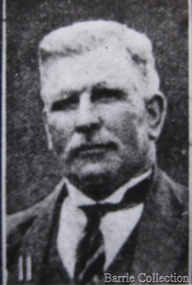
Photograph, Charles Ernest Barrie, Unknown
... He was a member of the Methodist Church and later the Scots Presbyterian Church. He was Superintendent of the Sunday School of the Methodist Church to 1910 and later Scots Presbyterian Church until 1931. ...He was a member of the Methodist Church and later the Scots Presbyterian Church. He was Superintendent of the Sunday School of the Methodist Church to 1910 and later Scots Presbyterian Church until 1931. ...This document is has been compiled by Wendy Barrie daughter of Ernest (Bon) and Edna Barrie and granddaughter of Charles E and Jessie M Barrie. Ernie Barrie operated a travelling Chaff Cutter in the St Arnaud area where his parents William and Mary Ann had taken up land at Coonooer West in 1873. Ernie commenced his working life with a team of bullocks and a chaff cutter. The earliest connection he had with Melton was in 1887. By the beginning of the 20th century Ernie and his father William and brothers, William, Samuel, James Edwin,[Ted] Robert, Arthur and Albert have been associated with farming and milling in the Melton district. In the early 1900’s Ernie and his brother Ted were in partnership in a Chaff cutting and Hay processing Mill on the corner of Station and Brooklyn road Melton South. The mill was managed by William for a time. By 1906 Charles Ernest and James Edwin were in partnership in the Station Road mill when a connecting rail line across Brooklyn Road for a siding was constructed to the Melton Railway Station. In 1911 the Mill’s letterhead shows C.E. BARRIE Hay Pressing and Chaff Cutting Mills. Melton Railway Station. Telephone No 1 Melton. This Mill as sold to H S K Ward in 1916 and stood until 1977 when it burnt down in a spectacular fire. Ernie built a house at Melton South beside the Chaff Mill at Station Road in 1906 and married Jessie May Lang in August at the Methodist Church. Jessie’s father was Thomas Lang. He came to Melton in 1896 and was the Head Teacher at Melton State School No 430 until he retired in 1917. They had 9 children with 8 surviving to adulthood. Jessie and Ernie had 6 sons and 3 daughters. All the children lived at Darlingsford. In April 1910 the family left Melton for a brief period and moved to a farm in Trundle in NSW. They returned to Melton and purchased Darlingsford in May 1911. For a time during WW1 they lived at Moonee Ponds near the Lang grandparents at Ascot Vale. Mary and Bon attended Bank St State School. The children developed diphtheria in 1916 and their youngest boy, Cecil died of complications. Mary and Bon were taken to Fairfield Hospital and both recovered. At the end of the war influenza broke out the family returned to Darlingsford and shared the home for a short while with the Pearcey family who had been working the farm. By 1922 the family had and grown and Edgar, Tom, Horace, Jessie, Joyce and Jim were living a Darlingsford. Ernie continued during the 1920’s working the farm and attend his many civic and community commitments. Two 8 clydesdale horse teams were used to work the land which meant early rising for the horses to be fed and harnessed to commence the days work. In 1916 Ernie also became involved in a Chaff Mill on the corner of Sunshine and Geelong Road West Footscray, which at the time was being run by John Ralph Schutt. It was known an Schutt Barrie. A flour mill was added at a later stage. Other Schutt and Barrie mills were situated at Parwan and Diggers Rest. Another mill was situated beside the railway line at Rockbank. The Footscray mill ceased operation in 1968 Ernie spent a lot of time and energy at the Parwan Mill and travelling around Parwan and Balliang farms, where he came to know many of the families in the district. Ernies commitment to the civic development to the Melton and district was extensive, he was involved with a number of large events during the 1920’s such as the Melton Exhibitions and the 1929 Back to Melton Celebrations. He was a member of the Australian Natives Association at the turn of the century. He was Chairman of the School Committee at Melton State School 430 and the Melton South State School in thw1920s. He donated the land for a Hall for Melton South in 1909, known as Exford Hall and later in 1919 renamed Victoria Hall. The Hall was demolished in 1992. He was a Councillor, JP, and Vice President and President of the Melton Mechanics Institute Hall Committee in 1915- 1916. He was a member of the Methodist Church and later the Scots Presbyterian Church. He was Superintendent of the Sunday School of the Methodist Church to 1910 and later Scots Presbyterian Church until 1931. This is reflected in the theme of children in the stained glass window which was dedicated in his memory by his wife Jessie as a gift to the Scots Church. Charles Ernest Barrie made many generous donations to many charities who supported young people and children. In 1918 Jessie and Ernie made the first donation to a very prominent Victorian charity whose work still continues. Yooralla. In July 1931 Ernie’s untimely death was a major blow to the family and the Melton community. To this day people still vividly recall the day they lined the streets for his funeral. The day of the funeral is recalled as the day Melton stood as two of their prominent citizens who tragically died on the same day Photograph of Charles Ernest Barrie taken from Scenes at Melton and Old Residents local identities -
 Melton City Libraries
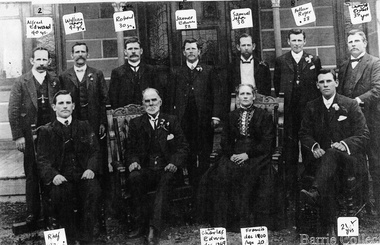
Photograph, Charles Ernest Barrie and family, 1906
... He was a member of the Methodist Church and later the Scots Presbyterian Church. He was Superintendent of the Sunday School of the Methodist Church to 1910 and later Scots Presbyterian Church until 1931. ...He was a member of the Methodist Church and later the Scots Presbyterian Church. He was Superintendent of the Sunday School of the Methodist Church to 1910 and later Scots Presbyterian Church until 1931. ...Photograph was taken on the 23rd of August 1906, the day of Jessie May Lang and Charles Ernest Barrie's wedding. Held at the Methodist Church Melton. UMMARY – Charles Ernest Barrie d.1931 Born 1871 Ballarat d 1931 This document is has been compiled by Wendy Barrie daughter of Ernest (Bon) and Edna Barrie and granddaughter of Charles E and Jessie M Barrie. My grandfather was well known in the district and was mostly referred to as Ernie. He shared the same initials as his second son Edgar. His three eldest sons lived and farmed in Melton for their entire lives. His descendants are still associated with farming, engineering and earthmoving in Melton. Ernie Barrie operated a travelling Chaff Cutter in the St Arnaud area where his parents William and Mary Ann had taken up land at Coonooer West in 1873. Ernie commenced his working life with a team of bullocks and a chaff cutter. The earliest connection he had with Melton was in 1887. By the beginning of the 20th century Ernie and his father William and brothers, William, Samuel, James Edwin,[Ted] Robert, Arthur and Albert have been associated with farming and milling in the Melton district. In the early 1900’s Ernie and his brother Ted were in partnership in a Chaff cutting and Hay processing Mill on the corner of Station and Brooklyn road Melton South. The mill was managed by William for a time. By 1906 Charles Ernest and James Edwin were in partnership in the Station Road mill when a connecting rail line across Brooklyn Road for a siding was constructed to the Melton Railway Station. In 1911 the Mill’s letterhead shows C.E. BARRIE Hay Pressing and Chaff Cutting Mills. Melton Railway Station. Telephone No 1 Melton. This Mill as sold to H S K Ward in 1916 and stood until 1977 when it burnt down in a spectacular fire. Ernie built a house at Melton South beside the Chaff Mill at Station Road in 1906 and married Jessie May Lang in August at the Methodist Church. Jessie’s father was Thomas Lang. He came to Melton in 1896 and was the Head Teacher at Melton State School No 430 until he retired in 1917. They had 9 children with 8 surviving to adulthood. Jessie and Ernie had 6 sons and 3 daughters. All the children lived at Darlingsford. In April 1910 the family left Melton for a brief period and moved to a farm in Trundle in NSW. They returned to Melton and purchased Darlingsford in May 1911. For a time during WW1 they lived at Moonee Ponds near the Lang grandparents at Ascot Vale. Mary and Bon attended Bank St State School. The children developed diphtheria in 1916 and their youngest boy, Cecil died of complications. Mary and Bon were taken to Fairfield Hospital and both recovered. At the end of the war influenza broke out the family returned to Darlingsford and shared the home for a short while with the Pearcey family who had been working the farm. By 1922 the family had and grown and Edgar, Tom, Horace, Jessie, Joyce and Jim were living a Darlingsford. Ernie continued during the 1920’s working the farm and attend his many civic and community commitments. Two 8 clydesdale horse teams were used to work the land which meant early rising for the horses to be fed and harnessed to commence the days work. In 1916 Ernie also became involved in a Chaff Mill on the corner of Sunshine and Geelong Road West Footscray, which at the time was being run by John Ralph Schutt. It was known an Schutt Barrie. A flour mill was added at a later stage. Other Schutt and Barrie mills were situated at Parwan and Diggers Rest. Another mill was situated beside the railway line at Rockbank. The Footscray mill ceased operation in 1968. Ernie spent a lot of time and energy at the Parwan Mill and travelling around Parwan and Balliang farms, where he came to know many of the families in the district. Ernies commitment to the civic development to the Melton and district was extensive, he was involved with a number of large events during the 1920’s such as the Melton Exhibitions and the 1929 Back to Melton Celebrations. He was a member of the Australian Natives Association at the turn of the century. He was Chairman of the School Committee at Melton State School 430 and the Melton South State School in thw1920s. He donated the land for a Hall for Melton South in 1909, known as Exford Hall and later in 1919 renamed Victoria Hall. The Hall was demolished in 1992. He was a Councillor, JP, and Vice President and President of the Melton Mechanics Institute Hall Committee in 1915- 1916. He was a member of the Methodist Church and later the Scots Presbyterian Church. He was Superintendent of the Sunday School of the Methodist Church to 1910 and later Scots Presbyterian Church until 1931. This is reflected in the theme of children in the stained glass window which was dedicated in his memory by his wife Jessie as a gift to the Scots Church. Charles Ernest Barrie made many generous donations to many charities who supported young people and children. In 1918 Jessie and Ernie made the first donation to a very prominent Victorian charity whose work still continues. Yooralla. In July 1931 Ernie’s untimely death was a major blow to the family and the Melton community. To this day people still vividly recall the day they lined the streets for his funeral. The day of the funeral is recalled as the day Melton stood as two of their prominent citizens who tragically died on the same day. Charles Ernest Barrie with his parents and brothers at the front of the mill house in Melton South local identities -
 City of Melbourne Libraries
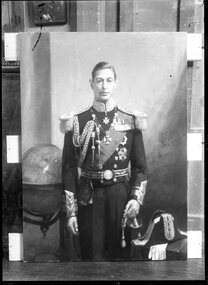
Photograph, Bull, Hugh Jones, 1897-1993, "A Royal Portrait" (Duke of York), 1933
... The federal Parliament had previously been situated in Melbourne, but Canberra was chosen as the location for Australia’s capital as a compromise between fierce rival states, Victoria and NSW. It is written in the Constitution that the federal capital would be in “the State of NSW... distant not less than one hundred miles from Sydney.” ...The federal Parliament had previously been situated in Melbourne, but Canberra was chosen as the location for Australia’s capital as a compromise between fierce rival states, Victoria and NSW. It is written in the Constitution that the federal capital would be in “the State of NSW... distant not less than one hundred miles from Sydney.” ...Published: The Age, Sat 14 October 1933 Published title: A Royal Portrait Published caption: "Seen at his studio, Alphington, Mr. W. B. Mclnnes's portrait of the Duke of York, which he painted recently on commission from the trustees of the Castlemaine Gallery, at St. John’s Wood, London, impresses as a vital record of one whose natural habitat is a palace, and whose place in life is one of near relationship to the throne of England. The Duke is painted in the uniform of the admiral of the fleet, a highly ornate vesture entailing much elaboration of gold and numerous medals, in dealing with which the artist has not failed to centre his attention on the head, and has succeeded in producing what is undoubtedly a soundly painted portrait and a good likeness. During the five fittings Mr. Mclnnes, apart from the ordinary social amenities, found his Royal sitter little inclined to talk, though he spoke feelingly of his trip to Australia and the pleasure it had given him: but with the Duchess the tendency to be sociable was much more clearly pronounced. She took, and expressed, a keen interest in the social and political matters of the day with a special concern for the supremacy of England and Australia in all questions relating to sport, such as cricket, tennis and golf. She spoke well of her portrait painted by Quinn, and regretted that she would not see the two hung side by side at the Castlemaine Gallery." Description: An unframed painting of a standing, middle-aged man dressed in the uniform of a Royal Navy admiral of the Fleet with medals, sash, ornate belt, cuffs and epaulettes. His left hand rests on the handle of a sword in its scabbard and his bicorn hat and white gloves are on a table beside him. To his right is a globe of the world showing Australia. Research by project volunteer, Fiona Collyer: In 1933, Castlemaine Art Gallery trustees commissioned artist W.B. McInnes (1889-1939) to paint a portrait of Prince Albert, Duke of York as a companion piece to the portrait of his wife, the Duchess of York, that the gallery had commissioned Australian official war artist James Quinn (1869-1951) to paint in 1930. During the First World War, the Duchess’s childhood home, Glamis Castle in Scotland was used as a makeshift military hospital and convalescence home for wounded soldiers. Many servicemen from the Castlemaine area recuperated there and had fond memories of the kindness of the teenage Lady Elizabeth Bowes-Lyon (1900-2002, later Duchess of York) who spent the war years running errands and aiding in the welfare and morale of the patients. In 1927, the Duke and Duchess of York (later King George VI and Queen Elizabeth) came to Australia to formally open the newly built Parliament House in Canberra and to tour the country. While visiting Victoria in April, they embarked on a whistle-stop train journey to Bendigo, stopping at Kyneton for ten minutes and Castlemaine for 15 minutes. At Kyneton, an excited crowd of 10,000 people welcomed the couple with “three cheers and three cheers for Baby Betty” before the Duchess was presented with a bouquet of locally grown roses and the Duke a bound album of photographs of noted beauty spots of the district. Next the Royal Couple stopped at Castlemaine to the cheers of 15,000 people. There the couple were presented with a basket of prime quality Harcourt apples and a pair of cot blankets, manufactured at Castlemaine Woollen Mills, a birthday gift for baby Princess Betty. The Duchess recognised Colonel W.E. James, of the Seventh Battalion, who had convalesced at Glamis Castle in 1917, and they chatted before the train departed, while the Duke shook hands with returned soldiers. Last stop was the town of Bendigo which was colourfully decorated with bunting and flags, arches and flowers. 3000 pigeons were released on their arrival and the liberated birds circled overhead for several minutes as if to welcome the Royal Couple. A crowd of 50,000 cheering people lined the streets in bright sunshine as the couple drove by. From an arch over Hargreaves Street, pretty girls showered the pair with rose petals. The Duke was presented with a gold nugget and an album, handsomely bound in morocco, of a history of the Bendigo mining industry, while the Duchess received a bouquet of prize winning white chrysanthemums. After 75 minutes in Bendigo they journeyed back to Melbourne for a State reception. While the couple were in Melbourne, the Duke often played lawn tennis at the Government House courts with three times Grand Slam champion Norman Brookes, who declared that while he considered the Duke a second class player whose serve lacked sting, he had a fine backhand and with time and practice he could become a first class player. The federal Parliament had previously been situated in Melbourne, but Canberra was chosen as the location for Australia’s capital as a compromise between fierce rival states, Victoria and NSW. It is written in the Constitution that the federal capital would be in “the State of NSW... distant not less than one hundred miles from Sydney.” The word Canberra is thought to derive from the local Ngunnawal word “Kanbarra” meaning “meeting place”. The Provisional Parliament House was a large, white, three storey building facetiously dubbed “The Wedding Cake”, plonked down in a bare, former sheep paddock. It was decorated for the event with Union Jacks and Australian red ensign flags. On 9 May, the day of the opening, the expectant crowd assembled in front of the building. Only two of the spectators were Aboriginal. One was Jimmy Clements (1847-1927, aka Nangar or Yangar, but popularly known as “King Billy”), accompanied by his three dogs. (The title “King” or “Queen” was often given by white settlers to Aborigines who were seen as allies and could maintain good relations between First Nations groups and the colonists. Some were given inscribed brass breastplates or gorgets to wear.) Jimmy was an excellent horse breaker and expert tracker for the police. He was also the nephew of “Queen” Nellie Hamilton (1842-1897) of the Canberra-Queanbeyan region, home of the Ngambri and Ngunnawal people. Nellie was the oldest surviving full-blooded Aboriginal woman in the district. The other was George John Noble (1840s-1928, aka Ooloogan, also “Marvellous” due to his regular use of the word). Both were initiated Wiradjuri walamira elders: “clever men” believed to have the ability to heal physical and spiritual ailments. They were also travelling showmen, skilled at boomerang and spear throwing and often performed at country agricultural shows and football matches. They had walked barefoot for three days from the Brungle Mission, near Gundagai. 11 May 1927, The Argus reported that “King Billy... claims sovereign rights to the Federal Territory” which the National Archives of Australia describes as “possibly the first recorded instance of Aboriginal protest at Parliament House in Canberra.” 10 May 1927, The Argus reported on Jimmy Clements: “During the wait great interest was taken in the appearance near the east stand of an aborigine, a member of the Gundagai tribe, and a well known character in the district. He was very old and grey and ruggedly picturesque. He was determined to go his own way in spite of the arguments of two inspectors and one sergeant of police. Immediately and instinctively the crowd in the stands rallied to his side. There were choruses of advice and encouragement for him to do as he pleased. A well-known clergyman stood up and called out that the aborigine had a better right than any man present to a place on the steps of the House of Parliament and in the Senate during the ceremony. The old man’s persistence and the sympathy of the crowd won him an excellent position and also a shower of small change that must have amounted to 30/ or 40/ [shillings].” At 10.30 am, Australia’s eighth Prime Minister, Mr Stanley Bruce (1923-1929) welcomed the Royal couple onto the crimson carpeted portico. Unfortunately, Dame Nellie Melba’s rendition of “God Save the King” and the greater part of the Duke’s reply was drowned out by the roar of squadrons of aeroplanes circling overhead. A brief religious service followed, conducted by leaders of the Methodist, Presbyterian and Anglican churches. Interestingly, there was no Roman Catholic representation at the ceremony even though around one quarter of Australians were Catholic at the time. The Duke unlocked the front doors with a golden key, then unveiled a statue of his father King George V by sculptor Sir Bertram Mackennal in the King’s Hall. Then the official party, Senators, members of the House of Representatives and invited guests entered the Senate chamber where the Duke read a message from the King, establishing Canberra as the seat of the Federal Government, watched on by Australia’s elite. The conclusion of the ceremony was announced by a gay fanfare of trumpets from the entrance of Parliament House and a 21 gun salute and answered by cheers from the crowd. The dignitaries then feasted on a luncheon of turtle soup, poached schnapper, fillets of beef, roast chicken and ham, straw potatoes, green peas, Canberra Pudding (a pudding made with dripping, dried fruit and jam), fruit, ices, coffee and cheese. They toasted the King with non-alcoholic fruit punch as the Federal Capital Territory (later ACT) was a “dry” area and no speeches were made. The diary entry that day of Ethel Baird, Lady Stonehaven, the wife of the Governor-General, is brief and to the point: “To P.H. & waited for Yorks. Ceremony went off without a hitch. Ghastly Banquet Lunch.” Later that day, the Duke mounted a coal black mare, police horse Number 303 which had been hastily re-named “Black Bess” for the occasion, to receive the final salute from the assembled troops and returned soldiers dressed in mufti. The RAAF squadron were flying overhead in “V” formations when suddenly, one of the planes, piloted by Flying Officer Francis Charles Ewen, left the formation, nose-diving 900 metres from Parliament House and landing behind the Y.W.C.A. refreshment marquee. Francis, aged only 28, tragically died of his wounds later that day. The Federal Capital Commission contracted Sargent’s Pies of Sydney to supply 5000 meals for the event. They supplied pies, sausage rolls, scones and sandwiches with the agreed price of 3 shillings a head. Only 1200 meals were served and the uneaten remainder dumped, with the Commission bearing the cost of the unsold food. An estimated crowd of 20,000 attended the opening, far fewer than the expected 100,000. Many visitors travelled long distances, bringing their own hampers of food and camping in tents as there was very limited accommodation available. Thousands of people around Australia listened to the ceremony broadcast on the wireless, with receiving sets installed in schools, public halls and workplaces and it was also filmed for posterity. The next morning, the Royal couple, along with Prime Minister Bruce and Mrs Bruce held an informal public reception on the steps of Parliament House where early settlers, residents and visitors to Canberra filed past them. The Press widely reported Jimmy Clements’ encounter with the Duke and Duchess. The Sun-Pictorial reported 11 May 1927: "MET THE DUKE. ABORIGINE KING HE APPROVED Sugarbag: Sports Suit. John Clements, otherwise King Billy, a full blooded aborigine king, aged 86, was among the 2000 who filed past the Duke and the Duchess at the public reception at Canberra to day. “How you likem Duke and Duchess Billy?” he was asked afterwards. “I think they are both very nice.” he replied in good English. King Billy was a very bedraggled figure, with tangled locks and a beard which almost hid his wrinkled and black face. He wore an old sports suit and carried a sugarbag. Passing the Duke and Duchess he turned full towards them. The crowd cheered, and the Duke and Duchess smiled. The Duke was particularly amused.” The Canberra Times reported 13 May 1927: "A REAL AUSTRALIAN. A quaint but pathetic figure stood in broad relief in the queue of ranks at the reception. Where his dusky forbears have gathered in native ceremonial for centuries past, a lone representative of a fast vanishing race saluted visiting Royalty. Despite the grotesque garb and untamed mane the aborigine comported himself not without dignity. With his three faithful dogs, he made an immediate target for a battery of cameras.” "The Argus reported 11 May 1927: "...an ancient aborigine who calls himself King Billy and who claims sovereign rights to the federal Territory walked slowly forward alone and saluted the Duke and Duchess. They cheerily acknowledged his greeting. The old aborigine, with his long, matted beard and nondescript clothing, is a popular identity of Canberra, and must be one of the most extraordinary figures who has received a Royal salute.” The Sun (Sydney) reported 10 May 1927: “Suddenly, in the midst of the forest of green and white colored hats of women, appeared a head with a shaggy leonine mane and a patriarchal beard. Jacky, the aboriginal, an identity of the district, who is also known as the King of Canberra, had arrived to testify to his loyalty. He saluted the Duke with an excellent dash, and shambled past with his faithful sheep dog aide-de-camp at his heels. The Duke and Duchess were highly amused at this quaint figure moving along with a sort of bodyguard of shrieking young boys and girls.” The Sydney Morning Herald 11 May 1927 mistook Jimmy for his friend “Marvellous”: “...the appearance of an aged aboriginal widely known in the district as “Marvellous, the uncrowned king of Queanbeyan." His beaming black countenance was almost hidden beneath a shock of hair and beard. Bare-footed and carrying a sugar bag in one hand and a tiny Australian flag in the other, he at first mistook a policeman at the foot of the steps for the Duke. To his great embarrassment and to the vast amusement of the onlookers, the policeman became the object of a hearty salutation. However, "Marvellous" was quickly shepherded back to a position in the procession and as he passed along brought his hand up to an approved military salute for the benefit of their Royal Highnesses. The Duke returned it with a special wave.” The Labor Daily 11 May 1927 irreverently reported on the scene: "People March Past. Some 400 people, old identities of Canberra marched past. They were mostly aged ladies with memories faithfully preserving the traditions of other days and curtsied reverently. The younger generations, who speedily joined the procession, behaved differently however. Surely it was the most motley collection that ever passed before Royalty. Men without collars jostled others well dressed. Fat women, young women, children of all heights and ages were there. The oldest inhabitants, in the persons of the abo, "Marbly", and his companion were present. The poor old fellows evidently were keen to get closer to the Duke than the procession dared go, but they were overawed by the stern glances of military men.” The Canberra Times reported 13 May 1927: "...and towards the end of the procession, a full-blooded aboriginal, bareheaded and barefooted, and carrying an old swag on his back, made a picturesque figure as he several times saluted the Royal couple, his old eyes beaming inexpressible delight.” The Register reported 11 May 1927: "PUBLIC MARCH PAST. Old “Jacky”, an aboriginal identity of the district, who has been following the proceedings of the various ceremonies with apparently great interest, appeared in the march past. He halted in front of the steps and raised his hand to his shaggy grey locks in an attempt at a salute. Smiling, the Duke returned the salute, and the Duchess bestowed a charming smile on the figure of mingled pathos and comedy.” Tweed Daily reported 12 May 1927: “King Billy” WAS THERE. Appropriately enough, the inevitable “King Billy” with his refreshing impression of possum and gum-leaves, was present at the dedication of the Federal capital at Canberra. Bare-footed, in a dingy old suit and battered felt hat, he wandered on to the empty stand after the illustrious assemblage had passed into Parliament House. A desolate figure in all that he stood for, he proved, an amiable representative of the dispossessed race. He cheerfully waved a Union Jack for the camera man, and grinned into the very eye of a movie man’s camera without flinching.” Footage of Jimmy filmed that day features in the film “The Birth Of White Australia” produced in 1928 and shows him enthusiastically waving a small Union Jack flag in front of Parliament House with his three dogs at his feet. The caption reads " "King Billy" calls for cheers for the son of the great white King across the seas. “Mine tinkit that pfellers father budgeree King liket me” supposedly says Jimmy." Jimmy told the Daily Telegraph, 13 May 1927 “I have opened your Parliament House on my own ground, now you can go and look at it." Jimmy died on 28 August 1927, aged 80. The Herald newspaper on 30 August 1927, published an illustration depicting Jimmy’s dog standing on his grave, his customary chimney pot hat leaning on his headstone. The caption reads: “The Dead King — His Only Mourner. Drawn by Will Dyson (King Billy, last of the Canberra aborigines, lived just long enough to see the Duke of York open Australia’s capital on the site where his tribe once roamed. He died in the Queanbeyan Hospital yesterday morning.)” A letter published in the Sydney Morning Herald, 19 September 1927 reported: "Old King Billy... Sir, ...I would like to mention... the passing away of one, if not the last remaining aboriginal chieftains. He may be called “Old King Billy,” and his death occurred here in Queanbeyan a few weeks ago. The removal of this well-known black has left another big gap in all that remains distinctively Australian in character. He was one of the last remaining tribe of the Monaro district, and one of the most predominant personalities throughout the Commonwealth. ...he had lived through 80 years all told. He was on many occasions sought by artists for his splendid physique and personality as a model, and many a journey he has had to make to Sydney on that account. A more striking and pronounced type could not be found. ...A very fine cast in lifelike form is to be seen in the Australian Museum, Sydney ...his last important appearance in public was at the Commonwealth celebrations at Canberra, to which territory he partly belonged. ...we have no aborigine statue chiselled to the memory of their race, a more fitting and lasting memorial could not be undertaken than to have one modelled from this fine figure and erected to the memory of his race at Canberra... It would be a fitting adornment if planted with the Australian gumtrees for any avenue or garden. [King Billy] ...a very intelligent fellow, responding readily to kindness and common sense. Hoping yet to see a befitting testimonial and a lasting memorial to a race that is rapidly and I may say, unfortunately, disappearing, I am etc., SYDNEY R.OAKLEY, Queanbeyan." The “lifelike form” referred to by the correspondent was a sculpture that Jimmy Clements had posed for: “The Wunderlich Aboriginal Group” for The Australian Museum in Sydney. In 1925, Mr Ernest Wunderlich, director of Wunderlich Limited, manufacturer of building materials and President of the Board of Trustees at The Australian Museum, commissioned renowned sculptor George Rayner Hoff (sculptor of the Anzac Memorial in Hyde Park, Sydney, National War Memorial in Adelaide, and “Lion” the original Holden Motor Company car emblem) to sculpt a life sized Aboriginal family group diorama as a gift to the Museum. There was much concern at this time that the Aboriginal population and especially the “full blooded” were fading into oblivion so fast that they may soon become extinct. Three “full blooded” Aborigines were chosen for models. An article in The Australian Museum magazine, July/September 1926 about The Wunderlich Aboriginal Group explained “...it will not be many years before the aborigine, in New South Wales and Victoria at least, will be an entity of the past. Every year sees a shrinkage in their number, and the coastal tribes that once roamed the Sydney district are, unfortunately, no longer with us. ...the man, who is hurling a boomerang, is Yangar, or “Jimmy Clements,” son of Gayan-Bleuet-Galoom, the late “King of Orange,” western New South Wales. “Jimmy” is an old man, but well preserved. He has a very retentive memory and recollects the various tribal customs and initiation ceremonies, but regarding these he is extremely reticent and will not communicate his “honoured secrets.” The female figure is “Nellie Walker,” a daughter of Geri-Bungel, and a native of Bombala, Monaro district, southern New South Wales. The boy is Harold Marsh, aged nine years, who was born at Kinchela, Macleay River, northern New South Wales. He is now living at the Brewarrina settlement... In the selection of aborigines great care had to be taken to ensure that the individuals were pure bloods, and to the Aborigines’ Protection Board and the Police Department of this State thanks are due for the valuable assistance rendered by them.” Ngarigo woman, Nellie Bungil Walker (1867-1932) had five children, two died as babies and her remaining children were taken from her. She worked as a domestic and was living at La Perouse Aboriginal Community, Sydney at the time of her sculpture’s creation. In the years after the sculpture was made, Nellie and Rayner remained friends. Yaegl boy Harold “Harry” Marsh was from the Kinchela Aboriginal Training Home for boys near Kempsey, (1924-1970), an agricultural training institution under the jurisdiction of the Aboriginal Protection Board to house Aboriginal boys forcibly removed from their families “in the interest of the moral or physical welfare” of the boys. The boys at Kinchela were aged 5-15 years old and referred to as numbers, not names and any connection to Aboriginal culture or language was forbidden. Brutal and cruel physical punishment and sexual assaults were rampant. Survivors recall being flogged and chained naked to a huge Morton Bay fig tree overnight or “sent down the line” where every boy was ordered to punch the “wrong doer” as hard as possible for fear that they would be next. The Kinchela children are acknowledged as part of the Stolen Generation. In 1925, Rayner Hoff created a terracotta bust “Harry Marsh” which is in the collection of the Art Gallery of New South Wales. The figures of the trio were modelled in clay before being cast in plaster and hand-coloured by Museum artist Miss Ethel A. King. The finished figures were completed with wigs and fur pelts and with Jimmy hurling a boomerang and Nellie holding a dilly-bag. They were placed in a glass cabinet in the Australian Ethnology Gallery. The subjects were not named. The Sydney Morning Herald 1 July 1926 critiqued the sculptures. "A GROUP OF STATUARY. MUSEUM’S ACQUISITION. Artistically the group is very fine, for the sculptor has caught his subjects in attitudes that reveal all the stalwart athletic lines of their bodies... The man, who is depicted as about 60 years of age, is bearded, immense, and savagely primitive-is throwing a boomerang, and beside him a boy, aged about 11 years is following beneath a shading hand, the flight of birds at which the hunter aims. Behind them, patient, obedient, stand(s) the woman waiting with her dilly bag to gather the spoils.” In 1996, Nellie’s daughter, Victoria Kempsey née Walker, happened to visit The Australian Museum and saw the sculpture of her mother, displayed semi-naked in a glass cabinet, alongside glass cabinets of taxidermied animals. She had last seen her mother 62 years previously when Nellie was dying from tuberculosis. Greatly distressed, Victoria wrote to the Museum requesting that they remove the sculpture, which they did. In 2023, a documentary was produced called “Her Name Is Nanny Nellie” which follows the journey of Nellie Walker’s great-granddaughter Auntie Irene Ridgeway discovering Nellie’s story, honouring her life and restoring her sculpture. Irene told Refinery29 Australia that “It was about reclaiming her life, reclaiming her history and who she really was as a real person. She was not a naked and unnamed lady standing in a museum. It's giving them back their families, they weren't just there to be looked at as flora and fauna or as 'natives'." The documentary was written and directed by Irene’s son Daniel King and premiered at the 2023 Adelaide Film Festival and broadcast on NITV. The restored sculpture of Nellie, dressed in 1920s style clothing was displayed at The Australian Museum, Sydney in The Bayala Nura Gallery in 2023. Irene wanted Nellie to be depicted in the way she actually was when she posed for the sculpture in 1925. The other two sculptures were not displayed due to ongoing conversations with family members and the fragility of the sculptures. It is anticipated that they may be displayed in the future. Melbourne born William Beckwith (Bill) McInnes (1889-1939) studied drawing at National Gallery School in Melbourne from the age of 14 under the tuition of artist Frederick McCubbin before succeeding his former teacher as Master of Drawing at the School from 1916-1934. He was acting Director of the NGV and Head of the National Gallery School from 1934. In 1927, Bill and official war artist H. Septimus Power were commissioned to paint the opening of the new federal Parliament House in Canberra. Septimus painted the general scene of the arrival of the Royal entourage in front of Parliament House, while Bill depicted the ceremony inside the Senate chamber. Bill was widely acclaimed for his landscapes and lauded as the heir to great Australian landscape artist Arthur Streeton. He won the Archibald Prize seven times (including the inaugural, a portrait of architect Desbrowe Annear) which made him a highly sought after portrait painter and he earned kudos for his commission to paint the Duke of York. During the breaks in painting the portrait, the pair chatted and Bill was surprised by the Duke’s wide knowledge of Australian affairs. The Duke was particularly interested to hear how the rabbit crisis was being handled. Bill’s work is held in major Australian galleries including the NGV, which has 12 of his paintings in their collection. Bill was married to fellow artist Violet McInnes and they lived at “The Poplars” in Alphington with their six children. Violet painted still life of flowers and portraits. In 1941, she entered her portrait of fellow artist Sybil Craig into the Archibald Prize and in 1945 Violet was appointed an official war artist. Defending his traditional style Bill said “...we in Australia have not been bitten by Cubism or Futurism or other of the “isms”...and I am glad of it”. References: THE DUCHESS OF YORK. (1931, December 7). The Argus (Melbourne, Vic. : 1848 - 1957), p. 8. Retrieved April 3, 2025, from http://nla.gov.au/nla.news-article4427568 WAR NURSE (1930, March 11). The Sun (Sydney, NSW : 1910 - 1954), p. 1. Retrieved April 3, 2025, from http://nla.gov.au/nla.news-article223714728 The Royal Visit. (1927, April 29). The Age (Melbourne, Vic. : 1854 - 1954), p. 9. Retrieved April 4, 2025, from http://nla.gov.au/nla.news-article205813465 Canberra. (1927, April 30). Advocate (Burnie, Tas. : 1890 - 1954), p. 5. Retrieved January 10, 2025, from http://nla.gov.au/nla.news-article68233606 Australian Dictionary of Biography, Nangar, https://adb.anu.edu.au/biography/nangar-33736 Australian Dictionary of Biography, Jimmy Clements, https://en.wikipedia.org/wiki/Jimmy_Clements Wikipedia, George John Noble, https://en.wikipedia.org/wiki/George_John_Noble PARLIAMENT AT CANBERRA. (1927, May 14). The Australasian (Melbourne, Vic. : 1864 - 1946), p. 37 (METROPOLITAN EDITION). Retrieved December 25, 2024, from http://nla.gov.au/nla.news-article140733921 CANBERRA CEREMONY (1927, May 10). The Argus (Melbourne, Vic. : 1848 - 1957), p. 19. Retrieved November 3, 2024, from http://nla.gov.au/nla.news-article3853643 CANBERRA. (1927, May 11). The Argus (Melbourne, Vic. : 1848 - 1957), p. 20. Retrieved November 24, 2024, from http://nla.gov.au/nla.news-article3853897 THE FINAL SCENES (1927, May 11). The Labor Daily (Sydney, NSW : 1924 - 1938), p. 5. Retrieved January 10, 2025, from http://nla.gov.au/nla.news-article236614453 TWIN SONS (1927, May 10). The Sun (Sydney, NSW : 1910 - 1954), p. 11. Retrieved April 4, 2025, from http://nla.gov.au/nla.news-article223616143 National Archives of Australia, Aboriginal [Jimmy Clements, a Wiradjuri elder] on steps of Parliament House (King Billy), https://recordsearch.naa.gov.au/SearchNRetrieve/Interface/ViewImage.aspx?B=3050026 Sydney Morning Herald, The chant of Jimmy Clements: I’ll do the honours on my ground, thanks, https://www.smh.com.au/national/the-chant-of-jimmy-clements-i-ll-do-the-honours-on-my-ground-thanks-20241023-p5kkt5.html MET THE DUKE (1927, May 11). The Sun News-Pictorial (Melbourne, Vic. : 1922 - 1954; 1956), p. 14. Retrieved November 3, 2024, from http://nla.gov.au/nla.news-article275177101 PUBLIC MARCH PAST. (1927, May 11). The Register (Adelaide, SA : 1901 - 1929), p. 11. Retrieved April 2, 2025, from http://nla.gov.au/nla.news-article54271512 A REAL AUSTRALIAN (1927, May 13). The Canberra Times (ACT : 1926 - 1995), p. 12. Retrieved December 18, 2024, from http://nla.gov.au/nla.news-article1213124 THE PEOPLE'S DAY (1927, May 13). The Canberra Times (ACT : 1926 - 1995), p. 3. Retrieved April 3, 2025, from http://nla.gov.au/nla.news-article1213105 KING BILLY" WAS THERE. (1927, May 12). Tweed Daily (Murwillumbah, NSW : 1914 - 1949), p. 2. Retrieved November 27, 2024, from http://nla.gov.au/nla.news-article190193273 A BUSY DAY. (1927, May 11). The Sydney Morning Herald (NSW : 1842 - 1954), p. 15. Retrieved November 3, 2024, from http://nla.gov.au/nla.news-article16374845 Nothing Wrong With Canberra Opening, Says "King Billy" (1927, May 13). The Daily Telegraph (Sydney, NSW : 1883 - 1930), p. 2. Retrieved November 3, 2024, from http://nla.gov.au/nla.news-article245750627 THIS IS MARVELLOUS! (1927, May 11). The Sun News-Pictorial (Melbourne, Vic. : 1922 - 1954; 1956), p. 16. Retrieved December 9, 2024, from http://nla.gov.au/nla.news-article275177155 Mildenhall's Canberra, Royal Visit, May 1927. Canberra citizens passing the Royal Party on the front steps of Parliament House at the Civic Reception 1927 [photograph], https://mildenhall.moadoph.gov.au/rephoto/62 Australian Dictionary of Biography, 1927 - Jimmy Clements, John Noble, and the Opening of Parliament House, https://adb.anu.edu.au/the-quest-for-indigenous-recognition/jimmy-clements YouTube, The Birth of White Australia (1928), amateurish racism on the big screen [Jimmy Clements at 11.12 minutes in], https://www.youtube.com/watch?v=OByX4iPsTgo YouTube, We Were Just Little Boys, https://m.youtube.com/watch?v=u4Hw9d91k2E WASTE AT CANBERRA. (1927, May 20). The South Eastern Times (Millicent, SA : 1906 - 1954), p. 1. Retrieved April 4, 2025, from http://nla.gov.au/nla.news-article200058308 YouTube, Museum of Australian Democracy at Old Parliament House, Whispers in the Corridors-An Aboriginal Presence, https://www.youtube.com/watch?v=fwifXP61M5Y History Snoop, Air Fatality in Canberra Scars an Historic Day in Australia, https://www.historysnoop.com/air-fatality-in-canberra/ YouTube, NFSA Films, The Opening Of Canberra, Australia's Capital City, https://www.youtube.com/watch?v=pOA8llA0iE0 Pauline Conolly, Pudding & Pies at Parliament House, https://paulineconolly.com/2022/pudding-and-pies-at-parliament-house/ THE MENU (1927, May 5). The Sun (Sydney, NSW : 1910 - 1954), p. 13 (FINAL EXTRA). Retrieved April 2, 2025, from http://nla.gov.au/nla.news-article223623278 PROMISING (1927, May 7). The Sun (Sydney, NSW : 1910 - 1954), p. 2. Retrieved December 15, 2024, from http://nla.gov.au/nla.news-article223616208 The Dead King -- His Only Mourner (1927, August 30). The Herald (Melbourne, Vic. : 1861 - 1954), p. 6. Retrieved November 3, 2024, from http://nla.gov.au/nla.news-article244196114 The VOICE of the CITY (1927, August 31). The Daily Telegraph (Sydney, NSW : 1883 - 1930), p. 4. Retrieved December 26, 2024, from http://nla.gov.au/nla.news-article246406061 THE LAST OF HIS TRIBE. (1927, September 2). Bairnsdale Advertiser and Tambo and Omeo Chronicle (Vic. : 1882 - 1946), p. 6. Retrieved December 24, 2024, from http://nla.gov.au/nla.news-article269318935 GONE WEST. (1927, September 17). The Irwin Index (Mingenew, WA : 1926 - 1956), p. 1. Retrieved December 23, 2024, from http://nla.gov.au/nla.news-article251554113 King Billy Dead. (1927, September 10). The Port Macquarie News and Hastings River Advocate (NSW : 1882 - 1950), p. 5. Retrieved December 1, 2024, from http://nla.gov.au/nla.news-article112534982 DEATH OF KING BILLY OF CANBERRA. (1927, September 16). Huon Times (Franklin, Tas. : 1910 - 1933), p. 5. Retrieved December 23, 2024, from http://nla.gov.au/nla.news-article136428435 OLD KING BILLY. (1927, September 19). The Sydney Morning Herald (NSW : 1842 - 1954), p. 5. Retrieved November 19, 2024, from http://nla.gov.au/nla.news-article16404722 "Marvellous" is Dead. (1928, March 30). The Gundagai Times and Tumut, Adelong and Murrumbidgee District Advertiser (NSW : 1868 - 1931), p. 2. Retrieved December 8, 2024, from http://nla.gov.au/nla.news-article122748136 LAST OF LACHLAN RIVER TRIBE (1926, May 3). Evening News (Sydney, NSW : 1869 - 1931), p. 7. Retrieved December 18, 2024, from http://nla.gov.au/nla.news-article117289515 Coal Strike Effects (1926, June 11). The Daily Telegraph (Sydney, NSW : 1883 - 1930), p. 14. Retrieved November 30, 2024, from http://nla.gov.au/nla.news-article245759732 SBS On Demand, Her name is Nanny Nellie, https://www.sbs.com.au/ondemand/movie/her-name-is-nanny-nellie/2300137539512 The Australian Museum Magazine, Vol. 2, No. 11, July-Sept 1926, The Wunderlich Aboriginal Group, https://shorturl.at/uViTe ABC News, King Billy and Marvellous were not invited to the 1927 opening of Parliament House — but that didn't stop their fight for sovereignty, https://shorturl.at/HGpjC Museum of Australian Democracy at Old Parliament House, The thieving diva: behind the scenes of the opening ceremony at Parliament House, https://www.moadoph.gov.au/explore/stories/heritage/the-thieving-diva-behind-the-scenes-of-the-opening-ceremony-at-parliament Refinery29, Beyond a museum glass case: one First Nations woman's quest to reclaim her ancestors' story, https://www.refinery29.com/en-au/my-name-is-nelly-documentary-irene-ridgeway-interview Sydney Morning Herald, Why it took 100 years to restore the dignity of Nanny Nellie, https://www.smh.com.au/national/why-it-took-100-years-to-restore-the-dignity-of-nanny-nellie-20230719-p5dpjo.html Australian Museum, Meeting Nanny Nellie, https://australian.museum/publications/explore_summer2024/nanny-nellie/ ABORIGINES. (1926, July 1). The Sydney Morning Herald (NSW : 1842 - 1954), p. 14. Retrieved November 29, 2024, from http://nla.gov.au/nla.news-article16302447 Wikipedia, Kinchela Aboriginal Boys Training Home, https://en.wikipedia.org/wiki/Kinchela_Aboriginal_Boys%27_Training_Home Art Gallery NSW, Harry Marsh by Rayner Hoff, https://www.artgallery.nsw.gov.au/collection/works/59.2000/ Art Gallery of South Australia, Lion (produced for the Holden Motor Company) by Rayner Hoff, https://www.agsa.sa.gov.au/collection-publications/collection/works/lion-produced-for-the-holden-motor-company/27253/ Wikipedia, William Beckwith McInnes, https://en.wikipedia.org/wiki/William_Beckwith_McInnes DUKE OF YORK PORTRAIT UNIVEILED IN CASTLEMAINE GALLERY (1933, December 4). The Sun News-Pictorial (Melbourne, Vic. : 1922 - 1954; 1956), p. 18. Retrieved April 4, 2025, from http://nla.gov.au/nla.news-article276125581 Castlemaine Art Museum, Portrait of His Royal Majesty the Duke of York, https://collection.castlemaineartmuseum.org.au/objects/181/portrait-of-his-royal-majesty-the-duke-of-york Photographer notations on slide: "Portrait of Duke of York by W.B. McInnes 1933 B4". 1930-1939, aboriginal culture, royal visits, openings (events), sculpture, land rights, museums, museum displays -
 Melton City Libraries
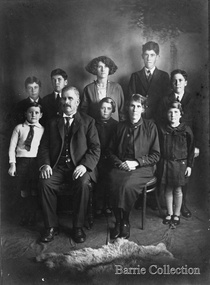
Photograph, Charles Ernest and Jessie Barrie with family, Unknown
... He was a member of the Methodist Church and later the Scots Presbyterian Church. He was Superintendent of the Sunday School of the Methodist Church to 1910 and later Scots Presbyterian Church until 1931. ...He was a member of the Methodist Church and later the Scots Presbyterian Church. He was Superintendent of the Sunday School of the Methodist Church to 1910 and later Scots Presbyterian Church until 1931. ...This document is has been compiled by Wendy Barrie daughter of Ernest (Bon) and Edna Barrie and granddaughter of Charles E and Jessie M Barrie. I was born in during WW 11 and the first child of my generation to live on the ‘ Darlingsford’ property at Melton. My grandfather was well known in the district and was mostly referred to as Ernie. He shared the same initials as his second son Edgar. His three eldest sons lived and farmed in Melton for their entire lives. His descendants are still associated with farming, engineering and earthmoving in Melton. Ernie Barrie operated a travelling Chaff Cutter in the St Arnaud area where his parents William and Mary Ann had taken up land at Coonooer West in 1873. Ernie commenced his working life with a team of bullocks and a chaff cutter. The earliest connection he had with Melton was in 1887. By the beginning of the 20th century Ernie and his father William and brothers, William, Samuel, James Edwin,[Ted] Robert, Arthur and Albert have been associated with farming and milling in the Melton district. In the early 1900’s Ernie and his brother Ted were in partnership in a Chaff cutting and Hay processing Mill on the corner of Station and Brooklyn road Melton South. The mill was managed by William for a time. By 1906 Charles Ernest and James Edwin were in partnership in the Station Road mill when a connecting rail line across Brooklyn Road for a siding was constructed to the Melton Railway Station. In 1911 the Mill’s letterhead shows C.E. BARRIE Hay Pressing and Chaff Cutting Mills. Melton Railway Station. Telephone No 1 Melton. This Mill as sold to H S K Ward in 1916 and stood until 1977 when it burnt down in a spectacular fire. Ernie built a house at Melton South beside the Chaff Mill at Station Road in 1906 and married Jessie May Lang in August at the Methodist Church. Jessie’s father was Thomas Lang. He came to Melton in 1896 and was the Head Teacher at Melton State School No 430 until he retired in 1917. They had 9 children with 8 surviving to adulthood. Jessie and Ernie had 6 sons and 3 daughters. All the children lived at Darlingsford. In April 1910 the family left Melton for a brief period and moved to a farm in Trundle in NSW. They returned to Melton and purchased Darlingsford in May 1911. For a time during WW1 they lived at Moonee Ponds near the Lang grandparents at Ascot Vale. Mary and Bon attended Bank St State School. The children developed diphtheria in 1916 and their youngest boy, Cecil died of complications. Mary and Bon were taken to Fairfield Hospital and both recovered. At the end of the war influenza broke out the family returned to Darlingsford and shared the home for a short while with the Pearcey family who had been working the farm. By 1922 the family had and grown and Edgar, Tom, Horace, Jessie, Joyce and Jim were living a Darlingsford. Ernie continued during the 1920’s working the farm and attend his many civic and community commitments. Two 8 clydesdale horse teams were used to work the land which meant early rising for the horses to be fed and harnessed to commence the days work. In 1916 Ernie also became involved in a Chaff Mill on the corner of Sunshine and Geelong Road West Footscray, which at the time was being run by John Ralph Schutt. It was known an Schutt Barrie. A flour mill was added at a later stage. Other Schutt and Barrie mills were situated at Parwan and Diggers Rest. Another mill was situated beside the railway line at Rockbank. The Footscray mill ceased operation in 1968 Ernie spent a lot of time and energy at the Parwan Mill and travelling around Parwan and Balliang farms, where he came to know many of the families in the district. Ernies commitment to the civic development to the Melton and district was extensive, he was involved with a number of large events during the 1920’s such as the Melton Exhibitions and the 1929 Back to Melton Celebrations. He was a member of the Australian Natives Association at the turn of the century. He was Chairman of the School Committee at Melton State School 430 and the Melton South State School in thw1920s. He donated the land for a Hall for Melton South in 1909, known as Exford Hall and later in 1919 renamed Victoria Hall. The Hall was demolished in 1992. He was a Councillor, JP, and Vice President and President of the Melton Mechanics Institute Hall Committee in 1915- 1916. He was a member of the Methodist Church and later the Scots Presbyterian Church. He was Superintendent of the Sunday School of the Methodist Church to 1910 and later Scots Presbyterian Church until 1931. This is reflected in the theme of children in the stained glass window which was dedicated in his memory by his wife Jessie as a gift to the Scots Church. Charles Ernest Barrie made many generous donations to many charities who supported young people and children. In 1918 Jessie and Ernie made the first donation to a very prominent Victorian charity whose work still continues. Yooralla. In July 1931 Ernie’s untimely death was a major blow to the family and the Melton community. To this day people still vividly recall the day they lined the streets for his funeral. The day of the funeral is recalled as the day Melton stood as two of their prominent citizens who tragically died on the same day. Their eldest daughter Mary had married Keith Robinson in 1930 and had just moved to Heatherdale Toolern Vale with their year old baby son. Bon the eldest son was 22, Edgar 18, Tom 16, Horace 15, Jessie and Joyce 10 and Jim 8 years old. A heavy burden of responsibility fell on the shoulders of the two eldest children, Mary particularly for her mother and Bon stepped in assuming head of the family for his mother, brothers and sisters living at the Darlingsford homestead. In the early 1930’s the three eldest sons took on many of the Civic and Church commitments which their father had held. This community involvement extended well into the 1980s. In 1941 Bon married Edna Myers and they moved into a house shifted from Harkness Lane to Harkness Lane on the eastern section of the Darlingford property. Edgar married Margaret Hodgkinson a Primary school teacher at Melton in 1949 and they lived in the Darlingsford house. Earlier Tom married May Ferris and lived on the eastern side of Ferris Lane in the Ferris home. Bon , Edgar and Tom often operated as a team effort, in particular at harvest time when a larger team of workers was needed. The three farms cultivated wheat, barley and oats and supplied the Mill with sheafed hay. They continued using horse teams until mechanisation in the 1940’s made the horses redundant. By the 1960s their five sons continued with farming. Many loads of hay were transported to the Mill in Footscray. Well into the 1960s hired harvest hands along with agricultural university students were involved in bringing in he harvest. Stacking was an art form in itself and Tom held the expertise for building and shaping the sides and roof. The stacks built in the district each had their own unique shape and could be recognized by their builders. The Barrie brothers developed a mechanical fork lift for picking up complete stooks and moving them to be loaded to the elevator to build the haystack. The prototype built by Bill Gillespie was attached to a Bedford truck. Later refinements in a collaborative effort with the Gillespie brothers a multi pronged fork was attached to the front of tractor which was hydraulically operated to raise each stook onto trucks to be transported to the site of the haystacks. This method of handling sheaves significantly reduced laborious pitchforking individual sheaves. This invention was soon taken up by farmers far and wide and was a common sight in the district at harvest time in the stacking season. I recall visiting farmers calling in at the house at Ferris Road farm to inspect this break through invention. The Clydesdale horse teams were used into the 1940s but by the 1950s the Barries’ farms were fully mechanised. When the demand for sheafed hay declined other crops were introduced these included barley, lucerne, wheat and peas. Sheep were added to the mix in the 1950s in an attempt to keep the farms more viable. In the 1970s part of the Barrie’s farms were facing a major disruption with the impending compulsorily acquisition of a strip of land for the construction the freeway bypass, which divided access between the Darlingsford homestead with those on Ferris Lane. Charles Ernest Barrie and Jessie May Lang's children: 1. Mary Ena BARRIE was born on 07 October 1907. She died on 29 April 1999. 2. Ernest Wesley BARRIE was born on 29 April 1909 in Ascot Vale, Victoria, Australia.He died on 25 December 1985 in Melton, Victoria, Australia. 3. Cecil William BARRIE was born on 23 February 1911.He died on 25 May 1916. 4. Charles Edgar BARRIE was born on 01 June 1913.He died on 06 October 1975. 5. Thomas Lindsay BARRIE was born on 25 November 1914.He died on 14 September 1990 in Melton, Victoria, Australia. 6. William Horace BARRIE was born on 11 October 1915.He died on 19 December 1950. 7. Jessie Maud BARRIE was born on 06 November 1920 in Bacchus Marsh, Victoria, Australia.She died on 26 February 1994. 8. Dorothy Joyce BARRIE was born on 06 November 1920 in Bacchus Marsh, Victoria, Australia.She died on 18 March 2003.. 9. James Edward BARRIE was born on 17 January 1922 in Bacchus Marsh, Victoria, Australia.He died on 23 August 2004 Family Photo with Edgar, Tom, Mary, Ernest (Bon), Horace, Jim, Charles Ernest, Jessie and Joyce local identities -
 Uniting Church Archives - Synod of Victoria
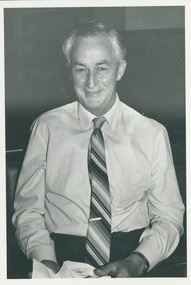
BW photo, December 1987
... This time there was a letter from the Government advising that a building on the south side of Collins Street originally owned by the Free Presbyterian Church in the 1800s was to be placed on the Historic Register and this was our first intimation of the matter. ...Alex Gillespie (29/2/1928–1/9/2009) worked for the Presbyterian Church as its Managing Treasurer for many years before then moving to the Uniting Church as the Synod Treasurer. ...Eulogy by John McArthur t seems trite to say that it is a privilege to be able to speak about Alex’s work in the Church, but having known Alex for over 50 years and our various activities having been inextricably intertwined it is indeed an honour as well as a privelge. I first met Alex in the late 1950s when we were members of the PFA State Council – they were halcyon days for the young people in the church with very strong youth groups in most congregations. Alex was the state Treasurer. John Anderson was the President with Maureen Hancock, the secretary, Maureen, who with many others from that Council are here today. Alex was also very active in his local church at Canterbury in all aspects of its life and witness as we have heard from his children, Barrie and Jo, earlier in this service Alex who had trained as an accountant, applied for and been appointed to a position with the PCV and upon the retirement of his mentor, S. K. Williams, was appointed the Financial Secretary of the Church. When I was appointed as a member of the Trusts Corporation, I was very glad to see that Alec was the secretary – most members were nearly twice my age and it waas comforting to be with an old friend of somewhat similar age. The meetings were reasonably formal as one would expect from a gathering of some of the very senior business men in our State. Alex’s records were immaculate – not only did his agendas have the business arising from the previous meeting but there on the side were a list of matters that in Alex’s opinion had not been satisfactorily finalised over the past year. But one matter has stuck in my memory - only the correspondence that required action was considered, many other letters were left to be formally minuted. This time there was a letter from the Government advising that a building on the south side of Collins Street originally owned by the Free Presbyterian Church in the 1800s was to be placed on the Historic Register and this was our first intimation of the matter. One trustee, a knight of the realm, whose chin was always down on his chest, ( I wondered whether he was asleep or something) raised his head and said “If one just stood still in Collins Street for five minutes they would slap a historic citation on you” and back down went his head. I was not sure what would happen next when I looked at Alex and slowly, that recognisable smile appeared on his face – not really a smile , more like a grin as Barrie and Jo said earlier, one that would appear time and time again over the years at meetings which were meant to be quite formal. Alex had an encyclopaedic memory – for example, ask him about bequest funds, say, the W. S. Godfrey Perpetual Bequest, his answer would be, “Ah yes, donated by the man who founded the Grocery business in Carlton, the capital now would be about 53, 250 dollars, been no call on it for 2 ½ years”. If a new project was thought appropriate and needed funding, he would be able to find a fund or a bequest that, with a little tweaking, could be used to seed the programme. His financial presentations at meetings contained all the information one could want – he would choose his words carefully, and one would sometimes think – get on with it Alex - but his purpose was to make it quite clear what funds were available and what was their correct use. He took this financial acumen into other committees of the church, the Stipend Committee dealing with Ministers’ salaries, the Beneficiary Committee, the superannuation fund for both ministers and lay workers. There are many in the church who have had cause to be grateful for his financial input which added to their well being. But his work was not all with financial matters – as the Financial Secretary for the State, Alex was ex-offficio a member of the Presbytery of Maroondah where he was not the Treasurer and although as an ex officio member he was not expected to take that much part in the Presbytery’s activities – but Alex did, he took part in the strategy and pastoral care committees which showed his depth of concern for others in his church life. But I believe it was around this time that Alex produced some of his greatest work for the church – Church Union, not all Presbyterians wanted to be part of the Uniting Church – so a Statutory Commision was established on a national level, to divide the assets of the Church between those desiring to form part of the Uniting Church and those wanting to remain Presbyterian. Each State produced detailed records and submissions for the Commission – and Victoria was always the first to have its documents to the Commission – although Alex had made it quite clear that he would be with the Uniting Church, his work was meticulous, impartial and assisted greatly the work of the Commission relating to Victoria. And this in addition to his normal day to day work which continued over a period of some four or five years. The inauguration of the Uniting Church did present Alex, and indeed the rest of us, with some challenges. There were the financial records of three churches to be merged, properties to be considered, new community programmes required, new administrative structures to be put in place. Alex took these all in his stride – although after the initial planning, his role was to concentrate on financial matters only, the other activities had to be financed. As the chairperson of the Finance Division and the Resources Commission for a large portion of the early years of the Uniting Church, I was more than pleased to have Alex again by my side, reports were prepared, queries answered, it was just like old times. The Rev. Allan Stuart, now retired and living closer to his family in NSW was one on those young people from the Canterbury congregation – emailed me recently “Alex has been a faithful servant of the Church, at all levels from the National Assembly to the local congregation. But times are changing, and Alex had rightly passed the torch onto others” Allan was right but I also think that words of that great Scottish poet, Robert Louis Stevenson, sum up Alex’s life: “A man is a success when he has lived well, laughed often and loved much. One who has gained the respect of intelligent men and the love of children; who has filled his niche and accomplished his task; who leaves the world better than he found it, whether by work, relationships, one who looked for the best in others and gave the best he had.” To me, that is our friend who we remember today - Alexander Robert Gillespie. BW photo of Alex Gillespie dressed in shirt sleaves and tie, upper body. C&N 11/2/1987, p. 33 alex gillespie (29/2/1928–1/9/2009) worked for the presbyterian church as its managing treasurer for many years before then moving to the uniting church as the synod treasurer. -
 Melton City Libraries
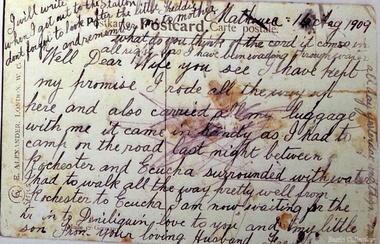
Postcard, Postcards from Fred and Mattie Myers, 1909-1914
... To Mr Fred Myers Wandook Stn Denniliquin NSW Dear Fred, received your letter I am sorry to hear you are having such wet weather I will write a letter tomorrow baby is better With Love from M Post Card: 1910 Postmark Stamp 1d Aug 12 1910 Moama NSW Melton postmark stamped Aug 25? ...To Mr Fred Myers Wandook Stn Denniliquin NSW Dear Fred, received your letter I am sorry to hear you are having such wet weather I will write a letter tomorrow baby is better With Love from M Post Card: 1910 Postmark Stamp 1d Aug 12 1910 Moama NSW Melton postmark stamped Aug 25? ...Post Card: Melton Railway Station 1909 Mattie to Fred My Dear Fred I received your letter and the L2 10/- I was very pleased to hear that I could write again. You say you will come home after the last shead. I should think so. I had a letter from E Jenkins so I am going down to see her next week we call the baby Fernie now I hope you will agree. Dear Fern has got the whooping cough. Written on the side: I suppose you will be away four weeks yet. Love from Mattie will write on Sunday. This letter appears to be connected with the post card Barwonleigh Saturday October 1908 handwriting My Dear Mattie I received your letter and was sorry to hear of our dear little babys misfortune how did it happen do you know what was the cause of it Mrs Watts must be a blind old fool not to have known what it was when you took him to her the first time poor dear you must be worried to death with all this trouble tell me what the doctor thinks of the rupture. I do hope dear he will get over this all right you must be nearly dead going without sleep for so long I had a bit of misfortune myself on Thursday the machine locked and jumped out of my hand and stuck in my bone I kept on working but it was very painful as all the holding is done with the..next page ..knee the boss also has been chipping a good deal this week he says the next time he has occasion to speak to me I will have to go he is very particular. I would like to go through if possible even if I do a lot less. I have about sixteen hundred done up to now and would get another nine hundred if I was let alone but I suppose we will live lovie even if I go do you know if they are full handed at Eynesbury if I thought I could get a week there I would cut myself out here quick. Well dear lovie I am sending you a couple of pounds as I suppose you will want it to get a truss. I don’t think they are very expensive and hope things will find this better with you. Well my dear love I must close with fond love for you and baby from your loving Husband Fred Post Card: 16 Aug 1909 - Mathoura The card depicts a small sailing boat laden with blue flowers. Well Dear Wife you see I have kept my promise. I rode all the way up here and also carried all my luggage with me it came in handy as I had to camp on the road last night between Rochester and Echuca surrounded by water. I had to walk all the way pretty well from Rochester to Echuca. I am now waiting for the train to Deniliquin. Love to you and my little son Fred. From you loving Husband Fred Written along the top and side of the card. what do you think if the card comes in all right as I have been wading through water all day yesterday and this might be …? will write when I get to the Station, don’t forget to look after the little Freddie and remember me to mother. Post Card: 1909 - view across the Flat from the Creek looking to the Presbyterian Church in the distance with some small dwellings in the foreground. To Mr Fred Myers Wandook Stn Denniliquin NSW Dear Fred, received your letter I am sorry to hear you are having such wet weather I will write a letter tomorrow baby is better With Love from M Post Card: 1910 Postmark Stamp 1d Aug 12 1910 Moama NSW Melton postmark stamped Aug 25? Hare Street, looking south Echuca Mrs F Myers, Melton P O Vic Dear Mattie, Just a line to let you know I got here all right I go to Pericotta tonight and to Cobran to morrow best love to all from yours Fred Letter Cobran Stn Via Deniliquin N.S.W. Sunday 21st Aug extract I am having a good time here, a good cook and the best of everything no fires to light or kettles to boil just get up and wire in… plenty hard work the sheep are pretty tough but much better than Wandook. I am well among them here we had a little rain on Friday but not enough to stop us so we have got one full week in .. the weather is lovely. I have been basking in the sunshine mainly in the morning and feel strong and fit a as fiddle, they are a grand lot of men here I only knew one out of the lots but know them all pretty well now, we have a bit of a concert here every nights almost there are a few good singers here and we also had a phonograph up from the station with all the latest records we have two dancers among ourselves very boisterous affairs indeed thy do make the dust fly. I have not ventured to take part in it and don’t think I will either. I get enough dancing all day long and besides I have to furnish the music you ought to see them going when I rattle up the concertina. Letter Cobran Stn via Deniliquin Thursday Sept 1st 1910 [abbreviated] My Dear Mattie, I received your welcome letter today. I though I was never going to get one as it was Sunday fortnight when I wrote to you but we only the mail here twice a week so it takes a long time to write and get an answer. I also got a reply from Eynesbury and a favourable reply it starts on the 13th Oct. …. I have 800 sheep shorn up to date and am fifth among about 30 men. I am sending two more [Ls] this time which I drew on Saturday. I don’t like sending too much more this time as there is a chance of it going astray and it is not very easily earned…. Things must be humming in Melton with all them babies coming and people getting married… I suppose we will be having new neighbours soon. If Mr Watts is selling out he was getting more property then he could keep. I hope you will soon have rain…. you will have to watch our little boy the dear little rascal he must be getting very cute opening the gates he will be tumbling into the tank …. I love to think of the happy times we have had together and hope that we will love one another to the end .. the mail will not leave here until Monday Love to you dear wife and baby Fred Post Card: – I Cling to you like Ivy Cobran September 18th 1910 Fred awaits a letter from Mattie I still have three weeks here yet.. I am sending L2 tell if you got the other 1L 1911 Letters Fred to Mattie October Spring Plains Oct 1911 Mia Mia Post Office I had a great job to catch the train at Diggers Rest as after I turned off the Keilor Rd it was very way and muddy and I had to walk a lot of the way and got there just in time. I came right into Redesdale by the train and stopped there last night… they had heavy rain on thursday up here and a tremendous fall of hail which covered the ground over a foot deep. There are only 4 shearers here yet.. I saw some of the sheep they look very rough and big so there will be no big tallies done, the men are saying he is giving 2s per hundred extra, so that will help a little. We are going to start Cobran via Deniliquin. Post Card: three scenes of Mathoura 10/9/1914 EB on a photo copy 10/9/12 ? Mathoura Thursday Dear Mattie, Just a line to let you know I got up here all right. I rode the seat out of my trousers. I have done 100 miles on the bike. I met none of the old hands this time so will go out on my own… Your loving husband Fred, did Marjie miss me at all. Post Card: Cobran 15th Sept 1912 Hearts and intertwined flowers and little envelope he has written Marjorie …just a line to let you know I will cut out here Friday next in find, we have had two falls of rain since I wrote and it has bean blowing a hurricane for couple of days and may blow up again however if we are delayed I will send you a card Wednesday I am longing to see you and the two little kiddies again…. Fred Copy only Golf Hill Sep 26th Cut out 31 Oct Total 2332 1913 Post Card: Scene View Street, Bendigo August 1913 Mathoura Tuesday My Dear Mattie Just a line to let you know I got up here all right. Teddy Ginger and another couple of chaps on the way ……. Letter Cobran Sunday Aug 7th 1913 My Dear Mattie Just a line to let you know that weather permitting we will cut out here about Thursday morning….I have not got any more shearing here. I have not heard from the other place…. Expect me about Friday …. I suppose Freddie and Marjie will be glad to see me, Marjie will climb all over me. I will be glad to se you all again you will have a fortnight before Golf Hill starts. I see in the Express you sent that Annie McPherson of (Dunvegan) is engaged to Len Farrell, she appears to be going to take no risks with him she wont let him slip through her hands like the banker did…… Fred Post Card: 1914 Garland of roses Warrambeen Stn Shelford PO October 14th 1914 Birthday wishes. Post Card: Love’s Golden Chain Golf Hill Tuesday Oct 17 1914 Birthday wishes [ this one might be a different year] Letter Cobran Wed 2nd Sept 1914 My Dear Mattie, I received your welcome letter today and also the papers which were very acceptable as we don’t get many papers here we only get see one at odd times as we get none for the hut this year.. I have not seen a bit of butter since I left home as it is too dear for us for sinners here. Poor Marjie had a cold.. so the little kid wants to go to the war, she must think it is good like a picnic. We had light rain on Monday as usual only half a day’s shearing in the shed so that is all we done this week, we took a vote 9 to 6 no shearing so nothing till to morrow morning Thursday so there is still a good fortnights shearing to do, will do nothing Saturday polling day as we have to go 13 miles is near Services where I was last year so we will want the full day 50 men to vote and some will probably have to walk to get there, all solid for Labour. I have just had an interval for lunch, pudding, yeast buns and rock cakes… We are doing nothing but eating and sleeping this week. Fred I am sending L1 in this which will do you till I come back if I keep drawing up I will have none when I finish so make the most of it. Post Card: Two doves with violets 1915 Cobran Wed 18th Sept [could be 1912] Sorry to tell you we are delayed with rain so will not be home till next week… only 3 days of shearing to do…. expect me about the middle of next week….I wish I was with you now and the dear little ones Fred Post Card: Iris Flowers Barwonleigh Stn Tuesday Oct 14th 1918 Happy birthday greetings from Fred Post Card: Irrigation channel Swan Hill 5 Year not shown Swan Hill Tuesday night Just a few lines to let you know I got this far all right. I had to walk nearly all the way to Gisborne and got there last night and took the train here today. It has been raining all the way between Gisborne and here. Moulamein tomorrow. I think it will be another case of walking as it is wet here no metal roads all mud. best love to yourself and the little ones and also mother. will write Sunday Post Card: The White Man’s Burden.The writing on the back rubbed out Mattie has written, I was weighed and I am 8 stone 10 pounds. 14 Post Cards, some have the original dates, others have the date added later by Martha. Two envelopes, one with addressed to Melton postmark Moule, stamp torn off, the other Cards from my dear Fred. The letters and the notebooks can be cross checked according the their contents. Italics show the dates added by Mattie local identities -
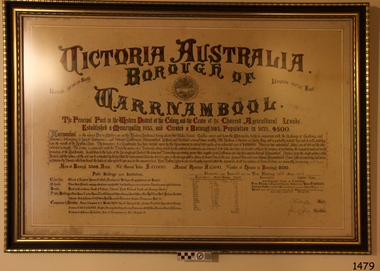 Flagstaff Hill Maritime Museum and Village
Document - Framed Poster, Borough of Warrnambool, Victoria, Australia, after 30/06/1875
... Church of England, Roman Catholic, Presbyterian, Wesleyan, Congregational and Baptist. ...Church of England, Roman Catholic, Presbyterian, Wesleyan, Congregational and Baptist. ...This document, also referred to as a word picture or Tablet, is framed in glass and timber with gilt trim, is handwritten with colour highlights. The penned letters rest on ruled guide lines, decorated where the lines intersect. The writing gives a description of the state of Borough of Warrnambool around 1875; its location, the area it covers, its population, Harbour and facilities, public buildings and institutions, imports and exports, financial worth, number of houses, connection with other areas of the Colony. A possible reason and origin for the document is found in an article ‘Link with US Exhibition’ from the Warrnambool Standard of December 19, 1981, written by local historian Bruce Morris. The writer mentions that the Warrnambool Borough Council met on 15th June 1875 and recorded a letter from G.C. Levey , secretary to the Melbourne group of commissioners representing the Colony, and Victoria in particular, for the Philadelphia Centennial Exhibition of 1876. The letter asks Council to provide “statistics as to the population, social condition and commercial and industrial state of the district in and around Warrnambool.” A sub committee was formed for the project. The Mayor, Cr. Thomas King, wrote and signed a Report, presented to the council on July 14, 1875, in which “The Committee … begs to recommend that a Tablet be prepared setting for the particulars respecting the following matters relating to the Borough”. The matters included area, population, annual income, churches, schools, other public buildings, societies and companies, general description of houses erected, and returns of exports and imports for 1874. The minutes note that the Report was adopted. The article above also notes the opinion of Warrnambool printers who have examined the document; it is almost certainly to be an old lithograph, which means there could be several copies. It is possible that there may be a copy in Melbourne and another in Philadelphia. It is interesting to note that (1) the quoted location co-ordinates are for an “Unnamed Road, Packsaddle NSW 2880, Australia”, and that the DMS co-ordinates for Warrnambool’s Council Offices differ, being 38.23.9.12 South, 142.28.52.887. (2) the date for “Exports and Imports for the Year Ending 30th June 1875” is different to the period mentioned by Cr. King in the sub committee’s Report of recommendation “returns of exports and imports for 1874”. The information required to have the figures for the end of June 1875 would need to have been compiled very quickly for the Tablet to be ready for the opening of the Philadelphia Exhibition on 10 May 1876. The document/certificate shows the following – - - - - - - - - - - - - - - -- - - - - - - - - - - - - - -- - - - - - - - - - - - - - -- - - - - - - - - - - - - - - “Victoria Australia, Borough of Warrnambool. Latitude, 30.24.50 South, Longitude 142.32 East The Principal Port in the Western District of the Colony and the Centre of its Choicest Agricultural Lands. Established a Municipality in 1855, and Created a Borough 1863. Population in 1875 4,500. Warrnambool is the nearest Port to Melbourne on the Western Seaboard, being about 160 miles distant. Coaches run to and from the Metropolis daily, in connexion [connection] with the Railway of Geelong and Steamers belonging to Local Companies sail between Melbourne, Warrnambool, Belfast [renamed Port Fairy], and Portland several times weekly. The Harbour is known as Lady Bay, and is partially protected by a reef of rocks stretching from the mouth of the Hopkins River. The formation of a Breakwater has been decided upon by the Government, to extend 600 yards, at an estimated cost of £100,000. There are two substantial Jetties, one of 800 and the other of 600 feet in length. The former is connected with the Town by means of a Tramroad, along which Goods, inwards & outwards, are conveyed, & the latter has been constructed solely for the purpose of facilitating the transit of material for the formation of the Breakwater. In addition to the trade of the Borough and District, the principal Townships up country receive their supplies from Melbourne and ship their exports through Warrnambool. Potatoes form the staple produce of the district, and the richness of the soil can be estimated by the fact that the Government Statistics for 1875 give as the average yield a return of Seven Tons to the acre. Several thousand acres between Warrnambool and Tower Hill are now being laid down in Potatoes by Tenants who have leased the lands at rates up to £5 per acre for the season 1875-6. Wool, Tallow, hides &c are also largely exported, while the shipments of all descriptions of Farm Produce are annually increasing. Area of Borough, 3362 Acres. Net Annual Value £27,000. Annual Revenue £5,500. Number of Houses in Borough 800. Public Buildings and Institutions Churches. Church of England, Roman Catholic, Presbyterian, Wesleyan, Congregational and Baptist. Schools. Three State Schools, average attendance nearly 1000. New Building in course of erection. Several private establishments. Banks. Bank of Australasia, Bank of Victoria, National Bank, Colonial Bank and Savings Bank. Public Buildings. Court house, Custom house, Post & Telegraph Offices, Survey & Land Offices, Shire £, Town Hall, Mechanics Institute, Volunteer Orderly Room, Odd Fellows Hall, Hospital & Benevolent Asylum, Temperance Hall &c. Companies & Societies. Steam Navigation Co, Woolen Mill Co, Gas Co, Racing Club, Amateur Turf Club, Agricultural Society, Farmers’ Club, Cricket Club, Anglers’ Society, Building Society, Freemasons Odd Fellows, Foresters, Druids, Hibernians. Protestant Alliance, Rechabites, Sons of Temperance, &c, Fire Brigade &c. --- Exports and Imports for the Year Ending 30th June 1875 –-- --Exports Total Tonnage 27,800 (Calculated at the Current Warrnambool Market Prices) Potatoes Wool Wheat Barley Hides Skins Fowls Butter Cheese Eggs Tallow Leather Ale Pigs Sheep Sundries --Imports 13,000 Tons Of the Estimated Value of £520,000 Total Tonnage of Exports and Imports 40m900 Tons, Value £806,627 Passenger Travels, to ad from Warrnambool during year, 10,000 persons Revenue from all sources paid through Warrnambool Sub Treasury From 1860 to June 1875 £1, 292, 300 Thomas King [signed] Mayor Henry T Read [signed] Town Clerk” - - - - - - - - - - - - - - -- - - - - - - - - - - - - - -- - - - - - - - - - - - - - -- - - - - - - - - - - - - - - The document is of historical, social, economic and local significance in that it summarises activities, business, community, trade, travel and government at a point in time in Warrnambool’s history – 30th June 1875. Document, also referred to as a ‘word picture’ or ‘tablet’. Document is framed in glass and timber with gilt trim, handwritten with colour highlights. The penned letters rest on ruled guide lines, decorated where the lines intersect. Document outlines the establishment of Warrnambool as a Municipality in 1855 and Borough in 1863, with a population of 4,500 in 1875. It states geographic location, public buildings and institutions, harbor facilities and imports and exports for the year ending 30th June 1875. Two signatures "Thomas King" Mayor and "Henry T Read" Town Clerk. It shows the Coat of Arms of the Borough of Warrnambool. Signatures - "Thomas King" Mayor and "Henry T Read" Town Clerk. Warrnambool Coat of Arms; “British Coat of Arms, above sailing vessel and sheaf of wheat in sun, motto “By these we flourish” and around circumference “Borough of Warrnambool 1855” flagstaff hill, warrnambool, shipwrecked coast, flagstaff hill maritime museum, maritime museum, shipwreck coast, flagstaff hill maritime village, great ocean road, borough of warrnambool, municipality of warrnambool, document borough of warrnambool 1875, word picture of warrnambool 1875, tablet of borough of warrnambool 1875, statistics borough of warrnambool 1875, lithograph borough of warrnambool 1875, coat of arms warrnambool, warrnambool city motto – in these we flourish, establishment of warrnambool, warrnambool history, thomas king mayor of warrnambool, henry t read town clerk of warrnambool, warrnambool breakwater, warrnambool jetty, warrnambool imports and exports 1875, warrnambool agriculture 1875, warrnambool business 1875, warrnambool population 1875, centennial exhibition philadelphia 1876, framed certificate -
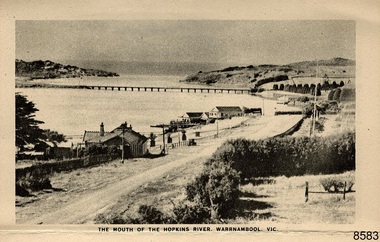 Flagstaff Hill Maritime Museum and Village
Postcard - Postcard Folder - scenes, George Rose, Rose Stereographic Company, Rose Series Picturesque Views of Warrnambool Australia [Warrnambool], 1880-1942
... [Kepler Street towards Presbyterian Church on Spence St] George Rose, 1861-1942: - famous for his Late 19th and early 20th century photography. ...This postcard folder contains lithographs of photographs taken locally by Georg Rose between 1880 and 1942. He reproduced them at his company's premises, the Rose Stereographic Company at Armadale, Victoria. The postcard folder was purchased as a Warrnambool souvenir by the donor's parents around 1945 to 1950. Interestingly, the city on the cover is printed as "Warrambool", which is a location in New South Wales, but the postcards within all have the locations and text of Warrnambool. The photographs include the 'new' concrete bridge, built in 1922 to replace the original bridge, built in 1872. The boathouses belonging to Proudfoots and to Flett/Fanny Nelson are also pictured on the Hopkins River mouth. The twelve photographs included locations connected to other items in our Collection. The photographs are titled: - b. The Avenue and War Memorial. Warrnambool. Vic. c. The Blow-hole. Thunder Point. Warrnambool. Vic. d. Botanical Gardens. Warrnambool. Vic. e. Eagle Rock. Warrnambool. Vic. f. The New Concrete Bridge and Breakwater. Warrnambool. Vic. g. Liebig Street. Warrnambool. Vic. h. Looking to Thunder Point. Warrnambool. Vic. i. The Beach. Warrnambool. Vic. j. Hopkins Falls. Warrnambool. Vic. k. Shelly Beach. Warrnambool. Vic. l. The Mouth of the Hopkins River. Warrnambool. Vic. m. Panorama of Warrnambool. Vic. [Kepler Street towards Presbyterian Church on Spence St] George Rose, 1861-1942: - famous for his Late 19th and early 20th century photography. He was born in Clunes, Victoria, and was in his 20th year when he founded Rose Stereograph Company in 1880. He took the opportunity of a popular trend of the times to produce stereographs, pairs of almost duplicate photographs which appeared to be in 3D when viewed in a handheld stereo viewer. By the 1920s these lost their popularity, so he used his photographic skills to produce cards and postcards of scenes and people. The photographs in this postcard folder were taken between 1880 and 1942 by the renowned Victorian photographer George Rose. The locations match photographs and postcards in our collection that were taken at different times. A comparison between them shows the changes over time in the land and bay, the buildings and other structures, transportation and even the fashions of the times, building the story of our local history. This copy of a postcard folder has a blue-grey textured rectangular card cover with a sketch of a rose on the front along with the name of the postcard series. the location of the series' focus, the producer's details and lines for adding an address. The folded cover contains a long, concertinaed page with six titled photographs on each side, totalling twelve in all. Interestingly, the cover has the location name of "Warrambool", a place in NSW, instead of Warrnambool, the location of all of the photographs inside. The folder contains scenes from Warrnambool and nearby popular areas including Lady Bay, Port of Warrnambool, Warrnambool Breakwater, Viaduct, Merri River Footbridge, the Hopkins River Mouth, with Proudfoot’s and the Fanny Nelson/Flett boathouses. The cover has a sketch of a rose and inscriptions. The photographs for the lithographs were taken prior between 1880 and 1942 by well-known Victorian photographer, George Rose, Rose Stereograph Company of Armadale, Victoria. Image: [Rose with rosebud and leaves] Printed: "Rose Series / Picturesque Views of / WARRAMBOOL / AUSTRALIA" [correct spelling is WARRNAMBOOL] "PUBLISHED BY / ROSE STEREOGRAPH CO / ARMADALE. VIC." Printed lines (3) for an address. Printed rectangle [ ] for attaching a stamp. flagstaff hill maritime museum and village, great ocean road, shipwreck coast, warrnambool, flagstaff hill, flagstaff hill maritime museum, flagstaff hill maritime village, warramble, postcard, postcard folder, warrnambool scenes, picturesque views of warrnambool, picturesque views of warramble, lady bay, port of warrnambool, breakwater, warrnambool breakwater, viaduct, merri river footbridge, merri river suspension bridge, suspension footbridge, merri river mouth, hopkins river mouth, proudfoot's, fanny nelson, nelson's boatsheds, nelson's boathouse, boathouse, hopkins river boathouses, flett's boathouse, flett, george rose, image of a rose, rose series, rose stereograph co, rose stereographic company, lighograph, armadale victoria, lady bay beach, beach scene, lower light, concrete footbridge, 1922 footbridge, viaduct road, rose postcard, new concrete bridge, 1945, 1890, 1922, small footbridge, 1872 footbridge, 1872, merri river estuary, stingray bay, postcards -
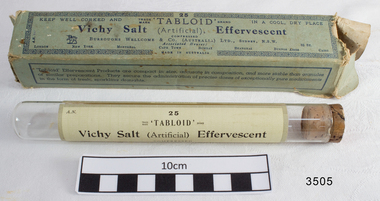 Flagstaff Hill Maritime Museum and Village
Box and glass tube, about 1912
... The organisation began in South Australia through the Presbyterian Church in that year, with its first station being in the remote town of Oodnadatta, where Dr Angus was stationed. ...Wellcome & Burroughs pharmaceutical company was founded in London in 1880 by American pharmacists. The first overseas branch opened in Sydney, Australia, in 1898 and by 1912 another 7 branches had opened. The box lists all of the 9 branches on it. Vichy Effervescent Salts are an antacid mixture in a tablet form. Wellcome & Burroughs company invented the name “Tabloid” to describe the process of compacting powders in measured doses to form a tablet. The label attached around the glass tube lists the same information as on the box, and also gives directions “One powdered and dissolved in wineglassful (about two ounces) of water represents an equal quantity of Vichy Water (Grand Grille Spring) in all its essential constituents and may be taken when required, as ordered by the physician.” “KEEP WELL CORKED AND IN A COOL DRY PLACE” The mineral spring waters from Vichy, France, have been used through the ages as a natural therapy, including aiding the digestive system. The Vichy tablets are made from chemicals that have similar properties. This box once containing Vichy Effervescent Salts was donated to Flagstaff Hill Maritime Village by the family of Doctor William Roy Angus, Surgeon and Oculist. It is part of the “W.R. Angus Collection” that includes historical medical equipment, surgical instruments and material once belonging to Dr Edward Ryan and Dr Thomas Francis Ryan, (both of Nhill, Victoria) as well as Dr Angus’ own belongings. The Collection’s history spans the medical practices of the two Doctors Ryan, from 1885-1926 plus that of Dr Angus, up until 1969. ABOUT THE “W.R.ANGUS COLLECTION” Doctor William Roy Angus M.B., B.S., Adel., 1923, F.R.C.S. Edin.,1928 (also known as Dr Roy Angus) was born in Murrumbeena, Victoria in 1901 and lived until 1970. He qualified as a doctor in 1923 at University of Adelaide, was Resident Medical Officer at the Royal Adelaide Hospital in 1924 and for a period was house surgeon to Sir (then Mr.) Henry Simpson Newland. Dr Angus was briefly an Assistant to Dr Riddell of Kapunda, then commenced private practice at Curramulka, Yorke Peninsula, SA, where he was physician, surgeon and chemist. In 1926, he was appointed as new Medical Assistant to Dr Thomas Francis Ryan (T.F. Ryan, or Tom), in Nhill, Victoria, where his experiences included radiology and pharmacy. In 1927 he was Acting House Surgeon in Dr Tom Ryan’s absence. Dr Angus had become engaged to Gladys Forsyth and they decided he would take time to further his studies overseas in the UK in 1927. He studied at London University College Hospital and at Edinburgh Royal Infirmary and in 1928, was awarded FRCS (Fellow from the Royal College of Surgeons), Edinburgh. He worked his passage back to Australia as a Ship’s Surgeon on the on the Australian Commonwealth Line’s T.S.S. Largs Bay. Dr Angus married Gladys in 1929, in Ballarat. (They went on to have one son (Graham 1932, born in SA) and two daughters (Helen (died 12/07/1996) and Berenice (Berry), both born at Mira, Nhill ) Dr Angus was a ‘flying doctor’ for the A.I.M. (Australian Inland Ministry) Aerial Medical Service in 1928 . The organisation began in South Australia through the Presbyterian Church in that year, with its first station being in the remote town of Oodnadatta, where Dr Angus was stationed. He was locum tenens there on North-South Railway at 21 Mile Camp. He took up this ‘flying doctor’ position in response to a call from Dr John Flynn; the organisation was later known as the Flying Doctor Service, then the Royal Flying Doctor Service. A lot of his work during this time involved dental surgery also. Between 1928-1932 he was surgeon at the Curramulka Hospital, Yorke Peninsula, South Australia. In 1933 Dr Angus returned to Nhill where he’d previously worked as Medical Assistant and purchased a share of the Nelson Street practice and Mira hospital from Dr Les Middleton one of the Middleton Brothers, the current owners of what was once Dr Tom Ryan’s practice. Dr L Middleton was House Surgeon to the Nhill Hospital 1926-1933, when he resigned. [Dr Tom Ryan’s practice had originally belonged to his older brother Dr Edward Ryan, who came to Nhill in 1885. Dr Edward saw patients at his rooms, firstly in Victoria Street and in 1886 in Nelson Street, until 1901. The Nelson Street practice also had a 2 bed ward, called Mira Private Hospital ). Dr Edward Ryan was House Surgeon at the Nhill Hospital 1884-1902 . He also had occasions where he successfully performed veterinary surgery for the local farmers too. Dr Tom Ryan then purchased the practice from his brother in 1901. Both Dr Edward and Dr Tom Ryan work as surgeons included eye surgery. Dr Tom Ryan performed many of his operations in the Mira private hospital on his premises. He too was House Surgeon at the Nhill Hospital 1902-1926. Dr Tom Ryan had one of the only two pieces of radiology equipment in Victoria during his practicing years – The Royal Melbourne Hospital had the other one. Over the years Dr Tom Ryan gradually set up what was effectively a training school for country general-practitioner-surgeons. Each patient was carefully examined, including using the X-ray machine, and any surgery was discussed and planned with Dr Ryan’s assistants several days in advance. Dr Angus gained experience in using the X-ray machine there during his time as assistant to Dr Ryan. Dr Tom Ryan moved from Nhill in 1926. He became a Fellow of the Royal Australasian College of Surgeons in 1927, soon after its formation, a rare accolade for a doctor outside any of the major cities. He remained a bachelor and died suddenly on 7th Dec 1955, aged 91, at his home in Ararat. Scholarships and prizes are still awarded to medical students in the honour of Dr T.F. Ryan and his father, Dr Michael Ryan, and brother, John Patrick Ryan. ] When Dr Angus bought into the Nelson Street premises in Nhill he was also appointed as the Nhill Hospital’s Honorary House Surgeon 1933-1938. His practitioner’s plate from his Nhill surgery states “HOURS Daily, except Tuesdays, Fridays and Saturday afternoons, 9-10am, 2-4pm, 7-8pm. Sundays by appointment”. This plate is now mounted on the doorway to the Port Medical Office at Flagstaff Hill Maritime Village, Warrnambool. Dr Edward Ryan and Dr Tom Ryan had an extensive collection of historical medical equipment and materials spanning 1884-1926 and when Dr Angus took up practice in their old premises he obtained this collection, a large part of which is now on display at the Port Medical Office at Flagstaff Hill Maritime Village in Warrnambool. During his time in Nhill Dr Angus was involved in the merging of the Mira Hospital and Nhill Public Hospital into one public hospital and the property titles passed on to Nhill Hospital in 1939. In 1939 Dr Angus and his family moved to Warrnambool where he purchased “Birchwood,” the 1852 home and medical practice of Dr John Hunter Henderson, at 214 Koroit Street. (This property was sold in1965 to the State Government and is now the site of the Warrnambool Police Station. ). The Angus family was able to afford gardeners, cooks and maids; their home was a popular place for visiting dignitaries to stay whilst visiting Warrnambool. Dr Angus had his own silk worm farm at home in a Mulberry tree. His young daughter used his centrifuge for spinning the silk. Dr Angus was appointed on a part-time basis as Port Medical Officer (Health Officer) in Warrnambool and held this position until the 1940’s when the government no longer required the service of a Port Medical Officer in Warrnambool; he was thus Warrnambool’s last serving Port Medical Officer. (The duties of a Port Medical Officer were outlined by the Colonial Secretary on 21st June, 1839 under the terms of the Quarantine Act. Masters of immigrant ships arriving in port reported incidents of diseases, illness and death and the Port Medical Officer made a decision on whether the ship required Quarantine and for how long, in this way preventing contagious illness from spreading from new immigrants to the residents already in the colony.) Dr Angus was a member of the Australian Medical Association, for 35 years and surgeon at the Warrnambool Base Hospital 1939-1942, He served as a Surgeon Captain during WWII1942-45, in Ballarat, Victoria, and in Bonegilla, N.S.W., completing his service just before the end of the war due to suffering from a heart attack. During his convalescence he carved an intricate and ‘most artistic’ chess set from the material that dentures were made from. He then studied ophthalmology at the Royal Melbourne Eye and Ear Hospital and created cosmetically superior artificial eyes by pioneering using the intrascleral cartilage. Angus received accolades from the Ophthalmological Society of Australasia for this work. He returned to Warrnambool to commence practice as an ophthalmologist, pioneering in artificial eye improvements. He was Honorary Consultant Ophthalmologist to Warrnambool Base Hospital for 31 years. He made monthly visits to Portland as a visiting surgeon, to perform eye surgery. He represented the Victorian South-West subdivision of the Australian Medical Association as its secretary between 1949 and 1956 and as chairman from 1956 to 1958. In 1968 Dr Angus was elected member of Spain’s Barraquer Institute of Barcelona after his research work in Intrasclearal cartilage grafting, becoming one of the few Australian ophthalmologists to receive this honour, and in the following year presented his final paper on Living Intrasclearal Cartilage Implants at the Inaugural Meeting of the Australian College of Ophthalmologists in Melbourne In his personal life Dr Angus was a Presbyterian and treated Sunday as a Sabbath, a day of rest. He would visit 3 or 4 country patients on a Sunday, taking his children along ‘for the ride’ and to visit with him. Sunday evenings he would play the pianola and sing Scottish songs to his family. One of Dr Angus’ patients was Margaret MacKenzie, author of a book on local shipwrecks that she’d seen as an eye witness from the late 1880’s in Peterborough, Victoria. In the early 1950’s Dr Angus, painted a picture of a shipwreck for the cover jacket of Margaret’s book, Shipwrecks and More Shipwrecks. She was blind in later life and her daughter wrote the actual book for her. Dr Angus and his wife Gladys were very involved in Warrnambool’s society with a strong interest in civic affairs. Their interests included organisations such as Red Cross, Rostrum, Warrnambool and District Historical Society (founding members), Wine and Food Society, Steering Committee for Tertiary Education in Warrnambool, Local National Trust, Good Neighbour Council, Housing Commission Advisory Board, United Services Institute, Legion of Ex-Servicemen, Olympic Pool Committee, Food for Britain Organisation, Warrnambool Hospital, Anti-Cancer Council, Boys’ Club, Charitable Council, National Fitness Council and Air Raid Precautions Group. He was also a member of the Steam Preservation Society and derived much pleasure from a steam traction engine on his farm. He had an interest in people and the community He and his wife Gladys were both involved in the creation of Flagstaff Hill, including the layout of the gardens. After his death (28th March 1970) his family requested his practitioner’s plate, medical instruments and some personal belongings be displayed in the Port Medical Office surgery at Flagstaff Hill Maritime Village, and be called the “W. R. Angus Collection”. The W.R. Angus Collection is significant for still being located at the site it is connected with, Doctor Angus being the last Port Medical Officer in Warrnambool. The collection of medical instruments and other equipment is culturally significant, being an historical example of medicine from late 19th to mid-20th century. Dr Angus assisted Dr Tom Ryan, a pioneer in the use of X-rays and in ocular surgery. A rectangular box of Tabloid brand 'Vichy Salt (Artificial Effervescent), medication from Dr T.F. Ryan's medical practice. Inside is a glass tube with rounded base and a cork stopper. The tube contains a cotton wool swab. Around the tube is a paper label listing the same information as per box label. Box is lined with white corrugated cardboard. (part of the W.R. Angus Collection) On label of box “Vichy Salt (Artificial) Effervescent”, 25 compressed tablets, made by Burroughs, Wellcome & Co. Australia Ltd, Sydney, NSW. “ ” “KEEP WELL CORKED AND IN A COOL DRY PLACE” flagstaff hill, warrnambool, shipwrecked coast, flagstaff hill maritime museum, maritime museum, shipwreck coast, flagstaff hill maritime village, great ocean road, wellcome & burroughs, vichy, tabloid, wellcome & burroughs, dr w r angus, dr t f ryan, nhill hospital, nhill, medical treatment, dental treatment, flagstaff hill, warrnambool, shipwrecked coast, flagstaff hill maritime museum, maritime museum, shipwreck coast, flagstaff hill maritime village, great ocean road, wellcome & burroughs, vichy, tabloid, wellcome & burroughs, dr w r angus, dr t f ryan, nhill hospital, nhill, medical treatment, dental treatment -
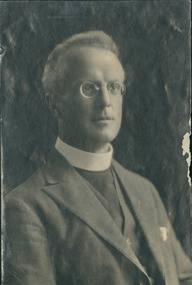 Uniting Church Archives - Synod of Victoria
Photograph, Rev. Dr. Clifford Norman Button, 1928
... b. 1888 London; 1908 to Sydney NSW University of Sydney, St Andrew's Theological Hall; 1918 ordained Binbara NSW; 1920 Glebe; overseas, Theological Seminary New York; Edinburgh PhD; 1924–27 Candish Church Edinburgh; 1928 Ballarat, St Andrew's; 1941, 1942 Moderator, Victoria; chairman Ballarat College; died June 4 1950. button, clifford norman st. andrew's ballarat victorian moderator ballarat college "Rev. ...b. 1888 London; 1908 to Sydney NSW University of Sydney, St Andrew's Theological Hall; 1918 ordained Binbara NSW; 1920 Glebe; overseas, Theological Seminary New York; Edinburgh PhD; 1924–27 Candish Church Edinburgh; 1928 Ballarat, St Andrew's; 1941, 1942 Moderator, Victoria; chairman Ballarat College; died June 4 1950. Head and shoulders portrait of Button who is wearing rimless glasses and a clerical collar and suit. "Rev. C. N. Button M.A., B.D., Ph.D, formerly of Merchison Presbyterian Church Edinburgh, who last Thursday Mar 1 accepted the call from St Andrews Kirk Congregation Ballarat" button, clifford norman, st. andrew's ballarat, victorian moderator, ballarat college -
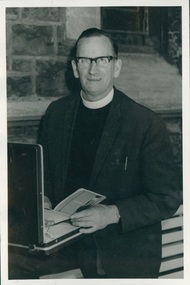 Uniting Church Archives - Synod of Victoria
Photograph, Undated, c. 1970s
... He married Emily Ferguson, a presbyterian girl, but felt a calling to the Methodist Church. John went to Underbool in Vic in 1939. ...He married Emily Ferguson, a presbyterian girl, but felt a calling to the Methodist Church. John went to Underbool in Vic in 1939. ...Born on the West Coast of Tasmania. Became a teacher inTasmania in the early 1930. He married Emily Ferguson, a presbyterian girl, but felt a calling to the Methodist Church. John went to Underbool in Vic in 1939. Joined the RAAF in 1942 and trained as a Navigator for Bomber Command. Was recalled in 1943 and began his ministry in the Woomelang Circuit, then at Mitiamo 1947-1950; Port Fairy 1950-52; Nathalia 1952-54. He left the ministry and bought a small farm near Bendigo. After 18 mths he started preaching at Mckenzie Street Methodist church with the title Pastor. In 1958 he was recalled to the ministry and served at Morwell. He was also chaplain to Morwell River Prison, Newport West, Coburg, Milan Italy and Finally at Moonee Ponds where he retired in 1978. After retirement he did supply work in places such as Sea Lake, Heathcote, Warragul and Quirindi NSW. John died on 25 July 2000. B & W photograph of Rev. John Adamthwaite standing in front of an open briefcase. john adamthwaite, methodist, minister -
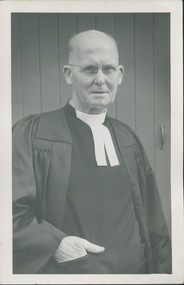 Uniting Church Archives - Synod of Victoria
Photograph, C. 1952 - 1954
... T G Allen served at Gympie 1921, Amidale NSW 1932, Eastwood NSW 1937, St. John's Essendon Vic 1943-1954 and Mowbranton Qld. 1955. ...T G Allen was born 07/06/1890 and died 10/03/1970. He was ordained at Wilston Qld. in 1921. T G Allen served at Gympie 1921, Amidale NSW 1932, Eastwood NSW 1937, St. John's Essendon Vic 1943-1954 and Mowbranton Qld. 1955. F15.1 and F15.2 black and white portrait photographs of a Presbyterian minister with white borders. They show the Rev T G Allan looking at the camera wearing clerical robes. His right hand is in his pocket. (1) Essendon December 1954 T. G. Allan (signed). (2) Centenary year 1952 T.G. Allan 1943- presbyterian minister, t g allen presbyterian minister, t g allen, st john's essenden presbyterian church
