
Showing 5 items matching "priest's stole"
-
 Flagstaff Hill Maritime Museum and Village
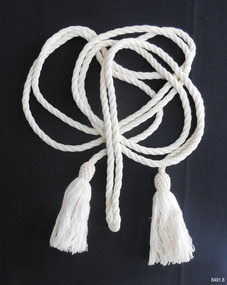
Ceremonial object - Priest's robe sash, Joyce Maslen, February 1982
... ...Priest's stole...Priest's robe sash or stole, part of a set of Ecclesiastical Linen once used in St. ...The church was funded and attended by the local community in the early 1900's and is now listed on the Victorian Heritage Database (VHD 118083) as a building of historical and social significance. flagstaff hill warrnambool maritime museum shipwreck coast great ocean road st andrews anglican church dennington dennington church warrnambool church 1907 ecclesiastical linen communion linen hand worked linen religious service religious ceremony Priest's stole Priest's robe sash sash knotted sash Priest's vestment Priest's robe sash or stole, part of a set of Ecclesiastical Linen once used in St. ...This item is part of the collection of Ecclesiastical Linen once used by St. Andrews Anglican Church on the corner of the Esplanade and 14 Drummond St, Dennington, Victoria. The first Anglican service was conducted on December 22nd, 1907. The church was decommissioned in January 2003. This item is part of the Ecclesiastical Linen collection, which is significant for its examples of handworked embroidery and drawn-thread work from the early 20th century. The items are also examples of a collection used for religious services during this period. The Ecclesiastical Linen is also significant for its association with the early development of the local township of Dennington and the importance the the community of setting aside land in the 1850's for the purpose of religious worship. The Ecclesiastical Linen is also significant for its connection to St Andrews Anglican Church, Dennington. The church was funded and attended by the local community in the early 1900's and is now listed on the Victorian Heritage Database (VHD 118083) as a building of historical and social significance. Priest's robe sash or stole, part of a set of Ecclesiastical Linen once used in St. Andrew's Anglican Church, Dennington, Victoria, between the years 1907 and 2003. The soft, white cotton, twisted cord is finished at each end with a knot and tassel.flagstaff hill, warrnambool, maritime museum, shipwreck coast, great ocean road, st andrews anglican church dennington, dennington church, warrnambool church 1907, ecclesiastical linen, communion linen, hand worked linen, religious service, religious ceremony, priest's stole, priest's robe sash, sash, knotted sash, priest's vestment -
 Flagstaff Hill Maritime Museum and Village
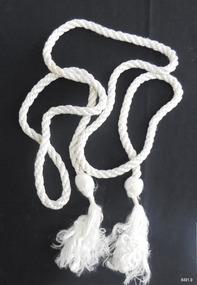
Ceremonial object - Priest's robe sash, Joyce Maslen, February 1982
... ...Priest's stole...Priest's robe sash or stole, part of a set of Ecclesiastical Linen once used in St. ...The church was funded and attended by the local community in the early 1900's and is now listed on the Victorian Heritage Database (VHD 118083) as a building of historical and social significance. flagstaff hill warrnambool maritime museum shipwreck coast great ocean road st andrews anglican church dennington dennington church warrnambool church 1907 ecclesiastical linen communion linen hand worked linen religious service religious ceremony Priest's stole Priest's robe sash sash knotted sash Priest's vestment Priest's robe sash or stole, part of a set of Ecclesiastical Linen once used in St. ...This item is part of the collection of Ecclesiastical Linen once used by St. Andrews Anglican Church on the corner of the Esplanade and 14 Drummond St, Dennington, Victoria. The first Anglican service was conducted on December 22nd, 1907. The church was decommissioned in January 2003. This item is part of the Ecclesiastical Linen collection, which is significant for its examples of handworked embroidery and drawn-thread work from the early 20th century. The items are also examples of a collection used for religious services during this period. The Ecclesiastical Linen is also significant for its association with the early development of the local township of Dennington and the importance the the community of setting aside land in the 1850's for the purpose of religious worship. The Ecclesiastical Linen is also significant for its connection to St Andrews Anglican Church, Dennington. The church was funded and attended by the local community in the early 1900's and is now listed on the Victorian Heritage Database (VHD 118083) as a building of historical and social significance. Priest's robe sash or stole, part of a set of Ecclesiastical Linen once used in St. Andrew's Anglican Church, Dennington, Victoria, between the years 1907 and 2003. The soft, white silky twisted cord is finished at each end with a knot and tassel.flagstaff hill, warrnambool, maritime museum, shipwreck coast, great ocean road, st andrews anglican church dennington, dennington church, warrnambool church 1907, ecclesiastical linen, communion linen, hand worked linen, religious service, religious ceremony, priest's stole, priest's robe sash, sash, knotted sash, priest's vestment -
 Flagstaff Hill Maritime Museum and Village
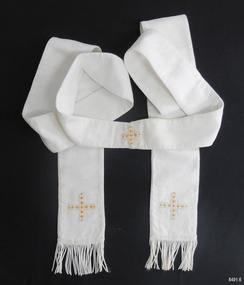
Ceremonial object - Priest's scarf, 1907 to mid 20th century
... ...priest's stole...Priest's scarf, also called a stole: part of a set of Ecclesiastical Linen once used in St. ...The church was funded and attended by the local community in the early 1900's and is now listed on the Victorian Heritage Database (VHD 118083) as a building of historical and social significance. flagstaff hill warrnambool maritime museum shipwreck coast great ocean road st andrews anglican church dennington dennington church warrnambool church 1907 ecclesiastical linen communion linen hand worked linen religious service religious ceremony ceremonial linen needlework embroidered applique cross symbol priest's scarf stole priest's stole Three embroidered symbols [ribbon cross with gold-coloured borders and small gold coloured crosses along the arms] Priest's scarf, also called a stole: part of a set of Ecclesiastical Linen once used in St. ...This item is part of the collection of Ecclesiastical Linen once used by St. Andrews Anglican Church on the corner of the Esplanade and 14 Drummond St, Dennington, Victoria. The first Anglican service was conducted on December 22nd, 1907. The church was decommissioned in January 2003. This item is part of the Ecclesiastical Linen collection, which is significant for its examples of handworked embroidery and drawn-thread work from the early 20th century. The items are also examples of a collection used for religious services during this period. The Ecclesiastical Linen is also significant for its association with the early development of the local township of Dennington and the importance the the community of setting aside land in the 1850's for the purpose of religious worship. The Ecclesiastical Linen is also significant for its connection to St Andrews Anglican Church, Dennington. The church was funded and attended by the local community in the early 1900's and is now listed on the Victorian Heritage Database (VHD 118083) as a building of historical and social significance. Priest's scarf, also called a stole: part of a set of Ecclesiastical Linen once used in St. Andrew's Anglican Church, Dennington, Victoria, between the years 1907 and 2003. The rectangle of lined coarse white fabric is slightly flared at the ends, which are finished with a white twisted cotton fringe. Three cross symbols, one at each end and one in the centre, have been handworked in white ribbon with gold-coloured edging and gold embroidery in the form of rows of small crosse.. Three embroidered symbols [ribbon cross with gold-coloured borders and small gold coloured crosses along the arms]flagstaff hill, warrnambool, maritime museum, shipwreck coast, great ocean road, st andrews anglican church dennington, dennington church, warrnambool church 1907, ecclesiastical linen, communion linen, hand worked linen, religious service, religious ceremony, ceremonial linen, needlework, embroidered, applique, cross symbol, priest's scarf, stole, priest's stole -
 Embroiderers Guild, Victoria
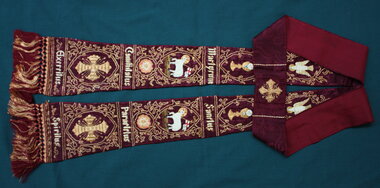
Textile - Ecclesiastical Stole
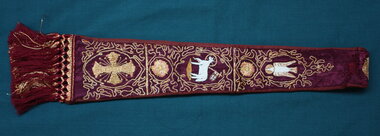
... The stole is a liturgical vestment of various Christian denominations, which symbolizes priestly authority; in Protestant denominations which do not have priests but use stoles as a liturgical vestment, however, it symbolizes being a member of the ordained. ...The stole is a liturgical vestment of various Christian denominations, which symbolizes priestly authority; in Protestant denominations which do not have priests but use stoles as a liturgical vestment, however, it symbolizes being a member of the ordained. ...The stole is a liturgical vestment of various Christian denominations, which symbolizes priestly authority; in Protestant denominations which do not have priests but use stoles as a liturgical vestment, however, it symbolizes being a member of the ordained. It consists of a band of coloured cloth, usually of silk, about seven and a half to nine feet long and three to four inches wide, whose ends may be straight or may broaden out in the shape of a spade or bell. The centre of the stole is worn around the back of the neck and the two ends hang down parallel to each other in front, either attached to each other or hanging loose. The stole is almost always decorated in some way, usually with two crosses, or sometimes another significant religious design. (wikipedia)Dark red silk damask ecclesiastical stole with gold work and silk embroidery. Motifs include dove, lamb, chalice, Maltese cross and flowers and Latin text. Silk and metal thread fringes both ends of both pieces.Latin textsembroidery, gold work, ecclesiastical -
 Embroiderers Guild, Victoria
Textile - Ecclesiastical Maniple
... priest could use to wipe his hands and face. The maniple corresponds to the epimanikia, cuffs worn on both wrists in the Eastern Orthodox, Eastern Lutheran and Eastern Catholic Churches. (wikipedia) Embroidery Gold work Ecclesiastical Latin texts Dark red silk damask ecclesiastical stole ...The maniple is a liturgical vestment used primarily within the Latin Rite of the Catholic Church, and occasionally by Lutheran and Anglican clergy. It is an embroidered band of silk or like fabric that hangs from the left forearm, worn over the alb. It is used only during Mass, and it is always of the same liturgical colour as other Mass vestments. The original purpose of the maniple is unclear, but it probably originated as a cloth that the priest could use to wipe his hands and face. The maniple corresponds to the epimanikia, cuffs worn on both wrists in the Eastern Orthodox, Eastern Lutheran and Eastern Catholic Churches. (wikipedia)Dark red silk damask ecclesiastical stole with gold work and silk embroidery. Motifs include dove, lamb, chalice, maltese cross and flowers and latin text. Silk and metal thread fringes both ends of both pieces.Latin textsembroidery, gold work, ecclesiastical
