
Showing 18 items matching "prime minister of new zealand"
-
 Williamstown Historical Society Inc
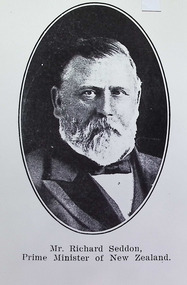
Photograph - Mr Richard Seddon, 15th Prime Minister of New Zealand, 1893-1906
... Mr Richard Seddon, 15th Prime Minister of New Zealand, 1893-1906......Prime Minister of New Zealand...Mr Richard Seddon Prime Minister of New Zealand Photograph Mr Richard Seddon, 15th Prime Minister of New Zealand, 1893-1906 ...mr richard seddon, prime minister of new zealand -
 Bendigo Historical Society Inc.
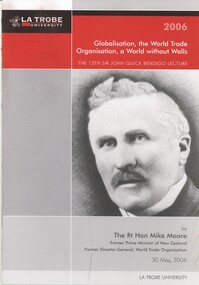
Book - GLOBALISATION, THE WORLD TRADE ORGANISATION, A WORLD WITHOUT WALLS, 2006
... The 13th Sir John Quick Bendigo lecture by the Rt Hon Mike Moore former Prime Minister of New Zealand former Director-General, World Trade Organisation. ...The 13th Sir John Quick Bendigo lecture by the Rt Hon Mike Moore former Prime Minister of New Zealand former Director-General, World Trade Organisation. ...Globalisation, the World Trade Organisation, a World without Walls. The 13th Sir John Quick Bendigo lecture by the Rt Hon Mike Moore former Prime Minister of New Zealand former Director-General, World Trade Organisation. Published by La Trobe university, 16 pages with black and white photographs.The Rt Hon Mike Mooreorganisation, union, the world trade organisation, globalisation, world trade, sir john quick, mike moore. -
 Flagstaff Hill Maritime Museum and Village
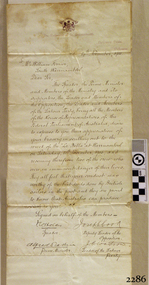
Letter - William Ferrier, 14th November 1905
... prime minister...australian government...new zealand...It is one of the only two shipwrecks discovered in Lady Bay, Warrnambool, out of the 15-17 shipwrecks in the bay. la bella william ferrier bill ferrier lady bay 1905 10th november 1905 11th november 1905 parliament of the commonwealth prime minister australian government new zealand flagstaff hill warrnambool shipwrecked coast flagstaff hill maritime museum maritime museum shipwreck coast flagstaff hill maritime village The printed coat of arms is that of the House of Representatives. ...The letter to William Ferrier of South Warrnambool from the Prime Minister and the Parliament of the Commonwealth recognised the significance of William’s brave and courageous lifesaving act to the people of Australia; “They all feel that your conduct was worthy of the best deeds done by British sailors in the past and they are proud to know that Australia can produce such as you.” The story of that brave rescue follows on below … The ship from which the sailors were rescued was the three-masted, iron and steel barquentine the La Bella, built in Norway in 1893. She was one of two iron and steel ships by Johan Smith, The company was one of the leading shipping families in Tvedestrand, Norway. She was significant to Norwegian shipping, being one of only 27 iron and steel ships ever built in Norway. She was registered in New Zealand and engaged from 1902 in inter-colonial trading of timber in the Pacific, between New Zealand and Australia and was often in Port Phillip Bay, Victoria. On 5th October 1905, the twelve-year-old La Bella left Lyttleton, New Zealand carrying a cargo of timber bound for Warrnambool, Australia. She was manned by a crew of twelve: the Master, (Captain Mylius, previously 1st Mate of La Bella, appointed Captain to La Bella on 6th February 1903) 2 Mates, Cook, six able seamen, one ordinary seaman and a boy. Bad weather en route caused her to shelter at Burnie on Tasmania's North West coast. On November 10th, the 37th day of her journey, La Bella approached Warrnambool. Captain Mylius steered her towards Lady Bay Channel in heavy south-west seas and evening mist. He ordered the helmsman to steer for the light. As the ship came round, a tremendous sea struck her on the port quarter, causing her to breach broadside in a north-westerly direction into breakers. The helm was brought round twice more, but each time heavy seas broke over her, the third time throwing the La Bella on to a submerged reef in Lady Bay now known as La Bella Reef (about 100 yards from the Warrnambool breakwater). The sea was so rough that it even wrenched a one-and-a-half ton anchor from its fastenings and into the sea. As Captain Mylius headed to the steel wheelhouse, intending to send up a rocket flare, a huge sea slammed the steel door into him (resulting in massive bruising front and back) Despite his injuries he still managed to set off a blue light, which he held up in his hands. La Bella’s lifeboats were filled with seawater and broke up on their chocks. The blue light was the first indication to people on the shore that there was a ship in distress. The Harbour Master, Captain Roe (who lived in the Harbour Master’s House opposite Flagstaff Hill), organised a group of volunteers to crew the lifeboat because the trained crew was unavailable; the crewmen were working on a steamer in Port Fairy at the time. He then poured oil onto the water to try and smooth the sea. At around 11 pm three of the crew took shelter in the steel forecastle but the sea crashed into it and broke it up. While the rest of the crew and onlookers watched helplessly in the moonlight the bodies were washed away into the sea, never to be seen again. Some of the crew lashed themselves to the weather rail to keep from being washed away. Watson, the ordinary seaman, became tangled in the rigging lines and was too weak to move, so the 2nd Mate, Robertson, put a line onto him so that he wouldn’t wash off. Around 11 pm three of the crew were unconscious from exhaustion. The situation on La Bella was becoming dangerous. The 2nd Mate moved to the ‘house’ and soon afterwards the ship slipped in the heavy sea. The lashings of the 1st Mate and the ‘boy’ Denham had kept them safe until about 2 am when they were washed overboard; no one was able to help. One by one, the exhausted crew were being washed overboard, too weak to hold on any longer. During the night the La Bella had broken into two and the deckhouse ran out towards the sea. Two more men drowned when trying to reach the lifeboat. By sunrise, the only survivors of the twelve were the Master, 2nd Mate and three seamen. Early in the morning, Captain Roe used the rocket apparatus on shore to try and shoot a line to the ship for a safer rescue but each attempt fell short of the target. Several attempts were made by the lifeboat to rescue the stricken sailors, but the rough conditions made this difficult for the boat to get close enough to the ship and the lifeboat had to return to shore. During a final attempt to reach the ship Captain Mylius ordered his men to jump into the sea. Leonard Robertson, 2nd mate, jumped and swam towards the lifeboat, taking hold of the boat hook offered to him. Oscar Rosenholme managed to reach the boat floating on a piece of timber from the ship’s load and a third survivor, Noake, also made the boat. Along with the lifeboat rescue crew, 25-year-old William Ferrier rowed his small dingy through the heavy seas and managed to rescue the Captain, whom he landed on the breakwater. Ferrier then returned to the ship to attempt a final rescue, losing his oars and rowlocks into the high sea. Using just a spare paddle he skulled towards the La Bella, reaching her stern in time to cut loose the lone surviving sailor, Payne, from the lashing that held him to the ship; the terrified sailor dropped from the ship and into the dingy. Shortly after the last man was rescued, the La Bella was lifted by a huge wave and crashed back down on the reef; she broke up and sank. The ordeal had lasted ten hours. The survivors were taken to the nearby Bay View Hotel and gratefully received warm food and clothing, medical attention and a place to sleep. In the following days, an unidentified body of a young person has washed ashore; it was either Watson or Denham. The body was buried in the Warrnambool cemetery with an appropriate gravestone and inscription. William Ferrier became a national hero as news of the daring rescue spread. In recognition of his bravery in the two daring rescues, he was awarded the Silver Medal for Bravery by the Royal Humane Society and was honoured in the letter from the Prime Minister and the Parliament of the Commonwealth, telegrams and a cheque for £20 from the Governor-General, over £150 subscribed by the public, including Warrnambool and district and readers of The Argus, and a gold medal from the Glenelg Dinghy Club of South Australia. Ferrier’s rescue efforts are one of the most heroic in Victoria’s shipwreck history. (William Ferrier’s son, Frank, received a similar award almost fifty years later when he helped rescue four members of the crew on the yacht Merlan after it ran on to a reef near the Point Lonsdale Lighthouse. ) The wreck of La Bella now lies on her port side in 13 metres of sheltered water inside the reef she struck. The bow section is relatively intact and part of the stern has drifted north-easterly towards the mouth of the Hopkins River. The reef the La Bella struck now bears its name. Those five rescued from the La Bella were Captain George Mylius, Leonard Robertson (2nd Mate, 21 years old), R. Payne, Oscar Rosenholme and Jack Noake. Those seven who lost their lives were Mr Coulson (1st mate), Charles Jackman (cook) Gustave Johnson, Pierre Johann and Robert Gent (all able seamen), Harry Watson (ordinary seaman) and Jack Denham (ship’s boy), Captain Mylius was found guilty of careless navigation; he had sailed into the bay without the services of a pilot. His Master Certificate was suspended for twelve months. Later he was also charged with the manslaughter of one of the crew who had died when the La Bella was wrecked but found not guilty. The event’s adverse publicity and damage to his career took a toll on his health and he died of a heart attack six months after the wreck; he was only thirty-seven. His body was buried in the Melbourne General Cemetery. The La Bella was “the best documented of all sailing ships owned in New Zealand”. Her record books, ship logs, correspondence and supporting papers are still available. At the time of the tragedy, she was owned by Messers David C.Turnbull and Co. of Timaru, New Zealand timber merchants and shipping agents, who had purchased her on 13th December 1901. A detailed account of the last journey of La Bella can be read in “Leonard Robertson, the Whangaroa & La Bella” written by Jack Churchouse, published in 1982 by Millwood Press Ltd, Wellington, NZ. As well as this letter, Flagstaff Hill’s La Bella Collection includes a photograph of the wrecked La Bella, a brass rail holder and a postcard of William Ferrier with four of the survivors. Some 15 – 17 ships are believed to have sunk in Lady Bay, but only two have been discovered on the seafloor; the “La Bella” and the “Edinburgh Castle”. Both wrecks are popular diving sites and are preserved as significant historical marine and marine archaeological sites. This original congratulatory letter sent to William Ferrier by the Prime Minister and Government of Australia demonstrates the importance attached to his efforts for Victoria and to Australia. The letter is part of the La Bella Collection and is significant at both a local and state level. Its connection to the La Bella shipwreck and the rescue of five survivors highlights the dangers of Victoria’s Shipwreck Coast. The letter to William Ferrier from the Australian Government acknowledges the bravery of ordinary Australians who risked their lives to save victims of shipwrecks along the coast. The letter is significant to the history of Warrnambool as it honours William Ferrier, a local fisherman whose descendants continue to live in the area. It highlights the way of life of people who lived in coastal towns in 19th century Victoria and the effects of shipwrecks upon them. The letter connects to the postcard of William Ferrier with four of the five rescued crew, the photograph of the wreck of the La Bella and the artefact from the wreck, the rail holder. This letter is significant because of its association with the sailing ship “La Bella”. The “La Bella” is of local and state and national significance. It is one of the only two shipwrecks discovered in Lady Bay, Warrnambool, out of the 15-17 shipwrecks in the bay. Letter to William Ferrier of South Warrnambool from the Prime Minister and Members of Parliament commending him on his bravery. The printed letterhead includes a coat of arms in the top centre and the official address. The letter is very neatly hand written in black pen and includes 4 signatures of Members of Parliament. The rectangular paper is cream coloured with some yellow/brown discolouring. It has the letterhead on the right hand side of it and the written letter begins below the letterhead. The paper has been folded so that the right side becomes the cover page of the letter. The writing is continued onto the inside right hand page of the folded paper and the writing ends here. There is more recent writing on the bottom right hand corner of the back page. The paper has been officially folded in half a total 3 times and there is heavy discolouration on the sections that form the front and back of the folded letter. There is a 4th fold line that is less pronounced that the other folds and would make the paper the size to fit into a pocket. At several fold creases the paper has worn through. The edges of the paper have minor tears. The printed coat of arms is that of the House of Representatives. Underneath is printed “The Parliament of the Commonwealth, / Parliament House / Melbourne”. The hand written, letter is dated “14th November, 1905” and addressed to “Mr. William Ferrier / South Warrnambool” The letter begins “The Speaker, the Prime Minister and Members of the Ministry and its supporters, the Leader and Members of the Opposition, the Leader and Members of the Labour Party, being all the Members of the House of Representatives of the Federal Parliament of Australia” … It continues “desire to express to you their appreciation of your bravery in skulling out to the wreck of the “La Bella” at Warrnambool on Saturday, 11th November, 1905, and recovering therefrom two of the crew who were in imminent danger of their lives. They all feel that your conduct was worthy of the best deeds done by British sailors in the past and they are proud to know that Australia can produce such as you.” The letter is “Signed on behalf of the Members – Speaker (Frederick Holder ), Deputy Leader of the Opposition (Joseph Cook ), Prime Minister (Alfred Deakin), Leader of the Labour Party ( J.C. Watson)” On the back of the letter is blue ink handwriting “OWNER / G. FERRIER / TO. BE. PHOTOGRAPHED / 27-4-76”la bella, william ferrier, bill ferrier, lady bay, 1905, 10th november 1905, 11th november 1905, parliament of the commonwealth, prime minister, australian government, new zealand, flagstaff hill, warrnambool, shipwrecked coast, flagstaff hill maritime museum, maritime museum, shipwreck coast, flagstaff hill maritime village -
 Federation University Historical Collection
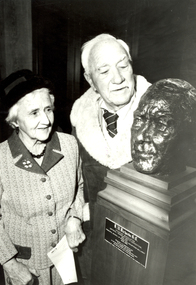
Photograph - Photograph - Black and White, Ballarat Courier, Dick Richards and his sister, Mrs V.S. Greenhalgh with the Bust of Dick Richards, 06/1983
... New Zealand on 9 February 1917 to a hero's welcome. Joyce, Wild, Hayward and Richards later won the Albert Medal for their heroic devotion to duty. Later an inlet on the Antartic continent was named after Richards. Dick Richards wrote the following years after the ordeal "To me no undertaking carried through to conclusion is for nothing. And so I don't think of our struggle as futile. It was something the human spirit accomplished." Prime Minister...New Zealand on 9 February 1917 to a hero's welcome. Joyce, Wild, Hayward and Richards later won the Albert Medal for their heroic devotion to duty. Later an inlet on the Antartic continent was named after Richards. Dick Richards wrote the following years after the ordeal "To me no undertaking carried through to conclusion is for nothing. And so I don't think of our struggle as futile. It was something the human spirit accomplished." Prime Minister ...Dick Richards joined the Ballarat School of Mines in 1914, and soon afterwards was granted leave to join an expedition to Antartica. In 1915 he sailed from Australia with the Antartic Exploraton Expedition, led by Sir Ernest Shackleton. Most Antarctic enthusiasts know of Ernest Shackleton's attempt to cross the continent, only to be thwarted by the sinking of the ship 'Endurance'. Dick Richards was the physicist and sled manager for Shackleton's Ross Sea Party - with the task to meet Shackleton on the other side of the continent. When Shackleton planned his transcontinental crossing he decided to use supply depots as loads of supplies were too heavy to pull. The depots would enable Shackleton's party to carry just enough to reach the Pole, relying on the depots which were to be left by the Aurora's crew every 60 miles, stowed in 2 sledge journeys in 1915 and 1916. Dick Richards spent 3 freezing years in Antarctica between 1914 and 1917. Richards' worst experience was when his ship Aurora, tethered offshore, was blown away in a gale leaving Richards marooned for two years with nine other men on the ice floe. The expedition, consisting of two teams, were attempting to cross Antarctica from opposite sides, linking up somewhere near the middle. "That was with pretty poor equipment by today's standards, and we did not make it." (Dick Richards) The Ross Sea Party arrived in McMurdo Sound aboard the Aurora in January 1915. The men planned to make two sledging trips to leave supply depots every 60 nautical miles to Mount Hope about 400 miles away. The going was tough as the sledges were overloaded. Temperatures were as low as minus 68F. In June 1916 the party crossed on foot to Cape Evans, occupied Scott's Hut (from his Terra Nova Expedition, erected in January 1911) in May 1915, for two months. On 10 January 1917 Richards was hunting for seals when he saw a ship on the horizon. It was 'The Aurora'. Picking up the relieved survivors 'The Aurora' arrived in New Zealand on 9 February 1917 to a hero's welcome. Joyce, Wild, Hayward and Richards later won the Albert Medal for their heroic devotion to duty. Later an inlet on the Antartic continent was named after Richards. Dick Richards wrote the following years after the ordeal "To me no undertaking carried through to conclusion is for nothing. And so I don't think of our struggle as futile. It was something the human spirit accomplished." Prime Minister Bob Hawke wrote in 1984 'Your incredible journey of almost 2000 miles across the Antarctic Wastelands - involving some 9 months in the field with makeshift equipment - and you're adherence to duty in the face of enormous difficulty, suffering from scurvy, and the death of comrades, will; be an inspiration to your countrymen of the future as it is to us today." After returning to Australia Dick Richards resumed his work at SMB as Lecturer in Physics and Mathematics, and developed many pieces of experimental equipment. During World War Two he acted as a scientific adviser in the production of optical apparatus in Australia. In 1946 he was appointed Principal and twelve years later he retired after a total of 44 years service. Dick Richards has been honoured through the naming of a Ballarat School of Mines prize - The R.W. Richards Medal. This medal later became a University of Ballarat prize. It has been awarded annually since 1959 to the Bachelor of Applied Science graduate considered to have achieved the most outstanding academic performance of their course. (See http://guerin.ballarat.edu.au/aasp/is/library/collections/art_history/honour-roll/honourroll_Richards,Dick.shtml )A man and lady inspect a bust of Richard (Dick) Richards by sculptor Victor Greenhalgh. The scultpure is at the Ballarat School of Mines. The man is Dick Richards, and the woman is his sister and wife of sculptor Victor Greenhalgh. Both Dick Richards and Victor Greenhalgh were former students and teachers at the Ballarat School of Mines. The bust of Dick Richards was Victor Greenhalgh's last work and was cast in bronze after his death. The bust was presented to the Ballarat School of Mines by Mrs V.S. Greenhalgh (widow of the sculptor and sister of the subject). At the presentation Victor Greenhagh's son said "the two men had been friends as well as brothers-in-law, were of similar age, both enjoyed red wine, beer and cricket and both were educationalists, one an artist the other a mathematician."dick richards, r.w. richards, richards, richard w. richards, victor greenhalgh, bust, sculpture, ballarat school of mines, antarctica, ross shore -
 Federation University Historical Collection
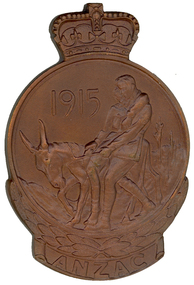
Medal - Numismatics, ANZAC Commemorative Medal for R.M. Serjeant, 1967
... _Serjeant_Jnr The following statement on the ANZAC Commemorative Medallion and Badge was made by by Prime Minister Holt in 16 March 1967 when the Minister for Defence announced that it had been decided by the Australian Government, in consultation with the New Zealand Government, to issue a medallion and lapel badge to the veterans of the Gallipoli Campaign. ..._Serjeant_Jnr The following statement on the ANZAC Commemorative Medallion and Badge was made by by Prime Minister Holt in 16 March 1967 when the Minister for Defence announced that it had been decided by the Australian Government, in consultation with the New Zealand Government, to issue a medallion and lapel badge to the veterans of the Gallipoli Campaign. ...Robert M. Serjeant was the only son of Theo and Alice Serjeant, and grandson of famed mine manager Robert Malachy Serjeant (1829-1902). Robert Serjeant was a past student of the Ballarat School of Mines (SMB), and at the time of his World War One enlistment he had just finished an electrical course, and was working as a junior member of the SMB Department of Electricity. Robert Serjeant enlisted in December 1914. Corporal Serjeant (2138) of the 8th Battalion, died of wounds received in action at Gallipoli on 28 April 1915, aged 20. He was buried at sea and his name is listed at the Lone Pine Memorial. A brown paper parcel of Robert Serjeant's belongings was returned to his parents. It contained his discs, wrist-watch (damaged), notebook, hymn book and letters. [1] The Ballarat Courier reported: 'He was of quiet disposition, and a great student, devoting himself closely to his work.' Further information on R.M. Serjeant can be found at https://bih.federation.edu.au/index.php/Robert_M._Serjeant_Jnr The following statement on the ANZAC Commemorative Medallion and Badge was made by by Prime Minister Holt in 16 March 1967 when the Minister for Defence announced that it had been decided by the Australian Government, in consultation with the New Zealand Government, to issue a medallion and lapel badge to the veterans of the Gallipoli Campaign. "Last March, the Minister for Defence announced that it had been decided by the Australian Government, in consultation with the New Zealand Government, to issue a medallion and lapel badge to the veterans of the Gallipoli Campaign. I am glad to be able to announce that arrangements have now been completed for the production of the medallion and the badge. The Minister for the Army will be arranging distribution to those wishing to receive them as soon as possible. The Government hopes that production of the medallion and lapel badge will be sufficiently advanced to permit at least some of them to be distributed by ANZAC Day. The medallion (with the name of the recipient inscribed) will be issued to the surviving members of the Australian Defence Force who served on the Gallipoli Peninsula, or in direct support of the operations from close off-shore, at any time during the period from the first ANZAC Day in April, 1915 to the date of final evacuation in January, 1916. Next of kin or other entitled persons will be entitled to receive the medallion on behalf of their relatives, if the relative died on active service or has since died. For surviving members, a lapel badge will also be available for wearing. This will be a replica of the obverse (or front) of the medallion and will be about 1 inch high and 2/3 inch wide - the same size as the RSL badge. The medallion is the work of Mr. Raymond Ewers, the well-known Australian artist, based on a suggestion by Mr. Eric Garrett, a staff artist with the Department of the Army. It has been endorsed by both the Government of New Zealand and ourselves. It will be approximately 3 inches high and 2 inches wide. The obverse of the medallion depicts Simpson and his donkey carrying a wounded soldier to safety. It will be bordered on the lower half by a laurel wreath above the word ANZAC. The reverse (the back) shows a relief map of Australian and New Zealand superimposed by the Southern Cross. The lower half will be bordered by New Zealand fern leaves. The medallion will be cast in bronze and the lapel badge will be metal of a bronze colour. For the information of the honourable members I present also a brief statement setting out the conditions of eligibility which will apply to the medallion and badge and the manner in which those desiring to receive them should apply."(https://www.awm.gov.au/encyclopedia/anzac/medallion/doc.asp, accessed 26/02/2014) Conditions of eligibility. All members of the Australian Defence Force who served during the Gallipoli Campaign are entitled to receive the ANZAC Commemorative medallion. The campaign lasted from April 25, 1915 to January 8, 1916. The award will be made for service on the Gallipoli Peninsula and service in support of the operations in an area off-shore eastward of a line drawn from Yukyeri Point (lat 39 50' 40'' N long 26 9' 45'' E) through a point in lat 39 53' N long 26 0' E thence to Cape Gremea (lat 40 35' N long 26 6' E). The award will also be available to members of philanthropic organisations and the Press who were accredited to the AIF, and to Australian members of the crews of merchant ships or hospital ships which operated in direct support within the defined area. Note: The boundary line would run just off-shore from the land masses north and south of the Dardanelles, and is estimated to be within about 5 miles from the beach at ANZAC Cove. (https://www.awm.gov.au/encyclopedia/anzac/medallion/doc.asp, accessed 26/02/2014) This Item is significance because is was only issued to members of the Australian and New Zealand Defence Force who served at Gallipoli. This Medallion is significant because of its relationship to Robert M. Serjeant who died on 28 April 2015 at Gallipoli of wounds received in Action. Bronze commemorative medal in black presentation case showing Simpson and his donkey carrying a wounded soldier to safety. A crown is situated on top of the medal, and the word ANZAC beneath the medal. The opposite side depicts Australia, New Zealand and the Southern Cross Constellation. The lower half is bordered with New Zealand Fern leaves. The commemorative medal was presented to the family of Robert M. Serjeant. Gift of David Stevens, 2014.Engraved: "1238 R.M. Serjeant"serjeant, r.m. serjeant, robert m. sergeant, anzac, medal, numismatics -
 Federation University Historical Collection
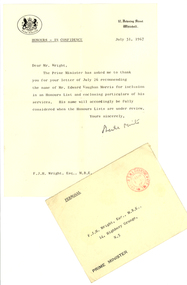
Letter - Correspondence, Prime Minister to Frank Wright, 1967, 31/7/1967
... New Zealand. The Frank Wright Medal at the Royal South Street competition is awarded to an individual recognized as making an outstanding contribution to brass music in Australia frank wright harold wilson prime minister letter .1) Letter - Printed - Prime Minister's Crest of Office, 10, Downing Street Whitehall., Typed - Honours - In Confidence, July 31, 1967, Dear Mr. ...In 1967 the British Prime Minister was Harold Wilson. Frank Wright was a renown resident of Smeaton, where he was born. He lived at Laura Villa, and attended Smeaton State School. His father William was a gold miner and his mother's name was Sarah. Their family won many singing and instrumental awards. Frank was tutored by Percy Code and was awarded a gold medal for the highest marks in the ALCM examinations in the British Colonies at the age of seventeen years. He became the Australian Open Cornet Champion by the age of eighteen. A year later, Frank conducted the City of Ballarat Band, and later the Ballarat Soldiers’ Memorial Band. He formed the Frank Wright Frisco Band and Frank Wright and his Coliseum Orchestra. These bands won many South Street awards, and Frank as conductor won many awards in the Australian Band Championship contest. In 1933 Frank Wright sailed to England to conduct the famous St Hilda’s Band and was later appointed Musical Director of the London County Council, where he organized many amazing concerts in parks, in and around the London district. He was made Professor of Brass and Military Band Scoring and conducted at the Guildhall of Music and Drama. Frank was often invited to adjudicate Brass Band Championships around Europe, in Australia, including South Street and in New Zealand. The Frank Wright Medal at the Royal South Street competition is awarded to an individual recognized as making an outstanding contribution to brass music in Australia.1) Typed letter on a printed letterhead .2) Typed and post marked envelope with printed address on reverse..1) Letter - Printed - Prime Minister's Crest of Office, 10, Downing Street Whitehall., Typed - Honours - In Confidence, July 31, 1967, Dear Mr. Wright, The Prime Minister has asked me to thank you for your letter of July 26 recommending the name of Mr. Edward Vaughan Morris for inclusion in an Honours List and enclosing particulars of his services. His name will accordingly be fully considered when the Honours Lists are under review.Yours sincerely, (handwritten signature), F.J.H. Wright, Esq., M.B.E. .2) Envelope - Typed on front - Personal, F.J.H. Wright, Esq., M.B.E., 14, Highbury Grange, N.5, Prime Minister, Printed on back - 10 Downing Street, Whitehallfrank wright, harold wilson, prime minister, letter -
 Flagstaff Hill Maritime Museum and Village
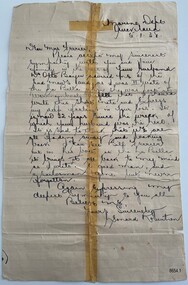
Letter - Ferrier Letter, Leonard Robertson, Marine Department, 5 January 1938
... prime minister...australian government...new zealand...Flagstaff Hill Maritime Museum and Village Great Ocean Road Shipwreck Coast la bella william ferrier bill ferrier lady bay 1905 10th november 1905 11th november 1905 parliament of the commonwealth prime minister australian government new zealand flagstaff hill warrnambool shipwrecked coast flagstaff hill maritime museum maritime museum flagstaff hill maritime village leonard Robertson rescue Frank Ferrier La Bella Reef Otto Bayer Inscribed in blue ink: "OWNER. ...This letter of sympathy is written to the widow of William Ferrier who rescued Captain Mylius and another seaman from the shipwreck, La Bella, at Warrnambool. Leonard Robertson, from Auckland, was II Mate of the La Bella. The letter was written from the Marine Dept. Queensland. Many newspaper accounts narrate the rescue and evidence given at the Marine Court of Inquiry. A book "Leonard Robertson, the Whangaroa & La Bella"/Jack Churchouse was printed. William Ferrier was born in Warrnambool and it is reported that he was a member of the lifeboat crew and served some years in the lighthouse service. During the La Bella rescue Ferrier used his dinghy, as he was an experienced fisherman of 25 years old. Ferrier, moved to Queenscliff at some stage and died at the Geelong hospital after having a seizure at sea. Ferrier's 15 years old son was having his birthday and fishing with him at the time. He was survived by his widow and 13 children. Otto Bayer who had informed Robertson of Ferrier's death was a crew member of the lifeboat. The site of the La Bella wreck lies in Lady Bay Warrnambool, at La Bella Reef - named after the fact. Transcript: Marine Dept Queensland 5.1.38 Dear Mrs Ferrier, Please accept my Sincerest Sympathy with you and your family in the loss of your husband. Mr. Otto Bayer advised me of the sad news and as I was II Mate of the La Bella when she was lost at Warrnambool I feel that I should write this short note and express my deep feelings in your loss. It is now 32 years since the wreck of which your husband was the hero. It is sad to think that we are all fading away and looking back I can see Bill Ferrier out in his boat at the La Bella it brings it all back to my mind as I write. A good man, and sailorman, is gone but never forgotten. Again expressing my deepest sympathy to you all Believe me, Yours Sincerely Leonard Robertson.This item is of historical significance in relation to the La Bella shipwreck as it is written and signed by a survivor and witness of the rescue. It is a single letter to the wife of the hero William 'Bill' Ferrier. The Ferrier family have a long social history with Warrnambool and Ferrier Drive is named in honour of the hero. The letter front is written on a lined and yellowed paper that has been repaired. The repair runs from top to bottom and has been done with cello tape. A small repair runs across the middle a couple of centimetres from the top and for approximately four centimetres down the middle. There are some small tears to the edges, particularly on fold creases. There are small brown age spots to peripheral areas. This is a sympathy letter from Leonard Robertson, II Mate and survivor of the La Bella to the widow of William (Bill) Ferrier rescue hero on his death. Inscribed in blue ink: "OWNER. G. FERRIER / LOANED. TO. BE / PHOTOGRAPHED / 27/4/76"flagstaff hill maritime museum and village, great ocean road, shipwreck coast, la bella, william ferrier, bill ferrier, lady bay, 1905, 10th november 1905, 11th november 1905, parliament of the commonwealth, prime minister, australian government, new zealand, flagstaff hill, warrnambool, shipwrecked coast, flagstaff hill maritime museum, maritime museum, flagstaff hill maritime village, leonard robertson, rescue, frank ferrier, la bella reef, otto bayer -
 Flagstaff Hill Maritime Museum and Village
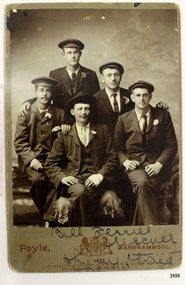
Postcard - People, Bill Ferrier - rescuer, 11th November, 1905
... New Zealand timber merchants and shipping agents, who had purchased her on 13th December 1901. A detailed account of the last journey of La Bella can be read in “Leonard Robertson, the Whangaroa & La Bella” written by Jack Churchouse, published in 1982 by Millwood Press Ltd, Wellington, NZ. As well as this postcard, Flagstaff Hill’s La Bella Collection includes a photograph of the wrecked La Bella, a brass rail holder and the letter from the Prime Minister...New Zealand timber merchants and shipping agents, who had purchased her on 13th December 1901. A detailed account of the last journey of La Bella can be read in “Leonard Robertson, the Whangaroa & La Bella” written by Jack Churchouse, published in 1982 by Millwood Press Ltd, Wellington, NZ. As well as this postcard, Flagstaff Hill’s La Bella Collection includes a photograph of the wrecked La Bella, a brass rail holder and the letter from the Prime Minister ...The postcard shows a photograph of William Ferrier, the 25-year-old Warrnambool fisherman from South Warrnambool whose rescue of two sailors from the wrecked La Bella made him an overnight National hero, quoted as “one of the most heroic rescues in Victoria’s shipwreck history”. The La Bella was wrecked on 10th November 1905 and the photograph was taken on the next day. In the photograph, William Ferrier is seated in the centre, with four of the five survivors beside him: (from left to right) Leonard Robertson, R. Payne, Oscar Rosenholme and Jack Noake. The photograph was taken by Foyle Photography Studio in Warrnambool, originally owned by James Charles Foyle. He previously had a photographic studio in Melbourne 1882 1887, then opened “Foyle’s Photo Card Studios” in Liebig St, Warrnambool. James Foyle died on 13th July 1905 and his son and daughter, Charles and Lilian Foyle continued on with the business until 1945. This photograph was most likely taken by either Charles or Lilian Foyle. The story of William Ferrier’s brave act follows on below … The ship from which the sailors were rescued was the three-masted, iron and steel barquentine the La Bella, built in Norway in 1893. She was one of two iron and steel ships by Johan Smith, the company was one of the leading shipping families in Tvedestrand, Norway. She was significant to Norwegian shipping, being one of only 27 iron and steel ships ever built in Norway. She was registered in New Zealand and engaged from 1902 in inter-colonial trading of timber in the Pacific, between New Zealand and Australia and was often in Port Phillip Bay, Victoria. On 5th October 1905, the twelve-year-old La Bella left Lyttleton, New Zealand carrying a cargo of timber bound for Warrnambool, Australia. She was manned by a crew of twelve: the Master, (Captain Mylius, previously 1st Mate of La Bella, appointed Captain to La Bella on 6th February 1903) 2 Mates, Cook, six able seamen, one ordinary seaman and a boy. Bad weather en route caused her to shelter at Burnie on Tasmania's North West coast. On November 10th, the 37th day of her journey, La Bella approached Warrnambool. Captain Mylius steered her towards Lady Bay Channel in heavy south-west seas and evening mist. He ordered the helmsman to steer for the light. As the ship came round, a tremendous sea struck her on the port quarter, causing her to breach broadside in a northwesterly direction into breakers. The helm was brought round twice more, but each time heavy seas broke over her, the third time throwing the La Bella on to a submerged reef in Lady Bay now known as La Bella Reef (about 100 yards from the Warrnambool breakwater). The sea was so rough that it even wrenched a one-and-a-half ton anchor from its fastenings and into the sea. As Captain Mylius headed to the steel wheelhouse, intending to send up a rocket flare, a huge sea slammed the steel door into him (resulting in massive bruising front and back) Despite his injuries he still managed to set off a blue light, which he held up in his hands. La Bella’s lifeboats were filled with seawater and broke up on their chocks. The blue light was the first indication to people on the shore that there was a ship in distress. The Harbour Master, Captain Roe (who lived in the Harbour Master’s House opposite Flagstaff Hill), organised a group of volunteers to crew the lifeboat because the trained crew was unavailable; the crewmen were working on a steamer in Port Fairy at the time. He then poured oil onto the water to try and smooth the sea. At around 11 pm three of the crew took shelter in the steel forecastle but the sea crashed into it and broke it up. While the rest of the crew and onlookers watched helplessly in the moonlight the bodies were washed away into the sea, never to be seen again. Some of the crew lashed themselves to the weather rail to keep from being washed away. Watson, the ordinary seaman, became tangled in the rigging lines and was too weak to move, so the 2nd Mate, Robertson, put a line onto him so that he wouldn’t wash off. Around 11 pm three of the crew were unconscious from exhaustion. The situation on La Bella was becoming dangerous. The 2nd Mate moved to the ‘house’ and soon afterwards the ship slipped in the heavy sea. The lashings of the 1st Mate and the ‘boy’ Denham had kept them safe until about 2 am when they were washed overboard; no one was able to help. One by one, the exhausted crew were being washed overboard, too weak to hold on any longer. During the night the La Bella had broken into two and the deckhouse ran out towards the sea. Two more men drowned when trying to reach the lifeboat. By sunrise, the only survivors of the twelve were the Master, 2nd Mate and three seamen. Early in the morning, Captain Roe used the rocket apparatus on shore to try and shoot a line to the ship for a safer rescue but each attempt fell short of the target. Several attempts were made by the lifeboat to rescue the stricken sailors, but the rough conditions made this difficult for the boat to get close enough to the ship and the lifeboat had to return to shore. During a final attempt to reach the ship Captain Mylius ordered his men to jump into the sea. Leonard Robertson, 2nd mate, jumped and swam towards the lifeboat, taking hold of the boat hook offered to him. Oscar Rosenholme managed to reach the boat floating on a piece of timber from the ship’s load and a third survivor, Noake, also made the boat. Along with the lifeboat rescue crew, 25-year-old William Ferrier rowed his small dingy through the heavy seas and managed to rescue the Captain, whom he landed on the breakwater. Ferrier then returned to the ship to attempt a final rescue, losing his oars and rowlocks into the high sea. Using just a spare paddle he skulled towards the La Bella, reaching her stern in time to cut loose the lone surviving sailor, Payne, from the lashing that held him to the ship; the terrified sailor dropped from the ship and into the dingy. Shortly after the last man was rescued, the La Bella was lifted by a huge wave and crashed back down on the reef; she broke up and sank. The ordeal had lasted ten hours. The survivors were taken to the nearby Bay View Hotel and gratefully received warm food and clothing, medical attention and a place to sleep. In the following days, an unidentified body of a young person had washed ashore; it was either Watson or Denham. The body was buried in the Warrnambool cemetery with an appropriate gravestone and inscription. William Ferrier became a national hero as news of the daring rescue spread. In recognition of his bravery in the two daring rescues, he was awarded the Silver Medal for Bravery by the Royal Humane Society and was honoured in the letter from the Prime Minister and the Parliament of the Commonwealth, telegrams and a cheque for £20 from the Governor-General, over £150 subscribed by the public, including Warrnambool and district and readers of The Argus, and a gold medal from the Glenelg Dinghy Club of South Australia. Ferrier’s rescue efforts are one of the most heroic in Victoria’s shipwreck history. (William Ferrier’s son, Frank, received a similar award almost fifty years later when he helped rescue four members of the crew on the yacht Merlan after it ran on to a reef near the Point Lonsdale Lighthouse. ) The wreck of La Bella now lies on her port side in 13 metres of sheltered water inside the reef she struck. The bow section is relatively intact and part of the stern has drifted north-easterly towards the mouth of the Hopkins River. The reef the La Bella struck now bears its name. Those five rescued from the La Bella were Captain George Mylius, Leonard Robertson (2nd Mate, 21 years old), R. Payne, Oscar Rosenholme and Jack Noake. Those seven who lost their lives were Mr Coulson (1st mate), Charles Jackman (cook) Gustave Johnson, Pierre Johann and Robert Gent (all able seamen), Harry Watson (ordinary seaman) and Jack Denham (ship’s boy), Captain Mylius was found guilty of careless navigation; he had sailed into the bay without the services of a pilot. His Master Certificate was suspended for twelve months. Later he was also charged with manslaughter of one of the crew who had died when the La Bella was wrecked but found not guilty. The event’s adverse publicity and damage to his career took a toll on his health and he died of a heart attack six months after the wreck; he was only thirty-seven. His body was buried in the Melbourne General Cemetery. The La Bella was “the best documented of all sailing ships owned in New Zealand”. Her record books, ship logs, correspondence and supporting papers are still available. At the time of the tragedy, she was owned by Messers David C.Turnbull and Co. of Timaru, New Zealand timber merchants and shipping agents, who had purchased her on 13th December 1901. A detailed account of the last journey of La Bella can be read in “Leonard Robertson, the Whangaroa & La Bella” written by Jack Churchouse, published in 1982 by Millwood Press Ltd, Wellington, NZ. As well as this postcard, Flagstaff Hill’s La Bella Collection includes a photograph of the wrecked La Bella, a brass rail holder and the letter from the Prime Minister and other Members of Parliament that was sent to William Ferrier to commend him for his bravery. Some 15 – 17 ships are believed to have sunk in Lady Bay, but only two have been discovered on the seafloor; the “La Bella” and the “Edinburgh Castle”. Both wrecks are popular diving sites and are preserved as significant historical marine and marine archaeological sites. This postcard is part of the La Bella Collection and is significant at both a local and state level. Its connection to the La Bella shipwreck and the rescue of five survivors highlights the dangers of Victoria’s Shipwreck Coast. The photograph of William Ferrier and four of the five survivors demonstrates the bravery of ordinary Australians who risked their lives to save victims of shipwrecks along the coast. The postcard is significant to the history of Warrnambool as it portrays William Ferrier, a local fisherman whose descendants continue to live in the area. It highlights the way of life of people who lived in coastal towns in 19th century Victoria and the effects of shipwrecks upon them. The postcard connects to the congratulatory letter which was sent to William Ferrier by the Prime Minister and Government of Australia and demonstrates the importance they attached to his efforts for Victoria and to Australia. The postcard is also an example of the photography of Foyle Photographers who were in the town of Warrnambool from the late 1800’s. Charles and Lillian Foyle took over the business when their father James died in 1905. Lillian Foyle is significant as the first woman photographer in Warrnambool. It is not known whether Charles of Lillian took this photograph. This postcard is significant because of its association with the sailing ship “La Bella”. The “La Bella” is of local and state and national significance. It is one of the only two shipwrecks discovered in Lady Bay, Warrnambool, out of the 15-17 shipwrecks in the bay. Sepia photograph of William (Bill) Ferrier (seated in the middle), heroic rescuer of two crew members of the La Bella, wrecked at Warrnambool. The photograph is a postcard and shows five men dressed formally in suits and hats. Printed below the photograph are the name and place of the photographer, a royal crest and the details of two patrons of the photographer. Also below the photograph are some handwritten words in black pen. On the back of the postcard is a handwritten message in the same writing as the front.Printed on the front of the card is “Foyle, WARRNAMBOOL” “PATRONS: / HIS ROYAL HIGHNESS THE DUKE OF CORNWALL & YORK. / HIS EXCELLENCY LORD BRAS_ EY, R.O.B.” Handwritten on the front of the card is “Bill Ferrier / rescuer / Oh my hero _ _ _ “ Handwritten on the back of the card is a message. “La Bella” Wrecked off W.Bool Breakwater Nov. 1906 (_ _ _ _ show night) Payne Noake Rosenholme Robertson and Capt Mylius (saved) (moonlight bright) Watson (_ _ _ _ boy) Richwoud [possibly Richmond] drowned” and signed “Desdewoua [possibly Desdemona] Slogos”la bella, foyle, william ferrier, bill ferrier, lady bay, 1905, 10th november 1905, 11th november 1905, parliament of the commonwealth, royal humane society medal, flagstaff hill, warrnambool, shipwrecked coast, flagstaff hill maritime museum, maritime museum, shipwreck coast, flagstaff hill maritime village -
 Conservation Volunteers
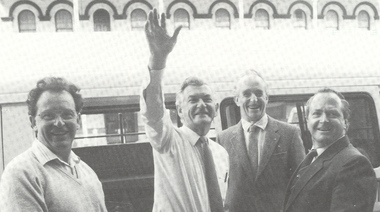
Photograph: Prime Minister Bob Hawke visits Ballarat and meets President of ATCV John Mewton and CEO Tim Cox
... New Zealand...Colin Jackson...Better Earth...Environmental Conservation...Volunteers...Volunteering...Corporate volunteering...Education – Environmental...Carbon footprint...Climate change...Ballarat...Safety...Training...Partnerships...Victoria...Vic...NSW...Queensland...ACT...Australian Capital Territory...NT...Northern Territory...Western Australia...WA...South Australia...SA...Tasmania...New Zealand...Californi1a Conservation Corps...ATCV...Bob Hawke...Prime Minister...Prime Minister Bob Hawke Although determinedly apolitical ATCV/CVA has maintained good relations with all sides of politics. CVA Conservation Volunteers Conservation Volunteers Australia Conservation Volunteers New Zealand Colin Jackson Better Earth Environmental Conservation Volunteers Volunteering Corporate volunteering Education – Environmental Carbon footprint Climate change Ballarat Safety Training Partnerships Victoria Vic NSW Queensland ACT Australian Capital Territory NT Northern Territory Western Australia WA South Australia SA Tasmania New Zealand Californi1a Conservation Corps ATCV Bob Hawke Prime Minister John Mewton Tim Cox Black and white photograph Photograph: Prime Minister Bob Hawke visits Ballarat and meets President of ATCV John Mewton and CEO Tim Cox Photograph: Prime Minister Bob Hawke visits Ballarat and meets President of ATCV John Mewton and CEO Tim Cox ...Prime Minister Bob HawkeAlthough determinedly apolitical ATCV/CVA has maintained good relations with all sides of politics.Black and white photographcva, conservation volunteers, conservation volunteers australia, conservation volunteers new zealand, colin jackson, better earth, environmental conservation, volunteers, volunteering, corporate volunteering, education – environmental, carbon footprint, climate change, ballarat, safety, training, partnerships, victoria, vic, nsw, queensland, act, australian capital territory, nt, northern territory, western australia, wa, south australia, sa, tasmania, new zealand, californi1a conservation corps, atcv, bob hawke, prime minister, john mewton, tim cox -
 National Vietnam Veterans Museum (NVVM)
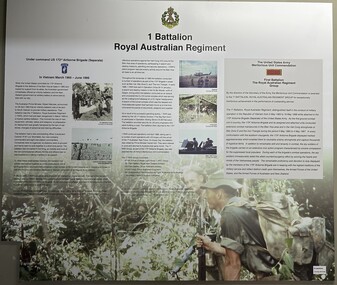
Poster - Information Board - 1 Battalion Royal Australian Regiment in Vietnam March 1965 - June 1966, 1 Royal Australian Regiment 1st Tour 1965-1966
... Prime Minister Harold Holt...Anzac Day...US Army's Meritorious Unit Commendation...4th/19th Prince of Wales Light Horse...ACP Troop...161 Field Battery...Royal New Zealand...This item commemorates the conflict in Vietnam. 1 Battalion Royal Australian Regiment Viet Cong VC Bien Hoa 173rd Airborne Brigade Ben Cat War Zone D The Iron T Operation Crimp Ho Bo Woods Saigon Tunnels of Cu Chi US 1st Infantry Dicision Operation Rolling Stone 1st Australian Task Force Prime Minister Harold Holt Anzac Day US Army's Meritorious Unit Commendation 4th/19th Prince of Wales Light Horse ACP Troop 161 Field Battery Royal New Zealand Artillery 105 Field Battery Royal Australian Artillery 3 Field Troop Royal Australian Engineers 161 (Indep) Recce Flt Australian Army Aviation Corps 1 Australian Logistics Support Company Sgt William John Noble 3411105 Royal Australian Infantry Corps A large white information board commemorating 1 Battalion Royal Australian Regiment under command US 173rd Airborne Brigade (separate) during 1965 to 1966 in Vietnam. ...This item commemorates the conflict in Vietnam.A large white information board commemorating 1 Battalion Royal Australian Regiment under command US 173rd Airborne Brigade (separate) during 1965 to 1966 in Vietnam. There are 5 photos of soldiers in the jungle and one photo of a soldier walking with a local. In brief the board describes the history of first tour with a detailed citation of US meritorious unit commendation.1 battalion, royal australian regiment, viet cong, vc, bien hoa, 173rd airborne brigade, ben cat, war zone d, the iron t, operation crimp, ho bo woods, saigon, tunnels of cu chi, us 1st infantry dicision, operation rolling stone, 1st australian task force, prime minister harold holt, anzac day, us army's meritorious unit commendation, 4th/19th prince of wales light horse, acp troop, 161 field battery, royal new zealand artillery, 105 field battery, royal australian artillery, 3 field troop, royal australian engineers, 161 (indep) recce flt, australian army aviation corps, 1 australian logistics support company, sgt william john noble, 3411105, royal australian infantry corps -
 National Vietnam Veterans Museum (NVVM)
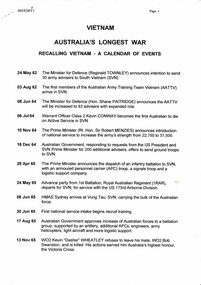
Document, A copy of Vietnam: Australia's Longest War: Recalling Vietnam - A Calendar Of Events. (Copy 2)
... Prime Minister Harold Holt...1st Australian Task Force...1ATF...RAAF...RAAF IROQUOIS Helicopter...Special Air Service Squadron...9 Squadron...First Australian Logistic Support Group...1 ALSG...5 RAR...Pte Errol Wayne Noack...4717546...Battle of Long Tan...D Company...6 Battalion...North Vietnam Army...VNA...Viet Cong...3 Troop...1 APC Sqn...Wounded In Action...US Presidental Unit Citation...Maj Peter John Badcoe...41400...103 Field Battery...FARELF...V Company...Royal New Zealand...Shane Paitridge (Miniter for Defence) WO2 (Temporary) Kevin George Conway 13097 Royal Australian Infantry Corps SVN 1st Battalion Royal Australian Regiment 1 RAR US 173rd Airborne Brigade HMAS Sydney Vung Tau Australian National Serviceman APC WO2 (Temporary) Kevin Arthur Wheatley 29890 Killed in Action VC Victoria Cross Prime Minister Harold Holt 1st Australian Task Force 1ATF RAAF RAAF IROQUOIS Helicopter Special Air Service Squadron 9 Squadron First Australian Logistic Support Group 1 ALSG 5 RAR Pte Errol Wayne Noack 4717546 Battle of Long Tan D Company 6 Battalion North Vietnam Army VNA Viet Cong 3 Troop 1 APC Sqn Wounded In Action US Presidental Unit Citation Maj Peter John Badcoe 41400 103 Field Battery FARELF V Company Royal New Zealand Regiment 2 Bn RAR 2RAR/NZ/ANZAC 3 Bn RAR Tet Offensive Baria Phuoc Tuy Province A Company Fire support Base Coral 1 Bn RAR Mortar Platoon 102 Field Battery Fire support Base Balmoral Cneturion Tanks WO2 Rayene Steward Simpson 217622 Distinguished Conduct Medal WO Keith Payne Batle of Binh Bah Prime Minister Sir William McMahon Prime Minister Sir John Gorton WO2 Keith Payne 12222 A copy of Vietnam: Australia's Longest War: Rrecalling Vietnam - A Calendar Of Events. ...A copy of Vietnam: Australia's Longest War: Rrecalling Vietnam - A Calendar Of Events. See medai files for more information.reginald townley (minister for defecne), australian army training team vietnam (aattv), hon. shane paitridge (miniter for defence), wo2 (temporary) kevin george conway, 13097, royal australian infantry corps, svn, 1st battalion, royal australian regiment, 1 rar, us 173rd airborne brigade, hmas sydney, vung tau, australian national serviceman, apc, wo2 (temporary) kevin arthur wheatley, 29890, killed in action, vc, victoria cross, prime minister harold holt, 1st australian task force, 1atf, raaf, raaf iroquois helicopter, special air service squadron, 9 squadron, first australian logistic support group, 1 alsg, 5 rar, pte errol wayne noack, 4717546, battle of long tan, d company, 6 battalion, north vietnam army, vna, viet cong, 3 troop, 1 apc sqn, wounded in action, us presidental unit citation, maj peter john badcoe, 41400, 103 field battery, farelf, v company, royal new zealand regiment, 2 bn rar, 2rar/nz/anzac, 3 bn rar, tet offensive, baria, phuoc tuy province, a company, fire support base coral, 1 bn rar, mortar platoon, 102 field battery, fire support base balmoral, cneturion tanks, wo2 rayene steward simpson, 217622, distinguished conduct medal, wo keith payne, batle of binh bah, prime minister sir william mcmahon, prime minister sir john gorton, wo2 keith payne, 12222 -
 National Vietnam Veterans Museum (NVVM)
Document, A Copy of Vietnam Veterans Council of Victoria Inc.: A brief history of the Vietnam War (Copy 1), 1993
... Prime Minister - Robert Menzies...Australian Army Training Team Vietnam (AATTV)...Royal Australian Air force...RAAF...Caribou...Australian National Serviceman...1st Battalion...Royal Australian Regiment...1RAR...HMAS Sydney...Bien Hoa Airbase...US 173rd Airborne Brigade...Cu Chi...Tunnels...Tunnel Rats...Saigon-Cholon...Australian Task Force...Phuoc Tuy Province...5RAR...6RAR...Nui Dat...1st Australian Task Force...1ATF...Headquarters...Australian Force Vietnam...Ho Chi Minh City...Phuoc Tuy...D Company...Battle of Long Tan...Gunners...New Zealand...South China Sea Laos Cambodia The Viet Minh Ho Chi Minh Battle of Dien Bien Phu Vietnamese Communist Party National Liberation Front Viet Cong Saigon Bien Hoa The Domino Theory South East Asia Australian Government Prime Minister - Robert Menzies Australian Army Training Team Vietnam (AATTV) Royal Australian Air force RAAF Caribou Australian National Serviceman 1st Battalion Royal Australian Regiment 1RAR HMAS Sydney Bien Hoa Airbase US 173rd Airborne Brigade Cu Chi Tunnels Tunnel Rats Saigon-Cholon Australian Task Force Phuoc Tuy Province 5RAR 6RAR Nui Dat 1st Australian Task Force 1ATF Headquarters Australian Force Vietnam Ho Chi Minh City Phuoc Tuy D Company Battle of Long Tan Gunners New Zealand Gunners Australian Gunners M113 RAAF Helicopters D445 Provincial Battalion Vietnam Veterans' Day ANZAC HMAS Hobart U.S. 7th Fleet A Squadron Canberra Bomber Vung Tau Harbour Tet Offensive Baria Long Dien Long Hai Hills C Company 3RAR Fire Support Base Fire Support Base - Coral Fire Support Base - Balmoral 8RAR Vietnamese Territorial Force US Troops Whitlam Labor Government Prime Minister Gough Whitlam Agent Orange Evatt Royal Commission Post Traumatic Stress Disorder PTSD Welcome Home Parade 1987 A Copy of Vietnam Veterans Council of Victoria Inc.: A brief history of the Vietnam War which was compiled as a guide to secondary school students and or any other person wishing to study the history of the Vietnam War. ...A Copy of Vietnam Veterans Council of Victoria Inc.: A brief history of the Vietnam War which was compiled as a guide to secondary school students and or any other person wishing to study the history of the Vietnam War. For more information please read the media files.vietnam veterans council of victoria inc., south china sea, laos, cambodia, the viet minh, ho chi minh, battle of dien bien phu, vietnamese communist party, national liberation front, viet cong, saigon, bien hoa, the domino theory, south east asia, australian government, prime minister - robert menzies, australian army training team vietnam (aattv), royal australian air force, raaf, caribou, australian national serviceman, 1st battalion, royal australian regiment, 1rar, hmas sydney, bien hoa airbase, us 173rd airborne brigade, cu chi, tunnels, tunnel rats, saigon-cholon, australian task force, phuoc tuy province, 5rar, 6rar, nui dat, 1st australian task force, 1atf, headquarters, australian force vietnam, ho chi minh city, phuoc tuy, d company, battle of long tan, gunners, new zealand gunners, australian gunners, m113, raaf helicopters, d445 provincial battalion, vietnam veterans' day, anzac, hmas hobart, u.s. 7th fleet, a squadron, canberra bomber, vung tau harbour, tet offensive, baria, long dien, long hai hills, c company, 3rar, fire support base, fire support base - coral, fire support base - balmoral, 8rar, vietnamese territorial force, us troops, whitlam labor government, prime minister gough whitlam, agent orange, evatt royal commission, post traumatic stress disorder, ptsd, welcome home parade 1987 -
 National Vietnam Veterans Museum (NVVM)
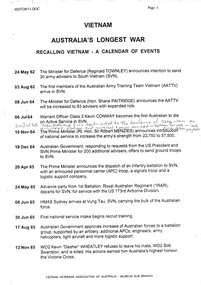
Document, A copy of Vietnam: Australia's Longest War: Recalling Vietnam - A Calendar Of Events. (Copy 1)
... Prime Minister Harold Holt...1st Australian Task Force...1ATF...RAAF...RAAF IROQUOIS Helicopter...Special Air Service Squadron...9 Squadron...First Australian Logistic Support Group...1 ALSG...5 RAR...Pte Errol Wayne Noack...4717546...Battle of Long Tan...D Company...6 Battalion...North Vietnam Army...VNA...Viet Cong...3 Troop...1 APC Sqn...Wounded In Action...US Presidental Unit Citation...Maj Peter John Badcoe...41400...103 Field Battery...FARELF...V Company...Royal New Zealand...Shane Paitridge (Miniter for Defence) WO2 (Temporary) Kevin George Conway 13097 Royal Australian Infantry Corps SVN 1st Battalion Royal Australian Regiment 1 RAR US 173rd Airborne Brigade HMAS Sydney Vung Tau Australian National Serviceman APC WO2 (Temporary) Kevin Arthur Wheatley 29890 Killed in Action VC Victoria Cross Prime Minister Harold Holt 1st Australian Task Force 1ATF RAAF RAAF IROQUOIS Helicopter Special Air Service Squadron 9 Squadron First Australian Logistic Support Group 1 ALSG 5 RAR Pte Errol Wayne Noack 4717546 Battle of Long Tan D Company 6 Battalion North Vietnam Army VNA Viet Cong 3 Troop 1 APC Sqn Wounded In Action US Presidental Unit Citation Maj Peter John Badcoe 41400 103 Field Battery FARELF V Company Royal New Zealand Regiment 2 Bn RAR 2RAR/NZ/ANZAC 3 Bn RAR Tet Offensive Baria Phuoc Tuy Province A Company Fire support Base Coral 1 Bn RAR Mortar Platoon 102 Field Battery Fire support Base Balmoral Cneturion Tanks WO2 Rayene Steward Simpson 217622 Distinguished Conduct Medal Batle of Binh Bah Prime Minister Sir William McMahon Prime Minister Sir John Gorton WO2 Keith Payne 12222 A copy of Vietnam: Australia's Longest War: Rrecalling Vietnam - A Calendar Of Events. ...A copy of Vietnam: Australia's Longest War: Rrecalling Vietnam - A Calendar Of Events. This has an added date for 20 Jul 64 which is handwritten in pencil. See medai files for more information.reginald townley (minister for defecne), australian army training team vietnam (aattv), hon. shane paitridge (miniter for defence), wo2 (temporary) kevin george conway, 13097, royal australian infantry corps, svn, 1st battalion, royal australian regiment, 1 rar, us 173rd airborne brigade, hmas sydney, vung tau, australian national serviceman, apc, wo2 (temporary) kevin arthur wheatley, 29890, killed in action, vc, victoria cross, prime minister harold holt, 1st australian task force, 1atf, raaf, raaf iroquois helicopter, special air service squadron, 9 squadron, first australian logistic support group, 1 alsg, 5 rar, pte errol wayne noack, 4717546, battle of long tan, d company, 6 battalion, north vietnam army, vna, viet cong, 3 troop, 1 apc sqn, wounded in action, us presidental unit citation, maj peter john badcoe, 41400, 103 field battery, farelf, v company, royal new zealand regiment, 2 bn rar, 2rar/nz/anzac, 3 bn rar, tet offensive, baria, phuoc tuy province, a company, fire support base coral, 1 bn rar, mortar platoon, 102 field battery, fire support base balmoral, cneturion tanks, wo2 rayene steward simpson, 217622, distinguished conduct medal, batle of binh bah, prime minister sir william mcmahon, prime minister sir john gorton, wo2 keith payne, 12222 -
 National Vietnam Veterans Museum (NVVM)
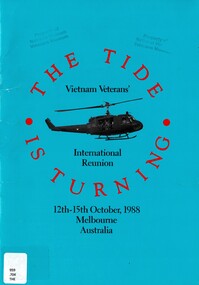
Book, Unknown, The Tide Is Turning: Vietnam Veteran's International Reunion 12th -15th October, 1988 Melbourne, Australia
... Prime Minister R.J. Hawke...Prime Miister of New Zealand Hon. D. Lange...Vietnam veterans reunion Prime Minister R.J. Hawke Prime Miister of New Zealand Hon. D. Lange 1988 is Australia's Bicentennial year: a year in which we celebrate the fact that we are a free nation, proud of our milticultural heritage and working with confidence toward the twentyfirst century. ...1988 is Australia's Bicentennial year: a year in which we celebrate the fact that we are a free nation, proud of our milticultural heritage and working with confidence toward the twentyfirst century.1988 is Australia's Bicentennial year: a year in which we celebrate the fact that we are a free nation, proud of our milticultural heritage and working with confidence toward the twentyfirst century.vietnam veterans reunion, prime minister r.j. hawke, prime miister of new zealand hon. d. lange -
 Warrnambool and District Historical Society Inc.
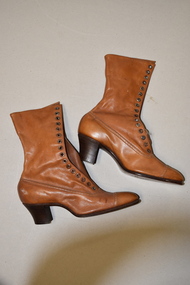
H. Perry & Co, Brown lace up boots x 2, 1906
... They come from the New Zealand International Exhibition held at Hagley Park, Christchurch from November 1906 to April 1907. This exhibition was the brainchild of the New Zealand Prime Minister, Richard Seddon who died before the exhibition opened. ...They come from the New Zealand International Exhibition held at Hagley Park, Christchurch from November 1906 to April 1907. This exhibition was the brainchild of the New Zealand Prime Minister, Richard Seddon who died before the exhibition opened. ...These boots may have been made as a sample as they are a very small size and do not appear to have been worn. They come from the New Zealand International Exhibition held at Hagley Park, Christchurch from November 1906 to April 1907. This exhibition was the brainchild of the New Zealand Prime Minister, Richard Seddon who died before the exhibition opened. Nearly 2 million people visited the exhibition at a time when the population of New Zealand was less than one million. The exhibition was thus rated a success even though there was a financial loss. No information has been found on the bootmakers, H. Perry & Co. In the 19th and early 20th centuries boots were an essential item for women who often had to walk through unmade streets and muddy paddocks. This item is of interest as it is a memento of an important New Zealand Exhibition early in the 20th century. This is a pair of a lady’s light brown leather boots. The boots have long leather tongues with 16 eyelets either side to lace up the front instep. The laces are missing. The wooden heels are slightly raised. H. Perry & Co. New Zealand International Exhibition Christchurch 1906-7 vintage footwear, christchurch new zealand exhibition, 1906-7 -
 Bendigo Historical Society Inc.
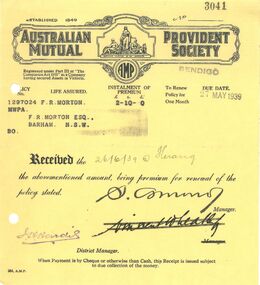
Financial record - INVOICE COLLECTION: The Australian Mutual Provident Society
... New Zealand invest, build wealth and retire with confidence." Milestones 1849 – The Australian Mutual Provident Society (AMP) opens for business 1860 – Benjamin Short joins AMP as its first agent 1869 – The National Mutual Life Association of Australasia opens for business 1899 – James Tuscon Thompson joins National Mutual as its first agent 1962 – The iconic AMP building in Sydney's Circular Quay is opened by Prime Minister Robert Menzies 1995 – National Mutual demutualises and lists on the Australian Stock Exchange 1998 – AMP demutualises and lists on the Australian Stock Exchange. ...New Zealand invest, build wealth and retire with confidence." Milestones 1849 – The Australian Mutual Provident Society (AMP) opens for business 1860 – Benjamin Short joins AMP as its first agent 1869 – The National Mutual Life Association of Australasia opens for business 1899 – James Tuscon Thompson joins National Mutual as its first agent 1962 – The iconic AMP building in Sydney's Circular Quay is opened by Prime Minister Robert Menzies 1995 – National Mutual demutualises and lists on the Australian Stock Exchange 1998 – AMP demutualises and lists on the Australian Stock Exchange. ...https://www.amp.com.au/about-amp/what-we-do "From its humble beginnings in 1849 by offering life insurance as the Australian Mutual Provident Society, AMP has evolved over the past 175 years to be a publicly listed company with over 1.3 million customers and AU$133 billion in assets under management (as at FY23). Proudly celebrating 175 years of business in 2024, AMP now helps millions of people in Australia and New Zealand invest, build wealth and retire with confidence." Milestones 1849 – The Australian Mutual Provident Society (AMP) opens for business 1860 – Benjamin Short joins AMP as its first agent 1869 – The National Mutual Life Association of Australasia opens for business 1899 – James Tuscon Thompson joins National Mutual as its first agent 1962 – The iconic AMP building in Sydney's Circular Quay is opened by Prime Minister Robert Menzies 1995 – National Mutual demutualises and lists on the Australian Stock Exchange 1998 – AMP demutualises and lists on the Australian Stock Exchange. AMP Bank opens for business 2000 – AMP plays a major part in the first Olympics of the new century, supporting the Sydney 2000 Olympic Games, the Paralympic Games and the Olympic Torch Relay 2009 – AMP and China Life Group form strategic partnership 2011 – AMP and AXA Asia Pacific (formerly National Mutual) merge. AMP and Mitsubishi UFJ Trust and Banking form strategic partnership 2017 – AMP Capital takes a minority stake in US based real estate investment manager PCCP 2020 – Completed sale of AMP Life insurance business to Resolution Life 2022 – Announced sale of global asset management business, AMP Capital, to focus on AMP’s core businesses in banking and wealth management. 2024 – AMP celebrates 175 years of helping people create their tomorrow10934.35a: No. 3041 A small, square sheet of yellow paper with two clean punch holes on the left side and a perforated edge. The paper is thin, but sturdy. Printed in black ink is the business name and details: Australian Mutual Provident Society established 1849. Policy No. 1297024 The receipt is printed in black ink. Payment due 27 May 1939. Receipt indicates payment received 26 June 1939. Payment listed in British Pounds, totaling 2 pounds 10 shillings. 10934.35b: No. 3861 A small, square sheet of yellow paper with two clean punch holes on the left side and a perforated edge. The paper is thin, but sturdy. Printed in black ink is the business name and details: Australian Mutual Provident Society established 1849. Policy No. 1311528 The receipt is printed in black ink. Payment due 18 Jun 1939. Receipt indicates payment received 26 June 1939. Payment listed in British Pounds, totaling 2 pounds 10 shillings. 10934.35c: No. 1671 A small, square sheet of yellow paper with two clean punch holes on the left side and a perforated edge. The paper is thin, but sturdy. Printed in black ink is the business name and details: Australian Mutual Provident Society established 1849. Policy No. 1311528 The receipt is printed in black ink. Payment due 18 Mar 1939. Receipt indicates payment received 25 March 1939. Payment listed in British Pounds, totaling 2 pounds 10 shillings. 10934.35d: No. 903 A small, square sheet of yellow paper with two clean punch holes on the left side and a perforated edge. The paper is thin, but sturdy. Printed in black ink is the business name and details: Australian Mutual Provident Society established 1849. Policy No. 1297024 The receipt is printed in black ink. Payment due 27 Feb 1939. Receipt indicates payment received 25 March 1939. Payment listed in British Pounds, totaling 2 pounds 10 shillings. 10934.35e: No. 8557 A small, square sheet of yellow paper with two clean punch holes on the left side and a perforated edge. The paper is thin, but sturdy. Printed in black ink is the business name and details: Australian Mutual Provident Society established 1849. Policy No. 1297024 The receipt is printed in black ink. Payment due 27 Dec 1938. Receipt indicates payment received 25 Jan 1939. Payment listed in British Pounds, totaling 2 pounds 10 shillings. 10934.35f: No. 338 A small, square sheet of yellow paper with two clean punch holes on the left side and a perforated edge. The paper is thin, but sturdy. Printed in black ink is the business name and details: Australian Mutual Provident Society established 1849. Policy No. 1311528 The receipt is printed in black ink. Payment due 18 Jan 1939. Receipt indicates payment received 25 Jan 1939. Payment listed in British Pounds, totaling 2 pounds 10 shillings. 10934.35g: No. 365 A small, square sheet of yellow paper with two clean punch holes on the left side and a perforated edge. The paper is thin, but sturdy. Printed in black ink is the business name and details: Australian Mutual Provident Society established 1849. Policy No. 1297024 The receipt is printed in black ink. Payment due 27 Jun 1939. Receipt indicates payment received 25 Feb 1939. Payment listed in British Pounds, totaling 2 pounds 10 shillings. receipt attached to 10934.35j 10934.35h: No. 2321 A small, square sheet of yellow paper with two clean punch holes on the left side and a perforated edge. The paper is thin, but sturdy. Printed in black ink is the business name and details: Australian Mutual Provident Society established 1849. Policy No. 1311528 The receipt is printed in black ink. Payment due 18 April 1939. Receipt indicates payment received 27 April 1939. Payment listed in British Pounds, totaling 2 pounds 10 shillings. receipt is attached to 10934.35i 10934.35i: No. 1697 A small, square sheet of yellow paper with two clean punch holes on the left side and a perforated edge. The paper is thin, but sturdy. Printed in black ink is the business name and details: Australian Mutual Provident Society established 1849. Policy No. 1297024 The receipt is printed in black ink. Payment due 27 Mar 1939. Receipt indicates payment received 27 April 1939. Payment listed in British Pounds, totaling 2 pounds 10 shillings. Attached to 10934.35h 10934.35j: No. 876 A small, square sheet of yellow paper with two clean punch holes on the left side and a perforated edge. The paper is thin, but sturdy. Printed in black ink is the business name and details: Australian Mutual Provident Society established 1849. Policy No. 1311528 The receipt is printed in black ink. Payment due 18 Feb 1939. Receipt indicates payment received 25 Feb 1939. Payment listed in British Pounds, totaling 2 pounds 10 shillings. Attached 10934.35gac morton, amp, australian mutual provident society, insurance -
 Sunshine and District Historical Society Incorporated
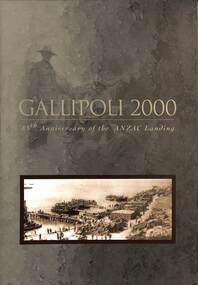
Pamphlet - Gallipoli 2000 85th Anniversary of the ANZAC Landing, Australian and New Zealand Governments by the Department of Veterans' Affairs, 2000
... The Foreword was signed by both, The Honourable John Howard MP, Prime Minister of Australia and The Right Honorable Helen Clark, MP, Prime Minister of New Zealand. ...A souvenir document which commemorates the 85th anniversary of the Gallipoli campaign, held at Anzac Cove in April 2000The commemoration was historically significant as one of the last major events where surviving ANZAC veterans could witness the anniversary firsthand prior to the death of the final veteran in 2002. The Foreword was signed by both, The Honourable John Howard MP, Prime Minister of Australia and The Right Honorable Helen Clark, MP, Prime Minister of New Zealand. Gallipoli 2000 85th Anniversary of the ANZAC Landinggallipoli, world war 1914 - 1918, anzac -
 Dandenong/Cranbourne RSL Sub Branch
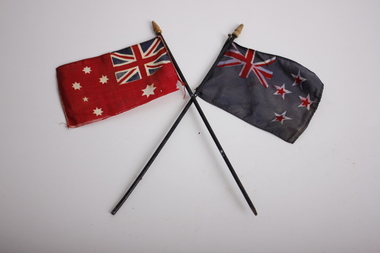
Flag - The Australian Red Ensign Flag and New Zealand Flag, unknown
... In 1941, Australia′s Prime Minister Robert Menzies stated that there should be no restrictions on private citizens using the Blue Ensign on land and, in 1947, Prime Minister Ben Chifley reaffirmed this position but it wasn’t until the passage of the Flags Act 1953 that the restriction on civilians flying the Blue Ensign was lifted after which, use of the Red Ensign on land became a rarity. Since 2008, 3 September has been officially commemorated as both Australian National Flag/Merchant Navy Day which allows the Australian Red Ensign to be flown on land for the occasion as a matter of protocol. The blue flag is the New Zealand...In 1941, Australia′s Prime Minister Robert Menzies stated that there should be no restrictions on private citizens using the Blue Ensign on land and, in 1947, Prime Minister Ben Chifley reaffirmed this position but it wasn’t until the passage of the Flags Act 1953 that the restriction on civilians flying the Blue Ensign was lifted after which, use of the Red Ensign on land became a rarity. Since 2008, 3 September has been officially commemorated as both Australian National Flag/Merchant Navy Day which allows the Australian Red Ensign to be flown on land for the occasion as a matter of protocol. The blue flag is the New Zealand ...Likely from WWIPair of miniature flags on small black flag poles with wooden caps. The Australian Red Ensign, or the Australian Civil Ensign, is simply a red version of the Australian National flag. It is for use only at sea and officially never on land, but can be used by private citizens. At sea, it is the only flag allowable for merchant ships registered in Australia under the Navigation and Shipping Act 1912 and The Shipping Registration Act 1981. Pleasure craft, however, may fly either the Red Ensign or the National Flag. The history of the Red Ensign is intertwined with the history of the Australian National flag. From 1901 to 1954 the Red Ensign was used as the National Flag by State and Local Governments, private organisations and individuals. The Blue Ensign was for Government use only, reflecting British practice with its ensigns. The design of the Australian Red Ensign was always kept in step with the Blue Ensign (i.e. with respect to the number of points on the stars, etc.) but there was often public confusion about which was the `correct′ flag to fly. Many thought the choice was merely one of fashion or preference. In 1941, Australia′s Prime Minister Robert Menzies stated that there should be no restrictions on private citizens using the Blue Ensign on land and, in 1947, Prime Minister Ben Chifley reaffirmed this position but it wasn’t until the passage of the Flags Act 1953 that the restriction on civilians flying the Blue Ensign was lifted after which, use of the Red Ensign on land became a rarity. Since 2008, 3 September has been officially commemorated as both Australian National Flag/Merchant Navy Day which allows the Australian Red Ensign to be flown on land for the occasion as a matter of protocol. The blue flag is the New Zealand National Flag.flag, ensign, anzac, new zealand, navy, naval
