
Showing 12 items matching "prince albert's death"
-
 Embroiderers Guild, Victoria
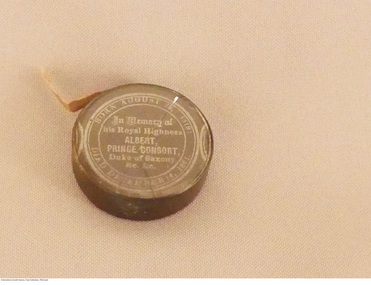
Tool - Tape measure commemorating Prince Albert's death in 1861, Tape measure
... Tape measure commemorating Prince Albert's death in 1861....Commemorating Prince Albert's death, while also showing technological advances of thinner glass and the spring activated retractor rewinding the tape. ...Circular brass tape measure cover commemorating 1861 death of Prince Albert. Portrait on front, Inscription on back. ...Tape measure Tool Tape measure commemorating Prince Albert's death in 1861. ...Commemorating Prince Albert's death, while also showing technological advances of thinner glass and the spring activated retractor rewinding the tape. Tools made to commemorate events such as the Prince's death are valuable for providing the date and social events of the time. Tools with known dates are important for marking the history of the tool, its technology and the times.Circular brass tape measure cover commemorating 1861 death of Prince Albert. Portrait on front, Inscription on back. Both front and back glass covered. Spring rewind mechanism. Narrow cotton tape, End pull and first 1/4 missing.In memory of His Royal Highness Albert, Prince Consort, Duke of Saxony, Etc Etc. Within outer circle band "Born August 26, 1819. Died December 14, 1861.' On side next to opening: :"3 ft Patent' prince albert, tape measure -
 Embroiderers Guild, Victoria
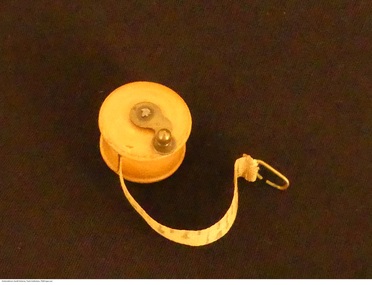
Tool - Fishing reel style tape measure, tape measure, 1860's
... ...Prince Albert's death...A tape measure which marks the death of Prince Albert in 1861 and its spring activated retractor was an important new development replacing spindles or handles to rewind the tape...A tape measure which marks the death of Prince Albert in 1861 and its spring activated retractor was an important new development replacing spindles or handles to rewind the tape A souvenir of the Prince Consort's death. ...A tape measure which marks the death of Prince Albert in 1861 and its spring activated retractor was an important new development replacing spindles or handles to rewind the tapeA souvenir of the Prince Consort's death. Its construct demonstrates new technologies of photography, thinner glass and a the spring activated retractorWooden cylindrical tape measure holder in the form of a fishing reel. Brass winding handle. Cotton tape measured in inches 0-36in. Brass pull ring.tape measure, prince albert's death -
 Flagstaff Hill Maritime Museum and Village
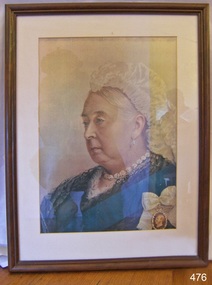
Print - Portrait of Queen Victoria, Hoy Art Picture Framing, Original probably painted in 1887 or 1897 to commemorate 50 or 60 years on the throne
... death, it was said, Britain had a worldwide empire on which the sun never set. In the early part of her reign, she was influenced by two men: her first Prime Minister, Lord Melbourne, and then her husband, Prince Albert, whom she married in 1840. ...death, it was said, Britain had a worldwide empire on which the sun never set. In the early part of her reign, she was influenced by two men: her first Prime Minister, Lord Melbourne, and then her husband, Prince Albert, whom she married in 1840. ...Queen Victoria was born at Kensington Palace, London, on 24 May 1819. She was the only daughter of Edward, Duke of Kent, the fourth son of George III. Her father died shortly after her birth and she became heir to the throne because the three uncles who were ahead of her in the succession - George IV, Frederick Duke of York, and William IV - had no legitimate children who survived. Warmhearted and lively, Victoria had a gift for drawing and painting; educated by a governess at home, she was a natural diarist and kept a regular journal throughout her life. On William IV's death in 1837, she became Queen at the age of 18. Queen Victoria is associated with Britain's great age of industrial expansion, economic progress and, especially, empire. At her death, it was said, Britain had a worldwide empire on which the sun never set. In the early part of her reign, she was influenced by two men: her first Prime Minister, Lord Melbourne, and then her husband, Prince Albert, whom she married in 1840. Both men taught her much about how to be a ruler in a 'constitutional monarchy, in which the monarch had very few powers but could use much influence. Albert took an active interest in the arts, science, trade and industry; the project for which he is best remembered was the Great Exhibition of 1851, the profits from which helped to establish the South Kensington museums complex in London. Her marriage to Prince Albert produced nine children between 1840 and 1857. Most of her children married into other Royal families in Europe. Edward VII (born 1841), married Alexandra, daughter of Christian IX of Denmark. Alfred, Duke of Edinburgh and of Saxe-Coburg and Gotha (born 1844) married Marie of Russia. Arthur, Duke of Connaught (born 1850) married Louise Margaret of Prussia. Leopold, Duke of Albany (born 1853) married Helen of Waldeck-Pyrmont. Victoria, Princess Royal (born 1840) married Friedrich III, German Emperor. Alice (born 1843) married Ludwig IV, Grand Duke of Hesse and by Rhine. Helena (born 1846) married Christian of Schleswig-Holstein. Louise (born 1848) married John Campbell, 9th Duke of Argyll. Beatrice (born 1857) married Henry of Battenberg. Victoria bought Osborne House (later presented to the nation by Edward VII) on the Isle of Wight as a family home in 1845, and Albert bought Balmoral in 1852. Victoria was deeply attached to her husband and she sank into depression after he died, aged 42, in 1861. She had lost a devoted husband and her principal trusted adviser in affairs of state. For the rest of her reign she wore black. Until the late 1860s she rarely appeared in public; although she never neglected her official Correspondence, and continued to give audiences to her ministers and official visitors, she was reluctant to resume a full public life. She was persuaded to open Parliament in person in 1866 and 1867, but she was widely criticised for living in seclusion and quite a strong republican movement developed. Seven attempts were made on Victoria's life, between 1840 and 1882 - her courageous attitude towards these attacks greatly strengthened her popularity. With time, the private urgings of her family and the flattering attention of Benjamin Disraeli, Prime Minister in 1868 and from 1874 to 1880, the Queen gradually resumed her public duties. In foreign policy, the Queen's influence during the middle years of her reign was generally used to support peace and reconciliation. In 1864, Victoria pressed her ministers not to intervene in the Prussia-Denmark war, and her letter to the German Emperor (whose son had married her daughter) in 1875 helped to avert a second Franco-German war. On the Eastern Question in the 1870s - the issue of Britain's policy towards the declining Turkish Empire in Europe - Victoria (unlike Gladstone) believed that Britain, while pressing for necessary reforms, ought to uphold Turkish hegemony as a bulwark of stability against Russia, and maintain bi-partisanship at a time when Britain could be involved in war. Victoria's popularity grew with the increasing imperial sentiment from the 1870s onwards. After the Indian Mutiny of 1857, the government of India was transferred from the East India Company to the Crown, with the position of Governor-General upgraded to Viceroy, and in 1877 Victoria became Empress of India under the Royal Titles Act passed by Disraeli's government. During Victoria's long reign, direct political power moved away from the sovereign. A series of Acts broadened the social and economic base of the electorate. These acts included the Second Reform Act of 1867; the introduction of the secret ballot in 1872, which made it impossible to pressurise voters by bribery or intimidation; and the Representation of the Peoples Act of 1884 - all householders and lodgers in accommodation worth at least £10 a year, and occupiers of land worth £10 a year, were entitled to vote. Despite this decline in the Sovereign's power, Victoria showed that a monarch who had a high level of prestige and who was prepared to master the details of political life could exert an important influence. This was demonstrated by her mediation between the Commons and the Lords, during the acrimonious passing of the Irish Church Disestablishment Act of 1869 and the 1884 Reform Act. It was during Victoria's reign that the modern idea of the constitutional monarch, whose role was to remain above political parties, began to evolve. But Victoria herself was not always non-partisan and she took the opportunity to give her opinions, sometimes very forcefully, in private. After the Second Reform Act of 1867, and the growth of the two-party (Liberal and Conservative) system, the Queen's room for manoeuvre decreased. Her freedom to choose which individual should occupy the premiership was increasingly restricted. In 1880, she tried, unsuccessfully, to stop William Gladstone - whom she disliked as much as she admired Disraeli and whose policies she distrusted - from becoming Prime Minister. She much preferred the Marquess of Hartington, another statesman from the Liberal party which had just won the general election. She did not get her way. She was a very strong supporter of the Empire, which brought her closer both to Disraeli and to the Marquess of Salisbury, her last Prime Minister. Although conservative in some respects - like many at the time she opposed giving women the vote - on social issues, she tended to favour measures to improve the lot of the poor, such as the Royal Commission on housing. She also supported many charities involved in education, hospitals and other areas. Victoria and her family travelled and were seen on an unprecedented scale, thanks to transport improvements and other technical changes such as the spread of newspapers and the invention of photography. Victoria was the first reigning monarch to use trains - she made her first train journey in 1842. In her later years, she became the symbol of the British Empire. Both the Golden (1887) and the Diamond (1897) Jubilees, held to celebrate the 50th and 60th anniversaries of the Queen's accession, were marked with great displays and public ceremonies. On both occasions, Colonial Conferences attended by the Prime Ministers of the self-governing colonies were held. Despite her advanced age, Victoria continued her duties to the end - including an official visit to Dublin in 1900. The Boer War in South Africa overshadowed the end of her reign. As in the Crimean War nearly half a century earlier, Victoria reviewed her troops and visited hospitals; she remained undaunted by British reverses during the campaign: 'We are not interested in the possibilities of defeat; they do not exist.' Victoria died at Osborne House on the Isle of Wight, on 22 January 1901 after a reign which lasted almost 64 years, then the longest in British history. Her son, Edward VII succeeded her. She was buried at Windsor beside Prince Albert, in the Frogmore Royal Mausoleum, which she had built for their final resting place. Above the Mausoleum door are inscribed Victoria's words: "Farewell best beloved, here, at last, I shall rest with thee, with thee in Christ I shall rise again." Source: https://www.royal.uk/queen-victoria This picture captures Queen Victoria in her later years. It may well have been painted to commemorate her Golden Anniversary in 1887, or her Diamond Anniversary in 1897.Picture, print, reproduction of a drawing or photograph of Queen Victoria. She is wearing a dark-coloured dress, white headdress and a diamond necklace and earrings. On her left shoulder is the Royal Order of Victoria and Albert, awarded to female members of the British Royal Family and female courtiers. There are four grades or classes of this Royal Order as well as the Sovereign's Badge, which is exclusive to her. Also across her left shoulder, is a blue riband representing the Order of the Garter. The picture is in a medium-coloured timber frame with a white string across the width at the rear. The label says it was framed by Hoy Art, Warrnambool. The signature of the Queen is on the picture but is not obvious since the picture has been re-framed."HOY ART / PICTURE FRAMING / 48 Kepler St, Warrnambool 3280 / Phone (055) 62 8022" Signature (hidden by new framing) "Victoria H.R.S."flagstaff hill, warrnambool, shipwrecked-coast, flagstaff-hill, flagstaff-hill-maritime-museum, maritime-museum, shipwreck-coast, flagstaff-hill-maritime-village, picture of queen victoria, queen victoria, the royal order of victoria and albert, the order of the garter, hoy art -
 Flagstaff Hill Maritime Museum and Village
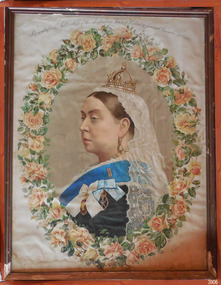
Print - Portrait, Australian Town and Country Journal, c. 1886
... She married Prince Albert of Saxe-Coburg and Gotha on February 10, 1840. Queen Victoria lived and reigned until her death on January 22, 1901, at age 82 years, after reigning for sixty-three years and seven months. ...She married Prince Albert of Saxe-Coburg and Gotha on February 10, 1840. Queen Victoria lived and reigned until her death on January 22, 1901, at age 82 years, after reigning for sixty-three years and seven months. ...This print was an 1885 Christmas gift from the publishers of the Australian Town and Country Journal to their subscribers. At that time Queen Victoria was 65 years old although she may not have been that age when the portrait was painted. The print shows Queen Victoria’s signature in the bottom right corner. It cost sixpence per copy and operated from 1870-1919. The Australian Town and Country Journal was printed weekly, on Saturdays, in Sydney. The edition on December 26, 1885, contained 51 pages. The Journal claimed “Circulation Ten Thousand Copies, Greater than any other Weekly in Australia.” The frame of the print has a solid back of thick timber panels and is crudely made. The edges of the frame appear to have an underlying plaster base that has been covered with a layer of wood. The corners are reinforced with metal protectors. The subject of the print is Queen Victoria, Queen of the United Kingdom of Britain and Ireland. She was born as Princess Alexandrina Victoria of Kent on May 24, 1819. She became Queen on June 24, 1837 when King William IV died. She married Prince Albert of Saxe-Coburg and Gotha on February 10, 1840. Queen Victoria lived and reigned until her death on January 22, 1901, at age 82 years, after reigning for sixty-three years and seven months. This portrait is significant historically for its origin as an inclusion the Australian Town and Country Journal, a late 19th century Australian weekly newspaper, in circulation for almost fifty years. The portrait gifted to the newspaper’s subscribers is historically significant as an example of the connection between the people in the British Colony of Australia, with the value and respect held for the Queen of the Colony. The frame of the portrait, of solid and protective construction, shows the value that the owners placed on this portrait.Print behind glass in a brown wooden frame; coloured print of a portrait of Queen Victoria, made in watercolours. The Queen is wearing a blue sash, crown, and white ribbon pinned to the sash along with a cameo brooch and Royal Emblem. The portrait has an oval floral border of roses in pastel colours. Text is printed outside the border, as a title above and a signature below, in the lower right corner. The back of the frame is made of heavy timber panels with holes for attaching wire. The timber frame is over a white layer of soft substance, perhaps plaster. "Presented to the Subscribers of the Australian Town and Country Journal, December 25th 1885" “Victoria R”flagstaff hill, warrnambool, flagstaff hill maritime village, flagstaff hill maritime museum, maritime museum, shipwreck coast, great ocean road, queen victoria, princess alexandrina victoria of kent, portrait of queen victoria, australian town and country journal, presented to subscribers, 1885 -
 City of Moorabbin Historical Society (Operating the Box Cottage Museum)
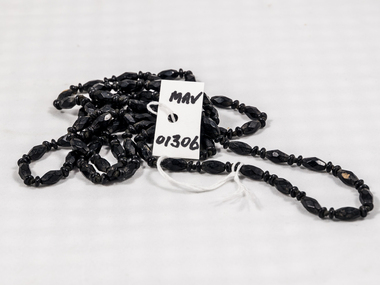
Jewellery, jet necklace, c1880
... Jet became popular in the Victorian era for mourning jewellery, which became fashionable after the death of Queen Victoria's husband Prince Albert in 1861. Jet is a dense black fossilized wood, almost like coal, and very light in weight. ...Jet became popular in the Victorian era for mourning jewellery, which became fashionable after the death of Queen Victoria's husband Prince Albert in 1861. Jet is a dense black fossilized wood, almost like coal, and very light in weight. ...Jet became popular in the Victorian era for mourning jewellery, which became fashionable after the death of Queen Victoria's husband Prince Albert in 1861. Jet is a dense black fossilized wood, almost like coal, and very light in weight. It is easy to cut, so carved well. It became popular in the Victorian era for mourning jewellery, which became fashionable.This jet necklace is typical of the mourning jewellery worn by early settler women in Moorabbin Shire c1900A continuous circular, long, black necklace with small jet beads.Nonejewellery, mourning wear, jet stone, queen victoria fashion, early settlers, pioneers, black clothing, moorabbin mirror, bader fran, rietman august, rennick stefanie, resin jewellery, -
 Orbost & District Historical Society
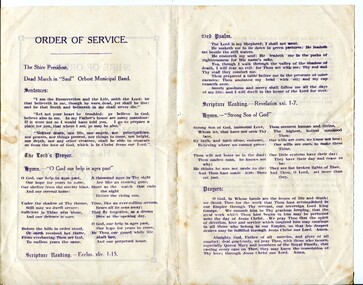
program, 1936
... Prince Albert as midshipmen aboard the HMS Bacchante in 1880. He was King of the United Kingdom and the British Dominions, and Emperor of India, from 6 May 1910 until his death in 1936. ...Prince Albert as midshipmen aboard the HMS Bacchante in 1880. He was King of the United Kingdom and the British Dominions, and Emperor of India, from 6 May 1910 until his death in 1936. ...This service was held on January 28, 1936 at the Mechanics' Institute, Orbost. Born in 1865, George V was the second eldest son of Edward VII and Alexandra 1865. He first visited Australia with his elder brother Prince Albert as midshipmen aboard the HMS Bacchante in 1880. He was King of the United Kingdom and the British Dominions, and Emperor of India, from 6 May 1910 until his death in 1936. The Shire of Orbost was a local government area about 380 kilometres east of Melbourne. The shire covered an area of 9,347 square kilometres and existed from 1892 until 1994. Originally, Orbost was part of the Bairnsdale Road District which was created on 30 April 1867. Splitting away as part of the Shire of Tambo in 1882, Orbost was first incorporated as a shire in its own right as the Shire of Croajingolong on 30 May 1892. It received its present name on 17 February 1893. On 3 January 1913 part of its western riding was annexed to Tambo as its Cunninghame Riding. On 2 December 1994, the Shire was abolished, and merged with City and Shire of Bairnsdale, Shire of Tambo, most of the Shire of Omeo and the Boole Boole Peninsula from Shire of Rosedale into the Shire of East Gippsland.This item reflects the significance of monarchy for Australia and the constitutional history of Australia.The item reflects the interest in the royal family to Australians at this time as well as the general feeling of respect and admiration felt by the rural communities towards the British Royal Family..A folding single sheet, white paper program with a dark purple print. It is a program for the Orbost Shire Council memorial service for the death of King George V. On the front is "Shire of Orbost Memorial Service for his late Majesty King George V". Details of the time and venue are below. This print is inside a rectangular border. On the back of the program are the words of the national anthem, Kipling's "Recessional" and a prayer. Inside is the order of the service.royalty george-v-death-memorial orbost-shire-council -
 City of Moorabbin Historical Society (Operating the Box Cottage Museum)
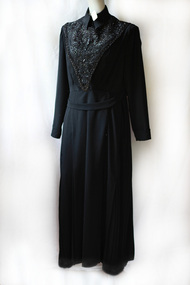
Clothing - Clothing, Lady's black beaded dress, c1900
... During the reign of Queen Victoria, whose long and conspicuous grief over the death of her husband, Prince Albert, appropriate dress for men and women for the period of mourning was strictly prescribed and rigidly adhered to. ...During the reign of Queen Victoria, whose long and conspicuous grief over the death of her husband, Prince Albert, appropriate dress for men and women for the period of mourning was strictly prescribed and rigidly adhered to. ...During the reign of Queen Victoria, whose long and conspicuous grief over the death of her husband, Prince Albert, appropriate dress for men and women for the period of mourning was strictly prescribed and rigidly adhered to. Widows were expected to wear special clothes to indicate that they were in mourning for up to four years after the death, although a widow could choose to wear such attire for the rest of her life. To change the costume earlier was considered disrespectful to the deceased and, if the widow was still young and attractive, suggestive of potential sexual promiscuity. Those subject to the rules were slowly allowed to re-introduce conventional clothing at specific time periods; such stages were known by such terms as "full mourning", "half mourning", and similar descriptions. For half mourning, muted colours such as lilac, grey and lavender could be introduced.. Special caps and bonnets, usually in black or other dark colours, went with these ensembles. There was special mourning jewellery, often made of jet. By the late 20th century, this no longer applied, and black had been widely adopted by women in cities as a fashionable colour. A lady's full length black fine wool dress with pleated bodice and skirt. A beaded detachable collar sits over the dress forming a V shape back and front and is attached by hooks and eyes on right shoulder . Centre front from neck to point is a row of small black circular sequins. clothing, dressmaking, craftwork, cheltenham, market gardeners, pioneers, early settlers, moorabbin, bentleigh -
 Orbost & District Historical Society
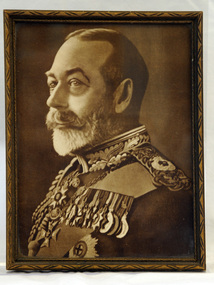
framed photograph, circa 1920's
... George V (George Frederick Ernest Albert; 3 June 1865 – 20 January 1936) was King of the United Kingdom and the British Dominions, and Emperor of India, from 6 May 1910 until his death in 1936. He was the second son of Albert Edward, Prince...George V (George Frederick Ernest Albert; 3 June 1865 – 20 January 1936) was King of the United Kingdom and the British Dominions, and Emperor of India, from 6 May 1910 until his death in 1936. He was the second son of Albert Edward, Prince ...George V was the first king of the House of Windsor. George V (George Frederick Ernest Albert; 3 June 1865 – 20 January 1936) was King of the United Kingdom and the British Dominions, and Emperor of India, from 6 May 1910 until his death in 1936. He was the second son of Albert Edward, Prince of Wales (later King Edward VII), and the grandson of the British monarch, Queen Victoria Saving an item dedicated to the royal family is typical of the general feeling of respect and admiration felt by the rural communities towards the British Royal Family.A framed sepia head and shoulders photograph of King George V in military uniform and wearing medals. It is in a wooden frame with decorated edging and has a cardboard stand.monarchy royal-family george-v photograph -
 Bendigo Historical Society Inc.
Newspaper - JENNY FOLEY COLLECTION: PALL MALL
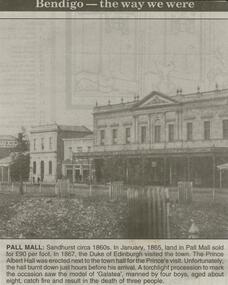
... Prince Albert Hall was erected next to the town hall for the Prince's visit. Unfortunately, the hall burnt down just hours before his arrival. A torchlight procession to mark the occasion saw the model of 'Galatea', manned by four boys, aged about eight, catch fire and result in the death of three people. ...Prince Albert Hall was erected next to the town hall for the Prince's visit. Unfortunately, the hall burnt down just hours before his arrival. A torchlight procession to mark the occasion saw the model of 'Galatea', manned by four boys, aged about eight, catch fire and result in the death of three people. ...Bendigo Advertiser ''The way we were'' from 2000. Pall Mall: Sandhurst circa 1860s. In January, 1865, land in Pall Mall sold for 90 pounds per foot. In 1867, the Duke of Edinburgh visited the town. The Prince Albert Hall was erected next to the town hall for the Prince's visit. Unfortunately, the hall burnt down just hours before his arrival. A torchlight procession to mark the occasion saw the model of 'Galatea', manned by four boys, aged about eight, catch fire and result in the death of three people. The clip is in a folder.newspaper, bendigo advertiser, the way we were -
 Sunshine and District Historical Society Incorporated
Letter - Wallace 'Wal/Wally' More Collection
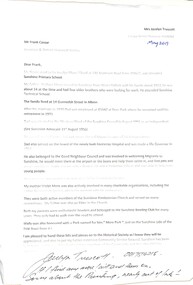
... Letter to Frank Cassar from Jocelyn Truscott nee More May 2019|Program of Gala Performance Sixty glorious Years The Barclay Theatre Melbourne 16th April 1972 Synopsis The film opens with Queen Victoria's announcement of her betrothal to Prince Albert a pronouncement far from enthusiastically received by Parliament Thence to Englands antipathy towards the Prince Consort. The birth of the Princess Royal. The opening of the Great Exhibition at Crystal Palace. The Charge of the Light Brigade at Balaclava. The death...These documents were donated to the Society by his daughter Jocelyn Truscott More Letter to Frank Cassar from Jocelyn Truscott nee More May 2019|Program of Gala Performance Sixty glorious Years The Barclay Theatre Melbourne 16th April 1972 Synopsis The film opens with Queen Victoria's announcement of her betrothal to Prince Albert a pronouncement far from enthusiastically received by Parliament Thence to Englands antipathy towards the Prince Consort. The birth of the Princess Royal. The opening of the Great Exhibition at Crystal Palace. The Charge of the Light Brigade at Balaclava. The death ...Wallace 'Wal/Wally' More documents from when he served as an independant Councillor for the City of Sunshine (Elected 1956). He lived at 14 Gunnedah Street Albion. More Park Ardeer is named after him. These documents were donated to the Society by his daughter Jocelyn TruscottLetter to Frank Cassar from Jocelyn Truscott nee More May 2019|Program of Gala Performance Sixty glorious Years The Barclay Theatre Melbourne 16th April 1972 Synopsis The film opens with Queen Victoria's announcement of her betrothal to Prince Albert a pronouncement far from enthusiastically received by Parliament Thence to Englands antipathy towards the Prince Consort. The birth of the Princess Royal. The opening of the Great Exhibition at Crystal Palace. The Charge of the Light Brigade at Balaclava. The death of the Prince Consort. The poignancy of Victoria's protracted retirement from public life. The misguided honour of her husband's memory. Later in happier circumstances during her Diamond Jubilee Celebrations. The control of the Suez Canal by Disraeli. The assassination of General Gordon Kitchener's conquest of Khartoum. The death of the Queen These are the highlights of This Magnificent Motion Picture|3 Notice paper for Centenary Commemoration meeting of the Council Wednesday 18th May 1960|Religious Program for City of Sunshine who were celebrating the Centenary Civic Thanksgiving Service 1860 - 1960 at the Town Hall Sunshine 1st May 1960 in the presence of His Worship the Mayor Cr D B Dempster JP Address by The Right Reverend Doctor A C Watson Moderator General of the Presbyterian Church of Australia|Typed Report City of Sunshine Mayors Report 1962 to 1963 Cr D F Thompson JP Mayor 2 September 1963|Typed Report City of Sunshine Mayors Report 1955 to 1956 Cr Henry B Dempster JP|Newspaper Article Footscray and District Hospital Annual Report 1972|Newspaper Article Its hard times for the kind ladies of Sunshine Sunshine Ladis Benevolent Society members Flo Morley Glad Crick Sadie Parsons and Connie Parsons With remaining members Edna Hopkins and Violet More the women have given a total of 130 years service to Sunshine's needy|Newspaper Article The Sun 30 June 1981 Baby Di|Newspaper Article Sunshine Advocate 31 August 1956 Who will be Mayor?more -
 St Kilda Historical Society
Ephemera - Special event program, In Celebration of the Opening of the Parliament of the Commonwealth of Australia, 1901
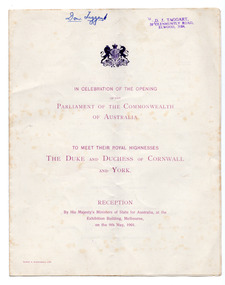
... Prince George Frederick Ernest Albert (1865–1936), Duke of Cornwall and York was the second son of Edward VII and Queen Alexandra. The visit was part of an Empire tour and a tribute to the response made throughout the Empire during the Boer War. On their return to Britain the couple were proclaimed Prince and Princess of Wales and, on the death...Prince George Frederick Ernest Albert (1865–1936), Duke of Cornwall and York was the second son of Edward VII and Queen Alexandra. The visit was part of an Empire tour and a tribute to the response made throughout the Empire during the Boer War. On their return to Britain the couple were proclaimed Prince and Princess of Wales and, on the death ...Program for the first opening of Parliament after Federation. Prince George Frederick Ernest Albert (1865–1936), Duke of Cornwall and York was the second son of Edward VII and Queen Alexandra. The visit was part of an Empire tour and a tribute to the response made throughout the Empire during the Boer War. On their return to Britain the couple were proclaimed Prince and Princess of Wales and, on the death of Edward VII in 1910, became George V and Queen Mary.White coloured folded program, printed in purpleFront page/cover: UK Coat of Arms In Celebration of the Opening of the Parliament of the Commonwealth of Australia. To meet their Royal Highnesses The Duke and Duchess of Cornwall and York. Reception by His Majesty's Ministers of State for Australia, at the Exhibition Building, Melbourne, on the 9th May, 1901. Middle pages: Programme (items listed) Back page/cover: Refreshments Will be Served all the Evening on the Ground Floor and in the Galleries 1901, opening of parliament, duke and duchess of cornwall and york, royal visits -
 Brighton Historical Society
Shoes, c1890s
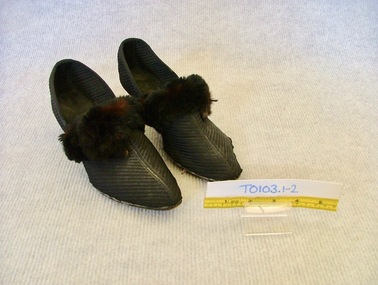
... Following the death of Queen Victoria's husband Prince Albert in 1861, the Queen's approach to mourning his death influenced social conventions for the public, with the wearing of black becoming a significant aspect of Victorian fashions. ...Following the death of Queen Victoria's husband Prince Albert in 1861, the Queen's approach to mourning his death influenced social conventions for the public, with the wearing of black becoming a significant aspect of Victorian fashions. ...This item is part of the Di Reidie collection. Diane Reidie was a much loved volunteer and President of Brighton Historical Society from 1999 until 2016. Originally from New Zealand, Di and her family lived in Male Street, Brighton for many years. A vibrant and energetic person with a zest for life and a gift for bringing people together, Di was a friend to many in the Bayside community and active in local community organisations. Her tireless work as President of BHS saw her named Bayside Citizen of the Year in 2008. As a seller and collector of vintage clothing, she was passionate about fashion history; one of her many enduring contributions to BHS was her extensive work in preserving, developing and promoting the Society's costume collection. In 2018-19, Di donated more than one hundred items from her personal vintage clothing collection to the Society. The collection, which includes clothing, hats, handbags and shoes from local and international designers, is representative of Di's wide-ranging interests, colourful personality, creativity, humour and love of fashion and travel. Di purchased these 1890s shoes around 1990 and recalled wearing them to approximately three events before she donated them to BHS in 2019. Di enjoyed the novelty and conversation they would inspire due to their unusual appearance by modern standards. The shoes are indicative of Di's playful approach to clothing and life. The decorative preserved mink pelt with head featured on the vamps of these shoes is typical of Victorian era interest in and prevalent use of preserved animals for decorative purposes in clothing, millinery and household adornment. This fashion reflected social positioning of oneself as being affluent, educated and worldly. Following the death of Queen Victoria's husband Prince Albert in 1861, the Queen's approach to mourning his death influenced social conventions for the public, with the wearing of black becoming a significant aspect of Victorian fashions. The shoes were made by Kendal Milne & Co, a large department store on Deansgate, Manchester. It has traded under various names and owners since it opened in 1832; it traded as Kendal Milne & Co from 1862-1919, and continued to be known by this name for many years after. The store is currently owned by the House of Fraser department store chain and is known as House of Fraser Manchester.Black silk linear quilted uppers of single piece construction with feature centre front vamp seam. Horsehair wadding can be seen along the side of the forefoot where the upper is coming away from the leather soles. Approx 4.5 cm plain black silk covered heel with leather top piece missing from right shoe. Both shoes feature the head of a small preserved mink with glass eyes. The toppling of the vamp features a decorative strip of mink fur. Inside of both shoes is a gold printed manufacturers label on the black silk insole.Manufacturers label - Made expressly for Kendall Milne and Co, Manchester.victoriana, mink pelt, taxidermy, 1890s, fur, di reidie, vintage clothing
