
Showing 606 items matching "printing presses"
-
 Bendigo Military Museum
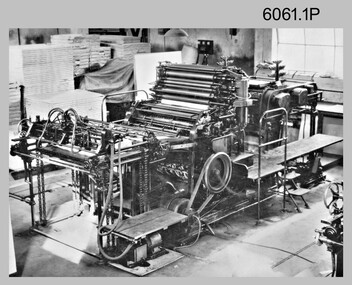
Photograph - George Mann Printing Presses operating at the Army Survey Regiment, c1960s
... George Mann Printing Presses operating at the Army Survey Regiment...George Mann Printing Presses operating at the Army Survey Regiment...The George Mann Fast Five Printing Press was a two-colour demy quad offset press. ...The photographs were scanned at 300 dpi. .1) - Photo, black & white, c1960s, printing press, Lithographic Squadron .2) - Photo, black & white, c1960s, unidentified, printing press, Lithographic Squadron .3) - Photo, black & white, c1960s, printing press, Lithographic Squadron .4) - Photo, black & white, c1960s, SPR Howard Dingle, Lithographic Squadron .5) - Photo, black & white, c1960s, printing presses, Lithographic Squadron...The George Mann Fast Five Printing Press was a two-colour demy quad offset press. ...These five photographs of the George Mann printing presses were probably taken circa 1960s in Lithographic Squadron at the Army Survey Regiment, Fortuna, Bendigo. The photos are not annotated except for .4P. The George Mann Fast Five Printing Press was a two-colour demy quad offset press. It was a robust and well-made lithographic printing machine built by the George Mann company in Leeds, UK. The two presses were in service at the Army Svy Regt in the 1960s and 1970s and replaced with the Komori and Planeta offset printing presses in 1975 and 1976 respectively.This is a set of photographs of the George Mann Printing Presses operational at the Army Survey Regiment, Bendigo from c1960s to 1970s. The photographs were printed on photographic paper and are part of the Army Survey Regiment’s Collection. The photographs were scanned at 300 dpi. .1) - Photo, black & white, c1960s, printing press, Lithographic Squadron .2) - Photo, black & white, c1960s, unidentified, printing press, Lithographic Squadron .3) - Photo, black & white, c1960s, printing press, Lithographic Squadron .4) - Photo, black & white, c1960s, SPR Howard Dingle, Lithographic Squadron .5) - Photo, black & white, c1960s, printing presses, Lithographic Squadron.1 to .3 – no annotation .4 - personnel names (with rank) annotated on back. .5 – no annotation royal australian survey corps, rasvy, army survey regiment, army svy regt, fortuna, asr, printing, litho -
 Bendigo Military Museum
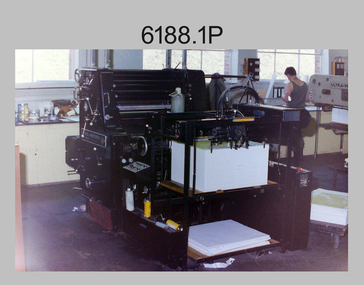
Photograph - Lithographic Squadron’s Printing Presses at the Army Survey Regiment, Fortuna Bendigo, c1980s
... Lithographic Squadron’s Printing Presses at the Army Survey Regiment, Fortuna Bendigo. ...Lithographic Squadron’s Printing Presses at the Army Survey Regiment, Fortuna Bendigo. ...The Komori Newkoni Printing Press features in photographs 6188.2P to 6188.6P. ...They are part of the Army Survey Regiment’s Collection. .1) - Photo, colour, c1980s, Original Heidelberg Printing Press, Print technician Jeff Willey on right, Lithographic Squadron. .2) to .6) - Photo, colour, c1980s, Komori Newkoni Printing Press, Lithographic Squadron. .7) to .11) - Photo, colour, c1980s, Planeta Polygraph Printing Press, Lithographic Squadron. .12) to .19) - Photo, colour, c1980s, Ultra-MAN-III Printing Presses, Lithographic Squadron....The Komori Newkoni Printing Press features in photographs 6188.2P to 6188.6P. ...This is a set of 19 photographs of the four types of printing presses in Lithographic Squadron at the Army Survey Regiment, Bendigo in the late 1980s. The Original Heidelberg Printing Press features in photograph 6188.1P. It was a robust and well-made single colour lithographic offset press that was in service at the Army Svy Regt for decades. Its primary use was for initial training and rapid response tasks, such as single pass overprints over existing print stock. See item 6062.4P for more information and photographs of the Heidelberg press. The Komori Newkoni Printing Press features in photographs 6188.2P to 6188.6P. It was a four-colour offset press in service at the Army Svy Regt from 1975 to the late 1980s. Intended improvements to productivity were not realised as it was unreliable, was very cramped between decks and there were safety concerns for the operators. See item 6063.5P for more information and photographs of the Komori press. The Planeta Polygraph Printing Press features in photographs 6188.7P to 6188.11P. It was a two-colour offset press in service from 1976 to 1994 and was mainly used to print Naval and medium format RAAF charts. It was more reliable than the Komori Printing Press however procurement was difficult when spare parts were required. It was replaced by the larger format Roland 8047B four colour Printing Press. See item 6064.9P for more information and photographs of the Planeta press. The Ultra-MAN-III Printing Presses feature in photograph 6188.12P to 6188.19P. The two presses were a standard map size format and were introduced in June 1962 as two-colour offset presses with improved safety features. Productivity greatly improved with the addition of a third colour deck in 1968, as the two presses could print a five-colour standard topographic map in two rather than the three passes before the upgrade. See item 6065.10P for more information and photographs of the Ultra-MAN-III presses. They were replaced with a single Heidelberg Speedmaster 102 five colour Printing Press in 1990. See item 6136.30P for more information and photographs of the Speedmaster press.This is a set of 19 photographs of the four types of printing presses in Lithographic Squadron at the Army Survey Regiment, Bendigo in the late 1980s. The photographs were on 35mm negative film and scanned at 96 dpi. They are part of the Army Survey Regiment’s Collection. .1) - Photo, colour, c1980s, Original Heidelberg Printing Press, Print technician Jeff Willey on right, Lithographic Squadron. .2) to .6) - Photo, colour, c1980s, Komori Newkoni Printing Press, Lithographic Squadron. .7) to .11) - Photo, colour, c1980s, Planeta Polygraph Printing Press, Lithographic Squadron. .12) to .19) - Photo, colour, c1980s, Ultra-MAN-III Printing Presses, Lithographic Squadron.There are no annotations.royal australian survey corps, rasvy, army survey regiment, army svy regt, fortuna, asr, litho -
 Bendigo Military Museum
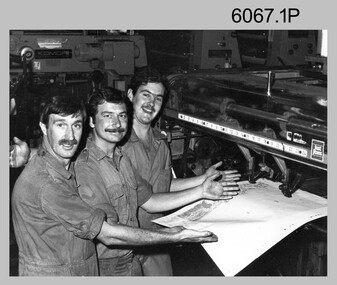
Photograph - Printer Technicians Operating Printing Presses at the Army Survey Regiment, c1970s, c1980s
... Printer Technicians Operating Printing Presses at the Army Survey Regiment...Printer Technicians Operating Printing Presses at the Army Survey Regiment...These nine photographs of Printer Technicians operating printing presses were probably taken circa 1970s and 1980s in Lithographic Squadron at the Army Survey Regiment, Fortuna, Bendigo.They are most likely operating the Komori, Planeta or Ultra-MAN-III offset printing presses. ...This is a set of nine photographs of Printer Technicians operating printing presses at the Army Survey Regiment, Bendigo, c1970s, c1980s. ...These nine photographs of Printer Technicians operating printing presses were probably taken circa 1970s and 1980s in Lithographic Squadron at the Army Survey Regiment, Fortuna, Bendigo.They are most likely operating the Komori, Planeta or Ultra-MAN-III offset printing presses. ...These nine photographs of Printer Technicians operating printing presses were probably taken circa 1970s and 1980s in Lithographic Squadron at the Army Survey Regiment, Fortuna, Bendigo.They are most likely operating the Komori, Planeta or Ultra-MAN-III offset printing presses. Although these photos are not annotated most personnel are positively identified.This is a set of nine photographs of Printer Technicians operating printing presses at the Army Survey Regiment, Bendigo, c1970s, c1980s. The photographs were printed on photographic paper and are part of the Army Survey Regiment’s Collection. The photographs were scanned at 300 dpi. .1) - Photo, black & white, c1980s, L to R: Roy Hicks, Peter Dillon, Terry Winzar, Lithographic Squadron .2) - Photo, black & white, c1980s, Daryl South, Lithographic Squadron .3) - Photo, black & white, c1980s, Greg Rowe, Lithographic Squadron .4) - Photo, black & white, c1980s, L to R: Terry Winzar, unidentified, unidentified, Lithographic Squadron .5) - Photo, black & white, c1980s, unidentified, Lithographic Squadron .6) - Photo, black & white, c1980s, Stuart Ridge, Lithographic Squadron .7) - Photo, black & white, c1980s, Stuart Ridge, Lithographic Squadron .8) - Photo, black & white, c1980s, Jim Ash, Lithographic Squadron .9) - Photo, colour, c1970s, L to R: Paul Davis, Alan Fitts, John ‘Flash’ Anderson, Lithographic Squadron.1P to .8P – no annotationroyal australian survey corps, rasvy, army survey regiment, army svy regt, fortuna, asr, litho, printing -
 Bendigo Military Museum
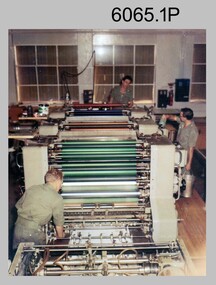
Photograph - Ultra-MAN-III Printing Presses operating at the Army Survey Regiment, c1970s to c1980s
... Ultra-MAN-III Printing Presses operating at the Army Survey Regiment...Ultra-MAN-III Printing Presses operating at the Army Survey Regiment...They were replaced with a single Heidelberg Speedmaster 102 five colour Printing Press in 1990. c1970s to c1980s....This is a set of photographs of the Ultra-MAN-III Printing Press operational at the Army Survey Regiment, Bendigo c1970s to c1980s. ...The two Ultra-MAN-III Printing Presses were made in Germany at a standard map size format and introduced in June 1962 as a two-colour offset press with improved safety features. ...These ten photographs of the Ultra-MAN-III Printing Presses were probably taken circa 1970s to 1980s in Lithographic Squadron at the Army Survey Regiment, Fortuna, Bendigo. Although most photos are not annotated except for photos .1, .3P, .6P; most personnel are positively identified. The two Ultra-MAN-III Printing Presses were made in Germany at a standard map size format and introduced in June 1962 as a two-colour offset press with improved safety features. With an upgrade to a third colour deck in 1968, productivity greatly improved as the two presses could print a five colour standard topographic map in two passes, rather than the three passes before their upgrade. They were replaced with a single Heidelberg Speedmaster 102 five colour Printing Press in 1990. c1970s to c1980s.This is a set of photographs of the Ultra-MAN-III Printing Press operational at the Army Survey Regiment, Bendigo c1970s to c1980s. The photographs were printed on photographic paper and are part of the Army Survey Regiment’s Collection. The photographs were scanned at 300 dpi. .1) - Photo, colour, c1970s, L to R: Morgan, Mulqueen, Cook, Lithographic Squadron .2) - Photo, black & white, c1980s, unidentified, Lithographic Squadron .3) - Photo, black & white, c1980s, Ken Slater, Lithographic Squadron .4) - Photo, black & white, c1980s, L to R: Kim Reynolds, Terry Winzar, Lithographic Squadron .5) - Photo, black & white, c1980s, Lithographic Squadron .6) - Photo, black & white, c1980s, L to R: Steve Egan, unidentified, Jim Cook, Lithographic Squadron .7) - Photo, black & white, c1980s, Kim Reynolds, Lithographic Squadron .8) - Photo, black & white, c1980s, Roy Hicks, Lithographic Squadron .9) - Photo, black & white, c1980s, Lithographic Squadron .10) - Photo, black & white, c1980s, Colin Yeats, Lithographic Squadron.1, .3P, .6P – personnel annotated 2P, .4P to .5P, .76P to .10P – no annotation royal australian survey corps, rasvy, army survey regiment, army svy regt, fortuna, asr, printing, litho -
 Bendigo Military Museum
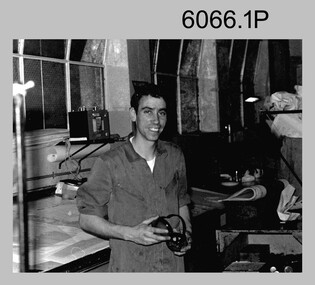
Photograph - Printer Technicians Operating Printing Presses at the Army Survey Regiment, c1980s
... Printer Technicians Operating Printing Presses at the Army Survey Regiment....Printer Technicians Operating Printing Presses at the Army Survey Regiment....These nine photographs of Printer Technicians operating printing presses were probably taken circa 1980s in Lithographic Squadron at the Army Survey Regiment, Fortuna, Bendigo. c1980s. ...These nine photographs of Printer Technicians operating printing presses were probably taken circa 1980s in Lithographic Squadron at the Army Survey Regiment, Fortuna, Bendigo. c1980s. ...These nine photographs of Printer Technicians operating printing presses were probably taken circa 1980s in Lithographic Squadron at the Army Survey Regiment, Fortuna, Bendigo. c1980s. They are most likely operating the Komori, Planeta or Ultra-MAN-III offset printing presses. Although most photos except for photos .1P to .4P are not annotated, most personnel are positively identified..1) - Photo, black & white, c1980s, SPR Mark ‘Dogs’ Doherty, Lithographic Squadron .2) - Photo, black & white, c1980s, Paul Davis, Lithographic Squadron .3) - Photo, black & white, c1980s, L to R: unidentified, CPL Peter Breukel, Lithographic Squadron .4) - Photo, black & white, c1980s, SPR Colin Campbell, Lithographic Squadron .5) - Photo, black & white, c1980s, CPL Paul Davis, Lithographic Squadron .6) - Photo, black & white, c1980s, CPL Paul Davis, Lithographic SPR Mark ‘Dogs’ Doherty Squadron .7) - Photo, black & white, c1980s, L to R: WO2 Jeff Lynch, CPL Paul Davis, Lithographic Squadron .8) - Photo, black & white, c1980s, unidentified, Lithographic Squadron .9) - Photo, black & white, c1980s, CPL Josh De Groot, Lithographic Squadron .1P to .4P – personnel annotated .5P to .6P, .8P to .9P – no annotation .7P – no personnel annotated, ‘Last PNG JOG’ annotatedroyal australian survey corps, rasvy, army survey regiment, army svy regt, fortuna, asr, litho, printing -
 Tatura Irrigation & Wartime Camps Museum
Craft - Model - Printing press, 1982
... Model - Printing press...Object produced to celebrate centenary of printing press use in Australia 1982....Tiny Metal replica of early Australian printing press. Basic shape. No moving parts. Silver frosting coloured....Craft Model - Printing press ...Object produced to celebrate centenary of printing press use in Australia 1982.Tiny Metal replica of early Australian printing press. Basic shape. No moving parts. Silver frosting coloured.Modern Printing Company 1882 - 1982printing presss, alloy models -
 Bendigo Military Museum
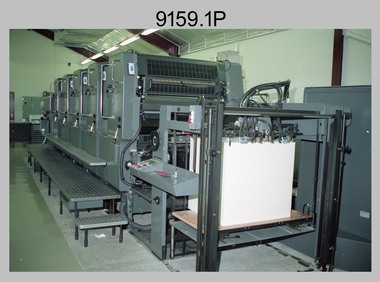
Photograph - Heidelberg Speedmaster 102 Printing Press, Lithographic Squadron – Army Survey Regiment, Fortuna, Bendigo, 1991
... Heidelberg Speedmaster 102 Printing Press, Lithographic Squadron – Army Survey Regiment, Fortuna, Bendigo...Heidelberg Speedmaster 102 Printing Press, Lithographic Squadron – Army Survey Regiment, Fortuna, Bendigo...This is a set of 10 photographs of the Army Survey Regiment’s Heidelberg Speedmaster 102 printing press in Lithographic Squadron’s ‘Wayzgoose Hall’ purpose-built printing building at Fortuna, Bendigo in 1991. ...Heidelberg Speedmaster 102 printing press. .2) - Photo, colour, 1991. Heidelberg Speedmaster 102 printing press. ...Heidelberg Speedmaster 102 printing press. .2) - Photo, colour, 1991. Heidelberg Speedmaster 102 printing press. ...This is a set of 10 photographs of the Army Survey Regiment’s Heidelberg Speedmaster 102 printing press in Lithographic Squadron’s ‘Wayzgoose Hall’ purpose-built printing building at Fortuna, Bendigo in 1991. The computer-controlled five colour lithographic offset printing press provided the Royal Australian Survey Corps vastly improved printing capability, as the five colours for a standard topographic map was printed in a single pass.This is a set of 10 photograph of the Heidelberg Speedmaster 102 Printing Press in Lithographic Squadron, Army Survey Regiment at Fortuna, Bendigo, 1991. The photographs are on 35mm colour negative film and were scanned at 2400 dpi. They are part of the Army Survey Regiment’s Collection. .1) - Photo, colour, 1991. Heidelberg Speedmaster 102 printing press. .2) - Photo, colour, 1991. Heidelberg Speedmaster 102 printing press. SGT Gary Kerr. .3) - Photo, colour, 1991. Heidelberg Speedmaster 102 printing press. .4) - Photo, colour, 1991. Heidelberg Speedmaster 102 printing press. Part of the printed stock delivery system. .5) - Photo, colour, 1991. Heidelberg Speedmaster 102 printing press servicing. L to R: CPL Daryl South, unidentified servicing contractor, CPL Lance Strudwick. .6) - Photo, colour, 1991. Heidelberg Speedmaster 102 printing press CPC 1-04 control unit and Map Colour Evaluation Workstation. L to R: WO2 Jeff Willey, SGT Gary Kerr. .7) to .8) - Photo, colour, 1991. Heidelberg Speedmaster 102 printing press. Back row L to R: SGT Gary Kerr, CPL Daryl South, WO2 Keith Fenton RE UK Exchange. Front row L to R: unidentified servicing contractor, CPL Lance Strudwick, SGT Dale Hudson. .9) - Photo, colour, 1991. Lithographic Squadron storeroom. .10) - Photo, colour, 1991. Lithographic Squadron’s LCPL Nikki Midgley.There are no personnel identified.royal australian survey corps, rasvy, army survey regiment, army svy regt, fortuna -
 Bendigo Military Museum
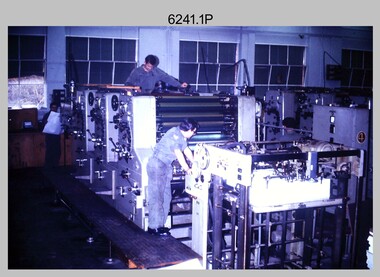
Photograph - Print Troop Equipment and Personnel, Lithographic Squadron – Army Survey Regiment, Fortuna, Bendigo, c1970s to 1980s
... They were replaced with a single Heidelberg Speedmaster 102 five colour Printing Press in 1990. There is more information on the Ultra-MAN-III, Printing Press on page 71 of Valerie Lovejoy’s book 'Mapmakers of Fortuna – A history of the Army Survey Regiment’ ISBN: 0-646-42120-4. ...George Mann Fast Five Quad Demi Printing Press in background. .3) - Photo, colour, c1970s, Ultra-MAN-III Printing Presses, unidentified technicians (x2), George Austen in background and George Mann Fast Five Quad Demi Printing Press next to back wall. .4) - Photo, colour, c1970s, Ultra-MAN-III Printing Press, unidentified technicians (x2) operating George Mann Fast Five Quad Demi Printing Press in background. .5) - Photo, colour, c1970s, Krause Wohlenberg heavy-duty paper guillotine, unidentified technician. .6) - Photo, colour, c1970s, Densitometer reading taken by unidentified technician. .7) - Photo, colour, c1980s, Ultra-MAN-III Printing Presses, L to R: Janet Murray, Lance Strudwick, Terry Winzar, Komori Newkoni and Planeta Polygraph Printing Press in background. .8) to .9) - Photo, colour, c1980s, Ultra-MAN-III Printing Presses, Janet Murray, Komori Newkoni and Planeta Polygraph Printing Presses in background....George Mann Fast Five Quad Demi Printing Press in background. .3) - Photo, colour, c1970s, Ultra-MAN-III Printing Presses, unidentified technicians (x2), George Austen in background and George Mann Fast Five Quad Demi Printing Press next to back wall. .4) - Photo, colour, c1970s, Ultra-MAN-III Printing Press, unidentified technicians (x2) operating George Mann Fast Five Quad Demi Printing Press in background. .5) - Photo, colour, c1970s, Krause Wohlenberg heavy-duty paper guillotine, unidentified technician. .6) - Photo, colour, c1970s, Densitometer reading taken by unidentified technician. .7) - Photo, colour, c1980s, Ultra-MAN-III Printing Presses, L to R: Janet Murray, Lance Strudwick, Terry Winzar, Komori Newkoni and Planeta Polygraph Printing Press in background. .8) to .9) - Photo, colour, c1980s, Ultra-MAN-III Printing Presses, Janet Murray, Komori Newkoni and Planeta Polygraph Printing Presses in background. ...This collection of nine photos was most likely taken in Lithographic Squadron, Army Survey Regiment, Fortuna, Bendigo, c1970s to 1980s. The two Ultra-MAN-III Printing Presses were made in Germany at a standard map size format and introduced in June 1962 as a two-colour offset press with improved safety features. With an upgrade to a third colour deck in 1968, productivity greatly improved as the two presses could print a five-colour standard topographic map in two passes, rather than the three passes before their upgrade. They were replaced with a single Heidelberg Speedmaster 102 five colour Printing Press in 1990. There is more information on the Ultra-MAN-III, Printing Press on page 71 of Valerie Lovejoy’s book 'Mapmakers of Fortuna – A history of the Army Survey Regiment’ ISBN: 0-646-42120-4. For additional photos, refer to item 6065.10P for Ultra-MAN-III presses. The Krause Wohlenberg in photo .5P was a heavy-duty guillotine to trim bulk printed map stock in the c1970s and c1980s. See item 6069.6P for more information and photos of guillotine equipment. Densitometer readings as shown in photo .6P were essential to the quality control of film and printing processes, reductions in time taken and material wastage.This is a set of nine photographs of Print Troop personnel and equipment from Lithographic Squadron at the Army Survey Regiment, Fortuna, Bendigo, c1970s to 1980s. The photographs are on 35mm colour slides and were scanned at 96 dpi. They are part of the Army Survey Regiment’s Collection. .1) - Photo, colour, c1970s, Ultra-MAN-III Printing Presses, L to R: unidentified technician, Laurie Sutton, SGT Jim Cook, unidentified technician. .2) - Photo, colour, c1970s, Ultra-MAN-III Printing Presses, unidentified technicians (x2). George Mann Fast Five Quad Demi Printing Press in background. .3) - Photo, colour, c1970s, Ultra-MAN-III Printing Presses, unidentified technicians (x2), George Austen in background and George Mann Fast Five Quad Demi Printing Press next to back wall. .4) - Photo, colour, c1970s, Ultra-MAN-III Printing Press, unidentified technicians (x2) operating George Mann Fast Five Quad Demi Printing Press in background. .5) - Photo, colour, c1970s, Krause Wohlenberg heavy-duty paper guillotine, unidentified technician. .6) - Photo, colour, c1970s, Densitometer reading taken by unidentified technician. .7) - Photo, colour, c1980s, Ultra-MAN-III Printing Presses, L to R: Janet Murray, Lance Strudwick, Terry Winzar, Komori Newkoni and Planeta Polygraph Printing Press in background. .8) to .9) - Photo, colour, c1980s, Ultra-MAN-III Printing Presses, Janet Murray, Komori Newkoni and Planeta Polygraph Printing Presses in background..1P to .9P - There are no annotations stored with the 35mm slides.royal australian survey corps, rasvy, army survey regiment, army svy regt, fortuna, asr, printing, litho -
 Melbourne Tram Museum
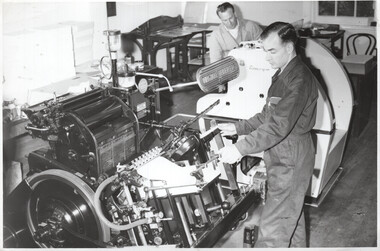
Photograph - MMTB Printing machine - Heidelberg, Melbourne & Metropolitan Tramways Board (MMTB), 1966
... ...printing presses...Yields information about the type of printing press used by the MMTB at Preston Workshops in the 1960s. tramways Printing Preston Workshops printing presses Black and white print with a plain back. ...Photos shows a Heidelberg printing machine and another machine alongside with two printers in the photo at Preston Workshops. The photo appeared in the 1966 Annual Report.Yields information about the type of printing press used by the MMTB at Preston Workshops in the 1960s.Black and white print with a plain back.tramways, printing, preston workshops, printing presses -
 Vision Australia
Machine - Object, Minnie Crabbe, Braille printing press, 1934
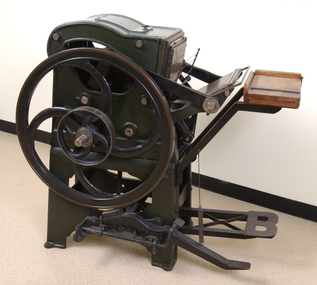
... Braille printing press...In 1934, the Victorian Association of Braille Writers annual report advised that it had acquired a Crabb-Hulme Braille Printing Press. Two years in development, the Press was designed by Miss Minnie Crabb (the librarian) and built to her specifications by Mr Hulme. ...Steel and cast iron printing press with two wheels on left hand side and two foot levers to operate a wheel on the right hand side....Braille printing press Machine Object Minnie Crabbe Sentinel Engineering Works ...In 1934, the Victorian Association of Braille Writers annual report advised that it had acquired a Crabb-Hulme Braille Printing Press. Two years in development, the Press was designed by Miss Minnie Crabb (the librarian) and built to her specifications by Mr Hulme. Invented to produce ephemeral material quickly, such as programs, catalogues and newsletters, and provided more opportunities for information to be quickly sent out to Braille readers.Steel and cast iron printing press with two wheels on left hand side and two foot levers to operate a wheel on the right hand side.victorian association of braille writers, braille equipment, minnie crabb -
 Bendigo Military Museum
Photograph - Printers at Work – Lithographic Squadron, Army Survey Regiment, Fortuna, Bendigo, c1985
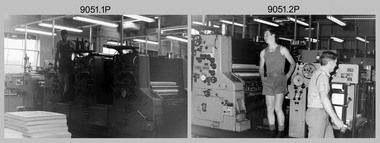
... They are most likely operating the Komori, Planeta or Ultra-MAN-III offset printing presses. Although these photos are not annotated most personnel are positively identified. ...Ultra-MAN-III offset printing press is in the background. .12) - Photo, black & white, c1985, L to R: CPL Jim Ash and CPL Stuart Ridge operate the Planeta offset printing press. .13) - Photo, black & white, c1985, L to R: CPL Jim Ash, SPR Mark ‘Dogs’ Doherty and CPL Stuart Ridge operate the Planeta offset printing press. ...Ultra-MAN-III offset printing press is in the background. .12) - Photo, black & white, c1985, L to R: CPL Jim Ash and CPL Stuart Ridge operate the Planeta offset printing press. .13) - Photo, black & white, c1985, L to R: CPL Jim Ash, SPR Mark ‘Dogs’ Doherty and CPL Stuart Ridge operate the Planeta offset printing press. ...This is a set of 23 photographs of Lithographic Squadron staff undertaking printing tasks at the Army Survey Regiment, Fortuna, Bendigo, c1985. They are most likely operating the Komori, Planeta or Ultra-MAN-III offset printing presses. Although these photos are not annotated most personnel are positively identified. The following photos are also published with other items: .2P - 6072.6P, .4P – 6067.2P, .10P - 6065.10P, .13P - 6070.5P and .18P - 6066.4P.This is a set of 23 photographs of Lithographic Squadron staff undertaking printing tasks at the Army Survey Regiment, Fortuna, Bendigo, c1985. The photographs are on 35mm negative film and scanned at 96 dpi. They are part of the Army Survey Regiment’s Collection. .1) - Photo, black & white, c1985, SPR Colin Yeats operates the Ultra-MAN-III offset printing press. .2) - Photo, black & white, c1985, SPR Colin Yeats operates the Ultra-MAN-III offset printing press. WO2 Ralph Chant walks past. .3) - Photo, black & white, c1985, an unidentified printer performs a map quality check. .4) - Photo, black & white, c1985, SPR Daryl South operates the Ultra-MAN-III offset printing press. .5) - Photo, black & white, c1985, Wohlenberg MCS-2 guillotine. .6) - Photo, black & white, c1985, L to R: an unidentified printer and CPL Jim Ash operating the Planeta offset printing press. .7) & .8) - Photo, black & white, c1985, L to R: CPL Dale Hudson and CPL Peter Breukel perform a map quality check at the Komori offset printing press. .9) - Photo, black & white, c1985, Print Troop leadership L to R: SGT Jeff Willey, unidentified officer, CAPT Bob Coote, SSGT Steve Egan. .10) - Photo, black & white, c1985, SPR Colin Yeats operates the Ultra-MAN-III offset printing press. .11) - Photo, black & white, c1985, SSGT Steve Egan assesses printed maps in the map despatch work area. Ultra-MAN-III offset printing press is in the background. .12) - Photo, black & white, c1985, L to R: CPL Jim Ash and CPL Stuart Ridge operate the Planeta offset printing press. .13) - Photo, black & white, c1985, L to R: CPL Jim Ash, SPR Mark ‘Dogs’ Doherty and CPL Stuart Ridge operate the Planeta offset printing press. SPR Daryl South in background. .14) - Photo, black & white, c1985, Komori offset printing press. .15) - Photo, black & white, c1985, L to R: an unidentified printer, CPL Peter Dillon perform a map quality check. .16) - Photo, black & white, c1985, L to R: CPL Dale Hudson and SPR Mark ‘Dogs’ Doherty ready to assist the Komori offset printing press operator. .17) - Photo, black & white, c1985, an unidentified printer loads up printing paper. .18) - Photo, black & white, c1985, an unidentified printer operates the Ultra-MAN-III offset printing press. .19) to .21) - Photo, black & white, c1985, an unidentified printer operates the Planeta offset printing press. .22) - Photo, black & white, c1985, SPR Mark ‘Dogs’ Doherty cleans up behind an Ultra-MAN-III offset printing press. .23) - Photo, black & white, c1985, Lithographic Squadron OC – MAJ Terry Edwards takes a coffee break outside of the Print Room. .1P to .23P – There are no annotationsroyal australian survey corps, rasvy, fortuna, army survey regiment, printing, litho, litho sqn -
Whitehorse Historical Society Inc.
Article, Publisher moves off the blocks, 2001
... He has collected 10 printing presses, assembled in Kilmore. he has just published his first book 'Southern invasion - northern conquest'....He has collected 10 printing presses, assembled in Kilmore. he has just published his first book 'Southern invasion - northern conquest'....He has collected 10 printing presses, assembled in Kilmore. he has just published his first book 'Southern invasion - northern conquest'. ...Former teacher and lecturer, Dennis Bryans, of BlackburnFormer teacher and lecturer, Dennis Bryans, of Blackburn has changed his career to publisher. He has collected 10 printing presses, assembled in Kilmore. he has just published his first book 'Southern invasion - northern conquest'.Former teacher and lecturer, Dennis Bryans, of Blackburnpublishers, bryans, dennis -
 Bendigo Military Museum
Photograph - Equipment and Personnel, Lithographic Squadron - Army Survey Regiment, Bendigo, c1975
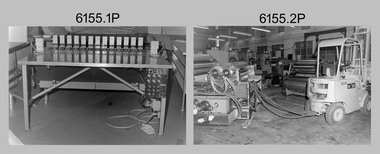
... There is more information on the Ultra-MAN-III Printing Presses, the KLIMSCH Commodore camera, Gavin Neilson and the Fotosetter type setting machine on pages 70-71, and the Newkoni Komori printing press on page 120 of Valerie Lovejoy’s book 'Mapmakers of Fortuna – A history of the Army Survey Regiment’ ISBN: 0-646-42120-4....Black and white photos .14P to .21P are on photographic paper and were scanned at 300 dpi. .1) - Photo, black & white, c1975, tri-linear film punch. .2) to .5) - Photo, black & white, c1975, Newkoni Komori printing press components. .6) - Photo, black & white, c1975, Newkoni Komori printing press components, Alex Cook. .7) - Photo, black & white, c1975, Newkoni Komori printing press components. .8) to .12) - Photo, black & white, c1975, northern exterior of print buildings. .13) - Photo, black & white, c1975, L to R: unidentified (x2), Jim Mulqueen, Ian ‘Lofty’ Turner. .14) - Photo, black & white, c1975, Log Electonics film processor. .15) - Photo, black & white, c1975, contact frame. .16) - Photo, black & white, c1975, film tri-punch stud registration table. .17) - Photo, black & white, c1975, Ultra-MAN-III Printing Presses. .18) to .19) - Photo, black & white, c1975, KLIMSCH Commodore camera, Gavin Neilson. .20) - Photo, black & white, c1975, map proof whirler. .21) - Photo, black & white, c1975, Fotosetter type setting machine....There is more information on the Ultra-MAN-III Printing Presses, the KLIMSCH Commodore camera, Gavin Neilson and the Fotosetter type setting machine on pages 70-71, and the Newkoni Komori printing press on page 120 of Valerie Lovejoy’s book 'Mapmakers of Fortuna – A history of the Army Survey Regiment’ ISBN: 0-646-42120-4. ...This is a set of 21 photographs of Lithographic Squadron equipment and personnel as well equipment operated by Cartographic Squadron, Army Survey Regiment, Fortuna, Bendigo circa 1975. The photos were mainly taken in the Printing, Camera, proofing and external buildings. Cartographic Squadron’s CPL Arty Lane operated the Fotosetter type setting machine, as shown in photo .21P for many years in a room on the top floor of Fortuna Villa. There is more information on the Ultra-MAN-III Printing Presses, the KLIMSCH Commodore camera, Gavin Neilson and the Fotosetter type setting machine on pages 70-71, and the Newkoni Komori printing press on page 120 of Valerie Lovejoy’s book 'Mapmakers of Fortuna – A history of the Army Survey Regiment’ ISBN: 0-646-42120-4.This is a set of 21 photograph of Lithographic Squadron equipment and personnel, Army Survey Regiment at Fortuna, Bendigo, 1989. Black and white photographs .1P to .13P are on 35mm negative film and scanned at 96 dpi. Black and white photos .14P to .21P are on photographic paper and were scanned at 300 dpi. .1) - Photo, black & white, c1975, tri-linear film punch. .2) to .5) - Photo, black & white, c1975, Newkoni Komori printing press components. .6) - Photo, black & white, c1975, Newkoni Komori printing press components, Alex Cook. .7) - Photo, black & white, c1975, Newkoni Komori printing press components. .8) to .12) - Photo, black & white, c1975, northern exterior of print buildings. .13) - Photo, black & white, c1975, L to R: unidentified (x2), Jim Mulqueen, Ian ‘Lofty’ Turner. .14) - Photo, black & white, c1975, Log Electonics film processor. .15) - Photo, black & white, c1975, contact frame. .16) - Photo, black & white, c1975, film tri-punch stud registration table. .17) - Photo, black & white, c1975, Ultra-MAN-III Printing Presses. .18) to .19) - Photo, black & white, c1975, KLIMSCH Commodore camera, Gavin Neilson. .20) - Photo, black & white, c1975, map proof whirler. .21) - Photo, black & white, c1975, Fotosetter type setting machine.No personnel are identified. .14P, .16P to .19P and .20P to .21P are annotated with 5-digit numbers on top right corner of photo.royal australian survey corps, rasvy, army survey regiment, army svy regt, fortuna, asr, litho, carto -
 Bendigo Military Museum
Photograph - Print Troop – Lithographic Squadron – Army Survey Regiment, Fortuna, Bendigo, 1986
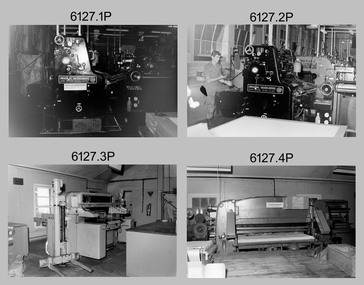
... Print Troop’s technicians were most likely operating the Komoni, Planeta or Ultra-MAN-III offset printing presses and working in the map despatch dock. ...They are part of the Army Survey Regiment’s Collection. .1) - Photo, black & white, 1986, Original Heidelberg Printing Press. .2) - Photo, black & white, 1986, Original Heidelberg Printing Press, unidentified technician. .3) - Photo, black & white, 1986, Heavy-duty paper guillotine. .4) - Photo, black & white, 1986, Polygraph Heavy-duty paper guillotine. .5) - Photo, black & white, 1986, Newkoni Komori Printing Press .6) - Photo, black & white, 1986, Ultra-MAN-III Printing Press, Russ Mollenhauer. .7) - Photo, black & white, 1986, Print roller cleaning tank .8) - Photo, black & white, 1986, Planeta Polygraph Printing Press .9) - Photo, black & white, 1986, Planeta Polygraph Printing Press .10) - Photo, black & white, 1986, Roy Hicks, unidentified technician, Steve Egan, Dale Hudson. .11) and .12) - Photo, black & white, 1986, L to R: Paper drilling machine, wire stitcher. .13) - Photo, black & white, 1986, Map Despatch dock, Greg Rowe. .14) - Photo, black & white, 1986, Print area, Pear Andersen. .15) - Photo, black & white, 1986, Map Despatch dock, Pear Andersen. .16) - Photo, black & white, 1986, Map Despatch dock, .17) - Photo, black & white, 1986, Map Despatch dock, Russ Mollenhauer. .18) - Photo, black & white, 1986, Map Despatch dock, unidentified technician. .19) - Photo, black & white, 1986, Map Despatch dock. ...Print Troop’s technicians were most likely operating the Komoni, Planeta or Ultra-MAN-III offset printing presses and working in the map despatch dock. ...This collection of twenty photos was most likely taken in Lithographic Squadron, Army Survey Regiment, Fortuna, Bendigo in 1986. Print Troop’s technicians were most likely operating the Komoni, Planeta or Ultra-MAN-III offset printing presses and working in the map despatch dock. Although these photos are not annotated most personnel are positively identified.This is a set of twenty photographs of Print Troop personnel and equipment from Lithographic Squadron at the Army Survey Regiment, Fortuna, Bendigo, 1986. The photographs were on 35mm negative film and were scanned at 96 dpi. They are part of the Army Survey Regiment’s Collection. .1) - Photo, black & white, 1986, Original Heidelberg Printing Press. .2) - Photo, black & white, 1986, Original Heidelberg Printing Press, unidentified technician. .3) - Photo, black & white, 1986, Heavy-duty paper guillotine. .4) - Photo, black & white, 1986, Polygraph Heavy-duty paper guillotine. .5) - Photo, black & white, 1986, Newkoni Komori Printing Press .6) - Photo, black & white, 1986, Ultra-MAN-III Printing Press, Russ Mollenhauer. .7) - Photo, black & white, 1986, Print roller cleaning tank .8) - Photo, black & white, 1986, Planeta Polygraph Printing Press .9) - Photo, black & white, 1986, Planeta Polygraph Printing Press .10) - Photo, black & white, 1986, Roy Hicks, unidentified technician, Steve Egan, Dale Hudson. .11) and .12) - Photo, black & white, 1986, L to R: Paper drilling machine, wire stitcher. .13) - Photo, black & white, 1986, Map Despatch dock, Greg Rowe. .14) - Photo, black & white, 1986, Print area, Pear Andersen. .15) - Photo, black & white, 1986, Map Despatch dock, Pear Andersen. .16) - Photo, black & white, 1986, Map Despatch dock, .17) - Photo, black & white, 1986, Map Despatch dock, Russ Mollenhauer. .18) - Photo, black & white, 1986, Map Despatch dock, unidentified technician. .19) - Photo, black & white, 1986, Map Despatch dock. Peter Dillon, Mick Minchin. .20) - Photo, black & white, 1986, Map Despatch dock.No personnel are identifiedroyal australian survey corps, rasvy, army survey regiment, army svy regt, fortuna, asr, litho, printing -
 Bendigo Military Museum
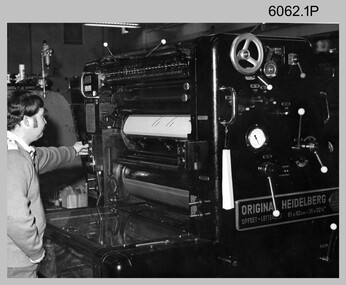
Photograph - Original Heidelberg Printing Press at the Army Survey Regiment, c1980s, 1990
... Original Heidelberg Printing Press at the Army Survey Regiment...Original Heidelberg Printing Press at the Army Survey Regiment...The Original Heidelberg Printing Press was a single colour offset press. ...This is a set of photographs of the Original Heidelberg Printing Press at the Army Survey Regiment, Bendigo c1980s, 1990. ...The Original Heidelberg Printing Press was a single colour offset press. ...The first three photographs of the Original Heidelberg Printing Press were probably taken circa 1980s in Lithographic Squadron at the Army Survey Regiment, Fortuna, Bendigo. The last photo was taken in 1990. The Original Heidelberg Printing Press was a single colour offset press. It was a robust and well-made lithographic printing press and was in service at the Army Svy Regt for decades. Its primary use was for initial training and rapid response tasks, such as single pass overprints over existing print stock.This is a set of photographs of the Original Heidelberg Printing Press at the Army Survey Regiment, Bendigo c1980s, 1990. The photographs were printed on photographic paper and are part of the Army Survey Regiment’s Collection. The photographs were scanned at 300 dpi. .1) - Photo, black & white, c1980s, SPR Mick Ellis, Lithographic Squadron .2) - Photo, black & white, c1980s, unidentified, Lithographic Squadron .3) - Photo, black & white, c1980s, SPR Terry Winzar, Lithographic Squadron .4) - Photo, colour, 1990, Ni Vanuatu Printer Technicians, Lithographic Squadron.1 – personnel annotated .2 to .3 – no annotation .4 – annotated with dateroyal australian survey corps, rasvy, army survey regiment, army svy regt, fortuna, asr, litho, printing -
 Bendigo Military Museum
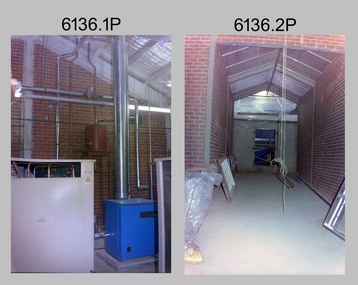
Photograph - New Printing Press, Lithographic Squadron – Army Survey Regiment, Fortuna, Bendigo, 1990
... New Printing Press, Lithographic Squadron – Army Survey Regiment, Fortuna, Bendigo. ...New Printing Press, Lithographic Squadron – Army Survey Regiment, Fortuna, Bendigo. ...This is a set of 30 photographs of contractors installing the Army Survey Regiment’s new Heidelberg Speedmaster 102 printing press in Lithographic Squadron’s purpose-built printing building at Fortuna, Bendigo in 1990. ...This is a set of 30 photograph of the Heidelberg Speedmaster 102 Printing Press installation in Lithographic Squadron, Army Survey Regiment at Fortuna, Bendigo, 1990. ...Photograph New Printing Press, Lithographic Squadron – Army Survey Regiment, Fortuna, Bendigo. ...This is a set of 30 photographs of contractors installing the Army Survey Regiment’s new Heidelberg Speedmaster 102 printing press in Lithographic Squadron’s purpose-built printing building at Fortuna, Bendigo in 1990. The computer-controlled five colour lithographic offset printing press provided the Royal Australian Survey Corps vastly improved printing capability, as the five colours for a standard topographic map was printed in a single pass. The print room was named Wayzgoose Hall after a medieval printing house festival. Wayzgoose Hall and the Speedmaster printing capability was commissioned by the Commander of the 3rd Military District BRIG P. Davies AM, ADC on Wednesday 27th June 1990. This occasion is covered in more detail in page 145 of Valerie Lovejoy’s book 'Mapmakers of Fortuna – A history of the Army Survey Regiment’ ISBN: 0-646-42120-4.This is a set of 30 photograph of the Heidelberg Speedmaster 102 Printing Press installation in Lithographic Squadron, Army Survey Regiment at Fortuna, Bendigo, 1990. The photographs were on 35mm colour negative film and were scanned at 96 dpi. They are part of the Army Survey Regiment’s Collection. No personnel are identified. Annotated with date on negative sleeve.royal australian survey corps, rasvy, army survey regiment, army svy regt, fortuna, asr, litho, printing -
 Federation University Art Collection
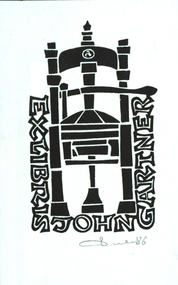
Bookplate, 'Ex Libris John Gartner'
... Gartner developed a strong interest in the history of typography and printing and was apprenticed at the Advocate where his father had been a linotype operator. Aged 17, Gartner bought a hand press and some fonts of type, and in 1937 acquired a platen press from which he set and printed his private press books, published under the imprint of The Hawthorn Press. ...Black and white etching of a printing press...(http://www3.slv.vic.gov.au/latrobejournal/issue/latrobe-84/t1-g-t7.html) australian bookplate design award bookplate keith wingrove memorial trust printmaking Signature with the year 86 Black and white etching of a printing press 'Ex Libris John Gartner' Bookplate ...John Gartner was a fine printer and publisher, an author, a noted philatelist, and also collector of Australian banknotes and coins. He was born on 16 July 1914 and was largely self-educated, leaving school at fourteen for work following the death of his father. Gartner developed a strong interest in the history of typography and printing and was apprenticed at the Advocate where his father had been a linotype operator. Aged 17, Gartner bought a hand press and some fonts of type, and in 1937 acquired a platen press from which he set and printed his private press books, published under the imprint of The Hawthorn Press. Gartner had a strong collection of Australian bookplates. He also looked at the work of artists overseas and commissioned personal plates. He subsequently built an international collection with preference for artists who printed from wood. His initial searches were in Belgium and Holland.(http://www3.slv.vic.gov.au/latrobejournal/issue/latrobe-84/t1-g-t7.html) Black and white etching of a printing pressSignature with the year 86australian bookplate design award, bookplate, keith wingrove memorial trust, printmaking -
 Bendigo Military Museum
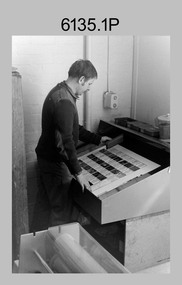
Photograph - Print Troop – Lithographic Squadron – Army Survey Regiment, Fortuna, Bendigo
... In the remaining photos, Print Troop’s technicians were most likely operating the Komoni, Planeta or Ultra-MAN-III offset printing presses, as well as working in the map despatch dock. ...They are part of the Army Survey Regiment’s Collection. .1) - Photo, black & white, 1988, Chromalin Proof laminating, Terry King. .2) - Photo, black & white, 1988, Chromalin Proof laminating, Terry King. .3) to .6) - Photo, black & white, 1988, Ultra-MAN-III Printing Press, Colin Yeats. .7) - Photo, black & white, 1988, Ultra-MAN-III Printing Press, L to R: Greg Rowe, SPR Mark ‘Dogs’ Doherty. .8) - Photo, black & white, 1988, Ultra-MAN-III Printing Press, SPR Mark ‘Dogs’ Doherty. .9) to .10) - Photo, black & white, 1988, Ultra-MAN-III Printing Press, John Bateman. .11) - Photo, black & white, 1988, Ultra-MAN-III Printing Press. .12) - Photo, black & white, 1988, Map laminator? ...They are part of the Army Survey Regiment’s Collection. .1) - Photo, black & white, 1988, Chromalin Proof laminating, Terry King. .2) - Photo, black & white, 1988, Chromalin Proof laminating, Terry King. .3) to .6) - Photo, black & white, 1988, Ultra-MAN-III Printing Press, Colin Yeats. .7) - Photo, black & white, 1988, Ultra-MAN-III Printing Press, L to R: Greg Rowe, SPR Mark ‘Dogs’ Doherty. .8) - Photo, black & white, 1988, Ultra-MAN-III Printing Press, SPR Mark ‘Dogs’ Doherty. .9) to .10) - Photo, black & white, 1988, Ultra-MAN-III Printing Press, John Bateman. .11) - Photo, black & white, 1988, Ultra-MAN-III Printing Press. .12) - Photo, black & white, 1988, Map laminator? ...This collection of 23 photos was most likely taken in Lithographic Squadron, Army Survey Regiment, Fortuna, Bendigo, in 1988. In photos .1P and .2P the technician is preparing a Chromalin map proof for supporting information that would be printed on the reverse side of a topographic map. This map was commonly referred to as a ‘snack’ map, with photos of edible indigenous plants and descriptions endemic to that region printed on the reverse side to assist soldiers living off the land in survival situations. The authoritative information was provided by Major Leslie James (Les) Hiddins aka ‘the Bush Tucker Man’ He is a retired Australian Army soldier and war veteran, who is best known for his love and knowledge of the Australian bush. See item 6190.6P for more information on the Chomalin proof production process. In the remaining photos, Print Troop’s technicians were most likely operating the Komoni, Planeta or Ultra-MAN-III offset printing presses, as well as working in the map despatch dock. Although these photos are not annotated most personnel are positively identified. This is a set of 23 photographs of Print Troop personnel and equipment from Lithographic Squadron at the Army Survey Regiment, Fortuna, Bendigo, 1988. The photographs were on 35mm negative film and were scanned at 96 dpi. They are part of the Army Survey Regiment’s Collection. .1) - Photo, black & white, 1988, Chromalin Proof laminating, Terry King. .2) - Photo, black & white, 1988, Chromalin Proof laminating, Terry King. .3) to .6) - Photo, black & white, 1988, Ultra-MAN-III Printing Press, Colin Yeats. .7) - Photo, black & white, 1988, Ultra-MAN-III Printing Press, L to R: Greg Rowe, SPR Mark ‘Dogs’ Doherty. .8) - Photo, black & white, 1988, Ultra-MAN-III Printing Press, SPR Mark ‘Dogs’ Doherty. .9) to .10) - Photo, black & white, 1988, Ultra-MAN-III Printing Press, John Bateman. .11) - Photo, black & white, 1988, Ultra-MAN-III Printing Press. .12) - Photo, black & white, 1988, Map laminator? L to R: SGT Dale Hudson, SGT Gary Kerr. .13) - Photo, black & white, 1988, Newkoni Komori Printing Press, Peter Hamilton. .14) to .17) - Photo, black & white, 1988, Original Heidelberg Printing Press, Peter Hamilton. .18) to .19) - Photo, black & white, 1988, Map Despatch area, SPR Steve Wright. .20) - Photo, black & white, 1988, Map Despatch area, L to R: unidentified, SGT Gary Kerr. .21) - Photo, black & white, 1988, Printing Presses - foreground: Ultra-MAN-III (x2), centre: Newkoni Komori and background: Planeta Polygraph. .22) - Photo, black & white, 1988, Ultra-MAN-III Printing Presses (x2). .23) - Photo, black & white, 1988, L to R: Daryl South, Mark McCulloch.No personnel are identifiedroyal australian survey corps, rasvy, army survey regiment, army svy regt, fortuna, asr, litho, printing -
 Bendigo Military Museum
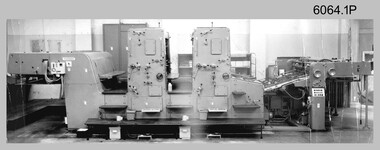
Photograph - Planeta Polygraph Printing Press operating at the Army Survey Regiment, c1970s to c1980s
... Planeta Polygraph Printing Press operating at the Army Survey Regiment...Planeta Polygraph Printing Press operating at the Army Survey Regiment...The Planata Printing Press was one of the replacements for the George Mann Printing Presses. ...This is a set of photographs of the Planeta Polygraph Printing Press operational at the Army Survey Regiment, Bendigo c1970s to c1980s. ...The Planata Printing Press was one of the replacements for the George Mann Printing Presses. ...These nine photographs of the Planeta Polygraph Printing Press were probably taken circa 1970s to 1980s in Lithographic Squadron at the Army Survey Regiment, Fortuna, Bendigo. The photos are not annotated except for .4P. The Planeta Polygraph Offset Printing Press was a two-colour offset press used to print Naval and medium format RAAF charts. The Planata Printing Press was one of the replacements for the George Mann Printing Presses. It was more reliable than the Komori Printing Press however procurement was difficult when spare parts were required. The Planeta Printing Press was built in East Germany and was in service at the Army Svy Regt from 1976 to 1994. It was replaced by the larger format Roland 8047B four colour Printing Press.This is a set of photographs of the Planeta Polygraph Printing Press operational at the Army Survey Regiment, Bendigo c1970s to c1980s. The photographs were printed on photographic paper and are part of the Army Survey Regiment’s Collection. The photographs were scanned at 300 dpi. .1) - Photo, black & white, c1970s, c1980s, Lithographic Squadron .2) - Photo, black & white, c1980s, L to R: CPL Gary Kerr, Roy Hicks, Josh Degroot, Lithographic Squadron .3) - Photo, black & white, c c1970s, 1980s, George Austen, Lithographic Squadron .4) - Photo, black & white, c1970s, c1980s, George Austen, Lithographic Squadron .5) - Photo, black & white, c1980s, L to R: unidentified, Jim Ash, Lithographic Squadron .6) - Photo, black & white, c1970s, c1980s, Gary Kerr, Lithographic Squadron .7) - Photo, black & white, c1970s, c1980s, CPL Russ Mollenhauer, Lithographic Squadron .8) - Photo, black & white, c1980s, Stuart Ridge, Lithographic Squadron .9) - Photo, colour, c1970s, L to R: CAPT Gary Kenney, Peter Barrett, Ken Modra, Lithographic Squadron .1 – no annotation .2P to.5P – personnel annotated .6P to .9 – no annotation royal australian survey corps, rasvy, army survey regiment, army svy regt, fortuna, asr, printing, litho -
 Bendigo Military Museum
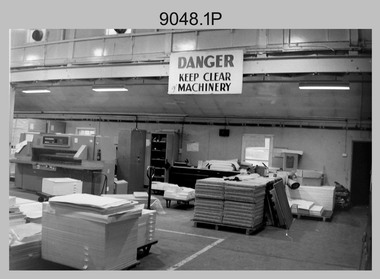
Photograph - Despatch Area of Print Room, Army Survey Regiment, Fortuna, Bendigo, c1985
... They were replaced with a single Heidelberg Speedmaster five colour Printing Press in 1990. The Original Heidelberg Printing Press seen in photo .6P was a single colour offset press. ...Unidentified print technician. .5) - Photo, black & white, c1985, Ultra-MAN-III Printing Presses in foreground. .6) - Photo, black & white, c1985, Original Heidelberg Printing Press in foreground, Ultra-MAN-III Printing Presses in background. .7) - Photo, black & white, c1985, Ultra-MAN-III Printing Presses in foreground. .8) - Photo, black & white, c1985, Map despatch work area. ...They were replaced with a single Heidelberg Speedmaster five colour Printing Press in 1990. The Original Heidelberg Printing Press seen in photo .6P was a single colour offset press. ...These 10 photographs of the despatch area of Lithographic Squadron’s Print Room were taken at the Army Survey Regiment, Fortuna, Bendigo circa 1985. bulk printed map stock to customers The despatch of printed map products was the final task performed by teams of Printer Technicians. It involved the wrapping of trimmed bulk maps into manageable parcels and sending them by freight to customers or to the Army Map Depot at Bandiana, VIC. The task’s Due date and sensitivity were essential considerations in the planning of production affecting the lead time and method of delivery. Freighting by commercial means was the normal method for routine tasks. The method of despatch for urgent time-critical tasks sometimes meant having to use military freight or safe-handed by Army Survey Regiment personnel. The Wohlenberg MCS-2 guillotine seen in photos .1P & .2P, .4P .8P & .9P was a heavy-duty guillotine that became in 1990 an integrated component of the Map Handling Station, to trim bulk printed map stock. See item 6242.25P for photos of the configuration. See Item 6069.6P for more information and photos of earlier types of guillotine equipment and Item 6070.9P for photos of Printer Technicians working in the despatch area of the Print Room. The two Ultra-MAN-III Printing Presses seen in photos .4P to .7P were made in Germany at a standard map size format and introduced in June 1962 as a two-colour offset press with improved safety features. With an upgrade to a third colour deck in 1968, productivity greatly improved as the two presses could print a five-colour standard topographic map in two passes, rather than the three passes before their upgrade. They were replaced with a single Heidelberg Speedmaster five colour Printing Press in 1990. The Original Heidelberg Printing Press seen in photo .6P was a single colour offset press. It was a robust and well-made lithographic printing press and was in service at the Army Svy Regt for decades. Its primary use was for initial training and rapid response tasks, such as single pass overprints over existing print stock.This is a set of 10 photographs of the despatch area of Lithographic Squadron’s Print Room, taken at the Army Survey Regiment. circa 1985, Fortuna Villa Bendigo. The photographs were printed on photographic paper and are part of the Army Survey Regiment’s Collection. The photographs were scanned at 300 dpi. .1) & .2) - Photo, black & white, c1985, Map despatch work area and Wohlenberg MCS-2 guillotine. .3) - Photo, black & white, c1985, Map despatch work area. Unidentified print technician. .4) - Photo, black & white, c1985, Map despatch work area and Wohlenberg MCS-2 guillotine. Unidentified print technician. .5) - Photo, black & white, c1985, Ultra-MAN-III Printing Presses in foreground. .6) - Photo, black & white, c1985, Original Heidelberg Printing Press in foreground, Ultra-MAN-III Printing Presses in background. .7) - Photo, black & white, c1985, Ultra-MAN-III Printing Presses in foreground. .8) - Photo, black & white, c1985, Map despatch work area. Pallets of wrapped printed maps in foreground, pallets of paper stock in background. .9) - Photo, black & white, c1985, Map despatch work area. Pallets of printed maps awaiting wrapping in foreground, Wohlenberg MCS-2 guillotine in background. .10) - Photo, black & white, c1985, Map despatch work area, pallets of wrapped printed maps in foreground, Pallets of wrapped printed maps in background..1P to .10P – There are no annotationsroyal australian survey corps, rasvy, fortuna, army survey regiment, printing, litho, litho sqn -
Maldon Vintage Machinery Museum Inc
PRINTING PRESS, unknown
... PRINTING PRESS...Large broadsheet printing press with large and small rollers....Maker's name on front "PAYNE & SONS" Large broadsheet printing press with large and small rollers. PRINTING PRESS ...Large broadsheet printing press with large and small rollers.Maker's name on front "PAYNE & SONS" -
 Bendigo Military Museum
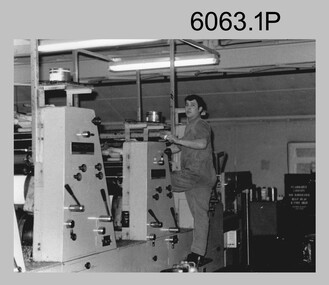
Photograph - Komori Newkoni Printing Press operating at the Army Survey Regiment, c1980s
... Komori Newkoni Printing Press operating at the Army Survey Regiment...Komori Newkoni Printing Press operating at the Army Survey Regiment...The Komori Newkoni Printing Press was a four-colour offset press. It was one of the replacements for the George Mann Printing Presses, however improvements to productivity were not realised as it was unreliable, was very cramped between decks and there were safety concerns for the operators. ...This is a set of photographs of the Newkoni Komori Printing Press operational at the Army Survey Regiment, Bendigo c1980s. ...The Komori Newkoni Printing Press was a four-colour offset press. It was one of the replacements for the George Mann Printing Presses, however improvements to productivity were not realised as it was unreliable, was very cramped between decks and there were safety concerns for the operators. ...These five photographs of the Komori Newkoni Printing Press were probably taken circa 1980s in Lithographic Squadron at the Army Survey Regiment, Fortuna, Bendigo. The photos are not annotated except for .4P. The Komori Newkoni Printing Press was a four-colour offset press. It was one of the replacements for the George Mann Printing Presses, however improvements to productivity were not realised as it was unreliable, was very cramped between decks and there were safety concerns for the operators. This lithographic printing machine built by Komori Printing Machinery Co., Ltd in Japan. The press was in service at the Army Svy Regt from 1975 to the 1980s.This is a set of photographs of the Newkoni Komori Printing Press operational at the Army Survey Regiment, Bendigo c1980s. The photographs were printed on photographic paper and are part of the Army Survey Regiment’s Collection. The photographs were scanned at 300 dpi. .1) - Photo, black & white, c1980s, Terry Winzar, Lithographic Squadron .2) - Photo, black & white, c1980s, Roy Hicks, Lithographic Squadron .3) - Photo, black & white, c1980s, L to R: unidentified, Kim Reynolds, unidentified (x3), John ‘Flash’ Anderson, Lithographic Squadron .4) - Photo, black & white, c1980s, Per Andersen, Lithographic Squadron .5) - Photo, black & white, c1980s, John ‘Flash’ Anderson, Lithographic SquadronInscriptions and markings .1 to .5 – no annotationsroyal australian survey corps, rasvy, army survey regiment, army svy regt, fortuna, asr, printing, litho -
 Bendigo Military Museum
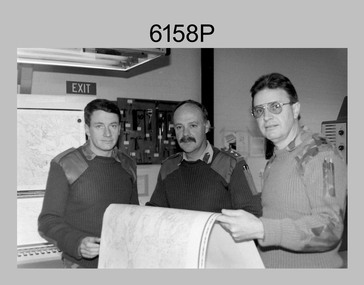
Photograph - First Topographic Map Printed on Speedmaster Press - Army Survey Regiment, Fortuna, Bendigo, c1992
... The computer-controlled five colour lithographic offset printing press provided the Royal Australian Survey Corps vastly improved printing capability, as the five colours for a standard topographic map was printed in a single pass. ...This is a photograph of three senior RASvy officers inspecting the first topographic map printed on the Heidelberg Speedmaster 102 Printing Press in Lithographic Squadron, Army Survey Regiment, Fortuna, Bendigo, c1992. ...The computer-controlled five colour lithographic offset printing press provided the Royal Australian Survey Corps vastly improved printing capability, as the five colours for a standard topographic map was printed in a single pass. ...This is a photograph of the Director Survey - COL Simon Lemon, CO Army Svy Regt - LTCOL Bob McHenry and probably OC Litho - MAJ Terry Lord inspecting the 1St topographic map printed on the new Heidelberg Speedmaster 102 Printing Press in c1992. *Estimated date based on the Director’s and CO’s period of appointment. The computer-controlled five colour lithographic offset printing press provided the Royal Australian Survey Corps vastly improved printing capability, as the five colours for a standard topographic map was printed in a single pass. The print room was named Wayzgoose Hall after a medieval printing house festival. Wayzgoose Hall and the Speedmaster printing capability was commissioned by the Commander of the 3rd Military District BRIG P. Davies AM, ADC on Wednesday 27th June 1990. This occasion is covered in more detail in page 145 of Valerie Lovejoy’s book 'Mapmakers of Fortuna – A history of the Army Survey Regiment’ ISBN: 0-646-42120-4. Colonel Simon Lemon was Director of the Royal Australian Survey Corps from January 1991 to June 1996.This is a photograph of three senior RASvy officers inspecting the first topographic map printed on the Heidelberg Speedmaster 102 Printing Press in Lithographic Squadron, Army Survey Regiment, Fortuna, Bendigo, c1992. The photograph is on 35mm black and white negative film and was scanned at 96 dpi. It is part of the Army Survey Regiment’s Collection. No personnel are identified. royal australian survey corps, rasvy, army survey regiment, army svy regt, fortuna, asr -
Federation University Art Collection
Bookplate, 'Ex Libris John Gartner'
... Gartner developed a strong interest in the history of typography and printing and was apprenticed at the Advocate where his father had been a linotype operator. Aged 17, Gartner bought a hand press and some fonts of type, and in 1937 acquired a platen press from which he set and printed his private press books, published under the imprint of The Hawthorn Press. ...Four men in an arched room, one operating a printing press...(http://www3.slv.vic.gov.au/latrobejournal/issue/latrobe-84/t1-g-t7.html) bookplate australian bookplate design award keith wingrove memorial trust Signature and the number 85 Four men in an arched room, one operating a printing press 'Ex Libris John Gartner' Bookplate ...John Gartner was a fine printer and publisher, an author, a noted philatelist, and also collector of Australian banknotes and coins. He was born on 16 July 1914 and was largely self-educated, leaving school at fourteen for work following the death of his father. Gartner developed a strong interest in the history of typography and printing and was apprenticed at the Advocate where his father had been a linotype operator. Aged 17, Gartner bought a hand press and some fonts of type, and in 1937 acquired a platen press from which he set and printed his private press books, published under the imprint of The Hawthorn Press. Gartner had a strong collection of Australian bookplates. He also looked at the work of artists overseas and commissioned personal plates. He subsequently built an international collection with preference for artists who printed from wood. His initial searches were in Belgium and Holland.(http://www3.slv.vic.gov.au/latrobejournal/issue/latrobe-84/t1-g-t7.html) Four men in an arched room, one operating a printing pressSignature and the number 85bookplate, australian bookplate design award, keith wingrove memorial trust -
Federation University Art Collection
Bookplate, ‘Ex Libris John Gartner’
... Gartner developed a strong interest in the history of typography and printing and was apprenticed at the Advocate where his father had been a linotype operator. Aged 17, Gartner bought a hand press and some fonts of type, and in 1937 acquired a platen press from which he set and printed his private press books, published under the imprint of The Hawthorn Press. ...A printmaker holds a life drawing print in front of a printing press....(http://www3.slv.vic.gov.au/latrobejournal/issue/latrobe-84/t1-g-t7.html) printmaking australian bookplate design award keith wingrove memorial trust bookplate Pencil marking 07 or 09 A printmaker holds a life drawing print in front of a printing press. ‘Ex Libris John Gartner’ Bookplate ...John Gartner was a fine printer and publisher, an author, a noted philatelist, and also collector of Australian banknotes and coins. He was born on 16 July 1914 and was largely self-educated, leaving school at fourteen for work following the death of his father. Gartner developed a strong interest in the history of typography and printing and was apprenticed at the Advocate where his father had been a linotype operator. Aged 17, Gartner bought a hand press and some fonts of type, and in 1937 acquired a platen press from which he set and printed his private press books, published under the imprint of The Hawthorn Press. Gartner had a strong collection of Australian bookplates. He also looked at the work of artists overseas and commissioned personal plates. He subsequently built an international collection with preference for artists who printed from wood. His initial searches were in Belgium and Holland.(http://www3.slv.vic.gov.au/latrobejournal/issue/latrobe-84/t1-g-t7.html) A printmaker holds a life drawing print in front of a printing press.Pencil marking 07 or 09printmaking, australian bookplate design award, keith wingrove memorial trust, bookplate -
 Pyrenees Shire Council
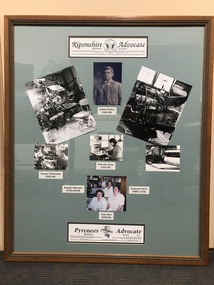
Photo montage, Riponshire Advocate, 2000
... black & white photos of staff and printing press at the Riponshire Advocate...Pyrenees Advocate black & white photos of staff and printing press at the Riponshire Advocate Riponshire Advocate Photo montage ...significant piece of history depicting the newspaper location (previously Beeripmo Centre) and machinery and staff producing the newspaper. black & white photos of staff and printing press at the Riponshire AdvocatePyrenees Advocate -
Federation University Art Collection
Bookplate, 'Ex Libris John Gartner'
... Gartner developed a strong interest in the history of typography and printing and was apprenticed at the Advocate where his father had been a linotype operator. Aged 17, Gartner bought a hand press and some fonts of type, and in 1937 acquired a platen press from which he set and printed his private press books, published under the imprint of The Hawthorn Press. ...Nude male standing looking away an d working on a printing press....(http://www3.slv.vic.gov.au/latrobejournal/issue/latrobe-84/t1-g-t7.html) bookplate Australian Bookplate Design awards keith Wingrove Memorial Trust printmaking life drawing Signature Franklin Nude male standing looking away an d working on a printing press. 'Ex Libris John Gartner' Bookplate ...John Gartner was a fine printer and publisher, an author, a noted philatelist, and also collector of Australian banknotes and coins. He was born on 16 July 1914 and was largely self-educated, leaving school at fourteen for work following the death of his father. Gartner developed a strong interest in the history of typography and printing and was apprenticed at the Advocate where his father had been a linotype operator. Aged 17, Gartner bought a hand press and some fonts of type, and in 1937 acquired a platen press from which he set and printed his private press books, published under the imprint of The Hawthorn Press. Gartner had a strong collection of Australian bookplates. He also looked at the work of artists overseas and commissioned personal plates. He subsequently built an international collection with preference for artists who printed from wood. His initial searches were in Belgium and Holland.(http://www3.slv.vic.gov.au/latrobejournal/issue/latrobe-84/t1-g-t7.html) Nude male standing looking away an d working on a printing press.Signature Franklinbookplate, australian bookplate design awards, keith wingrove memorial trust, printmaking, life drawing -
 Bendigo Military Museum
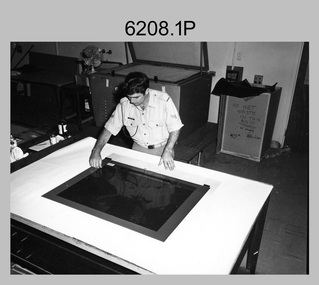
Photograph - Print Troop Equipment and Personnel, Lithographic Squadron – Army Survey Regiment, Fortuna, Bendigo, c1970s
... There is more information on the Ultra-MAN-III, Komoni and Planeta Printing Presses on pages 71 and 120 of Valerie Lovejoy’s book 'Mapmakers of Fortuna – A history of the Army Survey Regiment’ ISBN: 0-646-42120-4. ...The photographs were scanned at 300 dpi. .1) - Photo, black & white, c1970s, Preparing printing plate, SGT Alvan Howard. .2) to.3) - Photo, black & white, c1970s, Preparing printing plate, unidentified technician. .4) - Photo, black & white, 1979, Planeta Polygraph Printing Press., L to R: SPR Peter Breukel, CPL Lance Strudwick. .5) - Photo, black & white, c1970s, Ultra-MAN-III Printing Press. .6) and .7) - Photo, black & white, c1970s, Ultra-MAN-III Printing Press, unidentified technician. .8) - Photo, black & white, c1970s, Newkoni Komori Printing Press, unidentified technician. .9) - Photo, black & white, c1970s, Original Heidelberg Printing Press, unidentified technician. .10) - Photo, black & white, c1970s, MANN flatbed proof press, unidentified technician. .11) to .14) - Photo, black & white, c1970s, applying dye to a whirl-on proof, unidentified technician. .15) and .16) - Photo, black & white, c1970s, applying diazo coat to a scribe sheet, CPL Colin Hardisty. .17) - Photo, black & white, c1970s, Krause Wohlenberg heavy-duty paper guillotine, George Austen....The photographs were scanned at 300 dpi. .1) - Photo, black & white, c1970s, Preparing printing plate, SGT Alvan Howard. .2) to.3) - Photo, black & white, c1970s, Preparing printing plate, unidentified technician. .4) - Photo, black & white, 1979, Planeta Polygraph Printing Press., L to R: SPR Peter Breukel, CPL Lance Strudwick. .5) - Photo, black & white, c1970s, Ultra-MAN-III Printing Press. .6) and .7) - Photo, black & white, c1970s, Ultra-MAN-III Printing Press, unidentified technician. .8) - Photo, black & white, c1970s, Newkoni Komori Printing Press, unidentified technician. .9) - Photo, black & white, c1970s, Original Heidelberg Printing Press, unidentified technician. .10) - Photo, black & white, c1970s, MANN flatbed proof press, unidentified technician. .11) to .14) - Photo, black & white, c1970s, applying dye to a whirl-on proof, unidentified technician. .15) and .16) - Photo, black & white, c1970s, applying diazo coat to a scribe sheet, CPL Colin Hardisty. .17) - Photo, black & white, c1970s, Krause Wohlenberg heavy-duty paper guillotine, George Austen. ...This collection of 17 photos was most likely taken in Lithographic Squadron, Army Survey Regiment, Fortuna, Bendigo, c1970s. Although these photos are not annotated most personnel are positively identified. Some photos are cropped enlargements of previous photos. See item 6060.8P for more information and photos of platemaking. There is more information on the Ultra-MAN-III, Komoni and Planeta Printing Presses on pages 71 and 120 of Valerie Lovejoy’s book 'Mapmakers of Fortuna – A history of the Army Survey Regiment’ ISBN: 0-646-42120-4. For additional photos, refer to item 6062.4P for the Heidelberg press, item 6063.5P for the Komori press, item 6064.9P for the Planeta press and item 6065.10P for Ultra-MAN-III presses. In photos .11P to .14P the technician is applying a UV-sensitive pigmented dye emulating one of the map print colours to a white opaque polyester sheet mounted on a rotating table in a whirler. .12P and .14P are enlargements of previous photos. See item 6059.4P for more information and photos on the map proof making process. The Krause Wohlenberg operated by George Austen in photo .17P was a heavy-duty guillotine to trim bulk printed map stock in the c1970s and c1980s. See item 6069.6P for more information and photos of guillotine equipment.This is a set of 17 photographs of Print Troop personnel and equipment from Lithographic Squadron at the Army Survey Regiment, Fortuna, Bendigo, c1970s. The photographs were printed on photographic paper and are part of the Army Survey Regiment’s Collection. The photographs were scanned at 300 dpi. .1) - Photo, black & white, c1970s, Preparing printing plate, SGT Alvan Howard. .2) to.3) - Photo, black & white, c1970s, Preparing printing plate, unidentified technician. .4) - Photo, black & white, 1979, Planeta Polygraph Printing Press., L to R: SPR Peter Breukel, CPL Lance Strudwick. .5) - Photo, black & white, c1970s, Ultra-MAN-III Printing Press. .6) and .7) - Photo, black & white, c1970s, Ultra-MAN-III Printing Press, unidentified technician. .8) - Photo, black & white, c1970s, Newkoni Komori Printing Press, unidentified technician. .9) - Photo, black & white, c1970s, Original Heidelberg Printing Press, unidentified technician. .10) - Photo, black & white, c1970s, MANN flatbed proof press, unidentified technician. .11) to .14) - Photo, black & white, c1970s, applying dye to a whirl-on proof, unidentified technician. .15) and .16) - Photo, black & white, c1970s, applying diazo coat to a scribe sheet, CPL Colin Hardisty. .17) - Photo, black & white, c1970s, Krause Wohlenberg heavy-duty paper guillotine, George Austen.No personnel are annotated. .2P annotated ‘completed development on a negative working plate.’ .3P annotated ‘a wipe-on plate.’ .4P annotated ‘1979’. .12P annotated ‘Re-coating a proof with the next wanted colour on the vertical whirler.’ .13P annotated ‘has hardened (retained) area required. Done on a vertical whirler.’ .15P and .16P annotated ‘Preparing a sheet of scribe material with a Diazo (light sensitive) coating.’royal australian survey corps, rasvy, army survey regiment, army svy regt, fortuna, printing, litho -
 Federation University Art Collection
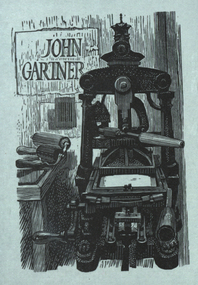
Bookplate, 'John Gartner'
... Gartner developed a strong interest in the history of typography and printing and was apprenticed at the Advocate where his father had been a linotype operator. Aged 17, Gartner bought a hand press and some fonts of type, and in 1937 acquired a platen press from which he set and printed his private press books, published under the imprint of The Hawthorn Press. ...Inside a room a large printing press is depicted alongside a bench with ink rollers on top ...(http://www3.slv.vic.gov.au/latrobejournal/issue/latrobe-84/t1-g-t7.html) bookplate keith wingrove memorial trust printmaking None Inside a room a large printing press is depicted alongside a bench with ink rollers on top 'John Gartner' Bookplate ...John Gartner was a fine printer and publisher, an author, a noted philatelist, and also collector of Australian banknotes and coins. He was born on 16 July 1914 and was largely self-educated, leaving school at fourteen for work following the death of his father. Gartner developed a strong interest in the history of typography and printing and was apprenticed at the Advocate where his father had been a linotype operator. Aged 17, Gartner bought a hand press and some fonts of type, and in 1937 acquired a platen press from which he set and printed his private press books, published under the imprint of The Hawthorn Press. Gartner had a strong collection of Australian bookplates. He also looked at the work of artists overseas and commissioned personal plates. He subsequently built an international collection with preference for artists who printed from wood. His initial searches were in Belgium and Holland.(http://www3.slv.vic.gov.au/latrobejournal/issue/latrobe-84/t1-g-t7.html) Inside a room a large printing press is depicted alongside a bench with ink rollers on top Nonebookplate, keith wingrove memorial trust, printmaking -
 Bendigo Military Museum
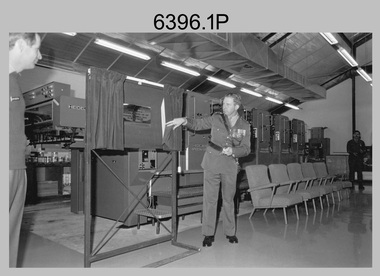
Photograph - Wayzgoose Hall and Speedmaster Printing Press Commissioning, Army Survey Regiment, Fortuna Villa, Bendigo, 1990
... Wayzgoose Hall and Speedmaster Printing Press Commissioning, Army Survey Regiment, Fortuna Villa, Bendigo...Wayzgoose Hall and Speedmaster Printing Press Commissioning, Army Survey Regiment, Fortuna Villa, Bendigo...The first photograph was probably taken at a media event announcing the introduction of the Heidelberg Speedmaster printing press in late 1990. LTCOL Rene van den Tol was the CO of the Army Survey Regiment from 1989 to 1991. ...This set of three photographs were taken at the commissioning ceremony of Wayzgoose Hall, the Army Survey Regiment’s new printing building and the Heidelberg Speedmaster Printing Press, at Fortuna Bendigo on Wednesday 27th June 1990. ...Wayzgoose Hall and Speedmaster Printing Press Commissioning, Army Survey Regiment, Fortuna Villa, Bendigo Photograph Wayzgoose Hall and Speedmaster Printing Press Commissioning, Army Survey Regiment, Fortuna Villa, Bendigo Army Survey Regiment ...The first photograph was probably taken at a media event announcing the introduction of the Heidelberg Speedmaster printing press in late 1990. LTCOL Rene van den Tol was the CO of the Army Survey Regiment from 1989 to 1991. Partly obscured behind the CO was Mr Bruce Reid, who was the newly elected federal member for Bendigo. The media event was held in Wayzgoose Hall, Lithographic Squadron’s new purpose-built building constructed to house the Speedmaster printing press. This occasion is covered in more detail in page 143 of Valerie Lovejoy’s book 'Mapmakers of Fortuna – A history of the Army Survey Regiment’ ISBN: 0-646-42120-4. Refer to Item 6291.6P for more photos of the Open Day.This set of three photographs were taken at the commissioning ceremony of Wayzgoose Hall, the Army Survey Regiment’s new printing building and the Heidelberg Speedmaster Printing Press, at Fortuna Bendigo on Wednesday 27th June 1990. The black & white photographs were printed on photographic paper and are part of the Army Survey Regiment’s Collection. The photographs were scanned at 300 dpi. .1) - Photo, black & white, 1990. Commissioning Ceremony L to R: CO LTCOL Rene van den Tol, Commander 3rd Military District BRIG P. Davies AM ADC, WO2 Jeff Willey in background. .2) - Photo, black & white, 1990. L to R: CO LTCOL Rene van den Tol, Commander 3rd Military District BRIG P. Davies AM ADC with first printed topographic map – 8123 4 Mansfield 1:50 000. .3) - Photo, black & white, 1990. L to R: SGT Gary Kerr in background, Seligson Claire Printing Press Suppliers - Richard Rasmussen and Oliver Holliwell, Bob Martin, Director of Survey COL Don Swiney MBE, RA Svy COL CMDT COL John Hillier, Commander 3rd Military District BRIG P. Davies AM ADC, Bruce Reid Bendigo MHR..1P to .3P – Annotated on back of photos ‘Opening New Print Room BRIG Davies 27 Jun 90’. Personnel and civilians are identified.royal australian survey corps, rasvy, army survey regiment, army svy regt, fortuna, asr, litho
