
Showing 6 items matching "prisoner of war escapes - singapore"
-
 Monbulk RSL Sub Branch
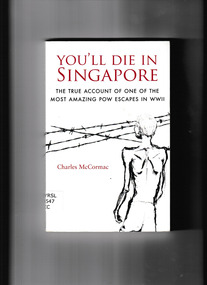
Book, Monsoon, You'll die in Singapore: True account of one of the most amazing POW escapes in WWII, 2005
... ...Prisoner of war escapes - Singapore...World war 1939 – 1945 - Prisons and prisoners – Japanese Prisoner of war escapes - Singapore With sixteen other POWs, author Charles McCormac broke out from his POW camp in Japanese-occupied Singapore and began a two-thousand-mile escape from Singapore, through the jungles of Indonesia to Australia. ...With sixteen other POWs, author Charles McCormac broke out from his POW camp in Japanese-occupied Singapore and began a two-thousand-mile escape from Singapore, through the jungles of Indonesia to Australia. The POWs' escape took a staggering five months and only two out of the original seventeen men survived. This is McCormac's compelling true account of one of the most horrifying and amazing escapes in World War Two. It is a story of courage, endurance and compassion, and makes for a very gripping read.Ill, maps, p.223.non-fictionWith sixteen other POWs, author Charles McCormac broke out from his POW camp in Japanese-occupied Singapore and began a two-thousand-mile escape from Singapore, through the jungles of Indonesia to Australia. The POWs' escape took a staggering five months and only two out of the original seventeen men survived. This is McCormac's compelling true account of one of the most horrifying and amazing escapes in World War Two. It is a story of courage, endurance and compassion, and makes for a very gripping read.world war 1939 – 1945 - prisons and prisoners – japanese, prisoner of war escapes - singapore -
 Monbulk RSL Sub Branch
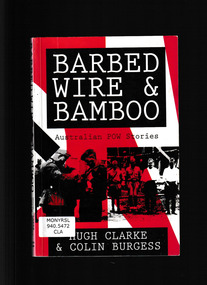
Book, Hugh V. Clarke and Colin Burgess, Barbed wire and bamboo : Australian POWs in Europe, North Africa, Singapore, Thailand and Japan, 1993
... war 1939 – 1945 - Prisons and prisoners - Japanese World war 1939 – 1945 - Prisons and prisoners – Germany A collection of stories of capture, imprisonment and escape in World War I and II. Covering experiences in Europe and in South East Asia, the book presents contrasting PoW experiences - of daring escapes from Colditz Castle, and of endurance and slow suffering in Japanese camps. Ill, maps, p.159 Barbed wire and bamboo : Australian POWs in Europe, North Africa, Singapore ...A collection of stories of capture, imprisonment and escape in World War I and II. Covering experiences in Europe and in South East Asia, the book presents contrasting PoW experiences - of daring escapes from Colditz Castle, and of endurance and slow suffering in Japanese camps.Ill, maps, p.159A collection of stories of capture, imprisonment and escape in World War I and II. Covering experiences in Europe and in South East Asia, the book presents contrasting PoW experiences - of daring escapes from Colditz Castle, and of endurance and slow suffering in Japanese camps.world war 1939 – 1945 - prisons and prisoners - japanese, world war 1939 – 1945 - prisons and prisoners – germany -
 Monbulk RSL Sub Branch
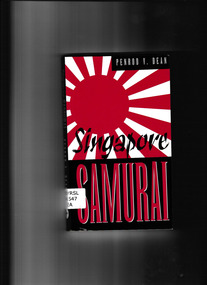
Book, Kangaroo Press, Singapore samurai, 1998
... World war 1939 – 1945 - Prisons and prisoners – Japanese Changi jail The authors escape from Changi jail and their subsequent recaapture and ill treatment. p.250. Singapore ...The authors escape from Changi jail and their subsequent recaapture and ill treatment.p.250.non-fictionThe authors escape from Changi jail and their subsequent recaapture and ill treatment. world war 1939 – 1945 - prisons and prisoners – japanese, changi jail -
 Monbulk RSL Sub Branch
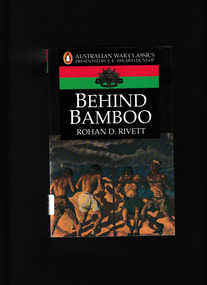
Book, Penguin, Behind bamboo, 1991
... World war 1939 – 1945 - Prisons and prisoners – Japanese Burma - Thailand railway The bestselling memoir of life as an Australian POW on the notorious Thai-Burma railway. Rohan Rivett was a journalist in Singapore when it fell to the Japanese in 1942. He escaped ...The bestselling memoir of life as an Australian POW on the notorious Thai-Burma railway. Rohan Rivett was a journalist in Singapore when it fell to the Japanese in 1942. He escaped south - across the treacherous Bangka Strait - to Indonesia, but was soon captured and became just one of thousands of POWs struggling for existence in a Japanese camp. The struggle was to last for more than three years. Behind Bamboo is unflinching in its honesty and haunting in its realism. It is a vivid, compelling testament to the Australians' will to survive and their unassailable spirit in the face of the most callous inhumanity.Ill, p.400.non-fiction The bestselling memoir of life as an Australian POW on the notorious Thai-Burma railway. Rohan Rivett was a journalist in Singapore when it fell to the Japanese in 1942. He escaped south - across the treacherous Bangka Strait - to Indonesia, but was soon captured and became just one of thousands of POWs struggling for existence in a Japanese camp. The struggle was to last for more than three years. Behind Bamboo is unflinching in its honesty and haunting in its realism. It is a vivid, compelling testament to the Australians' will to survive and their unassailable spirit in the face of the most callous inhumanity.world war 1939 – 1945 - prisons and prisoners – japanese, burma - thailand railway -
 Mrs Aeneas Gunn Memorial Library
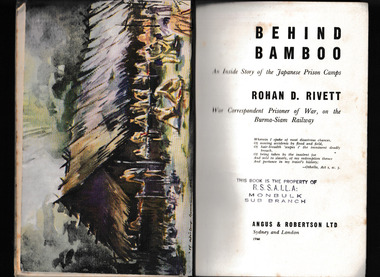
Angus and Robertson, Behind bamboo, 1946
... World War 1939-1945 - Prisoners of war - Japan Burma railway The bestselling memoir of life as an Australian POW on the notorious Thai-Burma railway. Rohan Rivett was a journalist in Singapore when it fell to the Japanese in 1942. He escaped ...The bestselling memoir of life as an Australian POW on the notorious Thai-Burma railway. Rohan Rivett was a journalist in Singapore when it fell to the Japanese in 1942. He escaped south - across the treacherous Bangka Strait - to Indonesia, but was soon captured and became just one of thousands of POWs struggling for existence in a Japanese camp. The struggle was to last for more than three years. Behind Bamboo is unflinching in its honesty and haunting in its realism. It is a vivid, compelling testament to the Australians' will to survive and their unassailable spirit in the face of the most callous inhumanity.Ill, p.391.non-fictionThe bestselling memoir of life as an Australian POW on the notorious Thai-Burma railway. Rohan Rivett was a journalist in Singapore when it fell to the Japanese in 1942. He escaped south - across the treacherous Bangka Strait - to Indonesia, but was soon captured and became just one of thousands of POWs struggling for existence in a Japanese camp. The struggle was to last for more than three years. Behind Bamboo is unflinching in its honesty and haunting in its realism. It is a vivid, compelling testament to the Australians' will to survive and their unassailable spirit in the face of the most callous inhumanity. world war 1939-1945 - prisoners of war - japan, burma railway -
 Returned Nurses RSL Sub-branch
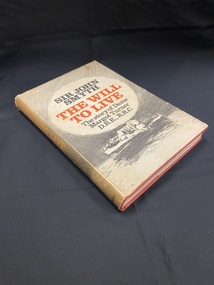
Book - Hardcover book, John Smyth, The will to live: the story of Dame Margot Turner D.B.E., R.R.C, 1970
... Margot Turner Japanese POW women prisoners of war Army Nurses Margot Turner joined Queen Alexandra's Imperial Military Nursing Service in 1937. In 1941 she was sent to Singapore. When Singapore surrendered to the Japanese she managed to escape ...Margot Turner joined Queen Alexandra's Imperial Military Nursing Service in 1937. In 1941 she was sent to Singapore. When Singapore surrendered to the Japanese she managed to escape, she spent four days alone on a raft before being captured as a prisoner of war. She survived three and a half years in the Japanese camp and later went on to become Matron-in-chief and Director of the Army Nursing Service.Red hard-cover book with a dust-jacket. The dust-jacket shows a grey and white pencil sketch on the front cover and spine of a nurse floating on a raft. The title and author are printed in the centre in black and red text. On the back cover is a black and white photograph of Margot Turner in uniform.non-fictionMargot Turner joined Queen Alexandra's Imperial Military Nursing Service in 1937. In 1941 she was sent to Singapore. When Singapore surrendered to the Japanese she managed to escape, she spent four days alone on a raft before being captured as a prisoner of war. She survived three and a half years in the Japanese camp and later went on to become Matron-in-chief and Director of the Army Nursing Service.margot turner, japanese pow, women prisoners of war, army nurses
