
Showing 18 items matching "propeller types"
-
 Moorabbin Air Museum
Book - Aviation basics, The ABC of Aviation
... ...Propeller types...Aviation basics Aircraft & industry Lighter than air & heavier than air aircraft Autogiros Airplane construction Structures and design Engine types Propeller types Control methods Aircraft instruments Introduction to the study of aviation, circa 1939 The ABC of Aviation Book Aviation basics ...Introduction to the study of aviation, circa 1939non-fictionIntroduction to the study of aviation, circa 1939aircraft & industry, lighter than air & heavier than air aircraft, autogiros, airplane construction, structures and design, engine types, propeller types, control methods, aircraft instruments -
 Nhill Aviation Heritage Centre
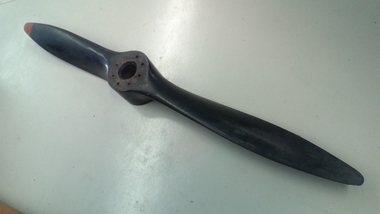
Propeller
... This type of propeller was used on Oxford Airspeed aircraft which was a similar type as the Avro Anson and also used for training at other air schools in Australia....This type of propeller was used on Oxford Airspeed aircraft which was a similar type as the Avro Anson and also used for training at other air schools in Australia. propeller cheetah Oxford Airspeed DRG Z 3931 /4 Cheetah X LH Wooden two blade propeller, painted black with red tip one end Propeller ...This type of propeller was used on Oxford Airspeed aircraft which was a similar type as the Avro Anson and also used for training at other air schools in Australia.Wooden two blade propeller, painted black with red tip one endDRG Z 3931 /4 Cheetah X LHpropeller, cheetah, oxford airspeed, -
 Flagstaff Hill Maritime Museum and Village
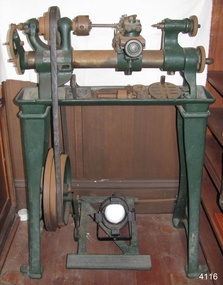
Machine - Treadle Lathe, 1920-1923
... type to be built in England. It was followed (1928) by an hydraulic version for turning gear blanks, and similar work. Further developments provided machines which, during the Second World War, turned all the crankshafts and propeller shafts for Bristol engines. ...type to be built in England. It was followed (1928) by an hydraulic version for turning gear blanks, and similar work. Further developments provided machines which, during the Second World War, turned all the crankshafts and propeller shafts for Bristol engines. ...The lathe-making business incorporated in 1902 as Drummond Bros Ltd originated in the fertile mind of Mr Arthur Drummond, said to have been living at that time at Pinks Hill, on the southern edge of Broad Street Common, west of Guildford. Mr Drummond, whose accomplishments included several pictures hung in the Royal Academy, was unable to find a lathe suitable for use in model engineering. In 1896 he designed for himself a ‘small centre lathe … which had a compound slide rest with feed-screws and adjustable slides’. He also designed and built ‘lathes of 4.5 inch and 5 inch centre height, which had beds of a special form whereby the use of a gap piece was eliminated but the advantages of a gap-bed lathe were retained’. Assisted by his brother, Mr Frank Drummond, who had served an apprenticeship to an engineering firm at Tunbridge Wells, the first lathes were made in a workshop adjoining Arthur Drummond’s house. The demand that speedily built up led to the decision to form a company and manufacture the lathes for sale commercially. Land was acquired nearby, at Rydes Hill, and the first factory built. The enterprise was a success, and the company quickly established ‘a high reputation in this country and abroad for multi-tool and copying lathes, and gear-cutting machines’. Other lathes were added to the range, including the first of the ’round bed’ machines for which the firm became widely known. A Drummond 3.5 inch lathe was among the equipment of Captain Scott’s 1912 expedition to the South Pole, and large numbers of 3.5 inch and 4 inch designs were exported to Australia, Canada and India. By the outbreak of war in 1914, 5 inch, 6 inch and 7 inch screw cutting lathes, arranged for power drive, were on sale. Large orders were received from the government for 3.5 inch lathes, for use in destroyers and submarines, and 5 inch lathes for the mechanised section of the Army Service Corps. The latter were used in mobile workshops. The factory worked night and day to supply the forces’ needs, until production was disrupted by a fire which destroyed a large part of the works in May 1915. As soon as rebuilding was complete work restarted. At the end of the war the entire production was being taken by the Government departments, a special feature being a precision screw lathe, bought by the Ministry of Munitions in 1918. Between the wars Drummond Bros Ltd introduced new machines for the motor vehicle, and later the aircraft industry, and the works were extended on many occasions to fulfill the increasing orders. The Maxicut multi-tool lathe (1925), designed for high-production turning operations, was one of the first machines of this type to be built in England. It was followed (1928) by an hydraulic version for turning gear blanks, and similar work. Further developments provided machines which, during the Second World War, turned all the crankshafts and propeller shafts for Bristol engines. Others, ordered by the Ministry of Supply were employed in turning shells, and many other specific needs of vehicle and aircraft manufacture were catered for by new types of Drummond lathes. Production of the small centre lathes ceased during the war when the company needed to concentrate on building multi-tool lathes and gear shapers. After the war a completely new Maxicut range was introduced, replacing the older versions, and fully automatic. The types were continually developed, and new versions manufactured until the end of the company’s life in 1980. The disappearance from the scene of Mr Arthur Drummond in 1946, and the end of the company’s autonomous existence in 1953 when the company was acquired by William Asquith Ltd, which was in turn bought by Staveley in 1966, meant that the factory at Rydes Hill became one – albeit very effective – part of a large national engineering company. Achievements at the Guildford works during its last years included the development of automated Maxicut gear-shapers in what was ‘probably the most fully automated gear shop in the country’, while a machine from Guildford was sent to the Osaka Fair in 1962. In 1963 an agreement was signed with Hindustan Machine Tools for the manufacture of Maxicut gear-shapers in state owned factories in Bangalore and Chandigarh. During 1963 the two largest multi-tool lathes ever made in the UK were installed in Ambrose Shardlow’s works in Sheffield for handling cranks up to 14 foot long. In 1976 Drummond lathes were included in Staveley’s £14,000,000 installation in Moscow of an automated production line for Zil motor cars. Up to the end invention continued at Guildford: a new Drummond Multi-turn memory-controlled machine was shown at the International Machine Tool Exhibition in 1977. This could not save the works from the pressures of the late 1970s, and Staveley Industries closed its Guildford site in 1980.An early example of a lathe that was designed primarily for the hobbyist model maker. It is in good condition and sought today by collectors as many of it's attributes were innovative at the time and lead to further development and incorporation of some of its features into more industrial models of production machinery. Lathe, round bed, treadle powered lathe, Drummond Type A, Serial number and maker's inscription. 1920-1923, Made by Drummond Brothers in Guildford, Surrey, England. Lathe is complete with Chuck, Tool post and Tail Stock in situ (30 extra parts)"MADE BY DRUMMOND BROTHERS LIMITED - PATENT TEES - RYDE'S HILL n GUILDFORD SURREY", "Serial Number 01470," "L44" or "L45 " flagstaff hill, warrnambool, shipwrecked coast, flagstaff hill maritime museum, maritime museum, shipwreck coast, flagstaff hill maritime village, great ocean road, lathe 1920-1923, round bed lathe, treadle lathe, drummond type a, guildford surrey, drummond brothers guildford surrey england, tread'e -
 Seaworks Maritime Museum
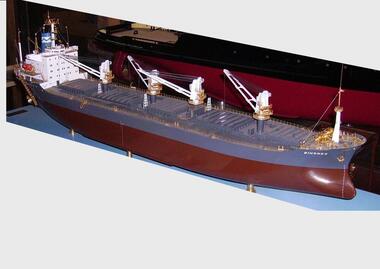
Shipbuilders model, MV Binsnes
... Post 1997: 20,589g. 11,810n. 34,545d. 7-cyl. 2 S.C.S.A. (760 x 1,550mm) Sulzer 7RND76 type motor engine, manufactured by the shipbuilder at Tamashima, geared to a shaft with a controllable pitch propeller. 14,000bhp, 15½kts. ...Post 1997: 20,589g. 11,810n. 34,545d. 7-cyl. 2 S.C.S.A. (760 x 1,550mm) Sulzer 7RND76 type motor engine, manufactured by the shipbuilder at Tamashima, geared to a shaft with a controllable pitch propeller. 14,000bhp, 15½kts. ...BINSNES (3) 1974: Ordered by Dillingham, Jebsen Shipping Corp, Liberia, from Sumitomo Heavy Industries Ltd., Uraga (Yard No. 986). 3.12.1976: Launched. 27.4.1977: Completed. (O.N. 6815). As built: 19,196g. 12,572n. 34,544d. 180.02(BB) x 28.45 x 10.891 metres oa. Post 1997: 20,589g. 11,810n. 34,545d. 7-cyl. 2 S.C.S.A. (760 x 1,550mm) Sulzer 7RND76 type motor engine, manufactured by the shipbuilder at Tamashima, geared to a shaft with a controllable pitch propeller. 14,000bhp, 15½kts. Bulk carrier with four 15-ton cranes capable of operating grabs carried aboard. Leased to the British Phosphate Commission. 1981: Transferred to Pacnorse Shipping International Ltd. 1982: Transferred to Sanders Shipping Ltd., (AS Kristian Jebsens Rederi, managers), Philippines, and renamed GENERAL ROXAS. 1986: Transferred to Pacnorse Shipping Nine Ltd., (same managers). 1986: Sold to the USSR-Black Sea Shipping Company, Russia, and renamed VASILIJ (VASILIV?) AZHAYEV. 1997: Hero Maritime Ltd., (Ocean Agencies Ltd., managers), St. Vincent and The Grenadines, and renamed KARAGOL. 1999: Sold to Flagship Company Ltd., (Barclay Shipping Ltd., managers), Malta, and renamed MILTIADIS M. Sold to Shandong Province Marine Shipping, named Shun Ying or Shunying (Apr 2008?). Ship builder's model of bulk carrier M.V. Binsnes IMO 7426203 built in Japan 1976, 19,196 gross tonnes. Model - Hull painted in burgundy and grey, with four cranes and detailed deck fittings with white and gold highlights, a Liberian flag flying from the stern, raised on a laminated wooden base (lacking perspex cover). Original ship 590.66' x 93.34' x 35.73' (180.02 x 28.45 x 10.89m). Original ship was built by Sumimoto Heavy Industries and leased to the British Phosphate CommissionPlaque at base: " M.V BISNES/ PRINCIPAL PARTICULARS OF 33,750 LTDW/ DIESAL BULK BARRIERS/ Length (overall) abt. 180.00 M/ length (between perpendiculars) 170.00 m, breadth (moulded) 28.40 M, Depth (moulded) 15.00 M/ Draft (designed loaded, moulded) 10.84 M/ Deadweight abt. 33.750 LT/ Gross Tonnage abt. 18,800 T/ Cargo Hold Capacity abt. 42,500 M/ Main Engine/ Type Sumitomo - Sulzer 7RND68 type main diesel engine/ Max Continuous Output BHP 14, 00 PSat 122 rpm/ Service speed at designed draft abt. 15.7 knots/ classification Lloyd's register of Shipping/ Keel -- Laying September 1976/ Launching December 1976/ Delivery April 1977/ Owner : Dillingham Jebsen Shipping Corporation, Liberia/ Builder: Sumitome Heavy Industries Ltd., Japan" second plaque: "MANUFACTURED BY/ FUJI BIJUTSU MOKEI CO., LTD/ TOKYO JAPAN" On model "Binsnes Monrovia" -
 Bendigo Historical Society Inc.
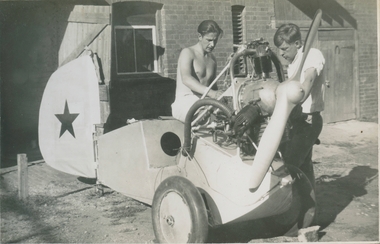
Photograph - Gliding in Bendigo, Late 1930s
... propellers, to the admiration of his sons. Alan developed macular degeneration in his mid-60s. He retired to Port Stephens, fishing and socializing when he wasn’t tinkering with wing-sails for his catamaran. As he could touch-type...propellers, to the admiration of his sons. Alan developed macular degeneration in his mid-60s. He retired to Port Stephens, fishing and socializing when he wasn’t tinkering with wing-sails for his catamaran. As he could touch-type ...These are the recollections of Alan Menere (1915 – 2001). Alan grew up in Moonee Ponds, Victoria, and moved to Bendigo while in his early 20s. There he met some like-minded young men who enjoyed challenges and matters mechanical. Flying was the adventure of the time, and they decided to give it a go. There was no intention to be on the leading edge of gliding technology. The challenge was to fly, and by their own efforts. They were aided in this by the embryonic regulatory arrangements covering light aircraft construction and flying, a sense of optimistic can-do, and the cavalier estimation of risks that goes with being in your early 20s. The events described here took place against a darkening political background. Alan and his mates were politically aware, very left wing, and viewed the gathering storm in Europe with apprehension. They could see from early on that war was coming, and it would change everything. Prevented from joining the Air Force by his red-green colour blindness, Alan joined the Army the day after the Pearl Harbour attack. He served in an Armoured Reconnaissance Unit in Western Australia, then with the Army Education Service in New Britain. After the War he joined the Commonwealth Public Service. He moved to Canberra, but his Bendigo habits stayed with him, as he built sailboards and carved propellers, to the admiration of his sons. Alan developed macular degeneration in his mid-60s. He retired to Port Stephens, fishing and socializing when he wasn’t tinkering with wing-sails for his catamaran. As he could touch-type, he quickly learned to use a computer. Very aware that he was the last member of the Bendigo group still alive, he resolved to set down his flying experiences. The images he selected are included, but there are many more from the Bendigo days.A CD entitled "Alan Menere - Recollections of Gliding in Bendigo in the late 1930s". The CD contains 33 documents consisting of one word file, one PDF file (entitled "The Urge to Fly") and the rest are of either photos of the Bendigo Gliding club or generally around Bendigo itself. Also included are some paper clippings of accidents that happened and description of flights.history, bendigo, bendigo gliding club, alan menere -
 Australian Gliding Museum
Machine - Auto-Tug Engine, 1983 or prior
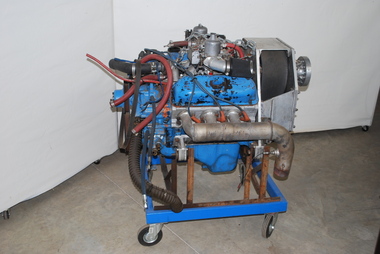
... propeller RPM for take-off as the original Lycoming 0-540 engine. However, fuel consumption was halved as the water cooling of the Ford engine enabled quicker descents with throttle closed following the release of the sailplane. Based on the results of GFA’s program, CASA concluded that engine was quite suitable for an aircraft installation and rated it more reliable than the equivalent Lycoming and Continental aircraft engine. The use of the 1982 Ford V6 engine type...propeller RPM for take-off as the original Lycoming 0-540 engine. However, fuel consumption was halved as the water cooling of the Ford engine enabled quicker descents with throttle closed following the release of the sailplane. Based on the results of GFA’s program, CASA concluded that engine was quite suitable for an aircraft installation and rated it more reliable than the equivalent Lycoming and Continental aircraft engine. The use of the 1982 Ford V6 engine type ...The 1982 Ford V6 engine, built at the Ford Essex Engine Plant at Windsor in Ontario Canada, was released by Ford for installation in a number of car and light truck models manufactured in Canada, United States, Mexico and Venezula. Production probably exceeded 7 million items. The Australian Gliding Museum’s exhibit was an engine converted for aircraft use that was bought for the Gliding Federation of Australia “Auto-Tug” program from Javelin Aircraft Company in Wichita in USA. “Auto-Tug” was an experimental program sponsored by the Gliding Federation of Australia to equip a glider – sailplane Piper Pawnee PA-25-150 tug with a water-cooled engine to alleviate the costs of running and maintaining the Lycoming engines fitted to Pawnee tugs in Australia. The program began in 1988 and was aimed at obtaining limited certification for converting dedicated glider – sailplane tow planes. The engine equipped with modified intake manifolds produced 198 hp for flight with the same propeller RPM for take-off as the original Lycoming 0-540 engine. However, fuel consumption was halved as the water cooling of the Ford engine enabled quicker descents with throttle closed following the release of the sailplane. Based on the results of GFA’s program, CASA concluded that engine was quite suitable for an aircraft installation and rated it more reliable than the equivalent Lycoming and Continental aircraft engine. The use of the 1982 Ford V6 engine type for Pawnee tug conversions was discontinued when the General Motors LS1 5.7 litre V8 became available. It is understood that a small number of conversions have been done using the LS1 engine. This brief history is based on information obtained from Mike Burns and David Sharples who were involved in the Auto-Tug program from 1988 to 1992. Technical information relating to the 1982 Ford V6 automotive engine is contained in a paper by D.L. Armstrong and G.F. Stirrat of the Engine Engineering Office at Ford. Indicative of technological experimentation in the sport of glidingFord auto engine mounted on mobile standaustralian gliding, glider, sailplane, auto-tug, pawnee, tug, auto, engine, motor, ford, gliding federation of australia, burns, sharples. -
 Geelong Naval and Maritime Museum
Teacup
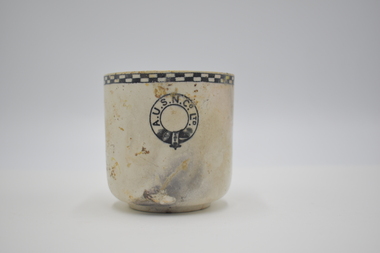
... The site today is marked by two of the four Scotch type boilers sitting upright and exposed at low tide, just north-east of the small boats channel at the entrance to Barwon Heads. Large sections of steel hull plating and framing, and impressively large pieces of ships structure and machinery including masts, booms, deck winches, propeller shaft, flywheel, and a thrust block lie scattered about and make the site an interesting shallow dive. ...The site today is marked by two of the four Scotch type boilers sitting upright and exposed at low tide, just north-east of the small boats channel at the entrance to Barwon Heads. Large sections of steel hull plating and framing, and impressively large pieces of ships structure and machinery including masts, booms, deck winches, propeller shaft, flywheel, and a thrust block lie scattered about and make the site an interesting shallow dive. ...The Orungal was originally built in Glasgow in 1923 for the Khedival Mail Steamship & Graving Dock Company of Egypt and named the S.S. Fezara. Due to the effects on steamship companies of the Great Depression including the steep costs of building new ships and increases in running costs and port charges, no new passenger ships had been ordered in Australia since before World War One. To meet demand for passenger berths, the Fezara (5826 tons) along with its sister ship the Famaka (5856 tons, renamed Ormiston), were chartered by the Australasian United Steam Navigation Company Ltd (A.U.S.N.Co.) in 1927. Both the A.U.S.N.Co and the Khedival Mail Steamship Co. were part of the P&O Group. The Orungal operated in this role as an interstate passenger and mail steamer between 1927 and 1940, being used mainly on the Melbourne to Queensland and Western Australian runs, with 240 single class berths. Following the outbreak of World War Two six of the nine large passenger liners servicing mainland Australian passenger and mail trades were requisitioned by the Government to ferry equipment, troops and supplies. Some of them were converted to armed merchant cruisers and used for patrol work and escort duties in the Indian and Pacific Oceans. The Orungal had originally been requisitioned by the government along with the Zealandia on 25 June 1940, to transport troops to Darwin, but was returned to commercial service because "of her unsuitability", perhaps too slow for the demands of the work. Despite being rejected for patrol and convoy duties the Orungal still had a vital role as one of only three passenger liners left to service the mainland Australian trade. Following its requisitioning by the Government shortly after war broke out, it had been fitted out with defensive armament. On its final voyage arriving at Port Phillip Heads from Sydney, Captain Gilling was attempting to enter the Heads ahead of a worsening south-westerly storm and, with a minefield known to have been laid in the area, had been warned by the Navy not to deviate from the swept channel. The captain and crew held fears that in the stormy seas a mine may have been carried away. In the worsening weather a blur of lights at Barwon Heads was mistaken for Port Lonsdale, and the Orungal steamed ashore onto Formby Reef, just east of the entrance of the Barwon River - instead of passing safely through the middle of the Rip. At the Marine Board Inquiry Capt. Gilling - who had been master of the Orungal since 1926 - stated that after becoming uneasy about his position and changing course to starboard one point: " At 10.21 pm I ordered the engine room to stand by and gave instructions for the patent log to be hauled in and for the sounding-gear to be got ready. Approximately two minutes later, in a flash of lightning, I saw land off the port beam. I immediately recognised it as Barwon Heads, and ordered the helm to be put hard to starboard, but the vessel struck before she had time to answer the helm" Barwon Heads and Ocean Grove residents were startled to hear the shrill blast of the ship's whistle, followed by the bright flares and explosions of signal rockets. The Queenscliff lifeboat crew, who had responded to the tragic collision between the Goorangai and another passenger liner the Duntroon in Port Phillip Bay less than 24 hours earlier, were later praised for their efforts in safely taking off all the passengers and crew. Most of the passengers were asleep at the time of the wreck, and were woken up by the commotion, the ship shaking "from stem to stern" and stewards ordering them to lifeboat stations in driving rain. It was a dramatic time with the ship siren wailing and distress rockets being fired. It was reported that "When it was found the ship was safe, the passengers all went to the music room. There they sang and danced for several hours. The ship's orchestra played merrily, and amateur performers among the passengers clowned, danced and sang to keep the laughter going. In the early hours of the morning passengers went to their cabins, most of them to sleep soundly while the keel grated on the rocks". At dawn the Queenscliff lifeboat arrived at the scene having been launched at 2.30am, and cautiously approached the ship which was being "battered by mountainous seas". By 5am oil from a burst oil line was helping to calm seas around the Orungal sufficiently enough for the lifeboat to approach, and all the passengers and crew were taken off in several trips by the lifeboat. A Court of Inquiry later found that the wreck was caused by an abnormal set of current to the north-west and cleared the officers and crew of neglect of duty. The sight of a huge liner almost on the beach saw an unprecedented amount of traffic as people drove an estimated 10,000 cars, using some 60,000 gallons of fuel in a time of strict petrol rationing, to see the spectacle. Salvage operations began in an attempt to refloat the vessel, scheduled for the high tide on 15 December 1940. However, during these operations, at 2.30 am on 13 December 1940, a major fire broke out, believed to have been caused by spontaneous combustion in the boiler room. The ship was soon ablaze, with smoke pouring from its hatches and ventilators, and at mid-morning the magazine exploded fiercely. Of the 60 men working aboard the vessel two were severely burned and had to be taken to Geelong Hospital. The gathered spectators witnessed the eerie sight of the ship's hull glowing red when night fell. The well-known building demolition contractor Whelan the Wrecker bought the salvage rights, and methodically proceeded to dismantle the ship and its fittings. The drama was not yet over for the wreckers when - without warning - the burnt-out hulk was 'attacked' by RAAF for strafing practice. Salvage rights were transferred to another private owner in 1963. By 1945 the combined effects of the exposed location, fire and salvage had seen what was left of the wreck disappear beneath the waves. The site today is marked by two of the four Scotch type boilers sitting upright and exposed at low tide, just north-east of the small boats channel at the entrance to Barwon Heads. Large sections of steel hull plating and framing, and impressively large pieces of ships structure and machinery including masts, booms, deck winches, propeller shaft, flywheel, and a thrust block lie scattered about and make the site an interesting shallow dive. It is interesting to compare the site of the Orungal with the intact remains of similar large passenger ships scuttled in deep water in the Ships' Graveyard, such as the Milora and Malaita. The site is subject to waves and surge, and is best dived on flat calm days The teacup originated from the SS Orungal and was likely used heavily in the ship's life as a passenger, mail and cargo carrier around Australia. The teacup is significant for its connections to SS Orungal and of this ships connected story of being sunk in extraordinary circumstances in the local region. A.U.S.N. Co. Ltd. Teacup salvaged from SS Orungal ss orungal, fezara, world war two, barwon heads, ocean grove -
 Tatura Irrigation & Wartime Camps Museum
Aeroplane model, 1944
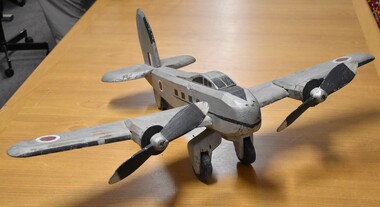
... Wooden WW2 type plane painted light grey (aged silver frost). 2 engine - propellers turn. ...There were also others for sale. models planes camp 13 internees camp guard No 86 Transport Wing RAAF A65-86 Wooden WW2 type plane painted light grey (aged silver frost). 2 engine - propellers turn. ...This object was purchased in Murchison under the hotel veranda in 1944 by the donors father for him. There were also others for sale.Wooden WW2 type plane painted light grey (aged silver frost). 2 engine - propellers turn. Wheels turn. Sold to donors father in 1944 by Camp guard in Murchison. Some decoration added by donor as a boy. Plane made by POW.No 86 Transport Wing RAAF A65-86models, planes, camp 13, internees, camp guard -
Moorabbin Air Museum
Archive (Item) - Box WP2 Prowse Collection See details under Description
... Pilot & Co Pilot Seat Assembly o Troop Seat - Two Man RAAF Spares o CAC CA15 Aircraft Dimensions o Nomad - Promo - N22B - N24A o CAC - General Overview Brochure o Saudi Arabia Aeromedical Proposal o Lincoln Conversion Spec to 6-seat Passenger o Comprehensive Plan for F/A-18A Final Assy & Fly-out at GAF - 1981 o Mamba Gas Turbine Propeller Engines o Aircraft Production Commission RAAF Pub No 187 Aug 1941 o Contractors and Type Trial of New Aircraft and the Organisation Necessary to Make the Trials o Various - Nomad Promotional Material o N22B Performance Summary ...Pilot & Co Pilot Seat Assembly o Troop Seat - Two Man RAAF Spares o CAC CA15 Aircraft Dimensions o Nomad - Promo - N22B - N24A o CAC - General Overview Brochure o Saudi Arabia Aeromedical Proposal o Lincoln Conversion Spec to 6-seat Passenger o Comprehensive Plan for F/A-18A Final Assy & Fly-out at GAF - 1981 o Mamba Gas Turbine Propeller Engines o Aircraft Production Commission RAAF Pub No 187 Aug 1941 o Contractors and Type Trial of New Aircraft and the Organisation Necessary to Make the Trials o Various - Nomad Promotional Material o N22B Performance Summary Archive Box WP2 Prowse Collection See details under Description ...Description: Defence Instruction Air Force AAP 7213.003-3MB2 Mirage Airctraft Metal Repairs - Book 2 of 2 Augusta-109-Hirundo - Preliminary General Description Sky Van: Military - Shorts Sky Van: Multi-Role Aircraft Sky Van: Civil VFW - Fokker VF Level of Importance: State. -
Moorabbin Air Museum
Document - Three Blade Hydraulic Propeller Equipment (Type R-/3-20-2/-) for No.2 SBAC Shaft, Rotol Limited
... Three Blade Hydraulic Propeller Equipment (Type R-/3-20-2/-) for No.2 SBAC Shaft ...Rotol Limited Document Three Blade Hydraulic Propeller Equipment (Type R-/3-20-2/-) for No.2 SBAC Shaft ... -
Moorabbin Air Museum
Manual (Item) - Woodward propeller type 2 synchro system
... Woodward propeller type 2 synchro system ...Woodward propeller type 2 synchro system ...Woodward propeller type 2 synchro system Manual Woodward propeller type 2 synchro system ... -
Moorabbin Air Museum
Booklet - Constant-Speed Hydraulic Propeller Governor Type CSSA, Woodward Governor Company
... Constant-Speed Hydraulic Propeller Governor Type CSSA...Woodward Governor Company Booklet Constant-Speed Hydraulic Propeller Governor Type CSSA ... -
Moorabbin Air Museum
Manual (Item) - Eclipse Service Manual No.11 Electric Propeller Governor Control Head Type 493
... Eclipse Service Manual No.11 Electric Propeller Governor Control Head Type 493...Eclipse Service Manual No.11 Electric Propeller Governor Control Head Type 493...Ex CAC Collection Eclipse Service Manual No.11 Electric Propeller Governor Control Head Type 493 Manual Eclipse Service Manual No.11 Electric Propeller Governor Control Head Type 493 ...Ex CAC Collection -
Moorabbin Air Museum
Book (Item) - RAAF Accessory Handbook , Hamilton Hydromatic Standard Propeller Type 24-D-50 S/N 141302
... RAAF Accessory Handbook , Hamilton Hydromatic Standard Propeller Type 24-D-50 S/N 141302....RAAF Accessory Handbook , Hamilton Hydromatic Standard Propeller Type 24-D-50 S/N 141302....RAAF Accessory Handbook , Hamilton Hydromatic Standard Propeller Type 24-D-50 S/N 141302. Book RAAF Accessory Handbook , Hamilton Hydromatic Standard Propeller Type 24-D-50 S/N 141302. ... -
Moorabbin Air Museum
Book (Item) - RAAF Accessory Log Book , Hamilton Hydromatic Standard Propeller Type 24 D 50-87 S/N 140879
... RAAF Accessory Log Book , Hamilton Hydromatic Standard Propeller Type 24 D 50-87 S/N 140879....RAAF Accessory Log Book , Hamilton Hydromatic Standard Propeller Type 24 D 50-87 S/N 140879....RAAF Accessory Log Book , Hamilton Hydromatic Standard Propeller Type 24 D 50-87 S/N 140879. Book RAAF Accessory Log Book , Hamilton Hydromatic Standard Propeller Type 24 D 50-87 S/N 140879. ... -
Moorabbin Air Museum
Book (Item) - RAAF Accessory Handbook , Hamilton Hydromatic Standard Propeller Type 24-D-50 S/N 141272
... RAAF Accessory Handbook , Hamilton Hydromatic Standard Propeller Type 24-D-50 S/N 141272....RAAF Accessory Handbook , Hamilton Hydromatic Standard Propeller Type 24-D-50 S/N 141272....RAAF Accessory Handbook , Hamilton Hydromatic Standard Propeller Type 24-D-50 S/N 141272. Book RAAF Accessory Handbook , Hamilton Hydromatic Standard Propeller Type 24-D-50 S/N 141272. ... -
Moorabbin Air Museum
Book (Item) - RAAF Accessory Log Book , Hamilton Hydromatic Standard Propeller Type 24 D 50-87 S/N 141317
... RAAF Accessory Log Book , Hamilton Hydromatic Standard Propeller Type 24 D 50-87 S/N 141317....RAAF Accessory Log Book , Hamilton Hydromatic Standard Propeller Type 24 D 50-87 S/N 141317....RAAF Accessory Log Book , Hamilton Hydromatic Standard Propeller Type 24 D 50-87 S/N 141317. Book RAAF Accessory Log Book , Hamilton Hydromatic Standard Propeller Type 24 D 50-87 S/N 141317. ... -
Moorabbin Air Museum
Book - Aircraft construction, The Airplane and its Components
... Aircraft construction Types of aircraft External components Internal components Engines Propellers Overview of aircraft internal components, circa 1942 The Airplane and its Components Book Aircraft construction ...Overview of aircraft internal components, circa 1942non-fictionOverview of aircraft internal components, circa 1942types of aircraft, external components, internal components, engines, propellers
