
Showing 823 items matching "public support"
-
 Ballarat Tramway Museum
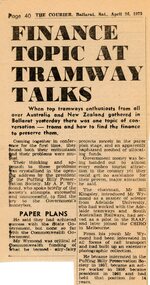
Newspaper - Newspaper - Clipping, Finance topic at tramway talks, April 1975
... ...public support...Government and public support necessary but both seemed to be fickle making for slow progress....Government and public support necessary but both seemed to be fickle making for slow progress. trams australia new zealand conference ballarat a p wymond finance government public support 1975 ron bridger collection puffing billy preservation society AS Box 48A The Courier. ...Ron Bridger was an avid collector of items related to transport, predominately Trams. These items include newspaper cuttings, pamphlets, reports, timetables, fares prices, plus special items relating to events. Items from Melbourne and regional Victoria, Interstate - Adelaide and Sydney, plus overseas, make up the collection. Tramway enthusiasts from across Australia and New Zealand met in Ballarat - conference for the first time. Their enthusiasm and problems were found to be mutual. The opening address was given by Mr A P Wymond, President of the Puffing Billy Preservation Society. Main topic was finance, need for government help and types of museums. Government and public support necessary but both seemed to be fickle making for slow progress.Newspaper clippingThe Courier. Saturday, April 26, 1975. Page 40trams, australia, new zealand, conference, ballarat, a p wymond, finance, government, public support, 1975, ron bridger collection, puffing billy preservation society, as box 48a -
 Ballarat Tramway Museum
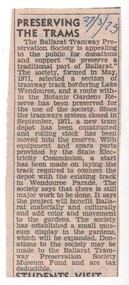
Newspaper, The Courier Ballarat, "Preserving the Trams", 27/03/1973 12:00:00 AM
... Newspaper clipping from The Courier, 27/3/1973 of the BTPS seeking public support for donations and support for its works. ...Newspaper clipping from The Courier, 27/3/1973 of the BTPS seeking public support for donations and support for its works. ...Newspaper clipping from The Courier, 27/3/1973 of the BTPS seeking public support for donations and support for its works. Describe the purpose of the BTPS, what it has done and its future planning and that donations are tax deductible.date in blue ink of "27/3/73" in top right hand corner of cutting.trams, tramways, btps, museum development, fund raising -
 Kew Historical Society Inc
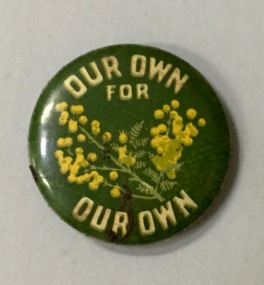
Badge - Fundraising Button, Australian Natives Association, Our Own For Our Own, 1910-1919
... The first ‘national’ Wattle Day was celebrated in Sydney, Melbourne and Adelaide in 1910. Public support for Wattle Day peaked during the First World War, when it was a potent symbol of Australia....The first ‘national’ Wattle Day was celebrated in Sydney, Melbourne and Adelaide in 1910. Public support for Wattle Day peaked during the First World War, when it was a potent symbol of Australia. ...Frances Rigg was a local business identity in Kew, at one stage managing the local branch of the English, Scottish and Australian (ES&A) Bank at 175 High Street from c. 1920 until the 1940s. After Francis Rigg’s death, the collection of buttons and medallions was inherited by his son, Ken Rigg (1922-2014). The collection was subsequently donated to the Kew Historical Society in 2015 by Francis' grandson, Adrian Rigg, at the time of the Gallipoli & Beyond Commemoration in 2015. The collection covers a period of almost 40 years. The majority of the buttons are patriotic buttons, issued and sold during and immediately after the First World World War (1914-1918) to raise funds for national and overseas causes. The collection also includes a number of locally significant sporting event buttons and sporting club medallions, issued in the 1920s and 1930s.Patriotic and other pressed tin buttons and badges were produced in large numbers in the first decades of the twentieth century. By nature, insubstantial and ephemeral, they have not always survived. The collections of badges, buttons and medallions in the Kew Historical Society collection is homogenous and yet diverse, ranging from buttons sold to raise funds for the war efforts in 1914-18 and 1939-45, to those used at festivals and sporting events. Because of the manufacturing process, many surviving buttons and badges have been affected by inadequate storage, suffering from oxidisation and physical damage. These survivors are now historically and socially significant artefacts, revealing much about the attitudes and values of the period in which they were produced. Their widespread distribution means that they are frequently significant at a local, state, national and international level.A ‘Wattle Day’ button made of pressed metal. The design is of branches of wattle on a dark green background. The first ‘national’ Wattle Day was celebrated in Sydney, Melbourne and Adelaide in 1910. Public support for Wattle Day peaked during the First World War, when it was a potent symbol of Australia."Our Own For / Our Own"wattle day, first world war (1914-18), badges, fundraising buttons -
 Melbourne Tram Museum
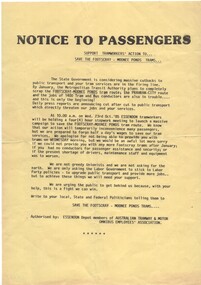
Document - Notice, Australian Tramway & Motor Omnibus Employees Association (ATMOEA), "Notice to Passengers - Support Tram workers' Action to Save the Footscray - Moonee Ponds Trams", Oct. 1985
... Notice or Flyer or Pamphlet - printed on a yellow A4 sheet titled "Notice to Passengers - Support Tram workers' Action to Save the Footscray - Moonee Ponds Trams" about a stop work meeting to be held at Essendon Tram depot 23/10/1985 and that services will not be running - apologise and ask for public support. Authorised by the ATMOEA Essendon Depot....Trams tramways Essendon Depot ATMOEA Unions Footscray Moonee Ponds Closure Services Notice or Flyer or Pamphlet - printed on a yellow A4 sheet titled "Notice to Passengers - Support Tram workers' Action to Save the Footscray - Moonee Ponds Trams" about a stop work meeting to be held at Essendon Tram depot 23/10/1985 and that services will not be running - apologise and ask for public support. Authorised by the ATMOEA Essendon Depot. ...Notice or Flyer or Pamphlet - printed on a yellow A4 sheet titled "Notice to Passengers - Support Tram workers' Action to Save the Footscray - Moonee Ponds Trams" about a stop work meeting to be held at Essendon Tram depot 23/10/1985 and that services will not be running - apologise and ask for public support. Authorised by the ATMOEA Essendon Depot.trams, tramways, essendon depot, atmoea, unions, footscray, moonee ponds, closure, services -
 Kew Historical Society Inc
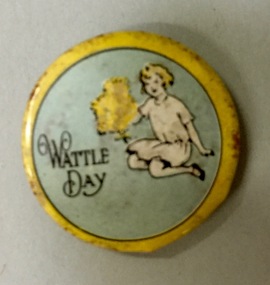
Badge - Fundraising Button, Australian Natives Association, Wattle Day, 1914-1919
... The first ‘national’ Wattle Day was celebrated in Sydney, Melbourne and Adelaide on 1 September 1910. Public support for Wattle Day peaked during World War I, when it was a potent symbol of home for military personnel serving overseas, and a means of raising money for organisations such as the Red Cross....The first ‘national’ Wattle Day was celebrated in Sydney, Melbourne and Adelaide on 1 September 1910. Public support for Wattle Day peaked during World War I, when it was a potent symbol of home for military personnel serving overseas, and a means of raising money for organisations such as the Red Cross. ...Frances Rigg was a local business identity in Kew, at one stage managing the local branch of the English, Scottish and Australian (ES&A) Bank at 175 High Street from c. 1920 until the 1940s. After Francis Rigg’s death, the collection of buttons and medallions was inherited by his son, Ken Rigg (1922-2014). The collection was subsequently donated to the Kew Historical Society in 2015 by Francis' grandson, Adrian Rigg, at the time of the Gallipoli & Beyond Commemoration in 2015. The collection covers a period of almost 40 years. The majority of the buttons are patriotic buttons, issued and sold during and immediately after the First World World War (1914-1918) to raise funds for national and overseas causes. The collection also includes a number of locally significant sporting event buttons and sporting club medallions, issued in the 1920s and 1930s.Patriotic and other pressed tin buttons and badges were produced in large numbers in the first decades of the twentieth century. By nature, insubstantial and ephemeral, they have not always survived. The collections of badges, buttons and medallions in the Kew Historical Society collection is homogenous and yet diverse, ranging from buttons sold to raise funds for the war efforts in 1914-18 and 1939-45, to those used at festivals and sporting events. Because of the manufacturing process, many surviving buttons and badges have been affected by inadequate storage, suffering from oxidisation and physical damage. These survivors are now historically and socially significant artefacts, revealing much about the attitudes and values of the period in which they were produced. Their widespread distribution means that they are frequently significant at a local, state, national and international level.A yellow and blue ‘Wattle Day’ badge featuring a seated girl holding a bouquet of wattle. The first ‘national’ Wattle Day was celebrated in Sydney, Melbourne and Adelaide on 1 September 1910. Public support for Wattle Day peaked during World War I, when it was a potent symbol of home for military personnel serving overseas, and a means of raising money for organisations such as the Red Cross."Wattle Day"patriotic buttons, wattle day, first world war (1914-18), badges -
 Kew Historical Society Inc
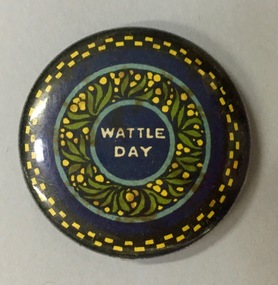
Badge - Fundraising Button, Australian Natives Association, Wattle Day, 1914-1919
... The first ‘national’ Wattle Day was celebrated in Sydney, Melbourne and Adelaide on 1 September 1910. Public support for Wattle Day peaked during World War I, when it was a potent symbol of home for military personnel serving overseas, and a means of raising money for organisations such as the Red Cross....The first ‘national’ Wattle Day was celebrated in Sydney, Melbourne and Adelaide on 1 September 1910. Public support for Wattle Day peaked during World War I, when it was a potent symbol of home for military personnel serving overseas, and a means of raising money for organisations such as the Red Cross. ...Frances Rigg was a local business identity in Kew, at one stage managing the local branch of the English, Scottish and Australian (ES&A) Bank at 175 High Street from c. 1920 until the 1940s. After Francis Rigg’s death, the collection of buttons and medallions was inherited by his son, Ken Rigg (1922-2014). The collection was subsequently donated to the Kew Historical Society in 2015 by Francis' grandson, Adrian Rigg, at the time of the Gallipoli & Beyond Commemoration in 2015. The collection covers a period of almost 40 years. The majority of the buttons are patriotic buttons, issued and sold during and immediately after the First World World War (1914-1918) to raise funds for national and overseas causes. The collection also includes a number of locally significant sporting event buttons and sporting club medallions, issued in the 1920s and 1930s.Patriotic and other pressed tin buttons and badges were produced in large numbers in the first decades of the twentieth century. By nature, insubstantial and ephemeral, they have not always survived. The collections of badges, buttons and medallions in the Kew Historical Society collection is homogenous and yet diverse, ranging from buttons sold to raise funds for the war efforts in 1914-18 and 1939-45, to those used at festivals and sporting events. Because of the manufacturing process, many surviving buttons and badges have been affected by inadequate storage, suffering from oxidisation and physical damage. These survivors are now historically and socially significant artefacts, revealing much about the attitudes and values of the period in which they were produced. Their widespread distribution means that they are frequently significant at a local, state, national and international level.This round ‘Wattle Day’ button is edged with a green and yellow wattle design. It is inscribed with white capital latters on a blue background in the centre. The first ‘national’ Wattle Day was celebrated in Sydney, Melbourne and Adelaide on 1 September 1910. Public support for Wattle Day peaked during World War I, when it was a potent symbol of home for military personnel serving overseas, and a means of raising money for organisations such as the Red Cross."Wattle Day"wattle day, patriotic buttons, first world war (1914-18) -
 Melbourne Tram Museum
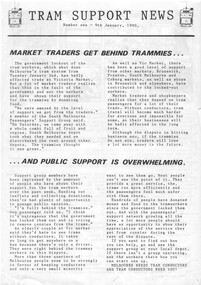
Administrative record - Correspondence, Passengers Support Group Network, ATMOEA Vic Branch, "Tram Support News", "Secretary's Newsletter", Jan. 1990
... Set of 2 documents about the industrial action of early 1990, that resulted in the tram blockade and the support offered to tram crews by the unions and other parties during the strike. .1 - A4 printed sheet - titled "Tram Support News - Number one - 9th Jan. 1990", - notes support offered by Market traders, public support and support group meetings at the various depots. ...Trams tramways Strike PTC Met Tram Tram Blockade Unions Employees Conductors Drivers One Man Trams Wages Set of 2 documents about the industrial action of early 1990, that resulted in the tram blockade and the support offered to tram crews by the unions and other parties during the strike. .1 - A4 printed sheet - titled "Tram Support News - Number one - 9th Jan. 1990", - notes support offered by Market traders, public support and support group meetings at the various depots. ...Set of 2 documents about the industrial action of early 1990, that resulted in the tram blockade and the support offered to tram crews by the unions and other parties during the strike. .1 - A4 printed sheet - titled "Tram Support News - Number one - 9th Jan. 1990", - notes support offered by Market traders, public support and support group meetings at the various depots. Has a cartoon about support mechanisms at the top of the second page. Produced by "Passengers Support Group Network" .2 - A4 printed sheet - on yellow paper titled "Secretary's Newsletter" - Jan. 1990 by the ATMOEA Vic Branch about the union actions and negotiations, the campaign, members support to pay bills, social security, kitchens at depots. Signed by Lou DiGregorio.trams, tramways, strike, ptc, met tram, tram blockade, unions, employees, conductors, drivers, one man trams, wages -
 Vision Australia
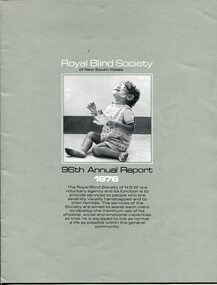
Administrative record - Text, 96th Annual Report Royal Blind Society of N.S.W. (1976), 1976
... Articles in the annual report include: the reduced subsidies provided by government and the increased need for public support, success of family counselling and support programs have reduced numbers at nursery and kindergarten, plans for Low Vision Clinic, reconditioning and assembly of bicycles in workshop, retirement of Matron Scott and Mrs McCallum (heads of Victor Maxwell nursery and Sandy Robertson kindergarten respectively), continued success of Mitchell Street Theatre, and all the NSW blind participants who attended the Toronto Olympiad won medals....Articles in the annual report include: the reduced subsidies provided by government and the increased need for public support, success of family counselling and support programs have reduced numbers at nursery and kindergarten, plans for Low Vision Clinic, reconditioning and assembly of bicycles in workshop, retirement of Matron Scott and Mrs McCallum (heads of Victor Maxwell nursery and Sandy Robertson kindergarten respectively), continued success of Mitchell Street Theatre, and all the NSW blind participants who attended the Toronto Olympiad won medals. ...Articles in the annual report include: the reduced subsidies provided by government and the increased need for public support, success of family counselling and support programs have reduced numbers at nursery and kindergarten, plans for Low Vision Clinic, reconditioning and assembly of bicycles in workshop, retirement of Matron Scott and Mrs McCallum (heads of Victor Maxwell nursery and Sandy Robertson kindergarten respectively), continued success of Mitchell Street Theatre, and all the NSW blind participants who attended the Toronto Olympiad won medals.1 volume of text and imagesroyal blind society of new south wales, corporation records, marno parsons, june gollan, joan mackenzie, alexis albert, lions club, mitchell manufacturing, phillip taylor, graham laurence, a.e. stephen, graeme innes, a innes, mrs mccallum, matron scott, val woods, marge brown, nan tait, lady norman, josephine gale, phyl eastman, mitchell street theatre, william street blind women's bowling club -
 Melbourne Tram Museum
Document - Report, National Trust, "Friends of the W class Trams Policy Statement", c1991
... Provides a statement of the trust's policy - classification, present threat, Met Proposal, comparison with Z class trams, tables of costs for each type of tram, options, power consumption, ride, life span, crew costing, public support, views on upgrading, conclusions. ...Provides a statement of the trust's policy - classification, present threat, Met Proposal, comparison with Z class trams, tables of costs for each type of tram, options, power consumption, ride, life span, crew costing, public support, views on upgrading, conclusions. ...Report - 10 A4 photocopied pages titled "Friends of the W class Trams Policy Statement" undated, signed by Don Gibson. Looks at the fleet after the delivery of all the B class trams, numbers of cars required for service, issues, a requested approach, equipment and their request - continue to run W class trams, store Z1 and Z2 trams. Provides a statement of the trust's policy - classification, present threat, Met Proposal, comparison with Z class trams, tables of costs for each type of tram, options, power consumption, ride, life span, crew costing, public support, views on upgrading, conclusions. Notes that Mr. Peter. Spyker was Minister for Transport at the time and that B class still being delivered - completed 1994. Mr Spyker was Minister from 1990 to 1992 - document c1991.trams, tramways, w class, b class, z class, national trust, the met -
 Eltham District Historical Society Inc
Document - Folder, Mash, Amelia
... Newspaper article: "Tourism needs public support" Diamond Valley News, 1 November 1995, Nillumbik Council has appointed La robe University to develop a tourism strategy for the shire. ...Newspaper article: "Tourism needs public support" Diamond Valley News, 1 November 1995, Nillumbik Council has appointed La robe University to develop a tourism strategy for the shire. ...Amelia Mash (nee Romerill), resident of Briar Hill and Eltham for more than 70 years, had died. Contents Newspaper article: "Loved for her kindness" Diamond Valley News, 1 November 1995, outlines the life of Amelia Mash (nee Romerill) who lived in Brian Hill and Eltham for more than 70 years.. Newspaper article: "Tourism needs public support" Diamond Valley News, 1 November 1995, Nillumbik Council has appointed La robe University to develop a tourism strategy for the shire. Megan Ritchie, LaTrobe University lecturer, will lead the team.Newspaper clippings, A4 photocopies, etcamelia mash, amelia romerill, annie roberill, bert romerill, williams road briar hill, john mash, dorothy mash, montmorencyfootball club, lower plenty football club, lower plenty cricket club, eltham cricket club, bundoora united cricket club, diamond valley basketball association -
 Melbourne Legacy
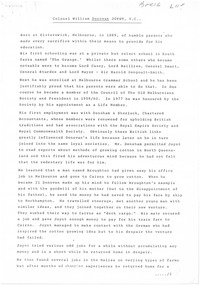
Document - Obituary, Colonel William Donovan Joynt, V.C
... He was also instrumental in gaining the support of both General Sir John Monash and the R.S.L. to build the Shrine of Remembrance, as well as ensuring media backing and thus public support for the project. He worked tirelessly for Legacy for 38 years until he retired at the age of 84, and entered fully into comradeship activities throughout his involvement. ...He was also instrumental in gaining the support of both General Sir John Monash and the R.S.L. to build the Shrine of Remembrance, as well as ensuring media backing and thus public support for the project. He worked tirelessly for Legacy for 38 years until he retired at the age of 84, and entered fully into comradeship activities throughout his involvement. ...Joynt was the seventh member of the newly formed Legacy in 1923 and became a member of the Board of Management in 1924 and worked closely with Stan Savige. He was also instrumental in gaining the support of both General Sir John Monash and the R.S.L. to build the Shrine of Remembrance, as well as ensuring media backing and thus public support for the project. He worked tirelessly for Legacy for 38 years until he retired at the age of 84, and entered fully into comradeship activities throughout his involvement. He won his VC in 1917 at Chuignes during one of the last battles on the Somme. The Victoria Cross is the highest award for acts of bravery in wartime and was instituted in 1856 by Queen Victoria. See also the funeral service at Cat No 01303.Detailed biography of one of the few Legatees to have been awarded the Victoria Cross.White A4 paper x 6 pages with black type.Box 16 L 11 (illegible) in black birodonovan joynt, obituary -
 Melbourne Legacy
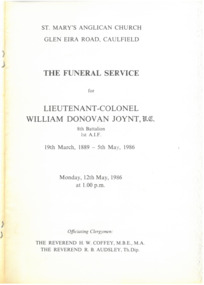
Document - Obituary, The Funeral Service for Lieutenant-Colonel William Donovan Joynt, V.C
... He was also instrumental in gaining the support of both General Sir John Monash and the R.S.L. to build the Shrine of Remembrance, as well as ensuring media backing and thus public support for the project. He worked tirelessly for Legacy for 38 years until he retired at the age of 84, and entered fully into comradeship activities throughout his involvement. ...He was also instrumental in gaining the support of both General Sir John Monash and the R.S.L. to build the Shrine of Remembrance, as well as ensuring media backing and thus public support for the project. He worked tirelessly for Legacy for 38 years until he retired at the age of 84, and entered fully into comradeship activities throughout his involvement. ...Joynt was the seventh member of the newly formed Legacy in 1923 and became a member of the Board of Management in 1924 and worked closely with Stan Savige. He was also instrumental in gaining the support of both General Sir John Monash and the R.S.L. to build the Shrine of Remembrance, as well as ensuring media backing and thus public support for the project. He worked tirelessly for Legacy for 38 years until he retired at the age of 84, and entered fully into comradeship activities throughout his involvement. He won his VC in 1917 at Chuignes during one of the last battles on the Somme. The Victoria Cross is the highest award for acts of bravery in wartime and was instituted in 1856 by Queen Victoria. The Chairman of Legacy Co-ordinating Council, Legatee K.D. Green, gave the eulogy (01303.5) at the funeral service.Records the life of an outstanding Australian of great social conscience, reflecting well on the Legacy organisation as a whole.01303.1-01303.2 sheets folded and stapled together to form a booklet with the order of service - black print on white paper 01303.5-01303.8 white sheets with black type. donovan joynt, founding legatee, obituary -
 Federation University Art Collection
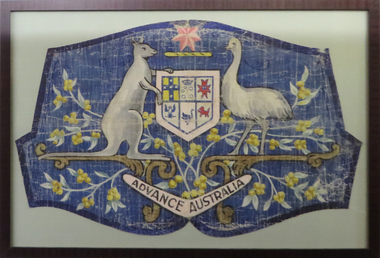
Painting - Acrylic on Canvas, Advance Australia
... Early Wattle Days involved planting wattle trees in school grounds, street decorations of wattle blossom, and wearing sprigs of wattle. As public support for Wattle Day peaked, World War I broke out. ...Early Wattle Days involved planting wattle trees in school grounds, street decorations of wattle blossom, and wearing sprigs of wattle. As public support for Wattle Day peaked, World War I broke out. ...This artwork was found among items associated with the Ballarat School of Mines. Although its purpose remains unknown, it was possibly painted by a staff member or student for use on Wattle Day. Wattle Day originated in October 1889 by the Wattle Blossom League, and was associated with the Australian Natives Association during the lead up to the Federation of Australian States. The first 'national' Wattle Day was celebrated on 1 September 1910. Early Wattle Days involved planting wattle trees in school grounds, street decorations of wattle blossom, and wearing sprigs of wattle. As public support for Wattle Day peaked, World War I broke out. Wattle took on a new significance during the war years, symbolising home for military personnel serving overseas. Beautifully designed Wattle Day badges, as well as wattle sprigs, were sold as a means of raising money for organisations such as the Red Cross. This item is part of the Federation University Art Collection. The Art Collection features over 1000 works and was listed as a 'Ballarat Treasure' in 2007.The Australian coat of arms with wattle, painted onto canvas.art, artwork, emu, kangaroo, crest, advance australia, wattle day, wattle, coat of arms, patriotic, australian coar of arms, national symbol -
 Melbourne Legacy
Document - Obituary, William Donovan Joynt, V.C
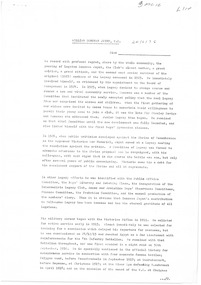
... He was also instrumental in gaining the support of both General Sir John Monash and the R.S.L. to build the Shrine of Remembrance, as well as ensuring media backing and thus public support for the project. He worked tirelessly for Legacy for 38 years until he retired at the age of 84, and entered fully into comradeship activities throughout his involvement. ...He was also instrumental in gaining the support of both General Sir John Monash and the R.S.L. to build the Shrine of Remembrance, as well as ensuring media backing and thus public support for the project. He worked tirelessly for Legacy for 38 years until he retired at the age of 84, and entered fully into comradeship activities throughout his involvement. ...Joynt was the seventh member of the newly formed Legacy in 1923 and became a member of the Board of Management in 1924 and worked closely with Stan Savige. He was also instrumental in gaining the support of both General Sir John Monash and the R.S.L. to build the Shrine of Remembrance, as well as ensuring media backing and thus public support for the project. He worked tirelessly for Legacy for 38 years until he retired at the age of 84, and entered fully into comradeship activities throughout his involvement. He won his VC in 1917 at Chuignes during one of the last battles on the Somme. The Victoria Cross is the highest award for acts of bravery in wartime and was instituted in 1856 by Queen Victoria. See also Cat.Nos. 01303, 01350. This obituary adds further information about the life of L/- W.D. Joynt and includes a typed copy of an extract from 'They dared mightily' by Laurence Wigmore (Canberra: Australian War Memorial, 1963) pages 141, 142 & 143 which detail the action which won him the V.C.Provides more military information than in other obituaries of Joynt, as well as further information on his activities in the broader community.White A4 paper x 6 pages with black type.Box 16 L1.14 in black ballpen Confusingly it is dated 20/6/78, handwritten in black biro, although Joynt did not die until 1986.donovan joynt, obituary -
 Frankston RSL Sub Branch
Handbook, An Official Guide to Sydney
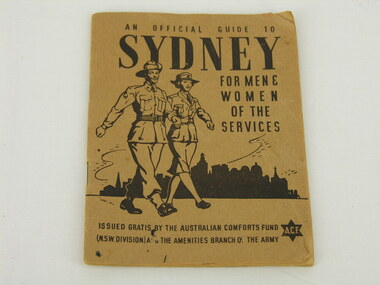
... Contains usefull information, contact details for support organisations, public transport information and a map. ...Contains usefull information, contact details for support organisations, public transport information and a map. ...Pocketbook produced by the Australian Comforts Fund as a guide to Sydney for service women and men stationed or visiting there. Contains usefull information, contact details for support organisations, public transport information and a map. The book has 32 pages and has a buff coloured paper cover. The booklet cover has the following printed in black ink: "An Official Guide to Sydney for Men & Women of the Services" "Issued by the Australian Comforts Fund (NSW Division) and the Amenities Branch of the Army" -
 Ballarat Tramway Museum
Newspaper, Geelong Advertiser, "Trams for Belmont", 29/7/2000
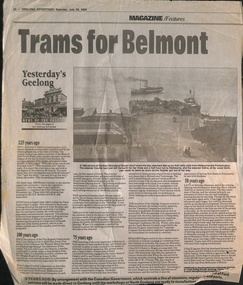
... Has a series of spot historys over the last 125 years, including one 75 years ago of the opening of the Belmont line, following public agitation and support by the Company. Notes the work of A L Walter, Town Clerk....Has a series of spot historys over the last 125 years, including one 75 years ago of the opening of the Belmont line, following public agitation and support by the Company. Notes the work of A L Walter, Town Clerk. ...Newspaper clipping from The Geelong Advertiser with the heading "Trams for Belmont", part of the "Yesterday's Geelong News of the past series". Has a series of spot historys over the last 125 years, including one 75 years ago of the opening of the Belmont line, following public agitation and support by the Company. Notes the work of A L Walter, Town Clerk.Yields information about the Belmont line extension in 1925.Newspaper item from the Geelong Advertiser, 29/7/2000tramways, geelong, mesco, belmont, new tramways -
 Bendigo Historical Society Inc.
Newsletter - PND Newsletter, 1980's
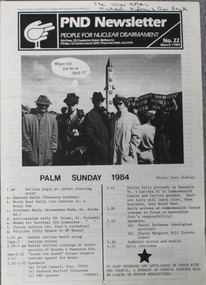
... The organization aims to eliminate the threat of nuclear war and mobilize public opinion in support of disarmament and peace. PND advocates for social justice and environmental preservation, with the ultimate goal of achieving complete and general world disarmament, supported by international agreements....The organization aims to eliminate the threat of nuclear war and mobilize public opinion in support of disarmament and peace. PND advocates for social justice and environmental preservation, with the ultimate goal of achieving complete and general world disarmament, supported by international agreements. ...People for Nuclear Disarmament (PND) was formed in Melbourne in October 1981 and has been a significant force in the global disarmament movement. The organization aims to eliminate the threat of nuclear war and mobilize public opinion in support of disarmament and peace. PND advocates for social justice and environmental preservation, with the ultimate goal of achieving complete and general world disarmament, supported by international agreements.Eight copies of PND Newsletter produced by People for Nuclear Disarmament on white A4 with black print varying between six and ten pages, dates in 1983 and 1984. Also, a 20 page A4 size black print on white paper PND publication titled FLASHPOINT June 84 Vol1 No1. There are another 14 newspaper cuttings and pamphlets relating to nuclear disarmament. people for nuclear disarmament, pnd newsletter, flashpoint -
 Melbourne Legacy
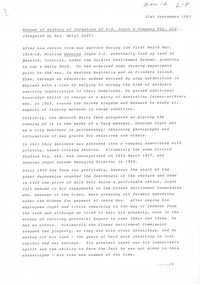
Document, Resume of history of formation of W.D. Joynt & Company Pty. Ltd
... He was also instrumental in gaining the support of both General Sir John Monash and the R.S.L. to build the Shrine of Remembrance, as well as ensuring media backing and thus public support for the project. He worked tirelessly for Legacy for 38 years until he retired at the age of 84, and entered fully into comradeship activities throughout his involvement. ...He was also instrumental in gaining the support of both General Sir John Monash and the R.S.L. to build the Shrine of Remembrance, as well as ensuring media backing and thus public support for the project. He worked tirelessly for Legacy for 38 years until he retired at the age of 84, and entered fully into comradeship activities throughout his involvement. ...Detailed account of the business history of Legatee W.D.Joynt VC prepared by Mrs Beryl Luff. Joynt was the seventh member of the newly formed Legacy in 1923 and became a member of the Board of Management in 1924 and worked closely with Stan Savige. He was also instrumental in gaining the support of both General Sir John Monash and the R.S.L. to build the Shrine of Remembrance, as well as ensuring media backing and thus public support for the project. He worked tirelessly for Legacy for 38 years until he retired at the age of 84, and entered fully into comradeship activities throughout his involvement. He won his VC in 1917 at Chuignes during one of the last battles on the Somme. The Victoria Cross is the highest award for acts of bravery in wartime and was instituted in 1856 by Queen Victoria. See also Cat No 01303. Mrs Luff wrote extensively about Joynt's business career and the challenges he faced throughout the Great Depression and the Second World War. Despite initially losing his farm and then a colour printing business he went on to form W.D. Joynt & Co which began by printing advertising and moved on to general printing, ultimately becoming one of the three largest paperback printers in Australia. in 1976, due to the then economic difficulties in Australia, the company went into receivership, but managed to trade its way out and eventually printed most of Mills & Boon's popular romance series. In 1981 the company became part of the McPherson Group of Companies and Joynt retired. His qualities of leadership, persistence and business acumen were of great benefit to Melbourne Legacy. Illustrates some of the difficulties faced by early Legatees throughout their working lives as a result of global economic crises.5 x typed sheets black on whiteBox 16 L14 in black biro on first pagedonovan joynt, founding legatee -
 Ballarat Heritage Services
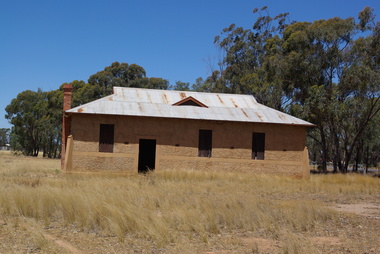
Photograph, Former Kurting Mechanics' Institute, Victoria, 2016, 10/01/2016
... The committee still has work ahead in the provision of a ceiling for the building and seating accomodation, but there is no doubt that the public support accorded them will be sufficient to enable these matters to be dealt with in the near future. ...The committee still has work ahead in the provision of a ceiling for the building and seating accomodation, but there is no doubt that the public support accorded them will be sufficient to enable these matters to be dealt with in the near future. ...Kurting. Mechanics' Hall OFFICIAL OPENING. SUCCESSFUL FUNCTION. Favored by beautiful weather, the official opening ot the new Mechanics' Hall erected at Kurting proved an entire success. There was a large attendance ol local and district residents, and a sports meeting held during the afternoon in aid of Red Cross funds resulted in a substantial amount being netted. The hall, which stands on ground generously donated by Mr J. Hogan, between the school and the creek, is a substantialyvconcrete building of pleasing design, and was erected at a cost of about £330 by Mr J. H. Secombe, who also materially assisted the committee in the matter of finance. It is 48ft. long by 24ft. wide, with 12ft, walls, and should prove equal to the needs of the district for many years to come. It is well ventilated, and has large windows, these opening outwards on hinges. Doors at each side, and the back, as well as in front, give free means of access, while a fireplace in the back allows of provision being made for supper arrangements, water being laid on from a tank. Provi sion has been made for the partitioning off ot portion of the hall at any time this may be considered desirable. To provide a stage eight tables of a uniform size have been constructed to fit across the width of the hall. By these it will be possible, when euchre parties are being held, to use the full length of the hall. ... (Inglewod Advertiser, 19 July 1918) and also to convert tiie "stage" into card tables. The committee still has work ahead in the provision of a ceiling for the building and seating accomodation, but there is no doubt that the public support accorded them will be sufficient to enable these matters to be dealt with in the near future. A fine floor has been put down.Photographs of the former Kurting Hall, Victoria.kurting, kurting hall, john hogan, kurting mechanics' institute -
Bendigo Historical Society Inc.
Document - HARRY BIGGS COLLECTION: POLICE BARRACKS (8), 10/7/1951, 11/7/1951
... Galvin dated 10/7/51 stating he will make representation to the Minister of Public Works in support of the Society's obtaining the Police Barracks. 2 - A letter on Legislative Council Victoria letterhead dated 11/7/1951 from T. ...Galvin dated 10/7/51 stating he will make representation to the Minister of Public Works in support of the Society's obtaining the Police Barracks. 2 - A letter on Legislative Council Victoria letterhead dated 11/7/1951 from T. ...Document. Harry Biggs Collection. 1 - Letter to Mr Haywood from W. L. Galvin dated 10/7/51 stating he will make representation to the Minister of Public Works in support of the Society's obtaining the Police Barracks. 2 - A letter on Legislative Council Victoria letterhead dated 11/7/1951 from T. H. Grigg, Hornsby St., Maldon to C. N. Oliver, President Historical Society of Bendigo stating he has 'taken up the matter' with the Under Secretary who has promised support.W. L. Galvin., H. Grigg.organization, club/society, community, harry biggs collection, police barracks -
 Broadmeadows Historical Society & Museum
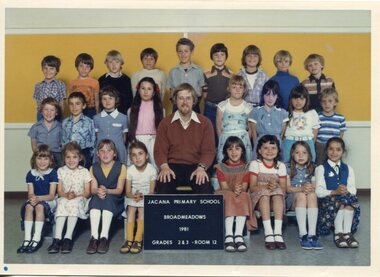
Photograph - Group Photograph, Jacana Primary School: Grade 2 and 3 - Room 12, 1981, 1981
... As part of the school’s visual archive, this photograph contributes to a broader understanding of how public education supported community cohesion, shaped local identity, and played a formative role in the lives of children and families across generations....As part of the school’s visual archive, this photograph contributes to a broader understanding of how public education supported community cohesion, shaped local identity, and played a formative role in the lives of children and families across generations. ...This 1981 photograph of Grade 2 and 3 students from Room 12 at Jacana Primary School offers a valuable glimpse into the everyday life of primary education in Melbourne’s northern suburbs during a period of suburban growth and demographic transformation. Founded in 1959, Jacana Primary School served the local community for over four decades, providing not only academic instruction but also a vital space for social development and community connection. The image reflects the school’s dedication to creating a nurturing and inclusive environment for young learners in their early years of schooling. It also illustrates the cultural diversity and changing social landscape of Jacana in the late 20th century. As part of the school’s visual archive, this photograph contributes to a broader understanding of how public education supported community cohesion, shaped local identity, and played a formative role in the lives of children and families across generations.The 1981 photograph of Grade 2 and 3 students in Room 12 at Jacana Primary School is a historically significant artefact that captures the everyday realities of early primary education during a period of growth and change in Melbourne’s northern suburbs. It reflects the school’s commitment to providing a nurturing and inclusive learning environment for young children, many of whom came from diverse cultural backgrounds. This image offers insight into the social and educational atmosphere of the early 1980s, including classroom dynamics, fashion, and the evolving demographic character of the Jacana community. As part of the visual legacy of a now-closed institution, the photograph preserves the memory of a school that played a vital role in shaping childhood experiences and fostering community identity across generations.Colour Photograph on Matte Paper, with white borderBack, Top Left Corner: (White label): PH-5009/ (Blue Label): PH-5596 Centre (in pencil) J.P.S., Manufacturers Mark; this paper/Manufactured/ by Kodakjacana primary school, education, photograph, group photograph, class photograph, grade 2 and 3, room 12, 1981 -
 Broadmeadows Historical Society & Museum
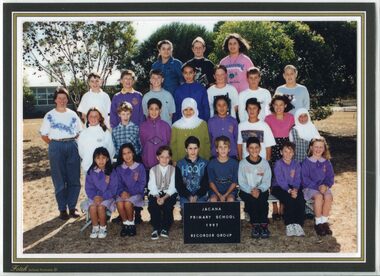
Photograph - Group Photograph, Fotek School Portraits, Jacana Primary School: Recorder Group 1997, 1997
... As part of the school’s visual archive, it contributes to a broader understanding of how public education supported both personal development and community cohesion during the late 20th century....As part of the school’s visual archive, it contributes to a broader understanding of how public education supported both personal development and community cohesion during the late 20th century. ...Jacana Primary School, established in 1959 and closed in 2009, served as a vital educational and social institution in Melbourne’s northern suburbs for fifty years. By 1997, the school had become a reflection of the area’s rich cultural diversity and evolving suburban identity. Music programs, such as the Recorder Group, played an important role in the school’s approach to inclusive and well-rounded education, offering students opportunities to explore creativity, build confidence, and contribute to school life beyond the classroom. The Recorder Group was often featured in school assemblies and community events, fostering a sense of pride and belonging among participants. This photograph captures not only the students involved but also the values of collaboration, expression, and celebration that were central to Jacana Primary’s ethos. As part of the school’s visual archive, it contributes to a broader understanding of how public education supported both personal development and community cohesion during the late 20th century.The 1997 Jacana Primary School Recorder Group photograph is a meaningful artefact that reflects the school’s dedication to fostering creativity and student participation through music. Captured during the final decade of the school’s operation, the image showcases the enthusiasm and diversity of students engaged in a shared artistic pursuit. It stands as more than a group portrait—it represents the inclusive and supportive environment that defined Jacana Primary School and its commitment to holistic education. The photograph also offers a nostalgic glimpse into the fashion and social atmosphere of the late 1990s, making it a treasured piece of local history for the school’s former students, staff, and community. Colour photograph, on Matte Photographic paper, mounted on white card.Back: (Upper left Corner) - Blue Label: PH - 2124jacana primary school, students, education, recorder group, 1997, jacana -
 Broadmeadows Historical Society & Museum
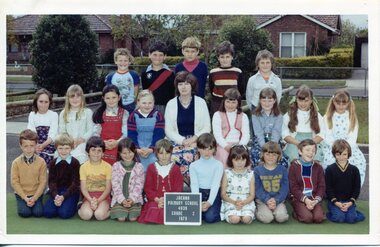
Photograph - Class Photograph, Jacana Primary School: Grade 2, 1979, 1979
... As part of the school’s visual archive, this photograph contributes to a broader understanding of how public education supported community cohesion, shaped local identity, and played a formative role in the lives of children and families across generations....As part of the school’s visual archive, this photograph contributes to a broader understanding of how public education supported community cohesion, shaped local identity, and played a formative role in the lives of children and families across generations. ...This 1979 group photograph of Grade 2 students and their teacher at Jacana Primary School offers a meaningful glimpse into the everyday experiences of primary education in Melbourne’s northern suburbs during a time of suburban expansion and demographic change. Established in 1959, Jacana Primary served the local community for over 40 years, providing not only academic instruction but also a vital space for social connection and community identity. The image reflects the school’s commitment to fostering a nurturing and inclusive environment for young learners in their early years of schooling. It also highlights the cultural diversity and evolving social fabric of Jacana in the late 20th century. As part of the school’s visual archive, this photograph contributes to a broader understanding of how public education supported community cohesion, shaped local identity, and played a formative role in the lives of children and families across generations.This 1979 group photograph of Grade 2 students and their teacher at Jacana Primary School is a historically significant artifact that captures a formative moment in the educational and social life of Melbourne’s northern suburbs. Established in 1959, Jacana Primary operated for over four decades, serving as a key institution in the local community until its closure in the early 2000s. The photograph reflects the school’s enduring commitment to nurturing young learners in an inclusive and supportive environment. It also offers insight into the cultural and demographic landscape of Jacana during a period of suburban growth and transformation. As part of the school’s visual legacy, this image documents the everyday experiences of students and highlights the role of public education in fostering community identity, cohesion, and continuity across generations.Colour Photograph on Matte Paper, with white borderBack, Top Left Corner: (White label): PH-5009/ (Blue Label): PH-5596 Centre (in pencil) J.P.S., Manufacturers Mark; this paper/Manufactured/ by Kodakjacana primary school, education, photograph, group photograph, 1979, class photograph, grade 2 -
 Broadmeadows Historical Society & Museum
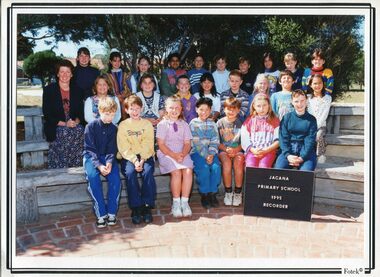
Photograph - Group Photograph, Fotek School Portraits, Jacana Primary School; Recorder Group, 1995, 1995
... As part of Jacana Primary’s visual archive, it contributes to a broader understanding of how public schools supported holistic development and community cohesion during the late 20th century....As part of Jacana Primary’s visual archive, it contributes to a broader understanding of how public schools supported holistic development and community cohesion during the late 20th century. ...Jacana Primary School, established in 1959 and closed in 2009, was a key educational institution in Melbourne’s northern suburbs, serving generations of families during a time of significant suburban development and demographic change. By the mid-1990s, the school had become a reflection of the area’s growing cultural diversity and community spirit. Music education played an important role in the school’s curriculum and extracurricular life, with programs like the Recorder Group offering students opportunities to explore creativity, develop discipline, and participate in shared performances. The 1995 Recorder Group photograph captures this aspect of school life, highlighting the value placed on artistic expression and student involvement beyond the classroom. Set against the backdrop of a changing urban landscape, the image also provides insight into the social atmosphere of the time, including fashion, hairstyles, and the informal culture of primary education. As part of Jacana Primary’s visual archive, it contributes to a broader understanding of how public schools supported holistic development and community cohesion during the late 20th century.The 1995 photograph of the Jacana Primary School Recorder Group is a valuable historical and emotional record that reflects the school’s dedication to fostering creativity and student engagement through music education. Captured within a now-closed institution, the image showcases the vibrant spirit, cultural diversity, and nurturing environment that defined Jacana Primary School during the mid-1990s. More than a group portrait, this photograph highlights the importance of extracurricular activities in shaping well-rounded educational experiences and building community among students. It also offers a charming glimpse into the fashion, hairstyles, and social atmosphere of the time, making it a treasured keepsake for former students, staff, and the wider Jacana community. As part of the school’s visual legacy, it preserves the memory of a place that played a formative role in the lives of generations of children.2 x Colour photographs on satin finish paper, 1 x mounted on white card backing, 1 x Laminated.(Front; Bottom right corner): Fotek © (Back Blue Label): Ph-5397 jacana primary school, students, staff, education, 1995, recorder -
![Royal Australian Nursing Federation campaign badge, [1986?]](/media/collectors/5bb42dc221eaf31100db1d3b/items/5c47b37d21ea6d01508a967f/item-media/5c47b3a721ea6d01508ae5bc/item-fit-380x285.jpg?cb=6) Australian Nursing & Midwifery Federation
Australian Nursing & Midwifery FederationRoyal Australian Nursing Federation campaign badge, [1986?]
... The text on the button, 'I SUPPORT R.A.N.F.' suggests that this badge was also distributed to members of the union movement and broader public to build community support for industrial action taken by nurses. ...The text on the button, 'I SUPPORT R.A.N.F.' suggests that this badge was also distributed to members of the union movement and broader public to build community support for industrial action taken by nurses. ...Distributed to nurses during campaigning for improved wages and working conditions in the 1980s, possibly during the historic 1986 Victorian 50-day nurses strike. The text on the button, 'I SUPPORT R.A.N.F.' suggests that this badge was also distributed to members of the union movement and broader public to build community support for industrial action taken by nurses. The Royal Australian Nursing Federation (RANF) became the Australian Nursing Federation in 1989, suggesting that this button is from the late 1980s.Circular red and white plastic button. Silver metal, plastic-coated, with safety pin fastener adhered to back. Button printed with 'I SUPPORT R.A.N.F. [Royal Australian Nursing Federation]' and 'R.A.N.F. Vic. [Victoria]'.nursing, nurses, industrial action, strike action, community, unionism, trade unions, badges, buttons, pins, campaigning, 1986 victorian nurses strike, labour history, royal australian nursing federation -
 Bendigo Historical Society Inc.
Newspaper - Fortuna Articles - "Long lives the king", Sept 13 2007
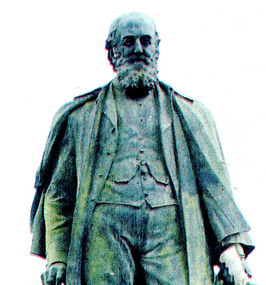
... Lansell was celebrated for his philanthropy, supporting public institutions, charities, and miners in need. ...Lansell was celebrated for his philanthropy, supporting public institutions, charities, and miners in need. ...This document proposes the creation of a documentary about George Lansell, known as the "Quartz King" of Bendigo, highlighting his significant impact on the region's goldfields and community. Suggests strong support for a film documenting George Lansell's life, backed by local council, historical society, and parliamentary representatives. Recommends submitting the idea to organizations like Film Australia. Lansell was a prominent mining magnate with private ownership of multiple mines and investments in Australia and abroad. He was known for his immense wealth, generosity, and contributions to Bendigo's prosperity. His mansion, Fortuna, was one of the most lavish in the colony. The Big 180 mine, owned by Lansell, was the deepest in the Southern Hemisphere by 1895 and yielded significant gold output. Lansell and his partners extracted an estimated three million pounds worth of gold from the Big 180. Lansell was celebrated for his philanthropy, supporting public institutions, charities, and miners in need. Upon his death in 1906, he left shares in his mines to employees and set up a trust fund for widows and orphans of Bendigo miners. The document emphasizes the rich historical material available for a documentary, drawing from local archives and historical accounts.Fortuna Article - "Long lives the king" Bendigo Miner 13 Sept 2007 by Max Thomson This item contains the following: 11217.32a Colour Photo of Mining Man Statue: the "Quartz King, Geoge Lansell 11217.32b Part of Page 10 - Article "Long lives the king"non-fictionbendigo, fortuna, george lansell, quartz king, big 180 mine -
Broadmeadows Historical Society & Museum
Photograph - Group Photograph, Classic Studios Victoria, Jacana Primary School: Staff 1988, 1988
... Situated in the suburb of Jacana, the school was part of a broader post-war initiative to expand public education and support families settling in newly developed housing estates. ...Situated in the suburb of Jacana, the school was part of a broader post-war initiative to expand public education and support families settling in newly developed housing estates. ...Jacana Primary School was established in 1959 during a time of rapid suburban growth in Melbourne’s northern suburbs. Situated in the suburb of Jacana, the school was part of a broader post-war initiative to expand public education and support families settling in newly developed housing estates. By 1988, the school had become a cornerstone of the local community, serving a diverse population that included many migrant families and reflecting the evolving cultural landscape of the area. The staff photograph from 1988 captures a dedicated team of educators who played a vital role in shaping the academic and social development of students during a dynamic period in Australian education. This era saw growing attention to inclusive teaching, community involvement, and the professionalisation of the teaching workforce. The image stands as a testament to the commitment and collaboration of Jacana Primary’s staff, whose efforts helped foster a supportive and enriching learning environment. As a historical artefact, the photograph offers insight into the educational values, workplace culture, and fashion of the late 1980s. It preserves the memory of a school that contributed significantly to the lives of children and families in Melbourne’s northern suburbs, and honours the legacy of those who worked within its classrooms and corridors.The 1988 staff photograph from Jacana Primary School is a historically significant record that highlights the people who shaped the educational experience of countless students during a formative period in Melbourne’s northern suburbs. Taken nearly three decades after the school’s founding in 1959, the image reflects the dedication and professionalism of the teaching and support staff who worked within a rapidly evolving and culturally diverse community. This photograph offers insight into the educational values and workplace culture of the late 1980s, a time marked by growing emphasis on inclusive education and community engagement. It also serves as a visual snapshot of the era, capturing fashion, hairstyles, and the collegial spirit of the staff. As Jacana Primary School has since closed, this image stands as a lasting tribute to the educators who contributed to its legacy and to the broader story of public education in post-war suburban Melbourne.Colour Photograph, with blue border at bottom, with names, on Matte Photographic Paper. Back: Top right Corner: (Blue Label): PH-1701 Front; See Attachment jacana primary school, education, photograph, group photograph, 1988, staff -
 Surrey Hills Historical Society Collection
Book, Canterbury Surrey Hills Community Finance Limited: Celebrating 15 Years and $5.6 Million back to the community, 2018
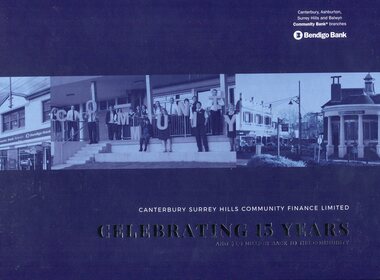
... The Surrey Hills branch was opened in the bank site previously operated by the CBA (Commonwealth Bank of Australia) after it took over the State Savings Bank of Victoria (SSB) which has the building constructed for bank use in 1916. A public meeting to garner support for opening a branch of the Bendigo Community Bank was held in the Surrey Hills Neighbourhood Centre. ...The Surrey Hills branch was opened in the bank site previously operated by the CBA (Commonwealth Bank of Australia) after it took over the State Savings Bank of Victoria (SSB) which has the building constructed for bank use in 1916. A public meeting to garner support for opening a branch of the Bendigo Community Bank was held in the Surrey Hills Neighbourhood Centre. ...This book celebrates the achievements of the Bendigo Community Bank after 15 years in Surrey Hills and Canterbury. The Surrey Hills branch was opened in the bank site previously operated by the CBA (Commonwealth Bank of Australia) after it took over the State Savings Bank of Victoria (SSB) which has the building constructed for bank use in 1916. A public meeting to garner support for opening a branch of the Bendigo Community Bank was held in the Surrey Hills Neighbourhood Centre. One of those pushing for restoration of banking services in the area was Damien Hudson, son of real estate agent Ray Hudson. He subsequently became a member of the Surrey Hills Community Bank Board. Dick Menting, who was the local Councillor at the time, was another key supporter who likewise became a board member as did Bob Stensholt, the MLA for Burwood .Hard covered book, H 23.2 cm , 71 pages, incl index(ms) jennifer flynn, bendigo bank, canterbury surrey hills community finance, community banking, (mr) damien hudson, (cr) dick menting, (mr) bob stensholt -
 Ballarat Tramway Museum
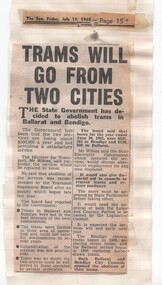
Newspaper, Herald Sun, "Trams will go from two cities", July to Oct 1968
... Series of newspaper clippings adhered to three quarto lined sheets about the 1968 attempt by the Victorian Government to close the Ballarat and Bendigo tramway systems. .1 - "Trams will go from two cities" - The Sun Friday 19/7/1968, about the Government's decision - gives reasons for the closure. .2 - "Protest over tram protest" - The Sun, 28/8/1968 - with a photo of No. 35 and that the Ballarat Save the Trams Committee not supporting a public protest meeting called by tramway employees. ...Closure Ballarat Bendigo Parliament St Kilda Junction SEC Series of newspaper clippings adhered to three quarto lined sheets about the 1968 attempt by the Victorian Government to close the Ballarat and Bendigo tramway systems. .1 - "Trams will go from two cities" - The Sun Friday 19/7/1968, about the Government's decision - gives reasons for the closure. .2 - "Protest over tram protest" - The Sun, 28/8/1968 - with a photo of No. 35 and that the Ballarat Save the Trams Committee not supporting a public protest meeting called by tramway employees. ...Yields information about the 1968 proposals to close both the Ballarat and Bendigo tramway systems by the state government.Series of newspaper clippings adhered to three quarto lined sheets about the 1968 attempt by the Victorian Government to close the Ballarat and Bendigo tramway systems. .1 - "Trams will go from two cities" - The Sun Friday 19/7/1968, about the Government's decision - gives reasons for the closure. .2 - "Protest over tram protest" - The Sun, 28/8/1968 - with a photo of No. 35 and that the Ballarat Save the Trams Committee not supporting a public protest meeting called by tramway employees. Also has cutting about the State cabinet being delayed by a good train breakdown, a Brisbane train strike and that Country considering the Underground is not vital. .3 - "The Country trams stay" - The Sun Thursday 3/10/1968 - about the Legislative Council not approving the motion to scrap the trams, Labor and Country party combined to defeat the motion. Also cutting on traffic changes to St Kilda Junction. Date of cutting has been taped onto the sheets.closure, ballarat, bendigo, parliament, st kilda junction, sec -
 Broadmeadows Historical Society & Museum
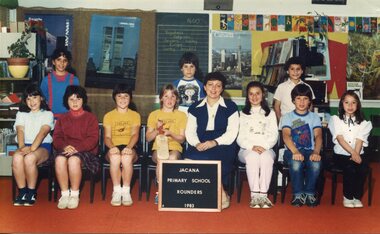
Photograph - Group Photograph, Jacana Primary School; Rounders, 1983, 1983
... Jacana Primary School, established in 1959 in Melbourne’s northern suburbs, was part of a post-war expansion of public education aimed at supporting families in rapidly growing suburban communities. ...Jacana Primary School, established in 1959 in Melbourne’s northern suburbs, was part of a post-war expansion of public education aimed at supporting families in rapidly growing suburban communities. ...Jacana Primary School, established in 1959 in Melbourne’s northern suburbs, was part of a post-war expansion of public education aimed at supporting families in rapidly growing suburban communities. By 1983, the school had become a well-established institution, known for its inclusive environment and strong community ties. Sport and physical education were central to student life at Jacana Primary, with games like rounders offering opportunities for teamwork, physical development, and social interaction. Rounders, a bat-and-ball game with similarities to baseball, was a popular playground and inter-school sport during the 1980s, especially among primary-aged students. The 1983 Rounders group photograph captures the spirit of school sport during this era—highlighting the importance of participation, camaraderie, and school pride. It also reflects broader trends in 1980s school life, including uniforms, hairstyles, and recreational activities. As Jacana Primary has since closed, this image serves as a valuable record of the school’s vibrant sporting culture and its role in shaping the everyday experiences of students in Melbourne’s north.The 1983 Rounders group photograph from Jacana Primary School is a culturally and historically significant artefact that captures the spirit of student life and sport during a formative period in the school’s history. Taken in the early 1980s, the image reflects the importance of physical education and recreational activities in fostering teamwork, resilience, and social connection among students. Rounders, a popular playground sport at the time, was emblematic of the informal yet meaningful ways children engaged with one another and built community within the school setting. The photograph also offers a visual snapshot of the era, showcasing the fashion, hairstyles, and outdoor culture of Australian primary schools in the 1980s. As Jacana Primary School has since closed, this image serves as a lasting tribute to the everyday experiences that shaped the lives of students and staff. It preserves the memory of a school that played a vital role in the social and educational development of children in Melbourne’s northern suburbs.A colour photograph on satin finish paper(Back blue label): PH-5388, (Back-stamp): Fujicolor /Paperjacana, jacana primary school, group photograph, team photograph, rounders, 1983
