
Showing 35 items matching "public transportation"
-
 Sunshine and District Historical Society Incorporated
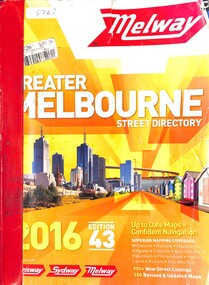
Book - Melway Greater Melbourne Street Directory 2016, Melway Publishing Pty Ltd, 2016
... ...public transportation...Past editions can provide invaluable material for researchers and historians. maps community services sporting clubs hospitals palces of worship public transportation The series of Melway Directories provides the most comprehensive maps of Great Melbourne area. ...The series of Melway Directories provides the most comprehensive maps of Great Melbourne area.Paper back booknon-fictionThe series of Melway Directories provides the most comprehensive maps of Great Melbourne area. maps, community services, sporting clubs, hospitals, palces of worship, public transportation -
 Sunshine and District Historical Society Incorporated
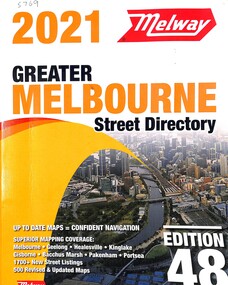
Book - Melway Greater Melbourne Street Directory 2021, Melway Publishing Pty Ltd, 2021
... ...public transportation...Past editions of the Melway can provide invaluable material for researchers and historians. maps public transportation community services educational facilities places of worship The series of Melway Directories provides the most comprehensive maps of Great Melbourne area. ...The series of Melway Directories provides the most comprehensive maps of Great Melbourne area.Paper back booknon-fictionThe series of Melway Directories provides the most comprehensive maps of Great Melbourne area. maps, public transportation, community services, educational facilities, places of worship -
 Sunshine and District Historical Society Incorporated
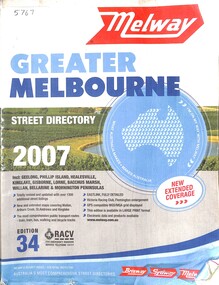
Book - Melway Greater Melbourne Street Directory 2007, Melway Publishing Pty Ltd, 2007
... ...public transportation...Past editions of the Melway can provide invaluable material for researchers and historians. maps community services educational facilities places of worship public transportation The series of Melway Directories provides the most comprehensive maps of Great Melbourne area. ...The series of Melway Directories provides the most comprehensive maps of Great Melbourne area.Paper back book with plastic jacketnon-fictionThe series of Melway Directories provides the most comprehensive maps of Great Melbourne area. maps, community services, educational facilities, places of worship, public transportation -
 Melbourne Tram Museum
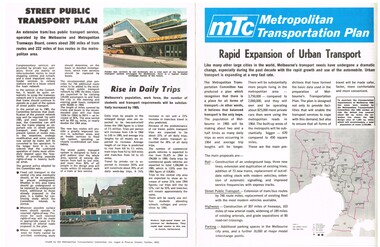
Pamphlet, The Metropolitan Transportation Committee, "Metropolitan Transportation Plan - Rapid Expansion of Urban Transport", c1968-69
... ... Public Transport... Transportation...Trams tramways Melbourne Road Transport Tramways Railways Public Transport Transportation Plan Pamphlet full colour, four pages, printed on off white paper titled "Metropolitan Transportation Plan - Rapid Expansion of Urban Transport", issued by the Metropolitan Transportation Committee, c1968 - 69, explaining the planning of the Committee for Melbourne's transport in 1985. ...Pamphlet full colour, four pages, printed on off white paper titled "Metropolitan Transportation Plan - Rapid Expansion of Urban Transport", issued by the Metropolitan Transportation Committee, c1968 - 69, explaining the planning of the Committee for Melbourne's transport in 1985. Looks at the future of Melbourne's rail, bus, tram and road network. Includes the survey and implementation. See Reg Item 623 for part of the final plan.trams, tramways, melbourne, road transport, tramways, railways, public transport, transportation plan -
 Melbourne Tram Museum
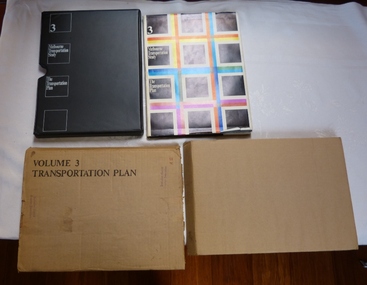
Document - Report, The Metropolitan Transportation Committee, "Melbourne Transportation Study - The Transportation Plan - Volume 3", 1969
... ... Public Transport... Transportation...Trams tramways Melbourne Road Transport Tramways Railways Public Transport Transportation Plan Has numerous AETA stamps throughout the book. ...Report titled "Melbourne Transportation Study - The Transportation Plan - Volume 3", presented in a black vinyl covered slip case, paper cover, bound, sewn with end papers, fold out maps, 74 pages. Each sheet within the report has rounded edges. Contained within a printed cardboard packing case. Includes many tables, graphs, charts and coloured sheets. Report prepared by The Metropolitan Transportation Committee - 1969, looking at the planning of all forms of transport for Melbourne with a timeframe of 1985. Chaired by Vernon Wilcox, Minister of Transport. Included Robert Risson - Chairman of MMTB. Set the basis for a very extensive freeway system that was only partly followed. Includes trams, trains (city loop), buses, parking, travel and population predictions, costs and implementation.Has numerous AETA stamps throughout the book. Inside front cover and on packing case "A12" in red ink.trams, tramways, melbourne, road transport, tramways, railways, public transport, transportation plan -
 City of Kingston
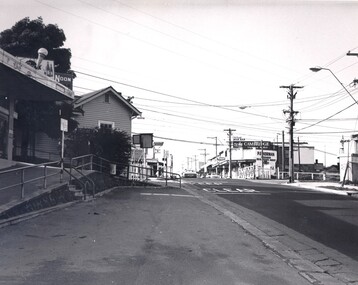
Photograph - Black and white, c. 1960
... One image from a collection of images produced by Public Transportation Corporation showing train stations and other public transport options around the (now) City of Kingston...One image from a collection of images produced by Public Transportation Corporation showing train stations and other public transport options around the (now) City of Kingston Highett Railway station Strip shopping Stamped in blue ink on reverse: COPYRIGHT / Public Transport Corporation / For re-ordering photographs / Please quote negative No H3986 / Enquiries C/- PTC Photographic Unit / Telephone switchboard 619 111 Black and white photograph of Highett railway station and nearby shops, Highett Road, Highett. ...One image from a collection of images produced by Public Transportation Corporation showing train stations and other public transport options around the (now) City of KingstonBlack and white photograph of Highett railway station and nearby shops, Highett Road, Highett.Stamped in blue ink on reverse: COPYRIGHT / Public Transport Corporation / For re-ordering photographs / Please quote negative No H3986 / Enquiries C/- PTC Photographic Unit / Telephone switchboard 619 111highett, railway station, strip shopping -
 Greensborough Historical Society
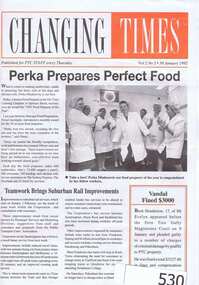
Newsletter, Changing Times. January 1992, 30/01/1992
... This is an issue of a weekly staff newspaper that was for employees of the Public Transportation Commission. It features an article on Theo Tzaros the then Watsonia Station Master who was a guest radio announcer on the Plenty Valley Community Radio station 3PVR....This is an issue of a weekly staff newspaper that was for employees of the Public Transportation Commission. It features an article on Theo Tzaros the then Watsonia Station Master who was a guest radio announcer on the Plenty Valley Community Radio station 3PVR. 3pvr plenty valley community radio watsonia station master watsonia railway station A black and white 8 page newsletter with orange highlighting. ...This is an issue of a weekly staff newspaper that was for employees of the Public Transportation Commission. It features an article on Theo Tzaros the then Watsonia Station Master who was a guest radio announcer on the Plenty Valley Community Radio station 3PVR.A black and white 8 page newsletter with orange highlighting.3pvr, plenty valley community radio, watsonia, station master, watsonia railway station -
 Melbourne Tram Museum
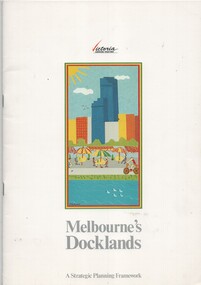
Document - Report, Ministry for Planning and Environment, "Melbourne's Docklands - A Strategic Planning Framework", 1989
... Has a good colour photograph of the area. Includes public transportation links using trams....Has a good colour photograph of the area. Includes public transportation links using trams. "Melbourne's Docklands - A Strategic Planning Framework" Document Report Ministry for Planning and Environment. ...Report - 32 A4 pages centre stapled colour printed on gloss paper, titled "Melbourne's Docklands - A Strategic Planning Framework", dated August 1989. Has a foreword by Tom Roper Minster for Planning and Environment. The report with a table of contents looks at the development of the Victoria Docklands area to the west of the railway yards. Has a good colour photograph of the area. Includes public transportation links using trams.trams, tramways, docklands, planning, melbourne, new track, public transport -
 Melbourne Tram Museum
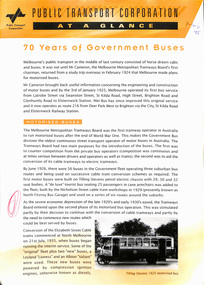
Pamphlet, Public Transport Corporation (PTC), "70 years of Government Buses", 1995
... Pamphlet - 4 A4 pages, full colour titled "70 years of Government Buses", part of a series, Public Transportation at a Glance. Notes the introduction of buses by the MMTB, Mr Cameron's 1924 trip, use of buses for conversion for the cable trams, types of buses used, double deck, Met Bus, PTC, MTA, AVM and services. ...Pamphlet - 4 A4 pages, full colour titled "70 years of Government Buses", part of a series, Public Transportation at a Glance. Notes the introduction of buses by the MMTB, Mr Cameron's 1924 trip, use of buses for conversion for the cable trams, types of buses used, double deck, Met Bus, PTC, MTA, AVM and services. ...Pamphlet - 4 A4 pages, full colour titled "70 years of Government Buses", part of a series, Public Transportation at a Glance. Notes the introduction of buses by the MMTB, Mr Cameron's 1924 trip, use of buses for conversion for the cable trams, types of buses used, double deck, Met Bus, PTC, MTA, AVM and services. Has photo of Tilling Stevens 1925 bus, MAN bus 1995.Has "May 95" in ink in top right hand corner.trams, tramways, buses, mmtb, double deck buses, conversion, ptc, mta, avm, met bus -
 Melbourne Tram Museum
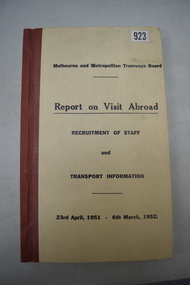
Document - Melbourne and Metropolitan Tramways Board - Report of Visit Abroad - Recruitment of Staff and Transport Information, 23rd April, 1951 - 6th March, 1952, Melbourne & Metropolitan Tramways Board (MMTB), c.1952
... The visit also collected information on operation details of public transportation in the visited locations, such as pay, amenities and facilities for employees, public relations, traffic operation, timetables, and rolling stock....The visit also collected information on operation details of public transportation in the visited locations, such as pay, amenities and facilities for employees, public relations, traffic operation, timetables, and rolling stock. ...Report from the Melbourne and Metropolitan Tramways Board (MMTB) on a visit to Great Britain (Manchester, Blackpool, Glasgow, London) and North America (New York, Toronto) to recruit single men for employment at the MMTB, in light of labour shortages. The visit also collected information on operation details of public transportation in the visited locations, such as pay, amenities and facilities for employees, public relations, traffic operation, timetables, and rolling stock.A document that detailed operations of public transport agencies in the UK, US and Canada from an Australian perspective during the 1950s.Report of Visit Abroad - Recruitment of Staff and Transport Information, 23rd April, 1951 - 6th March, 1952public transport, tramways, mmtb, employment, overseas tours, recruitment -
 Ringwood and District Historical Society
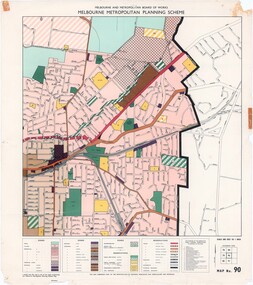
Map - Melbourne Metropolitan Planning Scheme, Municipality of Ringwood area - circa 1970
... Colour-coded map marking proposed and existing business, industrial, transportation, public reservation, etc. planning zones within the City of Ringwood. ...Colour-coded map marking proposed and existing business, industrial, transportation, public reservation, etc. planning zones within the City of Ringwood. ...Colour-coded map marking proposed and existing business, industrial, transportation, public reservation, etc. planning zones within the City of Ringwood. Includes (undated) certification that this map is one of the maps constituting the Melbourne Metropolitan Planning Scheme Map.Scale: 800 feet to 1 inch. -
 The Beechworth Burke Museum
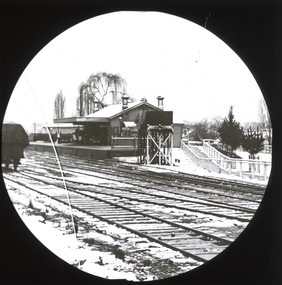
Photograph - Lantern Slide, c1900
... transportation running two trains a day and was a vital link to Melbourne from it's opening until it's closure in 1976. Lantern slides, sometimes called 'magic lantern' slides, are glass plates on which an image has been secured for the purpose of projection. Glass slides were etched or hand-painted for this purpose from the Eighteenth Century but the process became more popular and accessible to the public...transportation running two trains a day and was a vital link to Melbourne from it's opening until it's closure in 1976. Lantern slides, sometimes called 'magic lantern' slides, are glass plates on which an image has been secured for the purpose of projection. Glass slides were etched or hand-painted for this purpose from the Eighteenth Century but the process became more popular and accessible to the public ...This slide shows an image taken in c.1900 of the Beechworth Railway Station. The Beechworth Railway Station was officially opened on the 29 of September 1876, to allow for quicker and easier transportation of goods and supplies from Beechworth to Melbourne via Everton and Wangaratta. The railway station was heavily used for transportation running two trains a day and was a vital link to Melbourne from it's opening until it's closure in 1976. Lantern slides, sometimes called 'magic lantern' slides, are glass plates on which an image has been secured for the purpose of projection. Glass slides were etched or hand-painted for this purpose from the Eighteenth Century but the process became more popular and accessible to the public with the development of photographic-emulsion slides used with a 'Magic Lantern' device in the mid-Nineteenth Century. Photographic lantern slides comprise a double-negative emulsion layer (forming a positive image) between thin glass plates that are bound together. A number of processes existed to form and bind the emulsion layer to the base plate, including the albumen, wet plate collodion, gelatine dry plate and Woodburytype techniques. Lantern slides and magic lantern technologies are seen as foundational precursors to the development of modern photography and film-making techniquesThis glass slide is significant because it provides insight into Beechworth's social amenities and religious infrastructure in the late Nineteenth Century. It is also an example of an early photographic and film-making technology in use in regional Victoria in the time period.Thin translucent sheet of glass with a circular image printed on the front and framed in a black backing. It is held together by metals strips to secure the edges of the slide.burke museum, beechworth, lantern slide, slide, glass slide, plate, burke museum collection, photograph, monochrome, beechworth railway station, railway station, transport, railway history, railway -
 The Beechworth Burke Museum
Photograph - Lantern Slide, c1900
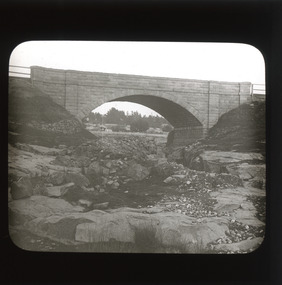
... transportation history of Australia. Lantern slides, sometimes called 'magic lantern' slides, are glass plates on which an image has been secured for the purpose of projection. Glass slides were etched or hand-painted for this purpose from the Eighteenth Century but the process became more popular and accessible to the public with the development of photographic-emulsion slides used with a 'Magic Lantern' device in the mid-Nineteenth Century. ...transportation history of Australia. Lantern slides, sometimes called 'magic lantern' slides, are glass plates on which an image has been secured for the purpose of projection. Glass slides were etched or hand-painted for this purpose from the Eighteenth Century but the process became more popular and accessible to the public with the development of photographic-emulsion slides used with a 'Magic Lantern' device in the mid-Nineteenth Century. ...Taken in c.1900 this image shows Newtown Bridge in Beechworth. Newtown Bridge is constructed with granite from the surrounding area and is a great example of the masonry work used in the construction of the town. This bridge has been listed by the National Trust as a significant object to the transportation history of Australia. Lantern slides, sometimes called 'magic lantern' slides, are glass plates on which an image has been secured for the purpose of projection. Glass slides were etched or hand-painted for this purpose from the Eighteenth Century but the process became more popular and accessible to the public with the development of photographic-emulsion slides used with a 'Magic Lantern' device in the mid-Nineteenth Century. Photographic lantern slides comprise a double-negative emulsion layer (forming a positive image) between thin glass plates that are bound together. A number of processes existed to form and bind the emulsion layer to the base plate, including the albumen, wet plate collodion, gelatine dry plate and Woodburytype techniques. Lantern slides and magic lantern technologies are seen as foundational precursors to the development of modern photography and film-making techniquesThis glass slide is significant because it provides insight into Beechworth's social amenities and religious infrastructure in the late Nineteenth Century. It is also an example of an early photographic and film-making technology in use in regional Victoria in the time period.Thin translucent sheet of glass with a square image printed on the front and framed in a black backing. It is held together by metals strips to secure the edges of the slide.burke museum, beechworth, lantern slide, slide, glass slide, plate, burke museum collection, photograph, monochrome, newtown bridge, masonry, transport, bridge, granite -
 The Beechworth Burke Museum
Photograph, Unknown c.1930s
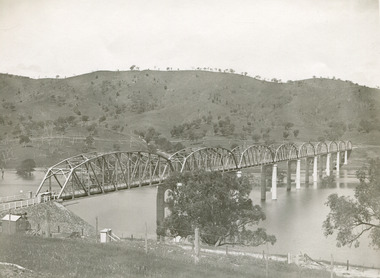
... Public Works were responsible for the construction works for the Hume Weir under the River Murray Waters Agreement. It is apparent that a similar joint arrangement was made for the construction of the Bethanga Bridge as part of the Hume Weir works. This photograph of the Bethanga Bridge is of historical significance as it showcases the architectural skills of Percy Allen and Vincent Packer. Additionally, it reveals the environmental landscape of the 1920s-1930s, is linked to the Hume Dam and both New South Wales and Victorian heritage. Bethanga Bethanga Bridge Hume Dam Pratt Truss Murray River Hume Weir Transportation ...This image shows Bethanga Bridge, which was constructed between 1927 and 1930 in Albury, NSW. The bridge was a necessity due to the building of the Hume Dam (Wier), 1919-1936. Bethanga Bridge is a long, nine-span, riveted-steel, variable depth, Pratt Truss road bridge of nine principal spans of 82 metres and a total length of 752 metres over the flooded valley of the Murray River, now part of Hume Reservoir. Because of its unique location, over the waters of a dam with the border running down the centre of the body of water, the Bethanga bridge is the only built structure shared by both New South Wales and Victoria. It was built 1.6 kilometres upstream of the dam and in 1961 was raised 300mm, with a concrete deck replacing the original wooden deck. The State Rivers and Water Supply Commission of Victoria and the New South Wales Department of Public Works were responsible for the construction works for the Hume Weir under the River Murray Waters Agreement. It is apparent that a similar joint arrangement was made for the construction of the Bethanga Bridge as part of the Hume Weir works.This photograph of the Bethanga Bridge is of historical significance as it showcases the architectural skills of Percy Allen and Vincent Packer. Additionally, it reveals the environmental landscape of the 1920s-1930s, is linked to the Hume Dam and both New South Wales and Victorian heritage. Unmounted black and white rectangular photograph. Reverse: 1997.3196 84-20-3bethanga, bethanga bridge, hume dam, pratt truss, murray river, hume weir, transportation -
 Flagstaff Hill Maritime Museum and Village
Ceramic - Soap dish, circa 1883
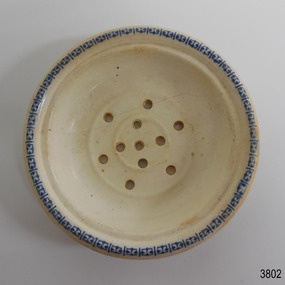
... transportation between colonial towns. Divers can still access parts of the scattered wreck and other artefacts recovered in the 1970s and 1980s can be viewed in both public and private collections. flagstaff hill warrnambool flagstaff hill maritime museum maritime museum shipwreck coast flagstaff hill maritime village great ocean road john chance west coast trader george roper captain john ward russell stourbridge bricks port phillip heads lonsdale reef dive wreck vhr s286 coastal trader ceramic vintage personal hygiene bathroom accessory soap dish Soap dish; glazed white porcelain. ...This ceramic soap dish was recovered from the wreck of the 1882-1883 George Roper between the late 1960’s to early 1970’s. It is one of the shipwreck artefacts in the John Chance Collection. Soap dishes were often part of a wash set that also included a water jug and wash bowl. The holes in the dish allowed water to drain out of the dish, keeping the soap dry for next use. The GEORGE ROPER 1882 - 1883 - The George Roper was a 4-masted iron sailing ship built in Liverpool, England, in 1882 for fast international trade with Australia. The large vessel was launched in February 1883. The ship was on its first trip, departing Liverpool for Melbourne, captained by John Ward and a crew of 31. She had almost reached her destination on July 4 1883, approaching Port Phillip Bay and being towed by the steam tug William. The weather changed to rough with fog and both the George Roper and the William hit the dangerous Lonsdale Reef at Port Phillip Heads. The Captain and crew were eventually rescued and taken to Queenscliff. Salvage syndicates were able to recover a lot of the cargo before the George Roper broke up and sank. Amongst the cargo was soft goods, draperies, household items, spirits of malt and distilled liquors, chemicals, dynamite, and 1,400 tons of steel rails for the Victorian Government. Also in the hold were Russell Stourbridge bricks, as paying ballast. This 1880s soap dish is an example of personal hygiene accessories and may have been part of a set comprising jug, bowl and dish.. The soap dish is also significant as it was recovered by John Chance, a diver from the wreck of the George Roper in the 1960s-70s. Items that come from several wrecks along Victoria's coast have since been donated to the Flagstaff Hill Maritime Village’s museum collection by his family, illustrating this item’s level of historical value. The soap dish is significant for its association with the barque George Roper, which is considered historically and archaeologically significant and as such, is listed on the Victorian Heritage Database, VHR S286. The George Roper is an example of a vessel built specifically for fast travel to and from Australia with a large shipment of cargo. Its cargo of steel rails adds to the historical significance of international trade to the growing colony of Australia and Victoria in particular, with rail transportation soon to become a faster and safer form of transportation between colonial towns. Divers can still access parts of the scattered wreck and other artefacts recovered in the 1970s and 1980s can be viewed in both public and private collections. Soap dish; glazed white porcelain. Round shallow bowl with blue patterned border, resembling butterflies. Two raised, concentric rings are moulded into the base. Six pierced holes are evenly spaced between the rings, five holes are in the centre of the dish.flagstaff hill, warrnambool, flagstaff hill maritime museum, maritime museum, shipwreck coast, flagstaff hill maritime village, great ocean road, john chance, west coast trader, george roper, captain john ward, russell stourbridge bricks, port phillip heads, lonsdale reef, dive wreck, vhr s286, coastal trader, ceramic, vintage, personal hygiene, bathroom accessory, soap dish -
 Flagstaff Hill Maritime Museum and Village
Ceramic - Cover, circa 1883
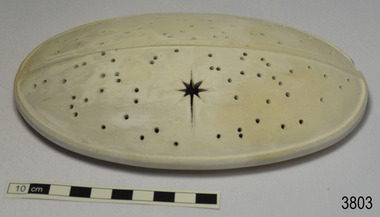
... transportation between colonial towns. Divers can still access parts of the scattered wreck and other artefacts recovered in the 1970s and 1980s can be viewed in both public and private collections. flagstaff hill warrnambool flagstaff hill maritime museum maritime museum shipwreck coast flagstaff hill maritime village great ocean road john chance west coast trader george roper w. h. potter & sons w.t. dickson and son captain john ward russell stourbridge bricks port phillip heads lonsdale reef dive wreck vhr s286 coastal trader ceramic vintage ventilated cover domestic item Cover; unglazed white ceramic, oval shape. ...This ceramic cover was recovered from the wreck of the 1882-1883 George Roper between the late 1960’s to early 1970’s. It is one of the shipwreck artefacts in the John Chance Collection. The purpose of the cover is unclear. The holes could be for ventilation. The cover may have been used to protect food or keep it at an even temperature. It may also have been used for covering fragrant petals, allowing some scent to escape through the holes. The residue around the underside of the holes and their random placement indicate that the cover could be partially handmade. The discolouration could have come from its time in the sea. The GEORGE ROPER 1882 - 1883 - The George Roper was a 4-masted iron sailing ship built in Liverpool, England, in 1882 for fast international trade with Australia. The large vessel was launched in February 1883. The ship was on its first trip, departing Liverpool for Melbourne, captained by John Ward and a crew of 31. She had almost reached her destination on July 4 1883, approaching Port Phillip Bay and being towed by the steam tug William. The weather changed to rough with fog and both the George Roper and the William hit the dangerous Lonsdale Reef at Port Phillip Heads. The Captain and crew were eventually rescued and taken to Queenscliff. Salvage syndicates were able to recover a lot of the cargo before the George Roper broke up and sank. Amongst the cargo was soft goods, draperies, household items, spirits of malt and distilled liquors, chemicals, dynamite, and 1,400 tons of steel rails for the Victorian Government. Also in the hold were Russell Stourbridge bricks, as paying ballast. The ventilated cover is as an example of domestic ceramic ware of the 1880s. The cover also holds significance as it was recovered by John Chance, a diver from the wreck of the George Groper in the 1960s-70s. Items that come from several wrecks along Victoria's coast have since been donated to the Flagstaff Hill Maritime Village’s museum collection by his family, illustrating this item’s level of historical value. The George Roper is considered historically and archaeologically significant and as such, is listed on the Victorian Heritage Database, VHR S286. It is an example of a vessel built specifically for fast travel to and from Australia with a large shipment of cargo. The George Roper’s cargo of steel rails adds to the historical significance of international trade to the growing colony of Australia and Victoria in particular, with rail transportation soon to become a faster and safer form of transportation between colonial towns. Divers can still access parts of the scattered wreck and other artefacts recovered in the 1970s and 1980s can be viewed in both public and private collections. Cover; unglazed white ceramic, oval shape. The cover has holes randomly poked through its surface, one large hole is a six pointed star shape. Underneath there is a narrow rim placed slightly inside the edge. There is residue on the underneath around the holes. There is orange-brown discolouration and areas where the surface is lighter coloured. flagstaff hill, warrnambool, flagstaff hill maritime museum, maritime museum, shipwreck coast, flagstaff hill maritime village, great ocean road, john chance, west coast trader, george roper, w. h. potter & sons, w.t. dickson and son, captain john ward, russell stourbridge bricks, port phillip heads, lonsdale reef, dive wreck, vhr s286, coastal trader, ceramic, vintage, ventilated cover, domestic item -
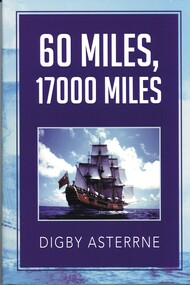 Bendigo Historical Society Inc.
Book - 60 MILES, 17000 MILES
... The book covers the history of mainly Great Britain from 1700 through to the 1850 period & the transportation of the general public to America and Australia....The book covers the history of mainly Great Britain from 1700 through to the 1850 period & the transportation of the general public to America and Australia. ...60 Miles, 17000 Miles a hard cover book with dust jacket 93 pages with black and white illustrations. The book covers the history of mainly Great Britain from 1700 through to the 1850 period & the transportation of the general public to America and Australia.Digby Asterrnevictoria, history, goldfields, great britain-victoria-gold discovery -
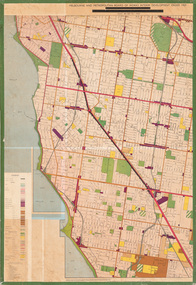 Bayside Gallery - Bayside City Council Art & Heritage Collection
Map - print, Melbourne and Metropolitan Board of Works, Interim development order: Brighton, Moorabbin and Sandringham, 1959
... The coloured map shows planning and municipal boundaries, rural, village and residential zones, businesses, industry, transportation. It also shows open spaces, public purposes (eg, hospitals, schools, local government), railways, roads, cemeteries and waterways....The coloured map shows planning and municipal boundaries, rural, village and residential zones, businesses, industry, transportation. It also shows open spaces, public purposes (eg, hospitals, schools, local government), railways, roads, cemeteries and waterways. ...The Melbourne and Metropolitan Board of Works (now Melbourne Water) was established in 1891. From that time, as part of their work laying water and sewerage connections, they created detailed plans of houses and other buildings in the Melbourne metropolitan area. In 1956 it acquired powers to construct and maintain highways and bridges, protect and improve the foreshores and create and maintain parks within the metropolitan region. This Interim development order comprises part of the municipalities of Brighton, Moorabbin and Sandringham and was made on 20 October 1959.brighton, moorabbin, sandringham, melbourne and metropolitan board of works, map, town planning, cartographic material, interim development order, bayside -
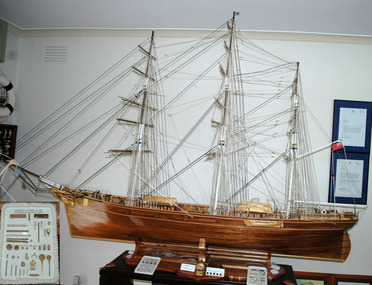 Plutarch Project
English wooden ship model, Cutty Sark replica, circa 1997
... public viewing. Of course, the “Cutty Sark” was not the only tea clipper constructed and owned by the Jock Willis Corporation, as there were others who were also used for the transportation of tea from China to Great Britain. ...public viewing. Of course, the “Cutty Sark” was not the only tea clipper constructed and owned by the Jock Willis Corporation, as there were others who were also used for the transportation of tea from China to Great Britain. ...This replica ship was modelled to exact scale by Denis Paraskevatos with the original basic kit enhanced by a large number of brass and mahogany wooden parts used and showing on two labels positioned at the base of the model. These replica parts were specifically designed and constructed by D. Paraskevatos with the help of his family. This model along a large number of others have been displayed at the Victorian Parliament for ten days from the 18th March 2002 (Queens Hall) to the 28th March 2002, and the Melbourne Town Hall from 19th to 27th August 2004. The history of the 65 meter British vessel named Cutty Sark is as follows: THE CUTTY SARK (history) The “Cutty Sark” was a British clipper ship, aptly named of course as a [clipper for its speed ], which was built in 1869 on the [river Clyde in Scotland ] by the Jock Willis Shipping Corporation. It was primarily used to transport tea from China to Great Britain, as well to a lesser extent later in its life, wool from Australia; however, with the advent of the steam engines and the creation also of the Suez Canal in 1869, its days of operation as a sailing vessel were numbered, as the steam ships were now prevailing as technologically advanced cargo carriers through the shorter route by the Suez Canal to China. In fact, within a few years of its operation, as its delegation in the tea industry was declining, it was assigned primarily the duty of transporting wool from Australia to England, but this activity was thwarted again by the steam ships, as they were enabled by their technologies to travel faster to Australia. Eventually, the “Cutty Sark” in 1895 was sold to a Portuguese company called “Ferreira and Co.”, where it continued to operate as a cargo ship until 1922, when it was purchased on that year by the retired sea captain Wilfred Dowman, who used it as a training ship in the town of Falmouth in Cornwall. After his death, the ship was conferred as a gesture of good will to the “Thames Nautical Training College” in Greenhithe in 1938, where it became an auxiliary cadet training ship, outliving its usefulness as a training vessel by 1954, and permanently [being dry docked in Greenwich, London, ] for public viewing. Of course, the “Cutty Sark” was not the only tea clipper constructed and owned by the Jock Willis Corporation, as there were others who were also used for the transportation of tea from China to Great Britain. Noteworthy additionally in its impressive resume is the fact that, the “Cutty Sark” was not only valued and admired for its speed, but also for its prestige that it afforded to its owners, [as media coverage was insatiable during a tea race that was regarded a national sporting event, with fiscal bets being placed on a predicted winning ship ]. Disappointingly, even though the English tea clippers were the best in the world at the time in terms of marine design, they had never won a tea race, and Jock Willis was certainly determined to achieve this goal, as the American clippers were considered the fastest in the tea trade. Nonetheless, the British clippers were proven to be formidable opponents to their American counterparts in the tea trade, when in 1868 a British tea clipper called [“Thermopylae”, managed to travel from the port of London to Melbourne, in only sixty one (61) days, which Jock Willis was hoping to improve on such a feat with the “Cutty Sark” ] . Remarkably, the maximum speed that the “Cutty Sark” could achieve was 17.5 knots in spite of the challenges of the unpredictable winds, if any at times, and the high seas or ferocious storms. Interestingly, [the “Cutty Sark’s” greatest recorded achievement in distance in twenty four (24) hours was three hundred and sixty three (363) nautical miles ], which meant that it was averaging approximately fifteen (15) knots; much faster obviously than the recorded twenty four (24) hour distance of the “Thermopylae” which had accomplished three hundred and fifty (358) nautical miles. .... ______________ -*- Please read the complete history of the Cutty Sark vessel by Maria Paraskevatos in one of the attachments provided with this exhibit. This model along with a large number of others was constructed by the Master craftsman Denis Paraskevatos, in Melbourne and has a historic, artistic significance because of the time and artist efforts in construction.The English Cutty Sark replica model is a wooden replica scaled at 1:25. The wood is mahogany and it is normally displayed in a glass covered enclosure. It has three masts and it is the largest vessel of Denis Paraskevatos collectionCUTTY SARK LONDONreplica, ship, art, model, cutty, sark, greek, artist, paraskevatos, παρασκευάτος, πανομοιότυπο -
 Melbourne Tram Museum
Document - Report, Melbourne & Metropolitan Tramways Board (MMTB), "Passenger movements by public transport for the Central city Business area based on results of the 1964 Melbourne Metropolitan Transportation Study, Nov. 1965
... "Passenger movements by public transport for the Central city Business area based on results of the 1964 Melbourne Metropolitan Transportation Study....Report - Foolscap landscape format, red tape binding - approx. 80 pages with notes, diagrams, charts, maps showing passenger traffic for parts of each route, including Railway Stations, passenger flows, titled "Passenger movements by public transport for the Central city Business area based on results of the 1964 Melbourne Metropolitan Transportation Study...."Passenger movements by public transport for the Central city Business area based on results of the 1964 Melbourne Metropolitan Transportation Study. ...Report - Foolscap landscape format, red tape binding - approx. 80 pages with notes, diagrams, charts, maps showing passenger traffic for parts of each route, including Railway Stations, passenger flows, titled "Passenger movements by public transport for the Central city Business area based on results of the 1964 Melbourne Metropolitan Transportation Study.In top right hand corner "Lees" in inktrams, tramways, mmtb, tramways, melbourne, surveys, passengers, railways, maps -
 Phillip Island Conservation Society Inc.
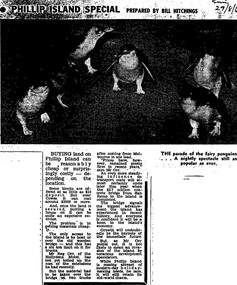
Work on paper - Photocopy of newspaper cutting, Melbourne Sun newspaper, "PHILLIP ISLAND SPECIAL PREPARED BY BILL HITCHINGS", 29.08.1969
... public in Melbourne. The significance of the new Phillip Island bridge to Phillip Islanders and visitors, and the cost of the bridge, are also outlined. Reg Orr was highly active in the business community of that era on Phillip Island. The Hollydene motel was a well-known Phillip Island accommodation venue. Phillip Island Phillip Island tourism Development Hollydene motel Reg Orr Phillip Island Penguin Parade Land values Phillip Island first bridge Phillip Island 2nd bridge Transportation ...This article by journalist Bill Hitchings describes the state of the land market and cost of transporting building materials, Phillip Island, late 1960s. At that stage a number of outlying residential estates had been created, especially on Phillip Island South Coast and at Cowes West. While blocks of land on the outlier estates were very cheap and poorly serviced, the Cowes blocks were selling at $3000 per residential block. Hitchings quotes the owner of the Hollydene motel, Reg Orr, as saying that when the new bridge opens shortly he did not expect it to create a rush of visitors or residents.Bill Hitching was a well-known Melbourne journalist. This article gives an idea of land values on Phillip Island in the late 1960s, the fact that business owners were prepared to upgrade and expand their businesses to cater for extra potential demand on accommodation, and the strong identification of Phillip Island with the Phillip Island Penguin Parade in the minds of the general public in Melbourne. The significance of the new Phillip Island bridge to Phillip Islanders and visitors, and the cost of the bridge, are also outlined. Reg Orr was highly active in the business community of that era on Phillip Island. The Hollydene motel was a well-known Phillip Island accommodation venue.T-shaped article cutting with large image at top of article, dark due to poor photcopy. Double collumn text under photo clearly readable. Black and white.Sun/29/8/6 (?) Probably: Melbourne Sun newspaper, 29 August, 1969phillip island, phillip island tourism, development, hollydene motel, reg orr, phillip island penguin parade, land values, phillip island first bridge, phillip island 2nd bridge, transportation costs -
 Ballarat Heritage Services
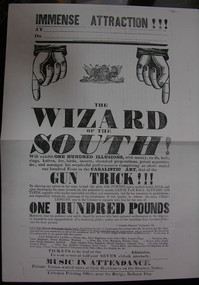
Photograph - Poster, Wizard of the South, October 1855
... transportation for seven years. He sailed to Australia on vessel 'Asia'. The register and conduct record noted that Amott was a Protestant, married, 5’11” tall with a mole on his neck , well behaved in both the Hulks and on the ship. The only disciplinary action noted in his conduct record was a fairly lenient two hours in public...transportation for seven years. He sailed to Australia on vessel 'Asia'. The register and conduct record noted that Amott was a Protestant, married, 5’11” tall with a mole on his neck , well behaved in both the Hulks and on the ship. The only disciplinary action noted in his conduct record was a fairly lenient two hours in public ...Thomas Arnott (Also known as Thomas Amott and Monsieur Du Pree) was the Wizard of the South who performed in Ballarat in 1855. A convict who served in Tasmania, he was a magician performing one of the earliest known magic shows in Australia. Thomas Amott was found guilty of grand larceny, and sentenced to transportation for seven years. He sailed to Australia on vessel 'Asia'. The register and conduct record noted that Amott was a Protestant, married, 5’11” tall with a mole on his neck , well behaved in both the Hulks and on the ship. The only disciplinary action noted in his conduct record was a fairly lenient two hours in public stocks for insolence to his assigned master in Hobart. The 'Asia' sailed from Portsmouth on 17 August 1827 and arrived at Van Diemen’s Land (Tasmania) on 07 December, offloading 198 convicts. Amott was assigned to work as a compositor in Hobart for James Ross, a Scottish free immigrant to Van Diemen’s Land in 1822. In April 1833 Amott was granted a ticket of leave, giving him increased freedom of movement in the colony prior to his being granted final Certificate of Freedom at the end of May 1834. He re-married at the Holy Trinity Church Hobart on 02 December 1833. Permission had been sought back in 1830 to marry Catherine (or Caroline) Fitzallen, a convict whose ticket-of-leave was granted in 1831. (This record draws on the research of Mary Christine Patterson)Copy of an entertainment poster and Licence to hold Theatrical Entertainments. wizard of the south, thomas arnott, thomas amott, monsieur du pree, entertainment -
 Unions Ballarat
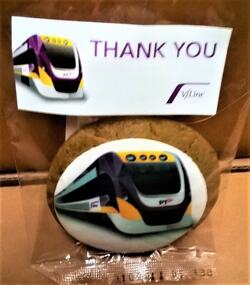
V/Line - thank you cookie, 2018
... Workplace issues and provision of consumer services (public transportation). btlc ballarat trades and labour council ballarat trades hall rtbu rail, tram and bus union v/line public transport victoria locomotives - Vlocity trains customer service Wrapper: nutritional information; manufacturer details; ingredients; "Thank You - V/Line"; use by date - 28/11/2018. ...The cookies were distributed to V/Line customers in 2018 as a placatory measure during an extended period of service disruption.Workplace issues and provision of consumer services (public transportation).Cookie: white icing with colour pictorial representation of V/Line VLocity train; sealed within a cellophane wrapper.Wrapper: nutritional information; manufacturer details; ingredients; "Thank You - V/Line"; use by date - 28/11/2018.btlc, ballarat trades and labour council, ballarat trades hall, rtbu, rail, tram and bus union, v/line, public transport victoria, locomotives - vlocity trains, customer service -
 Unions Ballarat
The Phoenix Foundry : Locomotive builders of Ballarat, Butrims, Robert et al, 2013
... Relevant to the history of public transportation, social customs and manufacturing in Ballarat and Victoria. btlc ballarat trades hall ballarat trades and labour council phoenix foundry manufacturing public transport locomotives trains mining - equipment employment Front cover: title and authors' names. ...The story of the Phoenix Foundry in Ballarat that commenced business in 1856 manufacturing mining machinery. The company started to make locomotives in 1870 but ceased business in 1905 when the Victorian Railways began to make their own trains.Relevant to the history of public transportation, social customs and manufacturing in Ballarat and Victoria.Paper; book. Front cover: red background; sepia picture of a locomotive with men and a child; Phoenix logo; white and black text.Front cover: title and authors' names.btlc, ballarat trades hall, ballarat trades and labour council, phoenix foundry, manufacturing, public transport, locomotives, trains, mining - equipment, employment -
 Melbourne Tram Museum
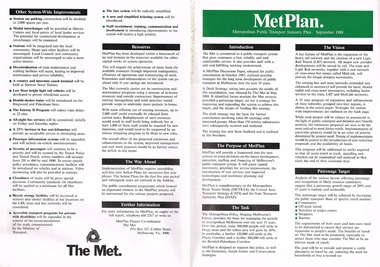
Pamphlet, The Met, "Met Plan", Sep. 1988
... Transportation... Met... Planning... Public...Trams tramways Melbourne Traffic Control Transportation Met Planning Public Transport Metplan Tramway Proposals Railways Folded A2 sheet to A4 size, full colour, printed both sides, titled "Met Plan" dated September 1988, detailing planning for Melbourne Public Transport, known as "MetPlan", prepared by The Met. ...Folded A2 sheet to A4 size, full colour, printed both sides, titled "Met Plan" dated September 1988, detailing planning for Melbourne Public Transport, known as "MetPlan", prepared by The Met. Shows the various proposals for railway upgrades, tram extensions, details the purpose, the Task, Vision, Patronage, Resources, system improvements. Has details of projects proposed for the Western, Northern, Eastern and South Regions. On the inside has a large map of Melbourne showing the various projects. 2nd copy added 23-10-2016trams, tramways, melbourne, traffic control, transportation, met, planning, public transport, metplan, tramway proposals, railways -
 Melbourne Tram Museum
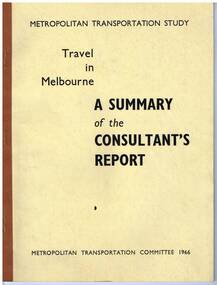
Document - Report, Metropolitan Transportation Committee, "Metropolitan Transportation Study - Travel in Melbourne, 1966
... Transportation Committee 1966". Provides a summary of the data provided by the traffic consultants - Wilbur Smith and Associates and Len T Frazer and Associates, late in 1963, looking a travel patterns in Melbourne. Includes public...Trams tramways Public Transport Road Transport Metropolitan Transport Committee Melbourne Report - 26 pages, stapled within textured card covers and cloth binding strip, titled "Metropolitan Transportation Study - Travel in Melbourne - A summary of the Consultants Report - Metropolitan Transportation Committee 1966". ...Report - 26 pages, stapled within textured card covers and cloth binding strip, titled "Metropolitan Transportation Study - Travel in Melbourne - A summary of the Consultants Report - Metropolitan Transportation Committee 1966". Provides a summary of the data provided by the traffic consultants - Wilbur Smith and Associates and Len T Frazer and Associates, late in 1963, looking a travel patterns in Melbourne. Includes public transport, goods movement, models economics, trip generation and general family stats. Has a table of contents and figures.trams, tramways, public transport, road transport, metropolitan transport committee, melbourne -
 Melbourne Tram Museum
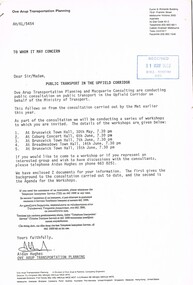
Document - Report, Ove Arup Transportation Planning, "Public Transport in the Upfield Corridor", May. 1989
... Consultative report - 8 A4 pages, stapled in the top right hand corner, titled "Public Transport in the Upfield Corridor". Prepared by Ove Arup Transportation Planning, dated May 1989. ..."Public Transport in the Upfield Corridor" Document Report Ove Arup Transportation Planning ...Consultative report - 8 A4 pages, stapled in the top right hand corner, titled "Public Transport in the Upfield Corridor". Prepared by Ove Arup Transportation Planning, dated May 1989. Provides an outline of the consultation process, dates, gives an outline of the options for the corridor, social costs, access to facilities, shoppers and business, costs and benefits. Two copies held. Second copy stamped 31/5/1989 -WMR Registry HDV.trams, tramways, upfield light rail, sydney rd, north coburg, conversion -
 Melbourne Tram Museum
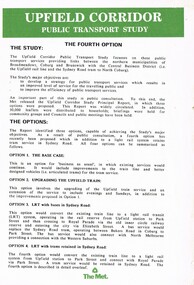
Pamphlet, The Met, "Upfield Corridor Public Transport Study", early 1989
... Public Transport Study", looking at a fourth option for the Upfield line. Lists the four options and gives details of the 4th option - retaining a tram services in Sydney Road between Bell Street and Park St during business hours. Notes the consultative period has been extended to June 1989, gives advice that Ove Arup Transportation...Public Transport Study", looking at a fourth option for the Upfield line. Lists the four options and gives details of the 4th option - retaining a tram services in Sydney Road between Bell Street and Park St during business hours. Notes the consultative period has been extended to June 1989, gives advice that Ove Arup Transportation ...Pamphlet - two A4 sheets - may not have been issued at the same time, titled "Upfield Corridor Public Transport Study", looking at a fourth option for the Upfield line. Lists the four options and gives details of the 4th option - retaining a tram services in Sydney Road between Bell Street and Park St during business hours. Notes the consultative period has been extended to June 1989, gives advice that Ove Arup Transportation Planning has been recently appointed, prior appoints and contact details.trams, tramways, upfield light rail, sydney rd, north coburg, conversion -
 Melbourne Tram Museum
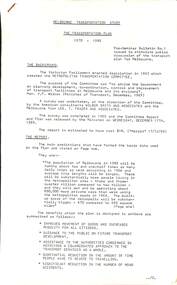
Document - Report, Australian Railway Union and others, "Melbourne Transportation Study - The Transportation Plan - 1970 to 1985", 1970
... Public Transport... History... MMTB... Transportation...Transportation Committee completed in 1969. Prepared by Australian Railways Union, Boilermakers and Blacksmiths Society, Tramway Employees' Association and the Amalgamated Engineering Union. .1 - Bulletin No. 1 - 18 white sheets duplicated - looks at the plan, results, services, motor vehicles and public transport. .2 - Bulletin No. 2 - 14 - yellow sheets duplicated - The Press and the Plan. .3 - Bulletin No. 3 - 10 pink sheets duplicated - The Underground loop - to be or not to be. .4 - Report on the Teach-in held on 15/5/1970 - 3 green sheets stapled - refers to the above documents and the 4th - The MMTB - its past and present - what of its future (that was in course of preparation)...Trams tramways Public Transport History MMTB Transportation Plan Unions Melbourne Railways A series of four reports regarding the implementation and work done by the Metropolitan Transportation Committee completed in 1969. ...A series of four reports regarding the implementation and work done by the Metropolitan Transportation Committee completed in 1969. Prepared by Australian Railways Union, Boilermakers and Blacksmiths Society, Tramway Employees' Association and the Amalgamated Engineering Union. .1 - Bulletin No. 1 - 18 white sheets duplicated - looks at the plan, results, services, motor vehicles and public transport. .2 - Bulletin No. 2 - 14 - yellow sheets duplicated - The Press and the Plan. .3 - Bulletin No. 3 - 10 pink sheets duplicated - The Underground loop - to be or not to be. .4 - Report on the Teach-in held on 15/5/1970 - 3 green sheets stapled - refers to the above documents and the 4th - The MMTB - its past and present - what of its future (that was in course of preparation)trams, tramways, public transport, history, mmtb, transportation plan, unions, melbourne, railways -
 Melbourne Tram Museum
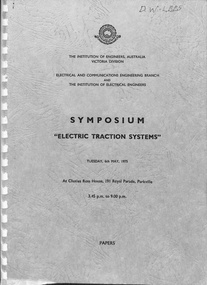
Document - Report, Engineers Australia, "Symposium 'Electric Traction Systems", May. 1975
... Transportation" - R. G. Chapman, SEC 2 - "Electric vehicles for Street Transport:" - F. D. Snell - MMTB 3 - "Electric Railways" - A. Firth - VR Paper 2 looks at the history of the MMTB system, the W class tram, control systems, lack of new trams in the 1960's, ordering of the Z class tram, its specification and manufacture, 980, 1041 and other forms of public transport on roads - trolley buses, gadgetbahns, and lots of possibilities of new systems including battery vehicles....Transportation" - R. G. Chapman, SEC 2 - "Electric vehicles for Street Transport:" - F. D. Snell - MMTB 3 - "Electric Railways" - A. Firth - VR Paper 2 looks at the history of the MMTB system, the W class tram, control systems, lack of new trams in the 1960's, ordering of the Z class tram, its specification and manufacture, 980, 1041 and other forms of public transport on roads - trolley buses, gadgetbahns, and lots of possibilities of new systems including battery vehicles. ...Report - approx. 55 A4 photocopied sheets - bound with white comb binding, with embossed leather imitation grey card covers, titled "Symposium 'Electric Traction Systems' ", presented by the Institution of Engineers Australia, Vic Div, Tues 6/5/1975. Contains three papers: 1 - "Electricity of Transportation" - R. G. Chapman, SEC 2 - "Electric vehicles for Street Transport:" - F. D. Snell - MMTB 3 - "Electric Railways" - A. Firth - VR Paper 2 looks at the history of the MMTB system, the W class tram, control systems, lack of new trams in the 1960's, ordering of the Z class tram, its specification and manufacture, 980, 1041 and other forms of public transport on roads - trolley buses, gadgetbahns, and lots of possibilities of new systems including battery vehicles.On rear in ink in top right hand corner "D. W. Lees"trams, tramways, reports, mmtb, tramcars, pcc class, z class, melbourne, history, trolley buses, electrical engineering, controllers
