
Showing 4 items matching "pully sheave"
-
 Flagstaff Hill Maritime Museum and Village
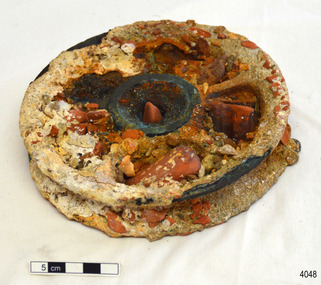
Functional object - Pulley Sheave, Russell & Co, 1888
... ...pully sheave...This ship's pully sheave was part of the Antares rigging. A pulley sheave is a circle on a shaft that is manufactured to hold up movement and change of way of a cable or/and rope, or transfer of power between the shaft and cable or/and rope. ...This ship's pully sheave was part of the Antares rigging. A pulley sheave is a circle on a shaft that is manufactured to hold up movement and change of way of a cable or/and rope, or transfer of power between the shaft and cable or/and rope. ...This ship's pully sheave was part of the Antares rigging. A pulley sheave is a circle on a shaft that is manufactured to hold up movement and change of way of a cable or/and rope, or transfer of power between the shaft and cable or/and rope. A pulley is a unique mechanism that is used to leverage the lifting of heavy loads to required heights. The Italian barque Antares was an iron three-masted sailing clipper built in 1888 by Russell & Co of Port Glasgow originally named the “Sutlej” and renamed in 1907 the “Antares” when sold to the Semider Bros of Genoa Italy. The vessel left Marseilles on the 18th of December 1913 with its master captain Gazedo destined for Mullaly & Byrne of Melbourne with a cargo of roofing tiles but failed to arrive. The wreckage was found near the Bay of Islands twenty-two miles east of Warrnambool after a body had washed ashore. Some of the timbers washed up were charred by fire, and a small boat's stern board with the name "Sutlej" led to the identification of the wreck as Antares which had been reported missing. According to later reports, the Antares wrecking was overshadowed by war news at the time. A young local boy had remarked that the Germans had arrived off the coast as he had seen them firing off shells and rockets, but his story was passed off as a joke. These rockets were most likely the distress signals from the stricken ship. The Italian barque/clipper Antares was sometime later reported as overdue. The wreck of the ship was later found at the base of a cliff at the Bay of Islands near Warrnambool in November 1914, there were no survivors.The Antares is significant as it was a sail trader carrying an international inbound cargo during the early part of the 20th century. It is part of the Great Ocean Road Historic Shipwreck Trail and as such is registered as a protected wreck in the Victorian Heritage Database VHS S34.Pulley sheave; brass, with recesses full of concretion. The metal has some blue-green colouration due to exposure to sea water. Recovered from the wreak of the Antares. Noneflagstaff hill, warrnambool, flagstaff-hill-maritime-museum, shipwreck-coast, flagstaff-hill-maritime-village, pulley sheave, antares, tall ship, peterborough, 1914 shipwreck, phillip le couteur, peter mathieson, constable stainsbury, sutlej, bay of islands, pully sheave, pulley, lifting equipment -
 Hand Tool Preservation Association of Australia Inc
Pully block
... pully block, single sheave...This item is part of the Thomas Caine Tool Collection, owned by The National Trust of Australia (Victoria) and curated by the Hand Tools Preservation Association of Australia. pully block, single sheave Pully block ...This item is part of the Thomas Caine Tool Collection, owned by The National Trust of Australia (Victoria) and curated by the Hand Tools Preservation Association of Australia.pully block, single sheave -
 Flagstaff Hill Maritime Museum and Village
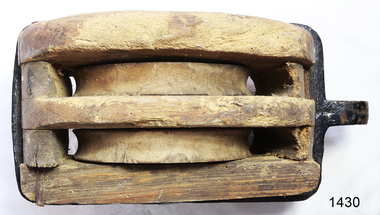
Equipment - Rope Block, Mid to Late 19th
... Wooden closed spelter double rope block with two pully's between sheaves, block has metal frame around outside of the sheaves and 4 metal pins, 2 each side of the frame at top and 2 at bottom, joining the sheaves together. ...It does however give an insight into a piece of sailing equipment that's design is still in use today on pleasure sailing craft. flagstaff hill warrnambool flagstaff hill maritime museum maritime museum shipwreck coast flagstaff hill maritime village great ocean road sailing ship pulley block sheave ship equipment Rope Block Sail Rigging None Wooden closed spelter double rope block with two pully's between sheaves, block has metal frame around outside of the sheaves and 4 metal pins, 2 each side of the frame at top and 2 at bottom, joining the sheaves together. ...A sailing block is single or multiple pulleys with one or more sheaves that are enclosed in an assembly between cheeks or chocks. In use, a block is fixed to the end of a line, to a spar, or a surface. A rope line is reeved through the sheaves, and maybe through one or more matching blocks at the far end, to make up what's known as a tackle. The purchase of a tackle refers to its mechanical advantage. In general, the more sheaves in the blocks that make up a tackle, the higher its mechanical advantage. The matter is slightly complicated by the fact that every tackle has a working end where the final run of rope leaves the last sheave. More mechanical advantage can be obtained if this end is attached to the moving load rather than the fixed end of the tackle. Various types of blocks are used in sailing. Some blocks are used to increase mechanical advantage and others are used simply to change the direction of a line. A ratchet block turns freely when a line is pulled in one direction but does not turn the other direction, although the line may slip past the sheave. This kind of block makes a loaded line easier to hold by hand, and is sometimes used on smaller boats for lines like main and jib sheets that are frequently adjusted. A single, large, sail-powered warship in the mid-19th century required more than 1,400 blocks of various kinds and sizes. An item from an old sailing vessel from the late 19th to early 20th century, unfortunately, the item cannot be identified as to what vessel it belonged to. It does however give an insight into a piece of sailing equipment that's design is still in use today on pleasure sailing craft. Wooden closed spelter double rope block with two pully's between sheaves, block has metal frame around outside of the sheaves and 4 metal pins, 2 each side of the frame at top and 2 at bottom, joining the sheaves together. The shaft between the sheaves is also wooden. Remnants of orange and black paint on outside of block. Shafts are chipped, wood has borer holes. (NOTE: Block was rediscovered after relocating objects to new storage area)Noneflagstaff hill, warrnambool, flagstaff hill maritime museum, maritime museum, shipwreck coast, flagstaff hill maritime village, great ocean road, sailing ship, pulley, block, sheave, ship equipment, rope block, sail rigging -
 Flagstaff Hill Maritime Museum and Village
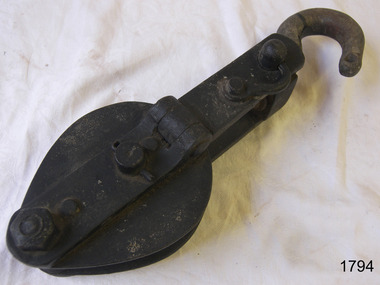
Equipment - Snatch Block, First quarter of the 20th century
... The subject item at this time cannot be associated with an historical event, person or place, provenance is unknown, item is believed to have been produced in the first quarter of the 20th century. flagstaff hill warrnambool flagstaff-hill-maritime-museum maritime-museum shipwreck-coast flagstaff-hill-maritime-village snatch block Metal Snatch Block Lifting Gear Rope Pully marine technology ship rigging Snatch block, metal, one sheave, with a large hook that has a hole drilled through its tip. ...A snatch block is a heavy-duty pulley inside a metal casing. It is primarily designed for handling heavy goods, working as a pulley point that can redirect the course of a winch line. Snatch blocks are also used to increase the lifting or pulling capacity of wire hoists and winches. There is no history or manufacturing provenance currently available.The subject item at this time cannot be associated with an historical event, person or place, provenance is unknown, item is believed to have been produced in the first quarter of the 20th century.Snatch block, metal, one sheave, with a large hook that has a hole drilled through its tip.flagstaff hill, warrnambool, flagstaff-hill-maritime-museum, maritime-museum, shipwreck-coast, flagstaff-hill-maritime-village, snatch block, metal snatch block, lifting gear, rope pully, marine technology, ship rigging
