
Showing 7 items matching "pulse systems"
-
 Moorabbin Air Museum
Book - Air navigation & radio, Radio Aids to Air Navigation
... ...Pulse systems...Air navigation & radio General principles Medium frequency systems MF aids VHF systems Hyperbolic aids Pulse systems Air traffic control aids Approach & landing aids Future aids Charts/documents/regulations Review of civil radio systems applied to aircraft & their ground contacts, circa 1956 Radio Aids to Air Navigation Book Air navigation & radio ...Review of civil radio systems applied to aircraft & their ground contacts, circa 1956non-fictionReview of civil radio systems applied to aircraft & their ground contacts, circa 1956general principles, medium frequency systems, mf aids, vhf systems, hyperbolic aids, pulse systems, air traffic control aids, approach & landing aids, future aids, charts/documents/regulations -
 Bendigo Military Museum
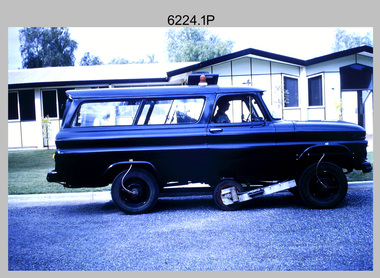
Photograph - Johnson Ground Elevation Meter (JGEM) Survey Vehicle - Army Survey Regiment, Fortuna, Bendigo, c1960s
... The wheel provided the velocity or distance signal through a pulse generator system. A sensitive pendulum mounted on this bar provided the angle measurement for each minute distance traversed. ...The wheel provided the velocity or distance signal through a pulse generator system. A sensitive pendulum mounted on this bar provided the angle measurement for each minute distance traversed. ...This is a set of 16 photograph of the Royal Australian Survey Corps’ Johnson Ground Elevation Meter (JGEM) Survey Vehicle taken at the Army Survey Regiment, Fortuna, Bendigo. The JGEM vehicle was extensively used by RA Svy within Australia from the late 1960s. A limited number of Ground Elevation Meter (GEM) station wagon type vehicles were manufactured by General Motors Corporation (GMC) in the USA for the United States Geological Survey, Canada’s mapping agencies, RA Svy and National Mapping (Natmap). The GEM was a four-wheel drive, four-wheel steer vehicle. Four-wheel steering was necessary to avoid systematic errors caused by non-tracking of front and rear wheels on conventionally steered vehicles. The manufacturer substituted the rear axle with a front axle and connected them to form the four-wheel steering mechanism. The two Australian GEM vehicles, referred to as Johnson GEMs (JGEMs) were converted into right-hand drive. After delivery in 1964, acceptance Natmap and RA Svy testing and operator training was undertaken at the Army's School of Military Survey located at Balcombe, Victoria. A small fifth wheel was mounted on a cantilever arm suspension midway between the front and rear wheels on the right side of the vehicle. It was lowered to and raised from its operating position by use of a constant pressure air cylinder. A telescopic bar, suspended between the front and rear axles, provided the reference datum for the angle measurement. The wheel provided the velocity or distance signal through a pulse generator system. A sensitive pendulum mounted on this bar provided the angle measurement for each minute distance traversed. The JGEM contained electromechanical instruments used to determine relative elevations, by trigonometric principles, along a traversed path. These relative elevations were obtained through apparatus which measures the instantaneous angle of inclination of the road and the instantaneous velocity of the meter along such a path. Road routes over which the JGEM operated were planned so that each started and ended as near as practicable to an existing point of known elevation (formally referred to as a level traverse bench mark). The difference in height from the bench mark and the road surface alongside the JGEM’s fifth wheel was measured with a level and staff. Along each route, mapping control photo reference points where new elevation values were required were identified on aerial photographs. Under favourable conditions it was possible to survey as much as 160km in an ordinary working day. The first of RA Svy’s JGEM operations was undertaken in 1:250,000 scale map areas of Queensland. CPL John Hook was the JGEM’s main operator in the early 1970s undertaking operations covering 1:250,000 scale map blocks over northern Victoria and central NSW, each requiring 36 points (9 runs of photography and 4 points across. SPR Lyn Thompson and SPR Bob McDonagh teamed with CPL Hook on some of these JGEM operations. When RA Svy was integrated into the Royal Australian Engineers in 1996, the JGEM vehicle with the Survey Corps collection was donated to its museum. It is believed to be the last of the original manufactured fleet in existence. The JGEM has undergone extensive refurbishment to achieve roadworthiness and is currently housed at The Australian Army Museum of Military Engineering, Hoslworthy Barracks, NSW. It can be viewed by making an appointment with the museum’s curator.This is a set of 16 photograph of the Royal Australian Survey Corps’ Johnson Ground Elevation Meter (JGEM) Survey Vehicle taken at the Army Survey Regiment, Fortuna, Bendigo. The photographs were on 35mm slide film and were scanned at 96 dpi. They are part of the Army Survey Regiment’s Collection. .1) - Photo, colour, c1960s, Johnson Ground Elevation Meter (JGEM) Survey Vehicle .2) - Photo, colour, c1960s, JGEM instrumentation, on-board computer. .3) - Photo, colour, c1960s, JGEM instrumentation. .4) - Photo, colour, c1960s, JGEM instrumentation, on-board computer. .5) - Photo, colour, c1960s, JGEM tyre pressure controller .6) - Photo, colour, c1960s, JGEM rear doors, SGT Geoff Briggs. .7) - Photo, colour, c1960s, JGEM 5th wheel distance/angle measurement device in lowered position, SGT Geoff Briggs. .8) - Photo, colour, c1960s, JGEM 5th wheel distance/angle measurement device in lowered position. .9) & .10) - Photo, colour, c1960s, JGEM tyre pressure system, SGT Geoff Briggs. .11) - Photo, colour, c1960s, JGEM tyre pressure system. SGT Geoff Briggs. .12) - Photo, colour, c1960s, JGEM levelling scope, levelling staff, unidentified technicians. .13) & .14) - Photo, colour, c1960s, JGEM levelling scope, unidentified technician. .15) & .16) - Photo, colour, c1960s, probably survey operation adjusted height plotted on block base sheet. .1P to .16P - Some of the equipment is annotated on the frame of the 35mm slides.royal australian survey corps, rasvy, army survey regiment, army svy regt, fortuna, asr, surveying -
 Kiewa Valley Historical Society
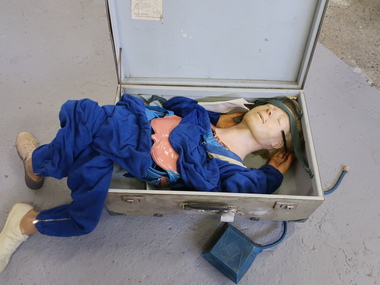
Resusci-Anne and Equipment
... Later the design was refined and included a simulated carotid pulse, eye pupils that could dilate and constrict and a system for recording the trainee's resuscitation performance on a paper tape. ...Later the design was refined and included a simulated carotid pulse, eye pupils that could dilate and constrict and a system for recording the trainee's resuscitation performance on a paper tape. ...Resusci Anne was used for teaching both emergency workers and members of the general public. Developed by Asmund S. Laerdal, Peter Safar, and James Elam and produced by the company Laerdal Medical.The first version of rescue Annie was presented by Laerdal in 1960. Later the design was refined and included a simulated carotid pulse, eye pupils that could dilate and constrict and a system for recording the trainee's resuscitation performance on a paper tape. Ref. WikipediaUsed in the Kiewa Valley by Educators of First Aid and emergency workersSee KVHS 0542 for Resusci-Anne Repair Kit Doll type model with face, arms and legs folded into a 1950s carrying case. The model has blue clothing. Enclosed are the instructions for packing the model and papers for treatment of an unconscious patient.resusci anne, first aid, emergency education -
 Kiewa Valley Historical Society
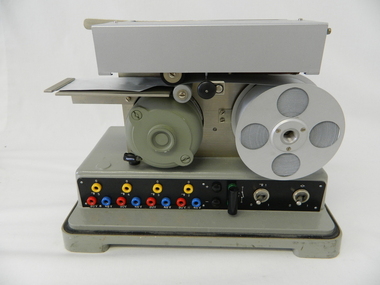
Timer Favag, Circa 1950
... This Favag Timer apparatus was a part of the first electronic control system -(1960's), in Victoria), which worked using telephone stepping selectors to convey a change in voltage providing a regulated pulse from the control centre(Mount Beauty) to the remote Power Stations opening and closing (stop/start) of various devices at the Power Station and a return signal confirmed the action taken. ...This Favag Timer apparatus was a part of the first electronic control system -(1960's), in Victoria), which worked using telephone stepping selectors to convey a change in voltage providing a regulated pulse from the control centre(Mount Beauty) to the remote Power Stations opening and closing (stop/start) of various devices at the Power Station and a return signal confirmed the action taken. ...This Favag Timer apparatus was a part of the first electronic control system -(1960's), in Victoria), which worked using telephone stepping selectors to convey a change in voltage providing a regulated pulse from the control centre(Mount Beauty) to the remote Power Stations opening and closing (stop/start) of various devices at the Power Station and a return signal confirmed the action taken. Testing of this unit was carried out using a "dummy" device at the remote Power Station so as not to disrupt the power plant's operation. This timer was one of many electrical apparatus connected to the large SEC Victoria Hydro Scheme's electrical power producing generators. These generators are powered by the hydro force of "stored" water at a higher altitude. The establishment of both the NSW and Victorian Hydro Schemes was achieved from the early 1900's to the 1960's. At this point in time the need for additional power sources to quench both an industrial and domestic demand for electricity was purely an economic and not and environmental (carbon reduction) factor. This hydro scheme was instigated by "the Government of the day" as a bold move and was the major force of the World War II refugee and "technical" workforce,inclusion of skilled and unskilled, migration into the Australian environment. Although this mass "invasion" of workers with families was thought of in some circles as intrusive, the expansion of population post war years and its integration into the Australian rural sector, produced the multi- lingual multi-cultural diversity of later years.This Favag Timer was one of the crucial pieces of equipment that made it possible for the Mount Beauty Terminal Station to control the operations of these Power Stations; McKay, Clover, West Kiewa Power Stations and the Dederang Terminal Station.This aluminium and anodised "FAVAG" (pulse) timer is fastened to a base structure which comes with its own metal cover that is fastened by two metal hooks. From the top of these hooks runs a thick leather "carry" strap.The instrument, itself, a small "micro motor" at one end tape feeding spool on the other. Aluminium metal structures offer a preventative barrier against any electronic spikes from static electricity sources. There are two toggle switches to the bottom right hand side and twelve coloured "pin" connection points.There is a sliding access sleeve which exposes a circuit board.with various leads fastened on each side. In front of one of this slide are two "screw in" fuses, spare fuses are in a small envelope taped above. Circuit diagrams are etched white on black background on the top face of the main structure. At the base of the back section is a two pronged input terminal. There is a fine black rubber layer (cushioning) for the mian top cover.On the cover fastened with two rivets "FAVAG" underneath in small print "Fabrique d'appareils electriques S.A." underneathe "NEUCHATEL-SUISSE". on one end is a "STATE ELECTRICITY COMMISSION OF VICTORIA" metal label screwed on.The back label has manufacturers' type and model number.sec vic kiewa hydro scheme, alternate energy supplies, alpine population growth -
 Bendigo Military Museum
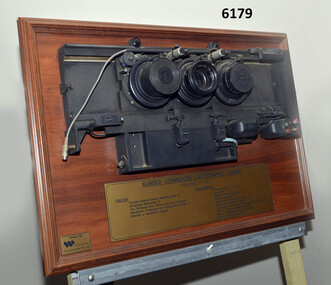
Plaque - Mounted Klimsch Commodore Cartographic Camera Lenses, WYCOMBE Constructions Pty Ltd, 1997
... Its characteristics were: Maximum Negative Size 1.27m sq, Copy Holder (Vacuum) 2m sq, Maximum Enlargement 400%, Maximum Reduction 13%, Automatic 60, 90 and 120cm Focal Length Lens, Transmission or Reflection Originals, Pulsed Xenon, Photo Flood or Fluorescent Tube Light Source, Maximum Reflection Original 1.3m x 1.85m, Maximum Transmission Original 1.3m x 1.85m, Exposure Light Monitoring System." ..."CHARACTERISTICS: Maximum Neg Size 1.27m sq, Copy Holder 2m sq, Maximum Enlargement 400%, Maximum Reduction 13%, Automatic 60, 90, 120cm Focal Length Lens, Transmission or Reflection Originals, Pulsed Xenon, Photo Flood or Fluorescent Tube Light Source, Maximum Reflection Original 1.3m x 1.85m, Maximum Transmission Original 1.3m x 1.85m, Exposure Light Monitoring System." ..."CHARACTERISTICS: Maximum Neg Size 1.27m sq, Copy Holder 2m sq, Maximum Enlargement 400%, Maximum Reduction 13%, Automatic 60, 90, 120cm Focal Length Lens, Transmission or Reflection Originals, Pulsed Xenon, Photo Flood or Fluorescent Tube Light Source, Maximum Reflection Original 1.3m x 1.85m, Maximum Transmission Original 1.3m x 1.85m, Exposure Light Monitoring System." ...These are the Lenses from the Klimsch Commodore Cartographic Camera that was located in Lithographic Squadron at the Army Survey Regiment, Fortuna, Bendigo. The KLIMSCH Commodore camera was originally introduced to the Survey Regiment in 1953 and was the largest in the Southern Hemisphere. It was replaced with a new model of the same size in 1977. These lenses are from this new model. The new model with its computer-based interface provided productivity gains with improved speed and its consistent results led to less wastage in time and materials. Its variomat lens system provided improved retention of map feature linear weights during the camera reduction process. The camera which was specially made for the Australian Army in Germany was fully automatic and power operated. It was claimed to be one of the biggest automatic cameras of its type in the world. It was made to the specifications of the Royal Australian Army Survey Corps to assist in the production of the very high standard maps for the Australian Army. THIS KLIMSCH COMMODORE CARTOGRAPHIC CAMERA was in operation 1977 - 1997". It was a Precision Darkroom Camera especially suited for Cartographic Reproduction of Line, Continous Tone, Halftone and Colour Separation. Reproduction of Negatives and Positives from a variety of Reflection or Transmission Originals. Its characteristics were: Maximum Negative Size 1.27m sq, Copy Holder (Vacuum) 2m sq, Maximum Enlargement 400%, Maximum Reduction 13%, Automatic 60, 90 and 120cm Focal Length Lens, Transmission or Reflection Originals, Pulsed Xenon, Photo Flood or Fluorescent Tube Light Source, Maximum Reflection Original 1.3m x 1.85m, Maximum Transmission Original 1.3m x 1.85m, Exposure Light Monitoring System." The camera was superseded by computerized image manipulation software associated with the Automap system. These significant and extremely high-quality Lenses were retrieved by WYCOMBE Constructions Pty Ltd during the demolishment of the camera in 1997 and then mounted on a display board. See also Item 6189.4P for more photographs of the camera.Lenses from the Klimsch Commodore Cartographic Camera mounted on a very heavy timber display board. The display board contains an engraved plate that describes the technical characteristics of the camera."KLIMSCH COMMODORE CARTOGRAPHIC CAMERA 1977 - 1997", "FUNCTION: Precision Darkroom Camera especially suited for Cartographic Reproduction of Line, Continous Tone, Halftone and Colour Separation. Reproduction of Negatives and Positives from a variety of Reflection or Transmission Originals." "CHARACTERISTICS: Maximum Neg Size 1.27m sq, Copy Holder 2m sq, Maximum Enlargement 400%, Maximum Reduction 13%, Automatic 60, 90, 120cm Focal Length Lens, Transmission or Reflection Originals, Pulsed Xenon, Photo Flood or Fluorescent Tube Light Source, Maximum Reflection Original 1.3m x 1.85m, Maximum Transmission Original 1.3m x 1.85m, Exposure Light Monitoring System." royal australian survey corps, rasvy, fortuna, army survey regiment, army svy regt, asr, litho -
 National Wool Museum
Machine - Morse Code Machine
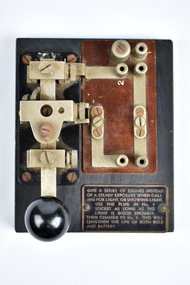
... Keys are used in all forms of electrical telegraph systems, including landline (also called wire) telegraphy and radio (also called wireless) telegraphy. An operator uses the telegraph key to send electrical pulses of two different lengths: short pulses, called dots or dits, and longer pulses, called dashes or dahs. ...Keys are used in all forms of electrical telegraph systems, including landline (also called wire) telegraphy and radio (also called wireless) telegraphy. An operator uses the telegraph key to send electrical pulses of two different lengths: short pulses, called dots or dits, and longer pulses, called dashes or dahs. ...A telegraph key or Morse key is a specialised electrical switch used by a trained operator to transmit text messages in Morse code in a telegraphy system. Keys are used in all forms of electrical telegraph systems, including landline (also called wire) telegraphy and radio (also called wireless) telegraphy. An operator uses the telegraph key to send electrical pulses of two different lengths: short pulses, called dots or dits, and longer pulses, called dashes or dahs. These pulses encode the letters and other characters that spell out the message.Metal device with black knob mounted on a wooden base. A plaque with printed text is also attached to the base.Printed: GIVE A SERIES OF DASHES INSTEAD / OF A STEADY EXPOSURE WHEN CALL- / ING FOR LIGHT, OR SHOWING LIGHT. / USE THE PLUG IN No. 1 / SOCKET AS LONG AS THE / LIGHT IS GOOD ENOUGH. / THEN CHANGE TO No. 2 THIS WILL / LENGTHEN THE LIFE OF BOTH BULB / AND BATTERY.morse code, communication, telegraph key, messages, pulses -
 Ballarat Tramway Museum
Newspaper, The Bulletin, "Revamping the old tram image", 29/04/1972 12:00:00 AM
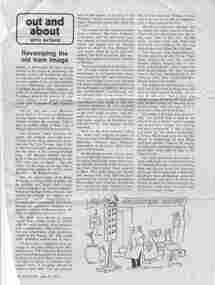
... system and the scene at the time in Bendigo upon closure. Title: Batman in The Bulletin: The Melbourne I Remember Author: Dunstan, Keith Publisher: Australian Scholarly Publishing ISBN-10: 1740970624 Year Published: 2004 Binding: Paperback For more than four decades his finger has been on the pulse of the city. ...system and the scene at the time in Bendigo upon closure. Title: Batman in The Bulletin: The Melbourne I Remember Author: Dunstan, Keith Publisher: Australian Scholarly Publishing ISBN-10: 1740970624 Year Published: 2004 Binding: Paperback For more than four decades his finger has been on the pulse of the city. ...Yields information about the a significant Australian author's (Batman in The Bulletin - Keith Dunstan) views on Melbourne's trams and the closure of Bendigo tramway system in 1972.Newspaper clipping from The Bulletin, April 29, 1972 in the 'out and about' column written by 'Batman', titled "Revamping the old tram image". Written by Keith Dunstan - see Other information below. Article concerns the romance of Melbourne's tramway system and its relationship to the closure of the Bendigo system and the scene at the time in Bendigo upon closure. Title: Batman in The Bulletin: The Melbourne I Remember Author: Dunstan, Keith Publisher: Australian Scholarly Publishing ISBN-10: 1740970624 Year Published: 2004 Binding: Paperback For more than four decades his finger has been on the pulse of the city. Whether the subject is royal tours, the passing of old ways, the destruction of our historic treasures, the splendour of Collins Street, the peculiarities of our politicians and leading citizens or the mad passion for sport; he knows about its foibles, its fads, fashions and fanaticisms. Best known as the founder of the Anti-Football League and as Melbourne's witty daily newspaper scribe Keith Dunstan wrote regularly for the legendary weekly news magazine The Bulletin from the early 1960s under the pseudonym of `Batman'. In an introduction specially written for this volume Keith tells the story of how his `moonlighting' efforts began and how he was found out. Includes a forward by Barry Humphries.closure, bendigo, melbourne
