Flagstaff Hill Maritime Museum and Village
Book - Literary Work, John Bunyan, The Pilgrims Progress, 1850
... Puritan lay preacher born in Elstow, Bedfordshire. Originally a tinsmith by trade, he experienced a profound spiritual awakening in his twenties. Following the restoration of the monarchy in 1660, non-conformist religious preaching outside the official Church of England was strictly outlawed.
...Puritan lay preacher born in Elstow, Bedfordshire. Originally a tinsmith by trade, he experienced a profound spiritual awakening in his twenties. Following the restoration of the monarchy in 1660, non-conformist religious preaching outside the official Church of England was strictly outlawed.
...
Written in 1678, The Pilgrim's Progress is a deeply influential Christian allegory that tracks the spiritual journey of a man named Christian.
Weighed down by a crushing burden on his back (representing his sins), Christian flees his home in the "City of Destruction", after reading a holy book. Guided by the evangelist Evangelist, he embarks on a perilous trek toward the Celestial City (Heaven). Along the way, his journey brings him face-to-face with a cast of characters who personify spiritual triumphs and trials, such as Faithful, Hopeful, Mr Worldly Wiseman, and Giant Despair. He must navigate legendary, treacherous obstacles like the Slough of Despond, the temptations of Vanity Fair, and a terrifying battle with the demon Apollyon.
The narrative is structured as a dream sequence experienced by the narrator. Because the second half follows Christian's wife, Christiana, and their children on the same path, it functions as both an adventure tale and a road map for the Puritan concept of salvation.
It should be noted that the 1850 George Virtue printing is a classic example of a mid-Victorian luxury reprint. It is highly notable because it was curated by the popular non-conformist minister and author Rev. Robert Philip.
The Pilgrims Progress
Author: John Bunyan
Curated By: Rev. Robert Philip
Publisher: George Virtue
Date: 1850
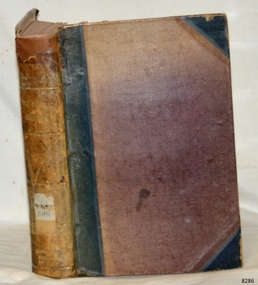
Further Information: Red hardcover with a red spine and reinforced corners, lettering in gilt. The spine has a Library label with an inscription.fictionWritten in 1678, The Pilgrim's Progress is a deeply influential Christian allegory that tracks the spiritual journey of a man named Christian.
Weighed down by a crushing burden on his back (representing his sins), Christian flees his home in the "City of Destruction", after reading a holy book. Guided by the evangelist Evangelist, he embarks on a perilous trek toward the Celestial City (Heaven). Along the way, his journey brings him face-to-face with a cast of characters who personify spiritual triumphs and trials, such as Faithful, Hopeful, Mr Worldly Wiseman, and Giant Despair. He must navigate legendary, treacherous obstacles like the Slough of Despond, the temptations of Vanity Fair, and a terrifying battle with the demon Apollyon.
The narrative is structured as a dream sequence experienced by the narrator. Because the second half follows Christian's wife, Christiana, and their children on the same path, it functions as both an adventure tale and a road map for the Puritan concept of salvation.
It should be noted that the 1850 George Virtue printing is a classic example of a mid-Victorian luxury reprint. It is highly notable because it was curated by the popular non-conformist minister and author Rev. Robert Philip. flagstaff hill, warrnambool, shipwrecked coast, flagstaff hill maritime museum, maritime museum, shipwreck coast, flagstaff hill maritime village, great ocean road, book, pattison collection, warrnambool library, warrnambool mechanics’ institute, ralph eric pattison, corangamite regional library service, warrnambool city librarian, mechanics’ institute library, victorian library board, warrnambool books and records, warrnambool children’s library, the pilgrims progress, john bunyan

 Mrs Aeneas Gunn Memorial Library
 Flagstaff Hill Maritime Museum and Village
 Warrnambool and District Historical Society Inc.