
Showing 29 items matching "pyjama"
-
 Hume City Civic Collection
Pyjama top, Inmates
... Pyjama top in unbleached calico with blue stripe. ..."Pyjama Coat Male" handwritten above pocket in ink (faded to brown)....Pyjama top in unbleached calico with blue stripe. ...Worn by patients at Sunbury AsylumPyjama top in unbleached calico with blue stripe. Pocket on left breast, standing collar, three metal buttons."Pyjama Coat Male" handwritten above pocket in ink (faded to brown).costume, sunbury asylum, george evans collection -
 Embroiderers Guild, Victoria
Clothing - Embroidered Pyjama Top, 1930's
... Cream v-neck sleeveless pyjama top bound in pale green bias binding. ...Note stapled to one pocket states "pyjama top 1930's"....Note stapled to one pocket states "pyjama top 1930's". Cream v-neck sleeveless pyjama top bound in pale green bias binding. ...Cream v-neck sleeveless pyjama top bound in pale green bias binding. Two small pockets. Front is embroidered in perle cottons in cream, pink and red floral motif.Note stapled to one pocket states "pyjama top 1930's". -
 Whitehorse Historical Society Inc.
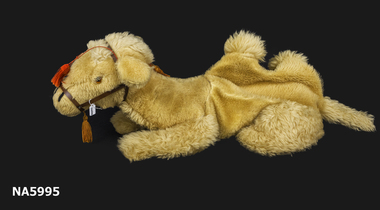
Functional object - Camel pyjama case, C 1975
... ...Pyjama...Pyjama case in the shape of a Bactrian camel. ...From donor and donor's mother. Camel Pyjama Toy N/A Pyjama case in the shape of a Bactrian camel. ...From donor and donor's mother.Pyjama case in the shape of a Bactrian camel. Tan in colour with two humps. Wearing a brown halter on its face, from which three tassels are hanging: one red and two orange. Zip in the underside. Stuffed with paper. Two beaded orange eyes and embroidered black nose and mouth.N/Acamel, pyjama, toy -
 Bendigo Military Museum
Uniform - PYJAMAS, 1968
... .1) Pyjama top, blue & white vertical stripes. ...Refer Cat No 1198.2 for his service history. uniforms - army costume - male nightwear Pyjamas .1) Printed on label: “3795164, M BETTS” .1) Pyjama top, blue & white vertical stripes. Size M. .2) Pyjama pants, blue & white vertical stripes. ...Pyjamas Army issue 1968. Made in Tasmania. Issued to Maurice Charles Betts at Recruit Training, Puckapunyal Vic. Refer Cat No 1198.2 for his service history. .1) Pyjama top, blue & white vertical stripes. Size M. .2) Pyjama pants, blue & white vertical stripes. Size M..1) Printed on label: “3795164, M BETTS”uniforms - army, costume - male nightwear, pyjamas -
 Linton and District Historical Society Inc
Photograph, The Reilly Twins, circa 1940, 1940
... Black and white photograph of two young ladies wearing pyjama suits standing in a garden....Reilly twins Faull collection Black and white photograph of two young ladies wearing pyjama suits standing in a garden. The Reilly Twins, circa 1940 Photograph Photograph ...Part of photograph album donated by Mrs Faull.Black and white photograph of two young ladies wearing pyjama suits standing in a garden.reilly twins, faull collection -
 National Vietnam Veterans Museum (NVVM)
Clothing - Silk pyjamas, c.1969
... Blue silk pyjama jacket and long pants set embossed with silk thread in various patterns. ...Pyjamas Silk Vietnam Souvenir Budd Roger Budd Blue silk pyjama jacket and long pants set embossed with silk thread in various patterns. ...This item was purchased by serviceman Roger Budd as gift he brought back from Vietnam. it was collected as it contributes to an understanding of the experience of the family and friends of those who served in the war in Vietnam.Blue silk pyjama jacket and long pants set embossed with silk thread in various patterns. Front opening has 4 elaborate black fasteners. Edges are bound in white.pyjamas, silk, vietnam, souvenir, budd, roger budd -
 Bendigo Historical Society Inc.
Photograph - PETER ELLIS COLLECTION: DANCING
... Balloons on wall Hanging stars and moon Back of photo reads: Bush Dance and Music Club Pyjama Dance Bendigo East Hall....Balloons on wall Hanging stars and moon Back of photo reads: Bush Dance and Music Club Pyjama Dance Bendigo East Hall. Photograph PETER ELLIS COLLECTION: DANCING ...Colour photograph. Couples dancing in hall wearing pyjamas. Balloons on wall Hanging stars and moon Back of photo reads: Bush Dance and Music Club Pyjama Dance Bendigo East Hall.clubs, music, bush dance & music club of bendigo -
 Greensborough Historical Society
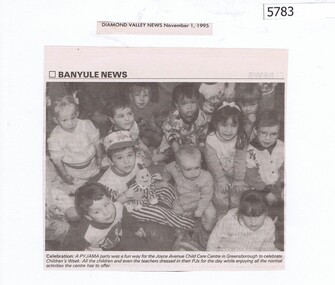
Newspaper Clipping, Diamond Valley News, Banyule News: Joyce Avenue Child Care Centre, 01/11/1995
... The Joyce Avenue Child Care Centre in Greensborough celebrated Children's Week with a pyjama party....The Joyce Avenue Child Care Centre in Greensborough celebrated Children's Week with a pyjama party. joyce avenue child care centre greensborough Newspaper clipping, black and white text and image. ...The Joyce Avenue Child Care Centre in Greensborough celebrated Children's Week with a pyjama party.Newspaper clipping, black and white text and image.joyce avenue child care centre greensborough -
 Bendigo Military Museum
Uniform - TROUSERS, INNER, H & E Ltd, 1951
... A note inside advises wearer that they must be worn over "drawers, pyjama type"....A note inside advises wearer that they must be worn over "drawers, pyjama type". Korean War Cold Weather Uniform Passchendaele Barracks Trust This is one pair of knitted woollen trousers. ...For use in Korean War. A note inside advises wearer that they must be worn over "drawers, pyjama type".This is one pair of knitted woollen trousers. Three button fly. The inside has a fluffy finish, the outside is smooth weave. Small cotton 'wedge' in the rear crotch area.korean war, cold weather uniform, passchendaele barracks trust -
 Mont De Lancey
Container - Raffia Basket, Unknown
... 'The Grey Sock' - instructions for knitting fine and coarse wool. Suitable pyjama pattern with instructions....'The Grey Sock' - instructions for knitting fine and coarse wool. Suitable pyjama pattern with instructions. A large lidded firm natural, green and tan raffia woven basket with a looped handle on the lid which is attached to the base by rusted twisted pieces of wire. ...The handmade basket has a variety of pieces of War Memorabilia as listed in the description.A large lidded firm natural, green and tan raffia woven basket with a looped handle on the lid which is attached to the base by rusted twisted pieces of wire. It closes with a brown strip of leather onto a metal clip at the side. Inside are pieces of War Memorabilia - an instruction card for Knitters Get Busy!, one tortoiseshell knitting needle, a pair of large olive green woollen mittens, two strips of paper with instructions and illustrations for sewing Red Cross Pyjamas for the Soldiers and a small grey folded card - 'The Grey Sock' which has directions for knitting good socks with finer wool and needles. This is incomplete.'Knitters Get Busy! War Chest Wants Socks Appeal for 150,000 Pairs'. There is an acrostic poem for the word KNITTERS, describing the word. 'The Grey Sock' - instructions for knitting fine and coarse wool. Suitable pyjama pattern with instructions.war, containers, knitting, sewing, baskets -
 Whitehorse Historical Society Inc.
Clothing - Shortie pyjama top, circa 1960's
... 1960's shortie pyjama top. Black nylon with pink nylon on reverse side, frilled panel around. ...Elastic inserted around waist Clothing Shortie pyjama top ...1960's shortie pyjama top. Black nylon with pink nylon on reverse side, frilled panel around. Off the shoulder neckline and over the shoulders. Frill around base and top of the panel with pink stitching exposed. Pink rouleau bows on each shoulder and in front of neckline. Elastic inserted around waistHelen Stuart Regd 38costume, female nightwear -
 Melbourne Tram Museum
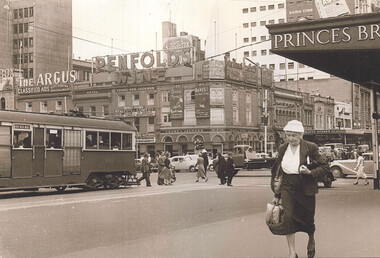
Photograph - W3 656 Swanston St at Flinders St, Hugh Ballment, c1955
... In the background are adverts for The Argus, Penfolds, Davis Furnishings, Beau Monde, Young and Jacksons Hotel, and an advert for The Rainmaker and the Pyjama Game at Her Majesty's Theatre, which dates the photo to c1955....In the background are adverts for The Argus, Penfolds, Davis Furnishings, Beau Monde, Young and Jacksons Hotel, and an advert for The Rainmaker and the Pyjama Game at Her Majesty's Theatre, which dates the photo to c1955. ...Black and white photograph of W3 class tram 656, in Swanston St about to cross Flinders St. Has a lady in the foreground with the awning for Princes Bridge Station behind. In the background are adverts for The Argus, Penfolds, Davis Furnishings, Beau Monde, Young and Jacksons Hotel, and an advert for The Rainmaker and the Pyjama Game at Her Majesty's Theatre, which dates the photo to c1955.Yields information about the use of W3 656 and the intersection of Flinders and Swanston Streets.Black and white photograph with a plain back.tramways, swanston st, flinders st, w3 class, tram 656 -
Emerald Museum & Nobelius Heritage Park
Clothing - Cream Petticoat, Late 1940s
... It was found in a Monkey Pyjama Case (VEMU2288) along three other clothing items (VEMU2293, VEMU2295, and VEMU2296). ...It was found in a Monkey Pyjama Case (VEMU2288) along three other clothing items (VEMU2293, VEMU2295, and VEMU2296). ...This petticoat was likely owned by Elaine Morris (then Nobelius) sometime between the ages of 12 and 14; as she was born in 1934, this item was likely purchased in the mid-late 1940s. It was found in a Monkey Pyjama Case (VEMU2288) along three other clothing items (VEMU2293, VEMU2295, and VEMU2296). VEMU2293 and VEMU2296 have been identified as likely dating to the late 1940s, with advertisements for both from 1949; this item is likely to be roughly contemporaneous to them.This item belonged to a member of the Nobelius family and is a good, well-preserved example of 1940s casual/sleep clothing.This cream satin petticoat originally had two thin shoulder straps; however, the right strap has broken. The only tag we identified was only a size descriptor (size OS - Oversize), with no further writing to indicate brand or product name. The top of the petticoat has a narrow band of different material, while the bottom is hemmed.Tag: "OS."1940s, clothing, elaine nobelius, nobelius family -
Emerald Museum & Nobelius Heritage Park
Clothing - Cream Petticoat, c. late 1940s
... It was found in a Monkey Pyjama Case (VEMU2288) along three other clothing items (VEMU2293, VEMU2295, and VEMU2296). ...It was found in a Monkey Pyjama Case (VEMU2288) along three other clothing items (VEMU2293, VEMU2295, and VEMU2296). ...This petticoat was likely owned by Elaine Morris (then Nobelius) sometime between the ages of 12 and 14; as she was born in 1934, this item was likely purchased in the mid-late 1940s. It was found in a Monkey Pyjama Case (VEMU2288) along three other clothing items (VEMU2293, VEMU2295, and VEMU2296). VEMU2293 and VEMU2296 have been identified as likely dating to the late 1940s, with advertisements for both from 1949; this item is likely to be roughly contemporaneous to them.This item belonged to a member of the Nobelius family and is a good, well-preserved example of 1940s casual/sleep clothing.This is a cream petticoat with adjustable shoulder straps and a decorative mesh-fabric pattern below the neckline. This item is likely to share a size (OS - Oversize) with its related items, having been worn by the same owner contemporaneously.N/A1940s, elaine nobelius, nobelius family, clothing -
 Emerald Museum & Nobelius Heritage Park
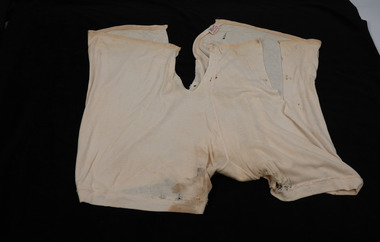
Clothing - 'Sutex Satinswade Pantees', Sutex, c. late 1940s
... It was found in a Monkey Pyjama Case (VEMU2288) that belonged to Elaine, alongside several other items of clothing (VEMU2293-5). ...It was found in a Monkey Pyjama Case (VEMU2288) that belonged to Elaine, alongside several other items of clothing (VEMU2293-5). ...This item was likely owned by Elaine Morris (then Nobelius) as a teenager, some time in the late 1940s. This is corroborated by the existence of advertising for this specific product from 1949, and its likely contemporaneity with VEMU2293 which has adverting from a similar time period. It was found in a Monkey Pyjama Case (VEMU2288) that belonged to Elaine, alongside several other items of clothing (VEMU2293-5). It was manufactured by the Sutex company, which had multiple manufacturing locations in Victoria - including Inglewood and Bendigo.This item belonged to a member of the Nobelius family and is a identifiable example of 1940s clothing.This item is a set of Sutex "Satinswade Pantees". The original advertisement describes them as follows: "Well cut, elastic at waist, cuff leg, in shades Peach and White. For excellent wearing." Seventy years later, this pair - the white version, though it now looks closer to cream - has suffered significant damage, with three large cuts from the waistline, significant staining, and holes from wear between the legs. It was size OS (Outsized).Tag: "Sutex / LUXURY LINGERIE / Satinswade / O.S"clothing, elaine nobelius, nobelius family, 1940s -
 Melbourne Tram Museum
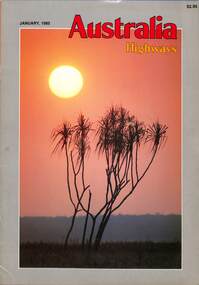
Magazine, Kevin Weldon, "Australia Highways", Jan 1985
... Magazine dated Jan 1985, the first and apparently the only issue published with articles on Fort Denison, trams for the Canberra Tradesmen's club, Robyn Archer, Pyjama Cricket, the glory of Kakadu, the longest backyard fence in the world, Australia takes to the beaches and a Calendar of events around Australia. ...Magazine dated Jan 1985, the first and apparently the only issue published with articles on Fort Denison, trams for the Canberra Tradesmen's club, Robyn Archer, Pyjama Cricket, the glory of Kakadu, the longest backyard fence in the world, Australia takes to the beaches and a Calendar of events around Australia. ...Magazine dated Jan 1985, the first and apparently the only issue published with articles on Fort Denison, trams for the Canberra Tradesmen's club, Robyn Archer, Pyjama Cricket, the glory of Kakadu, the longest backyard fence in the world, Australia takes to the beaches and a Calendar of events around Australia. Published by Kevin Weldon & Associate - see reference. The article on the trams at the Tradesmen's club including the moving of Adelaide D156, interior photos of trams at the club including W2 447. Written by Robert Beattie.Yields information the Canberra Tradesmen club.Magazine - 52 A4 full colour pages centre stapled - Vol 1 No 1 - January 1985trams, tramways, canberra tradesmen club, canberra, tram 156, tram 447, transporting trams -
Emerald Museum & Nobelius Heritage Park
Clothing - Peach Underwear Vest, Exacto, c. Mid-Late 1940s
... It was stored in a Monkey Pyjama Case (VEMU2288) along three other clothing items (VEMU2294-6)....It was stored in a Monkey Pyjama Case (VEMU2288) along three other clothing items (VEMU2294-6). ...This vest was likely owned by Elaine Morris (then Nobelius) sometime between the ages of 12 and 14; as she was born in 1934, this item was likely purchased in the mid-late 1940s. This estimation aligns with the existence of advertisements for this item - an Exacto brand, Mellowbloom line peach underwear vest - as early as 1949; it's possible the item existed before then so I am reluctant to date it to 1949, but its absence from advertising records suggest it may not have predated 1948-9 by much. It was stored in a Monkey Pyjama Case (VEMU2288) along three other clothing items (VEMU2294-6).This item belonged to a member of the Nobelius family and is a very well-preserved example of 1940s sleepwear.This item is a peach-coloured, knitwear vest in size OS (Outsized). It has a round neckline, lined by a strip of different, textured fabric in a slightly lighter shade, accompanied by a decorative knot in the same fabric. It has a tag at the bottom of the item on the rear. Tag, Centre: "MELLOWBLOOM / AN Exacto PRODUCT" Tag, Right Edge: "OS"clothing, 1940s, elaine nobelius, nobelius family -
 Ithacan Historical Society
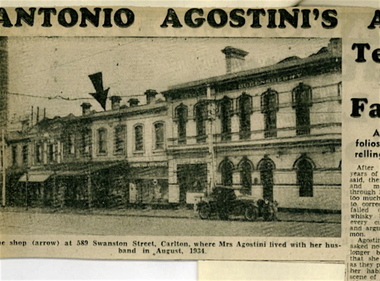
Photograph, Newspaper Photograph of Swanston Street businesses, 1944
... When Andrew Black took occupancy of the shop ate 589 Swanston Street, Carlton, he was unaware that a few years earlier it had been the scene of a murder and became known as the 'pyjama case murder'. On 1st September 1934, the body of an unidentified woman dressed only in pyjamas was found near Albury, NSW. ...When Andrew Black took occupancy of the shop ate 589 Swanston Street, Carlton, he was unaware that a few years earlier it had been the scene of a murder and became known as the 'pyjama case murder'. On 1st September 1934, the body of an unidentified woman dressed only in pyjamas was found near Albury, NSW. ...When Andrew Black took occupancy of the shop ate 589 Swanston Street, Carlton, he was unaware that a few years earlier it had been the scene of a murder and became known as the 'pyjama case murder'. On 1st September 1934, the body of an unidentified woman dressed only in pyjamas was found near Albury, NSW. For the following decade it remained an unsolved mystery until 1944 when Tony Agostini was arrested and confessed to killing his wife. At the time of the murder, the Agostinis were living in the building, where Andrew later ran his shoe repair business. While the case was newsworthy in 1944, the Carlton shop featured in Melbourne's newspapers.A photograph of a portion of a newspaper article about a 1944 cold case murder in Melbourne.carlton, swanston street, andrew black, shoe repairs -
 Emerald Museum & Nobelius Heritage Park
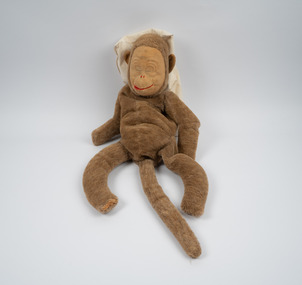
Container - Monkey Pyjama Case, Joy-Toys, c. 1937
... This pyjama case was produced in the 1930s by Joy-Toys, an Australian toy company founded in South Yarra in the early 1920s. ...This pyjama case was produced in the 1930s by Joy-Toys, an Australian toy company founded in South Yarra in the early 1920s. ...This pyjama case was produced in the 1930s by Joy-Toys, an Australian toy company founded in South Yarra in the early 1920s. It was gifted to Elaine Morris (then Nobelius - the granddaughter of Carl Axel Nobelius) at an early - perhaps 3rd - birthday. Elaine was born in 1934, so it would have been gifted around 1937. Several other Joy-Toys monkeys were made with hands and feet, which might either have fallen off or been removed over the past century or which may not have been included on this model. Some other models of Joy-Toys monkeys were based on the characters of British illustrator Lawson Wood, who used a wide cast of monkeys and other animals in his work. The zipper was made in Australia by Lightning, indicating that the monkey's components were also likely made locally.This pyjama case belonged to a member of the Nobelius family, and reflects a style of toymaking that today is far out of fashion from a distinctive company that is no longer in business.The monkey has a hollow body, with the interior lined with orange satin fabric and closed by a zipper. The shape of the monkey is filled out by the case's intended purpose - storing pyjamas. The head is stuffed, and features a face made of felt molded over buckram, with painted features in red (mouth and nostrils) and black (closed eyelids and eyelashes). Outside of the face, the monkey is covered in synthetic brown 'fur'. It is possible that the monkey once had hands and feet which have since been removed or lost. The monkey's limbs and tails are also stuffed and separated from the hollow body. The head and arms of the monkey are on joints allowing them to rotate 360 degrees. The monkey also has small furless fabric ears. There is damage separating fabric at the right shoulder and at several points in the interior.Zipper Obverse: "LIGHTNING" Zipper Reverse: "AUST MADE / PATENTED" Inside Tag: "JOY-TOYS / MADE IN AUSTRALIA"elaine morris, nobelius family, elaine nobelius, toys, children -
 Bendigo Historical Society Inc.
Clothing - LADIES CREAM SILK PAJAMAS, 1930's
... Embroidery is in a floral design. The pyjama pants are full length, with a fine bound finish - probably at or slightly above the ankles. ...Embroidery is in a floral design. The pyjama pants are full length, with a fine bound finish - probably at or slightly above the ankles. ...Clothing. Cream silk embroidered sleeveless top with a neckline at front and back, which is edged with a fine rouleau binding. The fine silk binding also edges rhe sleeveless armholes. The fabric is woven with a floral woven design. A 2 cm wide tie attaches to the side seams 13 cms below the armholes.The top is sleeveless, and the hemline which is rounded at the side seams, is finished with a self fabric binding. Silk shadow embroidery trims the front neckline, and extends to the midriff. Embroidery is in a floral design. The pyjama pants are full length, with a fine bound finish - probably at or slightly above the ankles. An 11 cm deep V shaped panel at the front waistline, and an elastic casing at the back waistline. A panel of shadow embroidery decorates the side hemline. A small dart, 6 cm long, from below the armhole on either side of front bodice.SILK and RAYON MADE IN CHINAcostume, female, ladies cream silk pyjamas -
 Royal District Nursing Service (now known as Bolton Clarke)
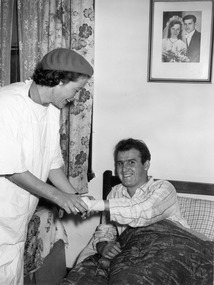
Photograph - Photograph, black and white, c.1958
... He is wearing a white and striped pyjama top and his lower body is covered by a patterned bed cover. ...He is wearing a white and striped pyjama top and his lower body is covered by a patterned bed cover. ...This photograph depicts a MDNS Sister visiting a male patient to give him nursing care. He is lying in bed in his home and the Sister is applying a bandage to his left wrist. Under her white gown the Sister is wearing the MDNS winter uniform of a grey dress with peaked collars and grey wool beret which has a central red Maltese cross attached. The Trained nurses (Nurses) of the Melbourne District Nursing Society (MDNS), from its inception in 1885, provided wound care to their patients who ranged in age from the very young to the elderly. The patients required their wounds to be dressed following various types of surgery, accidents, burns, cancer, leg ulcers etc. As research developed better products and dressing materials, the methods and medication applied to wounds changed. MDNS received Royal patronage in 1966 and as Royal District Nursing Service (RDNS), the Education department developed wound care programs, such as the Leg Ulcer Management Program to provide their Trained nurses (Sister) with methods of best quality care. They ran a program for Wound Care Specialists who made assessments and provided advice and support to the District Sisters working in the field as needed. The Sisters liaised with the patient’s Doctors and hospitals to provide information on the progress of patient’s wounds and to receive any change of wound care from the Doctors. Standing on the left of this photograph is a Melbourne District Nursing Service (MDNS) Sister who is wearing a white gown over her grey uniform, the collar of which can be seen. She is wearing her uniform grey wool beret over her short dark curly hair and is smiling as, with her outstretched left hand, she supports the partly bandaged extended left arm of a gentleman who is sitting up in bed to her right; his right arm is resting on the bed and supporting him as he is partly turned towards the Sister. She has part of a rolled bandage in her right hand. The male patient, who has short dark hair, is looking at the camera and smiling. He is wearing a white and striped pyjama top and his lower body is covered by a patterned bed cover. Part of a pillow with check pillow case sits flat behind him and part of a wooden horizontal slat bedhead is seen. On the wall behind the bed hangs a framed photograph of a couple on their wedding day. Patterned curtains cover the window in the left rear of the photograph.John Gallagher photography. 4 Benares Street, Mitcham Victoria WU 2568 No. 4-4melbourne district nursing service, mdns, mdns wound care, royal district nursing service, rdns -
 Nillumbik Shire Council
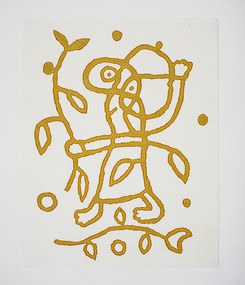
Print (etching): Michael LEUNIG (b.1945 Vic, AUS), Michael Leunig, ‘Pilgrim’ from 'The Baldessin & Friends' commemorative folio, 2016
... His best known works include The Adventures of Vasco Pyjama and the Curly Flats series. Leunig was declared one of Australian Living Treasures by the National Trust of Australia in 1999. ...His best known works include The Adventures of Vasco Pyjama and the Curly Flats series. Leunig was declared one of Australian Living Treasures by the National Trust of Australia in 1999. ...Michael Leunig is an Australian cartoonist, poet and cultural commentator. His best known works include The Adventures of Vasco Pyjama and the Curly Flats series. Leunig was declared one of Australian Living Treasures by the National Trust of Australia in 1999. George Baldessin (1939-1978) was a printmaker and sculptor who built his bluestone studio at St Andrews (Nillumbik) in 1971 with his partner Tess and the three Hails brothers, Rob, Doug and Don. Made of recycled materials the studio today contains all of George’s equipment including the large press, which he modelled himself with the help of Neil Jeffrey (Enjay Presses). George won many prizes throughout his career and is represented in many of Australia's public art collections including his famous 'Pears' sculpture in front of the National Gallery of Australia, Canberra. In 1975 he represented Australia in the Sao Paulo Biennale, before living and working in Paris until his return to St Andrews in 1977. In 1978 George was killed in a car accident aged 39 years. In 2001 Tess returned to St Andrews to reclaim the run-down studio and reconstitute it as The Baldessin Press & Studio - a printmaking retreat. It operates in George’s memory, so that artists may continue to create, perpetuating the generous spirit of George.one colour (yellow) etching on Somerset paper. Thick lines weave in and out to produce a figure reminiscent of his 'curly flat' characters holding a long stem flower/vine. ekphrasis2018, pilgrim, baldessin, leunig -
 Bendigo Historical Society Inc.
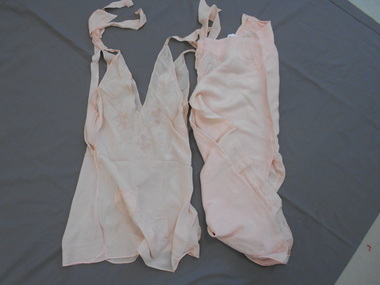
Clothing - PINK SILK PYJAMAS
... A two cm x 60 cms tie attaches at each side seam, and would tie at the back. Clothing. Pyjama pants have a V shaped waistband 11 cm deep at front and back, below which is a small 1.5 cm wide pleat on either side of front and back. ...A two cm x 60 cms tie attaches at each side seam, and would tie at the back. Clothing. Pyjama pants have a V shaped waistband 11 cm deep at front and back, below which is a small 1.5 cm wide pleat on either side of front and back. ...Clothing. Deep V neckline, front and back, has a tapered tie, at the shoulder to 4.5 cm, and slanted at the lower edge of the tie. The V neckline has a fine binding finish as do the armholes, and the lower edge of the bodice. Shadow, and pulled thread embroidery, in a floral design, outlines the V neckline in the front. A tiny 10 cm x 10 cm heart shaped pocket is bound at the edges and sits at lower right front. A small dart, 1 cm x 6 cm long is below the armholes, on each side seam. Fabric is cut on the cross to add flair. A two cm x 60 cms tie attaches at each side seam, and would tie at the back. Clothing. Pyjama pants have a V shaped waistband 11 cm deep at front and back, below which is a small 1.5 cm wide pleat on either side of front and back. An 11 cm deep plackett on both side seams - on the left hand side two x 1 cm pearl buttons and buttonholes fasten the plackett. The two buttons on the right hand side are missing. A panel of shadow embroidery decorates the outside lower edge of the trouser leg. Fabric is woven with a floral design. Lower edge of legs are finished with a fine binding. 11 cm peak at waistband. Pants with hem 88 cms, width at ankles 64 cms.Silk and Rayon Made in Chinacostume, female, pink silk pyjamas (bodice) -
 Royal District Nursing Service (now known as Bolton Clarke)
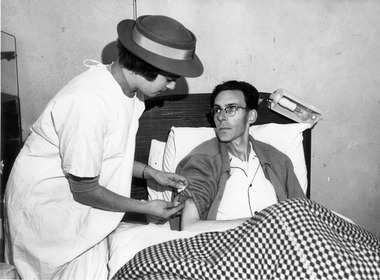
Photograph - Photograph, black and white, c.1956
... He is wearing a thick grey cardigan over a pale colour pyjama top which has dark piping; the lower part of his body is covered by a dark and light coloured check bed cover. ...He is wearing a thick grey cardigan over a pale colour pyjama top which has dark piping; the lower part of his body is covered by a dark and light coloured check bed cover. ...This photograph is taken in the bedroom of the man's home in the suburbs of Melbourne. It depicts one of the types of nursing care given by Melbourne District Nursing Society (MDNS) Sisters in the community. The Sister is visiting the man's home and is administering an injection which has been ordered by a doctor. Glass syringes were used by the Society until the mid 1960s and were re sterilized for future use. After this time plastic disposable syringes were used.The Trained nurses of the Melbourne District Nursing Society (MDNS), later known as Royal District Nursing Service (RDNS), visited patients in their home and gave best practice care in many fields of nursing and to people of many cultures throughout its 130 years of expansion. Initial visits not only assessed the specific nursing situation but the situation as a whole. Their patients ranged in age from babes, children, adults to the elderly and referrals were taken from Hospitals, General Practitioners and allied Health facilities. Some of the care provided was: – Post-Natal care given to mother and babe, Wound Care following various types of surgery, accidents, burns, cancer, leg ulcers etc. Supervising and teaching Diabetic Care, including teaching and supervising people with Diabetes to administer their own Insulin, and administering Insulin to those unable to give their own injections. Administering other injections and setting up weekly medication boxes. The Sisters performed Catheterizations on adults suffering from conditions such as Quadriplegia, Paraplegia, Multiple Sclerosis (MS), Motor Neurone Disease (MND) and Guillan-Barre Syndrome, and when required at school on children for e.g. those with Spina Bifida. The Sisters visited those requiring Cystic Fibrosis support and care; those requiring Haemo-Oncology care, including visiting children at school; those requiring Home Enteral Feeding care, and those requiring IV therapy at home and home Dialysis. Palliative Care was given including pain relief with the use of syringe drivers, personal care as needed, and advice and support to both patient and family. RDNS provided Stoma management to those needing Urostomy, Ileostomy and Colostomy care and those requiring Continence care. HIV/AIDS nursing care was provided; visits to Homeless Persons were made. Personal care was given to patients ranging in age and with varying mobility problems, such as those with MS, MND, Guillan-Barre Syndrome, Quadriplegia, Paraplegia, Acquired Brain Injury, following a Cerebrovascular Accident (Stroke), those with severe Arthritis and those with a form of Dementia. When necessary the elderly were assisted with personal care and advice given on safety factors with the use of hand rails, bath or shower seats, and hand showers. Rehabilitation with an aim towards independence remained at the forefront of the Sister’s minds and when possible using aids and instruction on safe techniques enabled the person to become fully independent. All care included giving advice and support to the patient and their Carers. The Sisters liaised with the persons Doctor, Hospital and allied Health personal when necessary.On the left of this black and white photograph, is a Melbourne District Nursing Society Sister who is standing side-on and leaning slightly forward as she administers an injection into the right upper arm of a gentleman to her right who is sitting up in bed resting against two white covered pillows. The male patient has short dark hair; is wearing glasses, and is looking up at the Sister. He is wearing a thick grey cardigan over a pale colour pyjama top which has dark piping; the lower part of his body is covered by a dark and light coloured check bed cover. The bed has a solid wooden headrest with a bed lamp attached to its upper right. The Sister who is wearing her uniform grey brimmed hat over her dark short hair, is wearing a white gown over her grey uniform, the collar of which is seen. Three fingers of her left hand are holding back the pushed up sleeve of the man's cardigan and she is holding a white swab between her thumb and first finger. She has a glass syringe resting in her right hand with her thumb and forefinger resting against the lower glass and metal section of the syringe; part of the metal needle is seen, the rest is inserted in the mans upper arm. On the far left of the photograph part of a dressing table mirror can be seen.' Rough Proof' Latrobe Studios Ref No. 59134-8melbourne district nursing service, mdns, royal district nursing service, rdns, rdns - injection -
 Royal District Nursing Service (now known as Bolton Clarke)
Photograph - Photograph, black and white, Barry Sutton, 25.07.1972
... He is wearing glasses; has short dark sparse hair and is wearing a dark coloured pyjama coat with some white piping, and a white handkerchief in the pocket. ...He is wearing glasses; has short dark sparse hair and is wearing a dark coloured pyjama coat with some white piping, and a white handkerchief in the pocket. ...Sister Barbara Watson is an RDNS Liaison Officer and is meeting with Hospital staff and a patient in a Ward at the Alfred Hospital before the patient is discharged home where he will receive the nursing care required from a visiting RDNS Sister. Sr. Watson is wearing her RDNS winter uniform, which is a blue/grey skivvie worn under a V neck tunic style frock made of herringbone blue/grey winter material.Liaison had occurred between doctors and the Trained nurses (Nurses) of the Melbourne District Nursing Society (MDNS), from its inception in 1885. This increased when Midwifery was introduced in August 1893 with close liaising with the Women’s Hospital. As District nursing grew it was recognized that closer liaising between many Public Hospitals would be beneficial, for not only the MDNS, later called Royal District Nursing Service (RDNS), Trained nurses (Sisters) but also for the patients and the hospitals. In August 1964 a Liaison Officer commenced at the Alfred Hospital. This soon increased to Liaison Officers working full time at several Public Hospitals. They facilitated the smooth transition from hospital to home for many patients who required ongoing nursing care. Liaison Sisters regularly attended discharge planning meetings, interviewed prospective patients, coordinated discharge and booked the first visit by the visiting RDNS District Sister. At the time of a patient’s discharge, the Liaison Sister forwarded information on their diagnosis and instructions regarding the care required at home to the appropriate RDNS Centre, and in turn the attending District Sister wrote a report of progress and any queries to the hospital Doctor, via the Liaison Sister, at the time the patient was attending outpatients. Any new instructions were then sent back to the District Sister. Liaising also occurred between District Sisters and Doctors when patients were referred by General Practitioners and did not attend a Hospital.Black and white photograph showing Royal District Nursing Service, RDNS, Sister (Sr.) Barbara Watson who is standing with hospital staff and with a patient who is resting in a hospital bed. On the left foreground of the photograph is Sr. Watson, who has blonde shoulder length curled hair and is wearing her RDNS uniform of a light grey skivvie worn under a darker grey V neck tunic style frock. She has her head turned to the left looking at the patient. Next right stands a Doctor, who is wearing glasses and has short dark hair. He is wearing his hospital white coat over his clothes and has his arms folded across his chest. Next right is another Doctor who is at the head of the hospital bed; He has short dark hair and is wearing his white hospital coat over a grey shirt. black tie and dark grey pants. They are all smiling at an elderly man who is sitting up in the bed resting against a white pillow and looking toward them. He is wearing glasses; has short dark sparse hair and is wearing a dark coloured pyjama coat with some white piping, and a white handkerchief in the pocket. He is looking at the three and has his hands clasped on top of the bedclothes. The hospital bed has a white iron frame and an 'over bed table' is at its foot and in the foreground of the photograph. On the right of the bed is a hospital Sister, who has short dark hair; is wearing glasses and wearing her white uniform dress and cap. She is smiling as she looks toward the patient and Doctors. A hospital curtain is against the wall behind her. Part of a window and curtain are seen on the far left of the photograph.Photographer stamp. Quote No. LA 6 Name of hospital and RDNS liaison sister.melbourne district nursing society, mdns, royal district nursing service, rdns, rdns liaison, sister barbara watson -
 Melton City Libraries
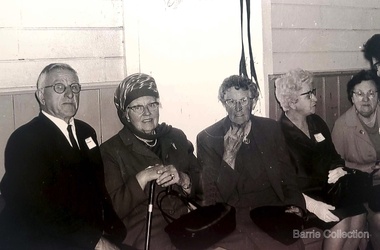
Photograph, Mrs Knox and Beryl Gillespie at the First Hundred Years Celebration of Melton State School 430, 1970
... Melton Amateurs players produced and tutored by Mabel Rogers exerts from Pyjama Game, South Pacific, Carousel - later years a group of ladies did gentle water exercise at Essendon and Station Road swimming pool. ...Melton Amateurs players produced and tutored by Mabel Rogers exerts from Pyjama Game, South Pacific, Carousel - later years a group of ladies did gentle water exercise at Essendon and Station Road swimming pool. ...Beryl Knox speaking about early life in Melton. Page 1 1949 – 64 years ago. We began our married life at Melton Sth. The house on the corner of the Exford Rd and Staughton St-- dusty gravel roads, box thorns and noxious weeds everywhere and a sprinkling of houses and vacant land. It was a friendly community consisting of old family names. McDonalds, Blacks, Dodemaide, Cahill, Coopers, Minns, Tinklers, Nesbitts, Cochranes, Wickhams, Exells. Mavis Butler. The home owned by Mr. Robinson and Miss Robinson had been shifted in two parts transported from Diggers Rest and it is still standing 2013. Bruce’s father purchased the house and two adjoining blocks, the Conways built on one and the Rawlinson family on the other block. Eileen still resides there, she was only a baby in a pram and the family had not long arrived from England. The railway line was close to the house and the contents would rattle when heavy steams trains went through, and on a clear frosty night the 1am paper train would echo roar through very loudly when labouring towards the Exford Bridge. Then the two carriage motor train was introduced, this was great for the workers and schoolies who travelled to Melbourne. The train pulled up at the crossing or riding to pick up or drop off. Melva Gillespie (nee Hirt) Bill Cahill delivered the milk by the billy and then in bottles. Len Kennedy (Paul Kennedy’s father, Norma Murrays son) delivered Jongebloeds bread, he always had a sweep going for the Melbourne Cup and raffles for the footy club. Mr. Woodgate owned an old bus and pick up point was the Post Office when there was a Saturday film on a Melton. There were no doctors or dentists in the district. If we need a Doctor we had to travel to Bacchus Marsh or discuss problems over the phone. In later years a Bacchus Marsh Doctor rented the Bluestone building in McKenzie St a couple of days a week. If we needed the Dentist we had to travel to West Footscray or Footscray. We did our banking at “State Savings” then the Miss Minns had the agency and then Bardsleys Store. We travelled to Bacchus Marsh to the National and Commercial banks. Station Rd to Western Highway, now (High Street) was a narrow stretch of bitumen and gravel farmland either side and a couple of farm houses and large gum trees on the properties. Page 2 North of the Railway line Mrs Bessie Jones, mother of Chas and Betty Jones managed the Post Office, next door to her Chas and Betty had the Shell Centre, and later moved the business to Melton. Hughie Nesbitt and mother owned the grocery and hardware store, and I bought my first set of saucepans there. On the opposite side of Station road Mr Coombe owned the fruit shop, and also provided soft drinks and lollies for children. The Chaff Mill was on the corner of Station Rd and Brooklyn Rd. Mr Lumsden was manager and later years Bernie Trethowan and Jack Butler were partners. It finally burnt down and is a Service Station now. Along Brooklyn Rd there were a few houses and Victoria Hall, not a very big hall, but catered for lots of functions, Balls, Fancy Dress, Bazaars, Square Dancing and meetings. The Bacchus Marsh Baptists held Sunday School in the hall. A group of shops were built south of the railway line Molly and Len Skinner managed the Post Office and handled a few essential groceries. Tom McDonald and Ron Lunsberg were the butchers. Mary and Syd Cooper lived next door to us and often in turn would run out of something when we had a baking spree we would borrow or exchange, sugar flour etc over the fence. Mavis and Jack Butler lived there before the Coopers. Bernie and Iris Trethowan lived two doors up. Neighbours were invited into their home to view the first black and white television in Melton Sth. Bill Exell was one of the first Melton Sth farmers to sell his land to developers, the land was idle for years before housing developed. I joined the Melton Valley Golf Club in 1960. The Gun Club as our Club House, an old tin shed consisting a water tank, trestle table and forms and dirt floor. It was a 9 hole course with sand scraps and landscape putting before greens. The Common or parkland was part of the Golf Course. It was open for every ones recreation. Roy Norton an old identity trained his trotters on the Common and wouldn’t clear the track for the golfers. The golfers had to avoid him to continue to play. We had to keep clear when the young youths came in their paddock cars and motorbikes. Over the years the Toolern Creek flooded its banks, water and debri covered the course on one year our first Club house was flooded out. It took several working bees to clean it up. We lived at Melton Sth for 15 years and moved to Melton on the farm “Croxton Park.” The Nixon family farm “Mowbray” adjoined the farm. Bruce worked the land cropping the farm when Mrs Nixon died. Page 3 (page 4 on the handwritten script) Bruce had the first offer to buy, in those days it wasn’t easy to get good bank loans. Part of the land is the Golf Course now and Mr O’Shea purchased the bulk. Moving to Melton was totally different – I became involved with Committees, Scouts, Guides, Mothers Clubs, CWA, Church Op shop (8 years). Melton Amateurs players produced and tutored by Mabel Rogers exerts from Pyjama Game, South Pacific, Carousel - later years a group of ladies did gentle water exercise at Essendon and Station Road swimming pool. I was 20 or so years in Probus. The local followed the football, there was always a Gymkhana on the long weekend in June. The tennis always created a lot of interest during the finals. It didn’t matter which team played the supporters were treated to a cup of tea and leftovers from their afternoon tea. In 1978 were the first residents to move into the Jennings Estate Kurunjang and lived there 31 years and retired 4 years ago into Unit. The amazing changes I have experienced. Merrimu supplied our water, after depending on tanks. The landscape changed completely when developers came in, no more dusty plains \ typed web Sept 2013 McFarlane, Mrs Knox and Beryl Gillespie at the First Hundred Years Celebration of Melton State School 430. The event was held at Mechanics Hall, Melton.local identities, local significant events, education -
 Embroiderers Guild, Victoria
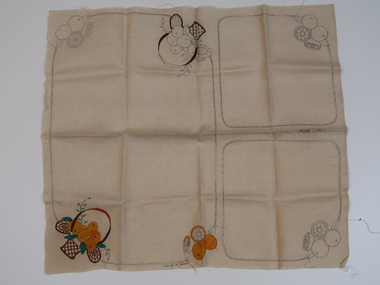
Unfinished Table Mat Set, 1937
... She started with the technique for linocuts and also wrote on pattern printing, embroidery, crafting cuddle toys, making evening gloves, and even a frog pyjama case for children. These crafts and designs were featured in The Sun and The Mercury. ..."Fruits of Your Handiwork" from the 'Woman's Needlework Feature" magazine article 26 July 1937 designed by Dorothy Ellsmore Paul.Dorothy Ellsmore Paul (née Dorothy May Ellsmore; 3 February 1902 – July 1973)[1] was an Australian artist and cartoonist. Paul was born Dorothy May Ellsmore in 1902 in Hertfordshire, England. She trained as an artist at Portsmouth Technical College. She left for Australia at just nineteen years old, arriving in Sydney on 18 March 1921. Once in Sydney she trained under Julian Ashton. She had ambitions of becoming a sculptor though this never eventuated. She was first published in The Sun with the cartoon We Do Believe in Fairies in their Sunbeams section. By 1924 she was drawing cartoons for the soldiers' magazine Aussie alongside fellow female cartoonists Mahdi McCrae, Betty and Esther Paterson, and Lillian Pedersen. The same year she exhibited her work in a black and white show at Anthony Hordern and Sons' Fine Art Gallery with such artists as Norman Lindsay, Percy Leason, and David Low. In 1926 she was illustrating short stories for The Australian Women's Mirror and the Sydney Mail. Her illustrations also featured in The Bulletin. In 1929 she edited a book The Etched Work of Sydney Long which included a sketch of hers of the artist. They were both associated with the Australian Painters-Etchers Society. Paul wrote the introduction for the Society's publication The Charm of the Etching. From 1931 to 1934 Paul wrote a feature section for The Australian Women's Mirror. She started with the technique for linocuts and also wrote on pattern printing, embroidery, crafting cuddle toys, making evening gloves, and even a frog pyjama case for children. These crafts and designs were featured in The Sun and The Mercury. She wrote and illustrated the stories Portrait of a Dark Girl and In Search of a Grandmother. She married fellow artist Oswald "Mick" Paul in 1925, son of artist and social reformer Emily Letitia Paul. His portrait of her was a finalist for the 1929 Archibald Prize. Paul has works in the collections of the National Library of Australia, the National Gallery of Australia, the State Library of New South Wales, and a bookplate of Sydney Long in the National Library of New Zealand. https://en.wikipedia.org/wiki/Dorothy_Ellsmore_Paul Stamped linen design with oranges and baskets. Partly embroidered.Pure Linen stamp. -
 Embroiderers Guild, Victoria
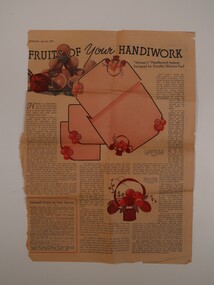
Table Mat Set Magazine Pattern, 1937
... She started with the technique for linocuts and also wrote on pattern printing, embroidery, crafting cuddle toys, making evening gloves, and even a frog pyjama case for children. These crafts and designs were featured in The Sun and The Mercury. ..."Fruits of Your Handiwork" from the 'Woman's Needlework Feature" magazine article 26 July 1937 designed by Dorothy Ellsmore Paul.Dorothy Ellsmore Paul (née Dorothy May Ellsmore; 3 February 1902 – July 1973)[1] was an Australian artist and cartoonist. Paul was born Dorothy May Ellsmore in 1902 in Hertfordshire, England. She trained as an artist at Portsmouth Technical College. She left for Australia at just nineteen years old, arriving in Sydney on 18 March 1921. Once in Sydney she trained under Julian Ashton. She had ambitions of becoming a sculptor though this never eventuated. She was first published in The Sun with the cartoon We Do Believe in Fairies in their Sunbeams section. By 1924 she was drawing cartoons for the soldiers' magazine Aussie alongside fellow female cartoonists Mahdi McCrae, Betty and Esther Paterson, and Lillian Pedersen. The same year she exhibited her work in a black and white show at Anthony Hordern and Sons' Fine Art Gallery with such artists as Norman Lindsay, Percy Leason, and David Low. In 1926 she was illustrating short stories for The Australian Women's Mirror and the Sydney Mail. Her illustrations also featured in The Bulletin. In 1929 she edited a book The Etched Work of Sydney Long which included a sketch of hers of the artist. They were both associated with the Australian Painters-Etchers Society. Paul wrote the introduction for the Society's publication The Charm of the Etching. From 1931 to 1934 Paul wrote a feature section for The Australian Women's Mirror. She started with the technique for linocuts and also wrote on pattern printing, embroidery, crafting cuddle toys, making evening gloves, and even a frog pyjama case for children. These crafts and designs were featured in The Sun and The Mercury. She wrote and illustrated the stories Portrait of a Dark Girl and In Search of a Grandmother. She married fellow artist Oswald "Mick" Paul in 1925, son of artist and social reformer Emily Letitia Paul. His portrait of her was a finalist for the 1929 Archibald Prize. Paul has works in the collections of the National Library of Australia, the National Gallery of Australia, the State Library of New South Wales, and a bookplate of Sydney Long in the National Library of New Zealand. https://en.wikipedia.org/wiki/Dorothy_Ellsmore_Paul "Fruits of Your Handiwork" from the 'Woman's Needlework Feature" magazine article 26 July 1937 designed by Dorothy Ellsmore Paul. Stamped linen design with oranges and baskets included. -
 Embroiderers Guild, Victoria
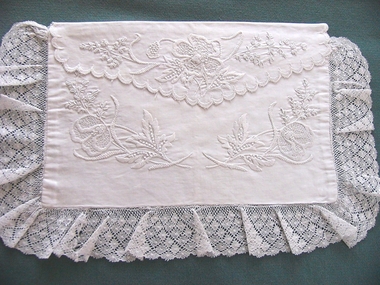
Textile - Mountmellick Embroidered Pyjama Case, Late 19th century
... Textile Mountmellick Embroidered Pyjama Case ...Mountmellick embroidery is a traditional, heavy white-on-white (whitework) hand embroidery style that originated around 1825 in the town of Mountmellick in County Laois, Ireland. Developed by Johanna Carter, the craft is celebrated for its deeply textured, sculptural appearance and all-Irish origins. Strictly monochrome white-on-white (white thread on white fabric). Traditionally worked on heavy, firm cotton satin jean, providing a sturdy, durable base for household items like bedspreads, tablecloths, and doilies. Uses thick, matte, twistless or heavy cotton threads that do not divide, contrasting with the sheen of the cotton jean fabric. Inspired by the local Irish flora, including blackberries, brambles, oak leaves, dog roses, ivy, ferns, and shamrocks, as well as later cultivated garden plants. Features heavily padded and knotted stitches, such as satin stitch, French knots, stem stitch, buttonhole stitch, and the signature Mountmellick stitch (which creates a triangle-like, spiked outline effect)Classic Mountmellick embroidery on satin jean with decorative scalloped edges top and base and fringed. Heavily embroidered with flowers, wheat and leaves.embroidery, mountmellick, ireland, late 19th century, pyjama case
