Embroiderers Guild, Victoria
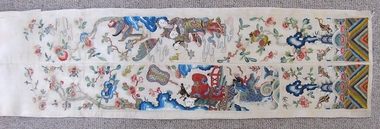
Accessory - Pair of Chinese Embroidered Sleeve Bands, 19 th C
... Information from Dr Rachel Silberstein, visiting Associate Professor at Rhode Island School of Design.
"This pair of sleeve bands are two halves of a scene known as "tian xian song zi" or "Heavenly immortals deliver a son". ...Information from Dr Rachel Silberstein, visiting Associate Professor at Rhode Island School of Design.
"This pair of sleeve bands are two halves of a scene known as "tian xian song zi" or "Heavenly immortals deliver a son". ...
Chinese sleeve embroidery bands, or wanxiu became popular in the late 19th century during the Qing Dynasty, evolving from the traditional Han cuff embroidery and Manchu styles. These detachable, decorated bands were added to women's informal jackets and robes, often featuring symbolic motifs like landscapes, flowers, and auspicious symbols. They served both a decorative function, displaying artistic skill and personal wishes, and a practical one by covering the sleeves when hands were folded at the waist.
History and evolution:
Origins: The practice of embroidering cuffs on robes existed during the previous Ming Dynasty for Han women, and this was adopted by the Manchu rulers who founded the Qing Dynasty.
Qing Dynasty (1644-1911): The practice was popularized and elaborated upon during this era, with detachable bands becoming a fashionable element for informal wear.
Symbolism: The embroidery included a complex visual vocabulary of wishes for a long life, many offspring, and a happy marriage, derived from nature, mythology, and classical literature.
Functionality: Women would fold their arms, often with their hands inside the sleeves, so the embroidered bands, which were sewn to hang down the back of the jacket, would be displayed prominently down the front.
19th century peak: The late 19th century was the peak of their popularity, with intricate designs becoming fashionable and even influenced by court tastes, such as those favoured by the Empress Dowager Cixi.
Later developments: The late 19th century saw the introduction of chemical 'aniline' dyes from Europe, leading to brighter, bolder colours in embroidery.
Motifs and their Meanings:
Auspicious symbols: Designs often included symbols for good fortune, wealth, and longevity.
Natural imagery: Birds, flowers, and landscapes were common motifs that could represent natural beauty or convey specific symbolic meanings.
Figurative scenes: Bands could also feature narrative scenes from classical stories or legends. The choice of motifs allowed women to express personal desires, cultural values, and aesthetic preferences, reflecting a more personal and informal style than official court attire.
Symbolism:
Mountains and sea, clouds and waves - Good luck.
Dragon/fish tail/flaming pearl = Good fortune. This refers to the legend 'liyutiaolongmen' - a carp rising from the waves with the head already changed into a dragon implies the wish for success in the civil service examination. It is an allegory for the persistent effort needed to overcome obstacles.
Male with black hat - Zhuang Yuan conferred. Among patterns with implied meanings , patterns related to the pursuits of scholarly honour and official rand include mainly the 'three number ones'. 'Zheng Yuan conferred' and 'carp jumping over the dragon gate'. In feudal society, examiners for the official positions had to go through three different levels of examinations.
Bats - the work for bat is 'fu' and is a visual pun for the word happiness 'fu'.
Rhino horn - wealth and good fortune.
The ruyi sceptre - is a curved decorative Chinese object that symbolizes power, good fortune, and the wish that “things go as you desire.” The head of the sceptre resembles the 'lingzhi' of the 'longevity fungus'.
Pomegranate - fertility ie; offspring, a virtue in China.
Boy holding the flowering branch in the arms of the woman - in the selection of officials through imperial examinations in feudal society, the winner of an official position is described as ' having picked the crown'. 'Gui' (sweet scented osmanthus) and 'gui' (high rank or official) are very close in sound Chinese. In this design the boy in the woman's arms is seen waving a sweet scented osmanthus, thus an auspicious message is delivered.
Information from Dr Rachel Silberstein, visiting Associate Professor at Rhode Island School of Design.
"This pair of sleeve bands are two halves of a scene known as "tian xian song zi" or "Heavenly immortals deliver a son". The historical origins of this saying is a story from 'The History of the Wei Imperial records', involving the Emperor Sheng and an immortal maiden who presents him with a son. After this, the expression "tian xian song zi" came to be used as good wishes for marriage, closely associated with 'qilin song zi' (the qilin delivers a son), another popular topic in nianhua popular prints".
Both cuffs show figures in an outdoor setting, done in colourful silk thread on a ivory satin.
Reading from the bottom to the top of the cuff both have pointed mountains, clouds and sea with a rhino horn and a 'rui' coming out of the waves.
Left cuff: above the sea there are a fish/dragon and a flaming pearl. Next two male figures standing on a bridge. One holds a fan and the other is wearing a black hat. More flowers, peonies and blossoms are above the figures.
Right cuff: Above the water and mountains is a bat, peonies and pomegranates. Above these are three figures and another bat. The figure in there rear holds a feathered fan, while the front figure holds a child, who is holding a flowering branch.
Above the trio is a low pagoda and blossoms.
Silk satin stitch, Pekin knots and couched gold metal thread.embroidery, garments, silk embroidery, china, landscape, garden, figures

 Bendigo Historical Society Inc.
 Kadimah Jewish Cultural Centre and National Library
 Embroiderers Guild, Victoria