
Showing 37 items matching "radio flying "
-
 Moorabbin Air Museum
Book - A Text Book on Aviation Volume 4 Navigation, Meteorology, Radio Beam Flying and Orientation Procedure, Leslie Thorpe
... A Text Book on Aviation Volume 4 Navigation, Meteorology, Radio Beam Flying and Orientation Procedure ...Leslie Thorpe Book A Text Book on Aviation Volume 4 Navigation, Meteorology, Radio Beam Flying and Orientation Procedure ... -
Moorabbin Air Museum
Book - Flight training for private pilots, Flying Training For The Private Pilot Licence Instrument Flying, Radio Navigation, Instrument Approach Procedure
... Flying Training For The Private Pilot Licence Instrument Flying, Radio Navigation, Instrument Approach Procedure...Flight Training Flight traning for private pilots Study guide on instrument flying, radio navigation & instrument approach procedure for private pilots circa 1980s Flying Training For The Private Pilot Licence Instrument Flying, Radio Navigation, Instrument Approach Procedure Book Flight training for private pilots ...Study guide on instrument flying, radio navigation & instrument approach procedure for private pilots circa 1980snon-fictionStudy guide on instrument flying, radio navigation & instrument approach procedure for private pilots circa 1980sflight traning for private pilots -
Moorabbin Air Museum
Book - Meteorology, Through the Overcast
... ...Radio flying & orientation...Forecasting Weather & airline flying Climatology Weather instruments Aircraft instruments Sperry Gyro Power plant Fuel & lubrication Fuel-air ratios The spark plug Whirling props Airplane behaviour Dead reckoning Radio Radio flying & orientation Instrument technique Celestial navigation Overview of weather & the art of instrument flying, circa 1943 Through the Overcast. ...Overview of weather & the art of instrument flying, circa 1943non-fictionOverview of weather & the art of instrument flying, circa 1943becoming a weather detective, stability & instability, air masses, weather map & teletype symbols, fronts and cyclones, fog /thunderstorms & icing., making a weather map., forecasting, weather & airline flying, climatology, weather instruments, aircraft instruments, sperry gyro, power plant, fuel & lubrication, fuel-air ratios, the spark plug, whirling props, airplane behaviour, dead reckoning, radio, radio flying & orientation, instrument technique, celestial navigation -
Moorabbin Air Museum
Manual (Item) - The Instrument Rating Manual ,Instrument Flying Techniques , Radio Navigation Aids , Preparing For An IFR Flight , IFR Operations , Meteorology, The Instrument Rating Manual
... The Instrument Rating Manual ,Instrument Flying Techniques , Radio Navigation Aids , Preparing For An IFR Flight , IFR Operations , Meteorology...The Instrument Rating Manual Manual The Instrument Rating Manual ,Instrument Flying Techniques , Radio Navigation Aids , Preparing For An IFR Flight , IFR Operations , Meteorology ... -
Moorabbin Air Museum
Book - Aeronautics, Aeronautics Volume II
... ...Blind flying panels...Radio...Aeronautics Parachutes Instruments & electrical equipment Blind flying panels Radio navigation Flying clothing Engine instruments Navigational equipment Electricity in the cockpit The altimeter Ice formation Airport aids to flight Catapults & assisted take offs Vertical speed indicator Instrument flying Airspeed indicators Air traffic rules Radio beams Air beacons Transatlantic flying Flares & pyrotechnics Cabin equipment Inspection & testing for wireless operators Electrical interference Sextants Hydraulic controls Bad weather flying Bonding & screening Aircraft as disease carriers Overview of aircraft instruments & accessories. ...Overview of aircraft instruments & accessories. No publication date stated, but looks to be around late 1930s/early 1940snon-fictionOverview of aircraft instruments & accessories. No publication date stated, but looks to be around late 1930s/early 1940sparachutes, instruments & electrical equipment, blind flying panels, radio navigation, flying clothing, engine instruments, navigational equipment, electricity in the cockpit, the altimeter, ice formation, airport aids to flight, catapults & assisted take offs, vertical speed indicator, instrument flying, airspeed indicators, air traffic rules, radio beams, air beacons, transatlantic flying, flares & pyrotechnics, cabin equipment, inspection & testing for wireless operators, electrical interference, sextants, hydraulic controls, bad weather flying, bonding & screening, aircraft as disease carriers -
 Robin Boyd Foundation
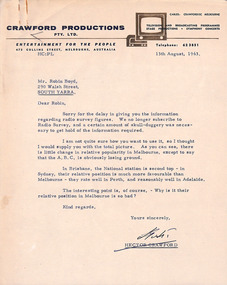
Letter, Hector Crawford, Letter from Hector Crawford to Robin Boyd, 13.08.1963
... ... radio ratings... The Flying... Dogtor" series was broadcast on Australian Television Network (later becoming the Seven Network) between February and April 1964 (see item D254 for schedule). radio survey data radio ratings The Flying Dogtor Robin Boyd Crawford Productions Typewritten, quarto, one page letter. ...Letter from Hector Crawford, Managing Director of Crawford Productions, and attached document provides information regarding 1963 radio survey figures (ratings) gauging relative popularity of stations in Australian cities.The Flying Dogtor" series was broadcast on Australian Television Network (later becoming the Seven Network) between February and April 1964 (see item D254 for schedule).Typewritten, quarto, one page letter. Attached document is 7 foolscap, typed pages.radio survey data, radio ratings, the flying dogtor, robin boyd, crawford productions -
 Robin Boyd Foundation
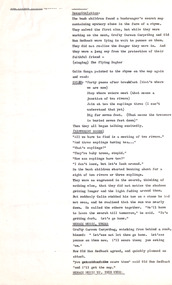
Document - Script, Robin Boyd, The Flying Dogtor. Episode 38, 1963
... Meanwhile, Granny Goanna worried that the children had not returned home and she radioed The Flying Dogtor....Meanwhile, Granny Goanna worried that the children had not returned home and she radioed The Flying Dogtor. The Flying Dogtor" series was broadcast on Australian Television Network (later becoming the Seven Network) between February and April 1964 (see item D254 for schedule). ...The bush children were following a mysterious map leading to a bushranger's hidden treasure when they were attacked by Crafty Carson Carpetbag and Old Man Redback. The map fell out of Colin's pocket and was pulled into the bushes. Meanwhile, Granny Goanna worried that the children had not returned home and she radioed The Flying Dogtor.The Flying Dogtor" series was broadcast on Australian Television Network (later becoming the Seven Network) between February and April 1964 (see item D254 for schedule).Typewritten, carbon copy, foolscap, 2 pagesPage 1: top of page, episode number and title cut offthe flying dogtor, robin boyd, crawford productions, manuscript -
 Robin Boyd Foundation
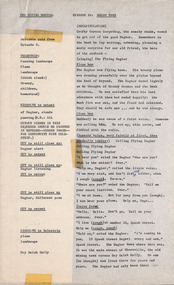
Document - Script, Robin Boyd, The Flying Dogtor. Episode 10 Ghost Town, 1963
... After the fire was distinguished and the flood subsided, on his way flying home, the Dogtor heard voices repeatedly on his radio "Calling Flying Dogtor". ...After the fire was distinguished and the flood subsided, on his way flying home, the Dogtor heard voices repeatedly on his radio "Calling Flying Dogtor". ...After the fire was distinguished and the flood subsided, on his way flying home, the Dogtor heard voices repeatedly on his radio "Calling Flying Dogtor". A sick voice asked for the Dogtor's help in the main street of Ghostville, the old mining town across Dry Gulch Gully, now a ghost town. He got to the abandoned address, 13 ("unlucky number") Spook Street. The Dogtor is about to open the door...The Flying Dogtor" series was broadcast on Australian Television Network (later becoming the Seven Network) between February and April 1964 (see item D254 for schedule).Typewritten, carbon copy, foolscap, 2 pagesPage 1: Left hand side has been amended and is attached with tape. Written corrections on right hand side.the flying dogtor, robin boyd, crawford productions, manuscript -
 Parks Victoria - Gabo Island Lightstation
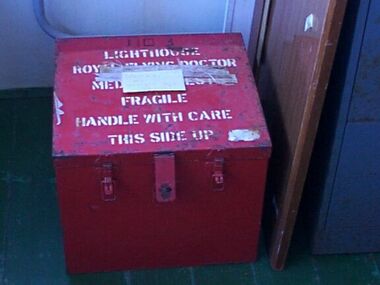
Cabinet
... Flying Doctor first aid kit. Medical first aid box kept at Lightstation. According to a Lighthouse keeper each item was numbered to ensure correct administration of medications by Lightstation staff via radio contact with The Flying Doctor Service. ...Flying Doctor first aid kit. Medical first aid box kept at Lightstation. According to a Lighthouse keeper each item was numbered to ensure correct administration of medications by Lightstation staff via radio contact with The Flying Doctor Service. ...Lightstations Flying Doctor first aid kit. Medical first aid box kept at Lightstation. According to a Lighthouse keeper each item was numbered to ensure correct administration of medications by Lightstation staff via radio contact with The Flying Doctor Service. The lightstation’s first aid case is a red painted metal box. The hinged lid is stencilled with white words of caution such as ‘handle with care and ‘this side up’. Inside are four tray inserts of different sizes. Until recent years the contents of the kit, including medications and an instruction book, were intact but have since been lost and cannot be located. Of the six lightstations investigated by this assessment project, it would seem that the case, which possibly dates to the early 1900s, is unique in its survival at Gabo Island. The cabinet has first level contributory significance for its historic value and provenance to the lightstation.The cabinet has first level contributory significance for its historic value and provenance to the lightstation.Red painted metal box with hinged lid. It has side handles with four removable, red painted metal tray inserts of varying sizes. Inscriptions stencilled in white on lid. Trays have letters stencilled in white on three sides. There are three latches to secure lid. Lock on central latch.Main chest stencilled in white , on top: "NO 3 / LIGHTHOUSE / ROYAL FLYINNG DOCTOR/ MEDICATIONS/HANDLE WITH CARE / THIS SIDE UP" •Four tray inserts, stencilled in white: "A", "B", "C", "D". -
 Flagstaff Hill Maritime Museum and Village
Booklet - Book and World Chart for Emergency Navigation, George Grady Press, The Raft Book, 1943
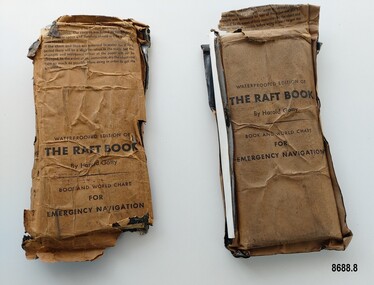
... He worked with several record breaking pilots including Ann Morrow Lindbergh (who went on to serve as a navigator for her husband Charles Lindbergh), helped Wiley Post break the world record circumnavigating the Earth, invented a new method of "dead reckoning" that revolutionised the ability to fly safely through cloudy conditions without drifting off course and famously navigated a small plane (whilst trying to cross the Pacific) over 1900 km through fog (with no radio) and using only his dead reckoning techniques, back to their starting point in Japan after they developed fuel problems. In 1932 Gatty received the Distinguished Flying Cross from President Hoover. ...He worked with several record breaking pilots including Ann Morrow Lindbergh (who went on to serve as a navigator for her husband Charles Lindbergh), helped Wiley Post break the world record circumnavigating the Earth, invented a new method of "dead reckoning" that revolutionised the ability to fly safely through cloudy conditions without drifting off course and famously navigated a small plane (whilst trying to cross the Pacific) over 1900 km through fog (with no radio) and using only his dead reckoning techniques, back to their starting point in Japan after they developed fuel problems. In 1932 Gatty received the Distinguished Flying Cross from President Hoover. ...Harold Gatty was born on January 5th, 1903 in Campbell Town, Tasmania. He was a navigator and aviation pioneer. He began his career learning navigation at the age of 14 as a midshipman at the Royal Australian Naval College but withdrew after three years and became an apprenticed ship's officer with the Patrick Steamship Company of Sydney. After W. W. 1 he joined the Australian Merchant Navy where he learned the constellations while standing night watch and became an expert in celestial navigation while serving on many ships sailing between Australia and California. In 1927 he moved to California and opened a navigation school and also a laboratory repairing navigational equipment. At this time he became very interested in air navigation and was aware of the limitations of existing methods and instruments for aerial navigation. He began researching ways of improving aerial navigation. Two early inventions of his were his air sextant and a ground speed and drift indicator which formed the basis of the automatic pilot which later came to be standard equipment on most aircraft. He worked with several record breaking pilots including Ann Morrow Lindbergh (who went on to serve as a navigator for her husband Charles Lindbergh), helped Wiley Post break the world record circumnavigating the Earth, invented a new method of "dead reckoning" that revolutionised the ability to fly safely through cloudy conditions without drifting off course and famously navigated a small plane (whilst trying to cross the Pacific) over 1900 km through fog (with no radio) and using only his dead reckoning techniques, back to their starting point in Japan after they developed fuel problems. In 1932 Gatty received the Distinguished Flying Cross from President Hoover. In 1934 Gatty formed the South Seas Commercial Company with Donald Douglas with the aim to deliver air services to the islands of the South Pacific. The Company was sold to Pan Am but he continued to work for them. In 1935 he went on a sailing expedition investigating several small islands in the South Pacific and was briefly marooned on Baker Island. He was able to use his extensive knowledge of seabird habits to save the crew. He was also very interested in the ability of the Polynesians to navigate using the stars. During the Second World War Gatty was given the honorary rank of Group Captain in the Royal Australian Air Force (RAAF) and worked for the U. S. Army Air Forces (USAAF) in the South Pacific. In 1943 he moved to Washington where he developed a survival book (The Raft Book) specifically for boat crews or air crews flying over the Pacific to help them survive and navigate their life rafts in remote areas of the ocean. The original book was 152 pages long however a condensed version was made which consisted of a 64 page booklet, combined map and star chart and calendar strip enclosed in a waterproof slipcase, to be placed in life rafts for emergency use. The booklet included navigational advice and ideas such as ocean currents, estimation of distance, using a compass, measurement of angles, recognising and steering by the stars, land indications from sea birds, migration of sea birds and insects, sounds from the land, the scent of the land and ocean currents and the colour of the sea etc. After W.W.2 Gatty moved to Fiji and formed Fiji Airways (which later became Air Pacific). Harold Gatty died in August 1957.The two copies of "The Raft Book" are significant as they are a written summary of the many methods of sea navigation (both modern and historical) that existed in the 1940's. They are also a record of Harold Gatty, who played a significant role in the development of modern day aerial navigation using his understanding of different sea navigational techniques.Two rectangular brown packets with waterproof coverings (oiled paper) titled "The Raft Book" by Harold Gatty. Each packet contains a folded 64 page paper booklet with detailed instructions for navigating a small craft in open seas, a folded chart (with a map of the world and oceans, well known constellations, latitude and longitude charts, Greenwich time and a scale for string lengths and Harp scale) and a long folded paper calendar strip.Front of package - "WATERPROOFED EDITION OF/ THE RAFT BOOK / By Harold Gatty / BOOK AND WORLD CHART / FOR / EMERGENCY NAVIGATION / To open envelope tear along above line. If the envelope is used again fold the flap to keep contents dry. 1. This envelope contains a book, chart and tape for emergency navigation. The contents are folded to take up the least possible space and therefore should not be removed until needed. 2. if the chart and tape are immersed in water for a long period, there will be a slight variation in the scale but the strength and resistence to tear of the paper will not be changed. In the event of long immersion, dry the chart and tape as much as possible before using in order to in order to get the greatest accuracy in scale. Front of booklet - THE RAFT BOOK / LORE OF THE SEA AND SKY /By Harold Gatty IMPORTANT FOR YOUR SECURITY/Upon abandoning ship you may have to be your own navigator. Take the following pre/cautions for your own safety:/ Carry a good type of pocket watch / keep it wound and have it running on Greenwich (England) / Time, which you can get from the navigating officer. / Keep track of the date at Greenwich; and on a 24-hour basis, / know whether the time is, say, 6 hours (6 A.M.) showing on / your watch, or 18 hours (6P.M.) Greenwich. / PROECT YOUR WATCH. GET A RUBBER SACK FOR IT (OBTAIN FROM PHARMACIST) AND KEEP IT DRY / KEEP A PENCIL IN YOUR POCKET/ POSITION OF SHIP WHEN ABANDONED PRINTED IN UNITED STATES OF AMERICA GEORGE GRADY PRESS, NEW YORK/COPYRIGHT, 1943, BY HAROLD AND FENNA GATTYflagstaff hill maritime museum and village, shipwreck coast, warrnambool, the raft book, harold gatty, book and world chart for emergency navigation, ww 2, ww ii, navigation, air navigation, aerial navigation, lindbergh, wiley post, dead reckoning, south seas commercial company, u.s. army airforce, usaaf, survival book, life rafts, sea navigation, emergency navigation, fiji airways, harp scale -
 Orbost & District Historical Society
book, Observer's Air Gunner's and W/T Operator's Flying Log Book, 1938
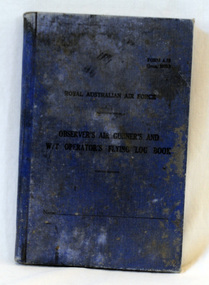
... radio operator, used to record exercises from bases in Victoria and South Australia. Inside, each page is printed with a table. Each column in the table has a title, 'Date', 'Hour', ' Aircraft Type and Number', 'Pilot', 'Duty', 'Remarks', 'Flying time / Day / Night'. ...radio operator, used to record exercises from bases in Victoria and South Australia. Inside, each page is printed with a table. Each column in the table has a title, 'Date', 'Hour', ' Aircraft Type and Number', 'Pilot', 'Duty', 'Remarks', 'Flying time / Day / Night'. ...This type of logbook was issued by the Royal Australian Air Force to non-pilot aircrew to record their flight hour and experience. This information was required for official administrative purposes. The book is incompletely filled in as recorder was "Discharged on compassionate grounds".This book is a useful reference tool.A blue, hard cover log book with details of R.A.A.F. observer/ air gunner/ telegraph operator/ radio operator, used to record exercises from bases in Victoria and South Australia. Inside, each page is printed with a table. Each column in the table has a title, 'Date', 'Hour', ' Aircraft Type and Number', 'Pilot', 'Duty', 'Remarks', 'Flying time / Day / Night'. The table has handwritten entries. air-transport flight-information royal- australian-air-force -
 Orbost & District Historical Society
map, 1985
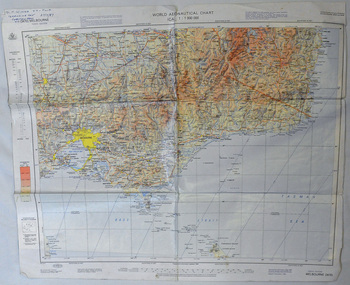
... radio frequencies and airspace boundaries. World aeronautical charts have a scale of 1:1,000,000 and cover relatively large areas. Orbost Aero Club began in 1969 with Basil Dowie as Chair, David Nixon as Secretary/Treasurer. The group went into recess from 1977-1991 closing in 1997. The mid 1960s were boom years in flying...radio frequencies and airspace boundaries. World aeronautical charts have a scale of 1:1,000,000 and cover relatively large areas. Orbost Aero Club began in 1969 with Basil Dowie as Chair, David Nixon as Secretary/Treasurer. The group went into recess from 1977-1991 closing in 1997. The mid 1960s were boom years in flying ...An aeronautical chart is a map designed to assist in navigation of aircraft. Using these charts and other tools, pilots are able to determine their position, safe altitude, best route to a destination, navigation aids along the way, alternative landing areas in case of an in-flight emergency, and other useful information such as radio frequencies and airspace boundaries. World aeronautical charts have a scale of 1:1,000,000 and cover relatively large areas. Orbost Aero Club began in 1969 with Basil Dowie as Chair, David Nixon as Secretary/Treasurer. The group went into recess from 1977-1991 closing in 1997. The mid 1960s were boom years in flying training in Australia and the number of Aero Clubs grew rapidly. The Club played a significant role in the establishment of the small airport at Marlo and in the ongoing operation and development of the airport over the years particularly for patient transfer by aerial ambulance. The Orbost Aero Club Club played a significant role in the establishment of the small airport at Marlo and in the ongoing operation and development of the airport over the years.A laminated map of eastern Victoria. A World Aeronautical Chart. It shows elevations, longitude etc and is designed for pre-flight planning as well as pilotage. Top left hand corner - D.F.N.Nixon VH-FWD 12 Kristine Ct Cheletenham 27/7/87orbost-aero-club aeronautical-map -
 Flagstaff Hill Maritime Museum and Village
Book, Radio and Electrical Encyclopedia and 1935 Catalogue, circa 1935
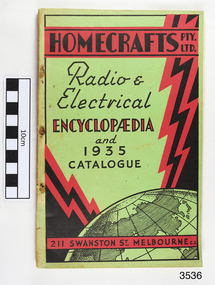
... ...radio equipment reference book...flying...Dr Angus assisted Dr Tom Ryan, a pioneer in the use of X-rays and in ocular surgery. flagstaff hill warrnambool shipwrecked-coast flagstaff-hill flagstaff-hill-maritime-museum maritime-museum shipwreck-coast flagstaff-hill-maritime-village radion equipment catalogue radio equipment reference book flying doctor romote medicine nhill dr w r angus nhill base hospital medical history mira hospital medical education electronic communication remote medical practice 1935 radio catalogue homecrafts pty ltd homeware hardware radio parts . ...This catalogue and reference book was used by Dr Angus during his medical practice at the inland Victorian country town of Nhill. It was donated to Flagstaff Hill Maritime Village by the family of Doctor William Roy Angus, Surgeon and Oculist. It is part of the “W.R. Angus Collection” that includes historical medical equipment, surgical instruments and material once belonging to Dr Edward Ryan and Dr Thomas Francis Ryan, (both of Nhill, Victoria) as well as Dr Angus’ own belongings. The Collection’s history spans the medical practices of the two Doctors Ryan, from 1885-1926 plus that of Dr Angus, up until 1969. ABOUT THE “W.R.ANGUS COLLECTION” Doctor William Roy Angus M.B., B.S., Adel., 1923, F.R.C.S. Edin.,1928 (also known as Dr Roy Angus) was born in Murrumbeena, Victoria in 1901 and lived until 1970. He qualified as a doctor in 1923 at University of Adelaide, was Resident Medical Officer at the Royal Adelaide Hospital in 1924 and for a period was house surgeon to Sir (then Mr.) Henry Simpson Newland. Dr Angus was briefly an Assistant to Dr Riddell of Kapunda, then commenced private practice at Curramulka, Yorke Peninsula, SA, where he was physician, surgeon and chemist. In 1926, he was appointed as new Medical Assistant to Dr Thomas Francis Ryan (T.F. Ryan, or Tom), in Nhill, Victoria, where his experiences included radiology and pharmacy. In 1927 he was Acting House Surgeon in Dr Tom Ryan’s absence. Dr Angus had become engaged to Gladys Forsyth and they decided he would take time to further his studies overseas in the UK in 1927. He studied at London University College Hospital and at Edinburgh Royal Infirmary and in 1928, was awarded FRCS (Fellow from the Royal College of Surgeons), Edinburgh. He worked his passage back to Australia as a Ship’s Surgeon on the on the Australian Commonwealth Line’s SS Largs Bay. Dr Angus married Gladys in 1929, in Ballarat. (They went on to have one son (Graham 1932, born in SA) and two daughters (Helen (died 12/07/1996) and Berenice (Berry), both born at Mira, Nhill ) Dr Angus was a ‘flying doctor’ for the A.I.M. (Australian Inland Ministry) Aerial Medical Service in 1928 . The organisation began in South Australia through the Presbyterian Church in that year, with its first station being in the remote town of Oodnadatta, where Dr Angus was stationed. He was locum tenens there on North-South Railway at 21 Mile Camp. He took up this ‘flying doctor’ position in response to a call from Dr John Flynn; the organisation was later known as the Flying Doctor Service, then the Royal Flying Doctor Service. A lot of his work during this time involved dental surgery also. Between 1928-1932 he was surgeon at the Curramulka Hospital, Yorke Peninsula, South Australia. In 1933 Dr Angus returned to Nhill where he’d previously worked as Medical Assistant and purchased a share of the Nelson Street practice and Mira hospital from Dr Les Middleton one of the Middleton Brothers, the current owners of what was once Dr Tom Ryan’s practice. Dr L Middleton was House Surgeon to the Nhill Hospital 1926-1933, when he resigned. [Dr Tom Ryan’s practice had originally belonged to his older brother Dr Edward Ryan, who came to Nhill in 1885. Dr Edward saw patients at his rooms, firstly in Victoria Street and in 1886 in Nelson Street, until 1901. The Nelson Street practice also had a 2 bed ward, called Mira Private Hospital ). Dr Edward Ryan was House Surgeon at the Nhill Hospital 1884-1902 . He also had occasions where he successfully performed veterinary surgery for the local farmers too. Dr Tom Ryan then purchased the practice from his brother in 1901. Both Dr Edward and Dr Tom Ryan work as surgeons included eye surgery. Dr Tom Ryan performed many of his operations in the Mira private hospital on his premises. He too was House Surgeon at the Nhill Hospital 1902-1926. Dr Tom Ryan had one of the only two pieces of radiology equipment in Victoria during his practicing years – The Royal Melbourne Hospital had the other one. Over the years Dr Tom Ryan gradually set up what was effectively a training school for country general-practitioner-surgeons. Each patient was carefully examined, including using the X-ray machine, and any surgery was discussed and planned with Dr Ryan’s assistants several days in advance. Dr Angus gained experience in using the X-ray machine there during his time as assistant to Dr Ryan. Dr Tom Ryan moved from Nhill in 1926. He became a Fellow of the Royal Australasian College of Surgeons in 1927, soon after its formation, a rare accolade for a doctor outside any of the major cities. He remained a bachelor and died suddenly on 7th Dec 1955, aged 91, at his home in Ararat. Scholarships and prizes are still awarded to medical students in the honour of Dr T.F. Ryan and his father, Dr Michael Ryan, and brother, John Patrick Ryan. ] When Dr Angus bought into the Nelson Street premises in Nhill he was also appointed as the Nhill Hospital’s Honorary House Surgeon 1933-1938. His practitioner’s plate from his Nhill surgery states “HOURS Daily, except Tuesdays, Fridays and Saturday afternoons, 9-10am, 2-4pm, 7-8pm. Sundays by appointment”. This plate is now mounted on the doorway to the Port Medical Office at Flagstaff Hill Maritime Village, Warrnambool. Dr Edward Ryan and Dr Tom Ryan had an extensive collection of historical medical equipment and materials spanning 1884-1926 and when Dr Angus took up practice in their old premises he obtained this collection, a large part of which is now on display at the Port Medical Office at Flagstaff Hill Maritime Village in Warrnambool. During his time in Nhill Dr Angus was involved in the merging of the Mira Hospital and Nhill Public Hospital into one public hospital and the property titles passed on to Nhill Hospital in 1939. In 1939 Dr Angus and his family moved to Warrnambool where he purchased “Birchwood,” the 1852 home and medical practice of Dr John Hunter Henderson, at 214 Koroit Street. (This property was sold in1965 to the State Government and is now the site of the Warrnambool Police Station. ). The Angus family was able to afford gardeners, cooks and maids; their home was a popular place for visiting dignitaries to stay whilst visiting Warrnambool. Dr Angus had his own silk worm farm at home in a Mulberry tree. His young daughter used his centrifuge for spinning the silk. Dr Angus was appointed on a part-time basis as Port Medical Officer (Health Officer) in Warrnambool and held this position until the 1940’s when the government no longer required the service of a Port Medical Officer in Warrnambool; he was thus Warrnambool’s last serving Port Medical Officer. (The duties of a Port Medical Officer were outlined by the Colonial Secretary on 21st June, 1839 under the terms of the Quarantine Act. Masters of immigrant ships arriving in port reported incidents of diseases, illness and death and the Port Medical Officer made a decision on whether the ship required Quarantine and for how long, in this way preventing contagious illness from spreading from new immigrants to the residents already in the colony.) Dr Angus was a member of the Australian Medical Association, for 35 years and surgeon at the Warrnambool Base Hospital 1939-1942, He served as a Surgeon Captain during WWII1942-45, in Ballarat, Victoria, and in Bonegilla, N.S.W., completing his service just before the end of the war due to suffering from a heart attack. During his convalescence he carved an intricate and ‘most artistic’ chess set from the material that dentures were made from. He then studied ophthalmology at the Royal Melbourne Eye and Ear Hospital and created cosmetically superior artificial eyes by pioneering using the intrascleral cartilage. Angus received accolades from the Ophthalmological Society of Australasia for this work. He returned to Warrnambool to commence practice as an ophthalmologist, pioneering in artificial eye improvements. He was Honorary Consultant Ophthalmologist to Warrnambool Base Hospital for 31 years. He made monthly visits to Portland as a visiting surgeon, to perform eye surgery. He represented the Victorian South-West subdivision of the Australian Medical Association as its secretary between 1949 and 1956 and as chairman from 1956 to 1958. In 1968 Dr Angus was elected member of Spain’s Barraquer Institute of Barcelona after his research work in Intrasclearal cartilage grafting, becoming one of the few Australian ophthalmologists to receive this honour, and in the following year presented his final paper on Living Intrasclearal Cartilage Implants at the Inaugural Meeting of the Australian College of Ophthalmologists in Melbourne In his personal life Dr Angus was a Presbyterian and treated Sunday as a Sabbath, a day of rest. He would visit 3 or 4 country patients on a Sunday, taking his children along ‘for the ride’ and to visit with him. Sunday evenings he would play the pianola and sing Scottish songs to his family. One of Dr Angus’ patients was Margaret MacKenzie, author of a book on local shipwrecks that she’d seen as an eye witness from the late 1880’s in Peterborough, Victoria. In the early 1950’s Dr Angus, painted a picture of a shipwreck for the cover jacket of Margaret’s book, Shipwrecks and More Shipwrecks. She was blind in later life and her daughter wrote the actual book for her. Dr Angus and his wife Gladys were very involved in Warrnambool’s society with a strong interest in civic affairs. Their interests included organisations such as Red Cross, Rostrum, Warrnambool and District Historical Society (founding members), Wine and Food Society, Steering Committee for Tertiary Education in Warrnambool, Local National Trust, Good Neighbour Council, Housing Commission Advisory Board, United Services Institute, Legion of Ex-Servicemen, Olympic Pool Committee, Food for Britain Organisation, Warrnambool Hospital, Anti-Cancer Council, Boys’ Club, Charitable Council, National Fitness Council and Air Raid Precautions Group. He was also a member of the Steam Preservation Society and derived much pleasure from a steam traction engine on his farm. He had an interest in people and the community He and his wife Gladys were both involved in the creation of Flagstaff Hill, including the layout of the gardens. After his death (28th March 1970) his family requested his practitioner’s plate, medical instruments and some personal belongings be displayed in the Port Medical Office surgery at Flagstaff Hill Maritime Village, and be called the “W. R. Angus Collection”. The W.R. Angus Collection is significant for still being located at the site it is connected with, Doctor Angus being the last Port Medical Officer in Warrnambool. The collection of medical instruments and other equipment is culturally significant, being an historical example of medicine from late 19th to mid-20th century. Dr Angus assisted Dr Tom Ryan, a pioneer in the use of X-rays and in ocular surgery. Radio and Electrical Encyclopaedia and 1935 Catalogue, Homecrafts Pty Ltd, 211 Swanston Street Melbourne. Soft cover. Includes advertisements. (W.R. Angus Collection) flagstaff hill, warrnambool, shipwrecked-coast, flagstaff-hill, flagstaff-hill-maritime-museum, maritime-museum, shipwreck-coast, flagstaff-hill-maritime-village, radion equipment catalogue, radio equipment reference book, flying doctor, romote medicine, nhill, dr w r angus, nhill base hospital, medical history, mira hospital, medical education, electronic communication, remote medical practice, 1935 radio catalogue, homecrafts pty ltd, homeware, hardware, radio parts, . -
 Montmorency–Eltham RSL Sub Branch
Medal - Mothers and Widows Badge 1939 - 1945
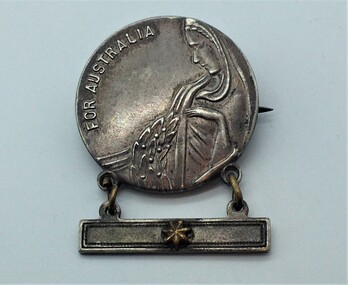
... The aircraft flown by the Commanding Officer of No. 20 Squadron W.Cdr Francis Bloomfield Chapman (271349) with Flying Officer S.A.Deacon as R.D.F. Operator (ie. radio officer) and 7 other crew members departed Cairns, and later reported being on fire, probably force landing 30 miles south east of Gasmata. ...The aircraft flown by the Commanding Officer of No. 20 Squadron W.Cdr Francis Bloomfield Chapman (271349) with Flying Officer S.A.Deacon as R.D.F. Operator (ie. radio officer) and 7 other crew members departed Cairns, and later reported being on fire, probably force landing 30 miles south east of Gasmata. ...This badge was issued to Mrs M Deacon (mother) of 67 Cramer St, Preston to commemorate her son Flying Officer Stanley Alfred DEACON (255057) who was lost in a Consolidated Catalina A-24-22 of No. 20 Squadron RAAF, on the night of 08/09March 1943. The aircraft flown by the Commanding Officer of No. 20 Squadron W.Cdr Francis Bloomfield Chapman (271349) with Flying Officer S.A.Deacon as R.D.F. Operator (ie. radio officer) and 7 other crew members departed Cairns, and later reported being on fire, probably force landing 30 miles south east of Gasmata. A 3-4 day air search failed to find any sign of the aircraft or survivors. Gasmata is located in New Britain, Bismarck Archipelago, Bismarck, New Guinea. Stanley Alfred Deacon is commemorated at the Australian War Memorial and the Rabaul Memorial. https://www.awm.gov.au/collection/P10307635 Obverse: Circular metal (silver-coloured) badge with raised image of woman with floral bouquet. Raised lettering (see below) Suspended from badge, a rectangular metal strip (suspended by two rings) with small star held by split pin. Reverse: Hinged metal pin clasp Engraving (see below)Obverse: FOR AUSTRALIA Reverse: ISSUED BY THE C'WLTH GOVT A.F. 3713 AMOR SYDNEYww2., mothers and widows badge -
 Flagstaff Hill Maritime Museum and Village
Equipment - EPIRB Transmitter
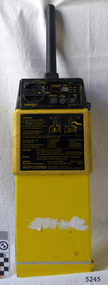
... Radio Beacon) was found on the beach at Levy's Point, Warrnambool, in December 2000 by a Warrnambool resident. Local police were alerted at the time. This distress signal unit is a world-wide COSPAS/SARSAT, satellite assisted, SAR (Search and Rescue) system for location of distress transmissions emitted by an EPIRB. Offshore cruising vessels must have such a unit as part of its essential safety equipment. This model EPIRB relies on four satellites with orbit times of approximately 100 minutes. Earlier units relied solely on aircraft flying...Radio Beacon) was found on the beach at Levy's Point, Warrnambool, in December 2000 by a Warrnambool resident. Local police were alerted at the time. This distress signal unit is a world-wide COSPAS/SARSAT, satellite assisted, SAR (Search and Rescue) system for location of distress transmissions emitted by an EPIRB. Offshore cruising vessels must have such a unit as part of its essential safety equipment. This model EPIRB relies on four satellites with orbit times of approximately 100 minutes. Earlier units relied solely on aircraft flying ...This distress EPIRB unit (Emergency Position Indication Radio Beacon) was found on the beach at Levy's Point, Warrnambool, in December 2000 by a Warrnambool resident. Local police were alerted at the time. This distress signal unit is a world-wide COSPAS/SARSAT, satellite assisted, SAR (Search and Rescue) system for location of distress transmissions emitted by an EPIRB. Offshore cruising vessels must have such a unit as part of its essential safety equipment. This model EPIRB relies on four satellites with orbit times of approximately 100 minutes. Earlier units relied solely on aircraft flying overhead to detect and forward on the EPIRB’s location to Search And Rescue authorities, whereas this new system utilises satellites. An employee from the Lokata firm provided additional information about the Lokata EPIRB units. They had a machined aluminium case with labels that were also made on site. The units could be activated manually or automatically released when a magnetic switch in the case casing was activated. This later model, circa 1983, would have been mounted externally on a vessel's bulkhead in a spring-loaded, stainless-steel protective 'skeleton' mounting, The unit released when the water pressure sensor detected a set time it was under the water, in a similar way that life crafts were released. Each unit was registered to a particular vessel - the vessel's details on this unit are indecipherable. The Lokata Company was established in 1970, designing and manufacturing marine products including communications. The company no longer makes products with the “Lokata” brand. In 2001 Sartech Engineering Ltd. took over the support for the Lokata EPIRB beacons. This emergency location device is a late 20th century invention to help save lives at sea. It adds to the history of maritime life, its risks, the lives lost as sea, and the many inventions aimed as rescuing and saving lives. The local area is notorious for the number of lives lost through shipwreck. It also carries stories of heroic efforts to save lives, and other inventions to help reduce the chance of accidents at sea.EPIRB unit; “Emergency Position Indication Radio Beacon”. A distress communication unit for sending a distress location transmission in an emergency at sea. The EPIRB is a yellow, rectangular box with dials, buttons, indicator lights and instruction. An antenna protrudes from the top of the unit. The EPIRB unit sends a 406P (X) EPIRB, with 406M-Hz frequency, 48-hour duration signal. The maker was LOKATA Ltd in England. Remnants of a white label remain on the side. Circa 1980s."NAME OF VESSEL 'SERVICE IF SELF TEST FAILS' " “LO-KATA” moulded into the body. "406P (X) EPIRB" “Model 406” "Lokata Type No 92408" "UK Type approved to MPT 1278" "Class 2" "Made by Lokata Ltd, Falmouth Cornwall England TR10 8AE"" "LOKATE LTD. New North Road Hainault, Ilford Essex IG6 2UR" "ARMED / SAFE / TRANSMIT / CODE / DISPLAY / SET / wait / pass / fail / TEST" "IDENTIFIER / 1349:24034234N" [some characters may be different] "COUNTRY / DENMARK" "VESSEL IDENTITY / 124 [the rest is indecipherable]flagstaff hill, warrnambool, shipwrecked-coast, flagstaff-hill, flagstaff-hill-maritime-museum, maritime-museum, shipwreck-coast, flagstaff-hill-maritime-village, emergency position indicating radio beacon, epirb, lokata ltd, marine safety equipment, satellite transmitting beacon, safety equipment, distress signal, life saving, safety at sea, shipwreck location, lo-kata, falmouth, emergency, beacon, radio signal, communication, marine equipment -
 Running Rabbits Military Museum operated by the Upwey Belgrave RSL Sub Branch
Hat
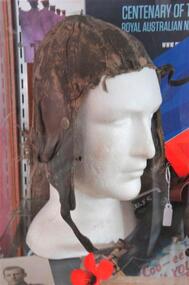
... Flying Helmet with radio connection...Headgear WW2 RAAF Flying Helmet with radio connection Hat ...Flying Helmet with radio connectionheadgear, ww2, raaf -
B-24 Liberator Memorial Restoration Australia Inc
Work on paper - Flying Log Book Exerpts of F/O D.R. Gilmore
... F/O Gilmore was a Radio Operator on B-24 Liberators from 6/1/1945 to 12/1945. Photocopied A4 sheets of paper Work on paper Flying Log Book Exerpts of F/O D.R. ...F/O Gilmore was a Radio Operator on B-24 Liberators from 6/1/1945 to 12/1945.Photocopied A4 sheets of paper -
 Monbulk RSL Sub Branch
Book, Aurum Press Ltd, The secret listeners : The men and women posted across the world to intercept the secret german codes for Bletchley Park, 2012
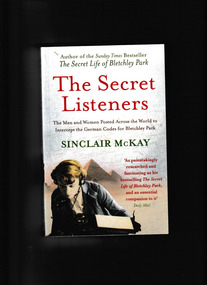
... radio traffic in the European theatre. This is the story of the - usually very young - men and women sent out to farflung outposts to listen in for Bletchley Park, an oral history of exotic locations and ordinary lives turned upside down by a sudden remote posting - the heady nightlife in Cairo, filing cabinets full of snakes in North Africa, and flights out to Delhi by luxurious flying boat. ...Before Bletchley Park could break the German war machine's code, its daily military communications had to be monitored and recorded by 'the Listening Service', the wartime department whose bases moved with every theatre of war (Cairo, Malta, Gibraltar, Iraq, Cyprus) as well as having listening stations along the eastern coast of Britain to intercept radio traffic in the European theatre. This is the story of the - usually very young - men and women sent out to farflung outposts to listen in for Bletchley Park, an oral history of exotic locations and ordinary lives turned upside down by a sudden remote posting - the heady nightlife in Cairo, filing cabinets full of snakes in North Africa, and flights out to Delhi by luxurious flying boat.Index, ill, map, p.354.non-fictionBefore Bletchley Park could break the German war machine's code, its daily military communications had to be monitored and recorded by 'the Listening Service', the wartime department whose bases moved with every theatre of war (Cairo, Malta, Gibraltar, Iraq, Cyprus) as well as having listening stations along the eastern coast of Britain to intercept radio traffic in the European theatre. This is the story of the - usually very young - men and women sent out to farflung outposts to listen in for Bletchley Park, an oral history of exotic locations and ordinary lives turned upside down by a sudden remote posting - the heady nightlife in Cairo, filing cabinets full of snakes in North Africa, and flights out to Delhi by luxurious flying boat.world war 1939-1945 - great britain - intelligence, world war 1939-1945 - cryptography -
 Monbulk RSL Sub Branch
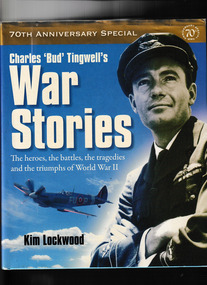
Book, Wilkinson Publishing, Charles 'Bud' Tingwell's war stories : the heroes, the battles, the tragedies and the triumphs of World War II, 2009
... World War 1939-1945 - Australian involvement Charles (Bud) Tingwell ollow Bud's journey from his early days as a young radio announcer in Sydney to his training and voyages across the oceans to Canada, Europe Europe and the Middle East, to his experiences flying aircraft and ground fire while doing his part in providing a valuable service to allied war effort. ...ollow Bud's journey from his early days as a young radio announcer in Sydney to his training and voyages across the oceans to Canada, Europe Europe and the Middle East, to his experiences flying aircraft and ground fire while doing his part in providing a valuable service to allied war effort. This book includes many the biographies of soliders.Index, ill, p.360.non-fictionollow Bud's journey from his early days as a young radio announcer in Sydney to his training and voyages across the oceans to Canada, Europe Europe and the Middle East, to his experiences flying aircraft and ground fire while doing his part in providing a valuable service to allied war effort. This book includes many the biographies of soliders.world war 1939-1945 - australian involvement, charles (bud) tingwell -
 National Vietnam Veterans Museum (NVVM)
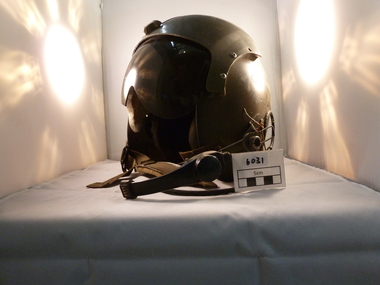
Uniform, Helmet
... Radio Technician, Royal Australian Airforce, who was also serving in 161 Recce. Craftsman O'Brien requested that he have his own helmet, instead of having to be issued with one prior to each test flight and retuning it afterwards. Corporal Menear obliged. Helmet Vietnam RAAF O'Brien 161 Recce Menear 19 Large/ DSA100-4804 Gentex Corp. Microphone / M-33A/AIC A flying ...Craftsman David W O'Brien served in the Royal Corps of Australian Electrical and Mechanical Engineers, and flew test flights in Vietnam with 161 Reconnaissance Flight (161 Recce) in 1965-66. His job was to ensure that instrument panels were functioning properly. This helmet was assembled for him by Corporal Peter D Menear, Air Radio Technician, Royal Australian Airforce, who was also serving in 161 Recce. Craftsman O'Brien requested that he have his own helmet, instead of having to be issued with one prior to each test flight and retuning it afterwards. Corporal Menear obliged.A flying helmet. Gentex/ 8415-782-3037. Is khaki in colour with a sun visor. It is fitted with a microphone at the front. 19 Large/ DSA100-4804 Gentex Corp. Microphone / M-33A/AIChelmet, vietnam, raaf, o'brien, 161 recce, menear -
 National Vietnam Veterans Museum (NVVM)
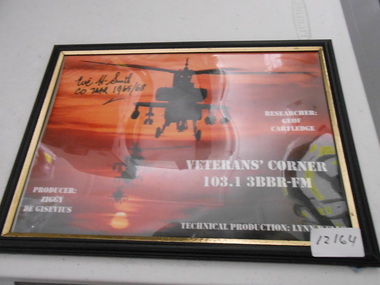
Poster, Veterans' Corner 103.1 3BBR-FM
... Framed poster advertising Veterans corner radio program, 103.1 3BBR-Fm. The image is of four Apache helicopters flying in formation with the setting. ...Smith/CO 7RAR 1965.68/Researcher: Geof/Cartledge/ Veterans' corner/103.1 3BBR-FM/Producer:/Ziggy/De Gisevius/Technical Production: Lynn Wells Framed poster advertising Veterans corner radio program, 103.1 3BBR-Fm. The image is of four Apache helicopters flying in formation with the setting. ...Framed poster advertising Veterans corner radio program, 103.1 3BBR-Fm. The image is of four Apache helicopters flying in formation with the setting. The poster is signed by EWE H-Smith CO 7 RAR 1965-68.Ewe H. Smith/CO 7RAR 1965.68/Researcher: Geof/Cartledge/ Veterans' corner/103.1 3BBR-FM/Producer:/Ziggy/De Gisevius/Technical Production: Lynn Wellsposter, 7 rar, veterans' corner -
 National Vietnam Veterans Museum (NVVM)
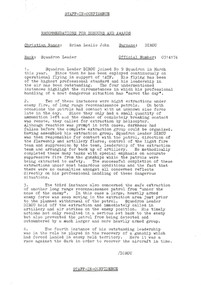
Document, Recommendation for Honours and Awards: Squadron Leader Brian Leslie John Dirou
... Flying Cross...United States of America Armed Forces...104 Signal Squadron...SAS Trooper David Fisher...2787344...Trooper...Royal Australian Infantry Corps...2nd Special Air Service Squadon...3rd Special Air Service Squadron...SAS...Nui Chua Chan (Hill 837)...US Army 53 Sig Bn Radio...He was awarded the Distinguished Flying Cross (DFC) by the United States of America Armed Forces Royal Australian Air Force Squadron Leader Brian Leslie John Dirou 0314174 Air pilots RAAF 9 Squadron Distinguished Flying Cross United States of America Armed Forces 104 Signal Squadron SAS Trooper David Fisher 2787344 Trooper Royal Australian Infantry Corps 2nd Special Air Service Squadon 3rd Special Air Service Squadron SAS Nui Chua Chan (Hill 837) US Army 53 Sig Bn Radio Site 152 Sig Det Comcen Nui Dat 1961-1975 -- Missing in action - Australia Cpl Richard "Rick" Talbot Male 43806 Royal Australian Corps of Signals Signalman David "Murf" Joseph Murphy 1733914 Australian National Serviceman Signalman John "Dinga" William Bell 39415 US Army 53rd Signal Battalion Operation Aussies Home A Photocopy of the recommendations for honours and awards for Squadron Leader Brian Leslie John Dirou. ...This item was donatedby Squadron Leader Brian Leslie John Dirou (03141740 who was a pilot with the Royal Australian Airforce who performed general duties. Suadron Leader Dirou served in Vitnam with No 9 Squadron from March 1968 to June 1969 and June 1971 to Oct 1971. He was awarded the Distinguished Flying Cross (DFC) by the United States of America Armed Forces A Photocopy of the recommendations for honours and awards for Squadron Leader Brian Leslie John Dirou. See medial files for full story.royal australian air force, squadron leader brian leslie john dirou, 0314174, air pilots, raaf, 9 squadron, distinguished flying cross, united states of america armed forces, 104 signal squadron, sas trooper david fisher, 2787344, trooper, royal australian infantry corps, 2nd special air service squadon, 3rd special air service squadron, sas, nui chua chan (hill 837), us army 53 sig bn radio site, 152 sig det comcen, nui dat, 1961-1975 -- missing in action - australia, cpl richard "rick" talbot male, 43806, royal australian corps of signals, signalman david "murf" joseph murphy, 1733914, australian national serviceman, signalman john "dinga" william bell, 39415, us army 53rd signal battalion, operation aussies home -
Moorabbin Air Museum
Manual (Item) - Royal Air Force Manual - Flying - Volume C, Radio and Radar
... Royal Air Force Manual - Flying - Volume C, Radio and Radar...Royal Air Force Manual - Flying - Volume C, Radio and Radar...AP 3456C Royal Air Force Manual - Flying - Volume C, Radio and Radar Manual Royal Air Force Manual - Flying - Volume C, Radio and Radar ...AP 3456C -
Moorabbin Air Museum
Document (item) - John Porter Collection
... Radio Operators' Manual. October 1944. D. Elford. Air Ministry - Instructors Handbook of Elementary Flying Training. ...Radio Operators' Manual. October 1944. D. Elford. Air Ministry - Instructors Handbook of Elementary Flying Training. ... -
 Robin Boyd Foundation
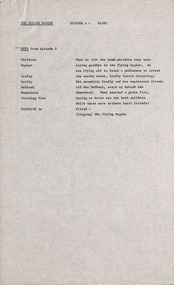
Document - Script, Robin Boyd, The Flying Dogtor. Episode 4 Rain, 1963
... radio. The fire then reached their store of fireworks and 'Boom!'. The Flying Dogtor" series was broadcast on Australian Television Network (later becoming the Seven Network) between February and April 1964 (see item D254 for schedule). ...Crafty Carson and his nasty friends started a grass fire which started to spread. The flames were raging and the bush children watched in horror. Granny Goanna was unwell and in the homestead. The bush children tried to call the Dogtor but flames had damaged the radio. The fire then reached their store of fireworks and 'Boom!'.The Flying Dogtor" series was broadcast on Australian Television Network (later becoming the Seven Network) between February and April 1964 (see item D254 for schedule).Typewritten, carbon copy, foolscap, 4 pages.Page 2, 'Man' handwritten in between 'Old' and 'Redback'.the flying dogtor, robin boyd, crawford productions -
Moorabbin Air Museum
Manual (Item) - AP 3456C Royal Air Force Manual Flying Volume C Radio And Radar
... AP 3456C Royal Air Force Manual Flying Volume C Radio And Radar...AP 3456C Royal Air Force Manual Flying Volume C Radio And Radar...Ministry Of Defence AP3456C AP 3456C Royal Air Force Manual Flying Volume C Radio And Radar Manual AP 3456C Royal Air Force Manual Flying Volume C Radio And Radar ...Ministry Of Defence AP3456C -
Moorabbin Air Museum
Article (item) - the airlog advertisement fo flying doctor march 1944, Flying doctor pedal radio
... Flying doctor pedal radio...Flying doctor pedal radio Article the airlog advertisement fo flying doctor march 1944 ... -
Moorabbin Air Museum
Manual - RAAF flying manuals, Royal Australian Air Force Flying - Volume 3 Radio and Radar
... Royal Australian Air Force Flying - Volume 3 Radio and Radar...RAAF Flying manuals Communications Communications procedures Hyperbolic navigation systems Doppler navigation systems Airborne search radar Approach & landing aids Part of 10 volume general reference on flying , circa 1960 Royal Australian Air Force Flying - Volume 3 Radio and Radar Manual RAAF flying manuals ...Part of 10 volume general reference on flying , circa 1960non-fictionPart of 10 volume general reference on flying , circa 1960communications, communications procedures, hyperbolic navigation systems, doppler navigation systems, airborne search radar, approach & landing aids -
Moorabbin Air Museum
Book - Australian aviation year books, Australian Aviation Year Book 1967/68
... flying schools...Approved firms...Fleet air arm...Aircraft leasing & hire purchase companies...Airline operators...Aircraft production...Aircraft register...Aerial work operators...Charter operators...Ground training colleges...History of Australian aviation...Insurance companies/brokers...RAAF...Radio...Australian aviation year books Aerodromes & airfields Aero clubs & flying schools Approved firms Fleet air arm Aircraft leasing & hire purchase companies Airline operators Aircraft production Aircraft register Aerial work operators Charter operators Ground training colleges History of Australian aviation Insurance companies/brokers RAAF Radio navigation aids Guide to aviation industry throughout Australia & Papua New Guinea Australian Aviation Year Book 1967/68 Book Australian aviation year books ...Guide to aviation industry throughout Australia & Papua New Guineanon-fictionGuide to aviation industry throughout Australia & Papua New Guineaaerodromes & airfields, aero clubs & flying schools, approved firms, fleet air arm, aircraft leasing & hire purchase companies, airline operators, aircraft production, aircraft register, aerial work operators, charter operators, ground training colleges, history of australian aviation, insurance companies/brokers, raaf, radio navigation aids -
Moorabbin Air Museum
Book - Instrument Flying, Instrument Pilot Exam Guide
... Instrument Flying Civil air regulations Radio / navigation aids Weather Instruments Sample exams Guide to exam for American FAA instrument pilot examination, circa 1964 Instrument Pilot Exam Guide Book Instrument Flying ...Guide to exam for American FAA instrument pilot examination, circa 1964non-fictionGuide to exam for American FAA instrument pilot examination, circa 1964civil air regulations, radio / navigation aids, weather, instruments, sample exams
