
Showing 6 items matching "railway, lamp, lantern, kerosene"
-
 Numurkah & District Historical Society
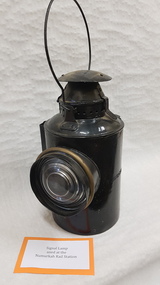
Railway Signal Lamp
... railway, lamp, lantern, kerosene...this signal lamp was used at the Numurkah Railway Station railway, lamp, lantern, kerosene Numurkah (metal embossing) Black-painted tin, cylindrical in shape, with handle. ...this signal lamp was used at the Numurkah Railway StationBlack-painted tin, cylindrical in shape, with handle. Circular lens at the front with brass-coloured edging. Smaller red lens at the back with white edging. Side slot for hanging lantern onto post or hook. Round chimney/vent at the topNumurkah (metal embossing)railway, lamp, lantern, kerosene -
 Numurkah & District Historical Society
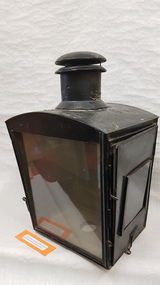
Railways Platform Lamp
... Railway, Platform lamp, Lantern, Signal, Kerosene...Railway, Platform lamp, Lantern, Signal, Kerosene Large Platform Lamp used by Railways to signal train at stoppings, Cubed in shape with angled sides. ...Large Platform Lamp used by Railways to signal train at stoppings, Cubed in shape with angled sides. Plain glass front, Red-coloured lens on both sides, which can be opened to reveal plain glass.. Covered chimney on top . Bracket on the back to hang the lamp up. railway, platform lamp, lantern, signal, kerosene -
 Orbost & District Historical Society
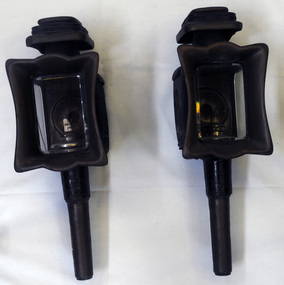
buggy lamps, 1880's -1910
... railway, remote areas still relied on the horse for local transport.Until Australian coachbuilders began making buggies from the 1860s, most were made in America Buggies with four wheels were light but comfortable. Many had hoods to keep the sun and rain off passengers. They were generally owned by doctors, ‘squatters’ and business people. Some had small turn-out seats at the back for children. Lamps are placed at different places on the carriage sides: 1 lamp on each side placed close to box seat These lanterns are examples of lighting devices used in the time of horse and carriage transport. lighting kerosene ...In the beginning of the19th century, the main mode of transportation was the horse and carriage. Even after the advent of the railway, remote areas still relied on the horse for local transport.Until Australian coachbuilders began making buggies from the 1860s, most were made in America Buggies with four wheels were light but comfortable. Many had hoods to keep the sun and rain off passengers. They were generally owned by doctors, ‘squatters’ and business people. Some had small turn-out seats at the back for children. Lamps are placed at different places on the carriage sides: 1 lamp on each side placed close to box seatThese lanterns are examples of lighting devices used in the time of horse and carriage transport.Two kerosene lanterns - buggy lamps.They are rectangular in shape and have a chimney on top. Both have carrying handles.There are 3 glass windows having two clear white lights and one small red round light on the back. The ceramic burner is made by Barton's.On ceramic wick holder - B in the middle of BARTONS B Underneath is TRADE MARK lighting kerosene-lights buggy-lamps transport lanterns -
 Mont De Lancey
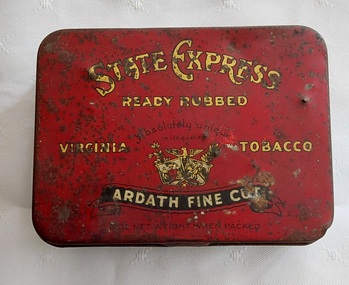
Domestic object - Tin, State Express, 1. mid 20th century
... Lantern,company started in the early 19th century, with William Henry Tilley manufacturing gas lamps in the 1830s. By 1919, the company pivoted to kerosene (paraffin) pressure lamps, using a pressurized system for lighting, which was improved with incandescent mantles. The company expanded rapidly, securing major contracts to supply lamps to railway...Lantern,company started in the early 19th century, with William Henry Tilley manufacturing gas lamps in the 1830s. By 1919, the company pivoted to kerosene (paraffin) pressure lamps, using a pressurized system for lighting, which was improved with incandescent mantles. The company expanded rapidly, securing major contracts to supply lamps to railway ...1. State Express Ready Rubbed, produced by the Ardath Tobacco Company (est. 1895 London), was a popular Virginia tobacco, notably manufactured in Australia during the mid-20th century. The tins were typically small to mid-sized, featuring the "State Express" and "Ardath Fine Cut" branding, with "Ready Rubbed" indicating it was pre-shredded tobacco. Used widely by Australian soldiers in WWII, these compact tins are highly collectible today, appearing through the 1960s. 2. The Tilley Storm Lantern,company started in the early 19th century, with William Henry Tilley manufacturing gas lamps in the 1830s. By 1919, the company pivoted to kerosene (paraffin) pressure lamps, using a pressurized system for lighting, which was improved with incandescent mantles. The company expanded rapidly, securing major contracts to supply lamps to railway companies for track work and inspections. Tilley lamps were extensively used by British armed forces during both World Wars. In WWII, they were essential for field operations, guiding aircraft (RAF), and providing light in blackout conditions. 1. A red rectangular, State Express cigarette tin with a hinged lid. The company logo and other details are printed in gold lettering on the lid as well as Ready Rubbed Virginia Tobacco Ardath Fine Cut. There is an insignia with two crossed heraldic flags and an eagle on top. This information is printed in black lettering on a gold background inside the lid. 2. The tin contains a folded green paper instruction leaflet for the use of a Tilley Storm Lantern made in England with a black plastic branded Tilley Spare Part Dipstick used for measuring the fuel level. There is also a broken thin black ring fitting.1. On the front of the lid: 'State Express Ready Rubbed Absolutely unique in its quality Virginia Tobacco Ardath Fine Cut'. There is an insignia with two crossed heraldic flags and an eagle on top. 2oz. Net Weight. When packed is at the bottom in black print. Inside the lid: 'Every tin of genuine Star Express Ready Rubbed Ardath Fine Cut has the name of Ardath printed on the paper lining' The insignia is also printed. 2. Included is a green folded pamphlet 'Hints on the use of your Tilley Storm Lantern (Regd.)' Information in the leaflet is quite detailed. The dipstick has 'The Tilley Lamp Co. Ltd. Dipstick for Models named on reverse. E.X.100.,P.L.53.,10.,T.L.13., R. T.L.106.,T.L.136.,X246.K.L.80.,LIFE BUOY. USE ONLY GENUINE 'TILLEY' SPARE PARTS'smoking equipment, cigarette containers, tobacco -
 Mont De Lancey
Domestic object - Kerosene Wall Lantern, early 1900's
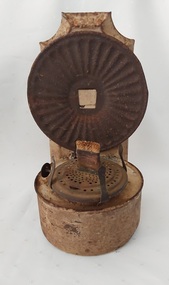
... Wall-mounted kerosene lanterns revolutionized home lighting in the mid-19th century, following Ignacy Łukasiewicz’s 1853 invention of the modern kerosene lamp. They provided a bright, safe alternative to whale oil, using glass chimneys and metal reflectors (often on wall brackets) to illuminate rooms and railway guard’s vans until rural electrification in the 1940s. ...Wall-mounted kerosene lanterns revolutionized home lighting in the mid-19th century, following Ignacy Łukasiewicz’s 1853 invention of the modern kerosene lamp. They provided a bright, safe alternative to whale oil, using glass chimneys and metal reflectors (often on wall brackets) to illuminate rooms and railway guard’s vans until rural electrification in the 1940s. ...Wall-mounted kerosene lanterns revolutionized home lighting in the mid-19th century, following Ignacy Łukasiewicz’s 1853 invention of the modern kerosene lamp. They provided a bright, safe alternative to whale oil, using glass chimneys and metal reflectors (often on wall brackets) to illuminate rooms and railway guard’s vans until rural electrification in the 1940s. A vintage cream coloured tin wall mounted kerosene lamp for use to light the home in the 1900's. It has a shaped back support with a mounted circular reflector attached to a slide in slot. At the front there is a kerosene container with an adjustable turning wick. A glass chimney would have covered the wick to stop the flame from blowing out. There are four metal clips to support the chimney.lamps, lighting equipment, argand lamps, kerosene lamps, wall lamps -
 Mont De Lancey
Domestic object - Kerosene Wall Lantern, early 1900's
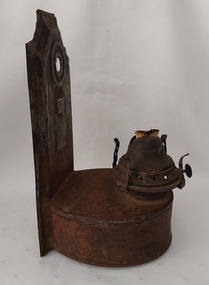
... Wall-mounted kerosene lanterns revolutionized home lighting in the mid-19th century, following Ignacy Łukasiewicz’s 1853 invention of the modern kerosene lamp. They provided a bright, safe alternative to whale oil, using glass chimneys and metal reflectors (often on wall brackets) to illuminate rooms and railway guard’s vans until rural electrification in the 1940s. ...Wall-mounted kerosene lanterns revolutionized home lighting in the mid-19th century, following Ignacy Łukasiewicz’s 1853 invention of the modern kerosene lamp. They provided a bright, safe alternative to whale oil, using glass chimneys and metal reflectors (often on wall brackets) to illuminate rooms and railway guard’s vans until rural electrification in the 1940s. ...Wall-mounted kerosene lanterns revolutionized home lighting in the mid-19th century, following Ignacy Łukasiewicz’s 1853 invention of the modern kerosene lamp. They provided a bright, safe alternative to whale oil, using glass chimneys and metal reflectors (often on wall brackets) to illuminate rooms and railway guard’s vans until rural electrification in the 1940s. A vintage tin wall mounted kerosene lamp for use to light the home in the 1900's. It has a shaped back support without a mounted circular reflector. At the front there is a kerosene container with an adjustable turning wick. A glass chimney would have covered the wick to stop the flame from blowing out. There are four metal clips to support the chimney.lamps, lighting equipment, argand lamps, kerosene lamps, wall lamps
