
Showing 8 items matching "railway construction deaths"
-
 Orbost & District Historical Society
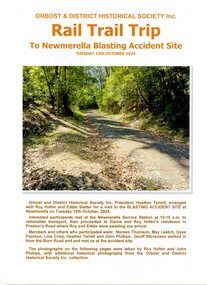
Booklet - Rail Trail Trip, John Phillips, The Newmerella Blasting Accident Site, Tuesday 15th October, 2024, 2025
... ...railway construction deaths...railway construction at Newmerella occurred, located about two miles west of Orbost. John and Peter Carroll and John Sullivan 13th of March 1914 died in this accident. railway blasting accident 1914 railway construction deaths Carroll Sullivan Orbost & District Historical Society Inc RAIL TRAIL TRIP To Newmerella Blasting Accident Site Tuesday 15th October, 2024 11 page plastic covered booklet. ...This booklet records the trip made by members of the Orbost and District Historical Society (including Heather Terrell, Roy Hofen and Eddie Slatter) on 15 October 2024 to view sites associated with the 1914 blasting accident site at Newmerella. Others attending were Noreen Thomson, May Leatch, Gaye Pearson, Lois Crisp, Heather Terrel, John Philips and Geoff Stevenson. This blasting accident which killed three workers occurred during construction of the Bairnsdale - Orbost railway line. It involved two men, a father and son from the same family (John and Peter Carroll) and another worker John Sullivan, all of whom died. It was the worst accident to occur during construction of this railway. This booklet is significant because it records details of the site where the deaths of three men working on the railway construction at Newmerella occurred, located about two miles west of Orbost. John and Peter Carroll and John Sullivan 13th of March 1914 died in this accident. 11 page plastic covered booklet. The cover page has a large coloured photograph of a trail through bushland. The writing on the cover is in orange print. Orbost & District Historical Society Inc RAIL TRAIL TRIP To Newmerella Blasting Accident Site Tuesday 15th October, 2024railway blasting accident 1914, railway construction deaths, carroll, sullivan -
 Lara RSL Sub Branch
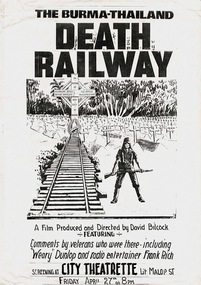
Newspaper Article, The Burma-Thailand Death Railway Film Poster
... The Burma Railway, also known as the Death Railway, the Siam–Burma Railway, the Thai–Burma Railway and similar names, was a 415-kilometre railway between Ban Pong, Thailand, and Thanbyuzayat, Burma, built by the Empire of Japan in 1943 to support its forces in the Burma campaign of World War II. This railway completed the rail link between Bangkok, Thailand, and Rangoon, Burma. This is a poster advertising the showing of a film on the making of the railway. In all, 9,500 Australian prisoners of war worked on the construction ...The Burma Railway, also known as the Death Railway, the Siam–Burma Railway, the Thai–Burma Railway and similar names, was a 415-kilometre railway between Ban Pong, Thailand, and Thanbyuzayat, Burma, built by the Empire of Japan in 1943 to support its forces in the Burma campaign of World War II. This railway completed the rail link between Bangkok, Thailand, and Rangoon, Burma. This is a poster advertising the showing of a film on the making of the railway.In all, 9,500 Australian prisoners of war worked on the construction of the Burma-Thailand Railway, which ran from Bampong, Thailand, to Thanbyuzayat, Burma . Building commenced at each end of the railway. Altogether, 2,646 Australians died working on the railway.Rectangular shaped black and white film poster.The Burma-Thailand Death Railway Film Posterposters, burma-thailand death railway film poster, world war two, lara r.s.l. -
 Flagstaff Hill Maritime Museum and Village
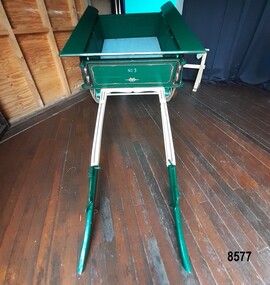
Vehicle - Tip Dray, Prior to 1930s
... death of Mr. Bourke in 1990, one of Mr. Bourke's sons (Andy) found the dray in a shed and restored it. The sign writing on the back and side panels were added during the restoration. This Tipping Dray is a significant example of a horse drawn vehicle that was used by workers from the early days of white settlement through to the 1940's and even into the early 1960's. It was used in a range of "working class" occupations - road construction, railway ...A Dray is a type of dead axle wagon that was used to transport heavy loads or objects. They had a flat level floor and while some had no sides, others had box bodies and sides. Tip Drays (also known as Tip Carts, Muck Cart, Scotch Cart, Tumbrel or Putt in different parts of England) were smaller than other drays as their loads were heavy and usually only pulled by one horse. Their basic design included two wheels, a tipping body and shafts. The Tip Dray has a unique mechanism that allows the top to tip backwards to tip the load out of the back of the dray. The tipper was activated by a handle at the front allowing the driver to operate it while still having control over the horse. A Tip Dray was an indispensable piece of equipment in the days before tractors and mechanical trucks. They were used by farmers and carters to transport hay, rocks, bricks, gravel and rubbish etc. and because they were useful for dumping loads, they were favoured for use in road and railway construction. A photo in the collection of the Lorne Historical Society shows a tipping dray being used during the construction of the Great Ocean Road. They were part of the daily street traffic in towns and cities around Australia from the early days of settlement. In Australia in the early 1900's, carters began to join unions to protect their jobs and pay. N.S.W. had a "Trolley, Draymen and Carters Union", Queensland had a "Tip Dray Men's Association" and in W. A. the "Top Dray Driver's Union" had a "cessation of work" in 1911 when they were fighting for an increase in their day's wages. In 1910 a meeting of Tip Carters was held in Geelong at the Trades Hall to discuss the formation of a union (The Geelong Tip Dray Carters) which was a success and a schedule of rates for all carting, whether by contract or day labor, was fixed. By 1912 they had "labelled" more than 50 drays and had representatives on the "Trades Hall and Eight Hours Committee". By the mid 1930's and early 1940's, tip drays were being superseded by mechanical trucks and utes. However tip drays continued to be used in some circumstances. They were a practical solution to the problem of petrol rationing during W. W. 2. It was noted in a letter to the editor in the "Sunshine Advocate" in 1938 that a positive argument for continued use of Tip Drays for rubbish collection related to the idea that a horse drawn vehicle involved with lots of stops and starts at different houses (very like a milkman's delivery route) often involved the horse "driving itself" while the driver picked up the rubbish - something a motor truck was unable to do! Another article written in August 1935 and published in the Age in a parliamentary report into the rubber industry noted "tip drays had almost disappeared and in their place, metal was carted in 5 ton motor trucks" but the report went on to say that as a part of the Government relief work (during the Great Depression) the Government had "to some extent reintroduced the tip drays so that a greater number of men would be employed". This particular tip dray was owned by Mr. Oswald (Jack) Bourke. He used it to deliver dry goods from Sunbury to the Queen Victoria Market in Melbourne several times a week in the 1930's and then (between 1945 and 1962) Mr. Bourke used it on the garbage round in Springvale Victoria for the Springvale Council. The Council owned three drays and the "No. 3" painted on this dray is in recognition of its original number. After the death of Mr. Bourke in 1990, one of Mr. Bourke's sons (Andy) found the dray in a shed and restored it. The sign writing on the back and side panels were added during the restoration. This Tipping Dray is a significant example of a horse drawn vehicle that was used by workers from the early days of white settlement through to the 1940's and even into the early 1960's. It was used in a range of "working class" occupations - road construction, railway construction, carting goods, rubbish collection etc. and would have been found in cities, country towns and on farms.A wooden and metal tipping dray with a box body and four sides. It has two iron and wooden wheels (with 14 spokes), two wooden shafts and a metal tipping mechanism. The back panel folds down to allow loads to be dumped out. It is painted in green and cream with sign writing on one of the sides and on the front and back panels. It features decorative painted lines and designs in burgundy, cream and light blue on most of the wooden parts. The tipping mechanism is on the front of the dray's left side and consists of a metal pin secured with a metal ring, and a lever.Front of dray - "No. 3" Side of dray - "A. & M. BOURKE / Contractors / LONGWARRY" Back of dray - "G.T. ANDREWS / QUEEN VICTORIA MARKET - Stand C23 / Phone DANDENONG 225"flagstaff hill maritime museum and village, warrnambool, shipwreck coast, tipping dray, dray, tip dray, tip cart, vehicles, horse drawn vehicle, springvale council, jack bourke, muck cart, scotch cart, tumbrel, putt, box body, oswald bourke, sunbury, queen victoria market, melbourne, no. 3 -
 Orbost & District Historical Society
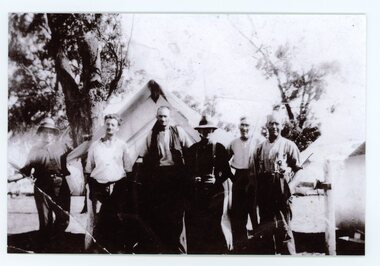
Photograph - workers camp, c. 1915
... The construction of the Bairnsdale to Orbost railway line 1912-1916 was a major event for East Gippsland and the Orbost district in particular. Hundreds of men worked on the project and at least 7 deaths...The construction of the Bairnsdale to Orbost railway line 1912-1916 was a major event for East Gippsland and the Orbost district in particular. Hundreds of men worked on the project and at least 7 deaths ...The construction of the Bairnsdale to Orbost railway line 1912-1916 was a major event for East Gippsland and the Orbost district in particular. Hundreds of men worked on the project and at least 7 deaths are recorded. Men lived in railway camps along the construction route. The caption on this photo indicates that these men were part of the workforce for the large timber railway bridges at Newmerella, adjacent to Orbost. This photo is significant because it records 6 workers involved in a major project for the Orbost district in the early 20th century. It records the way of life of these men. A b/w photograph of a group of 6 men in outdoor working clothes in front of tents. Behind the tents are trees and a bushland setting. Two men are wearing hats. This is a printed copy and is not an original photo. On the back of the photo: Workers on railway bridge at Newmerella, Victoria.railways, orbost-bairnsdale railway line, workers -
 Eltham District Historical Society Inc
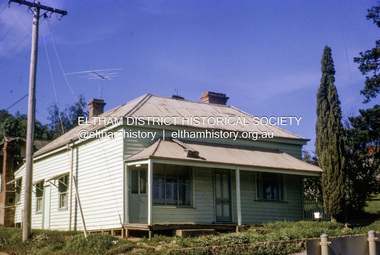
Slide, Old Eltham Bakery and cottage, cnr of York Street and Main Road, Eltham, c.Jul 1974
... construction of flats. The old bakery was one of the earliest stores in Eltham. It was once run by Luther Haley who was evicted when Mrs Burgoyne bought the shop in 1902. Luther built the first shop in the new business district next to the railway station in 1902 (later Staffs general store). It was also the scene of a suspected murder when the baker's wife was found dead at the bottom of the well but that was more urban myth. The unfortunate woman suffered a medical episode resulting in her death...construction of flats. The old bakery was one of the earliest stores in Eltham. It was once run by Luther Haley who was evicted when Mrs Burgoyne bought the shop in 1902. Luther built the first shop in the new business district next to the railway station in 1902 (later Staffs general store). It was also the scene of a suspected murder when the baker's wife was found dead at the bottom of the well but that was more urban myth. The unfortunate woman suffered a medical episode resulting in her death ...The old weatherboard building, possibly dating from the 1860s, comprised a dwelling with a shop in the front room opening off a timber verandah deck which directly fronted the Main Road footpath. At the rear was a brick building of much later date which was for many years used for the bakery. The buildings were demolished in 1979 for construction of flats. The old bakery was one of the earliest stores in Eltham. It was once run by Luther Haley who was evicted when Mrs Burgoyne bought the shop in 1902. Luther built the first shop in the new business district next to the railway station in 1902 (later Staffs general store). It was also the scene of a suspected murder when the baker's wife was found dead at the bottom of the well but that was more urban myth. The unfortunate woman suffered a medical episode resulting in her death and she consequently fell in to the well, so no murder after all. The incident happened in 1898 and the owner and baker was Mr Clement Brown. It was his wife Martha that met her unfortunate demise. A description of her struggle is in the link below. J.N. Burgoyne bought the bakery in 1902 (Mrs Burgoyne was the owner but it seems a lot of men back in those days put their businesses in the names of their wives). The subject of murder first came to light in a newspaper story in 1954 when their son J.J. (Jack) Burgoyne was speaking about the business after it had changed hands to Mr Jim Arnett and family. It was again referenced by Harry Burgoyne (grandson) in 1979 when the bakery was demolished. Seems like what may have been an embellished yarn of old became urban folklore but was simply not true. DEATH IN AN UNDERGROUND TANK. (1898, March 4). Evelyn Observer, and South and East Bourke Record (Vic. : 1882 - 1902), p. 2 (MORNING.). Retrieved June 16, 2026, from http://nla.gov.au/nla.news-article60698063 The bakery and shop was run by the Parkes family in the 1940s.35 mm colour positive transparency Mount - Kodak Kodachrome CardProcessed Jul 1974bakery, eltham, main road, york street -
 Eltham District Historical Society Inc
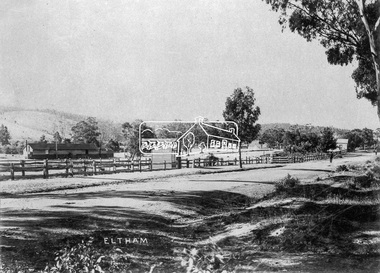
Photograph, J.H. Clark, Eltham, Main Road from Arthur Street towards station
... railway station which can be seen on the left. Cross Ref: 609 (opposite direction) Photographer: J.H. Clark John Henry Clark was the youngest of three boys born to William Henry Clark (1823-1877) and Maria White (1843-1914). He and his brothers, William Charles Clark (1872-1945), Clement Kent Clark (1874-1912) operated a photography business (Clark Bros.) from 25 Thomas Street, Windsor near Prahran during the period c.1894 to 1914. Following death of Clement in September 1912 and their mother in 1914, the Clark Bros business appears to have dissolved, the premises demolished, and a new house was under construction...railway station which can be seen on the left. Cross Ref: 609 (opposite direction) Photographer: J.H. Clark John Henry Clark was the youngest of three boys born to William Henry Clark (1823-1877) and Maria White (1843-1914). He and his brothers, William Charles Clark (1872-1945), Clement Kent Clark (1874-1912) operated a photography business (Clark Bros.) from 25 Thomas Street, Windsor near Prahran during the period c.1894 to 1914. Following death of Clement in September 1912 and their mother in 1914, the Clark Bros business appears to have dissolved, the premises demolished, and a new house was under construction ...View of Main Road, Eltham from Arthur Street towards the railway station which can be seen on the left. Cross Ref: 609 (opposite direction) Photographer: J.H. Clark John Henry Clark was the youngest of three boys born to William Henry Clark (1823-1877) and Maria White (1843-1914). He and his brothers, William Charles Clark (1872-1945), Clement Kent Clark (1874-1912) operated a photography business (Clark Bros.) from 25 Thomas Street, Windsor near Prahran during the period c.1894 to 1914. Following death of Clement in September 1912 and their mother in 1914, the Clark Bros business appears to have dissolved, the premises demolished, and a new house was under construction in 1915. John set up business independently in 1914 operating out of 29 Moor Street, Fitzroy where he is registered in the 1914 and 1915 Electoral Rolls. By 1916 John had relocated to Eltham where he continued his practice as a photographer and took many of the early images around the district of Little Eltham. Around 1930 John changed professions and opened a small cobbler's shop in 1931 near the pond opposite Dalton Street adjacent to the Jarrold family cottage. He never married and continued his profession as a bootmaker from this little shop, maintaining a close relationship with Mrs Jarrold for the rest of their lives. His bootmaker shop remains today beside the Whitecloud cottage and is one of only three remaining shops in the area from the early 20th century. There are a couple of images of Eltham taken by Clark Bros. in the Eltham District Historical Society collection, one such example being Hunniford’s Post Office with Miss Anne Hunniford out front (EDHS_00140 - marked on the back of the print, Clark Bros., 25 Thomas St. Windsor), which would date this image between c.1894 and 1914. Other early images of Eltham taken by John Henry Clark are marked on the face “J. H. Clark Photo” and it is assumed these are dated between 1914 and 1930. It is noted that the Grant of Probate for John H Clark of Eltham South dated 5 April !957 (513/387) records his occupation as "X Photographer".\This photo forms part of a collection of photographs gathered by the Shire of Eltham for their centenary project book,"Pioneers and Painters: 100 years of the Shire of Eltham" by Alan Marshall (1971). The collection of over 500 images is held in partnership between Eltham District Historical Society and Yarra Plenty Regional Library (Eltham Library) and is now formally known as 'The Shire of Eltham Pioneers Photograph Collection.' It is significant in being the first community sourced collection representing the places and people of the Shire's first one hundred years.Digital imagesepp, shire of eltham pioneers photograph collection, eltham, main road, railway station, eltham railway station, j.h. clark photo -
 Bendigo Military Museum
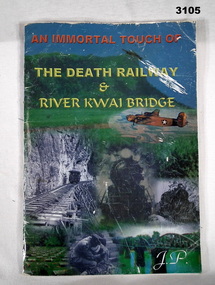
Book - BOOK, POW’S, Organised by JP, The Death Railway & River Kwai Bridge
... construction of the Thai Burma Railway & the bridge over the Rivew Kwai. Contains detailed photos & drawings. Taken from an oration by Fred Seiker in which he recalls the conditions under which the POW's lived & worked. books-military-history civil engineering/railways River Kwai burma Stamped inside front & back covers: Bendigo District RSL Sub Branch Soft cover illustrated front & back with colour & black & white photos. 60 pages with cut edges. Bound with staples. The Death ...Book details the construction of the Thai Burma Railway & the bridge over the Rivew Kwai. Contains detailed photos & drawings. Taken from an oration by Fred Seiker in which he recalls the conditions under which the POW's lived & worked.Soft cover illustrated front & back with colour & black & white photos. 60 pages with cut edges. Bound with staples. Stamped inside front & back covers: Bendigo District RSL Sub Branch books-military-history, civil engineering/railways, river kwai, burma -
 Kew Historical Society Inc
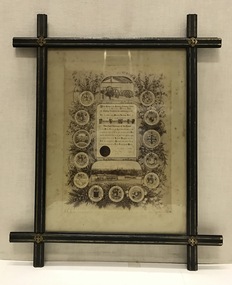
Certificate, Melbourne Tramways Trust, Framed Testimonial to Alderman Thomas O'Grady J.P. from the Melbourne Tramways Trust, 5 February 1886
... It lists one of his major achievements as the construction ‘with Leggett & Noonan [of] the fifty-six-mile (90 km) railway from Essendon to Seymour’. He was chairman of the Tramways Trust from its formation in 1884. His obituary in the Melbourne Herald (29 Apr 1890) reported: "DEATH...It lists one of his major achievements as the construction ‘with Leggett & Noonan [of] the fifty-six-mile (90 km) railway from Essendon to Seymour’. He was chairman of the Tramways Trust from its formation in 1884. His obituary in the Melbourne Herald (29 Apr 1890) reported: "DEATH ...The recipient of the testimonial, Thomas O’Grady (1824-90) had migrated to Melbourne in 1854, practising the trades of building and contracting. The Australian Dictionary of Biography records that he became a Councillor of the City of Melbourne in 1868. It lists one of his major achievements as the construction ‘with Leggett & Noonan [of] the fifty-six-mile (90 km) railway from Essendon to Seymour’. He was chairman of the Tramways Trust from its formation in 1884. His obituary in the Melbourne Herald (29 Apr 1890) reported: "DEATH OF ALDERMAN THOMAS O'GRADY. Today we have the sad duty of recording the death of two old colonists, who for many years, havo occupied very, prominent positions in building, commercial and municipal circles. The first of these is Alderman Thomas O'Grady, who died last night at his residence in Carlton. Mr O'Grady has been ill for some time, and at one period his death was expected any moment. Then he rallied, and strong hopes of his recovery were entertained; but he had a relapse, and expired as stated. The deceased gentleman was one of the oldest members of the City Council, in which he has held the various positions of Councillor, Alderman and Mayor. At the time of his death he sat as alderman for Victoria Ward. Mr O'Grady also at one time represented the City Council on the Harbor Trust, and was chairman of that body. He has been the council's representative on the Tramway Trust and was chairman of that body for some considerable time." As late as 1951, the Advocate (11 Oct 1951) stated that: "To Alderman Thomas O'Grady, Lord Mayor of Melbourne in 1872-3, is due the credit of the successful inauguration of Hospital Sunday. Alderman O'Grady was the first Catholic Lord Mayor of the city. He was elected a councillor for Smith Ward in 1868, and an alderman in 1869. In private life he was an extensive contractor, being a member of the firm of O'Grady, Leggett and Noonan, the contractors for the first section of the Northeastern Railways (between Melbourne and Seymour)."This is a unique civic document, illustrating the life and contribution of Thomas O’Grady (1824-90), Melbourne City Councillor and first Chairman of the Melbourne Tramways Trust. It is historically significant in its recording of the development of Melbourne's public transport system. The design of the certificate and particularly the ebonised frame are artistically and aesthetically significant.An illustrated testimonial presented to the first Chairman of the Melbourne Tramways Trust in 1886. The Testimonial is encased in an ebonized frame of the period. It includes the coat-of-arms of 12 cities, corporations, boroughs and towns, including that of Kew. At the head of the testimonial the engines used to drive the cable systems are illustrated. At the foot of the testimonial there is a picture of two cable trams.The testimonial reads: ‘At the meeting of the Melbourne Tramways Trust held on the Fifth Day of February 1886, the following resolution was unanimously carried. That the thanks of the Melbourne Tramways Trust are due and are hereby accorded to Alderman Thomas O’Grady Hon. JP, the first Chairman of the Trust for the ability, courtesy and impartiality with which he has discharged his duties during the past two years, and the Trust heartily congratulates him on the successful opening during his term of office of the Richmond Tramway (the first Cable line constructed in Australia) and tenders him its earnest wishes for his future prosperity and welfare.’ melbourne tramways trust, thomas o’grady (1824-90), cable trams, lord mayors of melbourne
