
Showing 4 items matching "raw materials - steel"
-
 Lara RSL Sub Branch
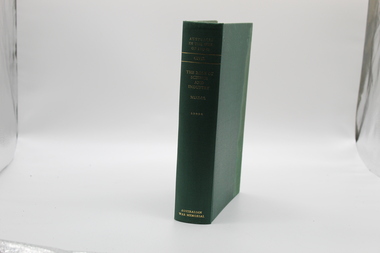
Book, Australia in the war of 1939-1945 CIVIL The role of science and industry. Author D.P. Mellor, First published in 1958
... ...raw materials - steel...An account of the part played by science and industry in the defence of Australia during the war 1939-1945 The role of Science and Industry mobilising industry for war mobilising science for war raw materials - steel machine tools fuel and power guns torpedoes and mines chemical warfare radar meteorology inventions Canberra Australian War Memorial Australia in the War of 1939-1945 - The Role of Science and Industry Photographs, maps, illustrations Australia in the war of 1939-1945 CIVIL The role of science and industry. ...An account of the part played by science and industry in the defence of Australia during the war 1939-1945The role of Science and IndustryAustralia in the War of 1939-1945 - The Role of Science and Industry Photographs, maps, illustrations Canberra Australian War Memorialmobilising industry for war, mobilising science for war, raw materials - steel, machine tools, fuel and power, guns, torpedoes and mines, chemical warfare, radar, meteorology, inventions -
 Robin Boyd Foundation
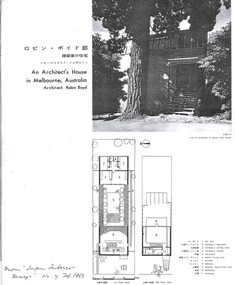
Article, Japan Interior Design, An Architect's House in Melbourne, Australia. Architect: Robin Boyd, Feb-62
... steel pipe inserted into the brick cavities form the structure and separate each room. The roof is connected to pairs of 3/4-inch thick cables, spaced four feet apart, attached to the brick walls of both buildings and supported by wooden posts that separate the glass panels in the rooms. The cables are not tightly strung together but are loosely suspended from the front structure, where the entrance is, to the rear one. The upper cable in the courtyard is covered with vine. The materials used are insulation board for the roof, raw...steel pipe inserted into the brick cavities form the structure and separate each room. The roof is connected to pairs of 3/4-inch thick cables, spaced four feet apart, attached to the brick walls of both buildings and supported by wooden posts that separate the glass panels in the rooms. The cables are not tightly strung together but are loosely suspended from the front structure, where the entrance is, to the rear one. The upper cable in the courtyard is covered with vine. The materials used are insulation board for the roof, raw ...This Japanese journal features a photographic article on Boyd's Walsh Street home. It was written by a Japanese architecture student who visited Walsh Street with a group of 6 such students in 1961. A translation of the text follows. ________________________________________________________ "An Architect’s House in Melbourne, Australia Author: Tamon Okubo This house was built by architect Robin Boyd as an experimental work. Although in a residential area of Melbourne, the site is a 40 x 126 ft rectangle in a corner of a former park with high rise buildings on either side. Due to its location, the design focuses on protecting the privacy of the house from the outside and on the composition of the interior space, creating a somehow introverted plan. However, the interior is not completely closed from the outside; it is cleverly designed to provide both views of the rooves of nearby houses as well as the mountains in the distance. Firstly, the couple’s room and the children’s rooms are in separate buildings. These two independent structures are connected by a courtyard. The ceiling of the courtyard is partly open, so one can look out from the second-floor terrace of the couple’s room. The walls on both sides of the courtyard are of opaque glass to ensure privacy from outside. In both buildings brick walls with three-inch steel pipe inserted into the brick cavities form the structure and separate each room. The roof is connected to pairs of 3/4-inch thick cables, spaced four feet apart, attached to the brick walls of both buildings and supported by wooden posts that separate the glass panels in the rooms. The cables are not tightly strung together but are loosely suspended from the front structure, where the entrance is, to the rear one. The upper cable in the courtyard is covered with vine. The materials used are insulation board for the roof, raw timber for the structural materials, native jarrah for the timber sections of the interior walls and white eucalyptus for the joints. Robin Boyd – A Brief Personal History 1919 Born in Melbourne, Australia 1947 As an architect, was the first director of the Small Homes Service, a public housing research institute established to provide homes for needy Australians. 1960 Wins the American Institute Architects Prize (the Japanese architect, Kenzo Tange, was awarded the same prize in 1959). In the same year he was elected an honorary member of the Institute. Mr Robin Boyd is currently writing a book on the history of Australian architecture, The Walls Around Us, as well as a book on Kenzo Tange. He is a frequent visitor to Japan to exchange ideas with Japanese architects and is quite a Japanophile. " This is a photocopy of the article from Japan Interior Design No 17. Pages 4-5 are glued together, and pages 6-7 are glued together, p8 p9, p10 are separate. There is writing on it (not Robin Boyd's hand). Geoffrey Serle, Robin Boyd's biographer, may have given it to Patricia Boyd.walsh st library -
 Sunshine and District Historical Society Incorporated
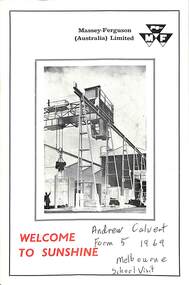
Booklet - Massey Ferguson Welcome To Sunshine Information Booklet, Massey Ferguson
... These booklets were presented to new staff and school tour groups, This copy was giver to Andrew "Andy" Culvert Form 5 during the school's site visit in 1969 Massey Ferguson Sunshine Harvester Works Massey Ferguson (Australia) Limited Welcome To Sunshine|The Massey Ferguson Story|Chain Making|Bright Steel Department|Heat Treatment|Tool Room|Foundry|Oxy Cutting|Cutting Up Shop|Machine Shop|Sheet Iren|Woodmill|Assembly|Enamelling|Steel Storage|Despatch|Quality Control|Apprentice Traning School Small white booklet with a picture of the foundary raw materials overhead crane and text Booklet Massey Ferguson Welcome To Sunshine Information Booklet Massey Ferguson ...These booklets were presented to new staff and school tour groups, This copy was giver to Andrew "Andy" Culvert Form 5 during the school's site visit in 1969Massey Ferguson (Australia) Limited Welcome To Sunshine|The Massey Ferguson Story|Chain Making|Bright Steel Department|Heat Treatment|Tool Room|Foundry|Oxy Cutting|Cutting Up Shop|Machine Shop|Sheet Iren|Woodmill|Assembly|Enamelling|Steel Storage|Despatch|Quality Control|Apprentice Traning Schoolmassey ferguson, sunshine harvester works -
 Puffing Billy Railway
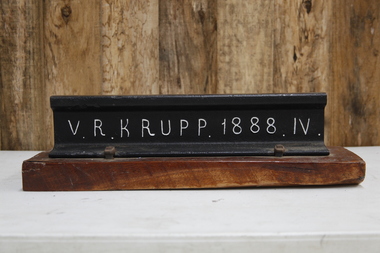
V. R. Krupp 1888. IV. Rail, 1888
... Krupp's main products are machinery and machine components made of high-quality cast steel, especially equipment for the railroads, most notably the seamless wheel tire, and from 1859 to an increased extent artillery. To secure raw materials...Krupp's main products are machinery and machine components made of high-quality cast steel, especially equipment for the railroads, most notably the seamless wheel tire, and from 1859 to an increased extent artillery. To secure raw materials ...60lbs rail that was used throughout the Victorian rail network. In 1887 Gibbs, Bright and Co. had a contract with Victorian Railways for railway and canal construction and supply of Krupp Rails. Gibbs, Bright and Co were merchant bankers and shipping agents and merchants who where also Directors of the GWR ( Great Western Railway ) and the Ship The "Great Britain" in England Gibbs, Bright and Company had principally been involved in shipping and trading, mainly in the West Indies, but following the discovery of gold in Victoria they established an office in Melbourne and soon became one of the leading shipping agents and merchants in the Colony. They expanded into passenger shipping and soon established offices in Brisbane, Sydney, Newcastle, Adelaide and Perth as well as launching passenger services between England, Mauritius and New Zealand. Gibbs, Bright also held a number of financial agencies from British mortgage, finance and investment companies as well as representing several British insurance companies in Australia. In addition they conducted a growing import business as well as an export business that included livestock, dairy produce, wool and flour. Also the company played a substantial part in the development of Australia's mineral resources, starting with lead in 1895, and later venturing into tin, gold, copper, cement and super phosphates. In Australia, after WWI, many of the larger companies were managing their own import and export so Gibbs, Bright and Company tended to focus its Agency business on smaller companies while expanding their interest into other markets such as timber, wire netting, zinc, stevedoring, road transport, marine salvage, gold mining as well as mechanical, structural, electrical and marine engineering. The Company's shipping interests continued to grow as well and still formed a major part of its business. In 1948 the parent company in England took the major step from tradition when they changed the business from a partnership into a private limited company. The name was the same, Antony Gibbs and Sons Limited, and in practice the effect of the change was very little. Some of the firm's branches and departments had already become limited companies and the formation of a parent company simplified the structure. The Australian operation was in time changed to Gibbs Bright & Co Pty Ltd in 1963. In 1848 Alfred Krupp becomes the sole proprietor of the company which from 1850 experiences its first major growth surge. In 1849 his equally talented brother Hermann (1814 - 1879) takes over the hardware factory Metallwarenfabrik in Berndorf near Vienna, which Krupp had established together with Alexander Schöller six years earlier. The factory manufactures cutlery in a rolling process developed by the brothers. Krupp's main products are machinery and machine components made of high-quality cast steel, especially equipment for the railroads, most notably the seamless wheel tire, and from 1859 to an increased extent artillery. To secure raw materials and feedstock for his production, Krupp acquires ore deposits, coal mines and iron works. On Alfred Krupp's death in 1887 the company employs 20,200 people. His great business success is based on the quality of the products, systematic measures to secure sales, the use of new cost-effective steel-making techniques, good organization within the company, and the cultivation of a loyal and highly qualified workforce among other things through an extensive company welfare system. From 1878 August Thyssen starts to get involved in processing the products manufactured by Thyssen & Co., including the fabrication of pipes for gas lines. In 1882 he starts rolling sheet at Styrum, for which two years later he sets up a galvanizing shop. The foundation stone for Maschinenfabrik Thyssen & Co. is laid in 1883 with the purchase of a neighboring mechanical engineering company. In 1891 August Thyssen takes the first step toward creating a vertical company at the Gewerkschaft Deutscher Kaiser coal mine in [Duisburg-]Hamborn, which he expands to an integrated iron and steelmaking plant on the River Rhine. Just before the First World War he starts to expand his group internationally (Netherlands, UK, France, Russia, Mediterranean region, Argentina). info from The company thyssenkrupp - History https://www.thyssenkrupp.com/en/company/history/the-founding-families/alfred-krupp.htmlHistoric - Victorian Railways - Track Rail - made by Krupp in 1888Section of VR Krupp 1888 Rail mounted on a piece of varnished wood. Rail made of ironpuffing billy, krupp, rail, victorian railways
