
Showing 913 items matching "real estate - kew (vic)"
-
 Kew Historical Society Inc
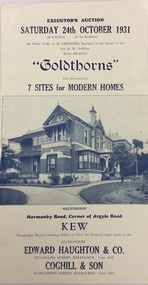
Document, Executor's Auction, Sunday 24th October 1931, "Goldthorns", Normanby Road, Corner of Argyle Road, Kew, 1931
... kew (vic)...real estate - kew (vic)...real estate brochure relating to the sale of a historically significant Kew mansion. The rarity the document is increased due to the photographs of the front of the house and of the extensive rear garden. goldthorns - normanby road, kew (vic) real estate - kew (vic) griffith family - kew (vic) gardens - kew (vic) subdivisions - kew (vic) Four page flyer advertising the sale of Goldthorns in Normanby Road, Kew in October 1931. ...Rare real estate brochure relating to the sale of a historically significant Kew mansion. The rarity the document is increased due to the photographs of the front of the house and of the extensive rear garden.Four page flyer advertising the sale of Goldthorns in Normanby Road, Kew in October 1931. The flyer contains a photograph of the front of the house, a list of its rooms, a site plan (including possible subdivisions). and a photo of the rear garden.goldthorns - normanby road, kew (vic), real estate - kew (vic), griffith family - kew (vic), gardens - kew (vic), subdivisions - kew (vic) -
 Kew Historical Society Inc
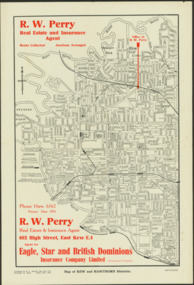
Map - Map of Kew and Hawthorn Districts
... kew (vic)...maps - hawthorn (vic)...R.W. Perry...Real estate...Perry Real estate Agents -- Kew (Vic.) RW Perry / Real Estate & Insurance Agent, 602 High Street, East Kew Two-colour map of Kew and Hawthorn Districts produced for by R.L. ...Map of Kew, East Kew and Hawthorn produced for a Kew Real Estate Agent, RW Perry. The map is undated.Two-colour map of Kew and Hawthorn Districts produced for by R.L. Jarrett for RW Perry, Real Estate & Insurance Agent. The map has unusual features such as a planned railway link from Kew Station to the former Outer Circle Railway. RW Perry / Real Estate & Insurance Agent, 602 High Street, East Kewmaps - kew (vic), maps - hawthorn (vic), r.w. perry, real estate agents -- kew (vic.) -
 Kew Historical Society Inc
Flyer - 60 Pakington Street, Kew
... Kew (Vic.)...real estate advertisements -- kew (Vic.)....) real estate advertisements -- kew (Vic.) Single page illustrated flyer, advertising 60 Pakington Street, Kew for sale. ...Subdivision plans and real estate flyers/brochures reveal a number of aspects of urban development and history. The Kew Historical Society's collection of these plans, as well as advertisements extracted from magazines, cover key aspects of community development and architectural history of Kew and Kew Eat as well as surrounding suburbs. While most of the plans in the collection were gifted to the Society by the former City of Kew, a number of other plans and advertisements have been donated by individuals, of which this is an example. Single page illustrated flyer, advertising 60 Pakington Street, Kew for sale. Annotation in pen and ink at right.neville collection, 60 pakington street -- kew (vic.), real estate advertisements -- kew (vic.) -
Kew Historical Society Inc
Flyer - 45 Pakington Street, Kew
... ...real estate advertisements -- kew (Vic.)...real estate flyers/brochures reveal a number of aspects of urban development and history. The Kew Historical Society's collection of these plans, as well as advertisements extracted from magazines, cover key aspects of community development and architectural history of Kew and Kew Eat as well as surrounding suburbs. While most of the plans in the collection were gifted to the Society by the former City of Kew, a number of other plans and advertisements have been donated by individuals, of which this is an example. Peter Neville real estate advertisements -- kew (Vic ...Subdivision plans and real estate flyers/brochures reveal a number of aspects of urban development and history. The Kew Historical Society's collection of these plans, as well as advertisements extracted from magazines, cover key aspects of community development and architectural history of Kew and Kew Eat as well as surrounding suburbs. While most of the plans in the collection were gifted to the Society by the former City of Kew, a number of other plans and advertisements have been donated by individuals, of which this is an example.Single page illustrated real estate flyer advertising 45 Pakington Street, Kew for sale by auction. Annotation in pen and ink at rightpeter neville, real estate advertisements -- kew (vic.), 45 pakington street -- kew (vic.) -
 Kew Historical Society Inc
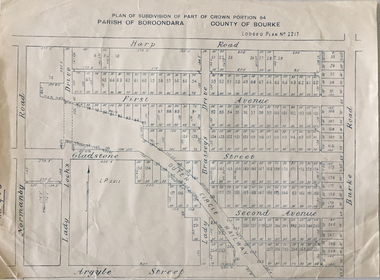
Plan - Subdivision Plan, Plan of Subdivision of Part of Crown Portion 84 / Parish of Boroondara / County of Bourke / Lodged Plan No. 2217, Twentieth Century
... real estate firm - J. R. Mathers and McMillan, 136 Cotham Road, Kew. The Plans in the collection are rarely in pristine form, being working plans on which the agent would write notes and record lots sold and the prices of these. The subdivision plans are historically significant examples of the growth of urban Melbourne from the beginning of the 20th Century up until the 1980s. A number of the plans are double-sided and often include a photograph on the reverse. A number of the latter are by noted photographers such as J.E. Barnes. Subdivision plans -- Kew (Vic ...Pru Sanderson, in her groundbreaking ‘City of Kew Urban Conservation Study : Volume 2 - Development History’ (1988), summarised the periods of urban development and subdivisions of land in Kew. The periods that she identified included 1845-1880, 1880-1893, 1893-1921, 1921-1933, 1933-1943, and Post-War Development. These periods were selected as they represented periods of rapid growth or decline in urban development. An obvious starting point for Sanderson’s groupings involved population growth and the associated economic cycles. These cycles also highlighted urban expansion onto land that was predominantly rural, although in other cases it represented the decline and breakup of large estates. A number of the plans in the Kew Historical Society’s collection can also be found in other collections, such as those of the State Library of Victoria and the Boroondara Library Service. A number are however unique to the collection.The Kew Historical Society collection includes almost 100 subdivision plans pertaining to suburbs of the City of Melbourne. Most of these are of Kew, Kew East or Studley Park, although a smaller number are plans of Camberwell, Deepdene, Balwyn and Hawthorn. It is believed that the majority of the plans were gifted to the Society by persons connected with the real estate firm - J. R. Mathers and McMillan, 136 Cotham Road, Kew. The Plans in the collection are rarely in pristine form, being working plans on which the agent would write notes and record lots sold and the prices of these. The subdivision plans are historically significant examples of the growth of urban Melbourne from the beginning of the 20th Century up until the 1980s. A number of the plans are double-sided and often include a photograph on the reverse. A number of the latter are by noted photographers such as J.E. Barnes.Undated Plan of Subdivision of Crown Portion 84 in what is now Kew. The area shown is bordered by Burke Road, Harp Road, Arglye Road and Normanby Road.subdivision plans -- kew (vic), harp road, burke road, normanby road, lady loch's drive, gladstone street, second avenue, first avenue -
 Kew Historical Society Inc
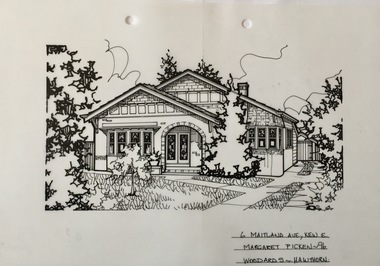
Drawing - Property Illustration, Margaret Picken, 6 Maitland Avenue, Kew, 1996
... real estate agents in Melbourne between 1983 and 2006. Each work is signed and dated by the artist. The drawings in the Picken Collection are invaluable assets for identifying architectural features and styles. The year in which the work was created is also a valuable record for house historians, as a number of the properties depicted have either been altered since that date or demolished. artist -- margaret picken 1950- property illustrations — buildings — kew (vic.) 6 maitland avenue - kew (vic) 6 MAITLAND AVE., KEW E. / MARGARET PICKEN ~96 / WOODARDS ~ HAWTHORN Pen and ink drawing on drafting film of 6 Maitland Avenue, Kew East, by Margaret Picken. 6 Maitland Avenue, Kew Drawing Property Illustration Margaret Picken Woodards (Hawthorn) ...After training as a Cartographic Draftsman within the mining industry, I worked as a property illustrator for real estate firms in the eastern suburbs of Melbourne for 23 years from 1983. I initially photographed houses with a Polaroid camera and made a 'thumbnail' sketch while there. The photos were used to scale off a sketch in pencil and then that sketch was overlaid with drafting film and the 'pen and ink' completed. The pens I used were the Rotring ‘Rapidigraph’ drafting pens. The ink was also made by Rotring (German).The film was ‘Rapidraw’, polyester drafting film, double matte. It takes a very fine line and doesn’t bleed. As well as house sketches, there were often floor plans and site plans ordered. Aerial sketches were ordered when the property needed an overall view. (Margaret Picken, 2020)This drawing is one of a series created by Margaret Picken for real estate agents in Melbourne between 1983 and 2006. Each work is signed and dated by the artist.Gift of Margaret Picken, 2020Pen and ink drawing on drafting film of 6 Maitland Avenue, Kew East, by Margaret Picken.6 MAITLAND AVE., KEW E. / MARGARET PICKEN ~96 / WOODARDS ~ HAWTHORNartist -- margaret picken 1950-, property illustrations — buildings — kew (vic.), 6 maitland avenue - kew (vic) -
 Kew Historical Society Inc
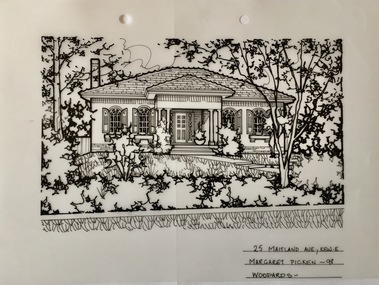
Drawing - Property Illustration, Margaret Picken, 25 Maitland Avenue, Kew, 1998
... real estate agents in Melbourne between 1983 and 2006. Each work is signed and dated by the artist. The drawings in the Picken Collection are invaluable assets for identifying architectural features and styles. The year in which the work was created is also a valuable record for house historians, as a number of the properties depicted have either been altered since that date or demolished. artist -- margaret picken 1950- property illustrations — buildings — kew (vic.) 25 maitland avenue - kew (vic) 25 MAITLAND AVE., KEW E. / MARGARET PICKEN ~98 / WOODARDS ~ Pen and ink drawing on drafting film of 25 Maitland Avenue, Kew by Margaret Picken. 25 Maitland Avenue, Kew Drawing Property Illustration Margaret Picken Woodards ...After training as a Cartographic Draftsman within the mining industry, I worked as a property illustrator for real estate firms in the eastern suburbs of Melbourne for 23 years from 1983. I initially photographed houses with a Polaroid camera and made a 'thumbnail' sketch while there. The photos were used to scale off a sketch in pencil and then that sketch was overlaid with drafting film and the 'pen and ink' completed. The pens I used were the Rotring ‘Rapidigraph’ drafting pens. The ink was also made by Rotring (German).The film was ‘Rapidraw’, polyester drafting film, double matte. It takes a very fine line and doesn’t bleed. As well as house sketches, there were often floor plans and site plans ordered. Aerial sketches were ordered when the property needed an overall view. (Margaret Picken, 2020)This drawing is one of a series created by Margaret Picken for real estate agents in Melbourne between 1983 and 2006. Each work is signed and dated by the artist.Gift of Margaret Picken, 2020Pen and ink drawing on drafting film of 25 Maitland Avenue, Kew by Margaret Picken.25 MAITLAND AVE., KEW E. / MARGARET PICKEN ~98 / WOODARDS ~ artist -- margaret picken 1950-, property illustrations — buildings — kew (vic.), 25 maitland avenue - kew (vic) -
 Kew Historical Society Inc
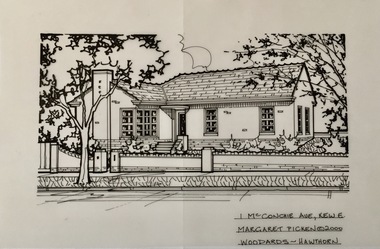
Drawing - Property Illustration, Margaret Picken, 1 McConchie Avenue, Kew East, 2000
... real estate agents in Melbourne between 1983 and 2006. Each work is signed and dated by the artist. The drawings in the Picken Collection are invaluable assets for identifying architectural features and styles. The year in which the work was created is also a valuable record for house historians, as a number of the properties depicted have either been altered since that date or demolished. artist -- margaret picken 1950- property illustrations — buildings — kew east (vic.) 1 mcconchie avenue - kew east (vic) 1 McCONCHIE AVE., KEW E. / MARGARET PICKEN ©2000 / WOODARDS ~ HAWTHORN Pen and ink drawing on drafting film of 1 McConchie Avenue, Kew East by Margaret Picken. 1 McConchie Avenue, Kew East Drawing Property Illustration Margaret Picken Woodards (Hawthorn) ...After training as a Cartographic Draftsman within the mining industry, I worked as a property illustrator for real estate firms in the eastern suburbs of Melbourne for 23 years from 1983. I initially photographed houses with a Polaroid camera and made a 'thumbnail' sketch while there. The photos were used to scale off a sketch in pencil and then that sketch was overlaid with drafting film and the 'pen and ink' completed. The pens I used were the Rotring ‘Rapidigraph’ drafting pens. The ink was also made by Rotring (German).The film was ‘Rapidraw’, polyester drafting film, double matte. It takes a very fine line and doesn’t bleed. As well as house sketches, there were often floor plans and site plans ordered. Aerial sketches were ordered when the property needed an overall view. (Margaret Picken, 2020)This drawing is one of a series created by Margaret Picken for real estate agents in Melbourne between 1983 and 2006. Each work is signed and dated by the artist.Gift of Margaret Picken, 2020Pen and ink drawing on drafting film of 1 McConchie Avenue, Kew East by Margaret Picken.1 McCONCHIE AVE., KEW E. / MARGARET PICKEN ©2000 / WOODARDS ~ HAWTHORNartist -- margaret picken 1950-, property illustrations — buildings — kew east (vic.), 1 mcconchie avenue - kew east (vic) -
 Kew Historical Society Inc
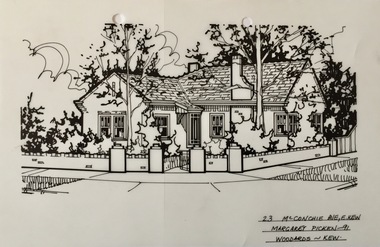
Drawing - Property Illustration, Margaret Picken, 23 McConchie Avenue, Kew East, 1991
... real estate agents in Melbourne between 1983 and 2006. Each work is signed and dated by the artist. The drawings in the Picken Collection are invaluable assets for identifying architectural features and styles. The year in which the work was created is also a valuable record for house historians, as a number of the properties depicted have either been altered since that date or demolished. artist -- margaret picken 1950- property illustrations — buildings — kew east (vic.) 23 mcconchie avenue - kew east (vic) 23 McCONCHIE AVE.,E. ...After training as a Cartographic Draftsman within the mining industry, I worked as a property illustrator for real estate firms in the eastern suburbs of Melbourne for 23 years from 1983. I initially photographed houses with a Polaroid camera and made a 'thumbnail' sketch while there. The photos were used to scale off a sketch in pencil and then that sketch was overlaid with drafting film and the 'pen and ink' completed. The pens I used were the Rotring ‘Rapidigraph’ drafting pens. The ink was also made by Rotring (German).The film was ‘Rapidraw’, polyester drafting film, double matte. It takes a very fine line and doesn’t bleed. As well as house sketches, there were often floor plans and site plans ordered. Aerial sketches were ordered when the property needed an overall view. (Margaret Picken, 2020)This drawing is one of a series created by Margaret Picken for real estate agents in Melbourne between 1983 and 2006. Each work is signed and dated by the artist.Gift of Margaret Picken, 2020Pen and ink drawing on drafting film of 23 McConchie Avenue, Kew East by Margaret Picken.23 McCONCHIE AVE.,E. KEW / MARGARET PICKEN ~91 / WOODARDS ~ KEWartist -- margaret picken 1950-, property illustrations — buildings — kew east (vic.), 23 mcconchie avenue - kew east (vic) -
 Kew Historical Society Inc
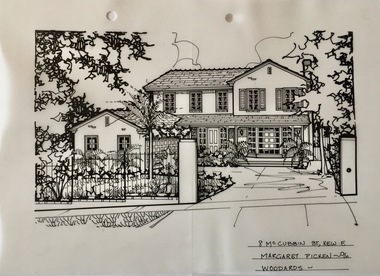
Drawing - Property Illustration, Margaret Picken, 8 McCubbin Street, Kew East, 1996
... real estate agents in Melbourne between 1983 and 2006. Each work is signed and dated by the artist. The drawings in the Picken Collection are invaluable assets for identifying architectural features and styles. The year in which the work was created is also a valuable record for house historians, as a number of the properties depicted have either been altered since that date or demolished. artist -- margaret picken 1950- property illustrations — buildings — kew east (vic.) 8 mccubbin street - kew east (vic) 8 McCUBBIN ST., KEW E. / MARGARET PICKEN ~96 / WOODARDS ~ Pen and ink drawing on drafting film of 8 McCubbin Street, Kew East by Margaret Picken. 8 McCubbin Street, Kew East Drawing Property Illustration Margaret Picken Woodards ...After training as a Cartographic Draftsman within the mining industry, I worked as a property illustrator for real estate firms in the eastern suburbs of Melbourne for 23 years from 1983. I initially photographed houses with a Polaroid camera and made a 'thumbnail' sketch while there. The photos were used to scale off a sketch in pencil and then that sketch was overlaid with drafting film and the 'pen and ink' completed. The pens I used were the Rotring ‘Rapidigraph’ drafting pens. The ink was also made by Rotring (German).The film was ‘Rapidraw’, polyester drafting film, double matte. It takes a very fine line and doesn’t bleed. As well as house sketches, there were often floor plans and site plans ordered. Aerial sketches were ordered when the property needed an overall view. (Margaret Picken, 2020)This drawing is one of a series created by Margaret Picken for real estate agents in Melbourne between 1983 and 2006. Each work is signed and dated by the artist.Gift of Margaret Picken, 2020Pen and ink drawing on drafting film of 8 McCubbin Street, Kew East by Margaret Picken.8 McCUBBIN ST., KEW E. / MARGARET PICKEN ~96 / WOODARDS ~ artist -- margaret picken 1950-, property illustrations — buildings — kew east (vic.), 8 mccubbin street - kew east (vic) -
 Kew Historical Society Inc
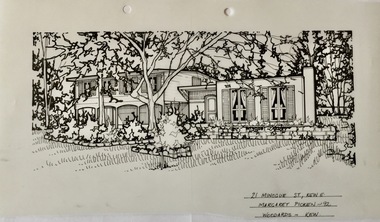
Drawing - Property Illustration, Margaret Picken, 21 Minogue Street, Kew East, 1992
... real estate agents in Melbourne between 1983 and 2006. Each work is signed and dated by the artist. The drawings in the Picken Collection are invaluable assets for identifying architectural features and styles. The year in which the work was created is also a valuable record for house historians, as a number of the properties depicted have either been altered since that date or demolished. artist -- margaret picken 1950- property illustrations — buildings — kew east (vic.) 21 minogue street - kew east (vic) 21 MINOGUE ST., KEW E. / MARGARET PICKEN ~92 / WOODARDS ~ KEW Pen and ink drawing on drafting film of 21 Minogue Street, Kew East by Margaret Picken. 21 Minogue Street, Kew East Drawing Property Illustration Margaret Picken Woodards (Kew) ...After training as a Cartographic Draftsman within the mining industry, I worked as a property illustrator for real estate firms in the eastern suburbs of Melbourne for 23 years from 1983. I initially photographed houses with a Polaroid camera and made a 'thumbnail' sketch while there. The photos were used to scale off a sketch in pencil and then that sketch was overlaid with drafting film and the 'pen and ink' completed. The pens I used were the Rotring ‘Rapidigraph’ drafting pens. The ink was also made by Rotring (German).The film was ‘Rapidraw’, polyester drafting film, double matte. It takes a very fine line and doesn’t bleed. As well as house sketches, there were often floor plans and site plans ordered. Aerial sketches were ordered when the property needed an overall view. (Margaret Picken, 2020)This drawing is one of a series created by Margaret Picken for real estate agents in Melbourne between 1983 and 2006. Each work is signed and dated by the artist.Gift of Margaret Picken, 2020Pen and ink drawing on drafting film of 21 Minogue Street, Kew East by Margaret Picken.21 MINOGUE ST., KEW E. / MARGARET PICKEN ~92 / WOODARDS ~ KEWartist -- margaret picken 1950-, property illustrations — buildings — kew east (vic.), 21 minogue street - kew east (vic) -
 Kew Historical Society Inc
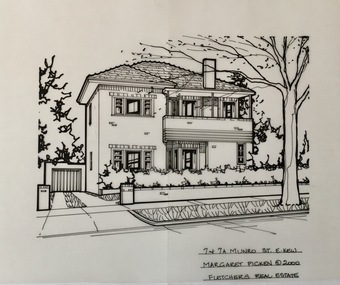
Drawing - Property Illustration, Margaret Picken, 7 & 7A Munro Street, Kew East, 2000
... real estate agents in Melbourne between 1983 and 2006. Each work is signed and dated by the artist. The drawings in the Picken Collection are invaluable assets for identifying architectural features and styles. The year in which the work was created is also a valuable record for house historians, as a number of the properties depicted have either been altered since that date or demolished. artist -- margaret picken 1950- property illustrations — buildings — kew east (vic.) 7 + 7a munro street - kew east (vic) 7 + 7A MUNRO ST., E. ...After training as a Cartographic Draftsman within the mining industry, I worked as a property illustrator for real estate firms in the eastern suburbs of Melbourne for 23 years from 1983. I initially photographed houses with a Polaroid camera and made a 'thumbnail' sketch while there. The photos were used to scale off a sketch in pencil and then that sketch was overlaid with drafting film and the 'pen and ink' completed. The pens I used were the Rotring ‘Rapidigraph’ drafting pens. The ink was also made by Rotring (German).The film was ‘Rapidraw’, polyester drafting film, double matte. It takes a very fine line and doesn’t bleed. As well as house sketches, there were often floor plans and site plans ordered. Aerial sketches were ordered when the property needed an overall view. (Margaret Picken, 2020)This drawing is one of a series created by Margaret Picken for real estate agents in Melbourne between 1983 and 2006. Each work is signed and dated by the artist.Gift of Margaret Picken, 2020Pen and ink drawing on drafting film of 7 & 7A Munro Street, Kew East by Margaret Picken.7 + 7A MUNRO ST., E. KEW / MARGARET PICKEN ©2000 / FLETCHERS REAL ESTATEartist -- margaret picken 1950-, property illustrations — buildings — kew east (vic.), 7 + 7a munro street - kew east (vic) -
 Kew Historical Society Inc
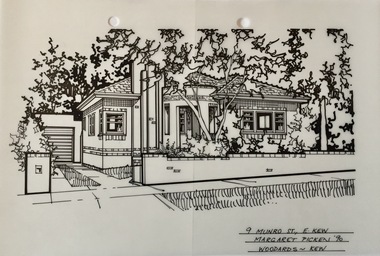
Drawing - Property Illustration, Margaret Picken, 9 Munro Street, Kew East, 1990
... real estate agents in Melbourne between 1983 and 2006. Each work is signed and dated by the artist. The drawings in the Picken Collection are invaluable assets for identifying architectural features and styles. The year in which the work was created is also a valuable record for house historians, as a number of the properties depicted have either been altered since that date or demolished. artist -- margaret picken 1950- property illustrations — buildings — kew east (vic.) 9 munro street - kew east (vic) 9 MUNRO ST., E. ...After training as a Cartographic Draftsman within the mining industry, I worked as a property illustrator for real estate firms in the eastern suburbs of Melbourne for 23 years from 1983. I initially photographed houses with a Polaroid camera and made a 'thumbnail' sketch while there. The photos were used to scale off a sketch in pencil and then that sketch was overlaid with drafting film and the 'pen and ink' completed. The pens I used were the Rotring ‘Rapidigraph’ drafting pens. The ink was also made by Rotring (German).The film was ‘Rapidraw’, polyester drafting film, double matte. It takes a very fine line and doesn’t bleed. As well as house sketches, there were often floor plans and site plans ordered. Aerial sketches were ordered when the property needed an overall view. (Margaret Picken, 2020)This drawing is one of a series created by Margaret Picken for real estate agents in Melbourne between 1983 and 2006. Each work is signed and dated by the artist.Gift of Margaret Picken, 2020Pen and ink drawing on drafting film of 9 Munro Street, Kew East, by Margaret Picken.9 MUNRO ST., E. KEW / MARGARET PICKEN '90 / WOODARDS ~ KEWartist -- margaret picken 1950-, property illustrations — buildings — kew east (vic.), 9 munro street - kew east (vic) -
 Kew Historical Society Inc
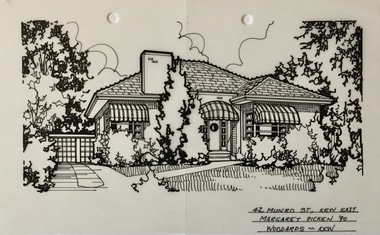
Drawing - Property Illustration, Margaret Picken, 42 Munro Street, Kew East, 1990
... real estate agents in Melbourne between 1983 and 2006. Each work is signed and dated by the artist. The drawings in the Picken Collection are invaluable assets for identifying architectural features and styles. The year in which the work was created is also a valuable record for house historians, as a number of the properties depicted have either been altered since that date or demolished. artist -- margaret picken 1950- property illustrations — buildings — kew east (vic.) 42 munro street - kew east (vic) 42 MUNRO ST., KEW EAST / MARGARET PICKEN '90 / WOODARDS ~ KEW Pen and ink drawing on drafting film of 42 Munro Street, Kew East by Margaret Picken. 42 Munro Street, Kew East Drawing Property Illustration Margaret Picken Woodards (Kew) ...After training as a Cartographic Draftsman within the mining industry, I worked as a property illustrator for real estate firms in the eastern suburbs of Melbourne for 23 years from 1983. I initially photographed houses with a Polaroid camera and made a 'thumbnail' sketch while there. The photos were used to scale off a sketch in pencil and then that sketch was overlaid with drafting film and the 'pen and ink' completed. The pens I used were the Rotring ‘Rapidigraph’ drafting pens. The ink was also made by Rotring (German).The film was ‘Rapidraw’, polyester drafting film, double matte. It takes a very fine line and doesn’t bleed. As well as house sketches, there were often floor plans and site plans ordered. Aerial sketches were ordered when the property needed an overall view. (Margaret Picken, 2020)This drawing is one of a series created by Margaret Picken for real estate agents in Melbourne between 1983 and 2006. Each work is signed and dated by the artist.Gift of Margaret Picken, 2020Pen and ink drawing on drafting film of 42 Munro Street, Kew East by Margaret Picken.42 MUNRO ST., KEW EAST / MARGARET PICKEN '90 / WOODARDS ~ KEWartist -- margaret picken 1950-, property illustrations — buildings — kew east (vic.), 42 munro street - kew east (vic) -
 Kew Historical Society Inc
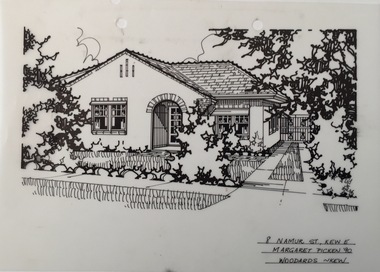
Drawing - Property Illustration, Margaret Picken, 8 Namur Street, Kew East, 1990
... real estate agents in Melbourne between 1983 and 2006. Each work is signed and dated by the artist. The drawings in the Picken Collection are invaluable assets for identifying architectural features and styles. The year in which the work was created is also a valuable record for house historians, as a number of the properties depicted have either been altered since that date or demolished. artist -- margaret picken 1950- property illustrations — buildings — kew east (vic.) 8 namur street - kew east (vic) 8 NAMUR ST., KEW E. / MARGARET PICKEN '90 / WOODARDS ~ KEW Pen and ink drawing on drafting film of 8 Namur Street, Kew East by Margaret Picken. 8 Namur Street, Kew East Drawing Property Illustration Margaret Picken Woodards (Kew) ...After training as a Cartographic Draftsman within the mining industry, I worked as a property illustrator for real estate firms in the eastern suburbs of Melbourne for 23 years from 1983. I initially photographed houses with a Polaroid camera and made a 'thumbnail' sketch while there. The photos were used to scale off a sketch in pencil and then that sketch was overlaid with drafting film and the 'pen and ink' completed. The pens I used were the Rotring ‘Rapidigraph’ drafting pens. The ink was also made by Rotring (German).The film was ‘Rapidraw’, polyester drafting film, double matte. It takes a very fine line and doesn’t bleed. As well as house sketches, there were often floor plans and site plans ordered. Aerial sketches were ordered when the property needed an overall view. (Margaret Picken, 2020)This drawing is one of a series created by Margaret Picken for real estate agents in Melbourne between 1983 and 2006. Each work is signed and dated by the artist.Gift of Margaret Picken, 2020Pen and ink drawing on drafting film of 8 Namur Street, Kew East by Margaret Picken.8 NAMUR ST., KEW E. / MARGARET PICKEN '90 / WOODARDS ~ KEWartist -- margaret picken 1950-, property illustrations — buildings — kew east (vic.), 8 namur street - kew east (vic) -
 Kew Historical Society Inc
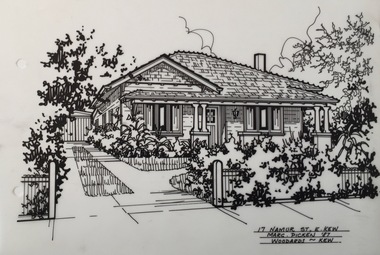
Drawing - Property Illustration, Margaret Picken, 17 Namur Street, Kew East, 1987
... real estate agents in Melbourne between 1983 and 2006. Each work is signed and dated by the artist. The drawings in the Picken Collection are invaluable assets for identifying architectural features and styles. The year in which the work was created is also a valuable record for house historians, as a number of the properties depicted have either been altered since that date or demolished. artist -- margaret picken 1950- property illustrations — buildings — kew east (vic.) 17 namur street - kew east (vic) 17 NAMUR ST., E. ...After training as a Cartographic Draftsman within the mining industry, I worked as a property illustrator for real estate firms in the eastern suburbs of Melbourne for 23 years from 1983. I initially photographed houses with a Polaroid camera and made a 'thumbnail' sketch while there. The photos were used to scale off a sketch in pencil and then that sketch was overlaid with drafting film and the 'pen and ink' completed. The pens I used were the Rotring ‘Rapidigraph’ drafting pens. The ink was also made by Rotring (German).The film was ‘Rapidraw’, polyester drafting film, double matte. It takes a very fine line and doesn’t bleed. As well as house sketches, there were often floor plans and site plans ordered. Aerial sketches were ordered when the property needed an overall view. (Margaret Picken, 2020)This drawing is one of a series created by Margaret Picken for real estate agents in Melbourne between 1983 and 2006. Each work is signed and dated by the artist.Gift of Margaret Picken, 2020Pen and ink drawing on drafting film of 17 Namur Street, Kew East by Margaret Picken.17 NAMUR ST., E. KEW / MARG. PICKEN '87 / WOODARDS ~ KEWartist -- margaret picken 1950-, property illustrations — buildings — kew east (vic.), 17 namur street - kew east (vic) -
 Kew Historical Society Inc
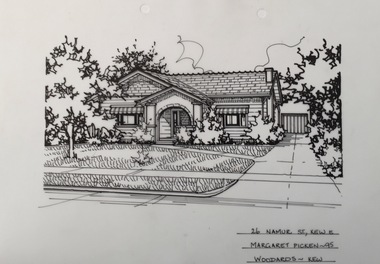
Drawing - Property Illustration, Margaret Picken, 26 Namur Street, Kew East, 1995
... real estate agents in Melbourne between 1983 and 2006. Each work is signed and dated by the artist. The drawings in the Picken Collection are invaluable assets for identifying architectural features and styles. The year in which the work was created is also a valuable record for house historians, as a number of the properties depicted have either been altered since that date or demolished. artist -- margaret picken 1950- property illustrations — buildings — kew east (vic.) 26 namur street - kew east (vic) 26 NAMUR ST., KEW E. / MARGARET PICKEN ~95 / WOODARDS ~ KEW Pen and ink drawing on drafting film of 26 Namur Street, Kew East by Margaret Picken. 26 Namur Street, Kew East Drawing Property Illustration Margaret Picken Woodards (Kew) ...After training as a Cartographic Draftsman within the mining industry, I worked as a property illustrator for real estate firms in the eastern suburbs of Melbourne for 23 years from 1983. I initially photographed houses with a Polaroid camera and made a 'thumbnail' sketch while there. The photos were used to scale off a sketch in pencil and then that sketch was overlaid with drafting film and the 'pen and ink' completed. The pens I used were the Rotring ‘Rapidigraph’ drafting pens. The ink was also made by Rotring (German).The film was ‘Rapidraw’, polyester drafting film, double matte. It takes a very fine line and doesn’t bleed. As well as house sketches, there were often floor plans and site plans ordered. Aerial sketches were ordered when the property needed an overall view. (Margaret Picken, 2020)This drawing is one of a series created by Margaret Picken for real estate agents in Melbourne between 1983 and 2006. Each work is signed and dated by the artist.Gift of Margaret Picken, 2020Pen and ink drawing on drafting film of 26 Namur Street, Kew East by Margaret Picken.26 NAMUR ST., KEW E. / MARGARET PICKEN ~95 / WOODARDS ~ KEWartist -- margaret picken 1950-, property illustrations — buildings — kew east (vic.), 26 namur street - kew east (vic) -
 Kew Historical Society Inc
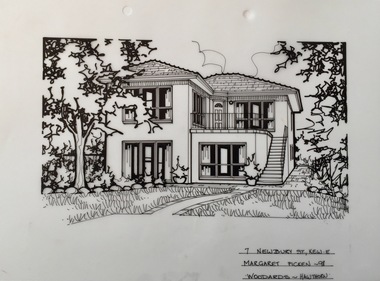
Drawing - Property Illustration, Margaret Picken, 7 Newbury Street, Kew East, 1998
... real estate agents in Melbourne between 1983 and 2006. Each work is signed and dated by the artist. The drawings in the Picken Collection are invaluable assets for identifying architectural features and styles. The year in which the work was created is also a valuable record for house historians, as a number of the properties depicted have either been altered since that date or demolished. artist -- margaret picken 1950- property illustrations — buildings — kew east (vic.) 7 newbury street - kew east (vic) 7 NEWBURY ST., KEW E. / MARGARET PICKEN ~98 / WOODARDS ~ HAWTHORN Pen and ink drawing on drafting film of 7 Newbury Street, Kew East by Margaret Picken. 7 Newbury Street, Kew East Drawing Property Illustration Margaret Picken Woodards (Hawthorn) ...After training as a Cartographic Draftsman within the mining industry, I worked as a property illustrator for real estate firms in the eastern suburbs of Melbourne for 23 years from 1983. I initially photographed houses with a Polaroid camera and made a 'thumbnail' sketch while there. The photos were used to scale off a sketch in pencil and then that sketch was overlaid with drafting film and the 'pen and ink' completed. The pens I used were the Rotring ‘Rapidigraph’ drafting pens. The ink was also made by Rotring (German).The film was ‘Rapidraw’, polyester drafting film, double matte. It takes a very fine line and doesn’t bleed. As well as house sketches, there were often floor plans and site plans ordered. Aerial sketches were ordered when the property needed an overall view. (Margaret Picken, 2020)This drawing is one of a series created by Margaret Picken for real estate agents in Melbourne between 1983 and 2006. Each work is signed and dated by the artist.Gift of Margaret Picken, 2020Pen and ink drawing on drafting film of 7 Newbury Street, Kew East by Margaret Picken.7 NEWBURY ST., KEW E. / MARGARET PICKEN ~98 / WOODARDS ~ HAWTHORNartist -- margaret picken 1950-, property illustrations — buildings — kew east (vic.), 7 newbury street - kew east (vic) -
 Kew Historical Society Inc
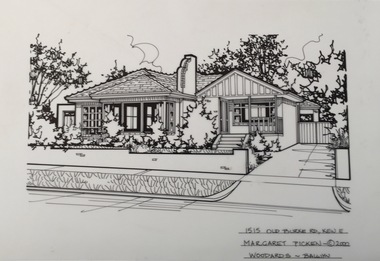
Drawing - Property Illustration, Margaret Picken, 1515 Old Burke Road, Kew East, 2000
... real estate agents in Melbourne between 1983 and 2006. Each work is signed and dated by the artist. The drawings in the Picken Collection are invaluable assets for identifying architectural features and styles. The year in which the work was created is also a valuable record for house historians, as a number of the properties depicted have either been altered since that date or demolished. artist -- margaret picken 1950- property illustrations — buildings — kew east (vic.) 1515 old burke road - kew east (vic) 1515 OLD BURKE RD., KEW E. / MARGARET PICKEN ©2000 / WOODARDS ~ BALWYN Pen and ink drawing on drafting film of 1515 Old Burke Road, Kew East by Margaret Picken. 1515 Old Burke Road, Kew East Drawing Property Illustration Margaret Picken Woodards (Balwyn) ...After training as a Cartographic Draftsman within the mining industry, I worked as a property illustrator for real estate firms in the eastern suburbs of Melbourne for 23 years from 1983. I initially photographed houses with a Polaroid camera and made a 'thumbnail' sketch while there. The photos were used to scale off a sketch in pencil and then that sketch was overlaid with drafting film and the 'pen and ink' completed. The pens I used were the Rotring ‘Rapidigraph’ drafting pens. The ink was also made by Rotring (German).The film was ‘Rapidraw’, polyester drafting film, double matte. It takes a very fine line and doesn’t bleed. As well as house sketches, there were often floor plans and site plans ordered. Aerial sketches were ordered when the property needed an overall view. (Margaret Picken, 2020)This drawing is one of a series created by Margaret Picken for real estate agents in Melbourne between 1983 and 2006. Each work is signed and dated by the artist.Gift of Margaret Picken, 2020Pen and ink drawing on drafting film of 1515 Old Burke Road, Kew East by Margaret Picken.1515 OLD BURKE RD., KEW E. / MARGARET PICKEN ©2000 / WOODARDS ~ BALWYNartist -- margaret picken 1950-, property illustrations — buildings — kew east (vic.), 1515 old burke road - kew east (vic) -
 Kew Historical Society Inc
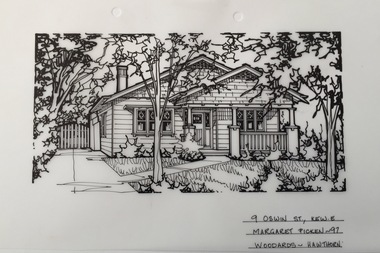
Drawing - Property Illustration, Margaret Picken, 9 Oswin Street, Kew East, 1997
... real estate agents in Melbourne between 1983 and 2006. Each work is signed and dated by the artist. The drawings in the Picken Collection are invaluable assets for identifying architectural features and styles. The year in which the work was created is also a valuable record for house historians, as a number of the properties depicted have either been altered since that date or demolished. artist -- margaret picken 1950- property illustrations — buildings — kew east (vic.) 9 Oswin street -- Kew East (vic.) 9 OSWIN ST., KEW E. / MARGARET PICKEN ~97 / WOODARDS ~ HAWTHORN Pen and ink drawing on drafting film of 9 Oswin Street, Kew East by Margaret Picken. 9 Oswin Street, Kew East Drawing Property Illustration Margaret Picken Woodards (Hawthorn) ...After training as a Cartographic Draftsman within the mining industry, I worked as a property illustrator for real estate firms in the eastern suburbs of Melbourne for 23 years from 1983. I initially photographed houses with a Polaroid camera and made a 'thumbnail' sketch while there. The photos were used to scale off a sketch in pencil and then that sketch was overlaid with drafting film and the 'pen and ink' completed. The pens I used were the Rotring ‘Rapidigraph’ drafting pens. The ink was also made by Rotring (German).The film was ‘Rapidraw’, polyester drafting film, double matte. It takes a very fine line and doesn’t bleed. As well as house sketches, there were often floor plans and site plans ordered. Aerial sketches were ordered when the property needed an overall view. (Margaret Picken, 2020)This drawing is one of a series created by Margaret Picken for real estate agents in Melbourne between 1983 and 2006. Each work is signed and dated by the artist.Gift of Margaret Picken, 2020Pen and ink drawing on drafting film of 9 Oswin Street, Kew East by Margaret Picken.9 OSWIN ST., KEW E. / MARGARET PICKEN ~97 / WOODARDS ~ HAWTHORNartist -- margaret picken 1950-, property illustrations — buildings — kew east (vic.), 9 oswin street -- kew east (vic.) -
 Kew Historical Society Inc
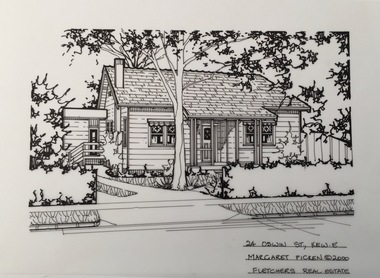
Drawing - Property Illustration, Margaret Picken, 24 Oswin Street, Kew East, 2000
... real estate agents in Melbourne between 1983 and 2006. Each work is signed and dated by the artist. The drawings in the Picken Collection are invaluable assets for identifying architectural features and styles. The year in which the work was created is also a valuable record for house historians, as a number of the properties depicted have either been altered since that date or demolished. artist -- margaret picken 1950- property illustrations — buildings — kew east (vic.) 24 oswin street - kew east (vic) 24 OSWIN ST., KEW E. / MARGARET PICKEN ©2000 / FLETCHERS REAL ESTATE Pen and ink drawing on drafting film of 24 Oswin Street, Kew East by Margaret Picken. 24 Oswin Street, Kew East Drawing Property Illustration Margaret Picken Fletchers Real Estate ...After training as a Cartographic Draftsman within the mining industry, I worked as a property illustrator for real estate firms in the eastern suburbs of Melbourne for 23 years from 1983. I initially photographed houses with a Polaroid camera and made a 'thumbnail' sketch while there. The photos were used to scale off a sketch in pencil and then that sketch was overlaid with drafting film and the 'pen and ink' completed. The pens I used were the Rotring ‘Rapidigraph’ drafting pens. The ink was also made by Rotring (German).The film was ‘Rapidraw’, polyester drafting film, double matte. It takes a very fine line and doesn’t bleed. As well as house sketches, there were often floor plans and site plans ordered. Aerial sketches were ordered when the property needed an overall view. (Margaret Picken, 2020)This drawing is one of a series created by Margaret Picken for real estate agents in Melbourne between 1983 and 2006. Each work is signed and dated by the artist.Gift of Margaret Picken, 2020Pen and ink drawing on drafting film of 24 Oswin Street, Kew East by Margaret Picken.24 OSWIN ST., KEW E. / MARGARET PICKEN ©2000 / FLETCHERS REAL ESTATEartist -- margaret picken 1950-, property illustrations — buildings — kew east (vic.), 24 oswin street - kew east (vic) -
 Kew Historical Society Inc
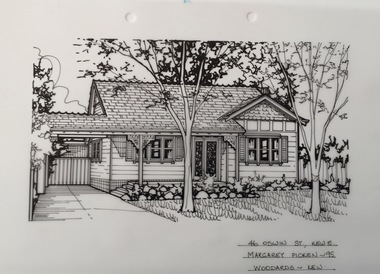
Drawing - Property Illustration, Margaret Picken, 46 Oswin Street, Kew East, 1995
... real estate agents in Melbourne between 1983 and 2006. Each work is signed and dated by the artist. The drawings in the Picken Collection are invaluable assets for identifying architectural features and styles. The year in which the work was created is also a valuable record for house historians, as a number of the properties depicted have either been altered since that date or demolished. property illustrations — buildings — kew east (vic.) 46 oswin street - kew east (vic) 46 OSWIN ST., KEW E. / MARGARET PICKEN ~95 / WOODARDS ~ KEW Pen and ink drawing on drafting film of 46 Oswin Street, Kew East by Margaret Picken. 46 Oswin Street, Kew East Drawing Property Illustration Margaret Picken Woodards (Kew) ...After training as a Cartographic Draftsman within the mining industry, I worked as a property illustrator for real estate firms in the eastern suburbs of Melbourne for 23 years from 1983. I initially photographed houses with a Polaroid camera and made a 'thumbnail' sketch while there. The photos were used to scale off a sketch in pencil and then that sketch was overlaid with drafting film and the 'pen and ink' completed. The pens I used were the Rotring ‘Rapidigraph’ drafting pens. The ink was also made by Rotring (German).The film was ‘Rapidraw’, polyester drafting film, double matte. It takes a very fine line and doesn’t bleed. As well as house sketches, there were often floor plans and site plans ordered. Aerial sketches were ordered when the property needed an overall view. (Margaret Picken, 2020)This drawing is one of a series created by Margaret Picken for real estate agents in Melbourne between 1983 and 2006. Each work is signed and dated by the artist.Gift of Margaret Picken, 2020Pen and ink drawing on drafting film of 46 Oswin Street, Kew East by Margaret Picken.46 OSWIN ST., KEW E. / MARGARET PICKEN ~95 / WOODARDS ~ KEWproperty illustrations — buildings — kew east (vic.), 46 oswin street - kew east (vic) -
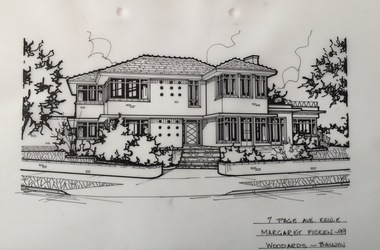 Kew Historical Society Inc
Drawing - Property Illustration, Margaret Picken, 7 Page Avenue, Kew East, 1999
... real estate agents in Melbourne between 1983 and 2006. Each work is signed and dated by the artist. The drawings in the Picken Collection are invaluable assets for identifying architectural features and styles. The year in which the work was created is also a valuable record for house historians, as a number of the properties depicted have either been altered since that date or demolished. artist -- margaret picken 1950- property illustrations — buildings — kew east (vic.) 7 page avenue - kew east (vic) 7 PAGE AVE., KEW E. / MARGARET PICKEN ~99 / WOODARDS ~ BALWYN Pen and ink drawing on drafting film of 7 Page Avenue, Kew East by Margaret Picken. 7 Page Avenue, Kew East Drawing Property Illustration Margaret Picken Woodards (Balwyn) ...After training as a Cartographic Draftsman within the mining industry, I worked as a property illustrator for real estate firms in the eastern suburbs of Melbourne for 23 years from 1983. I initially photographed houses with a Polaroid camera and made a 'thumbnail' sketch while there. The photos were used to scale off a sketch in pencil and then that sketch was overlaid with drafting film and the 'pen and ink' completed. The pens I used were the Rotring ‘Rapidigraph’ drafting pens. The ink was also made by Rotring (German).The film was ‘Rapidraw’, polyester drafting film, double matte. It takes a very fine line and doesn’t bleed. As well as house sketches, there were often floor plans and site plans ordered. Aerial sketches were ordered when the property needed an overall view. (Margaret Picken, 2020)This drawing is one of a series created by Margaret Picken for real estate agents in Melbourne between 1983 and 2006. Each work is signed and dated by the artist.Gift of Margaret Picken, 2020Pen and ink drawing on drafting film of 7 Page Avenue, Kew East by Margaret Picken.7 PAGE AVE., KEW E. / MARGARET PICKEN ~99 / WOODARDS ~ BALWYNartist -- margaret picken 1950-, property illustrations — buildings — kew east (vic.), 7 page avenue - kew east (vic) -
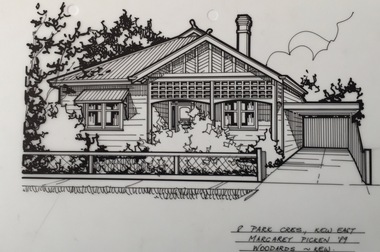 Kew Historical Society Inc
Drawing - Property Illustration, Margaret Picken, 8 Park Crescent, Kew, 1989
... real estate agents in Melbourne between 1983 and 2006. Each work is signed and dated by the artist. The drawings in the Picken Collection are invaluable assets for identifying architectural features and styles. The year in which the work was created is also a valuable record for house historians, as a number of the properties depicted have either been altered since that date or demolished. artist -- margaret picken 1950- property illustrations — buildings — kew (vic.) 8 park crescent - kew (vic) 8 PARK CRES., KEW EAST / MARGARET PICKEN '89 / WOODARDS ~ KEW Pen and ink drawing on drafting film of 8 Park Crescent, Kew by Margaret Picken. 8 Park Crescent, Kew Drawing Property Illustration Margaret Picken Woodards (Kew) ...After training as a Cartographic Draftsman within the mining industry, I worked as a property illustrator for real estate firms in the eastern suburbs of Melbourne for 23 years from 1983. I initially photographed houses with a Polaroid camera and made a 'thumbnail' sketch while there. The photos were used to scale off a sketch in pencil and then that sketch was overlaid with drafting film and the 'pen and ink' completed. The pens I used were the Rotring ‘Rapidigraph’ drafting pens. The ink was also made by Rotring (German).The film was ‘Rapidraw’, polyester drafting film, double matte. It takes a very fine line and doesn’t bleed. As well as house sketches, there were often floor plans and site plans ordered. Aerial sketches were ordered when the property needed an overall view. (Margaret Picken, 2020)This drawing is one of a series created by Margaret Picken for real estate agents in Melbourne between 1983 and 2006. Each work is signed and dated by the artist.Gift of Margaret Picken, 2020Pen and ink drawing on drafting film of 8 Park Crescent, Kew by Margaret Picken.8 PARK CRES., KEW EAST / MARGARET PICKEN '89 / WOODARDS ~ KEWartist -- margaret picken 1950-, property illustrations — buildings — kew (vic.), 8 park crescent - kew (vic) -
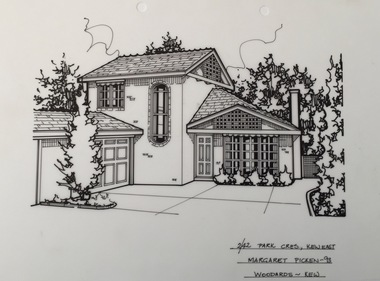 Kew Historical Society Inc
Drawing - Property Illustration, Margaret Picken, 2/42 Park Crescent, Kew, 1993
... real estate agents in Melbourne between 1983 and 2006. Each work is signed and dated by the artist. The drawings in the Picken Collection are invaluable assets for identifying architectural features and styles. The year in which the work was created is also a valuable record for house historians, as a number of the properties depicted have either been altered since that date or demolished. artist -- margaret picken 1950- property illustrations — buildings — kew (vic.) 2/42 park crescent - kew (vic) 2/42 PARK CRES., KEW EAST / MARGARET PICKEN ~93 / WOODARDS ~ KEW Pen and ink drawing on drafting film of 2/42 Park Crescent, Kew, by Margaret Picken. 2/42 Park Crescent, Kew Drawing Property Illustration Margaret Picken Woodards (Kew) ...After training as a Cartographic Draftsman within the mining industry, I worked as a property illustrator for real estate firms in the eastern suburbs of Melbourne for 23 years from 1983. I initially photographed houses with a Polaroid camera and made a 'thumbnail' sketch while there. The photos were used to scale off a sketch in pencil and then that sketch was overlaid with drafting film and the 'pen and ink' completed. The pens I used were the Rotring ‘Rapidigraph’ drafting pens. The ink was also made by Rotring (German).The film was ‘Rapidraw’, polyester drafting film, double matte. It takes a very fine line and doesn’t bleed. As well as house sketches, there were often floor plans and site plans ordered. Aerial sketches were ordered when the property needed an overall view. (Margaret Picken, 2020)This drawing is one of a series created by Margaret Picken for real estate agents in Melbourne between 1983 and 2006. Each work is signed and dated by the artist.Gift of Margaret Picken, 2020Pen and ink drawing on drafting film of 2/42 Park Crescent, Kew, by Margaret Picken.2/42 PARK CRES., KEW EAST / MARGARET PICKEN ~93 / WOODARDS ~ KEWartist -- margaret picken 1950-, property illustrations — buildings — kew (vic.), 2/42 park crescent - kew (vic) -
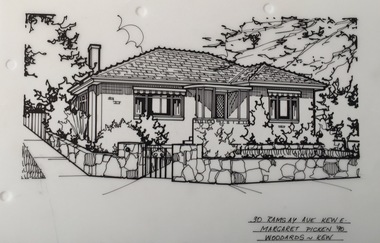 Kew Historical Society Inc
Drawing - Property Illustration, Margaret Picken, 30 Ramsay Avenue, Kew East, 1990
... real estate agents in Melbourne between 1983 and 2006. Each work is signed and dated by the artist. The drawings in the Picken Collection are invaluable assets for identifying architectural features and styles. The year in which the work was created is also a valuable record for house historians, as a number of the properties depicted have either been altered since that date or demolished. artist -- margaret picken 1950- property illustrations — buildings — kew east (vic.) 30 Ramsay Avenue -- Kew East (vic.) 30 RAMSAY AVE., KEW E / MARGARET PICKEN '90 / WOODARDS ~ KEW Pen and ink drawing on drafting film of 30 Ramsay Avenue, Kew East, by Margaret Picken. 30 Ramsay Avenue, Kew East Drawing Property Illustration Margaret Picken Woodards (Kew) ...After training as a Cartographic Draftsman within the mining industry, I worked as a property illustrator for real estate firms in the eastern suburbs of Melbourne for 23 years from 1983. I initially photographed houses with a Polaroid camera and made a 'thumbnail' sketch while there. The photos were used to scale off a sketch in pencil and then that sketch was overlaid with drafting film and the 'pen and ink' completed. The pens I used were the Rotring ‘Rapidigraph’ drafting pens. The ink was also made by Rotring (German).The film was ‘Rapidraw’, polyester drafting film, double matte. It takes a very fine line and doesn’t bleed. As well as house sketches, there were often floor plans and site plans ordered. Aerial sketches were ordered when the property needed an overall view. (Margaret Picken, 2020)This drawing is one of a series created by Margaret Picken for real estate agents in Melbourne between 1983 and 2006. Each work is signed and dated by the artist.Gift of Margaret Picken, 2020Pen and ink drawing on drafting film of 30 Ramsay Avenue, Kew East, by Margaret Picken.30 RAMSAY AVE., KEW E / MARGARET PICKEN '90 / WOODARDS ~ KEWartist -- margaret picken 1950-, property illustrations — buildings — kew east (vic.), 30 ramsay avenue -- kew east (vic.) -
 Kew Historical Society Inc
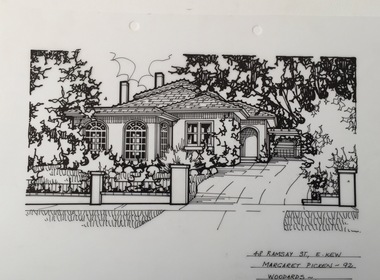
Drawing - Property Illustration, Margaret Picken, 48 Ramsay Avenue, Kew East, 1992
... real estate agents in Melbourne between 1983 and 2006. Each work is signed and dated by the artist. The drawings in the Picken Collection are invaluable assets for identifying architectural features and styles. The year in which the work was created is also a valuable record for house historians, as a number of the properties depicted have either been altered since that date or demolished. artist -- margaret picken 1950- property illustrations — buildings — kew east (vic.) 48 Ramsay Avenue -- Kew East (vic.) 48 RAMSAY AVE., E KEW / MARGARET PICKEN ~ 92 / WOODARDS ~ Pen and ink drawing on drafting film of 48 Ramsay Avenue, Kew East, by Margaret Picken. 48 Ramsay Avenue, Kew East Drawing Property Illustration Margaret Picken Woodards ...After training as a Cartographic Draftsman within the mining industry, I worked as a property illustrator for real estate firms in the eastern suburbs of Melbourne for 23 years from 1983. I initially photographed houses with a Polaroid camera and made a 'thumbnail' sketch while there. The photos were used to scale off a sketch in pencil and then that sketch was overlaid with drafting film and the 'pen and ink' completed. The pens I used were the Rotring ‘Rapidigraph’ drafting pens. The ink was also made by Rotring (German).The film was ‘Rapidraw’, polyester drafting film, double matte. It takes a very fine line and doesn’t bleed. As well as house sketches, there were often floor plans and site plans ordered. Aerial sketches were ordered when the property needed an overall view. (Margaret Picken, 2020)This drawing is one of a series created by Margaret Picken for real estate agents in Melbourne between 1983 and 2006. Each work is signed and dated by the artist.Gift of Margaret Picken, 2020Pen and ink drawing on drafting film of 48 Ramsay Avenue, Kew East, by Margaret Picken.48 RAMSAY AVE., E KEW / MARGARET PICKEN ~ 92 / WOODARDS ~artist -- margaret picken 1950-, property illustrations — buildings — kew east (vic.), 48 ramsay avenue -- kew east (vic.) -
 Kew Historical Society Inc
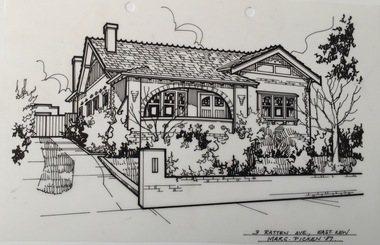
Drawing - Property Illustration, Margaret Picken, 3 Ratten Avenue, Kew East, 1987
... real estate agents in Melbourne between 1983 and 2006. Each work is signed and dated by the artist. The drawings in the Picken Collection are invaluable assets for identifying architectural features and styles. The year in which the work was created is also a valuable record for house historians, as a number of the properties depicted have either been altered since that date or demolished. artist -- margaret picken 1950- property illustrations — buildings — kew east (vic.) 3 ratten avenue -- Kew East (vic.) 3 RATTEN AVE., EAST KEW / MARGARET PICKEN '87 Pen and ink drawing on drafting film of 3 Ratten Avenue, Kew East, by Margaret Picken. 3 Ratten Avenue, Kew East Drawing Property Illustration Margaret Picken ...After training as a Cartographic Draftsman within the mining industry, I worked as a property illustrator for real estate firms in the eastern suburbs of Melbourne for 23 years from 1983. I initially photographed houses with a Polaroid camera and made a 'thumbnail' sketch while there. The photos were used to scale off a sketch in pencil and then that sketch was overlaid with drafting film and the 'pen and ink' completed. The pens I used were the Rotring ‘Rapidigraph’ drafting pens. The ink was also made by Rotring (German).The film was ‘Rapidraw’, polyester drafting film, double matte. It takes a very fine line and doesn’t bleed. As well as house sketches, there were often floor plans and site plans ordered. Aerial sketches were ordered when the property needed an overall view. (Margaret Picken, 2020)This drawing is one of a series created by Margaret Picken for real estate agents in Melbourne between 1983 and 2006. Each work is signed and dated by the artist.Gift of Margaret Picken, 2020Pen and ink drawing on drafting film of 3 Ratten Avenue, Kew East, by Margaret Picken.3 RATTEN AVE., EAST KEW / MARGARET PICKEN '87 artist -- margaret picken 1950-, property illustrations — buildings — kew east (vic.), 3 ratten avenue -- kew east (vic.) -
 Kew Historical Society Inc
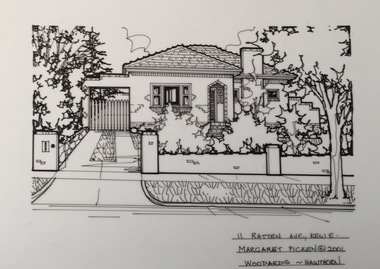
Drawing - Property Illustration, Margaret Picken, 11 Ratten Avenue, Kew East, 2001
... real estate agents in Melbourne between 1983 and 2006. Each work is signed and dated by the artist. The drawings in the Picken Collection are invaluable assets for identifying architectural features and styles. The year in which the work was created is also a valuable record for house historians, as a number of the properties depicted have either been altered since that date or demolished. artist -- margaret picken 1950- property illustrations — buildings — kew east (vic.) 11 ratten avenue - Kew East (vic.) 11 RATTEN AVE., KEW E / MARGARET PICKEN (c) 2001 / WOODARDS ~ HAWTHORN Pen and ink drawing on drafting film of 11 Ratten Avenue, Kew East, by Margaret Picken. 11 Ratten Avenue, Kew East Drawing Property Illustration Margaret Picken Woodards (Hawthorn) ...After training as a Cartographic Draftsman within the mining industry, I worked as a property illustrator for real estate firms in the eastern suburbs of Melbourne for 23 years from 1983. I initially photographed houses with a Polaroid camera and made a 'thumbnail' sketch while there. The photos were used to scale off a sketch in pencil and then that sketch was overlaid with drafting film and the 'pen and ink' completed. The pens I used were the Rotring ‘Rapidigraph’ drafting pens. The ink was also made by Rotring (German).The film was ‘Rapidraw’, polyester drafting film, double matte. It takes a very fine line and doesn’t bleed. As well as house sketches, there were often floor plans and site plans ordered. Aerial sketches were ordered when the property needed an overall view. (Margaret Picken, 2020)This drawing is one of a series created by Margaret Picken for real estate agents in Melbourne between 1983 and 2006. Each work is signed and dated by the artist.Gift of Margaret Picken, 2020Pen and ink drawing on drafting film of 11 Ratten Avenue, Kew East, by Margaret Picken.11 RATTEN AVE., KEW E / MARGARET PICKEN (c) 2001 / WOODARDS ~ HAWTHORNartist -- margaret picken 1950-, property illustrations — buildings — kew east (vic.), 11 ratten avenue - kew east (vic.) -
 Kew Historical Society Inc
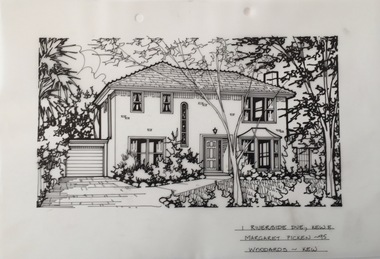
Drawing - Property Illustration, Margaret Picken, 1 Riverside Drive, Kew East, 1995
... real estate agents in Melbourne between 1983 and 2006. Each work is signed and dated by the artist. The drawings in the Picken Collection are invaluable assets for identifying architectural features and styles. The year in which the work was created is also a valuable record for house historians, as a number of the properties depicted have either been altered since that date or demolished. artist -- margaret picken 1950- property illustrations — buildings — kew east (vic.) 1 riverside drive -- kew east (vic.) 1 RIVERSIDE DVE., KEW E / MARGARET PICKEN ~95 / WOODARDS ~ KEW Pen and ink drawing on drafting film of 1 Riverside Drive, Kew East by Margaret Picken. 1 Riverside Drive, Kew East Drawing Property Illustration Margaret Picken Woodards (Kew) ...After training as a Cartographic Draftsman within the mining industry, I worked as a property illustrator for real estate firms in the eastern suburbs of Melbourne for 23 years from 1983. I initially photographed houses with a Polaroid camera and made a 'thumbnail' sketch while there. The photos were used to scale off a sketch in pencil and then that sketch was overlaid with drafting film and the 'pen and ink' completed. The pens I used were the Rotring ‘Rapidigraph’ drafting pens. The ink was also made by Rotring (German).The film was ‘Rapidraw’, polyester drafting film, double matte. It takes a very fine line and doesn’t bleed. As well as house sketches, there were often floor plans and site plans ordered. Aerial sketches were ordered when the property needed an overall view. (Margaret Picken, 2020)This drawing is one of a series created by Margaret Picken for real estate agents in Melbourne between 1983 and 2006. Each work is signed and dated by the artist.Gift of Margaret Picken, 2020Pen and ink drawing on drafting film of 1 Riverside Drive, Kew East by Margaret Picken.1 RIVERSIDE DVE., KEW E / MARGARET PICKEN ~95 / WOODARDS ~ KEWartist -- margaret picken 1950-, property illustrations — buildings — kew east (vic.), 1 riverside drive -- kew east (vic.)
