
Showing 65 items matching "reconnaissance aircraft"
-
 Wangaratta RSL Sub Branch
Model - Model P51 Mustang, David Knappstein
... ...Reconnaissance aircraft...The Mustang was first flown operationally by the RAF as a tactical-reconnaissance aircraft and fighter-bomber. P-51 Mustang is an American long-range, single-seat fighter and fighter-bomber used during World War II and the Korean War, among other conflicts and was designed in 1940....Mustang WW2 Korean War Reconnaissance aircraft Silver colour model plane with black and white stripes with red rudder. ...Handmade radio controlled model P51 Mustang aircraft. The Mustang was first flown operationally by the RAF as a tactical-reconnaissance aircraft and fighter-bomber. P-51 Mustang is an American long-range, single-seat fighter and fighter-bomber used during World War II and the Korean War, among other conflicts and was designed in 1940.Silver colour model plane with black and white stripes with red rudder. There is a propellor at the front, two rubber wheels beneath the wing span and one below rudder/tail.mustang, ww2, korean war, reconnaissance aircraft -
Moorabbin Air Museum
Document (Item) - Mission Avionics For Medium Range Maritime Reconnaissance Patrol Aircraft
... Mission Avionics For Medium Range Maritime Reconnaissance Patrol Aircraft...Description: 20 PAGES AIRCRAFT FLIGHT TEST RECORDING AND ANALYSIS SYSTEM AFTRAS Technical NOTES GENERAL II TN GENII Level of Importance: . Document Mission Avionics For Medium Range Maritime Reconnaissance Patrol Aircraft ...Description: 20 PAGES AIRCRAFT FLIGHT TEST RECORDING AND ANALYSIS SYSTEM AFTRAS Technical NOTES GENERAL II TN GENII Level of Importance: . -
 National Vietnam Veterans Museum (NVVM)
Photograph, Gibbons, Denis, Cessna Aircraft
... A black and white photograph of an Australian Army Cessna fixed wing reconnaissance aircraft from 161 (Indep) Recce Flight conducting low level sweeps of the jungle in Phuoc Tuy searching for signs of NVA/VietCong operating in the area....Photograph 161 Recon Flt Cessna NVA/VC Phuoc Tuy Australian Army 161 (Indep) Recce Flt Jungle NVA/VietCong Denis Gibbons A black and white photograph of an Australian Army Cessna fixed wing reconnaissance aircraft from 161 (Indep) Recce Flight conducting low level sweeps of the jungle in Phuoc Tuy searching for signs of NVA/VietCong operating in the area. ...Denis Gibbons (1937 – 2011) Trained with the Australian Army, before travelling to Vietnam in January 1966, Denis stayed with the 1st Australian Task Force in Nui Dat working as a photographer. For almost five years Gibbons toured with nine Australian infantry battalions, posting compelling war images from within many combat zones before being flown out in late November 1970 after sustaining injuries. The images held within the National Vietnam Veterans Museum make up the Gibbons Collection.A black and white photograph of an Australian Army Cessna fixed wing reconnaissance aircraft from 161 (Indep) Recce Flight conducting low level sweeps of the jungle in Phuoc Tuy searching for signs of NVA/VietCong operating in the area.photograph, 161 recon flt, cessna, nva/vc, phuoc tuy, australian army, 161 (indep) recce flt, jungle, nva/vietcong, denis gibbons -
Moorabbin Air Museum
Book - Aircraft Camouflage And Markings, RAAF Camouflage 1939 to 45 Vols 1 & 2
... Attack/ photographic / reconnaissance & patrol aircraft...Aircraft camouflage & markings Camouflage & concealment Emergency measures Camouflage ruses & experiments Colour schemes RAAF unit codes & abbreviations Colour schemes in transition Fighters & bombers in the Pacific Attack/ photographic / reconnaissance & patrol aircraft Eyes for the Army Trainers Seaplanes & flying boats Transport/communications & ambulance aircraft Description & illustrations of RAAF camouflage & markings in WW2, circa 1980 ( Vol 1 ) & 1989 ( Vo 2 ) 2 volumes RAAF Camouflage 1939 to 45 Vols 1 & 2 Book Aircraft Camouflage And Markings ...Description & illustrations of RAAF camouflage & markings in WW2, circa 1980 ( Vol 1 ) & 1989 ( Vo 2 )2 volumesnon-fictionDescription & illustrations of RAAF camouflage & markings in WW2, circa 1980 ( Vol 1 ) & 1989 ( Vo 2 )camouflage & concealment, emergency measures, camouflage ruses & experiments, colour schemes, raaf unit codes & abbreviations, colour schemes in transition, fighters & bombers in the pacific, , attack/ photographic / reconnaissance & patrol aircraft, eyes for the army, trainers, seaplanes & flying boats, transport/communications & ambulance aircraft -
 Department of Energy, Environment and Climate Action
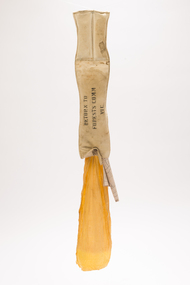
Drop Chute
... The information was often needed quickly by crews on the ground or in the control centre and these small chutes were used to drop messages and maps from the reconnaissance aircraft on a low pass above a cleared area like a football field. ...The information was often needed quickly by crews on the ground or in the control centre and these small chutes were used to drop messages and maps from the reconnaissance aircraft on a low pass above a cleared area like a football field. ...From the early 1960s, the Forests Commission had pre-season arrangements in place with local aeroclubs and pilots across regional Victoria. Air observers from FCV districts routinely flew during the summer months in small, fixed-wing aircraft on fire spotting missions and to map fire boundaries. The information was often needed quickly by crews on the ground or in the control centre and these small chutes were used to drop messages and maps from the reconnaissance aircraft on a low pass above a cleared area like a football field. About 3-foot long when fully extended, they had a small pouch secured with a press stud for the map or package. The chutes were made from tough canvas with a small, weighted sandbag at one end and a long yellow streamer tail on the other to help direct its fall and locating it on the ground. Drop chutes were still in common use in the 1990s, but the increased availability of helicopters combined with improved digital data transfer made drop chutes redundant. Simple, but now redundant technologyAerial drop chute"Return to Forests Comm Vic" stenciled on sidebushfire -
 Bendigo Military Museum
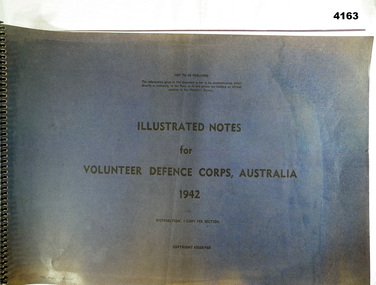
Manual - VOLUNTEER DEFENCE NOTES, 1942
... Spiral bound gloss paper illustrated notes for the Australian defence Corp Volunteers, 32 pages, subjects covered, camouflage, stalking, self defence, small arms, aircraft ID, reconnaissance reporting and general information on enemy forces....volunteers defence corp Spiral bound gloss paper illustrated notes for the Australian defence Corp Volunteers, 32 pages, subjects covered, camouflage, stalking, self defence, small arms, aircraft ID, reconnaissance reporting and general information on enemy forces. ...Spiral bound gloss paper illustrated notes for the Australian defence Corp Volunteers, 32 pages, subjects covered, camouflage, stalking, self defence, small arms, aircraft ID, reconnaissance reporting and general information on enemy forces.volunteers, defence corp -
 National Vietnam Veterans Museum (NVVM)
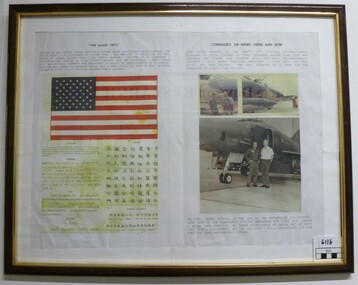
Document - 'The Blood Chit", 1968
... COMRADES IN ARM THEN AND NOW: Soon after arrival at the USAF'S 12th Tactical Reconnaissance Squadron in South Vietnam in 1968, Squadron Leader Alan Reed was assigned in an almost new Phantom RF74C (AF67442) Reconnaissance Aircraft - nicked name "Carolina Kangaroo" along with its crew chief, Sgt Dale Miller. ...COMRADES IN ARM THEN AND NOW: Soon after arrival at the USAF'S 12th Tactical Reconnaissance Squadron in South Vietnam in 1968, Squadron Leader Alan Reed was assigned in an almost new Phantom RF74C (AF67442) Reconnaissance Aircraft - nicked name "Carolina Kangaroo" along with its crew chief, Sgt Dale Miller. ..."The Blood Chit" carried by all United States Air Force Flight crews operating in South Vietnam, the "blood chit" so nick-named by flight crew - was designed to assist in the safe return of downed flight crew. The "chits" message - written in 15 languages - identified the carrier as a US citizen seeking food and assistance. Each "blood chit" was serially numbered and registered to assist in identification by US Forces. This one was issued to Squadron Leader Alan R Reed during his tour of duty in South Vietnam with the US 12th Tactical Reconnaissance Squadron. COMRADES IN ARM THEN AND NOW: Soon after arrival at the USAF'S 12th Tactical Reconnaissance Squadron in South Vietnam in 1968, Squadron Leader Alan Reed was assigned in an almost new Phantom RF74C (AF67442) Reconnaissance Aircraft - nicked name "Carolina Kangaroo" along with its crew chief, Sgt Dale Miller. The trio operated as a team for the remainder of Alan's tour of duty. In 1981, while serving in the USA as the Australian Air Attache, Alan (now an Air Commodore) visited Bergstrom Air Force Base during a major USAF exercise. By sheer coincidence he again met up with Dale (now a Lieutenant) and his old RF4C - still operational but now sans the Carolina Kangaroo emblem.Black and Gold Framed Article of "The Blood Chit"- Accompanied with U.S.A. Flag and explanation. Also two coloured and one black and white photo of Alan Reed and Crew Chief Sgt. Dale Miller beside the RF-4C Phantom nicknamed, "Carolina Kangaroo".alan reed, rf-4c phantom, "carolina kangaroo"., sgt dale miller, united states air force, 12th tactical reconnaissance squadron, blood chit, us forces, squadron leader alan reed, usaf, bergstrom air force base, royal australian air force, 052363, pilot, headquarters, australian force vietnam, raaf element -
Moorabbin Air Museum
Document (item) - Bill Prowse Collection WP14 See details in Description, Bill Prowse Collection WP14
... Jet Instrument Flying Trainer Type AT50 Maintenance Handbook Australia Flies First Local Hornet - extract from Flight International Magazine 16/3/85 Techniques of Oblique Aerial Photography of agricultural Field trials CSIRO Alata Magazine - Italy Jindivik Target Program for US Army McGregor Range Dowty Hydraulic System and Undercarriages fitted to Armstrong Whitworth Argosy - Course notes Summary of Evaluation of Tactical Transport Aircraft for RAAF - technical report TTA 13/77 Pilot's Notes General RAF Govt of India Press 1943 AP 2095 (RAF) Air BP Journal Number 28 Jindivik Details Sketch Nomad 22B Promotional Catalogue GAF Mirage Metallurgy Technical Memo No 322 Canberra Metallurgy Tech Memo 319 Fatigue racking in mail landing wheels Handbook of wireless Telegraphy Vol 1 1938 Jindivik target Program US Army Aircraft Flight Test recording and Analysis System AFTRAS Tech notes Mission Avionics for Medium Range Maritime Reconnaissance Patrol Aircraft - proposal by Litton Systems for GAF 1993 Assessment of Installation of Edward Davis Jet Engine in Jindivik Initial Study to redesign Jindivik Wing Nomad 22 Fenwick Aviation - French 1972 Jindivik Publication B4A-PO3 Equipment bench test Specs Mirage Metallurgy Memo 302 - disc brakes Mirage Metallurgy Tech memo 326 Corrosion of main landing wheels Adour Mk 871.F405 Rolls RoyceLeading the Trainer Market Adour/F405 Turbo Fan Jet Engine Promotional Jindivik Promotional Catalogue weapons test facilityJindivik Promotional Catalogue weapons test facility Canberra Production line magazine leaflet Mirage IIIO and IIID handwritten report ATAR 8 and 9 Snecma Engine Promotional engine Malkara Guided Weapon promotional leaflet CAC Promotional leaflet brief history 1939 to 1966 Fighters for today and tomorrow McDonnell Douglas McDonnell Douglas Hornet Production details Australian Industry Participation Program Northrop Turana Australia's Target reprint of article from Aircraft Magazine Ikara Anti Submarine guided weapon system - single page promotional Nomad de-icing team UK 1979 Jindivik weapons target facility The Hunted One promotional catalogue Jindivik tow system - line drawings Mirage III Bulletins Meteor Target a/c accident A77-802 Investigation result 1969 GAF Brochure and products 1969 Defence Science and Technology Organisation Brochures for Aeronautical and Maritime Research Lab Jindivik Mk4 Report GAF Jindivick brief history Design proposal for Searchlight on N22 Nomad The Link Trainer - article Thrust Alignment for launch/firing at Woomera Ikara - photos Turana - naval target 1970 article Ceres Agricultural CAC proposal Magazine Missile and Razzi 1962 RFDS 50th anniversary publication magazine Potential new workload estimates for GAF 1983 Parachute Assembly deceleration Type 936-71 ...Jet Instrument Flying Trainer Type AT50 Maintenance Handbook Australia Flies First Local Hornet - extract from Flight International Magazine 16/3/85 Techniques of Oblique Aerial Photography of agricultural Field trials CSIRO Alata Magazine - Italy Jindivik Target Program for US Army McGregor Range Dowty Hydraulic System and Undercarriages fitted to Armstrong Whitworth Argosy - Course notes Summary of Evaluation of Tactical Transport Aircraft for RAAF - technical report TTA 13/77 Pilot's Notes General RAF Govt of India Press 1943 AP 2095 (RAF) Air BP Journal Number 28 Jindivik Details Sketch Nomad 22B Promotional Catalogue GAF Mirage Metallurgy Technical Memo No 322 Canberra Metallurgy Tech Memo 319 Fatigue racking in mail landing wheels Handbook of wireless Telegraphy Vol 1 1938 Jindivik target Program US Army Aircraft Flight Test recording and Analysis System AFTRAS Tech notes Mission Avionics for Medium Range Maritime Reconnaissance Patrol Aircraft - proposal by Litton Systems for GAF 1993 Assessment of Installation of Edward Davis Jet Engine in Jindivik Initial Study to redesign Jindivik Wing Nomad 22 Fenwick Aviation - French 1972 Jindivik Publication B4A-PO3 Equipment bench test Specs Mirage Metallurgy Memo 302 - disc brakes Mirage Metallurgy Tech memo 326 Corrosion of main landing wheels Adour Mk 871.F405 Rolls RoyceLeading the Trainer Market Adour/F405 Turbo Fan Jet Engine Promotional Jindivik Promotional Catalogue weapons test facilityJindivik Promotional Catalogue weapons test facility Canberra Production line magazine leaflet Mirage IIIO and IIID handwritten report ATAR 8 and 9 Snecma Engine Promotional engine Malkara Guided Weapon promotional leaflet CAC Promotional leaflet brief history 1939 to 1966 Fighters for today and tomorrow McDonnell Douglas McDonnell Douglas Hornet Production details Australian Industry Participation Program Northrop Turana Australia's Target reprint of article from Aircraft Magazine Ikara Anti Submarine guided weapon system - single page promotional Nomad de-icing team UK 1979 Jindivik weapons target facility The Hunted One promotional catalogue Jindivik tow system - line drawings Mirage III Bulletins Meteor Target a/c accident A77-802 Investigation result 1969 GAF Brochure and products 1969 Defence Science and Technology Organisation Brochures for Aeronautical and Maritime Research Lab Jindivik Mk4 Report GAF Jindivick brief history Design proposal for Searchlight on N22 Nomad The Link Trainer - article Thrust Alignment for launch/firing at Woomera Ikara - photos Turana - naval target 1970 article Ceres Agricultural CAC proposal Magazine Missile and Razzi 1962 RFDS 50th anniversary publication magazine Potential new workload estimates for GAF 1983 Parachute Assembly deceleration Type 936-71 Bill Prowse Collection WP14 Document Bill Prowse Collection WP14 See details in Description ... -
 Frankston RSL Sub Branch
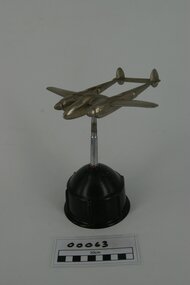
Trench Art, 1940s
... The RAAF was equipped with a small number of these aircraft, commencing in 1942, which were used for front line photographic reconnaissance duty. ...The RAAF was equipped with a small number of these aircraft, commencing in 1942, which were used for front line photographic reconnaissance duty. ...Miniature model of a WW2 era Lockheed P-38 Lightning twin engine aircraft mounted on a bakelite base. The aircraft is supported by a central, chromed bullet vertically mounted on the bakelite base to form a stand. The plane and central support have been made from chromed metal materials. The RAAF was equipped with a small number of these aircraft, commencing in 1942, which were used for front line photographic reconnaissance duty. The first version of the Lockheed P-38 was introduced in 1941 by the USA Lockheed aircraft company as a heavy fighter.Nilplane, trench art, p-38, lightning, lockheed, lockheed lightning, souvenir -
 Frankston RSL Sub Branch
Trench Art
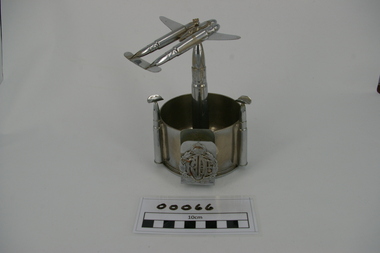
... The RAAF was equipped with a small number of these aircraft, commencing in 1942, which were used for front line photographic reconnaissance duty. ...The RAAF was equipped with a small number of these aircraft, commencing in 1942, which were used for front line photographic reconnaissance duty. ...Made by Cpl. Charlie Dawes 116777 R.A.A.F from parts got while serving at Goodenough and Thursday Isalnds WW2Miniature model of a WW2 era Lockheed P-38 Lightning twin engine aircraft mounted on a trench art ashtray made from various used munitions. This model was made during WW2 by Corporal Cyril 'Charlie' Dawes, RAAF service number 116777, from parts found whilst serving at Goodenough and Thursday Islands in the Torres Strait. The aircraft is supported by a 0.50 inch calibre bullet fixed to the inside of a section of an artillery case which forms the base. The base has three 0.303 inch calibre bullets attached vertically around the circumference and a metal matchbox holder with a RAAF hat badge insignia attached to the front. The items have been made from chromed metal materials. The RAAF was equipped with a small number of these aircraft, commencing in 1942, which were used for front line photographic reconnaissance duty. The first version of the Lockheed P-38 was introduced in 1941 by the USA Lockheed aircraft company as a heavy fighter.RAAF chrome cap badge (WW2 era with the kings crown)plane, trench art, ashtray -
 Frankston RSL Sub Branch
Souvenir Ashtray
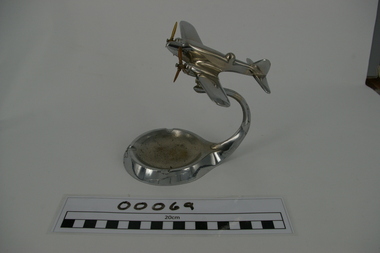
... These aircraft were used by the RAAF for general and maritime reconnaissance and training throughout WW2 and into the early 1950s. ...These aircraft were used by the RAAF for general and maritime reconnaissance and training throughout WW2 and into the early 1950s. ...Miniature model of a WW2 era Avro Anson twin engine aircraft mounted on an ashtray. The aircraft is supported by a curved arm attached to the circular ashtray base. The base has a small metal RAAF 'winged eagle' insignia attached to the front edge. The items have been made from chromed metal materials. The RAAF was equipped with Avro Anson aircraft in the late 1930 period prior to WW2. These aircraft were used by the RAAF for general and maritime reconnaissance and training throughout WW2 and into the early 1950s. The first version of the Avro Anson was developed in 1935 by the British Avro aircraft company.Chromed metal RAAF 'winged eagle' insignia on the front edge of the base.plane, trench art, ashtray, aircraft, souvenir, avro anson -
 Lara RSL Sub Branch
Framed photo print of Mosquito fighter plane
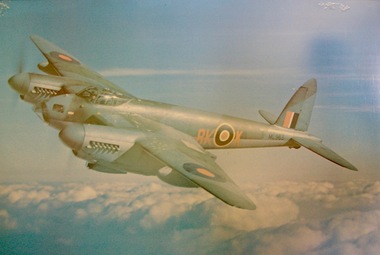
... aircraft development that some of the world's greatest aeroplanes have achieved their fame doing jobs other than the one they were originally designed for. No better example of this could be found than the Mosquito, which, conceived as a bomber, became one of the war's most potent fighters. More than this, indeed, it was probably the most successfully versatile of any twin-engined type built between 1939 and 1945. It excelled in all the widely varied roles. Its duties included the duties of low-level and high-attack day and night bomber, long-range photo-reconnaissance ...The de Havilland DH.98 Mosquito is a British twin-engine shoulder-winged multi-role combat aircraft. The crew of two, pilot and navigator, sat side by side. It served during and after the Second World War. It was one of few operational front-line aircraft of the era whose frame was constructed almost entirely of wood and was nicknamed The Wooden Wonder. https://en.wikipedia.org/wiki/De_Havilland_MosquitoIt is one of the paradoxes of aircraft development that some of the world's greatest aeroplanes have achieved their fame doing jobs other than the one they were originally designed for. No better example of this could be found than the Mosquito, which, conceived as a bomber, became one of the war's most potent fighters. More than this, indeed, it was probably the most successfully versatile of any twin-engined type built between 1939 and 1945. It excelled in all the widely varied roles. Its duties included the duties of low-level and high-attack day and night bomber, long-range photo-reconnaissance, mine layer, pathfinder, high-speed military transport, long-range day and night fighter, and fighter-bomber. It served in Europe, the Middle and Far East and on the Russian front. In fact, the ubiquitous Mosquito reigned supreme among General Purpose types. Of the grand total of 7,781 Mosquitos built, 6,710 were delivered during the war years. www.aviation-history.com/dehavilland/mosquito.html Rectangular shaped picture frame showing Mosquito fighter plane.fighter planes, ww2, british aircraft, mosquito fighter planes, lara r.s.l. -
 Waverley RSL Sub Branch
Plaque 4 Sqn.R.A.A.F. Hospital, R.A.A.F. Hospital
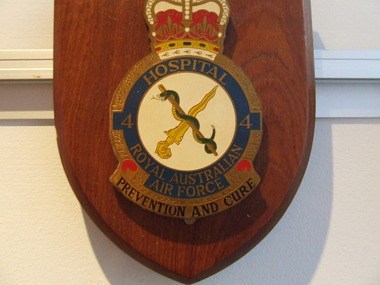
... In their slow and vulnerable aircraft, losses from anti-aircraft fire were high, however, this never deterred the Wirraway crews from completing their assigned tasks. This aggressive spirit was exemplified by Pilot Officer Archer and his crewman, Sergeant Coulston, who, while on a reconnaissance mission, found themselves above a Japanese Zero fighter. ...In their slow and vulnerable aircraft, losses from anti-aircraft fire were high, however, this never deterred the Wirraway crews from completing their assigned tasks. This aggressive spirit was exemplified by Pilot Officer Archer and his crewman, Sergeant Coulston, who, while on a reconnaissance mission, found themselves above a Japanese Zero fighter. ...No 4 Squadron, Australian Flying Corps, formed at Point Cook, Victoria, in October 1916. After embarking for England to complete its training, the squadron deployed to France in December 1917. From the outset, No 4 Squadron aircraft regularly engaged the Red Baron's elite 'Flying Circus' and, in spite of their lack of experience, quickly gained the ascendancy over the German squadron. During its brief war service, No 4 Squadron destroyed some 128 enemy aircraft and spawned a total of eleven aces. The squadron's highest scoring airman was Captain Cobby who, in addition to shooting down 29 aircraft, also destroyed 13 observation balloons. World War II saw No 4 Squadron Wirraways deployed to Port Moresby in support of Australian troops fighting in the New Guinea jungles. In their slow and vulnerable aircraft, losses from anti-aircraft fire were high, however, this never deterred the Wirraway crews from completing their assigned tasks. This aggressive spirit was exemplified by Pilot Officer Archer and his crewman, Sergeant Coulston, who, while on a reconnaissance mission, found themselves above a Japanese Zero fighter. Despite operating a vastly inferior aircraft, Pilot Officer Archer dived to the attack and shot down the enemy aircraft. In June 1943, No 4 Squadron received its first Boomerang fighters and continued to support Allied troops during the Cape Gloucester landings before moving to Morotai. No 4 Squadron ended the war in Borneo and returned to Australia in November 1945, where it was renamed No 3 Squadron - thus closing the chapter on a very distinguished and proud unit. Summary of Unit Name(s) Start Date End Date No. 4 RAAF Hospital, Butterworth 06/06/1966 06/06/1966 No. 4 RAAF Hospital, Butterworth 03/07/1966 No. 4 RAAF Hospital, Butterworth 01/08/1966 01/08/1966 No. 4 RAAF Hospital, Butterworth 05/09/1966 No. 4 RAAF Hospital, Butterworth 29/09/1966 No. 4 RAAF Hospital, Butterworth 29/10/1966 29/10/1966 http://www.airforce.gov.au/raafmuseum/research/units/4sqn.htmWooden Plaque 15cm x 13cm with insignia of 4 Sqn.R.A.A.F. Hospital 4 Sqn R.A.A.F. Hospital r.a.a.f. 4 squadron, butterworth, r.a.a.f. hospital -
 Waverley RSL Sub Branch
Aircraft shells
... Of particular interest is the "spade nosed" round used German aircraft in an attempt to cut the retaining cables of reconnaissance and barrage balloons used by British forces ...3 rounds Of particular interest is the "spade nosed" round used German aircraft in an attempt to cut the retaining cables of reconnaissance and barrage balloons used by British forces ...Of particular interest is the "spade nosed" round used German aircraft in an attempt to cut the retaining cables of reconnaissance and barrage balloons used by British forces 3 rounds Of particular interest is the "spade nosed" round used German aircraft in an attempt to cut the retaining cables of reconnaissance and barrage balloons used by British forces Aircraft shells ...Of particular interest is the "spade nosed" round used German aircraft in an attempt to cut the retaining cables of reconnaissance and barrage balloons used by British forces 3 rounds Of particular interest is the "spade nosed" round used German aircraft in an attempt to cut the retaining cables of reconnaissance and barrage balloons used by British forces -
 Monbulk RSL Sub Branch
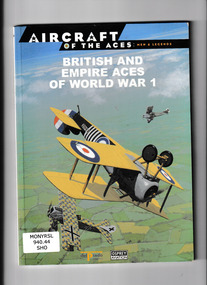
Book, Christopher Shores, British and empire aces of world war 1, 2001
... worls war 1914-1918 - aerial operations - britain fighter pilots - british empire At the outset of World War I the British had some 110 assorted aircraft, used mostly for the visual reconnaissance role. With the advent of faster and more agile single-seaters, the Allies and their adversaries raced to outdo each other in the creation of genuinely effective fighters with fixed forward-firing machine gun armament. ...At the outset of World War I the British had some 110 assorted aircraft, used mostly for the visual reconnaissance role. With the advent of faster and more agile single-seaters, the Allies and their adversaries raced to outdo each other in the creation of genuinely effective fighters with fixed forward-firing machine gun armament. It was not until 1917 that the British developed a truly effective interrupter gear, which paved the way for excellent single seaters such as the Sopwith Triplane Camel and the RAF S.E.5., later joined by the Bristol F.2B - the war's best two-seat fighter. This volume traces the rapid development of the fighter in World War I and the amazing exploits of the British and Empire aces who flew them.Ill, p.64.non-fictionAt the outset of World War I the British had some 110 assorted aircraft, used mostly for the visual reconnaissance role. With the advent of faster and more agile single-seaters, the Allies and their adversaries raced to outdo each other in the creation of genuinely effective fighters with fixed forward-firing machine gun armament. It was not until 1917 that the British developed a truly effective interrupter gear, which paved the way for excellent single seaters such as the Sopwith Triplane Camel and the RAF S.E.5., later joined by the Bristol F.2B - the war's best two-seat fighter. This volume traces the rapid development of the fighter in World War I and the amazing exploits of the British and Empire aces who flew them.worls war 1914-1918 - aerial operations - britain, fighter pilots - british empire -
 Bendigo Historical Society Inc.
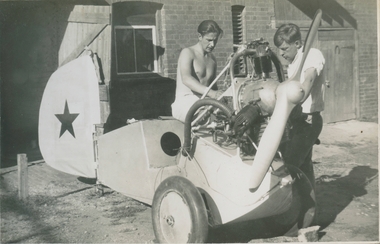
Photograph - Gliding in Bendigo, Late 1930s
... aircraft construction and flying, a sense of optimistic can-do, and the cavalier estimation of risks that goes with being in your early 20s. The events described here took place against a darkening political background. Alan and his mates were politically aware, very left wing, and viewed the gathering storm in Europe with apprehension. They could see from early on that war was coming, and it would change everything. Prevented from joining the Air Force by his red-green colour blindness, Alan joined the Army the day after the Pearl Harbour attack. He served in an Armoured Reconnaissance...aircraft construction and flying, a sense of optimistic can-do, and the cavalier estimation of risks that goes with being in your early 20s. The events described here took place against a darkening political background. Alan and his mates were politically aware, very left wing, and viewed the gathering storm in Europe with apprehension. They could see from early on that war was coming, and it would change everything. Prevented from joining the Air Force by his red-green colour blindness, Alan joined the Army the day after the Pearl Harbour attack. He served in an Armoured Reconnaissance ...These are the recollections of Alan Menere (1915 – 2001). Alan grew up in Moonee Ponds, Victoria, and moved to Bendigo while in his early 20s. There he met some like-minded young men who enjoyed challenges and matters mechanical. Flying was the adventure of the time, and they decided to give it a go. There was no intention to be on the leading edge of gliding technology. The challenge was to fly, and by their own efforts. They were aided in this by the embryonic regulatory arrangements covering light aircraft construction and flying, a sense of optimistic can-do, and the cavalier estimation of risks that goes with being in your early 20s. The events described here took place against a darkening political background. Alan and his mates were politically aware, very left wing, and viewed the gathering storm in Europe with apprehension. They could see from early on that war was coming, and it would change everything. Prevented from joining the Air Force by his red-green colour blindness, Alan joined the Army the day after the Pearl Harbour attack. He served in an Armoured Reconnaissance Unit in Western Australia, then with the Army Education Service in New Britain. After the War he joined the Commonwealth Public Service. He moved to Canberra, but his Bendigo habits stayed with him, as he built sailboards and carved propellers, to the admiration of his sons. Alan developed macular degeneration in his mid-60s. He retired to Port Stephens, fishing and socializing when he wasn’t tinkering with wing-sails for his catamaran. As he could touch-type, he quickly learned to use a computer. Very aware that he was the last member of the Bendigo group still alive, he resolved to set down his flying experiences. The images he selected are included, but there are many more from the Bendigo days.A CD entitled "Alan Menere - Recollections of Gliding in Bendigo in the late 1930s". The CD contains 33 documents consisting of one word file, one PDF file (entitled "The Urge to Fly") and the rest are of either photos of the Bendigo Gliding club or generally around Bendigo itself. Also included are some paper clippings of accidents that happened and description of flights.history, bendigo, bendigo gliding club, alan menere -
 National Vietnam Veterans Museum (NVVM)
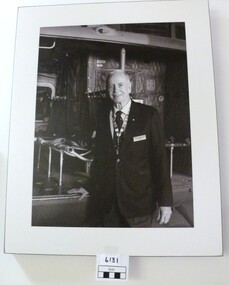
Photograph, C.2015
... My job was to fly reconnaissance missions in South and North Vietnam. My navigator was from North Carolina so we named our aircraft the 'Carolina Kangaroo'. ...My job was to fly reconnaissance missions in South and North Vietnam. My navigator was from North Carolina so we named our aircraft the 'Carolina Kangaroo'. ...AVM Alan Reed AO, Tan Son Nhut, Saigon, June - November 1968. I was an Australian exchange officer flying RF4C Phantoms and training United States Air Force (USAF) pilots and navigators to go to Vietnam. I felt I needed some Vietnam experience if I were to do my job as an instructor. I managed to persuade both the US and Australian Governments to let me go the the war. I claim to be one of the few people 'invited' to the war because, for protocol reasons. the USAF could not order me to go. I was on exchange with the USAF from 1967 to 1970. My job was to fly reconnaissance missions in South and North Vietnam. My navigator was from North Carolina so we named our aircraft the 'Carolina Kangaroo'. All up, I flew 100 missions in Vietnam. Squadron Leader Alan Reed from the Royal Australian Air Force 052363 served in Vietnam from 26 May 1968 until 20 November 1968. He spent most of his tour detached to the 12th Tactical Reconnaissance Squadron, US Air Force. He was made an Officer of the Order of Australia (AO) in June 1989 for his service to the RAAF as Air Officer Commanding, Support Command. For his service with the USAF, Alan Reed was awarded the United States Distinguished Flying Cross with oak leaf cluster. His final rank with the Air Force was Air Vice Marshal and his last posting was with Headquarters, Australian Force Vietnam (RAAF Element) Black and white photo of Alan Reed Sqdr Ldr Pilot at the N.V.V.M. 2015 with supporting info.pilot, alan reed, tan son nhut, saigon, phantom rf4c, united states air force, usaf, "carolina kangaroo"., squadron leader alan reed, royal australian air force, 052363, 12th tactical reconnaissance squadron, officer of the order of australia, raaf, distinguished flying cross, air vice marshall allan reed, headquarters, australian force vietnam -
 National Vietnam Veterans Museum (NVVM)
Model - Model of Phantom RF4C named 'Carolina Kangaroo', C.2014
... aircraft....Phantom RF4C...Allan Reed...Squadron Leader Alan Reed...Royal Australian Air Force...052363...12th Tactical Reconnaissance...Reconnaissance Squadron, US Air Force. He was made an Officer of the Order of Australia (AO) in June 1989 for his service to the RAAF as Air Officer Commanding, Support Command. For his service with the USAF, Alan Reed was awarded the United States Distinguished Flying Cross with oak leaf cluster. His final rank with the Air Force was Air Vice Marshal and his last posting was with Headquarters, Australian Force Vietnam (RAAF Element) Model aircraft ...Squadron Leader Alan Reed from the Royal Australian Air Force 052363 served in Vietnam from 26 May 1968 until 20 November 1968. He spent most of his tour detached to the 12th Tactical Reconnaissance Squadron, US Air Force. He was made an Officer of the Order of Australia (AO) in June 1989 for his service to the RAAF as Air Officer Commanding, Support Command. For his service with the USAF, Alan Reed was awarded the United States Distinguished Flying Cross with oak leaf cluster. His final rank with the Air Force was Air Vice Marshal and his last posting was with Headquarters, Australian Force Vietnam (RAAF Element) Phantom RF4C named 'Carolina Kangaroo' Plastic , Perspex.AC 448 US Air Force Star.model aircraft., phantom rf4c, allan reed, squadron leader alan reed, royal australian air force, 052363, 12th tactical reconnaissance squadron, officer of the order of australia, raaf, usaf, united states air force, distinguished flying cross, air vice marshall allan reed, headquarters, australian force vietnam, raaf element -
 National Vietnam Veterans Museum (NVVM)
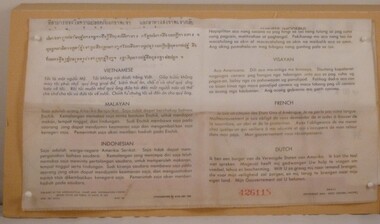
Functional Object - Letter, April 1961
... Alan Reed Squadron Leader Alan Reed 052363 Royal Australian Air Force 12th Tactical Reconnaissance Squadron Officer of the Order of Australia Distinguished Flying Cross USAF United States Air Force Air Vice Marshall Allan Reed Headquarters Australian Force Vietnam RAAF Element Pilot SQD LD Alan Reed.Service No. 42611S. Silk Pilots Letter , Squadron Leader A.R. Reed, Service number: 426115. LD Allan Reed. All Pilots of the RF-4C Phantom aircraft ...Squadron Leader Alan Reed from the Royal Australian Air Force 052363 served in Vietnam from 26 May 1968 until 20 November 1968. He spent most of his tour detached to the 12th Tactical Reconnaissance Squadron, US Air Force. He was made an Officer of the Order of Australia (AO) in June 1989 for his service to the RAAF as Air Officer Commanding, Support Command. For his service with the USAF, Alan Reed was awarded the United States Distinguished Flying Cross with oak leaf cluster. His final rank with the Air Force was Air Vice Marshal and his last posting was with Headquarters, Australian Force Vietnam (RAAF Element) Silk Pilots Letter , Squadron Leader A.R. Reed, Service number: 426115. LD Allan Reed. All Pilots of the RF-4C Phantom aircraft carried a silk letter with the same message in many languages. It asks people to assist the holder and advises that they will be rewarded for doing so.SQD LD Alan Reed.Service No. 42611S.silk pilots letter., alan reed, squadron leader alan reed, 052363, royal australian air force, 12th tactical reconnaissance squadron, officer of the order of australia, distinguished flying cross, usaf, united states air force, air vice marshall allan reed, headquarters, australian force vietnam, raaf element, pilot -
 National Vietnam Veterans Museum (NVVM)
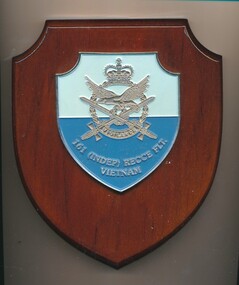
Plaque - 161 (INDEP) Recce Flight Vietnam Plaque
... 161 (Independent) Reconnaissance Flight was an Australian Army aviation unit of both fixed-wing and rotary aircraft. ...161 (Independent) Reconnaissance Flight was an Australian Army aviation unit of both fixed-wing and rotary aircraft. ...161 (Independent) Reconnaissance Flight was an Australian Army aviation unit of both fixed-wing and rotary aircraft. This item was collected because it commemorates the war in Vietnam.Shield-shaped wooden plaque with metal badge/insignia of crown, eagle, crossed swords and laurel wreath in two shades of blue. The emblem of 161 (Independent) Reconnaissance Flight Vietnam.VIGILANCE/ 161 (INDEP) RECCE FL.T./ VIETNAM161 reconnaissance flight, vietnam, army pilots, 161 recce -
 National Vietnam Veterans Museum (NVVM)
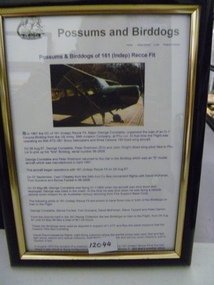
Document, Possums and Bird Dogs
... Cessna O.1 Bird Dog 161 Reconnaissance Flight 161 logo in top LH corner Framed document titled, "Possums and Bird Dogs of 161 (Indep) RECCE FLT." Document has a photo of an 0-1 Cessna Birddog aircraft and outlines the history of the aircraft in operations with 161 REECE FLT from 28/8/1967 to 23/5/1968. ...Framed document titled, "Possums and Bird Dogs of 161 (Indep) RECCE FLT." Document has a photo of an 0-1 Cessna Birddog aircraft and outlines the history of the aircraft in operations with 161 REECE FLT from 28/8/1967 to 23/5/1968.161 logo in top LH cornercessna o.1 bird dog, 161 reconnaissance flight -
 National Vietnam Veterans Museum (NVVM)
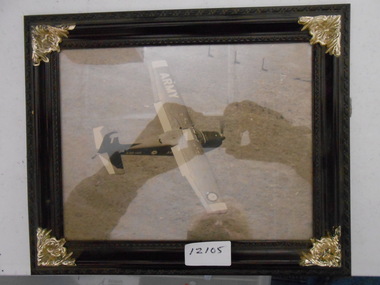
Photograph, Cessna 180 Aircraft, 1968
... Photograph Vietnam Cessna 180 161 Reconnaissance Flight Army Rondell, A98 - 148, Army Photograph of Australian Army 161 Recce Flt Cessna 180 in flight over Vietnam Cessna 180 Aircraft Photograph Photograph ...Photograph of Australian Army 161 Recce Flt Cessna 180 in flight over VietnamArmy Rondell, A98 - 148, Armyphotograph, vietnam, cessna 180, 161 reconnaissance flight -
 National Vietnam Veterans Museum (NVVM)
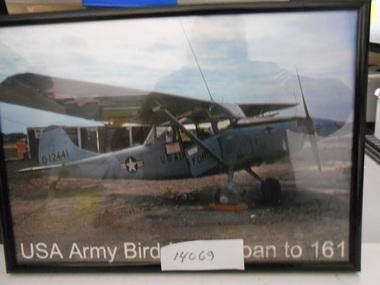
Photograph, US Army Bird Dog Aircraft
... Photograph Cessna O.1 Bird Dog 161 Reconnaissance Flight S/N O-12441, US Air Force logo Framed Coloured Photograph of US Army Bird Dog Aircraft on loan to 161 (INDEP) Recce Flt. ...Framed Coloured Photograph of US Army Bird Dog Aircraft on loan to 161 (INDEP) Recce Flt. Black frame.S/N O-12441, US Air Force logophotograph, cessna o.1 bird dog, 161 reconnaissance flight -
 National Vietnam Veterans Museum (NVVM)
Document, Pilatus Porter
... Framed document Pilatus Porter 161 Reconnaissance Flight Rego A14-692 Black Framed Document outlining specifications of Pilatus Porter Aircraft and it's Record in Vietnam Pilatus Porter Document Document ...Black Framed Document outlining specifications of Pilatus Porter Aircraft and it's Record in VietnamRego A14-692framed document, pilatus porter, 161 reconnaissance flight -
 National Vietnam Veterans Museum (NVVM)
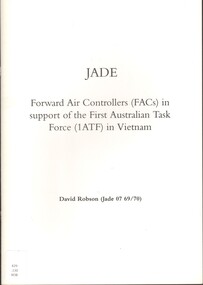
Booklet, Robson, David, JADE: Forward Air controllers (FACs) in support of the First Australian Task Force (1ATF) in Vietnam
... Forward Air Controller 1st Australian Task Force Cessna O-2A Aerial reconnaissance -- United States Vietnam War 1961-1975 -- Aerial operations American A brief history of FAC aircraft in Vietnam & in particular, The Cessna O-2A. ...A brief history of FAC aircraft in Vietnam & in particular, The Cessna O-2A.forward air controller, 1st australian task force, cessna o-2a, aerial reconnaissance -- united states, vietnam war, 1961-1975 -- aerial operations, american -
Moorabbin Air Museum
Assorted drawings and articles on small experimental aircraft - Description for details Keith Meggs Collection
... Various drawings articles and notes including the following: Newton Emu Stinson Thorp Sky Skooter Transavia PL12 Airtruk Air Tug Ford 4-AT Kreider Reisner XC-31 Fairchild Avro Anson Avro York Curtiss Commando Austaircar Frost fan experiment - correspondence DCA-1B Light Bomber Reconnaissance Monoplane Dept Civil Aviation Patent Papers for Aircraft for Supersonic Flight 1947 Russell Robinson Correspondence with De Haviland GA200C Mahiondra C-NM5 The Rover Sea Rover Woomera Post war aircraft drawings for DCA Zenith Luton Minor Teenie Two Yeoman YA-1 Dart Kitten Bell Brolga Pellarini PL1 PL.9 Sleep Rotary Wing Glider 1947 Victa Aircruiser Wicko Windsor Airvan Tremayne ECT3 ...Various drawings articles and notes including the following: Newton Emu Stinson Thorp Sky Skooter Transavia PL12 Airtruk Air Tug Ford 4-AT Kreider Reisner XC-31 Fairchild Avro Anson Avro York Curtiss Commando Austaircar Frost fan experiment - correspondence DCA-1B Light Bomber Reconnaissance Monoplane Dept Civil Aviation Patent Papers for Aircraft for Supersonic Flight 1947 Russell Robinson Correspondence with De Haviland GA200C Mahiondra C-NM5 The Rover Sea Rover Woomera Post war aircraft drawings for DCA Zenith Luton Minor Teenie Two Yeoman YA-1 Dart Kitten Bell Brolga Pellarini PL1 PL.9 Sleep Rotary Wing Glider 1947 Victa Aircruiser Wicko Windsor Airvan Tremayne ECT3 Assorted drawings and articles on small experimental aircraft - Description for details Keith Meggs Collection ... -
Moorabbin Air Museum
Document (item) - General Dynamics F-111C Reconnaissance Variant Flight Test Plan, Detailed Flight Test Plan for F-111C Reconnaissance Airplane
... aircraft with RAAF crew (mostly). Plain white book bound with staples Detailed Flight Test Plan for F-111C Reconnaissance Airplane Document General Dynamics F-111C Reconnaissance Variant Flight Test Plan ...Flight tests were to be conducted in Fort Worth, Texas, but using an RAAF aircraft with RAAF crew (mostly). -
Moorabbin Air Museum
Document (Item) - Aeronautica Macchi -S.p.A Varese (Italia) Tactical Support, Photographic Reconnaissance , Firing Training , Target Towing Versions MB-326-B Aircraft
... Aeronautica Macchi -S.p.A Varese (Italia) Tactical Support, Photographic Reconnaissance , Firing Training , Target Towing Versions MB-326-B Aircraft...Aeronautica Macchi -S.p.A Varese (Italia) Tactical Support, Photographic Reconnaissance , Firing Training , Target Towing Versions MB-326-B Aircraft...Report No.546 Aeronautica Macchi -S.p.A Varese (Italia) Tactical Support, Photographic Reconnaissance , Firing Training , Target Towing Versions MB-326-B Aircraft Document Aeronautica Macchi -S.p.A Varese (Italia) Tactical Support, Photographic Reconnaissance , Firing Training , Target Towing Versions MB-326-B Aircraft ...Report No.546 -
Moorabbin Air Museum
Manual - Avro Anson, The Anson Aeroplane (General Reconnaissance Landplane) Two Cheetah IX Engines
... Avro Anson Fuselage Main planes Tail unit Undercarriage Controls Engine installation Service equipment Erection/rigging/maintenance Technical overview of Avro Anson reconnaissance aircraft, circa 1937 Spiral bound book size manual The Anson Aeroplane (General Reconnaissance Landplane) Two Cheetah IX Engines Manual Avro Anson ...Technical overview of Avro Anson reconnaissance aircraft, circa 1937Spiral bound book size manualnon-fictionTechnical overview of Avro Anson reconnaissance aircraft, circa 1937fuselage, main planes, tail unit, undercarriage, controls, engine installation, service equipment, erection/rigging/maintenance -
Moorabbin Air Museum
Photograph (item) - Multiple copies of photos of Lancaster Yeoman Cropmaster Meteor Mirach Dornier meteor missile unmanned reconnaissance unnamed jet powered sea launched twin tail drone Boeing XB56 Plus photos including Sabre Auster Autocar armament including rockets and bombs Airport fire drill and fire suits Ford Trimotor Bankstown airport Beaufighter F111 Course setting Bombsight Mk 9c Pika Jindivik engine, photos of various aircraft including Sunderland Auster autocar aircraft bombs and rockets In folder named photos to be sorted
... photos of various aircraft including Sunderland Auster autocar aircraft bombs and rockets In folder named photos to be sorted Photograph Multiple copies of photos of Lancaster Yeoman Cropmaster Meteor Mirach Dornier meteor missile unmanned reconnaissance unnamed jet powered sea launched twin tail drone Boeing XB56 Plus photos including Sabre Auster Autocar armament including rockets and bombs Airport fire drill and fire suits Ford Trimotor Bankstown airport Beaufighter F111 Course setting Bombsight Mk 9c Pika Jindivik engine ...
