
Showing 15 items matching "red chain cotton"
-
 Flagstaff Hill Maritime Museum and Village
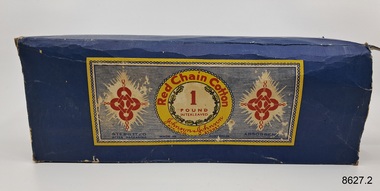
Functional object - Cotton Wool Roll, Johnson & Johnson, Early 20th century
... ...Red Chain Cotton...'Red Chain Cotton. 1 Pound Interleaved. Johnson & Johnson Pty Ltd, Sydney. ...Flagstaff Hill Maritime Museum and Village Great Ocean Road Shipwreck Coast Cotton Wool Medical Johnson & Johnson Red Chain Cotton W.R. Angus 'Red Chain Cotton. 1 Pound Interleaved. ...This cotton wool, used by Dr.William Roy Angus, Surgeon and Oculist, was donated to Flagstaff Hill Maritime Village by his daughter, Bernice McDade. It is part of the “W.R. Angus Collection” that includes historical medical equipment, surgical instruments and material once belonging to Dr Edward Ryan and Dr Thomas Francis Ryan, (both of Nhill, Victoria) as well as Dr Angus’ own belongings. The Collection’s history spans the medical practices of the two Doctors Ryan, from 1885-1926 plus that of Dr Angus, up until 1969. ABOUT THE “W.R.ANGUS COLLECTION” Doctor William Roy Angus M.B., B.S., Adel., 1923, F.R.C.S. Edin.,1928 (also known as Dr Roy Angus) was born in Murrumbeena, Victoria in 1901 and lived until 1970. He qualified as a doctor in 1923 at University of Adelaide, was Resident Medical Officer at the Royal Adelaide Hospital in 1924 and for a period was house surgeon to Sir (then Mr.) Henry Simpson Newland. Dr Angus was briefly an Assistant to Dr Riddell of Kapunda, then commenced private practice at Curramulka, Yorke Peninsula, SA, where he was physician, surgeon and chemist. In 1926, he was appointed as new Medical Assistant to Dr Thomas Francis Ryan (T.F. Ryan, or Tom), in Nhill, Victoria, where his experiences included radiology and pharmacy. In 1927 he was Acting House Surgeon in Dr Tom Ryan’s absence. Dr Angus had become engaged to Gladys Forsyth and they decided he would take time to further his studies overseas in the UK in 1927. He studied at London University College Hospital and at Edinburgh Royal Infirmary and in 1928, was awarded FRCS (Fellow from the Royal College of Surgeons), Edinburgh. He worked his passage back to Australia as a Ship’s Surgeon on the on the Australian Commonwealth Line’s T.S.S. Largs Bay. Dr Angus married Gladys in 1929, in Ballarat. (They went on to have one son (Graham 1932, born in SA) and two daughters (Helen (died 12/07/1996) and Berenice (Berry), both born at Mira, Nhill ) Dr Angus was a ‘flying doctor’ for the A.I.M. (Australian Inland Ministry) Aerial Medical Service in 1928 . The organisation began in South Australia through the Presbyterian Church in that year, with its first station being in the remote town of Oodnadatta, where Dr Angus was stationed. He was locum tenens there on North-South Railway at 21 Mile Camp. He took up this ‘flying doctor’ position in response to a call from Dr John Flynn; the organisation was later known as the Flying Doctor Service, then the Royal Flying Doctor Service. A lot of his work during this time involved dental surgery also. Between 1928-1932 he was surgeon at the Curramulka Hospital, Yorke Peninsula, South Australia. In 1933 Dr Angus returned to Nhill where he’d previously worked as Medical Assistant and purchased a share of the Nelson Street practice and Mira hospital from Dr Les Middleton one of the Middleton Brothers, the current owners of what was once Dr Tom Ryan’s practice. Dr L Middleton was House Surgeon to the Nhill Hospital 1926-1933, when he resigned. [Dr Tom Ryan’s practice had originally belonged to his older brother Dr Edward Ryan, who came to Nhill in 1885. Dr Edward saw patients at his rooms, firstly in Victoria Street and in 1886 in Nelson Street, until 1901. The Nelson Street practice also had a 2 bed ward, called Mira Private Hospital ). Dr Edward Ryan was House Surgeon at the Nhill Hospital 1884-1902 . He also had occasions where he successfully performed veterinary surgery for the local farmers too. Dr Tom Ryan then purchased the practice from his brother in 1901. Both Dr Edward and Dr Tom Ryan work as surgeons included eye surgery. Dr Tom Ryan performed many of his operations in the Mira private hospital on his premises. He too was House Surgeon at the Nhill Hospital 1902-1926. Dr Tom Ryan had one of the only two pieces of radiology equipment in Victoria during his practicing years – The Royal Melbourne Hospital had the other one. Over the years Dr Tom Ryan gradually set up what was effectively a training school for country general-practitioner-surgeons. Each patient was carefully examined, including using the X-ray machine, and any surgery was discussed and planned with Dr Ryan’s assistants several days in advance. Dr Angus gained experience in using the X-ray machine there during his time as assistant to Dr Ryan. Dr Tom Ryan moved from Nhill in 1926. He became a Fellow of the Royal Australasian College of Surgeons in 1927, soon after its formation, a rare accolade for a doctor outside any of the major cities. He remained a bachelor and died suddenly on 7th Dec 1955, aged 91, at his home in Ararat. Scholarships and prizes are still awarded to medical students in the honour of Dr T.F. Ryan and his father, Dr Michael Ryan, and brother, John Patrick Ryan. ] When Dr Angus bought into the Nelson Street premises in Nhill he was also appointed as the Nhill Hospital’s Honorary House Surgeon 1933-1938. His practitioner’s plate from his Nhill surgery states “HOURS Daily, except Tuesdays, Fridays and Saturday afternoons, 9-10am, 2-4pm, 7-8pm. Sundays by appointment”. This plate is now mounted on the doorway to the Port Medical Office at Flagstaff Hill Maritime Village, Warrnambool. Dr Edward Ryan and Dr Tom Ryan had an extensive collection of historical medical equipment and materials spanning 1884-1926 and when Dr Angus took up practice in their old premises he obtained this collection, a large part of which is now on display at the Port Medical Office at Flagstaff Hill Maritime Village in Warrnambool. During his time in Nhill Dr Angus was involved in the merging of the Mira Hospital and Nhill Public Hospital into one public hospital and the property titles passed on to Nhill Hospital in 1939. In 1939 Dr Angus and his family moved to Warrnambool where he purchased “Birchwood,” the 1852 home and medical practice of Dr John Hunter Henderson, at 214 Koroit Street. (This property was sold in1965 to the State Government and is now the site of the Warrnambool Police Station. ). The Angus family was able to afford gardeners, cooks and maids; their home was a popular place for visiting dignitaries to stay whilst visiting Warrnambool. Dr Angus had his own silk worm farm at home in a Mulberry tree. His young daughter used his centrifuge for spinning the silk. Dr Angus was appointed on a part-time basis as Port Medical Officer (Health Officer) in Warrnambool and held this position until the 1940’s when the government no longer required the service of a Port Medical Officer in Warrnambool; he was thus Warrnambool’s last serving Port Medical Officer. (The duties of a Port Medical Officer were outlined by the Colonial Secretary on 21st June, 1839 under the terms of the Quarantine Act. Masters of immigrant ships arriving in port reported incidents of diseases, illness and death and the Port Medical Officer made a decision on whether the ship required Quarantine and for how long, in this way preventing contagious illness from spreading from new immigrants to the residents already in the colony.) Dr Angus was a member of the Australian Medical Association, for 35 years and surgeon at the Warrnambool Base Hospital 1939-1942, He served as a Surgeon Captain during WWII1942-45, in Ballarat, Victoria, and in Bonegilla, N.S.W., completing his service just before the end of the war due to suffering from a heart attack. During his convalescence he carved an intricate and ‘most artistic’ chess set from the material that dentures were made from. He then studied ophthalmology at the Royal Melbourne Eye and Ear Hospital and created cosmetically superior artificial eyes by pioneering using the intrascleral cartilage. Angus received accolades from the Ophthalmological Society of Australasia for this work. He returned to Warrnambool to commence practice as an ophthalmologist, pioneering in artificial eye improvements. He was Honorary Consultant Ophthalmologist to Warrnambool Base Hospital for 31 years. He made monthly visits to Portland as a visiting surgeon, to perform eye surgery. He represented the Victorian South-West subdivision of the Australian Medical Association as its secretary between 1949 and 1956 and as chairman from 1956 to 1958. In 1968 Dr Angus was elected member of Spain’s Barraquer Institute of Barcelona after his research work in Intrasclearal cartilage grafting, becoming one of the few Australian ophthalmologists to receive this honour, and in the following year presented his final paper on Living Intrasclearal Cartilage Implants at the Inaugural Meeting of the Australian College of Ophthalmologists in Melbourne In his personal life Dr Angus was a Presbyterian and treated Sunday as a Sabbath, a day of rest. He would visit 3 or 4 country patients on a Sunday, taking his children along ‘for the ride’ and to visit with him. Sunday evenings he would play the pianola and sing Scottish songs to his family. One of Dr Angus’ patients was Margaret MacKenzie, author of a book on local shipwrecks that she’d seen as an eye witness from the late 1880’s in Peterborough, Victoria. In the early 1950’s Dr Angus, painted a picture of a shipwreck for the cover jacket of Margaret’s book, Shipwrecks and More Shipwrecks. She was blind in later life and her daughter wrote the actual book for her. Dr Angus and his wife Gladys were very involved in Warrnambool’s society with a strong interest in civic affairs. Their interests included organisations such as Red Cross, Rostrum, Warrnambool and District Historical Society (founding members), Wine and Food Society, Steering Committee for Tertiary Education in Warrnambool, Local National Trust, Good Neighbour Council, Housing Commission Advisory Board, United Services Institute, Legion of Ex-Servicemen, Olympic Pool Committee, Food for Britain Organisation, Warrnambool Hospital, Anti-Cancer Council, Boys’ Club, Charitable Council, National Fitness Council and Air Raid Precautions Group. He was also a member of the Steam Preservation Society and derived much pleasure from a steam traction engine on his farm. He had an interest in people and the community He and his wife Gladys were both involved in the creation of Flagstaff Hill, including the layout of the gardens. After his death (28th March 1970) his family requested his practitioner’s plate, medical instruments and some personal belongings be displayed in the Port Medical Office surgery at Flagstaff Hill Maritime Village, and be called the “W. R. Angus Collection”.The W.R. Angus Collection is significant for still being located at the site it is connected with, Doctor Angus being the last Port Medical Officer in Warrnambool. The collection of medical instruments and other items and equipment is culturally significant, being an historical example of medicine from late 19th to mid-20th century. Dr Angus assisted Dr Tom Ryan, a pioneer in the use of X-rays and in ocular surgery.Box of cotton wool. The cotton wool sheet is covered in blue tissue paper that has been rooled tightly and stored within a rectangular blue cardboard box. The box has white printed text on one side and a coloured paper label on another side. The text includes instructions for use. Made by Johnson & Johnson Pty Ltd, Sydney. The object is part of the W.R. Angus Collection.'Red Chain Cotton. 1 Pound Interleaved. Johnson & Johnson Pty Ltd, Sydney. Sterilized after packaging. Made in Australia. Absorbent.' 'To open, cut along the perforation. To close tuck-in flap. This cotton is of superior grade specially made for wound and surgical purposes. It will also be found useful in the household, office or factory and as a general toilet accessory.'flagstaff hill maritime museum and village, great ocean road, shipwreck coast, cotton wool, medical, johnson & johnson, red chain cotton, w.r. angus -
 Bendigo Historical Society Inc.
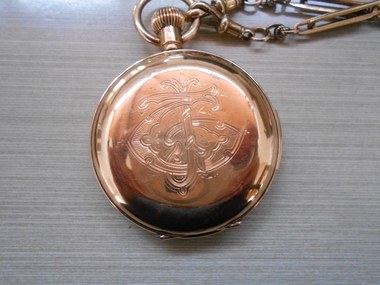
Functional object - Pocket watch
... The gold chain attached to the pocket watch has trombone links separated by groups of five small links. The pocket watch is stored in a light coloured suede pocket. The watch and suede pocket are stored inside a red cotton...The gold chain attached to the pocket watch has trombone links separated by groups of five small links. The pocket watch is stored in a light coloured suede pocket. The watch and suede pocket are stored inside a red cotton ..."Hunter" pocket watch that was presented to James "Jinger" Trewartha in1899 by the Long Gully Cricket Club. (See 10866.2) District Cricketers subscribed the money for the gold watch and chain that was presented to Trewartha at the 1899 Annual banquet of the Long Gully Cricket Club. A "hunter" pocket watch is a pocket watch with a hinged metal lid that covers the dial and crystal to protect them from damage. The name comes from the convenience of being able to open the watch with one hand while holding the reins of a horse. Pocket watches have been around since the fifteenth century. Around the sixteenth century, Charles II, made it popular by wearing it in a waistcoat. Bright gold 'hunter" pocket watch a double case back. Ornate engraving on front cover - Entwined initials J T. Engraved on back of watch "Presented to J. Trewartha Esq. by the L.G.C.C. Cricketers of Bendigo For Services rendered 1898 - 9" The white clock face has black Roman numerals and a small circular window with the seconds displayed. There is no visible brand on the clock face. The gold chain attached to the pocket watch has trombone links separated by groups of five small links. The pocket watch is stored in a light coloured suede pocket. The watch and suede pocket are stored inside a red cotton fabric envelope pocket with an overlapping section fastened with a press stud. Inside front cover 14 K, small oval shaped pattern.watch, pocket watch, gold, cricket -
 Bendigo Historical Society Inc.
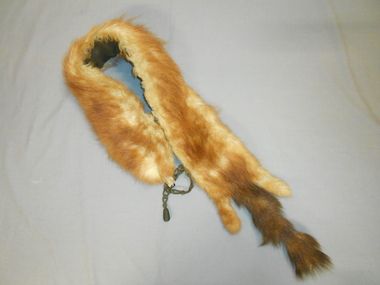
Clothing - EMILY NANKIVELL COLLECTION: RED FOX FUR COLLAR, Early 1900's-1930's
... red fox fur collar Narrow fox fur collar. Pointed 1 cm wide 'skin' nose, which forms the upper part of the enclosed metal clip fasten the collar (squeeze lever on inside). Two glass eyes. A corded ''chain'' finished with a woven toggle, and a cord covered hook fasten the fur around the neckline or shoulders. Ruched ribbon trims both ends of the crepe type cotton ...Narrow fox fur collar. Pointed 1 cm wide 'skin' nose, which forms the upper part of the enclosed metal clip fasten the collar (squeeze lever on inside). Two glass eyes. A corded ''chain'' finished with a woven toggle, and a cord covered hook fasten the fur around the neckline or shoulders. Ruched ribbon trims both ends of the crepe type cotton(?) lining '' tail'' has fur threaded onto a linen thread.costume accessories, female, red fox fur collar -
 Bendigo Historical Society Inc.
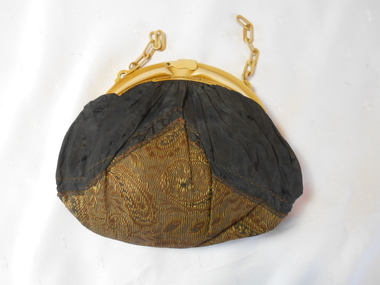
Textile - ACCESSORIES COLLECTION: LADIES BROWN FABRIC HANDBAG, 1900s Edwardian
... Plastic chain link carrying handle (broken). Lined with patterned cotton fabric (blue,red,yellow)....Plastic chain link carrying handle (broken). Lined with patterned cotton fabric (blue,red,yellow). ...Textiles. Brown fabric handbag with brown xylonite or celluloid frame with hinged clasp. Brown silk fabric with insert at lower edge of brown and gold patterened fabric. Plastic chain link carrying handle (broken). Lined with patterned cotton fabric (blue,red,yellow).textiles, domestic, ladies brown fabric handbag -
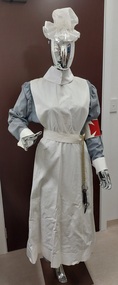 Alfred Hospital Nurses League - Nursing History Collection
Uniform - Trainee Nurse uniform [circa 1900]
... Belt made from starched cotton, Key chain [reproduction] with small metal scissors and 4 keys. Arm band made from cotton material with red felted wool Maltese cross badge attached....Belt made from starched cotton, Key chain [reproduction] with small metal scissors and 4 keys. Arm band made from cotton material with red felted wool Maltese cross badge attached. ...The best example of a [ca.1900's] uniform of a Alfred Hospital Nursing Student uniformTrainee Nurses Uniform [circa 1900]. Compiled from multiple donations and reproduction items. Reproduction mop hat made from cotton organza and grosgrain ribbon. The dress is made from a fine herringbone cotton fabric in the style of 1900s uniform. Gathering at waistband. The apron is also a reproduction with high round neck made from starched cotton. The starched collar is an original, it has square edges. It is stained at neckline and an overall yellow colour. Two starched cuffs. Belt made from starched cotton, Key chain [reproduction] with small metal scissors and 4 keys. Arm band made from cotton material with red felted wool Maltese cross badge attached.Armband inscribed Alfred Hospital in black ink. Belt inscribed 648 in black ink -
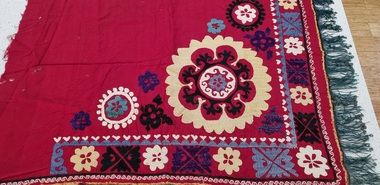 Embroiderers Guild, Victoria
Textile - Uzbekistan Embroidered Panel, 20 th C
... cotton, before being embroidered on narrow portable looms. They are usually produced in two or more pieces, meaning that they can be worked on by more than one person, before being stitched together. Just four stitches — tambour, basma, chain and kanda-khayol Part of a piece of embroidered Suzani in red ...A suzani is a large, hand-embroidered textile panel; the word comes from the Persian word suzan, which means needle. Originating from nomadic tribes in Tajikistan, Uzbekistan, Kazakhstan and other Central Asian countries, suzanis have become highly collectable and valued for their beautiful decoration and fine craftsmanship. They were traditionally made by brides and their mothers as part of a dowry, and presented to the groom on his wedding day. They represented the binding together of two families, and were adorned with symbols of luck, health, long life and fertility. Suzanis are made from cotton, sometimes silk. The pattern is first drawn onto the cotton, before being embroidered on narrow portable looms. They are usually produced in two or more pieces, meaning that they can be worked on by more than one person, before being stitched together. Just four stitches — tambour, basma, chain and kanda-khayol Part of a piece of embroidered Suzani in red cotton with corner embroidered with circular designs and framed corner panel. Designs are embroidered in white, cream, blue and black thread in tambour stitch. Backing is a floral yellow fabric. Green tassels on two sides with spangles attached. -
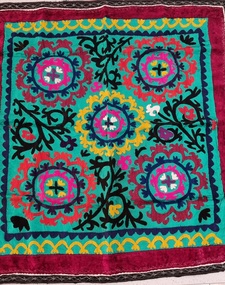 Embroiderers Guild, Victoria
Textile - Uzbekistan Embroidered Panel, 20 th C
... cotton, before being embroidered on narrow portable looms. They are usually produced in two or more pieces, meaning that they can be worked on by more than one person, before being stitched together. Just four stitches — tambour, basma, chain and kanda-khayol Panel of embroidered Suzani on green polyester fabric with maroon velvet border. Embroidered with stylized floral circular designs and foliage. Designs are embroidered in white, yellow, orange, bronze, pink, brown and black thread in tambour stitch. Backing is red ...A suzani is a large, hand-embroidered textile panel; the word comes from the Persian word suzan, which means needle. Originating from nomadic tribes in Tajikistan, Uzbekistan, Kazakhstan and other Central Asian countries, suzanis have become highly collectable and valued for their beautiful decoration and fine craftsmanship. They were traditionally made by brides and their mothers as part of a dowry, and presented to the groom on his wedding day. They represented the binding together of two families, and were adorned with symbols of luck, health, long life and fertility. Suzanis are made from cotton, sometimes silk. The pattern is first drawn onto the cotton, before being embroidered on narrow portable looms. They are usually produced in two or more pieces, meaning that they can be worked on by more than one person, before being stitched together. Just four stitches — tambour, basma, chain and kanda-khayol Panel of embroidered Suzani on green polyester fabric with maroon velvet border. Embroidered with stylized floral circular designs and foliage. Designs are embroidered in white, yellow, orange, bronze, pink, brown and black thread in tambour stitch. Backing is red cotton fabric. Border strips are embellished with machine patterned stitching. -
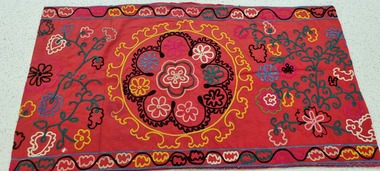 Embroiderers Guild, Victoria
Textile - Uzbekistan Embroidered Cushion Cover, 20 th C
... cotton, before being embroidered on narrow portable looms. They are usually produced in two or more pieces, meaning that they can be worked on by more than one person, before being stitched together. Just four stitches — tambour, basma, chain and kanda-khayol Cushion cover of embroidered Suzani on red ...A suzani is a large, hand-embroidered textile panel; the word comes from the Persian word suzan, which means needle. Originating from nomadic tribes in Tajikistan, Uzbekistan, Kazakhstan and other Central Asian countries, suzanis have become highly collectable and valued for their beautiful decoration and fine craftsmanship. They were traditionally made by brides and their mothers as part of a dowry, and presented to the groom on his wedding day. They represented the binding together of two families, and were adorned with symbols of luck, health, long life and fertility. Suzanis are made from cotton, sometimes silk. The pattern is first drawn onto the cotton, before being embroidered on narrow portable looms. They are usually produced in two or more pieces, meaning that they can be worked on by more than one person, before being stitched together. Just four stitches — tambour, basma, chain and kanda-khayol Cushion cover of embroidered Suzani on red cotton fabric. Embroidered with stylized floral design and foliage. Designs are embroidered in white, yellow, orange, bronze, pink, brown and black thread in tambour stitch. -
 Embroiderers Guild, Victoria
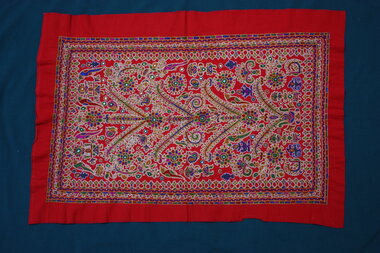
Textile - Indian Ahir Embroidery Panel, Late 20 th C
... Contemporary Ahir style embroidery, hand embroidered in chain stitch and shisha work on red cotton. Stitching is in yellow, green, purple, red and white....Embroidery Indian Shisha Contemporary Ahir style embroidery, hand embroidered in chain stitch and shisha work on red cotton. Stitching is in yellow, green, purple, red and white. ...Purchased by the donor from the women embroiderers at the New Dhanetic village near Bhuj in Gujarat in April 2011.Contemporary Ahir style embroidery, hand embroidered in chain stitch and shisha work on red cotton. Stitching is in yellow, green, purple, red and white.embroidery, indian, shisha -
 Embroiderers Guild, Victoria
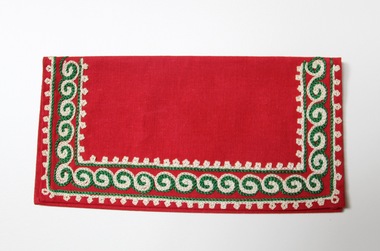
Textile - Serviette Holder, French
... Red cotton sachet, embroidered with cream and green tambour chain stitch design around the envelope edge....Embroidery Red cotton sachet, embroidered with cream and green tambour chain stitch design around the envelope edge. ...Red cotton sachet, embroidered with cream and green tambour chain stitch design around the envelope edge.embroidery -
 Embroiderers Guild, Victoria
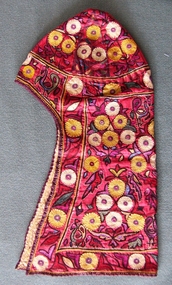
Clothing - Burmese Wedding Costume, c. 1850
... Red cotton (not a match to panels) chain stitch and shisha work, flowers and birds....Embroidery Garments Tambour work 1840-60 Burma Skirt Blouse (part of Wedding Costume) Red cotton (not a match to panels) chain stitch and shisha work, flowers and birds. ...Note: Virginia Mort feels that costume is from Rajastan or Gujerat. Definitely from West India.Red cotton (not a match to panels) chain stitch and shisha work, flowers and birds.embroidery, garments, tambour work, 1840-60, burma, skirt, blouse (part of wedding costume) -
 Yarrawonga and Mulwala Pioneer Museum
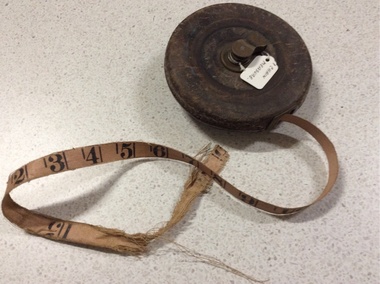
Tape Measure, Unknown
... Cotton tape 1 chain(22yds) long encased in a round leather stitched container. Has a brass shaft in the centre with a handle which rotates to wind or unwind tape. Marked with 1 inch intervals, black print, and 1 foot intervals red...Cotton tape 1 chain(22yds) long encased in a round leather stitched container. Has a brass shaft in the centre with a handle which rotates to wind or unwind tape. Marked with 1 inch intervals, black print, and 1 foot intervals red ...Cotton tape 1 chain(22yds) long encased in a round leather stitched container. Has a brass shaft in the centre with a handle which rotates to wind or unwind tape. Marked with 1 inch intervals, black print, and 1 foot intervals red print. Ed of tape torn off due to much use.Indeciperable -
 Embroiderers Guild, Victoria
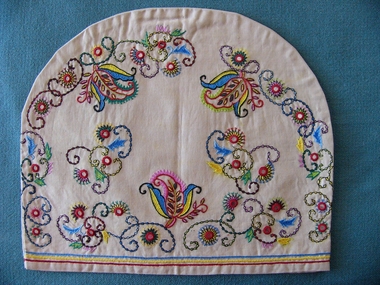
Textile - Tea Cosy Embroidered with Shisha Mirrors, Early 20th century
... Beige cotton with coloured surface stitchery and small pieces of mirror used in the floral design. Edge is 3 rows of chain stitch in blue, yellow and red....Beige cotton with coloured surface stitchery and small pieces of mirror used in the floral design. Edge is 3 rows of chain stitch in blue, yellow and red. ...A copy of traditional Indian shisha work. Beige cotton with coloured surface stitchery and small pieces of mirror used in the floral design. Edge is 3 rows of chain stitch in blue, yellow and red.embroidery, tea cosy, shisha work, 1900-20 -
 Southern Sherbrooke Historical Society Inc.
Textile - Helen Gibson collection - material, cottons, etc
... chain with yellow stemen, fashion accessory. -1 lavender coloured floral fashion accessory with yellow and red stemen. -1 white and red feather floral fashion accessory. -1 pink, burnt orange and ivory velvet floral chain fashion accessory with green stemens. -1 small ivory and pink floral cotton bouquet fashion accessory with green foilage. -1 small burnt orange velveteen three-flower chain fashion accessory, with yellow-green stemen. -1 tiny bouquet of lavender-coloured forget-me-nots, fashion accessory. -1 burnt orange, brown and ivory velveteen bouquet on an apricot ribbon, fashion accessory. -1 small light blue and ivory floral bouquet fashion accessory with green and brown foilage. -1 floral brooch consisting of 3 white and yellow flowers and 5 multicoloured fruits. ...chain with yellow stemen, fashion accessory. -1 lavender coloured floral fashion accessory with yellow and red stemen. -1 white and red feather floral fashion accessory. -1 pink, burnt orange and ivory velvet floral chain fashion accessory with green stemens. -1 small ivory and pink floral cotton bouquet fashion accessory with green foilage. -1 small burnt orange velveteen three-flower chain fashion accessory, with yellow-green stemen. -1 tiny bouquet of lavender-coloured forget-me-nots, fashion accessory. -1 burnt orange, brown and ivory velveteen bouquet on an apricot ribbon, fashion accessory. -1 small light blue and ivory floral bouquet fashion accessory with green and brown foilage. -1 floral brooch consisting of 3 white and yellow flowers and 5 multicoloured fruits. ... -
 Kew Historical Society Inc
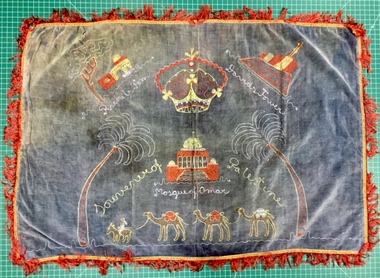
Textile - Souvenir Textile, Souvenir of Palestine, c1939-45
... cotton backing with a red fringe. The front of the textile is embroidered in red, yellow, blue and white chain stitch. ...cotton backing with a red fringe. The front of the textile is embroidered in red, yellow, blue and white chain stitch. ...Souvenir probably bought by an Australian soldier in the 2nd A.I.F., and brought back to Australia as a souvenir.Rectangular blue faded to grey velveteen water damaged textile with a plain white cotton backing with a red fringe. The front of the textile is embroidered in red, yellow, blue and white chain stitch. It shows two palms flanking the Mosque of Omar lower centre with three camels and a man on a horse below, Rachel's Tomb with tree upper left and David's Tower upper right."Souvenir of Palestine"; "Rachels tomb"; "Mosque of Omar"; "David's Tower"second world war 1939-1945, table cover, palestine, 2nd aif, souvenir, textiles - embroideries, wwi
