
Showing 8 items matching "register of managers and secretaries"
-
 Federation University Historical Collection
Book - Register, Ballarat School of Mines and Industries, Ballarat, Register of members, directors, managers and secretaries of the School of Mines and Industries Ballarat, 1971
... Register of members, directors, managers and secretaries of the School of Mines and Industries Ballarat... and secretaries...Register of members, directors, managers and secretaries of the School of Mines and Industries Ballarat Book Register Ballarat School of Mines and Industries, Ballarat ...School of Mines is a predecessor of Federation UniversityThis register lists the members, directors, mangers and secretaries of School of Mines in the 1970's and 80's giving us an understanding of the operations of the School of Mines in that era and of the people involved with the institution at that time. It shows projects that were being undertaken at the institution at the time and gives us an historical perspective on project costs and the type of work being doneBook with red spine and blue crocodile print cover and large label on the front with lined pages inside.register of members, register of directors, register of managers and secretaries, william anderson, matthew griffith beanland, rex hollioake, morgan bevan john, arthur nicholson, william james child north, hugh arthur patterson, keith price, james victor robertson, james smail, w. gordon smith, albet edward stohr, g. kingsley sutton, edgar john trevella tippett, kenneth crago webb, robert dobell, kenneth neerhut, e.j barker, n.a crouch, r. elsworthy, k.j flecknoe, l.f.j hillman, r. knowles, b.c muir, r.j selkirk, f.r uhe, l.c yandell, g.h beanland, p.r shiells, j. bell, p. kisler, s.a mendelson, j. chambers, r.b christie, i.c clarke, j. short, t.a wiseman, l. wallis, r. mcfarlane, l.j obrien, l. murphy, j.f mckay -
 Flagstaff Hill Maritime Museum and Village
Steel Sample, ca. 1876
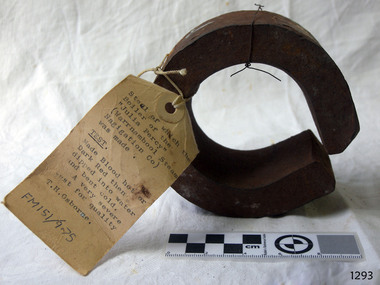
... (Mr Thomas Hamilton Osborne was the secretary for the Western Steam Navigation Co, established in Warrnambool in 1886. ...(Mr Thomas Hamilton Osborne was the secretary for the Western Steam Navigation Co, established in Warrnambool in 1886. ...The sample of steel from the S.S. Julia Percy’s boiler was made has been tested, according to the attached label. The test involved heating the steel to blood red temperature (or dark red colour) then dipping it into water and bending it when it was cold. A “very severe test for quality” was written on the ticket by T.H. Osborne. (Mr Thomas Hamilton Osborne was the secretary for the Western Steam Navigation Co, established in Warrnambool in 1886. The company’s office was on the corner of Timor and Liebig Streets in Warrnambool and its north-western wall is now part of the current Warrnambool Regional Art Gallery. ) Cold bending of steel in a press or through rollers is the typical method of curving steel for construction. The steel needs to be manufactured in such a way that it is strong enough yet still flexible enough not to crack when bent or rolled. The boiler on the Julia Percy could have been a Scotch Boiler, a design introduced in the 1870’s and still being used today. This design was more robust that previous boilers, generating higher working steam pressures. The design incorporate greater ability to roll iron plates, leading to greater strength, thicker plating and fewer riveted joints. They were originally made of iron then later incorporated steel sections until they were entirely constructed of steel. Many examples of this type of boiler can be found on wreck sites. Shipping was the cheapest and most practical means of carrying produce and goods during the period 1840-1890. Regular domestic steamer services commenced in the Warrnambool district in the late 1850’s and by 1870 the passenger trade was booming. Produce was loaded from the jetty into ‘lighters’ (small boats), which took it to the ships at anchorage in the bay. Passengers were taken to the ship’s side then climbed aboard up ladders or gangways. The coming of the railway in October 1889 meant the gradual decline and end of the steam shipping era. Originally the ship was known as the SS Julia Percy and was later renamed as the Leeuwin. She was an iron passenger-cargo steam ship built in Glasgow by Thomas Wingate for the Warrnambool Steam Packet Company, which commissioned the ship for the steamship trade in Victoria’s western district. She was first registered in Warrnambool, Victoria in 1876. At one point in time the Julia Percy would sail from Warrnambool to Melbourne every Friday and return from Melbourne to Warrnambool every Tuesday. The cost of a return ticket for a Saloon Fare was £1.0.0. She would sail “if practical and weather permitting”. The Julia Percy changed hands several times. Her next owner was the Western Steam Navigaiton Co of Melbourne (1887). It was the manager of this company, Mr. T.H. Osborne, who tagged ths steel sample above. Melbourne Steamship Co became the next owners (1890), followed by William Howard Smith and Sons (1901) for use in Queensland coastal trades, then she was bought by George Turnbull in 1903 and used for local mail contract in Western Australia. She was sold to the Melbourne Steamship Company Ltd. (1906) and re-named the Leeuwi but continued in her Western Australian coastal run. She was converted into a coal hulk in Melbourne in 1910 as a result of damaged caused when she was driven against the jetty at Dongara during a gale. The ship was eventually dismantled and scuttled in Bass Strait on 28 December 1934. The steel sample is significant for its association with the wreck of the Leeuwin (Julia Percy), which is on the Victorian Heritage Register. It is historically significant for being a rare artefact that has potential to interpret aspects of western Victoria’s 19th century steamship trade and Victorian cultural history, including the testing and manufacturing process associated with steam power. Leeuwin is listed on the Victorian heritage Register as being historically significant ‘as one of only four wrecks of steamships in Victorian waters associated with the western district of Victoria’s coastal steamship trade. Her registered number is VHR S413. A sample of the steel from which the boiler of the "SS Julia Percy" (later named Leeuwin) was made. The piece of steel is a ‘C’ shape with the ends almost meeting. A luggage ticket is tied onto the steel and has an inscription on it. The steel is rusty.Ticket with typed information “Steel of which the Boiler of the “Julia Percy” (Warrnambool Steam Navigation Co) was made. TEST: Made Blood hot or Dark Red then dipped into water and bent cold. A very severe test for quality T.H. Osborne. Below these words is the hand written inscription in black “FM 151 / 9.75” julia percy, leeuwin, steel, boiler, steam ship, metal testing, western steam navigation co., flagstaff hill, warrnambool, shipwrecked-coast, flagstaff-hill, flagstaff-hill-maritime-museum, maritime-museum, shipwreck-coast, flagstaff-hill-maritime-village, t.h. osborne -
 Flagstaff Hill Maritime Museum and Village
Functional object - Lamp Light, late 19th - early-20th century
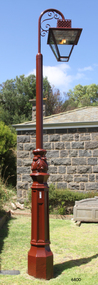
... Cockman Street was named after the first secretary of the gasworks in 1874, Walter Cockman (c.1821-1892). ...Cockman Street was named after the first secretary of the gasworks in 1874, Walter Cockman (c.1821-1892). ...This gas lamp light and stand came from the original manufacturer in Melbourne. Gas street lights such as this one were used in Melbourne from the mid-19th century. The lights enabled safer after-dark travel for pedestrians and vehicles and were a deterrent to crime. A lamp lighter was employed to keep the lamps lit, sometimes with little success due to weather conditions and the pranks of youths. WARRNAMBOOL Gasworks In Warrnambool prior to 1874 there were about twenty rare, individually lit street lights in Warrnambool, each with its own supply of kerosene. These lamps were in the central business area of Timor, Koroit and Liebig Streets. The Warrnambool Gas Company Ltd. was registered as an incorporated company in 1873. It was a private, locally owned business. It was located at 209-215 Merri Street, Warrnambool, on the land, which is just west of the later-built railway station. The first managers of the Gas Company lived in a substantial stone house on site, but later the managers lived in a residence in Henna Street between Merri and Timor Streets. The original home, which still stands, became a residence for the Railway Station Master from about 1890. In August 1874 the construction of the gasworks was complete and at the end of that month gas was supplied to all of the existing lamps in Warrnambool for the first time. The Warrnambool Gas Company wound up in 1880-1881 and was purchased by the Warrnambool Borough Council with money raised by a loan – the Borough’s first ‘loan transaction’. The Council established a piped network to supply gas to other street connections. The gasworks were privatised and upgraded in 1952. In 1972 the town supply was converted to liquid petroleum gas and by the early 1980s the gasworks were closed down. In 1986 Warrnambool was supplied with natural gas from a site near Port Campbell. The Warrnambool gasworks supplied all street and shop lighting and most domestic lighting until 1923 when electricity was available for lighting. Bromfield Street in Warrnambool was named after the director of the gasworks, James Astley Bromfield (1823-1903). He arrived in Warrnambool from Worcestershire, England, in 1852 and was very active in the local council and community. Cockman Street was named after the first secretary of the gasworks in 1874, Walter Cockman (c.1821-1892). He was a Mayor and businessman. The second Manager, Luther Rodgers, worked for the gas company for about twenty years and both Rodger Place and Rodgers Road in Warrnambool have been named after him. LAMP LIGHTS IN MELBOURNE In the 1820s Melbourne's innkeepers were legally required to have a lamp light outside their premises from sunset to sunrise. This was the first instance of street lamps being used in Melbourne. In 1847 the first oil lamp was used in the city. In 1849 a gas lamp was installed on the Swanston Street Bridge and much of the city had oil lamps installed by then. In August 1857 the installation of street gas lamps began in Melbourne. They were welcomed for the much brighter illumination they gave. By 1860 there were 414 lamp pillars. The phrase was quoted often - "A light was as good as a policeman". The first gas burners used for street lighting were called 'fishtail' gas burners. These were replaced in the early 1900s by gas mantles. The City of Melbourne Gas Coke Company was formed in 1850 but due to the Gold Rush the manufacture and distribution of the gas supply was delayed until January 1856. By the 1890s the gas supplying the lights was supplied by three companies in Melbourne. In 1879 a football match was played at the MCG under electric lighting and gradually electric arc lights were installed inside and outside buildings in the city. Lamp lights such as the one in Flagstaff Hill’s collection were no longer needed. (References: John Lindsay re Lamp Light history 2019-01-29, Former Warrnambool Gas Company Limited, Victorian Heritage Database Report, Heritage Number 149746 https://vhd.heritagecouncil.vic.gov.au/places/149746/download-report ) The lamp light is representative of the lamps used in Melbourne from the mid-nineteenth century to light the streets at night and make Melbourne a safer city. The lamp is also representative of the gas street lighting in Warrnambool from the mid-1870s-1920s.Lamp light or gas light. Street light, one of the last gas street lights removed from Melbourne. (Reconditioned by Friends of Flagstaff Hill, 2013)flagstaff hill, warrnambool, shipwrecked coast, flagstaff hill maritime museum, maritime museum, shipwreck coast, flagstaff hill maritime village, great ocean road, lamp light, gas light, gas lamp, street lamp, street light, gas street light, melbourne street lighting, warrnambool street lighting, melbourne gas street light, warrnambool gas company, warrnambool gasworks, james bromfield, walter cockman, luther rodgers, city of melbourne gas coke company -
 Bendigo Historical Society Inc.
Document - CZECH PHILHARMONIC ORCHESTRA
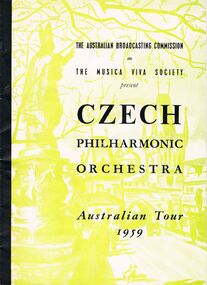
... Registered Office: 26 Paling's Building, Ash St., Sydney. President: Hon. Mr. Justice B P Macfarlan, Hon. Secretary: C J Berg, Hon. Treasurer: J B Elder, Manager...Registered Office: 26 Paling's Building, Ash St., Sydney. President: Hon. Mr. Justice B P Macfarlan, Hon. Secretary: C J Berg, Hon. Treasurer: J B Elder, Manager ...Czech Philharmonic Orchestra, Melbourne Town Hall. Australian Tour 1959. The first overseas symphony orchestra to visit this country. The Czech Philharmonic is one of the world's leading orchestras. It has s 60-year-old history which is backed by the rich musical traditions of its country. The Australian Broadcasting Commission in conjunction with the Musica Viva Society of Australia proudly presents the Czech Philharmonic Orchestra. Conductor: Ladislav Slovak Concertmaster: Bretislav Ludvik. Saturday, October 3, Monday, October 5. Czech Philharmonic Orchestra, article giving history of Orchestra from 1896 in Prague, photo of orchestra included. Ladislav Slovak, small article describing his work history, includes photograph. Programme. Analytical Notes. Musica Viva Society of Australia. Registered Office: 26 Paling's Building, Ash St., Sydney. President: Hon. Mr. Justice B P Macfarlan, Hon. Secretary: C J Berg, Hon. Treasurer: J B Elder, Manager: Regina Ridge. Victoria Branch: Registered Office: 5th Floor, 300 Lt. Collins St., Melbourne, C.1. President: F G Nicholls, Hon. Secretary: I G Spira, Hon. Treasurer: A Teague. Australian Broadcasting Commission. Chairman: Sir Richard Boyer, K.B.E., M.A. Vice-Chairman: E R Dawes, ESQ., C.M.G. Sir John Medley, KT., D.C.L., M.A. The Hon. Dame Enid Lyons, G.B.E. Mrs. G L Byth, O.B.E., B.A. A G Lowndes, M.Sc. H B Halvorsen, F.C.A., F.C.I.S. General Manager: Charles Moses, C.B.E. Manager for Victoria: Ewart Chapple. Concert Manager for Victoria: Ray Humphrey. Advertisements: AWA - Amalgamated Wireless (Australasia) Limited. Stereophonic Radiolagram. Philips Electrical Industries Pty Ltd. Fontana - Karel Ancerl recordings. The Ace of Clubs, 12'' LP Beethoven etc. Alfred Nott Pty. Ltd. H S Harvey, E Goetz, Opticians. Georges, shoes. Ernest Hiller, tailored suits. Philips Magnalux Television. TAA the nation's jet line. Cyclax, make-up and beauty preparations. Grutzner & Cartly Pty. Ltd. Furs. BNS Nylon - British Nylon Spinners (Australia) Pty. Ltd. Carinia Records - Czech Philharmonic Orchestra with World Famous Soloists now for the first time in Australia on High Fidelity Recordings. Suttons Pty. Ltd. 'The House of Music', you are cordially invited to inspect the fine Petrof pianos. RCA Records - recordings of Jan Peerce. Scala Record Import Co. Czech recordings. Boosey & Hawks (Australia) Pty. Ltd., Music and Books on Music. GMH - General Motors - Holden's Limited. Country Club Tailored by Buckwalter - Quiet Tone Sports Shirts. Allan's, Fine Pianos.entertainment, music, classical -
 Bendigo Historical Society Inc.
Financial record - Lydia Chancellor collection: Bendigo Gas Company and The Colonial Gas Association Limited
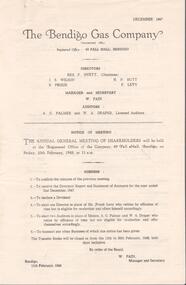
... registered office at 49 Pall Mall, Bendigo. Directors: Rex F. Hyett (Chairman), J.S. Wilson, H.N. Butt, S. Proud, F. Levy. Manager...registered office at 49 Pall Mall, Bendigo. Directors: Rex F. Hyett (Chairman), J.S. Wilson, H.N. Butt, S. Proud, F. Levy. Manager ...1. The Bendigo Gas Company formed in 1859, established the Bendigo Gas Works and became an incorporated company in 1860. It produced coal gas for the community until it was liquidated and delisted as a company in 1959. 2. The Colonial Gas Association was incorporated in 1888, selling shares for 5pounds and 10 pounds. It was originally formed in London with the aim of raising investment capital for the construction and maintenance of gas works across the cities and towns of Australia and New Zealand. Its original name was the Australasian Gas Association and this changed to the Colonial Gas Association in 1893.The Bendigo Gas Company notice of annual general meeting of shareholders for the years 1947 to 1952. The meeting to be held at the company registered office at 49 Pall Mall, Bendigo. Directors: Rex F. Hyett (Chairman), J.S. Wilson, H.N. Butt, S. Proud, F. Levy. Manager and secretary W. Pain. Also, The Colonial Gas Association Limited notice of annual meeting for the years from 1949 to 1953 to be held at 360 Collins Street, Melbourne. Directors: C.F. Broadhead (Chairman and managing director), James M MacFarlane, Robert Weir, Gerald L. Patterson.bendigo gas comany, the colonial gas association, shareholders -
 Bendigo Historical Society Inc.
Document - HANRO COLLECTION: LETTER ESTATE CHARLES HANDSCHIN
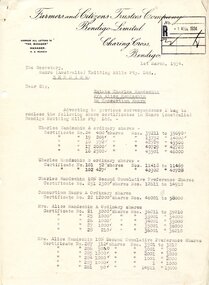
... Register Letter dated 1st March,1934 on Farmers and Citizens Trustees Company Bendigo Limited Charing Cross, Bendigo. the letter is addressed to the Secretary Hanro (Australia) Knitting Mills Pty. Ltd. Bendigo re Estate Charles Handschin P/A Alice Handschin. The letter list shares certificates in the names of Charles and Alice Handschin that have been enclosed in the letter and request the company to take the necessary steps the facilitate transfer to Hanro Consortium. The letter is signed by R. A. Rankin Manager ...Letter dated 1st March,1934 on Farmers and Citizens Trustees Company Bendigo Limited Charing Cross, Bendigo. the letter is addressed to the Secretary Hanro (Australia) Knitting Mills Pty. Ltd. Bendigo re Estate Charles Handschin P/A Alice Handschin. The letter list shares certificates in the names of Charles and Alice Handschin that have been enclosed in the letter and request the company to take the necessary steps the facilitate transfer to Hanro Consortium. The letter is signed by R. A. Rankin Manager.hanro, clothing, share register -
 Buninyong & District Historical Society
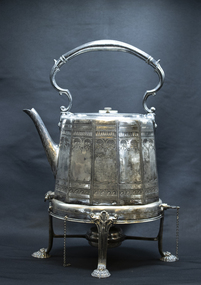
Functional object - Silver kettle, Commemorative silver hot water kettle with burner, 1892, 1892
... "A Presentation to Mr Daniel, Secretary of the Buninyong Butter Factory, 1892. ..."A Presentation to Mr Daniel, Secretary of the Buninyong Butter Factory, 1892. ..."A Presentation to Mr Daniel, Secretary of the Buninyong Butter Factory, 1892. In November 1892, the Buninyong Butter Factory was registered as a co-operative, and commenced operations on 23 November in the old court house complex on the edge of the Botanic Gardens in front of a large gathering of shareholders. Toasts were drunk to the success of the company, and Mr Odgers, manager, praised the work of Mr F.J. Daniel, the secretary of the company, who was presented with a silver hot-water kettle, suitably inscribed, on behalf of the shareholders of the company, as a slight recognition of his valuable services, and in doing so spoke of Mr Daniel as a model secretary." (Ballarat Star, 24 November 1892)This item is of historic significance highlighting an early Buninyong local business Silver hot water kettle with burner"Presented to F.J. Daniel Esq., by the shareholders of the Buninyong Butter Factory as a slight recognition of the valuable services rendered by him in the starting of the company" hot-water kettle, buninyong, butter factory, buninyong butter factory, local business -
 Power House Rowing Club
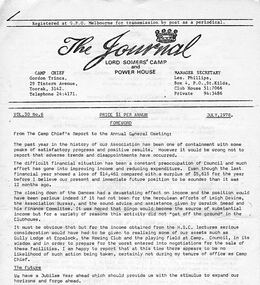
Newsletter, The Journal - Lord Somers' Camp and Power House - Vol.30 No.6 JULY, 1978, July 1978
... SECRETARY Les. Phillips, Box 4, P.O. , St.Kilda, Club House 51:7066 Private 94:3486 Vol. 30 No.6 JULY, 1978...Registered at G.P.O. Melbourne for transmission by post as a periodical The Journal LORD SOMERS' CAMP and POWER HOUSE CAMP CHIEF Gordon Trinca 29 Tintern Avenue, Toorak, 3142. Telephone 24:4171. MANAGER ...The Journal - Lord Somers' Camp and Power House - Vol. 30 No.6 JULY, 1978 Registered at G.P.O. Melbourne for transmission by post as a periodical The Journal LORD SOMERS' CAMP and POWER HOUSE CAMP CHIEF Gordon Trinca 29 Tintern Avenue, Toorak, 3142. Telephone 24:4171. MANAGER SECRETARY Les. Phillips, Box 4, P.O. , St.Kilda, Club House 51:7066 Private 94:3486 Vol. 30 No.6 JULY, 1978
