
Showing 3 items matching "retail sector"
-
 Melbourne Tram Museum
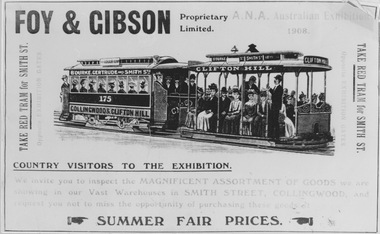
Print - Reproduction of Foy & Gibson advertisement, 1908
... ...retail sector...The company was a major employer and contributed to the successful retail sector in Melbourne and Australia. The passing cable tram line and Foy & Gibson benefited from each other. ...The company was a major employer and contributed to the successful retail sector in Melbourne and Australia. The passing cable tram line and Foy & Gibson benefited from each other. ...Foy & Gibson Pty Ltd was a major Melbourne department store located on Smith St, Collingwood, In the surrounding streets, the company owned extensive factories that manufactured an large variety of products for its stores. The company was a major employer and contributed to the successful retail sector in Melbourne and Australia. The passing cable tram line and Foy & Gibson benefited from each other. This advertisement can be found reproduced in a number of publications.Yields information about early Melbouren retail Black and white print from a 1908 catalogue glued to thick card with label below. No note on rear. Some of the lettering on the print is faded but legible.Label below reads "From the Exhibition catalogue, 1908".foy & gibson, department store, smith st, retail sector, manufacture -
 Bendigo Historical Society Inc.
Newspaper - Fortuna Articles - "A Vision for Fortuna Villa", Feb 20 2009
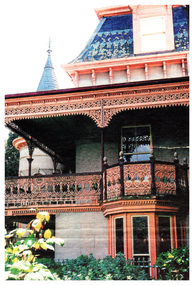
... sector, with visitors who stay longer and spend more. The success of recent cultural events in Bendigo, such as the Golden Age of Couture exhibition, demonstrates the city's capacity to attract international attention. The Villa Fortuna Action Group proposes transforming the site into a hub for cultural, commercial, and community activities. Suggested uses include concerts, festivals, exhibitions, heritage tours, retail...sector, with visitors who stay longer and spend more. The success of recent cultural events in Bendigo, such as the Golden Age of Couture exhibition, demonstrates the city's capacity to attract international attention. The Villa Fortuna Action Group proposes transforming the site into a hub for cultural, commercial, and community activities. Suggested uses include concerts, festivals, exhibitions, heritage tours, retail ...This document by Beverley Carter, (Lansell family historian) explores the future potential of Fortuna Villa in Bendigo, emphasizing its significance for community, tourism, and economic development. The Defence Department has vacated Fortuna Villa after more than 60 years. There is an opportunity for public ownership, with state or local government having first refusal, ensuring community access. Fortuna Villa could become a major asset for Bendigo, enhancing its profile and supporting economic growth. Cultural tourism is highlighted as a rapidly growing sector, with visitors who stay longer and spend more. The success of recent cultural events in Bendigo, such as the Golden Age of Couture exhibition, demonstrates the city's capacity to attract international attention. The Villa Fortuna Action Group proposes transforming the site into a hub for cultural, commercial, and community activities. Suggested uses include concerts, festivals, exhibitions, heritage tours, retail outlets, community meetings, conferences, weddings, and fine dining. The document references successful models like Abbotsford Convent and Werribee Mansion in Victoria, and Hylands House in the UK, as examples of adaptive reuse. While acknowledging significant short-term costs, the document argues that long-term financial and social benefits outweigh these concerns. The project is seen as a way to diversify the local economy, create jobs, and foster business partnerships.The author rejects the notion that tough economic times should prevent investment, suggesting such projects can help mitigate downturns. Fortuna Villa is presented as a once-in-a-lifetime chance for Bendigo to secure a property that symbolizes the city's golden past. The author stresses the importance of a comprehensive, coordinated approach to tourism in the region, with Fortuna Villa as a potential centerpiece.Urgency: There is a strong call to action, suggesting that the community must act quickly to secure the property before it is lost to others. The document is authored by Beverley Carter, a member of the Lansell family, who is writing a detailed family history and a series on George Lansell and Fortuna Villa, further underlining the site's historical importance.Fortuna Articles - "A Vision for Fortuna Villa" Feb 20 2009 The Bendigo Advertiser by Beverley Carter, photo by Julian Prowd This item contains the following: 11217.36a Colour Photo of Fortuna 11217.36b Part of Page 14 - "A Vision for Fortuna Villa" 11217.36c Part of Page 14 - "A Vision for Fortuna Villa"non-fictionbendigo, fortuna, george lansell, villa fortuna action group, beverley carter -
 St Kilda Historical Society
Ephemera - Envelope, Prohibition Poll envelope, 1938
... sector leading up to the poll on 8 October 1938. It is designed to look like a standard receipt or invoice docket (with fields for "No.", "Name", "Tax", and "Cash"), serving as a stark reminder to employees, suppliers, and patrons that their livelihood depended directly on keeping the state "wet." ' The anti-prohibition lobby targeted manufacturing, agriculture, trades, and retail suppliers to argue that voting "Yes" to abolition would cause widespread job loss and financial ruin during the recovery years of the Great Depression....sector leading up to the poll on 8 October 1938. It is designed to look like a standard receipt or invoice docket (with fields for "No.", "Name", "Tax", and "Cash"), serving as a stark reminder to employees, suppliers, and patrons that their livelihood depended directly on keeping the state "wet." ' The anti-prohibition lobby targeted manufacturing, agriculture, trades, and retail suppliers to argue that voting "Yes" to abolition would cause widespread job loss and financial ruin during the recovery years of the Great Depression. ...Victoria held historical state-wide prohibition polls (referendums on the abolition of liquor licenses) in 1930 and 1938, both of which soundly rejected making the state "dry". This is an anti-prohibition "How to Vote" slip distributed to businesses tied to the hospitality sector leading up to the poll on 8 October 1938. It is designed to look like a standard receipt or invoice docket (with fields for "No.", "Name", "Tax", and "Cash"), serving as a stark reminder to employees, suppliers, and patrons that their livelihood depended directly on keeping the state "wet." ' The anti-prohibition lobby targeted manufacturing, agriculture, trades, and retail suppliers to argue that voting "Yes" to abolition would cause widespread job loss and financial ruin during the recovery years of the Great Depression.Brown envelope printed in black ink on the front and with handwritten note in blue on the reverse side.On the front: No... Name... Tax... Cash... This establishment provides goods used in the Liquor Industry. Protect your own interests, by voting NO at the Prohibition Poll. On the back: Given to Historical Society of St Kilda by Cr C. Bell, Mayor St Kilda 14/3/82political activity, prohibition poll 1938
