
Showing 2 items matching "retorting and smelting"
-
 Bendigo Historical Society Inc.
Document - Archbold's Gold Treatment Works, Robert J. Kaufman, LRGM Services, 15th June, 2002
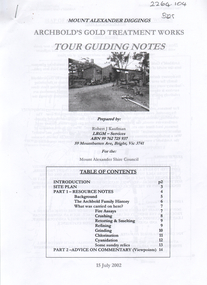
... The processes used in the treatment plant are described, including: fire assays, crushing, retorting and smelting, refining, grinding, chlorination, and cyanidation. ...The processes used in the treatment plant are described, including: fire assays, crushing, retorting and smelting, refining, grinding, chlorination, and cyanidation. ...The Archbold (Chewton) Gold Treatment Works was erected c.1884 by Jeremiah Archbold who operated an assay and metallurgical business specialising in the treatment of gold-bearing ore. The battery, furnaces and Chilean mills which survive on the site suggest that the chlorination process was used to assay pyritic ore. The works subsequently incorporated the cyanide process after its introduction to Victoria in the late 1890s. Upon Jeremiah's death in 1917, the works continued to be run by one of his sons, Herbert. Herbert Archbold went on to become widely known throughout Victoria for his cyaniding expertise. Herbert died in 1966 and the property was bought by his son Harry. When Harry Archbold died in the late 1980s the treatment works was closed and everything left as it was. https://vhd.heritagecouncil.vic.gov.au/places/7899/download-reportNineteen page document. On front page: ' Mount Alexander Diggings, Archbold's Gold Treatment Works, Tour Guiding Notes, prepared by Robert J. Kaufman, Prepared for the Mount Alexander Shire Council, 2002. The processes used in the treatment plant are described, including: fire assays, crushing, retorting and smelting, refining, grinding, chlorination, and cyanidation. The Archbold family history and an overview of the gold treatment works overall, is presented in the report. Black and white photographs and diagrams of various artefacts and processes are included. Advice on commentary from each viewpoint on the tour, is provided for tour guides. fire assays, crushing, retorting and smelting, refining, grinding, chlorination, and cyanidation., mount alexander, archbold, gold refining, cupels, crucible, berlin porcelain parting cups, assay laboratory -
 Bendigo Historical Society Inc.
Document - Mine Managers, a glimpse at a large subject. From Ballerstedt to Buerger
... They needed knowledge and competence in areas such as surveying, underground plan drawing, ventilation, amalgamation, retorting and smelting. They must also be literate and numerate. 2nd Class:- able to manage any mine where steam machinery was in use. 3rd Class:- for mines where there was no steam machinery . ...They needed knowledge and competence in areas such as surveying, underground plan drawing, ventilation, amalgamation, retorting and smelting. They must also be literate and numerate. 2nd Class:- able to manage any mine where steam machinery was in use. 3rd Class:- for mines where there was no steam machinery . ...Mine managers had a variety of roles. They were a go-between for investors or shareholders and were responsible for the effective utilisation of human and physical resources above and underground. From the early 1870's the Bendigo school of mines held courses and exams leading to a Mine Manager's Certificate. These certificates were awarded in 3 classifications:- 1st class certificate holders could manage any mine where large and expensive machinery was used. They needed knowledge and competence in areas such as surveying, underground plan drawing, ventilation, amalgamation, retorting and smelting. They must also be literate and numerate. 2nd Class:- able to manage any mine where steam machinery was in use. 3rd Class:- for mines where there was no steam machinery . They needed to have a good knowledge of whim, whip or windlass work. Conversations continued through to the 1920's about whether the requirement for a Managers Certificate should be made compulsory under amendment to the Mines Act 1883. There were also discussions of the minimum amount of mine experience applicants should possess.A research paper detailing the history of managers and their role in the Bendigo gold fields. A short address prepared by James A. Lerk April/ May 2002. 8 pages.mine managers, ballerstedt, buerger
