
Showing 8 items matching "riveted joints"
-
 Moorabbin Air Museum
Book - Aircraft structue, Metal Airplane Structures
... ...Riveted joints...Aircraft structure Types of metal aircraft Construction materials Structural elements Welded joints Riveted joints Stressed skin design Types of metal wings Metal wing beams Wing design Fuselage design Hull & float design Overview of design & construction of major components of various aircraft, circa 1938 Metal Airplane Structures Book Aircraft structue ...Overview of design & construction of major components of various aircraft, circa 1938non-fictionOverview of design & construction of major components of various aircraft, circa 1938types of metal aircraft, construction materials, structural elements, welded joints, riveted joints, stressed skin design, types of metal wings, metal wing beams, wing design, fuselage design, hull & float design -
Moorabbin Air Museum
Book - Aircraft design, Aircraft Layout and Detail Design
... Strength calculations for riveted & bolted joints...Aircraft design Requirements for a good layout Descriptive geometry Airfoils General design condsiderations Connections Forgings Castings Machined fittings Fitting analysis Strength calculations for riveted & bolted joints Bending Torsion Shear & its application to thin web beams Columns Overview of aircraft detail design, circa 1946 Aircraft Layout and Detail Design Book Aircraft design ...Overview of aircraft detail design, circa 1946non-fictionOverview of aircraft detail design, circa 1946requirements for a good layout, descriptive geometry, airfoils, general design condsiderations, connections, forgings, castings, machined fittings, fitting analysis, strength calculations for riveted & bolted joints, bending, torsion, shear & its application to thin web beams, columns -
 Flagstaff Hill Maritime Museum and Village
Steel Sample, ca. 1876
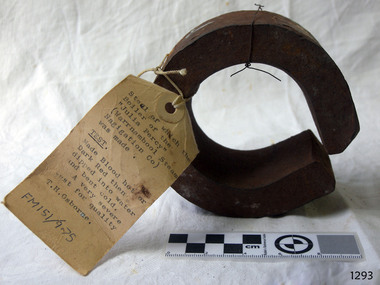
... The design incorporate greater ability to roll iron plates, leading to greater strength, thicker plating and fewer riveted joints. They were originally made of iron then later incorporated steel sections until they were entirely constructed of steel. ...The design incorporate greater ability to roll iron plates, leading to greater strength, thicker plating and fewer riveted joints. They were originally made of iron then later incorporated steel sections until they were entirely constructed of steel. ...The sample of steel from the S.S. Julia Percy’s boiler was made has been tested, according to the attached label. The test involved heating the steel to blood red temperature (or dark red colour) then dipping it into water and bending it when it was cold. A “very severe test for quality” was written on the ticket by T.H. Osborne. (Mr Thomas Hamilton Osborne was the secretary for the Western Steam Navigation Co, established in Warrnambool in 1886. The company’s office was on the corner of Timor and Liebig Streets in Warrnambool and its north-western wall is now part of the current Warrnambool Regional Art Gallery. ) Cold bending of steel in a press or through rollers is the typical method of curving steel for construction. The steel needs to be manufactured in such a way that it is strong enough yet still flexible enough not to crack when bent or rolled. The boiler on the Julia Percy could have been a Scotch Boiler, a design introduced in the 1870’s and still being used today. This design was more robust that previous boilers, generating higher working steam pressures. The design incorporate greater ability to roll iron plates, leading to greater strength, thicker plating and fewer riveted joints. They were originally made of iron then later incorporated steel sections until they were entirely constructed of steel. Many examples of this type of boiler can be found on wreck sites. Shipping was the cheapest and most practical means of carrying produce and goods during the period 1840-1890. Regular domestic steamer services commenced in the Warrnambool district in the late 1850’s and by 1870 the passenger trade was booming. Produce was loaded from the jetty into ‘lighters’ (small boats), which took it to the ships at anchorage in the bay. Passengers were taken to the ship’s side then climbed aboard up ladders or gangways. The coming of the railway in October 1889 meant the gradual decline and end of the steam shipping era. Originally the ship was known as the SS Julia Percy and was later renamed as the Leeuwin. She was an iron passenger-cargo steam ship built in Glasgow by Thomas Wingate for the Warrnambool Steam Packet Company, which commissioned the ship for the steamship trade in Victoria’s western district. She was first registered in Warrnambool, Victoria in 1876. At one point in time the Julia Percy would sail from Warrnambool to Melbourne every Friday and return from Melbourne to Warrnambool every Tuesday. The cost of a return ticket for a Saloon Fare was £1.0.0. She would sail “if practical and weather permitting”. The Julia Percy changed hands several times. Her next owner was the Western Steam Navigaiton Co of Melbourne (1887). It was the manager of this company, Mr. T.H. Osborne, who tagged ths steel sample above. Melbourne Steamship Co became the next owners (1890), followed by William Howard Smith and Sons (1901) for use in Queensland coastal trades, then she was bought by George Turnbull in 1903 and used for local mail contract in Western Australia. She was sold to the Melbourne Steamship Company Ltd. (1906) and re-named the Leeuwi but continued in her Western Australian coastal run. She was converted into a coal hulk in Melbourne in 1910 as a result of damaged caused when she was driven against the jetty at Dongara during a gale. The ship was eventually dismantled and scuttled in Bass Strait on 28 December 1934. The steel sample is significant for its association with the wreck of the Leeuwin (Julia Percy), which is on the Victorian Heritage Register. It is historically significant for being a rare artefact that has potential to interpret aspects of western Victoria’s 19th century steamship trade and Victorian cultural history, including the testing and manufacturing process associated with steam power. Leeuwin is listed on the Victorian heritage Register as being historically significant ‘as one of only four wrecks of steamships in Victorian waters associated with the western district of Victoria’s coastal steamship trade. Her registered number is VHR S413. A sample of the steel from which the boiler of the "SS Julia Percy" (later named Leeuwin) was made. The piece of steel is a ‘C’ shape with the ends almost meeting. A luggage ticket is tied onto the steel and has an inscription on it. The steel is rusty.Ticket with typed information “Steel of which the Boiler of the “Julia Percy” (Warrnambool Steam Navigation Co) was made. TEST: Made Blood hot or Dark Red then dipped into water and bent cold. A very severe test for quality T.H. Osborne. Below these words is the hand written inscription in black “FM 151 / 9.75” julia percy, leeuwin, steel, boiler, steam ship, metal testing, western steam navigation co., flagstaff hill, warrnambool, shipwrecked-coast, flagstaff-hill, flagstaff-hill-maritime-museum, maritime-museum, shipwreck-coast, flagstaff-hill-maritime-village, t.h. osborne -
 Bendigo Historical Society Inc.
Newspaper - LONG GULLY HISTORY GROUP COLLECTION: LANSELL ERECTS AUSTRALIA'S TALLEST POPPET HEAD
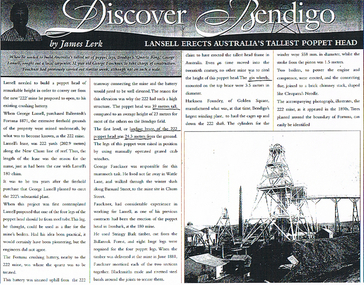
... Blacksmiths made and riveted steel bands around the joints to secure them. Harkness Foundry manufactured the winding plant which was the largest in Bendigo at that time. ...Blacksmiths made and riveted steel bands around the joints to secure them. Harkness Foundry manufactured the winding plant which was the largest in Bendigo at that time. ...BHS CollectionPhotocopy of a newspaper article titled Discover Bendigo by James Lerk. Article is titled Lansell Erects Australia's Tallest Poppet Head.George Fauckner was responsible for erecting the tall poppet head at the 222 mine. Eight huge logs were used to make the four legs which morticed together. Blacksmiths made and riveted steel bands around the joints to secure them. Harkness Foundry manufactured the winding plant which was the largest in Bendigo at that time. An accompanying photograph illustrates the 222 Mine as it appeared in the 1890's.bendigo, history, long gully history group, the long gully history group - lansell erects australia's tallest popper head, george fauckner, ballerstedt's fortuna, 222 mine, 180 mine, fortuna crushing battery, harkness foundry, cleopatra's needle, fortuna -
 Mont De Lancey
Tool - Blacksmith Tongs, Unknown
... A pair of small vintage handmade blacksmith tongs with two handles called reins, which are riveted together to form a hinge joint for the flat edged tongs. ...Blacksmithing tools Forging tools Metalworking tools Furnace tongs Tools A pair of small vintage handmade blacksmith tongs with two handles called reins, which are riveted together to form a hinge joint for the flat edged tongs. ...A pair of small vintage handmade blacksmith tongs with two handles called reins, which are riveted together to form a hinge joint for the flat edged tongs. The blacksmith opens and closes the tongs using the handles. They are made of flat mild steel. They were used for holding steel in position and turning it over during forging operations.blacksmithing tools, forging tools, metalworking tools, furnace tongs, tools -
 Mont De Lancey
Tool - Blacksmith Tongs, Unknown
... A pair of long handled vintage handmade blacksmith tongs with two handles called reins, which are riveted together to form a hinge joint for the flat edged tongs. ...Blacksmithing tools Forging tools Metalworking tools Furnace tongs Tools A pair of long handled vintage handmade blacksmith tongs with two handles called reins, which are riveted together to form a hinge joint for the flat edged tongs. ...A pair of long handled vintage handmade blacksmith tongs with two handles called reins, which are riveted together to form a hinge joint for the flat edged tongs. The blacksmith opens and closes the tongs using the handles. They are made of flat mild steel. They were used for holding steel in position and turning it over during forging operations.blacksmithing tools, forging tools, metalworking tools, furnace tongs, tools -
 Mont De Lancey
Tool - Blacksmith Tongs, Unknown
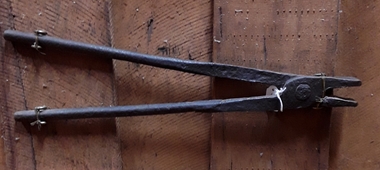
... A pair of vintage handmade blacksmith tongs with two handles called reins, which are riveted together to form a hinge joint for the long 90 degree right angled flat edged tongs. ...Blacksmithing tools Forging tools Metalworking tools Furnace tools Tools A pair of vintage handmade blacksmith tongs with two handles called reins, which are riveted together to form a hinge joint for the long 90 degree right angled flat edged tongs. ...A pair of vintage handmade blacksmith tongs with two handles called reins, which are riveted together to form a hinge joint for the long 90 degree right angled flat edged tongs. The blacksmith opens and closes the tongs using the handles. They are made of flat mild steel. They were used for holding steel in position and turning it over during forging operations.blacksmithing tools, forging tools, metalworking tools, furnace tools, tools -
 Wodonga & District Historical Society Inc
Photograph - Bethanga Bridge
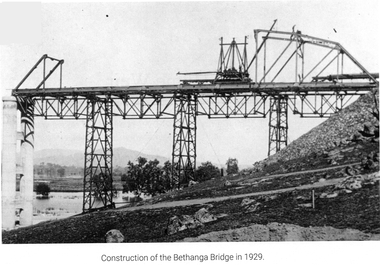
... The Bethanga Bridge was built between 1927 and 1930 as a joint venture between Victoria and New South Wales and was a key element of the River Murray Waters Agreement. It consists of nine spans of 82 metres long. Each span is supported between double reinforced concrete pylons and a riveted steel camel back Pratt truss. ...The Bethanga Bridge was built between 1927 and 1930 as a joint venture between Victoria and New South Wales and was a key element of the River Murray Waters Agreement. It consists of nine spans of 82 metres long. Each span is supported between double reinforced concrete pylons and a riveted steel camel back Pratt truss. ...The Bethanga Bridge was built between 1927 and 1930 as a joint venture between Victoria and New South Wales and was a key element of the River Murray Waters Agreement. It consists of nine spans of 82 metres long. Each span is supported between double reinforced concrete pylons and a riveted steel camel back Pratt truss. The overall span of the bridge is a length of 752 metres. It was completed in 1929 at a cost of £194,000. The road deck was initially constructed from timber but was replaced in 1961 with a concrete waffle slab deck 7.7metres wide. In 1961 the bridge deck and truss structure were raised 300 millimetres to allow for the enlargement of the lake. The bridge was designed in NSW by road engineer Percy Alan and the trusses were built by the Charles Ruwolt Pty. Ltd. Charles Ruwolt Pty. Ltd. was originally established by Charles Ruwolt as a foundry at Wangaratta in 1902 and transferred its operations to Richmond, Melbourne in 1914. By 1938 it had become one of the biggest engineering companies in Australia. After Charles Ruwolt’s death in 1946, Vickers Ltd. acquired the company and in 1948 the firm became known as Vickers Ruwolt Pty. Ltd. Because of the Bethanga Bridge’s unique location, over the waters of a dam with the border running down the centre of the body of water, the Bethanga Bridge is the only built structure shared by both Victoria and New South Wales. As the border of New South Wales aligns with the southern bank of the Murray River all of the other bridges along its length are deemed to be in New South Wales. The Bethanga Bridge is listed on both the New South Wales State Heritage Register and the Victorian Heritage Database. In 2015 the Bethanga Bridge was nominated for a heritage award by the Institution of Engineering Australia.These images are significant because they document the construction of a bridge which links Victoria and New South Wales and has been recognised for its historical, technical and engineering significance.A collection of photos documenting the construction of the Bethanga Bridge which links the States of Victoria and New South Wales as part of the construction of the Hume Dam .bethanga bridge, hume dam constuction, charles ruwolt, percy allan engineer
