Showing 14 items matching "road haulage"
-
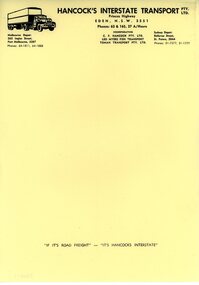
Orbost & District Historical SocietyCertificate - two Letterheads, Handcocks Transport, HANDCOCK'S TRANSPORT Pty Ltd, 1970s-1990s
... road haulage... companies of south-east Australia, including Orbost and Lakes Entrance. road haulage trucks Hancocks Transport 3346.1 HANDCOCK'S INTERSTATE TRANSPORT Pty Ltd, Princes Highway, Eden, NSW 2551 3346.2 HANDCOCKS CARRIERS SINCE 1926 Lakes Entrance 3809 3346.1 black printing onto cream paper. ...Hancocks Transport, begun in 1926, was one of the pioneers of road transport down the South East Coast of Australia. Initially founded at Pambula NSW, Hancocks developed a widespread network of routes, including through Lks Entrance and Orbost in Victoria.These 2 letterheads are significant because they relate to Hancocks Transport, one of the premier haulage companies of south-east Australia, including Orbost and Lakes Entrance. 3346.1 black printing onto cream paper. A drawing of a large truck is on the top left. 3346.2 black printing onto cream paper. A narrow red line around the text at the top of the paper. 3346.1 HANDCOCK'S INTERSTATE TRANSPORT Pty Ltd, Princes Highway, Eden, NSW 2551 3346.2 HANDCOCKS CARRIERS SINCE 1926 Lakes Entrance 3809road haulage, trucks, hancocks transport -
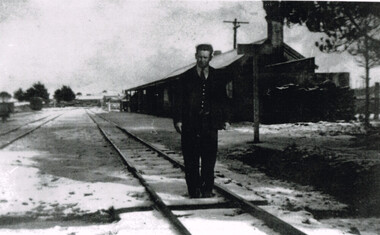
Otway Districts Historical SocietyPhotograph, Beech Forest Railway Station: Laurie McCabe in charge, 1920s
... When the timber industry went into decline because of poor markets and the crippling effects of the 1929 strike, and when road haulage signalled the beginning of a new transport era it was the beginning of the end. ...When the timber industry went into decline because of poor markets and the crippling effects of the 1929 strike, and when road haulage signalled the beginning of a new transport era it was the beginning of the end. ...Laurie McCabe was in charge of Beech Forest Station until October 1929. When the timber industry went into decline because of poor markets and the crippling effects of the 1929 strike, and when road haulage signalled the beginning of a new transport era it was the beginning of the end. As a result staffing levels were severely cut over the period 1927/29 with the two station masters at Beech Forest and Gellibrand replaced by caretakers in October 1929. The line was then supervised by travelling station masters of whom Laurie McCabe was one of two.B/W. Laurie McCabe in charge of Beech Forest Railway Station in the 1920s, pictured on track one just down from the station buildings. Note the slight snow covering on the tracks.beech forest; railways; laurie mccabe; -
Warrnambool and District Historical Society Inc.Functional object - Bullock's Yoke, 1902
... Warrnambool and District Historical Society Inc. 2 Gilles Street (south of Merri St) Warrnambool great-ocean-road This yoke would have been used as a harness for a bullock team . Bullocks were used extensively in the 19th and early 20th centuries for cartage and haulage, particularly for wool in the Western District. ...This yoke would have been used as a harness for a bullock team . Bullocks were used extensively in the 19th and early 20th centuries for cartage and haulage, particularly for wool in the Western District. This yoke was from the property "Rose Park" in Willatook and used about 1902. The property of "Rose Park" was owned by Stan Baulch who inherited the property in 1919. Up to his death in 1980 he was an active member of the Warrnambool and District Historical Society and had a special interest in the local history of bullock teams and bullockies.This is retained as a memento of early farming practices in the Western District of Victoria.The yoke has a heavy wooden curved piece shaped at both ends with holes along the piece to hold two heavy metal rings which protrude through the wooden section and have pointed ends. The holes also contain two large metal hoops. A short chain is attached bullock team and bullockies, stan baulch, rose park -
Halls Gap & Grampians Historical SocietyPhotograph - Coloured, Early 20th C
... Road Halls Gap grampians A tramline was built to bring logs down from a mill up on Stoney Creek. The tramline was made of timber and the trolleys of logs were pulled as afr as possible by horse and then a driver would ride the logs down to the flat land below pulling a brake when nearing the end. (Close to site of present Primary School). TRANSPORT Horse drawn STRUCTURES Tramway Photo is a copy of Anne Borella (nee Nicholson) depicting the haulage ...A tramline was built to bring logs down from a mill up on Stoney Creek. The tramline was made of timber and the trolleys of logs were pulled as afr as possible by horse and then a driver would ride the logs down to the flat land below pulling a brake when nearing the end. (Close to site of present Primary School).Photo is a copy of Anne Borella (nee Nicholson) depicting the haulage of timber along a tramline. Two horses are pulling a trolley while a driver stands on the load with the wheelbrake ready.transport, horse drawn, structures, tramway -
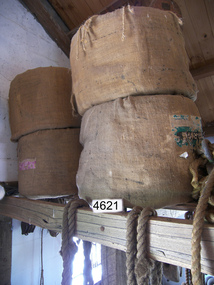
Flagstaff Hill Maritime Museum and VillageEquipment - Rope
... Flagstaff Hill Maritime Museum and Village 89 Merri Street Warrnambool great-ocean-road These coils of heavy strong cargo rope are covered in hessian for protection from the elements and for ease of handling. They would have been imported for local use such as haulage, fencing and towing. ...These coils of heavy strong cargo rope are covered in hessian for protection from the elements and for ease of handling. They would have been imported for local use such as haulage, fencing and towing. These rope coils or bails are an example of products imported into Australia for local use.Rope; four large coils of thick rope in hessian covers.Some of the covers have remnants of paper labels and black markings.flagstaff hill, warrnambool, maritime museum, maritime village, great ocean road, shipwreck coast, rope, rope coil, rope bail, cargo rope, hessian covered rope -
Glenelg Shire Council Cultural CollectionPhotograph - Photograph - Transwest Semi-trailer, n.d
... Glenelg Shire Council Cultural Collection History House Cliff Street Portland great-ocean-road Port of Portland Authority Archives. Port of Portland Archives Transwest Haulage Semi Trailer Black and white photograph of a Transwest Haulage semi-trailer tipped up to unload grain at the wharf. ...Port of Portland Authority Archives.port of portland archives, transwest haulage semi trailer -
Greensborough Historical SocietyPhotograph (Copy), Bullock Team near Yarrambat, 1899c
... Greensborough Historical Society 34A Glenauburn Road Lower Plenty Lower Plenty melbourne Shows a bullock team, typically used for "heavy haulage" up to the 19th century. ...Shows a bullock team, typically used for "heavy haulage" up to the 19th century.A typical scene for the local area in the 19th century.Photocopy of sepia toned photograph. Depicts bullock team. In pen: "Bullock Team thought to be near Yarrambat".yarrambat, bullock team, 19th century transportation -
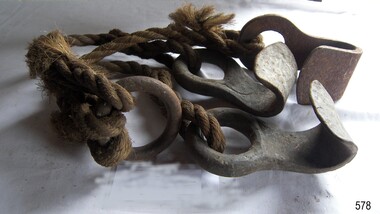
Flagstaff Hill Maritime Museum and VillageEquipment - Sling Hooks
... Road...Shipwreck Coast...sling hook...ring hook...rigging...cargo...haulage...Flagstaff Hill Maritime Museum and Village 89 Merri Street Warrnambool great-ocean-road Sling hooks are used in ship's rigging for cargo haulage. Sling hooks are necessary for hauling cargo. ...Sling hooks are used in ship's rigging for cargo haulage.Sling hooks are necessary for hauling cargo. Cargo was imported to and exported from the busy Port of Warrnambool in the 19th and early 20th centuries. Sling hooks are still used today for cargo.Sling hooks; three metal ring hook each on a short length of rope and all attached to the same metal ring . flagstaff hill, warrnambool, maritime museum, maritime village, great ocean road, shipwreck coast, sling hook, ring hook, rigging, cargo, haulage, cargo lifiting, maritime technology -
Coal Creek Community Park & MuseumSignals sign
... Coal Creek Community Park & Museum 12 Silkstone Road Korumburra gippsland - COAL CREEK - Haulage signals - 1 stop - 2 lower - 3 pull - 4 pull steady - 5 lower steady - 6 persons on hoist steady - 7 help wanted - 8 ring off 8504.1 - Square wooden sign painted white with black letters. ...8504.1 - Square wooden sign painted white with black letters.- COAL CREEK - Haulage signals - 1 stop - 2 lower - 3 pull - 4 pull steady - 5 lower steady - 6 persons on hoist steady - 7 help wanted - 8 ring off -
Puffing Billy RailwayMalcolm Moore Rail Tractor 0-4-0 2' Gauge, 1943
... road Belgrave yarra-valley-and-the-dandenong-ranges Malcolm Moore No. 1015 One of a Batch of 92 such rail tractors built. Builders Number 1015. Built for the Australian Army in 1943 Built for the Australian army - delivered to Army on the 3 March 1944 and was sold to the State Rivers and Water Supply Commission at Red Cliffs, Victoria. - used at the Red Cliffs Power station to haul briquettes from the rail siding Red Cliffs to the Red Cliffs Power Station and also used for shunting and some haulage from the Red Cliffs siding.. ...Malcolm Moore No. 1015 One of a Batch of 92 such rail tractors built. Builders Number 1015. Built for the Australian Army in 1943 Built for the Australian army - delivered to Army on the 3 March 1944 and was sold to the State Rivers and Water Supply Commission at Red Cliffs, Victoria. - used at the Red Cliffs Power station to haul briquettes from the rail siding Red Cliffs to the Red Cliffs Power Station and also used for shunting and some haulage from the Red Cliffs siding.. This rail tractor was originally powered by a Ford side valve V8 petrol engine. It arrived at the Museum from Red Cliffs in 1977 and is operational. Originally equipped with a Ford side valve V8 Later replaced by a Fordson Major diesel tractor engine.Historic - Narrow Gauge Industrial Railway - used by the Australian Army, and the State Rivers and Water Supply Commission at Redcliffs, Victoria, AustraliaMalcolm Moore No.1015 - Malcolm Moore Rail Tractor 0-4-0 Malcolm Moore Rail Tractor - Steel (Painted)Malcolm Moore Rail Tractor 0-4-0 Malcolm Moore 2' Gauge 1015puffing billy, malcolm moore, ford v8, rail tractor, fordson, australian army, state rivers and water supply commission, 2' gauge, industrial narrow gauge railway -
Puffing Billy RailwayTyers Valley Timber Bogies 2'6" gauge
... Puffing Billy Railway 1 old monbulk road Belgrave yarra-valley-and-the-dandenong-ranges Built by the Forests Commission of Victoria for the timber haulage on the Tyers Valley Tramway near Erica. ...Built by the Forests Commission of Victoria for the timber haulage on the Tyers Valley Tramway near Erica. Historic - Industrial Narrow Gauge Railway - Timber working - Timber Bogies used by Forests Commission of Victoria for the timber haulage on the Tyers Valley Tramway near EricaTimber Bogies - Made of Wood and steel and wrought irontyers valley, sawmill, puffing billy, forests commission of victoria, timber bogies, industrial narrow gauge railway -
Puffing Billy RailwayWonthaggi Coal Skip, Early 20th century
... Puffing Billy Railway 1 old monbulk road Belgrave yarra-valley-and-the-dandenong-ranges One of two types of four wheel skips widely used on the Wonthaggi Coal Fields for transportation from the underground workings to the surface screening and loading areas. Haulage ...One of two types of four wheel skips widely used on the Wonthaggi Coal Fields for transportation from the underground workings to the surface screening and loading areas. Haulage underground was accomplished by the use of pit ponies, whilst an endless rope system was used to bring the skips to the surface areas. Much of the coal for the colony of Victoria was sourced from Newcastle and the Hunter Region in New South Wales, along with local supplies from private and co-operative coal mines at Outtrim, Jumbunna and Korumburra in Gippsland. After the 1909–1910 strike by coal miners in the Hunter Valley, the Victorian state government were determined to ensure stability in local supplies of coal. The State Coal Mine and the town of Wonthaggi came into being in 1910 to supply coal for the Victorian Railways. It was one of the largest and most dangerous collieries in Australia. At its peak in 1926 the mine produced 2,435 long tons (2,474 t) per day, with the Victorian Railways buying 90% of production. In 1928, Wonthaggi coal accounted for around 60% of Victorian Railways coal consumption.Historic - Industrial - Victorian Railways - Narrow Gauge Railway rolling stock - Wonthaggi Coal Fields, Victoria, AustraliaRectangular steel bin with wood frame and steel wheelspuffing billy, coal skip, wonthaggi, wonthaggi coal fields, 2'0" gauge, brown coal -
Puffing Billy RailwayClimax - Geared Steam Locomotive No. 1694, 1928
... Puffing Billy Railway 1 old monbulk road Belgrave yarra-valley-and-the-dandenong-ranges Climax geared locomotive No. 1694 in active service on special occasions - stored at Emerald Station A Miraculous Survivor Climax locomotive No.1694 is a miraculous survivor of a rare breed of steam locomotive. For about 100 years from the mid-1850s sawn timber was carted from Victorian sawmills to the nearest railway station by timber tramway. These tramways were generally very rough, steeply graded, sharply curved, and of narrow gauge. Many had wooden rails, and horses provided haulage ...Climax geared locomotive No. 1694 in active service on special occasions - stored at Emerald Station A Miraculous Survivor Climax locomotive No.1694 is a miraculous survivor of a rare breed of steam locomotive. For about 100 years from the mid-1850s sawn timber was carted from Victorian sawmills to the nearest railway station by timber tramway. These tramways were generally very rough, steeply graded, sharply curved, and of narrow gauge. Many had wooden rails, and horses provided haulage. The better ones used steam locomotives. In all about fifty steam locomotives are known to have worked on Victorian timber tramways. These locomotives were usually somewhat peculiar - made to cope with arduous, rough conditions, rather than speed. Climax locomotive No.1694 is the only one of these locomotives to survive intact. It was built in 1928 by the Climax Manufacturing Company, Corry, Pennsylvania, USA, for the Forests Commission of Victoria. The distinctive feature of the Climax locomotive is that the cylinders do not directly connect to the driving wheels. Instead they drive a cross shaft near the centre of the locomotive. From there the drive is transmitted to the small driving wheels through rotating shafts, universal joints, and bevel gears. The driving wheels are mounted in two four-wheel bogies so that they can easily follow sharp curves in the track. None of these features are found in normal steam locomotives. The result is a locomotive that is extremely powerful for its size, and that will cope with sharp curves and steep grades with ease. But this is at the cost of speed, Climax locomotive No.1694 is just about flat-out at 13 km/h (8 mph). Climax Locomotive Built in 1928 for the Forests Commission of Victoria and painted all-over black with the name CLIMAX painted on the sides of the cab in white block letters, this locomotive was issued to the Tyers Valley tramway which branched off the Moe to Walhalla line at Collins Siding. This locomotive was withdrawn from service in 1949 following the closure of the tramway and in 1950 it travelled from Tyers Junction to Collins Siding to Erica where it remained stored until 1965. Loaned to the Puffing Billy Preservation Society for its Steam Museum, it was taken to Menzies Creek in 1965 where it remained until 1982 when the Emerald Tourist Railway Board bought it and transferred it to Belgrave for restoration. It was returned to service for special use on the Belgrave to Gembrook line in 1988 painted in its original all-over black livery, except that the word “Climax” on the sides of the cab was now painted in the style of the Climax Manufacturing Co., a style that this locomotive had never carried.Historical - Industrial railway - Forests Commission of Victoria, Timber Logging Climax Locomotive Climax geared Steam locomotive made of steel and wrought iron Climax 1694climax locomotive works, climax, geared steam locomotive, puffing billy, climax locomotive no. 1694, steam locomotive -
Wodonga & District Historical Society IncBook - A Railway LIfe, Lloyd Holmes, 1991
... Road Bonegilla the-murray new south wales railways victorian railways railroads history Lloyd Homes records 40 years of experience as an employee on the New South Wales and then Victorian Railways. His rich powers of description, keenness of observation and sense of humour result in a book that is very readable for anyone with a love of Australia. He captures the remote life of the railway, the warmth of human companionship and traces the transition from steam to diesel haulage ...Lloyd Homes records 40 years of experience as an employee on the New South Wales and then Victorian Railways. His rich powers of description, keenness of observation and sense of humour result in a book that is very readable for anyone with a love of Australia. He captures the remote life of the railway, the warmth of human companionship and traces the transition from steam to diesel haulage.non-fictionLloyd Homes records 40 years of experience as an employee on the New South Wales and then Victorian Railways. His rich powers of description, keenness of observation and sense of humour result in a book that is very readable for anyone with a love of Australia. He captures the remote life of the railway, the warmth of human companionship and traces the transition from steam to diesel haulage.new south wales railways, victorian railways, railroads history