
Showing 21 items matching "robert o’hara burke"
-
 The Beechworth Burke Museum
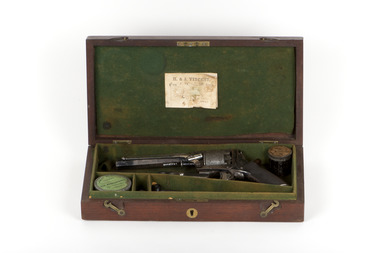
Weapon - Tranter Revolver, Robert O'Hara Burke's Revolver
... ...robert o'hara burke...This gun was presented to Robert O’Hara Burke Esq in 1858 by the Beechworth Police in recognition of his four years’ service as the Police Superintendent at Beechworth. ...It arrived back in Beechworth on Thursday 10th April, 2014. burke robert o'hara burke burke museum robert o'hara burke museum firearm burke and wills burke & wills burke and wills expedition expedition beechworth indigo shire north-east victoria revolver Presented to R. ...This gun was presented to Robert O’Hara Burke Esq in 1858 by the Beechworth Police in recognition of his four years’ service as the Police Superintendent at Beechworth. It arrived back in Beechworth on Thursday 10th April, 2014.Presented to R. O’Hara Burke Esq / Supt. of Police by the Officers of the district on his transfer from Beechworth / November 1858 /burke, robert o'hara burke, burke museum, robert o'hara burke museum, firearm, burke and wills, burke & wills, burke and wills expedition, expedition, beechworth, indigo shire, north-east victoria, revolver -
 The Beechworth Burke Museum
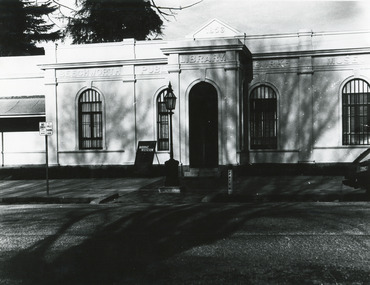
Photograph, c1970
... ...Robert O'Hara Burke...As Australia’s oldest regional museum, the building used for the Burke Museum was originally built as the Beechworth Athenaeum, and was later dedicated as a museum in memorial to the explorer Robert O’Hara Burke, who died on the Burke and Wills expeditions in 1861. ...Burke Museum Beechworth Beechworth Athenaeum Athenaeum memorial Robert O'Hara Burke Robert Burke Burke and Wills exhibitions Obverse: 1856/ BEECHWORTH/ PUBLIC/ LIBRARY/ BURKE/ MUSEUM/ BURK MUSEUM/ (parking signs illegible) Reverse: BMM 84-2-1/ A02989 1997 2696/ BMM 84-2-3 Black and white rectangular photograph printed on paper. ...Historical photograph taken of the frontage of the Burke Museum in Beechworth. As Australia’s oldest regional museum, the building used for the Burke Museum was originally built as the Beechworth Athenaeum, and was later dedicated as a museum in memorial to the explorer Robert O’Hara Burke, who died on the Burke and Wills expeditions in 1861. The Burke and Wills exhibitions were a significant colonial event that was memorialised in paintings, buildings, monuments, and statues. The photograph has historical significance, connecting with various themes such as exploring, establishing pathways, and significant colonial events or persons. The photograph depicts the frontage of the Burke Museum, which was dedicated as a memorial to the explorer Robert O’Hara Burke, who died on the Burke and Wills expeditions in 1861. Robert O’Hara Burke was a significant person who was connected to both Beechworth and to an important colonial event, the Burke and Wills expeditions. Born in Ireland, Burke migrated to Australia in 1853 and nearly a year later, was appointed to senior inspector at Beechworth. Described as quick-tempered yet generous, Burke later joined an expedition to explore the interior of the Victorian colony, which was later termed the Burke and Wills expeditions. While the expeditions generated a significant amount of interest, the objectives of the Burke and Wills expeditions were hazy, as was its planned route, leading to disaster on the trip as group infighting, poor provisions, and a lack of clear instructions ultimately resulted in Burke’s death. Regardless, the Burke and Wills expeditions promoted discovery and endures today in popular memory.Black and white rectangular photograph printed on paper.Obverse: 1856/ BEECHWORTH/ PUBLIC/ LIBRARY/ BURKE/ MUSEUM/ BURK MUSEUM/ (parking signs illegible) Reverse: BMM 84-2-1/ A02989 1997 2696/ BMM 84-2-3burke museum, beechworth, beechworth athenaeum, athenaeum, memorial, robert o'hara burke, robert burke, burke and wills exhibitions -
 The Beechworth Burke Museum
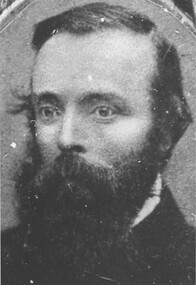
Photograph
... robert o'hara burke...This photograph is of Robert O'Hara Burke (6 May 1821 – c. 28 June 1861) who was an Irish soldier and police officer who achieved fame as an Australian explorer. ...This photograph is of Robert O'Hara Burke (6 May 1821 – c. 28 June 1861) who was an Irish soldier and police officer who achieved fame as an Australian explorer. ...This photograph is of Robert O'Hara Burke (6 May 1821 – c. 28 June 1861) who was an Irish soldier and police officer who achieved fame as an Australian explorer. He was the leader of the ill-fated Burke and Wills expedition, which was the first expedition to cross Australia from south to north, finding a route across the continent from the settled areas of Victoria to the Gulf of Carpentaria. Prior to leading this expedition, Burke was the superintendent of Police in Beechworth from 1854-1858. The Robert O’Hara Burke Memorial Museum was named in honour of Robert O’Hara Burke after his death at Coopers Creek in 1861 during expedition. This particular image of Robert O'Hara Burke features on the 'Pioneer Board' which is currently on display in the Museum. Black and white rectangular copy of a photograph. Image is printed on gloss photographic paper and has a white unprinted boarder. Reverse: 34 / Photo credit: Burke Museum / BEECHWORTH / 46% /robert o'hara burke, pioneers of beechworth, pioneer board, beechworth, police superintendent -
 City of Ballarat
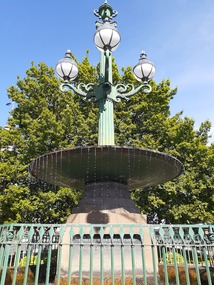
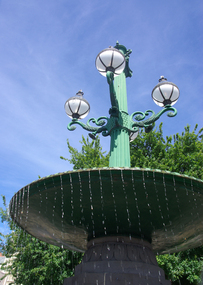
Artwork, other - Public Artwork, Burke and Wills Memorial Fountain
... ...Robert O’Hara Burke...Ballarat son Robert O’Hara Burke and his good mate William John Wills are commemorated in the Burke & Wills Fountain. ...Robert O'Hara Burke, Leader, Died 30th June, 1861. ...The fountain is of historic and aesthetic significance to the people of Ballarat Burke & Wills Robert O’Hara Burke William John Wills Ludwig Becker Charles Grey John King Robert O'Hara Burke, Leader, Died 30th June, 1861. ...Ballarat son Robert O’Hara Burke and his good mate William John Wills are commemorated in the Burke & Wills Fountain. This memorial to the famous explorers also features the names of those who assisted their ill-fated crossing of Australia. The fountain was once lit with gas and stocked with goldfish and tortoises.The fountain is of historic and aesthetic significance to the people of BallaratBluestone and cast metal fountain Robert O'Hara Burke, Leader, Died 30th June, 1861. William John Wills, Second, Died 39th June, 1861. Ludwig Becker, Naturalist, Died 29th April, 1861. Charles Grey, Assistant, Died 17th April, 1861. John King the only survivor of the EXPEDITION Died at St Kilda January 13th 1872. In Memory of the explorers who perished while crossing the Australian Continent in the year 1861. Erected by the Inhabitants of Ballarat. burke & wills, robert o’hara burke, william john wills, ludwig becker, charles grey, john king -
 The Beechworth Burke Museum
Photograph, 1910
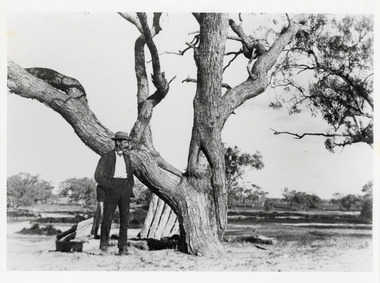
... Robert O'Hara Burke...This was the site where Robert O’Hara Burke and William John Wills returned from the Gulf of Carpentaria and found their support party had left only hours earlier. ...It captures the landscape and features of the location just fifty years after the expedition and offers insight into how the site was remembered and commemorated in the early 20th century. Robert O'Hara Burke Conrick John Burke Expeditions Dig Tree 4611.1 Reverse: 84.75 1/4611-1/THE BURKE AND Wills "DIG TREE". ...The photograph and copy depict the Dig Tree, a coolibah tree on Cooper Creek linked to the ill-fated Burke and Wills expedition of 1860–61. This was the site where Robert O’Hara Burke and William John Wills returned from the Gulf of Carpentaria and found their support party had left only hours earlier. And carvings on the tree pointed to buried supplies. The tree became a reminder of the tragedy and fatal misjudgements that led to it, as well as the harsh conditions of inland exploration.This 1910 photograph of the Dig Tree holds historic significance as it depicts one of the most iconic exploration sites. It captures the landscape and features of the location just fifty years after the expedition and offers insight into how the site was remembered and commemorated in the early 20th century. Black and white rectangular photograph printed on matte photographic paper unmounted. 4611.1 Reverse: 84.75 1/4611-1/THE BURKE AND Wills "DIG TREE"./SITUATED ON NAPPA MERRIE STATION, COOPERS CREEK QLD,/PHOTO TAKEN BY JOHN W. CONRICK OF NAPPA MERRIE ABOUT 1910. 4611.2 Reverse: 4611-2robert o'hara burke, conrick john, burke expeditions, dig tree -
 The Beechworth Burke Museum
Photograph, c1999-2000
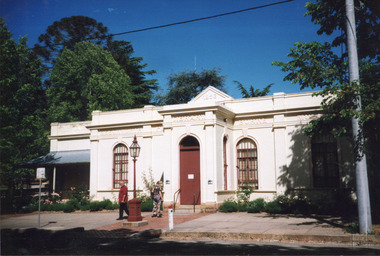
... ...robert o'hara burke...In 1863 the museum was dedicated as a memorial to former Beechworth police superintendent (1854-1858) and explorer Robert O’Hara Burke, following Burke’s death from malnutrition on the Burke and Wills expedition in 1861. ...In 1863 the museum was dedicated as a memorial to former Beechworth police superintendent (1854-1858) and explorer Robert O’Hara Burke, following Burke’s death from malnutrition on the Burke and Wills expedition in 1861. ...This photograph taken c1999/2000, depicts the Burke Museum’s granite façade and vestibule entrance. The museum's large red door is closed and there is a white sign is attached to the door. The museum site dates to the 1857 founding of the Beechworth Public Library and Athenaeum by a newly formed Young Men's Association (YMA). In 1863 the museum was dedicated as a memorial to former Beechworth police superintendent (1854-1858) and explorer Robert O’Hara Burke, following Burke’s death from malnutrition on the Burke and Wills expedition in 1861. Funded by the Victorian Government and the Royal Society of Victoria, the officially titled 'Victorian Exploring Expedition' was tasked with being the first European party to traverse Australia from south to north. The Burke Museum holds objects from the famous expedition and explores the multi-layered history of Beechworth and surrounds from the gold rush era to the present.This photograph is historically significant for its depiction of the Burke Museum c1999/2000. The Burke Museum is Australia’s oldest regional museum and part of Beechworth's Historic and Cultural Precinct, one of Australia’s best preserved historic-town sites and a popular tourist destination. Once the government centre for a vast gold fields region, this collection of nationally significant buildings tells the story of how Australia grew and prospered. The frequent use of honey-coloured local granite as a building material, which can be seen in the museum's fabric, gives Beechworth’s historic buildings a distinct and cohesive local character. This photograph captures this distinctive character and may be compared and studied alongside other images of historic buildings in the Burke Museum Photographic Collection.Rectangular colour photograph printed on photographic paper.Reverse: 7031 / Label: Burke Museum / 1999/2000 /burke museum, indigo shire, beechworth athanaeum, beechworth library, beechworth historic building, historic precinct, burke museum exhibition, from the liedertafel to the skating rink, honey-coloured local granite, robert o'hara burke, victorian gold fields, historic towns in victoria, colonial australia, liedertafel, colonial entertainments, beechworth brass band, historic victorian architecture, australia's oldest regional museum, burke and wills expedition, first europeans to cross australia, yound mens associations, beechworth tourism, things to see in beechworth, beechworth historic trail, young men's associations -
 The Beechworth Burke Museum
Book - 1875 Catalogue, William Detmold, RULES / CATALOGUE OF BOOKS / INVENTORY OF PICTURES, DRAWINGS, / MAPS, CHARTS, FURNITURE, SPECIMENS / OF THE / PUBLIC LIBRARY AND BURKE MUSEUM / BEECHWORTH, 1875
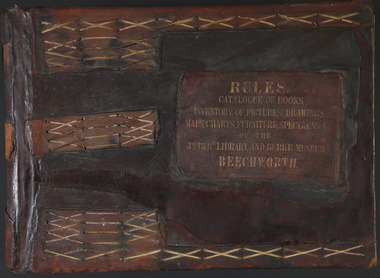
... ...robert o'hara burke...Then in 1861 when news of the death of Beechworth’s former police superintended, Robert O’Hara Burke, reached the town, it was agreed that the Public Library would also become a museum to tribute his legacy, renaming it as the ‘Public Library and Robert O’Hara Burke Memorial Museum, Beechworth’. ...Then in 1861 when news of the death of Beechworth’s former police superintended, Robert O’Hara Burke, reached the town, it was agreed that the Public Library would also become a museum to tribute his legacy, renaming it as the ‘Public Library and Robert O’Hara Burke Memorial Museum, Beechworth’. ...This large, leather bound journal was made for the Public Library and Burke Museum in Beechworth by book manufacturer, William Detmold in 1875. It was commissioned by the President of the Library and Burke Museum committee, Dr Antoine Mousse, for the purpose of cataloguing all the items in the collection. The cataloguer was the curator at that time, William Morton, whose hand-writing appears in the journal today. When William Morton first started recording in this journal in 1875, there were already a number of existing items in the institution. The Public Library and Burke Museum in Beechworth had actually been operating since the 1850s; first as a Young Men’s Association in 1856, then as Beechworth Athenaeum in 1858, then as the Beechworth Public Library in 1860. Then in 1861 when news of the death of Beechworth’s former police superintended, Robert O’Hara Burke, reached the town, it was agreed that the Public Library would also become a museum to tribute his legacy, renaming it as the ‘Public Library and Robert O’Hara Burke Memorial Museum, Beechworth’. Many of the items from the early institutions would have been used to form the nucleus of this new organisation. Plus, the additional items that were either collected or donated to develop it into a museum. The catalogue is extensive. There are exactly 461 pages of recorded items, each page detailing the various collections the museum acquired in the late 19th century. Collections recorded in this catalogue include a large collection of geological specimens, that were given to the museum in 1868 by the Geological Survey Department of Victoria. A large collection of taxidermy mounts, that were given to the museum as skins by the Museum of Australia in 1865. An extensive collection of Aboriginal artefacts that were purchased from amateur anthropologist R. E . Johns in 1868. As well as artworks, charts, photographs, machinery, maps etc., all of which have been held in the museum since. This catalogue also details the governance and management of the organisation. There were originally 30 rules that governed the actions for the management committee and, while anyone could read in the free library, only subscribers could borrow two books and one periodical. At first, subscriptions rates were 7/6 a quarter. This was later changed to £1 per annum, paid quarterly in advance. This was a considerable amount; 7/6 per quarter meant that the annual fee was £1.10. This was equivalent to about £650.00 or about $1,182.00AUD today, while the reduced subscription fee of £1 a year was the equivalent to £450.00 or about $818.00AUD today. Membership of the athenaeum would have been the reserve of the town's notable citizens. The vale of the catalogue lies not only in its historical connect with the establishment of the Athenaeum and the current museum, but also in its record of the names and positions of all members of the institution's committees of management from 1875-1876. This is a unique object that contains important records for a notable country town. Large brown leather bound book made in 1875 for the Beechworth library and museum by William Detmond. Inside is a comprehensive and detailed itemised listing of the paintings, drawings, charts, photographs, specimens and books that entered the institution from 1850 -1882. non-fictionCover: RULES / CATALOGUE OF BOOKS / INVENTORY OF PICTURES, DRAWINGS, / MAPS, CHARTS, FURNITURE, SPECIMENS / OF THE / PUBLIC LIBRARY AND BURKE MUSEUM / BEECHWORTHburke museum, beechworth, catalogue, museum catalogue, 1875, william morton, william detmold, exposition universelle, ferdinand von mueller, public library, collection, book, leather bound, restored, digitised, robert o'hara burke, hand-written -
 The Beechworth Burke Museum
Photograph, George Peach, c. 1930
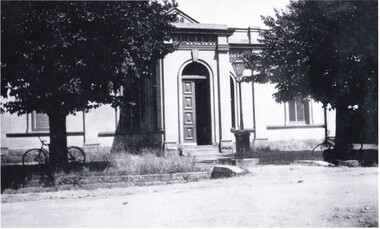
... ...Robert O'Hara Burke...Black and White photograph taken of the Robert O'Hara Burke Memorial Museum. The museum is named in honor of explorer and former Beechworth Superintendent Robert O'Hara Burke following his death in 1861....Burke Museum Robert O'Hara Burke robert o'hara burke museum Copy of a black and white landscape photograph on photographic paper. ...Black and White photograph taken of the Robert O'Hara Burke Memorial Museum. The museum is named in honor of explorer and former Beechworth Superintendent Robert O'Hara Burke following his death in 1861.This item is significant because it shows the historic Burke Museum in a historic context, which can be used to document the changes in the building and the surroundings which have occurred over time.Copy of a black and white landscape photograph on photographic paper.burke museum, robert o'hara burke, robert o'hara burke museum -
 The Beechworth Burke Museum
Photograph
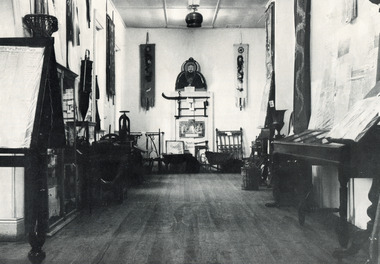
... ...Robert O'Hara Burke...Originally built as the Beechworth Athenaeum in 1857, the museum was later renamed to the Robert O'Hara Burke Memorial Museum, more commonly known as the Burke Museum, in honour of the famous explorer and former Beechworth Superintendent of Police, Robert O'Hara Burke, after his death in 1861 at Coopers Creek during the famed ill-fated Burke and Wills expedition....Beechworth Spring Creek Chinese Burke Museum Immigration Chinese Immigration Ovens Goldfield China Museum Robert O'Hara Burke Burke and Wills Expedition Burke and Wills Goldfields Black and white rectangular photograph printed on paper. ...This black and white photograph is estimated to have been taken c1900 inside the Burke Museum. Several objects part of the museum collection at the time can be seen, with a high number of Asian influence objects visible; potentially Chinese in origin, as several Chinese villages were located around Beechworth and across Spring Creek, from the mid 1800s. The Burke Museum is part of the Precinct of Beechworth, which was established upon the discovery of gold in 1852. Originally built as the Beechworth Athenaeum in 1857, the museum was later renamed to the Robert O'Hara Burke Memorial Museum, more commonly known as the Burke Museum, in honour of the famous explorer and former Beechworth Superintendent of Police, Robert O'Hara Burke, after his death in 1861 at Coopers Creek during the famed ill-fated Burke and Wills expedition.This photograph is contextually, historically and socially significant due to its connection to both the Burke Museum and Chinese culture in and around Beechworth during the mid-1800s through to 1900s. Around 4700 people of Chinese heritage lived at the Ovens goldfield by April of 1857, representing one-quarter of the entire population at the time. The object holds strong representativeness to the history of the Burke Museum and to the objects in its collection. Its interpretive capacity could be supported and enhanced with other photographs and objects in the collection. Collectively, these records and objects could provide an insight into the museum's collection and its relationship with the origins of the objects.Black and white rectangular photograph printed on paper. Unmounted; taped to paper. beechworth, spring creek, chinese, burke museum, immigration, chinese immigration, ovens goldfield, china, museum, robert o'hara burke, burke and wills expedition, burke and wills, goldfields -
 Federation University Historical Collection
Correspondence, Correspondence concerning the Burke Family, 1954, 20/05/1954
... ...Robert O'Hara Burke...Some possibility the author is writing about Robert O'Hara Burke, but he was not married....Lonergan Robert O'Hara Burke Mrs Burke Kearney F.G. Elford letterhead F.H. ...Some possibility the author is writing about Robert O'Hara Burke, but he was not married.Two letters typed .1) An air letter form J.L. Lonergan of Eastern Pensylvania addressed to Ballaratt University, and eventuallty delivered to the Ballarat School of Mines. The letter requests information on a Mrs Burke of Ballarat, whose husband was lost in the Bush. Mrs Burke ran a boading house. The author worked for Morris Machine Works and remembered a Chief Engineery from Ballarat visiting the plant at the beginning of World War One. .2) A letter on University of Melbourne letterhead redurecting the letter to Ballarat. The letter was signed by F.G. Elford for F.H. Johnston (Registrar)/j.l. lonergan, robert o'hara burke, mrs burke, kearney, f.g. elford, letterhead, f.h. johnston, morris machine works, air letter, aerograme -
 Bendigo Historical Society Inc.
Document - THE WILLIAM PATTON Burke and Wills EXPEDITION MAY 4 - 19 1991
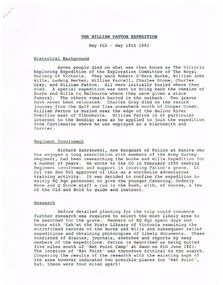
... ... Robert O'Hara Burke...DOCUMENT The William Patton Expedition May 4 - 19 1991 The Victoria Exploring Expedition of the Exploration Committee of The Royal Society of Victoria Robert O'Hara Burke William John Wills Ludwig Becker William Purcell Charles Stone Charles Gray William Patton Richard Zakrzewski Army Survey Regiment Burke and Wills Expedition Lt Col van den Tol State Library of Victoria Land Information Centre Bathurst Capt. ...Typed notes on an expedition by Army personnel and Richard Zakrzewski to find the grave of William Patton who was buried near the edge of the Bulloo River Overflow east of Tibooburra. He was a member of the Burke and Wills Party. Notes mention planning for the expedition and what they did while they were there. C. E. Burgess WO2, the author of the notes.document, the william patton expedition may 4 - 19 1991, the victoria exploring expedition of the exploration committee of the royal society of victoria, robert o'hara burke, william john wills, ludwig becker, william purcell, charles stone, charles gray, william patton, richard zakrzewski, army survey regiment, burke and wills expedition, lt col van den tol, state library of victoria, land information centre bathurst, capt. coulthard, wo1 slater, wo2 burgess, sgt de grauw, lcpl blake, capt cuskelly, wo1 gillies, ssgt sustart, cpl colde, cpl south, lcpl northausen, spr linwood, wo2 graham, ssgt gowers, sgt marshall, cpl doyle, cfn ellis, spr reynolds, spr hilbig, pte mckersie, 10/27 rsar, clifton downs homestead, gwen smith, william patton memorial -
 Bendigo Historical Society Inc.
Newspaper - LYDIA CHANCELLOR COLLECTION: TYNTYNDYER HOMESTEAD
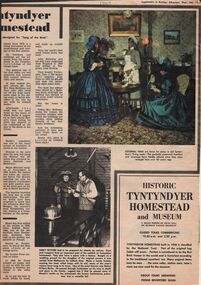
... ... Robert O'Hara Burke...HISTORY Australian early farming settlement Lydia Chancellor Collection collection Swan Hill Aboriginal Aboriginal Contact Australia history Australian history homesteads building house houses heritage tourism Aborigines settlers weapons guns pastoralists expedition John Holloway Andrew Beveridge Peter Beveridge Robert O'Hara Burke Narrinyeri Tribe bushrangers relics National Trust advertisement exploration An article from a 'Supplement to Bendigo Advertiser' giving some insights into the history of Tyntyndyer Homestead which is in the Swan Hill district. ...An article from a 'Supplement to Bendigo Advertiser' giving some insights into the history of Tyntyndyer Homestead which is in the Swan Hill district. It gives an insight into the early settlers and their struggles for survival. There is an advertisement within the supplement advertising the 'Historic Tyntyndyer Homestead and Museum.' Coloured and black and white photographs are included in this article which is dated 12/2/1969.history, australian, early farming settlement, lydia chancellor collection, collection, swan hill, aboriginal, aboriginal contact, australia, history, australian history, homesteads, building, house, houses, heritage, tourism, aborigines, settlers, weapons, guns, pastoralists, expedition, john holloway, andrew beveridge, peter beveridge, robert o'hara burke, narrinyeri tribe, bushrangers, relics, national trust, advertisement, exploration -
 Bendigo Historical Society Inc.
Photograph - EASTER PARADE 2004, 2004
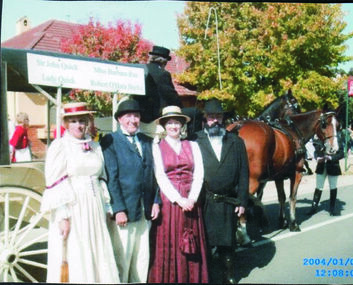
... ... Robert O'Hara Burke...Colour Photograph, An entry in the Bendigo Easter Parade 2004, The Driver is Laurie Jensen, Kay MacGregor is Miss Barbara Rae 'first woman's cricketer', Jim Evans is Sir John Quick, Coral Evans is Lady Quick, Ron Munro is Robert O'Hara Burke, Members of the Bendigo Historical Society, Kay MacGregor, Jim Evans and Coral Evans, and Ron Munro, Markings on photo read 2004/01/01....PHOTOGRAPH Portrait easter parade Easter Parade Bendigo Historical Society Sir John Quick Lady Quick Miss Barbara Rae Robert O'Hara Burke First Woman Cricketer Colour Photograph, An entry in the Bendigo Easter Parade 2004, The Driver is Laurie Jensen, Kay MacGregor is Miss Barbara Rae 'first woman's cricketer', Jim Evans is Sir John Quick, Coral Evans is Lady Quick, Ron Munro is Robert O'Hara Burke, Members of the Bendigo Historical Society, Kay MacGregor, Jim Evans and Coral Evans, and Ron Munro, Markings on photo read 2004/01/01. ...Colour Photograph, An entry in the Bendigo Easter Parade 2004, The Driver is Laurie Jensen, Kay MacGregor is Miss Barbara Rae 'first woman's cricketer', Jim Evans is Sir John Quick, Coral Evans is Lady Quick, Ron Munro is Robert O'Hara Burke, Members of the Bendigo Historical Society, Kay MacGregor, Jim Evans and Coral Evans, and Ron Munro, Markings on photo read 2004/01/01.photograph, portrait, easter parade, easter parade, bendigo historical society, sir john quick, lady quick, miss barbara rae, robert o'hara burke, first woman cricketer -
 Ballarat Heritage Services
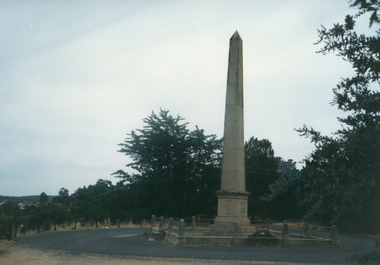
Photograph - Photograph - Colour, Clare Gervasoni, Burke and Wills Memorial, Castlemaine, c2007
... Robert O'Hara Burke...Four sided memorial for Robert O'Hara Burke and Wills in Castlemaine. ...Robert O'Hara's last position before leaving on the expedition to reach the Gulf of Victoria was with the police force in Castlemaine. Robert O'Hara Burke Castlemaine memorial Burke and Wills Four sided memorial for Robert O'Hara Burke and Wills in Castlemaine. ...Robert O'Hara's last position before leaving on the expedition to reach the Gulf of Victoria was with the police force in Castlemaine. Four sided memorial for Robert O'Hara Burke and Wills in Castlemaine. robert o'hara burke, castlemaine, memorial, burke and wills -
 Ballarat Heritage Services
Photograph - Colour, Burke and Wills Fountain, Sturt Street Gardens, 2011, 29/12/2011
... ...robert o'hara burke...Plaque "Robert O'hara Burke, Leader. Died 30th June, 1861. ...The fontain was once lit with gas and stocked with goldfish and tortoises. burke and wills burke and wills memorial sturt street ballarat explorers john king robert o'hara burke Plaque "Robert O'hara Burke, Leader. ...The fontain was once lit with gas and stocked with goldfish and tortoises.Colour photographs of the Burke and Wills Fountain in Sturt Street Balllarat.Plaque "Robert O'hara Burke, Leader. Died 30th June, 1861. William John Wills, Second. Died 30th June, 1861. Ludwig Becker, Naturalist. Died 29th April, 1861. Charles Grey, Assistant. Sied 17th April, 1861."burke and wills, burke and wills memorial, sturt street, ballarat, explorers, john king, robert o'hara burke -
 Wodonga & District Historical Society Inc
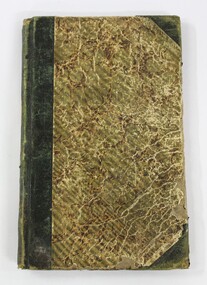
Administrative record - Wodonga Police Register of Duties 1855-1857
... ...robert o'hara burke...It has several references to Robert O'Hara Burke, who was a soldier, police officer in Victoria, and well-known explorer in the ill-fated Burke and Wills expedition....It has several references to Robert O'Hara Burke, who was a soldier, police officer in Victoria, and well-known explorer in the ill-fated Burke and Wills expedition. ...The Wodonga Police register dated to 1855-1857 provides a record of the names of police officers and details of their day-to-day duties, including crimes committed and steps taken to trace and apprehend perpetrators. It has several references to Robert O'Hara Burke, who was a soldier, police officer in Victoria, and well-known explorer in the ill-fated Burke and Wills expedition.The Wodonga police register has local significance due to the detailed information and date in the 1850s, which was before Wodonga became a separate Shire from Yackandandah Shire. It is also significant on a state and national level as an example of early police records. The detailed information provides significant research and interpretive potential. Green leather and faded green and brown marbled paper bound register or diary, recording the day-to-day duties of the Wodonga Police in 1855-1857. Pale blue watermarked paper with faint lines in the interior. Every second page has been removed and there is staining on some of the pages.The entries are written in iron gall ink and are deteriorated/faded in places. Red-brown and green marbled paper on the interior front and back covers, with linen binding. There are three small red wax seals on the inside front cover used to secure an introductory page of writing. The paper around the seals is torn and the page has become detached. Fragmentary inscription written on paper on the green leather spine.wodonga police, robert o'hara burke, police records, police register, wodonga, police journal, police diary -
 The Beechworth Burke Museum
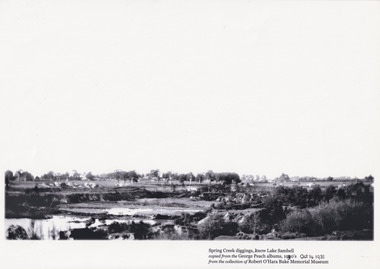
Photograph, Unknown
... Obverse: Spring Creek diggings, (k)now Lake Sambell / Copied from the George Peach Albums, 19(2)30’s Oct 14 1931 / From the collection of Robert O’Hara Burke Memorial Museum /...The photograph is significant as it contributes to knowledge about how Beechworth reinvented itself after the Gold rush period, and more broadly how country towns repurpose and redevelop infrastructure and facilities to meet the present needs of their population Lake Sambell Beechworth Rocky Mountain Mining Co LH Sambell Obverse: Spring Creek diggings, (k)now Lake Sambell / Copied from the George Peach Albums, 19(2)30’s Oct 14 1931 / From the collection of Robert O’Hara Burke Memorial Museum / Black and white rectangular photograph printed on matte photographic paper Photograph Photograph ...The photograph shows Lake Sambell under construction. The present day park and reserve occupies the site of the former Rocky Mountain Mining Company, an open-cut sluice mine that began operations in the mid-Nineteenth Century and operated until the early 1900s, through the peak of Victoria’s Gold Rush. It was converted into a park and leisure area in the 1920s. Lake Sambell was formally opened to the public on Friday 5th October 1928 and was opened by the Victorian Government’s Minister of Lands, Mr Bailey, as part of initiatives to boost the economies and development of country towns. The lake was named after Mr L.H. Sambell, a shire engineer and secretary of the Forward Beechworth Committee who was involved in promoting the transformation of the mining site and promoting plantation forestry and tourism as alternative industries. £300 to begin the process was provided by Mr J. McConvill, a former resident of Beechworth, who is remembered in a street name adjacent to the lake. An article in the Ovens and Murray Advertiser on Saturday, 5th May, 1917, gives some insight into issues in the Rocky Mountain Mining Company’s final years. The writer details the 1917 annual meeting of the Rocky Mountain Mining Company, stating that locals present appeared ‘well pleased this important local industry is in such a prosperous condition and that future prospects are so encouraging’. The author describes plans to give workers a bonus as evidence of profit-sharing that would ‘bridge the gulf between capital and labour’. The article concludes, however, with the statement that ‘there is a little arithmetical puzzle in the report in connection with the dredging operations I have been unable to solve.'The photograph is significant as it contributes to knowledge about how Beechworth reinvented itself after the Gold rush period, and more broadly how country towns repurpose and redevelop infrastructure and facilities to meet the present needs of their populationBlack and white rectangular photograph printed on matte photographic paperObverse: Spring Creek diggings, (k)now Lake Sambell / Copied from the George Peach Albums, 19(2)30’s Oct 14 1931 / From the collection of Robert O’Hara Burke Memorial Museum /lake sambell, beechworth, rocky mountain mining co, lh sambell -
Ringwood and District Historical Society
Document - Presentation Notes, How Geology and Geography can influence History: Canterbury Road by Gerry Robinson - June, 2014
... "Canterbury Road begins at Burke Road, renamed in the 1860’s as a tribute to Robert O’Hara Burke of Burke & Wills fame. It is hard to resist calling Canterbury Road “Burke & hills,” for it is the undulations that dominate much of its length on the 25.8 km journey to Montrose: undulations which are hills and monts, three of each - Surrey Hills, Box Hill and Forest Hill are followed by Vermont, Heathmont and Montrose, all on the way to Mount Dandenong. ..."..."Canterbury Road begins at Burke Road, renamed in the 1860’s as a tribute to Robert O’Hara Burke of Burke & Wills fame. It is hard to resist calling Canterbury Road “Burke & hills,” for it is the undulations that dominate much of its length on the 25.8 km journey to Montrose: undulations which are hills and monts, three of each - Surrey Hills, Box Hill and Forest Hill are followed by Vermont, Heathmont and Montrose, all on the way to Mount Dandenong. ..." ...Typewritten A4 page."Canterbury Road begins at Burke Road, renamed in the 1860’s as a tribute to Robert O’Hara Burke of Burke & Wills fame. It is hard to resist calling Canterbury Road “Burke & hills,” for it is the undulations that dominate much of its length on the 25.8 km journey to Montrose: undulations which are hills and monts, three of each - Surrey Hills, Box Hill and Forest Hill are followed by Vermont, Heathmont and Montrose, all on the way to Mount Dandenong. ..." -
 The Beechworth Burke Museum
Postcard, 2005
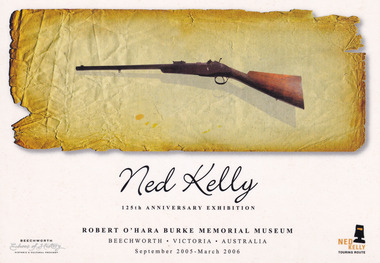
... To commemorate the 125th anniversary of Edward “Ned” Kelly’s committal trial in the Beechworth Historic Courthouse, the Robert O’Hara Burke Memorial Museum (henceforth Burke Museum) commissioned this postcard to coincide with their exhibition dating September 2005 to March 2006 and titled the Ned Kelly 125th Anniversary Exhibition. ...Obverse: Ned Kelly / 125th ANNIVERSARY EXHIBITION / ROBERT O'HARA BURKE MEMORIAL MUSEUM BEECHWORTH . VICTORIA . ...AUSTRALIA / September 2005-2006 / BEECHWORTH / Echoes of History / HISTORIC & CULTURAL PRECINCT / NED / KELLY / TOURING ROUTE / REVERSE: Ned Kelly / 125th ANNIVERSARY EXHIBITION / ROBERT O'HARA BURKE MEMORIAL MUSEUM BEECHWORTH . VICTORIA . ...To commemorate the 125th anniversary of Edward “Ned” Kelly’s committal trial in the Beechworth Historic Courthouse, the Robert O’Hara Burke Memorial Museum (henceforth Burke Museum) commissioned this postcard to coincide with their exhibition dating September 2005 to March 2006 and titled the Ned Kelly 125th Anniversary Exhibition. The postcard depicts a Snider-Enfield of .577 calibre which was reputedly favoured by the Bushranger. The firearm is of typical 1870s hunting design and was displayed as a focal point within this exhibition. The firearm, which was named “Betty” was reportedly taken by Kelly from Henry Dudley. The weapon has the letter ‘K’ engraved into the wood of the fore end. Other items also displayed in this exhibition include the Burke’s Kelly death mask, a replica of the Kelly Gang armour and photographs from the Burke Museum’s Kelly album. This postcard advertises an exhibition held at the Beechworth Burke Museum to commemorate the 125th anniversary of Kelly’s committal trial, which took place in Beechworth's historic courthouse. The selection and interpretation of items like the gun called 'Betty' are significant for understanding the changing nature of Kelly scholarship, treatment and curation, in particular, the popular and iconic myth of the Australian bushranger. The item can be compared with other Kelly photographs in Burke Museum's collection.Rectangular colour printed postcard celebrating Ned Kelly 125th Anniversary Exhibition at Burke Museum, Beechworth. Inset image of Ned Kelly's rifle. Obverse: Ned Kelly / 125th ANNIVERSARY EXHIBITION / ROBERT O'HARA BURKE MEMORIAL MUSEUM BEECHWORTH . VICTORIA . AUSTRALIA / September 2005-2006 / BEECHWORTH / Echoes of History / HISTORIC & CULTURAL PRECINCT / NED / KELLY / TOURING ROUTE / REVERSE: Ned Kelly / 125th ANNIVERSARY EXHIBITION / ROBERT O'HARA BURKE MEMORIAL MUSEUM BEECHWORTH . VICTORIA . AUSTRALIA / September 2005-2006 / AFFIX STAMP HERE / 7250 / This is the rifle that was taken from Henry Dudley by Ned Kelly. It became Ned's favourite / rifle, which he called 'Betty'. Note the 'K' carved into the wood of the fore-end. / Interestingly, there is at least one other rifle owned by Ned Kelly that also has a 'K' engraved / into it by Ned- the Colt revolving carbine used by Ned at Glenrowan /kelly album, ned kelly exhibition, ned kelly's rifle, betty, snider-enfield, .557 caliber, rifle, revolver, exhibition, beechworth, burke museum, 125th anniversary, firearm -
 The Beechworth Burke Museum
Photograph
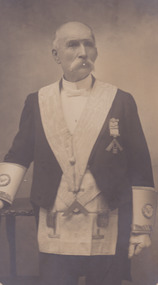
... Steele met a bother of Robert O’Hara Burke and was advised to travel to Australia and join as a police cadet. ...Steele met a bother of Robert O’Hara Burke and was advised to travel to Australia and join as a police cadet. ...This photograph, taken by Courtney’s Thelma Studios in Wangaratta, depicts Sergeant Arthur Loftus Maule Steele standing in the regalia of the Masonic Lodge. Before his death, Steele was a long term member of the St John’s Lodge of Masons where he was a Past Master and held office of treasurer for over thirty years. He was also a dedicated member of the Church of England and was an Electoral Inspector for Wangaratta. Steele was Sergeant of Police in Wangaratta for much of his life. He was one of 17 children born to Captain Robert Ball Steele and Mary Babington in Tours, France, in 1839. His parents were travelling at the time and soon after settled in Donegal, Ireland. At the age of 12, Steele was sent to the Military Academy of Dublin where he passed his examinations and prepared to enter the British Army. Steele met a bother of Robert O’Hara Burke and was advised to travel to Australia and join as a police cadet. Steele took the advice and travelled to Australia, arriving in Melbourne at the age of 17. He spend some time in a variety of employment including working as a clerk for the White Star Line. He entered the Victorian Police force in 1856. By 1864, Steele married Ruth Ingram Ballinger at Snowy Creek and worked at Omeo until being promoted to the mining centre of Beechworth, taking charge of the Yackandandah Station. Steele and Ballinger had ten children. Steele is well known in Victorian history for a variety of reasons, the most famous being the role he played in capturing Edward “Ned” Kelly at Glenrowan on the 28th June 1880. He also arrested Frank Neville (for the murder of a local resident Mr Nicholls) and Patrick Sheehan (first person to be executed in the Beechworth Gaol 1865 for the murder of James Kennedy at Rowdy Flat Yackandandah). He later worked on the case of Bridget Mepham (charged with the murder of her sister) at Wangaratta and retired from the Police force on the 1st of August 1896. In this retirement, Steele was a keen horticulturalist who enjoyed observing the habits and growth of new varieties cared for in his conservatory. Steele passed away in February 1914. This image has the potential to support current research on Sergeant Steele, the Masonic Lodge and photography during the c.1890s. Sergeant Steele is a well-researched member of the Victorian Police force and is known primarily for his involvement with the Kelly Gang. Therefore, depictions of Steele through photography can help to provide essential information about Steele outside of the Police force. This image has the capacity to inform about Steele’s involvement with the Masonic Lodge in Wangaratta. Therefore, it is important for what it can reveal regarding historic and social aspects. The Burke Museum is home to a large collection of Kelly centred photographs. The study of these photographs in connection to those in other museums have the ability to further current understanding on important figures and events in this historic occasion.Black and White rectangular photograph printed on matte photographic paper and mounted on an oval boardObverse: Courtney's Thelma Studios/ Wangaratta Reverse: 2747portrait, ned kelly, uniform, policeman, wangarratta, sergeant, steele, 1880, photograph, oval, black and white, sergeant steele, arthur loftus maule steele, arthur steele, wangaratta, beechworth -
Cobram Historical Society Inc
Uniform VWAAC
... At that time Freda lived at Hampton with hairdresser father, Robert O’Hara Burke. Buttons have inscribed VWAAC VWAAC UNIFORM, (volunteer Women’s Australian Army Corps) Belonged to Mrs Wm. ...Belonged to to Mrs Wm. Roy Denson. In Dairies she kept from 1916-1920, then Freda Sylvia Dorothy Burke, She related activities involved in with her sister Cpl. Marie Burke. At that time Freda lived at Hampton with hairdresser father, Robert O’Hara Burke.VWAAC UNIFORM, (volunteer Women’s Australian Army Corps) Belonged to Mrs Wm. Roy Denison. Front fastening buttons made from brass. Buttons have inscribed VWAAC
