
Showing 6 items matching "rocket motors"
-
 Moorabbin Air Museum
Book - Rocket and jet history, Rockets and Jets
... ...Rocket motors...Rocket & jet history The rocket in history How the rocket works Rocket fuels Rocket motors The rocket voyage Duct motors The gas turbine The jet engine The propeller jet Overview of the workings and operation of jet & rocket engines, circa 1949 - 1953 Rockets and Jets Book Rocket and jet history ...Overview of the workings and operation of jet & rocket engines, circa 1949 - 1953non-fictionOverview of the workings and operation of jet & rocket engines, circa 1949 - 1953the rocket in history, how the rocket works, rocket fuels, rocket motors, the rocket voyage, duct motors, the gas turbine, the jet engine, the propeller jet -
Moorabbin Air Museum
Manual - Royal Air Force technical manuals, Royal Air Force Manual - Flying - Volume B ,Aircraft Design Features and Systems
... ...Rocket motors...Royal Air Force technical manuals Propulsion Piston engines Gas turbines Rocket motors V/STOL engines Prihciples Ancillary systems Overview of aircraft design features & systems circa 1969 to early 1970s Royal Air Force Manual - Flying - Volume B ,Aircraft Design Features and Systems Manual Royal Air Force technical manuals ...Overview of aircraft design features & systems circa 1969 to early 1970snon-fictionOverview of aircraft design features & systems circa 1969 to early 1970spropulsion, piston engines, gas turbines, rocket motors, v/stol engines, prihciples, ancillary systems -
Moorabbin Air Museum
Document (item) - Turana - Australia's Naval Target Aircraft
... Description: Seven photos showing Ikara missile on nozzle alignment rig in test, show Woomera Rocket Range SA. Rocket motor nozzle had to be correct angle to body. ...Description: Seven photos showing Ikara missile on nozzle alignment rig in test, show Woomera Rocket Range SA. Rocket motor nozzle had to be correct angle to body. ...Description: Seven photos showing Ikara missile on nozzle alignment rig in test, show Woomera Rocket Range SA. Rocket motor nozzle had to be correct angle to body. Last photo is Ikara missile in launcher. Significance: M2 was first full scale pre production missile. Level of Importance: . -
 Sunshine and District Historical Society Incorporated
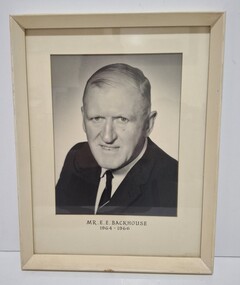
Photograph - Albion Explosive Factory Mr E.E. Backhouse 1964 - 1966 Site Manager Portrait Photograph, 1966
... He studied production of rocket motors, filling of bombs and the manufacture of cordite in the United Kingdom from 1948 to 1949. ...He studied production of rocket motors, filling of bombs and the manufacture of cordite in the United Kingdom from 1948 to 1949. ...Mr E.E. Backhouse (F.R.A.C.I.) joined the Colonial Ammunition Company as a laboratory assistant in 1920. He worked as a chemist at the Munitions Supply Laboratories from 1923 to 1928, at the Ammunition Factory Footscray from 1923 to 1936 and at the Explosive Factory Maribyrnong from 1936. He became the assistant manager at the Explosive Factory Maribyrnong from 1943 to 1953. He studied production of rocket motors, filling of bombs and the manufacture of cordite in the United Kingdom from 1948 to 1949. He was the manager of the Explosive Factory Mulwala from 1953 to 1955, manager at the Explosive Factory Maribyrnong 1956 to 1964 and manager at the Explosive Factory Albion from 1964 until his retirement in 1966. This item came from the Friends of the Black Powder Mill.Mr E.E. Backhouse 1964 - 1966albion explosive factory, explosive factory, ballarat road, deer park -
 Running Rabbits Military Museum operated by the Upwey Belgrave RSL Sub Branch
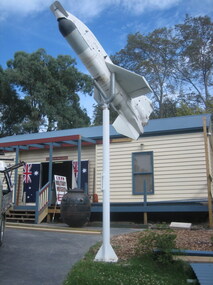
Ikara Missile, Maribyrnong Ordinance Factory in Victoria. et al, 1965
... Propulsion was provided by the MURAWA steel cased, solid propellant rocket motor with a combined boost and sustainer stage. ...Propulsion was provided by the MURAWA steel cased, solid propellant rocket motor with a combined boost and sustainer stage. ...During the 1950’s, the growing threat from Submarines, led the Royal Australian Navy to consider a quick reaction, long range ASW torpedo delivery system as an alternative to the USN’s ASROC and the RN’s Match. Full scale research and development began in 1960 using the Turana target drone as the basis for the delivery platform. Shipboard tests began in 1963 and the Government Aircraft Factory (GAF) began production of three variants M3, M4 and M5 in 1965. The M4 variant had a guidance system designed to interface to a full tactical data handling system while the M3 and M5 variants used a simpler system with a dedicated fire control system. The IKARA is an unmanned miniature aircraft with clip on upper and lower stabilizers and wings. The upper stabilizer (SVU) housed and electronic package that transmitted flight data back to the launch platform and received updated target acquisition data during flight. Flight maneuverability was provided by elevons fitted into the trailing edge of each wing, these were operated by an actuator system that received flight correction data transmitted to the autopilot from the fire control system. The payload, either the Mk44 or Mk46 lightweight torpedo was suspended to the underside of the airframe and faired into the body to provide and aerodynamic shape. The forward section of the body housed the autopilot and the thermal battery unit. Propulsion was provided by the MURAWA steel cased, solid propellant rocket motor with a combined boost and sustainer stage. IKARA was capable of engaging a target to the maximum range of the ships sonar, regardless of weather conditions. Target information is fed into the fire control system, which calculated to drop zone for the torpedo taking into account speed and direction of launch platform and target, win speed etc, then tracking the missile to the drop zone where command signals initiate torpedo release. The IKARA is an unmanned miniature aircraft with clip on upper and lower stabilizers and wings. navy, torpedo, rocket, submarine, missile -
 National Vietnam Veterans Museum (NVVM)
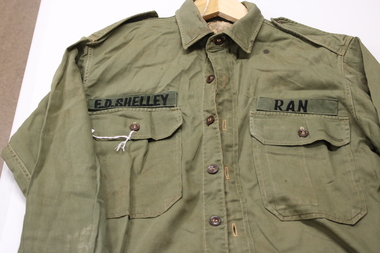
Uniform - Shirt with blood
... He was driving a motor pool truck back to US Bearcat Base near Bien Hoa on 22 December 1969, after a trip to Vung Tau to send flowers to the wife of a fellow serviceman to celebrate the birth of a child. An enemy rocket...He was driving a motor pool truck back to US Bearcat Base near Bien Hoa on 22 December 1969, after a trip to Vung Tau to send flowers to the wife of a fellow serviceman to celebrate the birth of a child. An enemy rocket ...Shirt worn by Leading Air Mechanic Airframes Engines, Errol Desmond Shelley No:R59338 when he was hit by shrapnel. He was driving a motor pool truck back to US Bearcat Base near Bien Hoa on 22 December 1969, after a trip to Vung Tau to send flowers to the wife of a fellow serviceman to celebrate the birth of a child. An enemy rocket propelled grenade (RPG) landed 20 metres to the right of the vehicle Errol was driving, and while the passengers were able to duck for cover, as driver, Errol could not. So, when a second RPG landed behind them, Errol was hit by two pieces of shrapnel. Errol served on the HMAS Melbourne from May - Jun 1965, and then with RAN Helicopter Flight Vietnam from Sept 1969 - Oct 1970. SEE PHOTOS FOR THE STORY IN ERROL'S WORDSKhaki long-sleeved shirt with button-down front, two pockets with embroidered name on right side and service name on other. Handwritten names and signatures on the back. Holes near collar at back and blood stains.E D Shelley in black thread on RHS RAN in black thread on LHS Signatures on back in inkshelley, ed shelley, shrapnel wound, blood stained, wounded, ran, hfv, bearcat
